REVIEW 4 major objections 6 minor 3 cited by
On the effects of material strength in dynamic fracture: A phase-field study
T0 review · 4 major / 6 minor · reviewed 2026-08-12 · deepseek-v4-flash
Pith's one-line read A phase-field fracture theory that treats material strength as an independent property, extended to include inertia, reproduces the crack angles and nucleation sites measured in dynamic impact experiments on steel, basalt, and glass.
desk verdict A solid dynamic extension of the strength-aware phase-field theory with convincing benchmark evidence that the strength surface governs dynamic crack paths; the main caveats are the assumed dynamic driving force and some calibrated loads. read the letter →
The pith
A machine-rendered reading of the paper's core claim, the machinery that carries it, and where it could break.
The reading
What carries the argument
The central object is the material strength surface, $F(\sigma_1,\sigma_2,\sigma_3)=0$, the set of critical stress states at which the material fractures under spatially uniform stress; here it is a Drucker-Prager surface with uniaxial tensile strength $\sigma_{ts}$ and hydrostatic strength $\sigma_{hs}$ as independent inputs. The theory encodes this surface in the phase-field evolution through a driving force $c_e(X,t)$ and a coefficient $\delta_\ell$ chosen so that, in the sharp-interface limit, the phase-field model's own strength surface reduces to the prescribed one. The coupled system consists of a hyperbolic linear-momentum balance with inertia $\rho \ddot{u}$ and an elliptic phase-field evolution with irreversibility constraints, discretized in space by adaptive finite elements and in time by an implicit scheme. The strength surface does double duty: under uniform stress it delays fracture until the surface is crossed, and near stress concentrators it suppresses crack growth into compressive regions that would otherwise produce spurious branches.
What would settle it
Take a brittle material whose tensile and compressive strengths have been measured independently under multiaxial quasi-static loading, run a dynamic Brazilian test with high-speed imaging, and compare where the crack first appears and the angle it grows. If cracks initiate at the compressive loading platens before the independently measured strength surface is exceeded, or if the crack path deviates from the centered horizontal crack the model predicts, the dynamic strength-surface extension is falsified.
Extended reading notes
Core claim
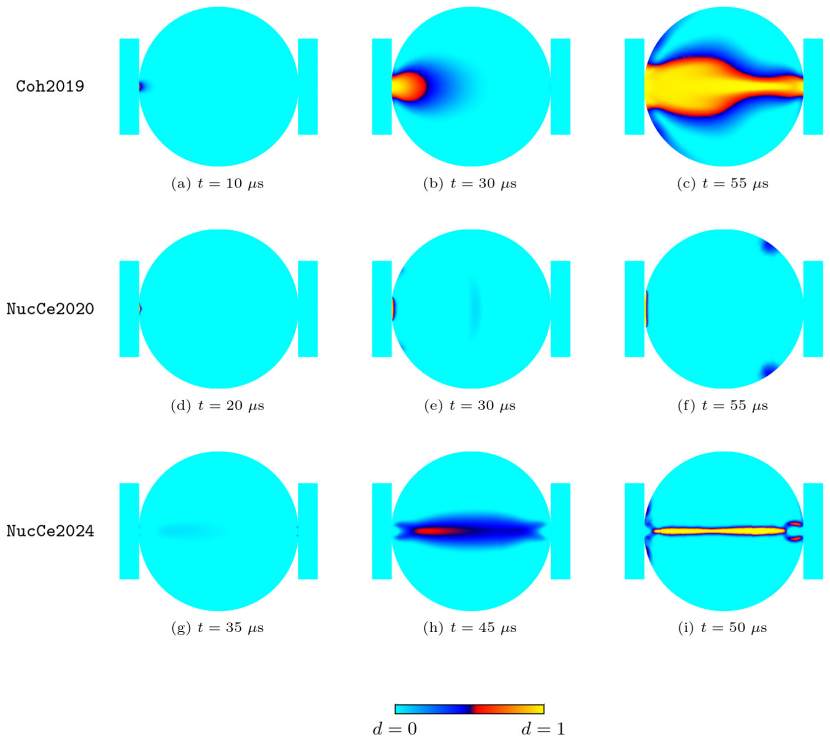
The paper's central claim is that in the dynamic regime the material strength surface remains an independent macroscopic material property on par with elasticity and toughness, and that inertia enters the theory simply by adding mass density to the momentum balance of the earlier quasi-static formulation. In concrete terms, the proposed model — a hyperbolic momentum equation coupled to an elliptic phase-field evolution — reproduces the roughly 70 degree crack path in Kalthoff-Winkler impact experiments, nucleates the dynamic Brazilian fracture of basalt in the specimen interior rather than at the compressive contacts, and produces soda-lime glass branching at 54 and 44 degrees, bracketing the experimental 47 to 55 degree range. Classical variational phase-field and cohesive models fail at least one of these benchmarks because their effective strength surfaces are locked to elasticity and toughness and cannot, for example, set compressive strength independently of tensile strength. That the correct crack paths emerge only when the strength surface is represented accurately is taken as evidence that strength governs propagation as well as nucleation under dynamic conditions.
Load-bearing premise
The model assumes that the set of stresses at which a material breaks in slow, uniform laboratory tests is the same set that governs fracture in the fast, nonuniform stress fields of an impact, so that the only dynamic change needed is adding inertia to the momentum balance.
Editorial extensions
If this is right
- The strength surface must be treated as an independently measured input in dynamic fracture simulations, alongside elastic moduli, toughness, and mass density.
- Crack nucleation sites under impact are set by the strength surface: in dynamic Brazilian tests the crack forms in the specimen interior rather than at the compressive contacts when the surface is represented accurately.
- Spurious lower branches in Kalthoff-Winkler simulations — a known artifact in some classical models — disappear once the effective strength surface matches the material's actual one.
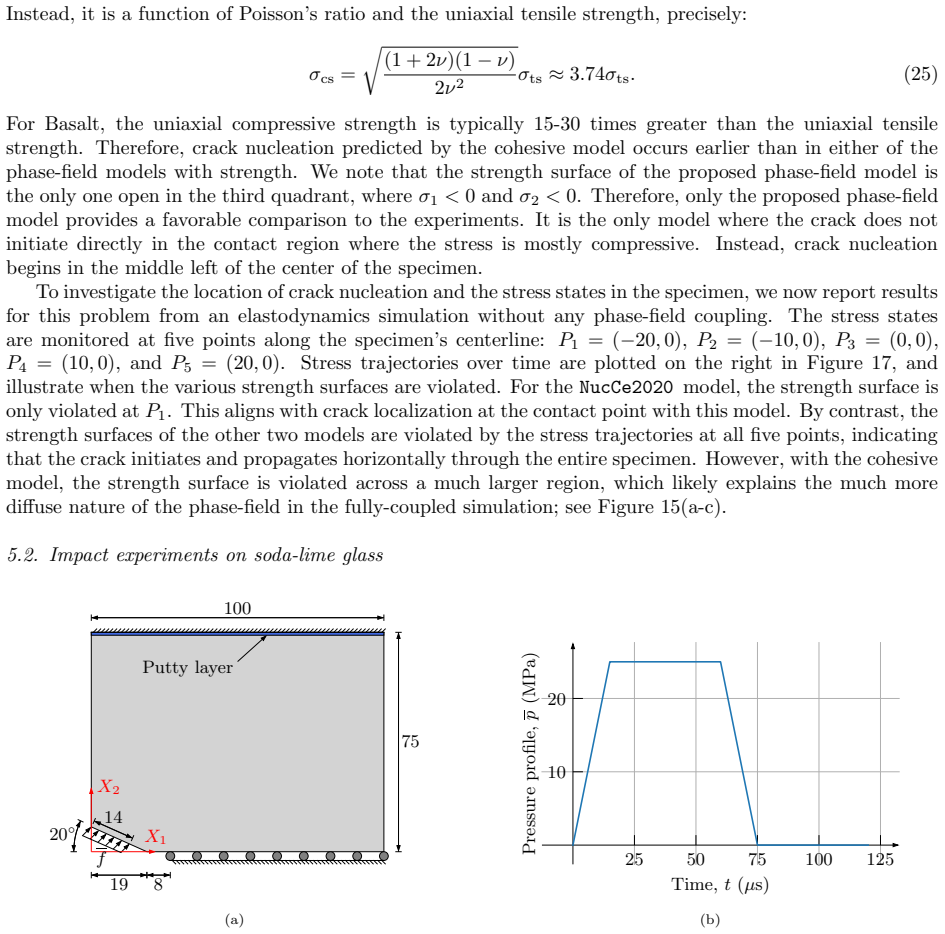
- The model brackets the observed soda-lime glass branching angles, with branching time matching experiments when a tangential load is included at the impact surface.
- The same framework extends to three-dimensional fragmentation, as demonstrated by the pressurized hollow-sphere simulation.
Reading between the lines
- This suggests the same construction could be used to import arbitrary experimentally measured strength surfaces, not just Drucker-Prager, into dynamic fracture simulations.
- If the dynamic extension holds, part of the historical scatter among cohesive, phase-field, and peridynamic predictions of dynamic fracture may reflect each model's implicit strength surface rather than genuine differences in material behavior.
- A natural use would be inverse identification: dynamic Brazilian or impact tests, matched by this model, could extract the compressive branch of the strength surface for materials that are difficult to test under uniform multiaxial compression.
Editorial analysis
A structured set of objections, weighed in public.
Referee Report
Summary. This paper extends a phase-field theory of fracture that incorporates an independent material strength surface (Drucker-Prager) to the dynamic regime by adding inertia to the momentum balance and retaining the quasi-static phase-field evolution equation. The authors present an adaptive finite-element and implicit time-stepping scheme implemented in RACCOON, and apply it to a single-edge notched specimen, the Kalthoff-Winkler experiment, a pressurized hollow sphere, dynamic Brazilian tests on basalt, and impact experiments on soda-lime glass. The central claim is that accounting for the material strength surface is essential for reproducing experimentally observed crack paths and branching angles in dynamic fracture, whereas classical phase-field models that lack an independent strength surface fail.
Significance. If the central claim holds, the paper provides a useful computational framework and a series of instructive benchmark comparisons that support the notion that material strength is an independent macroscopic property in dynamic fracture. The work is notable for making the RACCOON implementation available, for explicitly comparing the effective strength surfaces of competing phase-field models, for demonstrating regularization-length insensitivity in the single-edge notch problem, and for producing quantitative comparisons with experimental crack paths, branching angles, and crack speeds. The main caveat is that the dynamic extension is assumed rather than derived, and several loads are calibrated to experiment, so the predictive claims should be read with those qualifications in mind.
major comments (4)
- [Section 5.1, Eq. (24)] The dynamic extension is assumed, not derived: inertia enters only in the momentum balance, while the driving force ce (Eq. 13) and coefficient δℓ (Eq. 14) are imported unchanged from the quasi-static theory and are validated only for uniform stress states in Fig. 2 via Eq. (17). The paper applies these pointwise in transient, nonuniform, gradient-dominated stress fields without a derivation or a numerical check. Because the central claim relies on crack paths and nucleation locations produced by this model, the authors should either provide a derivation/justification for the dynamic form of the phase-field equation or supply a specific numerical validation (e.g., a dynamic homogeneous-stress test or a convergence study in ℓ) that ties nucleation events back to the intended strength surface.
- [Section 5.1, Eq. (24)] The prescribed displacement amplitude u0 in the Brazilian simulation is calibrated to match the experimentally measured fracture stress using an elastodynamic simulation without fracture (text preceding Eq. 24). As a result, the agreement between the simulated and experimental central crack nucleation is not a fully predictive test of the strength surface. The authors should report the sensitivity of nucleation location and time to u0 and explicitly state which features of the comparison are predictive as opposed to fitted.
- [Section 5.2, Fig. 18(b) and Eq. (26)] The pressure profile applied to the V-notch in the soda-lime glass simulations is adjusted based on a wave-propagation estimate, and the friction coefficient of 0.35 is assumed rather than measured. Since the reported branching angles and times depend on these choices, the claim that the model captures branching angles requires a sensitivity study with respect to the pressure duration and friction coefficient, or independent justification of those values.
- [Section 2.3, Eq. (17)] The effective strength surface F^PF in Eq. (17) is constructed, through the choices of ce and δℓ, to converge to the input Drucker-Prager surface; hence the agreement in Fig. 2 is by construction and does not independently validate the strength-surface concept. The actual support for the central claim must come from the dynamic benchmark comparisons. The manuscript should state this distinction explicitly and, ideally, provide a test that separates the role of the macroscopic strength surface from the specific pointwise prescription of ce.
minor comments (6)
- [Abstract and Section 3] The abstract states that the discretized equations are solved in a staggered manner, but Section 3 describes a fixed-point iteration scheme; please align the two descriptions.
- [Tables 2, 3, 5] The parameter ψc (nucleation energy) is listed for the cohesive model but is not used by the NucCe models; please clarify its role in the table and in the text where it appears.
- [Figure 7] The text and figure use 'Coh2019 (V-D)' while Table 1 uses 'Vol./Dev.'; please make the label for the volumetric-deviatoric split consistent throughout.
- [Section 4.2, Fig. 10] The text states that the spurious branch vanishes at ℓ=0.2 mm, but Fig. 10 shows NucCe2020 only; please include results for the same regularization lengths for the NucCe2024 model for a complete comparison.
- [Section 4.1, Eq. (18)] The dissipated energy D = W − K − U is defined as a residual; because the model contains an explicit external driving force ce, please comment on the accuracy of this energy-balance definition in the presence of the driving force term.
- [References] Reference [41] lists the author as 'Tipper, H.V.'; this appears to be a typo for 'Tippur, H.V.' and should be corrected.
Circularity Check
Only a by-construction consistency check for the effective strength surface; the central experimental predictions are independently grounded.
-
self definitional
[Section 2.3, Eq. (17), Fig. 2]
"Under states of uniform stress σ (and hence uniform strain E) in the body, the phase-field theory (8)-(11) predicts the strength surface F PF(σ1, σ2, σ3) = tr σ2 D 2µ + (tr σ)2 9κ − bce(I1, J2, 0; ℓ) − 3δℓGc 8ℓ = 0. (17) For the case of driving force (13) and coefficient (14), Figure 2 compares the strength surface (17) predicted by the phase-field theory with the actual Drucker-Prager strength surface (12) of a representative material for various values of the regularization length ℓ."
The coefficients α1, α2 and δℓ in Eqs. (13)-(15) are explicit functions of the same material strengths σts and σhs that define the input Drucker-Prager surface (12). The homogeneous phase-field equilibrium condition is used to select/verify these coefficients, so Eq. (17) reproducing Eq. (12) is a designed consistency check rather than an independent first-principles prediction. This step is not load-bearing for the paper's experimental conclusions: the strength inputs are independent material data, and the benchmark outputs (crack angles, nucleation sites, branching angles) are not fitted to the effective surface.
full rationale
The paper's central claim—that an independent material strength surface is essential in dynamic fracture—is supported by genuine experimental comparisons. For the Kalthoff-Winkler problem, the steel strength parameters (σts, σcs) are specified as material properties and the simulated crack angle is an output, not a fitted target; the contrast between NucCe2020 and NucCe2024 further isolates the effect of the strength-surface representation. In the Brazilian basalt case, the load amplitude u0 is calibrated to the experimentally observed fracture stress, but the distinguishing prediction is that nucleation occurs away from the contact region; that outcome is controlled by the independently chosen compressive-to-tensile strength ratio, not by the calibration. The soda-lime glass simulations use a pressure profile from a separate LS-DYNA model and predict branching angles (44-54 deg) that bracket the experiments without fitting those angles. The paper's self-citations to prior work by the same authors motivate the framework, but the benchmarks provide independent evidence for the conclusions. The only by-construction element is the verification that the chosen ce and δℓ reproduce the input Drucker-Prager surface under uniform stress, which is a consistency check, not a scientific prediction. Therefore the circularity is minor and does not undermine the central derivation.
Assumptions & free parameters
free parameters (5)
- u0 (prescribed displacement amplitude in Brazilian test) =
1 mm
- Friction coefficient for tangential V-notch load =
0.35
- Pressure profile p(t) applied at V-notch =
See Figure 18(b)
- Random strength perturbation field (hollow sphere) =
sigma_ts/sigma_ts and sigma_hs/sigma_hs in {0.95, 1.0, 1.05} over patches of about 5*l
- Regularization length l =
0.375-0.625 mm (SEN), 0.75 mm (KW), 1.25 mm (Brazilian), 0.25 mm (glass), 1 mm (sphere)
assumptions (5)
- domain assumption A material strength surface exists as an independent macroscopic property, separate from elasticity and toughness.
- domain assumption The dynamic governing equations are the quasi-static equations with inertial term rho*u_tt added to the momentum balance (Eq. 8).
- ad hoc to paper The driving force ce (Eq. 13) and coefficient delta_l (Eq. 14) imported from Kamarei et al. [18] remain valid under dynamic, transient, nonuniform stress states.
- domain assumption The phase-field regularization with AT1 geometric function w(d)=d and degradation g(d)=(1-d)^2 converges to the sharp-crack theory as l approaches 0.
- domain assumption Contact conditions with rigid bars in the Brazilian test and symmetry planes in the various specimens are appropriate idealizations.
Cite this review
Pith. "Pith review of On the effects of material strength in dynamic fracture: A phase-field study." pith.science (2026). https://pith.science/paper/M5DRUJLD
@misc{pith2026241116393,
  author       = {Pith},
  title        = {Pith review of: On the effects of material strength in dynamic fracture: A phase-field study},
  year         = {2026},
  howpublished = {\url{https://pith.science/paper/M5DRUJLD}},
  note         = {Machine review of arXiv:2411.16393}
}
abstract
Over the past seven years, full-field analyses of a wide range of classical as well as modern quasi-static fracture experiments on nominally elastic brittle materials -- ranging from hard ceramics to soft elastomers -- have repeatedly identified the material strength surface as one of the key material properties that governs not only the nucleation of cracks, but also their propagation. Central to these analyses are the results generated by the Griffith phase-field fracture theory with material strength introduced in [21,23,20]. The first of two objectives of this paper is to extend this theory to account for inertia, this for the basic case of isotropic linear elastic brittle materials. From an applications point of view, the theory amounts to solving an initial-boundary-value problem comprised of a hyperbolic PDE coupled with an elliptic PDE for the displacement field $\mathbf{u}(\mathbf{X},t)$ and the phase field $d(\mathbf{X},t)$. A robust scheme is presented to generate solutions for these equations that is based on an adaptive finite-element discretization of space and an implicit finite-difference discretization of time. %At every time increment $t_m$, the resulting discretized equations are solved separately in a staggered manner for $\mathbf{u}(\mathbf{X},t_m)$ and $d(\mathbf{X},t_m)$ by means of Newton-Raphson schemes. The second objective is to illustrate the descriptive and predictive capabilities of the proposed theory via simulations of benchmark problems and experiments. These include problems involving fracture nucleation from large pre-existing cracks, such as the classical Kalthoff-Winkler experiments, as well as problems involving fracture nucleation within the bulk, such as the dynamic Brazilian fracture experiments.
Figures


Figures from the paper (18 more)






Forward citations
Cited by 3 Pith papers
-
Dynamic phase-field model for brittle fracture in grounded glaciers
Gravity-driven crevasse propagation in glaciers is a dynamic instability; only a dynamic phase-field model with degraded mass density produces sharp, localized cracks.
-
A comparison of phase field models of brittle fracture incorporating strength: I -- Mixed-mode loading
Under mixed-mode loading, the complete nucleation phase-field model matches benchmarks, the star-convex variational model produces spurious compressive cracks, and the hybrid cohesive-zone model propagates at an incor...
-
On the construction of explicit analytical driving forces for crack nucleation in the phase field approach to brittle fracture with application to Mohr-Coulomb and Drucker-Prager strength surfaces
An explicit analytical driving force makes phase field fracture models reproduce any material strength surface that is linear in its material coefficients, illustrated on Mohr-Coulomb and Drucker-Prager surfaces.
Reference graph
Works this paper leans on
-
[32]
On validating peridynamic models and a phase-field model for dynamic brittle fracture in glass
Mehrmashhadi, J., Bahadori, M., Bobaru, F., 2020. On validating peridynamic models and a phase-field model for dynamic brittle fracture in glass. Engineering Fracture Mechanics 240, 107355
work page 2020
-
[1]
Amor, H., Marigo, J.J., Maurini, C., 2009. Regularized formulation of the variational brittle fracture with unilateral contact: Numerical experiments. Journal of the Mechanics and Physics of Solids 57, 1209–1229. 22
work page 2009
-
[2]
Benson, S.J., Todd S. Munson, 2006. Flexible complementarity solvers for large-scale applications. Optimization Methods and Software 21, 155–168
work page 2006
-
[3]
A phase-field description of dynamic brittle fracture
Borden, M.J., Verhoosel, C.V., Scott, M.A., Hughes, T.J., Landis, C.M., 2012. A phase-field description of dynamic brittle fracture. Computer Methods in Applied Mechanics and Engineering 217-220, 77–95
work page 2012
-
[4]
Numerical experiments in revisited brittle fracture
Bourdin, B., Francfort, G.A., Marigo, J.J., 2000. Numerical experiments in revisited brittle fracture. Journal of the Mechanics and Physics of Solids 48, 797–826
2000
-
[5]
A time-discrete model for dynamic fracture based on crack regularization
Bourdin, B., Larsen, C., Richardson, C., 2011. A time-discrete model for dynamic fracture based on crack regularization. International Journal of Fracture , 133–143
work page 2011
-
[6]
Computational modelling of impact damage in brittle materials
Camacho, G., Ortiz, M., 1996. Computational modelling of impact damage in brittle materials. International Journal of Solids and Structures 33, 2899–2938
work page 1996
-
[7]
Soil mechanics and plastic analysis or limit design
Drucker, D.C., Prager, W., 1952. Soil mechanics and plastic analysis or limit design. Quarterly of applied mathematics 10, 157–165
work page 1952
Show all 42 references
-
[8]
Revisiting brittle fracture as an energy minimization problem
Francfort, G.A., Marigo, J.J., 1998. Revisiting brittle fracture as an energy minimization problem. Journal of the Mechanics and Physics of Solids 46, 1319–1342
1998
-
[9]
A phase-field formulation for dynamic cohesive fracture
Geelen, R.J., Liu, Y., Hu, T., Tupek, M.R., Dolbow, J.E., 2019. A phase-field formulation for dynamic cohesive fracture. Computer Methods in Applied Mechanics and Engineering 348
2019
-
[10]
A primal-dual active set method and predictor-corrector mesh adaptivity for computing fracture propagation using a phase-field approach
Heister, T., Wheeler, M.F., Wick, T., 2015. A primal-dual active set method and predictor-corrector mesh adaptivity for computing fracture propagation using a phase-field approach. Computer Methods in Applied Mechanics and Engineering 290, 466–495
2015
-
[11]
Continuum phase field modeling of dynamic fracture: variational principles and staggered fe implementation
Hofacker, M., Miehe, C., 2012. Continuum phase field modeling of dynamic fracture: variational principles and staggered fe implementation. International journal of fracture 178, 113–129
2012
-
[12]
A phase field model of dynamic fracture: Robust field updates for the analysis of complex crack patterns
Hofacker, M., Miehe, C., 2013. A phase field model of dynamic fracture: Robust field updates for the analysis of complex crack patterns. International Journal for Numerical Methods in Engineering 93, 276–301
2013
-
[13]
Hu, T., 2022. RACCOON. URL: https://github.com/hugary1995/raccoon
2022
-
[14]
A phase-field model of fracture with frictionless contact and random fracture properties: Application to thin-film fracture and soil desiccation
Hu, T., Guilleminot, J., Dolbow, J.E., 2020. A phase-field model of fracture with frictionless contact and random fracture properties: Application to thin-film fracture and soil desiccation. Computer Methods in Applied Mechanics and Engineering 368, 113106
2020
-
[15]
The finite element method:Linear static and dynamic finite element analysis
Hughes, T.J.R., 2000. The finite element method:Linear static and dynamic finite element analysis. Dover Publications, Mineola, NY
2000
-
[16]
Dynamic crack propagation with a variational phase-field model: limiting speed, crack branching and velocity
J, B., C, R.L., J-F., M., 2017. Dynamic crack propagation with a variational phase-field model: limiting speed, crack branching and velocity. Int J Fract 204, 79–100
2017
-
[17]
Failure mode transition at high rates of shear loading
Kalthoff, J., Winkler, S., 1988. Failure mode transition at high rates of shear loading. DGM Informationsgesellschaft mbH, Impact Loading and Dynamic Behavior of Materials 1, 185–195
1988
-
[18]
The poker-chip experiments of synthetic elastomers explained
Kamarei, F., Kumar, A., Lopez-Pamies, O., 2024. The poker-chip experiments of synthetic elastomers explained. Journal of the Mechanics and Physics of Solids 188, 105683
2024
-
[19]
Nucleation of fracture: The first-octant evidence against classical variational phase-field models
Kamarei, F., O, Dolbow, J., Lopez-Pamies, O., 2025. Nucleation of fracture: The first-octant evidence against classical variational phase-field models. Journal of Applied Mechanics In press
2025
-
[20]
Revisiting nucleation in the phase-field approach to brittle fracture
Kumar, A., Bourdin, B., Francfort, G.A., Lopez-Pamies, O., 2020. Revisiting nucleation in the phase-field approach to brittle fracture. Journal of the Mechanics and Physics of Solids 142, 104027
2020
-
[21]
Fracture and healing of elastomers: A phase-transition theory and numerical implementation
Kumar, A., Francfort, G.A., Lopez-Pamies, O., 2018a. Fracture and healing of elastomers: A phase-transition theory and numerical implementation. Journal of the Mechanics and Physics of Solids 112, 523–551
-
[22]
The strength of the Brazilian fracture test
Kumar, A., Liu, Y., Dolbow, J.E., Lopez-Pamies, O., 2024. The strength of the Brazilian fracture test. Journal of the Mechanics and Physics of Solids 182, 105473
2024
-
[23]
The phase-field approach to self-healable fracture of elastomers: A model accounting for fracture nucleation at large, with application to a class of conspicuous experiments
Kumar, A., Lopez-Pamies, O., 2020. The phase-field approach to self-healable fracture of elastomers: A model accounting for fracture nucleation at large, with application to a class of conspicuous experiments. Theoretical and Applied Fracture Mechanics 107, 102550
2020
-
[24]
The poker-chip experiments of Gent and Lindley (1959) explained
Kumar, A., Lopez-Pamies, O., 2021. The poker-chip experiments of Gent and Lindley (1959) explained. Journal of the Mechanics and Physics of Solids 150, 104359
1959
-
[25]
The configurational-forces view of fracture and healing in elastomers as a phase transition
Kumar, A., Ravi-Chandar, K., Lopez-Pamies, O., 2018b. The configurational-forces view of fracture and healing in elastomers as a phase transition. International Journal of Fracture 213, 1–16
-
[26]
The revisited phase-field approach to brittle fracture: Application to indentation and notch problems
Kumar, A., Ravi-Chandar, K., Lopez-Pamies, O., 2022. The revisited phase-field approach to brittle fracture: Application to indentation and notch problems. International Journal of Fracture 237, 83–100
2022
-
[27]
A variational formulation of Griffith phase-field fracture with material strength
Larsen, C., Dolbow, J., Lopez-Pamies, O., 2024. A variational formulation of Griffith phase-field fracture with material strength. International Journal of Fracture , 1–9
2024
-
[28]
Existence of solutions to a regularized model of dynamic fracture
Larsen, C., Ortner, C., S¨ uli, E., 2010. Existence of solutions to a regularized model of dynamic fracture. Mathematical Models and Methods in Applied Sciences , 1021–1048
2010
-
[29]
Classical variational phase-field models cannot predict fracture nucleation
Lopez-Pamies, O., Dolbow, J., Francfort, G., Larsen, C., 2025. Classical variational phase-field models cannot predict fracture nucleation. Computer Methods in Applied Mechanics and Engineering 433, 117520
2025
-
[30]
Convergence of a gradient damage model toward a cohesive zone model
Lorentz, E., Cuvilliez, S., Kazymyrenko, K., 2011. Convergence of a gradient damage model toward a cohesive zone model. Comptes Rendus M´ ecanique 339, 20–26
2011
-
[31]
Evaluation of variational phase-field models for dynamic brittle fracture
Mandal, T.K., Nguyen, V.P., Wu, J.Y., 2020. Evaluation of variational phase-field models for dynamic brittle fracture. Engineering Fracture Mechanics 235, 107169
2020
-
[33]
Uncovering the dynamic fracture behavior of pmma with peridynamics: 23 The importance of softening at the crack tip
Mehrmashhadi, J., Wang, L., Bobaru, F., 2019. Uncovering the dynamic fracture behavior of pmma with peridynamics: 23 The importance of softening at the crack tip. Engineering Fracture Mechanics 219, 106617
2019
-
[34]
A phase field model for rate-independent crack propagation: Robust algorithmic implementation based on operator splits
Miehe, C., Hofacker, M., Welschinger, F., 2010a. A phase field model for rate-independent crack propagation: Robust algorithmic implementation based on operator splits. Computer Methods in Applied Mechanics and Engineering 199, 2765–2778
-
[35]
Thermodynamically consistent phase-field models of fracture: Variational principles and multi-field fe implementations
Miehe, C., Welschinger, F., Hofacker, M., 2010b. Thermodynamically consistent phase-field models of fracture: Variational principles and multi-field fe implementations. International journal for numerical methods in engineering 83, 1273–1311
-
[36]
MOOSE: Enabling massively parallel multiphysics simulation
Permann, C.J., Gaston, D.R., Andrˇ s, D., Carlsen, R.W., Kong, F., Lindsay, A.D., Miller, J.M., Peterson, J.W., Slaughter, A.E., Stogner, R.H., Martineau, R.C., 2020. MOOSE: Enabling massively parallel multiphysics simulation. SoftwareX 11, 100430
2020
-
[37]
Fracture criteria of reactor graphite under multiaxial stesses
Sato, S., Awaji, H., Kawamata, K., Kurumada, A., Oku, T., 1987. Fracture criteria of reactor graphite under multiaxial stesses. Nuclear Engineering and Design 103, 291–300
1987
-
[38]
Eigenfracture: An eigendeformation approach to variational fracture
Schmidt, B., Fraternali, F., Ortiz, M., 2009. Eigenfracture: An eigendeformation approach to variational fracture. SIAM Multiscale Modeling and Simulation 7, 1237–1266
2009
-
[39]
Reformulation of elasticity theory for discontinuities and long-range forces
Silling, S., 2000. Reformulation of elasticity theory for discontinuities and long-range forces. Journal of the Mechanics and Physics of Solids 48, 175–209
2000
-
[40]
Dynamic fracture of soda-lime glass: A full-field optical investigation of crack initiation, propagation and branching
Sundaram, B.M., Tippur, H.V., 2018. Dynamic fracture of soda-lime glass: A full-field optical investigation of crack initiation, propagation and branching. Journal of the Mechanics and Physics of Solids 120, 132–153
2018
-
[41]
Tipper, H.V., Dondeti, S., 2020. Experimental identification of dynamic crack branching precursors in soda-lime silicate glass., in: presented at the Experimental and Computational Fracture Mechanics, Baton Rouge, LA
2020
-
[42]
Determination of Dynamic Tensile Strength of Microwave-Induced Basalt Using Brazilian Test
Yin, T., Wu, B., Wang, C., Wu, Y., 2022. Determination of Dynamic Tensile Strength of Microwave-Induced Basalt Using Brazilian Test. Rock Mechanics and Rock Engineering 55. 24
2022
Reviewed August 12, 2026 · model on record in the stance chip above.
Discussion (0). Continue with ORCID to comment.