REVIEW 3 major objections 6 minor 61 references
An Information-Theoretic Regularizer for Lossy Neural Image Compression
T0 review · 3 major / 6 minor · reviewed 2026-08-12 · deepseek-v4-flash
Pith's one-line read For lossy neural image compressors, minimizing the latent entropy is equivalent to maximizing the conditional source entropy, and adding that objective as a regularizer improves compression and generalization.
desk verdict Consistent small BD-rate gains from a plug-and-play regularizer, but the central claim is undercut by a missing control: the regularizer may just reweight the rate term. read the letter →
The pith
A machine-rendered reading of the paper's core claim, the machinery that carries it, and where it could break.
The reading
What carries the argument
The load-bearing object is the identity $H(U)=I(X;\hat{X})=H(X)-H(X|\hat{X})$ for direct coding (Theorem 1) and its transform-coding analogue $H(U)=H(X)-H(X|\hat{X})+H(U|\hat{X})$ (Theorem 2). This identity reframes a difficult minimization over the discrete latent entropy as a maximization over the conditional source entropy, which is smooth and can be modeled by a neural density estimator. The regularizer is realized by a source entropy model $q_\theta(X|\hat{X})$ whose architecture mirrors the latent entropy model; training alternates between updating the compression network with the regularized objective and updating $q_\theta$ by maximum likelihood. The paper's design choice to align the source and latent entropy models is essential: stronger or weaker source models both degrade performance.
What would settle it
Train the same baseline architecture with the rate weight set to $\lambda/(1+\alpha)$ (the effective reweighting implied by the identity when $H(X)$ is treated as constant) under identical seeds, data, and training steps, and compare BD-rate on Kodak. If the rescaled baseline matches the regularized model, the gains are explained by trade-off reweighting; if the regularized model still wins, the regularizer has an independent effect.
Extended reading notes
Core claim
The central claim is that for a deterministic encoder–quantizer–decoder chain the latent entropy satisfies $H(U)=I(X;\hat{X})$, which for direct coding equals $H(X)-H(X|\hat{X})$ and for transform coding equals $H(X)-H(X|\hat{X})+H(U|\hat{X})$. Because the source entropy $H(X)$ is fixed for a given training set, minimizing $H(U)$ is equivalent (up to the $H(U|\hat{X})$ term, which the paper argues diminishes as training progresses) to maximizing the conditional source entropy $H(X|\hat{X})$. The paper turns this equivalence into a regularizer by appending $-\alpha\,\mathbb{E}[\log q_\theta(X|\hat{X})]$ to the rate-distortion objective, where $q_\theta$ is a learned source entropy model, and training with a two-stage max-min procedure. Reported results show consistent BD-rate improvements for hyperprior, autoregressive, attention, ELIC, and MLIC++ models, with larger relative gains on out-of-domain datasets in many configurations.
Load-bearing premise
The load-bearing premise is that adding the conditional-source-entropy term does something more than rescaling the rate term in the loss; if the reported bitrate savings are just a hidden reweighting of the rate-distortion trade-off, the regularizer is not a new optimization principle.
Editorial extensions
If this is right
- Adding $-\alpha\,\mathbb{E}[\log q_\theta(X|\hat{X})]$ to the training loss is a drop-in modification for any neural compression model and requires no changes at inference time.
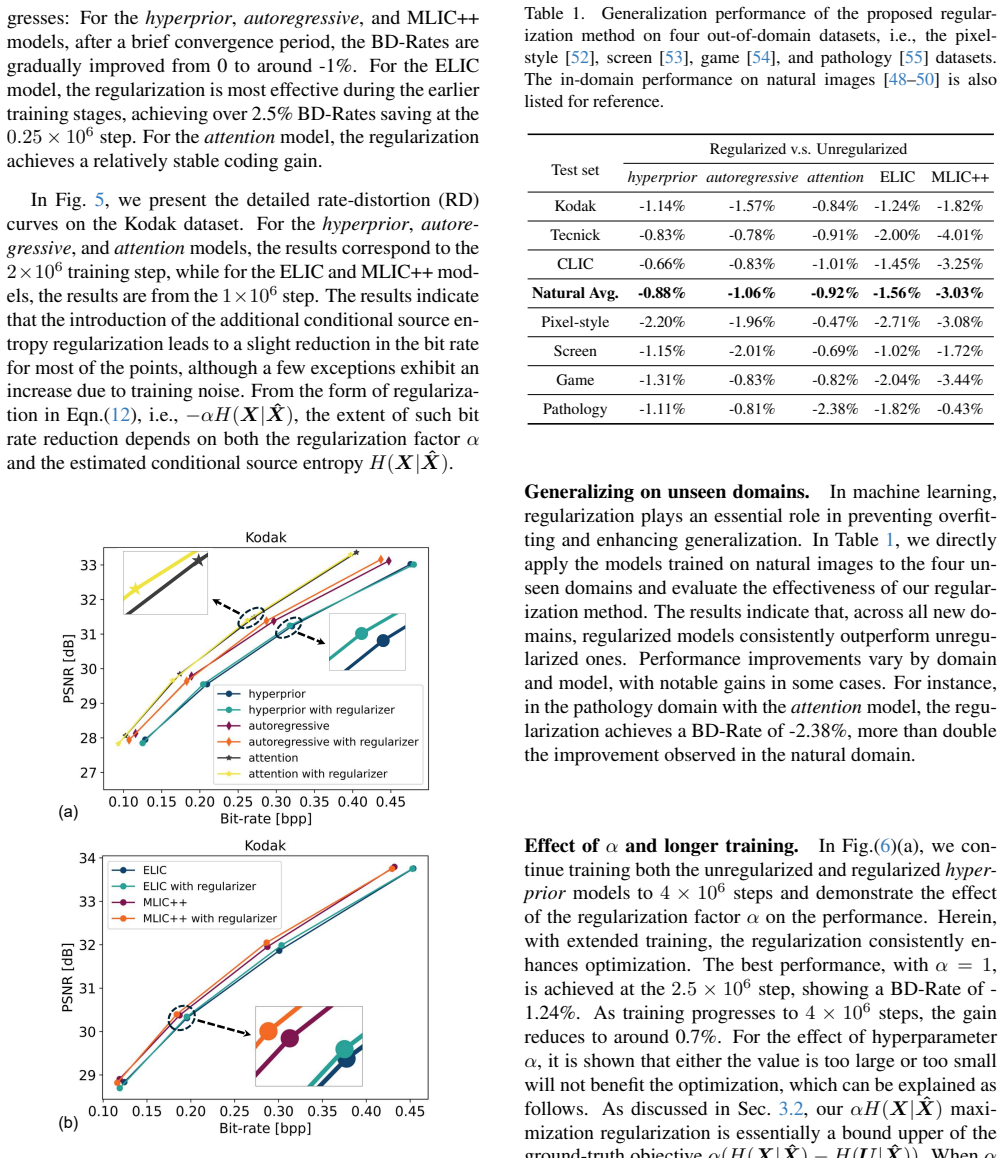
- The regularizer improves rate-distortion performance consistently across architectures, with reported BD-rate savings from about $-0.8\%$ to $-3.0\%$ at the final training steps.
- Out-of-domain generalization is improved on pixel-art, screen-content, game, and pathology datasets, often by more than the in-domain gain.
- The benefit depends on tuning the regularization factor $\alpha$ and on aligning the source entropy model with the latent entropy model; misalignment can turn the gain negative.
Reading between the lines
- An extension the paper leaves implicit: since the identity makes $-\alpha\,H(X|\hat{X})$ an effective reweighting of the rate term when $H(X)$ is fixed, the reported gains should be compared against a baseline trained with $\lambda/(1+\alpha)$; without that control, the regularizer's independent contribution is not fully isolated.
- A testable transfer: the same conditional-source-entropy regularizer could be applied to other lossy neural codecs (video, audio, point clouds) wherever a reconstruction-conditional density can be trained, though the paper demonstrates it only on images.
- The two-stage max-min training is structurally similar to adversarial training, so part of the benefit may come from the source entropy model acting as a learned critic of reconstruction quality; the paper does not analyze this channel.
Editorial analysis
A structured set of objections, weighed in public.
Referee Report
Summary. The paper proposes an information-theoretic regularizer for lossy neural image compression. It derives an identity relating the latent entropy H(U) to the conditional source entropy H(X|X̂) for deterministic direct and transform coders (Theorem 1 and Theorem 2), and uses this identity to argue that minimizing H(U) is, to some extent, equivalent to maximizing H(X|X̂). Based on this, the authors add a term -α H(X|X̂) to the standard rate-distortion loss, implemented by training an auxiliary source entropy model qθ(X|X̂) in a GAN-style alternating scheme. They report BD-rate improvements over vanilla training across five compression architectures (hyperprior, autoregressive, attention, ELIC, MLIC++) on natural images and four out-of-domain datasets, with no inference overhead and documented training complexity.
Significance. If the regularizer genuinely improves optimization and generalization beyond what is achievable by simply adjusting the rate-distortion trade-off, it would be a simple, plug-and-play training modification with no inference cost. The information-theoretic derivation is correct and standard, and the experimental evaluation is extensive, covering multiple architectures, bit-rate points, training steps, and unseen domains. The paper also reports training-time overhead. However, the central novelty claim is currently unsupported because the proposed regularizer is algebraically close to a rescaling of the rate term, and the missing control baseline (training with an effectively rescaled λ) prevents the authors from demonstrating that their method offers more than an implicit change of the rate-distortion operating point.
major comments (3)
- [Sec. 3.2, Eq. (12) and Sec. 4.2] The proposed regularizer is algebraically equivalent to rescaling the rate term, up to an unmodeled term. Using Theorem 2 (Eq. (11)), H(X|X̂) = H(X) - H(U) + H(U|X̂). Substituting into Eq. (12) and treating the estimated rate R as approximately H(U), the objective becomes (1+α)R + λD - α H(U|X̂) - α H(X). The -α H(X) term is constant during training, and the -α H(U|X̂) term is explicitly not modeled and is argued to decay (Sec. 3.2). Thus, up to this unmonitored term, the method is exactly equivalent to training the vanilla loss with λ' = λ/(1+α). The paper never trains a baseline with λ/(1+α), so the reported BD-rate gains (-0.88% to -3.03% in Sec. 4.2) may reflect a different effective operating point on the same rate-distortion frontier rather than a new structural regularization principle. To support the central claim, please add experiments with λ/(1+α) for all five models at matched effective λ, and compare the regularized runs against these rescaled baselines.
- [Sec. 3.2 (paragraph on H(U|X̂))] The theoretical motivation relies on H(U|X̂) being either negligible or decaying during training, but this quantity is never measured or reported. The statement that 'this H(U|X̂) gap, in principle, should decrease as training progresses' is an assumption, not a demonstrated fact. If H(U|X̂) does not decay, the regularizer is optimizing an upper bound of unknown tightness, which would also explain the sensitivity to α observed in Fig. 6(a). Please measure H(U|X̂) (or a proxy) over the course of training for both regularized and vanilla runs, or otherwise substantiate the decay claim.
- [Sec. 1 and Sec. 2 (novelty claim)] The paper claims to present 'the first study of information-theoretic regularization for the neural image compression task.' This claim is disproportionate if the method reduces to a rate rescaling, which the missing control in the first comment would reveal. The identity in Theorem 2 is correct, but the interpretation of the added term as a 'structural regularizer' rather than an effective λ change is the load-bearing point. Please either provide the control and demonstrate a benefit over λ rescaling, or adjust the novelty claim accordingly.
minor comments (6)
- [Throughout] The paper uses discrete entropy notation for image sources, which are continuous-valued in practice; the identities still hold for discrete sources, but clarity would be improved by noting whether differential entropy is intended.
- [Eq. (12)] The regularizer term is written as 'α EX [log qθ(X|X̂)]' with an underbrace '≈ -H(X|X̂)'. Since the expectation of log q is negative, the sign is correct, but the notation is easy to misread; consider writing '-α H(X|X̂)' directly or adding a brief explanation.
- [Algorithm 1] The alternating update is described, but it is not explicit whether the compression network update in step 4 uses the source entropy model qθ from the previous iteration or a fresh forward pass; please clarify for reproducibility.
- [Sec. 4.1] In the sentence on quantization surrogates, 'ANU' appears to be a typo for 'AUN' (additive uniform noise).
- [Sec. 4.2 and Fig. 4] The text says BD-Rates are 'gradually improved from 0 to around -1%', but a negative BD-Rate means better performance; please state this explicitly so the reader does not misinterpret the sign.
- [Sec. 4.3, Table 2] The training-time overhead is reported only for λ=0.0018; a sentence on whether this is representative across bit-rate points would be useful.
Circularity Check
No significant circularity: the information-theoretic identities are derived from definitions; the lambda-rescaling issue is a missing control, not a circular step.
full rationale
The derivation chain in Sec. 3.1 (Lemmas 1-2 and Theorems 1-2) is self-contained: H(U)=H(X)-H(X|Xhat)+H(U|Xhat) follows from deterministic encoder/decoder mappings and the definition of mutual information, and no conclusion is assumed as a premise. The regularizer in Eq. (12) is not fitted to the reported BD-rate results; the auxiliary source entropy model q_theta is trained by maximum likelihood, and the compression network is evaluated on held-out and unseen-domain datasets. There is no load-bearing self-citation chain or imported uniqueness theorem. The main legitimate concern is experimental rather than circular: via Eq. (11), the proposed objective is approximately (1+alpha)R + lambda D + alpha H(U|Xhat) minus a constant, so the regularizer may partly act as a rescaling of the rate term, and the paper does not train a baseline with lambda/(1+alpha). That missing control bears on the novelty and attribution of the BD-rate gains, not on whether the paper's derivation is circular. Accordingly, no circular step is identified; the circularity score is low.
Assumptions & free parameters
free parameters (1)
- regularization factor alpha =
0.1 for hyperprior, ELIC, MLIC++; 1 for autoregressive, attention
assumptions (4)
- domain assumption The analysis transform TA and synthesis transform TS are deterministic functions.
- domain assumption The source distribution H(X) is fixed during training.
- domain assumption The learned source entropy model qθ(X|X̂) provides an accurate estimate of the true conditional source entropy.
- ad hoc to paper The regularizer's effect is not equivalent to simply rescaling the rate-distortion trade-off lambda.
Cite this review
Pith. "Pith review of An Information-Theoretic Regularizer for Lossy Neural Image Compression." pith.science (2026). https://pith.science/paper/ZZ4LZ4T6
@misc{pith2026241116727,
  author       = {Pith},
  title        = {Pith review of: An Information-Theoretic Regularizer for Lossy Neural Image Compression},
  year         = {2026},
  howpublished = {\url{https://pith.science/paper/ZZ4LZ4T6}},
  note         = {Machine review of arXiv:2411.16727}
}
read the original abstract
Lossy image compression networks aim to minimize the latent entropy of images while adhering to specific distortion constraints. However, optimizing the neural network can be challenging due to its nature of learning quantized latent representations. In this paper, our key finding is that minimizing the latent entropy is, to some extent, equivalent to maximizing the conditional source entropy, an insight that is deeply rooted in information-theoretic equalities. Building on this insight, we propose a novel structural regularization method for the neural image compression task by incorporating the negative conditional source entropy into the training objective, such that both the optimization efficacy and the model's generalization ability can be promoted. The proposed information-theoretic regularizer is interpretable, plug-and-play, and imposes no inference overheads. Extensive experiments demonstrate its superiority in regularizing the models and further squeezing bits from the latent representation across various compression structures and unseen domains.
Figures


Figures from the paper (5 more)



Reference graph
Works this paper leans on
-
[1]
Coding theorems for a discrete source with a fidelity criterion,
C. E. Shannon et al., “Coding theorems for a discrete source with a fidelity criterion,”IRE Nat. Conv. Rec, vol. 4, no. 142- 163, p. 1, 1959. 1
work page 1959
-
[2]
Sayood, Introduction to data compression
K. Sayood, Introduction to data compression. Morgan Kauf- mann, 2017. 1
work page 2017
-
[3]
An introduction to neural data compression,
Y . Yang, S. Mandt, L. Theis,et al., “An introduction to neural data compression,” Foundations and Trends® in Computer Graphics and Vision, vol. 15, no. 2, pp. 113–200, 2023. 1
work page 2023
-
[4]
Variational image compression with a scale hyper- prior,
J. Ball ´e, D. Minnen, S. Singh, S. J. Hwang, and N. John- ston, “Variational image compression with a scale hyper- prior,” arXiv preprint arXiv:1802.01436 , 2018. 1, 2, 3, 5, 6
arXiv 2018
-
[5]
T. Berger, “Rate-distortion theory,” Wiley Encyclopedia of Telecommunications, 2003. 1
work page 2003
-
[6]
Theoretical foundations of transform coding,
V . K. Goyal, “Theoretical foundations of transform coding,” IEEE Signal Processing Magazine, vol. 18, no. 5, pp. 9–21,
-
[7]
End- to-end optimized image compression,
J. Ball ´e, V . Laparra, and E. P. Simoncelli, “End- to-end optimized image compression,” arXiv preprint arXiv:1611.01704, 2016. 2
arXiv 2016
-
[8]
Joint autoregres- sive and hierarchical priors for learned image compression,
D. Minnen, J. Ball ´e, and G. D. Toderici, “Joint autoregres- sive and hierarchical priors for learned image compression,” Advances in neural information processing systems, vol. 31,
Show all 61 references
-
[9]
Channel-wise autoregressive en- tropy models for learned image compression,
D. Minnen and S. Singh, “Channel-wise autoregressive en- tropy models for learned image compression,” in 2020 IEEE International Conference on Image Processing (ICIP), pp. 3339–3343, IEEE, 2020. 2, 5
2020
-
[10]
Learned image compression with discretized gaussian mixture like- lihoods and attention modules,
Z. Cheng, H. Sun, M. Takeuchi, and J. Katto, “Learned image compression with discretized gaussian mixture like- lihoods and attention modules,” in Proceedings of the IEEE/CVF conference on computer vision and pattern recognition, pp. 7939–7948, 2020. 2, 5, 6, 1
2020
-
[11]
Checker- board context model for efficient learned image compres- sion,
D. He, Y . Zheng, B. Sun, Y . Wang, and H. Qin, “Checker- board context model for efficient learned image compres- sion,” in Proceedings of the IEEE/CVF Conference on Com- puter Vision and Pattern Recognition , pp. 14771–14780,
-
[12]
Mlic++: Linear complexity multi- reference entropy modeling for learned image compression,
W. Jiang and R. Wang, “Mlic++: Linear complexity multi- reference entropy modeling for learned image compression,” in ICML 2023 Workshop Neural Compression: From Infor- mation Theory to Applications, 2023. 2, 5, 6
2023
-
[13]
Mambavc: Learned vi- sual compression with selective state spaces,
S. Qin, J. Wang, Y . Zhou, B. Chen, T. Luo, B. An, T. Dai, S. Xia, and Y . Wang, “Mambavc: Learned vi- sual compression with selective state spaces,”arXiv preprint arXiv:2405.15413, 2024. 2
2024 arXiv
-
[14]
On uniform scalar quan- tization for learned image compression,
H. Zhang, L. Li, and D. Liu, “On uniform scalar quan- tization for learned image compression,” arXiv preprint arXiv:2309.17051, 2023. 2, 4
2023 arXiv
-
[15]
Soft-to-hard vector quantization for end-to-end learning compressible represen- tations,
E. Agustsson, F. Mentzer, M. Tschannen, L. Cavigelli, R. Timofte, L. Benini, and L. V . Gool, “Soft-to-hard vector quantization for end-to-end learning compressible represen- tations,” Advances in neural information processing systems, vol. 30, 2017. 2
2017
-
[16]
Improving inference for neural image compression,
Y . Yang, R. Bamler, and S. Mandt, “Improving inference for neural image compression,”Advances in Neural Information Processing Systems, vol. 33, pp. 573–584, 2020. 2
2020
-
[17]
Universally quantized neural compression,
E. Agustsson and L. Theis, “Universally quantized neural compression,” Advances in neural information processing systems, vol. 33, pp. 12367–12376, 2020. 2
2020
-
[18]
Soft then hard: Rethinking the quantization in neural image compression,
Z. Guo, Z. Zhang, R. Feng, and Z. Chen, “Soft then hard: Rethinking the quantization in neural image compression,” in International Conference on Machine Learning, pp. 3920– 3929, PMLR, 2021. 2, 3
2021
-
[19]
An introduction to varia- tional autoencoders,
D. P. Kingma, M. Welling, et al., “An introduction to varia- tional autoencoders,” Foundations and Trends® in Machine Learning, vol. 12, no. 4, pp. 307–392, 2019. 2
2019
-
[20]
Ad- versarially regularized autoencoders,
J. Zhao, Y . Kim, K. Zhang, A. Rush, and Y . LeCun, “Ad- versarially regularized autoencoders,” in International con- ference on machine learning, pp. 5902–5911, PMLR, 2018. 2, 3
2018
-
[21]
Learning autoencoders with relational regularization,
H. Xu, D. Luo, R. Henao, S. Shah, and L. Carin, “Learning autoencoders with relational regularization,” inInternational Conference on Machine Learning, pp. 10576–10586, PMLR, 2020
2020
-
[22]
Vector quantization-based regulariza- tion for autoencoders,
H. Wu and M. Flierl, “Vector quantization-based regulariza- tion for autoencoders,” in Proceedings of the AAAI Confer- ence on Artificial Intelligence, vol. 34, pp. 6380–6387, 2020. 3
2020
-
[23]
Supervised autoen- coders: Improving generalization performance with unsuper- vised regularizers,
L. Le, A. Patterson, and M. White, “Supervised autoen- coders: Improving generalization performance with unsuper- vised regularizers,” Advances in neural information process- ing systems, vol. 31, 2018. 3
2018
-
[24]
Constrained generation of se- mantically valid graphs via regularizing variational autoen- coders,
T. Ma, J. Chen, and C. Xiao, “Constrained generation of se- mantically valid graphs via regularizing variational autoen- coders,” Advances in Neural Information Processing Sys- tems, vol. 31, 2018. 3
2018
-
[25]
Consistency regularization for variational auto-encoders,
S. Sinha and A. B. Dieng, “Consistency regularization for variational auto-encoders,” Advances in Neural Information Processing Systems, vol. 34, pp. 12943–12954, 2021. 2, 3
2021
-
[26]
Ochoa-Dominguez and K
H. Ochoa-Dominguez and K. R. Rao, Discrete cosine trans- form. CRC Press, 2019. 2
2019
-
[27]
Vari- able rate image compression with recurrent neural net- works,
G. Toderici, S. M. O’Malley, S. J. Hwang, D. Vincent, D. Minnen, S. Baluja, M. Covell, and R. Sukthankar, “Vari- able rate image compression with recurrent neural net- works,” arXiv preprint arXiv:1511.06085, 2015. 2
2015 arXiv
-
[28]
Non-local attention optimized deep image compres- sion,
H. Liu, T. Chen, P. Guo, Q. Shen, X. Cao, Y . Wang, and Z. Ma, “Non-local attention optimized deep image compres- sion,” arXiv preprint arXiv:1904.09757, 2019. 2
1904 arXiv
-
[29]
Transformer-based image compression,
M. Lu, P. Guo, H. Shi, C. Cao, and Z. Ma, “Transformer-based image compression,” arXiv preprint arXiv:2111.06707, 2021. 2
2021 arXiv
-
[30]
Learned image compression with mixed transformer-cnn architectures,
J. Liu, H. Sun, and J. Katto, “Learned image compression with mixed transformer-cnn architectures,” in Proceedings of the IEEE/CVF conference on computer vision and pattern recognition, pp. 14388–14397, 2023. 2
2023
-
[31]
End-to-end opti- mized versatile image compression with wavelet-like trans- form,
H. Ma, D. Liu, N. Yan, H. Li, and F. Wu, “End-to-end opti- mized versatile image compression with wavelet-like trans- form,” IEEE Transactions on Pattern Analysis and Machine Intelligence, vol. 44, no. 3, pp. 1247–1263, 2020. 2
2020
-
[32]
Lvqac: Lattice vector quantiza- tion coupled with spatially adaptive companding for effi- cient learned image compression,
X. Zhang and X. Wu, “Lvqac: Lattice vector quantiza- tion coupled with spatially adaptive companding for effi- cient learned image compression,” in Proceedings of the IEEE/CVF Conference on Computer Vision and Pattern Recognition, pp. 10239–10248, 2023. 2
2023
-
[33]
Nvtc: Nonlinear vector transform coding,
R. Feng, Z. Guo, W. Li, and Z. Chen, “Nvtc: Nonlinear vector transform coding,” in Proceedings of the IEEE/CVF Conference on Computer Vision and Pattern Recognition , pp. 6101–6110, 2023. 2
2023
-
[34]
Trellis-coded quantization for end-to-end learned image compression,
K. S ¨uhring, M. Sch ¨afer, J. Pfaff, H. Schwarz, D. Marpe, and T. Wiegand, “Trellis-coded quantization for end-to-end learned image compression,” in 2022 IEEE International Conference on Image Processing (ICIP) , pp. 3306–3310, IEEE, 2022. 2
2022
-
[35]
Nlic: Non- uniform quantization based learned image compression,
Z. Ge, S. Ma, W. Gao, J. Pan, and C. Jia, “Nlic: Non- uniform quantization based learned image compression,” IEEE Transactions on Circuits and Systems for Video Tech- nology, 2024. 2
2024
-
[36]
Causal contextual prediction for learned image compression,
Z. Guo, Z. Zhang, R. Feng, and Z. Chen, “Causal contextual prediction for learned image compression,” IEEE Transac- tions on Circuits and Systems for Video Technology, vol. 32, no. 4, pp. 2329–2341, 2021. 2
2021
-
[37]
Unified multivariate gaussian mixture for efficient neural image com- pression,
X. Zhu, J. Song, L. Gao, F. Zheng, and H. T. Shen, “Unified multivariate gaussian mixture for efficient neural image com- pression,” in Proceedings of the IEEE/CVF Conference on Computer Vision and Pattern Recognition, pp. 17612–17621,
-
[38]
Learned image compression with gaussian-laplacian-logistic mixture model and concatenated residual modules,
H. Fu, F. Liang, J. Lin, B. Li, M. Akbari, J. Liang, G. Zhang, D. Liu, C. Tu, and J. Han, “Learned image compression with gaussian-laplacian-logistic mixture model and concatenated residual modules,” IEEE Transactions on Image Processing, vol. 32, pp. 2063–2076, 2023. 2
2023
-
[39]
Coarse-to-fine hyper-prior modeling for learned image compression,
Y . Hu, W. Yang, and J. Liu, “Coarse-to-fine hyper-prior modeling for learned image compression,” in Proceedings of the AAAI Conference on Artificial Intelligence , vol. 34, pp. 11013–11020, 2020. 2
2020
-
[40]
Lossy image compression with compressive autoencoders,
L. Theis, W. Shi, A. Cunningham, and F. Husz ´ar, “Lossy image compression with compressive autoencoders,” arXiv preprint arXiv:1703.00395, 2017. 3
2017 arXiv
-
[41]
Deep learning,
I. Goodfellow, “Deep learning,” 2016. 4
2016
-
[42]
Generative adversarial nets,
I. Goodfellow, J. Pouget-Abadie, M. Mirza, B. Xu, D. Warde-Farley, S. Ozair, A. Courville, and Y . Bengio, “Generative adversarial nets,” Advances in neural informa- tion processing systems, vol. 27, 2014. 4
2014
-
[43]
Elic: Efficient learned image compression with unevenly grouped space-channel contextual adaptive coding,
D. He, Z. Yang, W. Peng, R. Ma, H. Qin, and Y . Wang, “Elic: Efficient learned image compression with unevenly grouped space-channel contextual adaptive coding,” in Proceedings of the IEEE/CVF Conference on Computer Vision and Pat- tern Recognition, pp. 5718–5727, 2022. 5, 6, 2
2022
-
[44]
Compressai: a pytorch library and evaluation plat- form for end-to-end compression research,
J. B ´egaint, F. Racap ´e, S. Feltman, and A. Pushparaja, “Compressai: a pytorch library and evaluation plat- form for end-to-end compression research,” arXiv preprint arXiv:2011.03029, 2020. 5, 1
2011 arXiv
-
[45]
Unofficial elic
W. Jiang, “Unofficial elic.” https : // github . com / JiangWeibeta/ELIC, 2022. 5
2022
-
[46]
A unified end-to-end frame- work for efficient deep image compression,
J. Liu, G. Lu, Z. Hu, and D. Xu, “A unified end-to-end frame- work for efficient deep image compression,” arXiv preprint arXiv:2002.03370, 2020. 6
2002 arXiv
-
[47]
Adam: A method for stochastic optimiza- tion,
D. P. Kingma, “Adam: A method for stochastic optimiza- tion,” arXiv preprint arXiv:1412.6980, 2014. 6
2014 arXiv
-
[48]
Kodak lossless true color image suite (photocd pcd0992),
E. Kodak, “Kodak lossless true color image suite (photocd pcd0992),” URL http://r0k.us/graphics/kodak, vol. 6, p. 2,
-
[49]
6th Challenge on Learned Image Compression
“6th Challenge on Learned Image Compression.” https: / / www . compression . cc / tasks / index . html. Accessed: 2024-11-13. 6
2024
-
[50]
Testimages: a large-scale archive for testing visual devices and basic image process- ing algorithms.,
N. Asuni and A. Giachetti, “Testimages: a large-scale archive for testing visual devices and basic image process- ing algorithms.,” in STAG, pp. 63–70, 2014. 6, 7
2014
-
[51]
Few-shot domain adaptation for learned image compression,
T. Zhang, H. Zhang, Y . Li, L. Li, and D. Liu, “Few-shot domain adaptation for learned image compression,” arXiv preprint arXiv:2409.11111, 2024. 6
2024 arXiv
-
[52]
Dynamic low-rank instance adaptation for universal neural image compression,
Y . Lv, J. Xiang, J. Zhang, W. Yang, X. Han, and W. Yang, “Dynamic low-rank instance adaptation for universal neural image compression,” in Proceedings of the 31st ACM Inter- national Conference on Multimedia, pp. 632–642, 2023. 6, 7
2023
-
[53]
Implicit trans- former network for screen content image continuous super- resolution,
J. Yang, S. Shen, H. Yue, and K. Li, “Implicit trans- former network for screen content image continuous super- resolution,” Advances in Neural Information Processing Sys- tems, vol. 34, pp. 13304–13315, 2021. 6, 7
2021
-
[54]
Uni- fied blind quality assessment of compressed natural, graphic, and screen content images,
X. Min, K. Ma, K. Gu, G. Zhai, Z. Wang, and W. Lin, “Uni- fied blind quality assessment of compressed natural, graphic, and screen content images,” IEEE Transactions on Image Processing, vol. 26, no. 11, pp. 5462–5474, 2017. 6, 7
2017
-
[55]
Bracs: A dataset for breast carcinoma subtyping in h&e histology images,
N. Brancati, A. M. Anniciello, P. Pati, D. Riccio, G. Scog- namiglio, G. Jaume, G. De Pietro, M. Di Bonito, A. Foncu- bierta, G. Botti, et al., “Bracs: A dataset for breast carcinoma subtyping in h&e histology images,” Database, vol. 2022, p. baac093, 2022. 6, 7
2022
-
[56]
Xception: Deep learning with depthwise sepa- rable convolutions,
F. Chollet, “Xception: Deep learning with depthwise sepa- rable convolutions,” in Proceedings of the IEEE conference on computer vision and pattern recognition, pp. 1251–1258,
-
[57]
Calculation of average PSNR differences between RD-curves,
G. Bjontegaard, “Calculation of average PSNR differences between RD-curves,” ITU SG16 Doc. VCEG-M33, 2001. 1 An Information-Theoretic Regularizer for Lossy Neural Image Compression Supplementary Material
2001
-
[58]
Proof of Lemma 1 For a deterministic quantization process Q(·), the condi- tional probability p(U |X) can only take values of 0 or 1, i.e., p(U |X) = 1, if U = Q(X) 0, if U ̸= Q(X) . (18) Similarly, for a deterministic dequantization process Q−1(·), it is by definition a bijec...
-
[59]
Proof of Lemma 2 Recalling the proof in Sec. 6, since both the analysis trans- form TA(·) and synthesis transformTS(·) are deterministic, the following holds: p(U |X) = 1, if U = Q(TA(X)) 0, if U ̸= Q(TA(X)) , (26) p( ˆX|U ) = 1, if ˆX = TS(Q−1(U )) 0, if ˆX ̸= TS(Q−1(U )) , (...
-
[60]
Four bit-rate points, i.e., λ ∈ {0.0018, 0.0035, 0.0067, 0.0130} are trained with 2 × 10⁶ steps
Reproduced baselines We retrain the hyperprior [4], autoregressive [8] and attention [10] models from scratch, adhering to the default implementation and training configurations of CompressAI’s [44]. Four bit-rate points, i.e., λ ∈ {0.0018, 0.0035, 0.0067, 0.0130} are trained ...
-
[61]
The details are depicted in Fig.7
More details on source entropy models Herein, the module designs are identical to the latent de- signs [4, 8, 10, 12, 43], with only minor dimension ad- justment. The details are depicted in Fig.7. For the at- tention modules, the depthwise separable convolution is adopted [56]
Reviewed August 12, 2026 · model on record in the stance chip above.
Discussion (0). Continue with ORCID to comment.