REVIEW 2 major objections 5 minor 1 cited by
Predicting center of mass position in non-cyclic activities: The influence of acceleration, prediction horizon, and ground reaction forces
T0 review · 2 major / 5 minor · reviewed 2026-08-12 · deepseek-v4-flash
Pith's one-line read The paper shows that incorporating ground reaction forces into center-of-mass prediction, through constant or cubic acceleration profiles, cuts position error and improves direction accuracy at 125–250 ms horizons, and identifies 250 ms…
desk verdict Solid empirical comparison with an abstract that overstates one accuracy finding; the AE result holds, the ADA claim needs correction. read the letter →
The pith
A machine-rendered reading of the paper's core claim, the machinery that carries it, and where it could break.
The reading
What carries the argument
The load-bearing mechanism is a discrete-time double-integrator state-space model of the CoM, $\ddot{p}=u$, where the input $u$ is the GRF-derived acceleration (net external force divided by mass, with gravity removed). Given current position and velocity, the future position is computed by propagating the state with one of three assumed acceleration profiles over the horizon: zero, constant at the first sample, or a cubic that starts at the first sample and decays to zero with zero jerk at both ends. The cubic profile is motivated by minimum-jerk humanoid planning; the oracle profile uses the future GRFs directly and serves as a lower bound. Because the error formula (Appendix C) reduces to a double integral of the difference between assumed and true acceleration, a constant mismatch under the simplifying assumptions produces the observed quadratic error growth in horizon length.
What would settle it
Re-run the prediction pipeline with an instrumented chair or handrail that records contact forces during sit-to-stand and stand-to-sit, and compare ground-truth CoM acceleration from force plates plus contact forces against the whole-body marker estimate; if the zero-acceleration baseline then matches the GRF-based profiles at 125 and 250 ms, the reported benefit would be shown to depend on unmeasured external contacts.
Extended reading notes
Core claim
The authors claim that future center-of-mass position over short horizons can be predicted by forward integration of a double-integrator model, and that the quality of that prediction is governed mainly by horizon length and by whether the assumed acceleration profile uses ground reaction forces. Using whole-body marker trajectories as ground truth, they find that position error grows quadratically with horizon (R² > 0.930 for all profiles) and direction accuracy falls linearly (R² > 0.615). At horizons of 125 and 250 ms, the constant and cubic-to-zero profiles—both seeded with the GRF-derived acceleration at the first sample—outperform the zero-acceleration baseline on average error and average direction accuracy, with statistically significant differences and large effect sizes; at longer horizons the advantage fades and sometimes reverses for worst-case error. The authors therefore treat 250 ms as a threshold for practical predictive intent inference.
Load-bearing premise
The comparisons assume that the whole-body marker-based OpenSim CoM estimate is an unbiased ground truth and that the measured ground reaction forces plus gravity are the only external forces acting on the body, so unmeasured chair or handrail contacts during activities like sit-to-stand and stand-to-sit would violate the acceleration input.
Editorial extensions
If this is right
- At horizons up to 250 ms, GRF-informed constant and cubic profiles reduce average CoM position error and improve direction accuracy relative to zero-acceleration prediction, with the largest effects at 125 ms.
- Prediction error grows quadratically and direction accuracy declines linearly with horizon for all profiles, so extending the prediction window beyond a few hundred milliseconds carries a steep accuracy cost.
- The 250 ms horizon is proposed as a practical threshold for CoM-based intent prediction in applications such as lower-limb wearable robots.
- At longer horizons, zero-acceleration can produce lower maximum errors than GRF-based profiles, because a single early acceleration sample becomes an unreliable forecast.
- Even the oracle profile, which uses the true future GRFs, accumulates integration drift and loses direction accuracy, so no constant-profile method can fully escape horizon-dependent degradation.
Reading between the lines
- Editorial inference: the one-sample advantage of GRF information suggests that even partially available GRFs in instrumented footwear or bionic limbs could improve short-horizon intent inference without a full motion-capture ground truth.
- Editorial inference: because the quadratic error growth follows from double integration of a constant acceleration mismatch, the same scaling should appear whenever a point-mass CoM model is forward-integrated with a mismatched acceleration forecast; testing this in a different dataset (e.g., walking perturbations) would check the generality.
- Editorial inference: chair contact forces during sit-to-stand and stand-to-sit are a plausible unmeasured external force; adding an instrumented chair or handrail would reveal whether the reported GRF benefit changes when contacts are not on the force plates.
- Editorial inference: the near-oracle performance at 125 ms aligns with neuromuscular reaction time, suggesting that a control loop running at this timescale might be the natural operating point for balance-assist controllers.
Editorial analysis
A structured set of objections, weighed in public.
Referee Report
Summary. This manuscript studies short-horizon prediction of the whole-body center-of-mass (CoM) position during 14 non-cyclic activities performed by 10 healthy adults. The CoM is modeled as a double integrator driven by acceleration inputs derived from ground reaction forces, and four acceleration assumptions are compared: zero, constant, cubic-to-zero, and an oracle that uses future measured accelerations. For horizons of 125 to 625 ms, the authors report that average and maximum position errors grow quadratically with horizon length while direction accuracy decreases linearly, and that GRF-based constant and cubic profiles improve prediction at short horizons relative to the zero-acceleration baseline. The paper proposes 250 ms as a practical horizon threshold for intent inference in wearable robotics.
Significance. If the results hold, the paper provides a transparent, parameter-free baseline for CoM prediction and a concrete argument that even a single instantaneous GRF sample improves short-horizon prediction relative to a constant-velocity assumption. The statistical analysis is careful: Welch ANOVA, Bonferroni-corrected post-hoc tests, F-tests for trend degree, weighted least squares, confidence intervals, and reported effect sizes. The a priori definition of the acceleration profiles and the use of an oracle reference reduce circularity concerns, and the quadratic-error explanation in Appendix C is explicit and testable. The broad qualitative conclusions are likely robust, but the abstract overstates the direction-accuracy evidence for the constant profile, and the GRF-derived acceleration assumption is not satisfied for all analyzed activities due to unmeasured chair-contact forces.
major comments (2)
- [Abstract and Section 3, Table 2] The abstract claims that "the constant and cubic profiles, which utilize the GRFs, outperform the zero-acceleration assumption in ... accuracy ... at horizons of 125 and 250 ms (p<0.034, d>1.44)." Table 2 shows that for ADA at T=250 ms the Zero-Const comparison has p=1.00 with no reported effect size, so the Constant profile does not significantly improve direction accuracy at 250 ms; only the Zero-Cubic comparison is significant there (p=0.034, d=1.44). The results text in Section 3 also states that differences were found between Zero-Const only at T=125 ms. The abstract and the corresponding sentence in Section 4.2 should be corrected to distinguish the Constant and Cubic profiles, e.g., Constant improving direction accuracy only at 125 ms and Cubic improving it at all tested horizons.
- [Section 2.1 and Appendix B, Eq. (B.1)] Equation (B.1) defines the acceleration input using ground reaction forces and gravity as the only external forces, but the protocol includes Sit to Stand, Stand to Sit, and Foot on Chair, during which the chair exerts reaction forces on the body that are not measured by the force plates. For samples in which the participant is still in contact with the chair, u[1] and the Oracle inputs are not the true CoM acceleration, so the error comparisons involving the Constant, Cubic, and Oracle profiles can be biased for those activities. The authors should either quantify the extent of chair-contact samples through a sensitivity analysis that excludes those activities or phases, or add an explicit limitation with evidence that the conclusions are unchanged; as written, the assumption in Eq. (B.1) is not satisfied for all analyzed data.
minor comments (5)
- [Abstract and Fig. 3b] The abstract reports R2>0.930 for the quadratic position-error fits, while Fig. 3b shows R2=0.918 for the Constant maximum-error fit; these numbers should be reconciled.
- [Section 4.2] The sentence "with the Zero having a significantly larger ADA than Cubic at all levels of T" appears to have the comparison reversed; Table 2 and Fig. 4a indicate that Cubic has significantly higher ADA than Zero, so the wording should be corrected.
- [Section 2.1] The manual labeling of force plate contact events is not described with any reliability measure; a brief statement on inter- or intra-rater consistency, or an automated rule-based alternative, would strengthen reproducibility.
- [Section 2.2] The choice of 125 ms as the minimum horizon is justified by a self-cited prior conference paper (Noghani and Bolivar-Nieto, 2024); restating the relevant evidence or providing an independent rationale would make the horizon grid self-contained.
- [Section 4.3] The statement that at T=250 ms the profiles achieved "AE <0.57 cm, ME <11.7 cm" should specify that these are mean values and should indicate whether the bounds apply to all profiles or only to the GRF-based profiles.
Circularity Check
No significant circularity: the acceleration profiles are defined a priori and predictions are compared against an independent marker-derived CoM estimate; the only minor self-citation is not load-bearing.
full rationale
The prediction pipeline is self-contained. The three acceleration profiles (Zero, Constant, Cubic-to-zero) are fixed functional forms specified in Section 2.2, with no parameters fitted to the error data; the only data-driven input is the instantaneous GRF-derived acceleration u[1], while the Oracle additionally uses future GRFs and is explicitly labeled as an ideal reference. Prediction errors (Eq. 2) and metrics (Eqs. 3-7) compare forward-integrated positions against the whole-body marker/OpenSim CoM estimate, which is an independent measurement chain (Section 2.1). The quadratic error growth is first established by F-tests on the measured errors (Section 3) and then rationalized post hoc in Appendix C under simplifying assumptions; the appendix is an explanation of the mechanism, not the source of the data. The only self-citation, Noghani and Bolívar-Nieto (2024), is used solely to justify the 125 ms minimum horizon ('The minimum length of 125 ms was determined by previous results...') and does not supply the comparative result that GRF-based profiles outperform zero acceleration; therefore it is not load-bearing. The abstract's joint claim about direction accuracy at 250 ms is somewhat overbroad relative to Table 2 (Zero-Const ADA p=1 at T=250 ms), but that is an internal reporting inconsistency, not a circular derivation. Limitations regarding unmeasured external forces and wearable deployment are acknowledged in Section 4.4 and affect external validity, not the internal derivation chain.
Assumptions & free parameters
free parameters (3)
- Marker data low-pass filter cutoff =
6 Hz
- GRF low-pass filter cutoff =
20 Hz
- Manual contact event labels =
hand-labeled per trial
assumptions (4)
- domain assumption Newton's second law: sum of external forces equals mass times CoM acceleration, with GRFs and gravity as the only external forces (Eq. B.1).
- domain assumption Whole-body marker-based OpenSim CoM estimate is the ground truth reference.
- domain assumption The future CoM acceleration is well approximated by one of three profiles: zero, constant, or cubic-to-zero with zero endpoint jerk.
- standard math Statistical model assumptions: normality, variance handling via weighted least squares, and Bonferroni-corrected post-hoc tests.
Cite this review
Pith. "Pith review of Predicting center of mass position in non-cyclic activities: The influence of acceleration, prediction horizon, and ground reaction forces." pith.science (2026). https://pith.science/paper/W4AGECZ5
@misc{pith2026241116891,
  author       = {Pith},
  title        = {Pith review of: Predicting center of mass position in non-cyclic activities: The influence of acceleration, prediction horizon, and ground reaction forces},
  year         = {2026},
  howpublished = {\url{https://pith.science/paper/W4AGECZ5}},
  note         = {Machine review of arXiv:2411.16891}
}
abstract
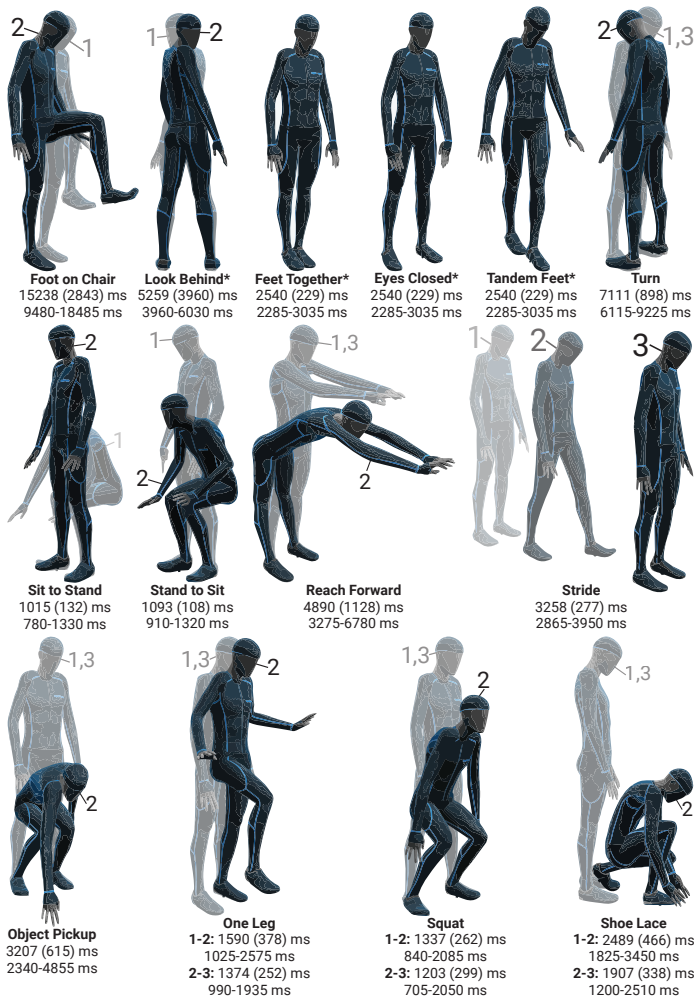
The whole-body center of mass (CoM) plays an important role in quantifying human movement. Prediction of future CoM trajectory, modeled as a point mass under influence of external forces, can be a surrogate for inferring intent. Given the current CoM position and velocity, predicting the future CoM position by forward integration requires a forecast of CoM accelerations during the prediction horizon. However, it is unclear how assumptions about the acceleration, prediction horizon length, and information from ground reaction forces (GRFs), which provide the instantaneous acceleration, affect the prediction. We study these factors by analyzing data of 10 healthy young adults performing 14 non-cyclic activities. We assume that the acceleration during a horizon will be 1) zero, 2) remain constant, or 3) converge to zero as a cubic trajectory, and perform predictions for horizons of 125 to 625 milliseconds. We quantify the prediction performance by comparing the position error and accuracy of identifying the main direction of displacement against trajectories obtained from a whole-body marker set. For all the assumed accelerations profiles, position errors grow quadratically with horizon length ($R^2 > 0.930$) while the accuracy of the predicted direction decreases linearly ($R^2>0.615$). Post-hoc tests reveal that the constant and cubic profiles, which utilize the GRFs, outperform the zero-acceleration assumption in position error ($p<0.001$, Cohen's $d>3.23$) and accuracy ($p<0.034$, Cohen's $d>1.44)$ at horizons of 125 and 250$\,ms$. The results provide evidence for benefits of incorporating GRFs into predictions and point to 250$\,ms$ as a threshold for horizon length in predictive applications.
Figures


Figures from the paper (1 more)

Forward citations
Cited by 1 Pith paper
-
Comparative analysis of whole-body center-of-mass estimation methods in dynamic and static activities using marker-based systems
Compared with whole-body marker models, a pelvis-marker-only estimate yields roughly double the force residual in dynamic activities, while Kalman-filter fusion of ground reaction forces did not beat the whole-body ma...
Reference graph
Works this paper leans on
-
[8]
Adjustments to McConville et al. and Young et al. body segment inertial parameters. Journal of Biomechanics 40, 543–553. doi: 10.1016/j.jbiomech.2006.02.013. Hof, A., Gazendam, M., Sinke, W.,
-
[11]
Control of lateral balance in walking. Gait & Posture 25, 250–258. doi: 10.1016/j.gaitpost.2006.04.013. Horak, F.B., Nashner, L.M.,
-
[13]
ACM Transactions on Graphics 42, 1–12
From Skin to Skeleton: Towards Biomechanically Accurate 3D Digital Humans. ACM Transactions on Graphics 42, 1–12. doi: 10.1145/3618381. Kim, M., Collins, S.H.,
-
[19]
Journal of Neurophysiology 98, 1928–1940
Validating Determinants for an Alternate Foot Placement Selection Algorithm During Human Locomotion in Cluttered Terrain. Journal of Neurophysiology 98, 1928–1940. doi: 10.1152/jn. 00044.2006. Murphy, K.P.,
arXiv 1928
-
[20]
Prediction of Whole-Body Center of Mass Using Joint Angles and Ground Reaction Forces: A Framework for Human Intent Prediction, in: 2024 10th IEEE RAS /EMBS International Con- ference for Biomedical Robotics and Biomechatronics (BioRob), IEEE, Heidelberg, Germany. pp. 1095–1100. doi:10.1109/BioRob60516.2024.10719954. OptiTrack,
arXiv 2024
-
[21]
Beck, O.N., Shepherd, M.K., Rastogi, R., Martino, G., Ting, L.H., Sawicki, G.S.,
doi: 10.1186/s12984-022-01000-y . Beck, O.N., Shepherd, M.K., Rastogi, R., Martino, G., Ting, L.H., Sawicki, G.S.,
-
[23]
IEEE Transactions on Biomedical Engineering 63, 2068–2079
Full-Body Musculoskeletal Model for Muscle-Driven Simulation of Human Gait. IEEE Transactions on Biomedical Engineering 63, 2068–2079. doi:10.1109/TBME.2016.2586891. Seth, A., Sherman, M., Reinbolt, J.A., Delp, S.L.,
arXiv 2016
-
[24]
OpenSim: A musculoskeletal modeling and simulation frame- work for in silico investigations and exchange. Procedia IUTAM 2, 212–232. doi: 10.1016/j.piutam.2011.04
Show all 32 references
-
[25]
Procedia IUTAM 12 2, 241–261
Simbody: Multibody dynamics for biomedical research. Procedia IUTAM 12 2, 241–261. doi: 10.1016/j.piutam.2011.04.023. Tesio, L., Rota, V .,
2011 doi
-
[27]
Journal of Biomechanics 122, 110411
Compensation due to age-related decline in sit-to-stand and sit-to-walk. Journal of Biomechanics 122, 110411. doi: 10.1016/j.jbiomech.2021.110411. Van Heerden, K.,
2021
-
[28]
IEEE Robotics and Automation Letters 2, 135–142
Real-Time Variable Center of Mass Height Trajectory Planning for Humanoids Robots. IEEE Robotics and Automation Letters 2, 135–142. doi: 10.1109/LRA.2016.2579741. Vlutters, M., Van Asseldonk, E., Van Der Kooij, H.,
2016
-
[30]
IEEE Transactions on Robotics 40, 43–63
Optimization-Based Control for Dynamic Legged Robots. IEEE Transactions on Robotics 40, 43–63. doi: 10.1109/TRO.2023.3324580. Werling, K., Bianco, N.A., Raitor, M., Stingel, J., Hicks, J.L., Collins, S.H., Delp, S.L., Liu, C.K.,
2023
-
[31]
PLOS ONE 18, e0295152
AddBiomechan- ics: Automating model scaling, inverse kinematics, and inverse dynamics from human motion data through sequential optimization. PLOS ONE 18, e0295152. doi: 10.1371/journal.pone.0295152. Zhang, T., Tran, M., Huang, H.,
-
[32]
1 ∆T 0 1 # , B =
Design and Experimental Verification of Hip Exoskeleton With Balance Capacities for Walking Assistance. IEEE /ASME Transactions on Mechatronics 23, 274–285. doi: 10.1109/TMECH.2018. 2790358. 13 Appendix A. Description of the activities Table A.3: List of activities performed b...
2018 doi
-
[62]
Kuindersma, S., Deits, R., Fallon, M., Valenzuela, A., Dai, H., Permenter, F., Koolen, T., Marion, P., Tedrake, R.,
doi: 10.3389/fnbot.2017.00062. Kuindersma, S., Deits, R., Fallon, M., Valenzuela, A., Dai, H., Permenter, F., Koolen, T., Marion, P., Tedrake, R.,
2017
-
[82]
Azocar, A.F., Mooney, L.M., Duval, J.F., Simon, A.M., Hargrove, L.J., Rouse, E.J.,
doi: 10.1186/s12984-023-01205-9 . Azocar, A.F., Mooney, L.M., Duval, J.F., Simon, A.M., Hargrove, L.J., Rouse, E.J.,
-
[999]
Van Der Kruk, E., Silverman, A.K., Reilly, P., Bull, A.M.,
doi: 10.3389/fneur.2019.00999. Van Der Kruk, E., Silverman, A.K., Reilly, P., Bull, A.M.,
2019
-
[1986]
Journal of Neurophysiology 55, 1369–1381
Central programming of postural movements: Adaptation to altered support-surface configurations. Journal of Neurophysiology 55, 1369–1381. doi: 10.1152/jn.1986.55.6.1369. Iqbal, K., Pai, Y .C.,
1986 doi
-
[1997]
Journal of Biomechanics 30, 347–354
Center of mass velocity-position predictions for balance control. Journal of Biomechanics 30, 347–354. doi: 10.1016/S0021-9290(96)00165-0 . Rajagopal, A., Dembia, C.L., DeMers, M.S., Delp, D.D., Hicks, J.L., Delp, S.L.,
-
[2005]
Journal of Biomechanics 38, 1–8
The condition for dynamic stability. Journal of Biomechanics 38, 1–8. doi:10.1016/j.jbiomech.2004.03.025. Hof, A.L.,
2004 doi
-
[2007]
IEEE Transactions on Biomedical Engineering 54, 1940–1950
OpenSim: Open-Source Software to Create and Analyze Dynamic Simulations of Movement. IEEE Transactions on Biomedical Engineering 54, 1940–1950. doi: 10.1109/TBME.2007.901024. Divekar, N.V ., Thomas, G.C., Yerva, A.R., Frame, H.B., Gregg, R.D.,
1940
-
[2008]
Human Movement Science 27, 112–125
The ‘extrapolated center of mass’ concept suggests a simple control of balance in walking. Human Movement Science 27, 112–125. doi:10.1016/j.humov.2007.08.003. Hof, A.L., Van Bockel, R.M., Schoppen, T., Postema, K.,
2007 doi
-
[2011]
Gait & Posture 33, 292–296
Over rough and smooth: Amputee gait on an irregular surface. Gait & Posture 33, 292–296. doi: 10.1016/j.gaitpost.2010.11.023. 11 Delp, S.L., Anderson, F.C., Arnold, A.S., Loan, P., Habib, A., John, C.T., Guendelman, E., Thelen, D.G.,
2010 doi
-
[2013]
Journal of The Royal Society Interface 10, 20120999
Assessing the stability of human locomotion: A review of current measures. Journal of The Royal Society Interface 10, 20120999. doi: 10.1098/rsif.2012.0999. Bruijn, S.M., Van Die ¨en, J.H.,
2012
-
[2014]
Biology Letters 10, 20140405
Stepping in the direction of the fall: The next foot placement can be predicted from current upper body state in steady-state walking. Biology Letters 10, 20140405. doi: 10.1098/rsbl.2014.0405. Wensing, P.M., Posa, M., Hu, Y ., Escande, A., Mansard, N., Prete, A.D.,
2014
-
[2016]
Autonomous Robots 40, 429–455
Optimization-based locomotion planning, estimation, and control design for the atlas humanoid robot. Autonomous Robots 40, 429–455. doi: 10.1007/s10514-015-9479-3 . Leestma, J.K., Smith, C.R., Sawicki, G.S., Young, A.J.,
-
[2017]
3 ed., Routledge, Third edition / Scott E
Designing Experiments and Analyzing Data: A Model Comparison Perspective. 3 ed., Routledge, Third edition / Scott E. Maxwell, Harold D. Delaney, and Ken Kelley. | New York,. doi:10.4324/9781315642956. Molinaro, D.D., Scherpereel, K.L., Schonhaut, E.B., Evangelopoulos, G., Shep...
-
[2018]
Journal of The Royal Society Interface 15, 20170816
Control of human gait stability through foot placement. Journal of The Royal Society Interface 15, 20170816. doi:10.1098/rsif.2017.0816. Buurke, T.J., Van De Venis, L., Den Otter, R., Nonnekes, J., Keijsers, N.,
2017
-
[2021]
Behavior Research Methods 53, 264–277
T-Test and ANOV A for data with ceiling and/or floor effects. Behavior Research Methods 53, 264–277. doi: 10.3758/s13428-020-01407-2 . Maxwell, S.E., Delaney, H.D., Kelley, K.,
-
[2022]
https://docs.optitrack.com/ movement-sciences/movement-sciences-markersets/biomech-57
Biomech 57 markerset - movement sciences documentation. https://docs.optitrack.com/ movement-sciences/movement-sciences-markersets/biomech-57 . Accessed: 2024-10-25. Pai, Y .C., Patton, J.,
2024
-
[2023]
Journal of Biomechanics 146, 111415
Comparison of ground reaction force and marker-based methods to estimate mediolateral center of mass displacement and margins of stability during walking. Journal of Biomechanics 146, 111415. doi: 10.1016/j.jbiomech.2022.111415. Cohen, J.,
2022
-
[2024]
Annals of Biomedical Engineering 52, 2013–2023
A Data-Driven Approach to Estimate Human Center of Mass State During Perturbed Locomotion Using Simulated Wearable Sensors. Annals of Biomedical Engineering 52, 2013–2023. doi: 10.1007/s10439-024-03495-z . Liu, Q., Wang, L.,
2013 doi
Reviewed August 12, 2026 · model on record in the stance chip above.
Discussion (0). Continue with ORCID to comment.