REVIEW 3 major objections 4 minor 69 references
Expanded Generalized Needlet Internal Linear Combination (eGNILC) Framework for the 21-cm Foreground Removal
T0 review · 3 major / 4 minor · reviewed 2026-08-12 · deepseek-v4-flash
Pith's one-line read eGNILC recovers the 21-cm power spectrum in simulated SKA-MID and BINGO skies with 10-20 percent power loss.
desk verdict A credible incremental extension of GNILC for 21-cm foreground cleaning, but the headline power-loss numbers rest on an unvalidated model-selection step. read the letter →
The pith
A machine-rendered reading of the paper's core claim, the machinery that carries it, and where it could break.
The reading
What carries the argument
The central machinery is the needlet-space internal linear combination with mixing matrix \(S = $R_s^{{1/2}}$U_s\), where \(R_s\) is the 21-cm signal covariance and \(U_s\) is the signal subspace obtained from the whitened data covariance. The discrete cosine transform of the frequency axis makes the foreground contribution low-rank; the modified AIC, \(\mathrm{AIC}(m, N_p) = 2m + n_{ch}\left[1/(1-2m/N_p) + \ln(1 - 2m/N_p)\right] + \sum_{i=1}^{n_{ch}-m}[\mu_i - \ln\mu_i - 1]\), selects the foreground degrees of freedom \(m\); and robust principal component analysis splits the data covariance into a low-rank foreground part plus a sparse signal part to supply a blind estimate of the mixing matrix.
What would settle it
Run eGNILC on the same SKA-MID mock twice, once with the heuristic \(N_p\) multiplied by 0.5 and once by 2; if the recovered power spectrum moves by more than the quoted 10-20 percent, the result depends on an unvalidated \(N_p\) and the AIC step is the fragile link.
Extended reading notes
Core claim
eGNILC performs the internal linear combination in needlet space but first transforms the frequency axis with a discrete cosine transform, so that spectrally smooth foregrounds occupy only a few low-order modes. The mixing matrix is built from the 21-cm signal subspace, and the number of foreground modes \(m\) is selected by a modified Akaike Information Criterion that includes the eGNILC bias \(1 - 2m/N_p\), where \(N_p\) is the effective number of independent pixels in the covariance-estimation domain. In simulations, the recovered 21-cm auto- and cross-power spectra match the input to within roughly 20 percent for SKA-MID and 10 percent for BINGO over the quoted multipole ranges when no instrumental noise is added; the frequency-dependent Airy beam causes serious errors only at large multipoles. The paper additionally shows that when adjacent frequency channels are highly correlated, the algorithm must be applied to decimated subsets of channels, and that the eGNILC bias is negligible for simple power-law foregrounds outside the Galactic plane when no beam is present.
Load-bearing premise
The recovery claim rests on the AIC correctly identifying the foreground degrees of freedom \(m\), which requires knowing the effective number of independent pixels \(N_p\); the paper sets \(N_p\) through a heuristic beam-based estimate and never validates it against the original AIC.
Editorial extensions
If this is right
- For simple power-law foregrounds with no beam, eGNILC leaves the 21-cm power spectrum essentially unbiased outside the Galactic plane.
- With a realistic frequency-dependent Airy beam and no thermal noise, eGNILC recovers SKA-MID power spectra within about 10-20 percent over multipoles \(\ell \in [20,250]\) and BINGO spectra within about 10 percent over \(\ell \in [20,300]\).
- Applying the discrete cosine transform along frequency reduces the power loss at low multipoles, where plain GNILC lacks accuracy.
- When adjacent frequency channels are highly correlated, eGNILC must be run on decimated uncorrelated subsets; BINGO-like channel spacing avoids this need.
- The usable multipole range is limited at low \(\ell\) by the number of independent samples available for covariance estimation and at high \(\ell\) by the frequency-varying beam.
Reading between the lines
- The paper leaves thermal and \(1/f\) noise untreated, so a natural extension is to add instrumental noise to the SKA-MID and BINGO mocks and test whether the RPCA sparse component absorbs the noise as the text suggests.
- Because high adjacent-channel correlation forced the SKA-MID analysis to split 500 channels into 10 subsets, eGNILC's performance at very fine frequency resolution will depend on how that grouping is chosen; a formal criterion for choosing the number of subsets would settle this dependence.
- The modified AIC is never compared with the original AIC on the same mocks; an explicit comparison would show whether the \(N_p\) term actually changes the selected foreground degrees of freedom and the recovered spectrum.
Editorial analysis
A structured set of objections, weighed in public.
Referee Report
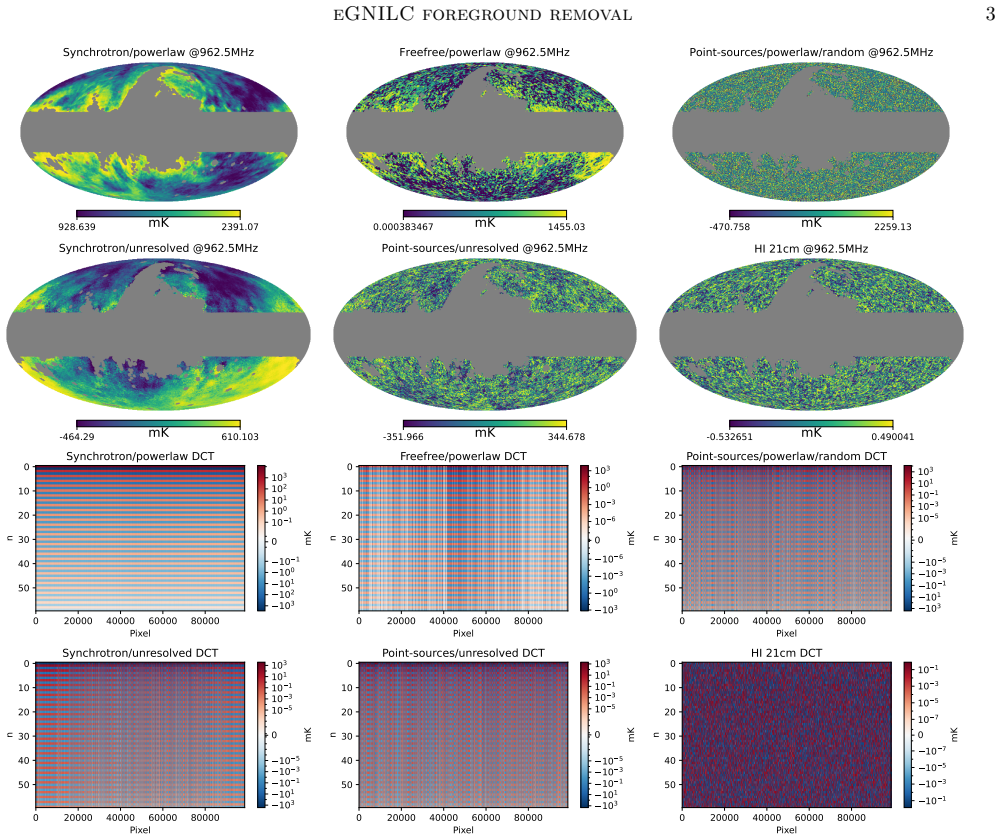
Summary. The paper presents an extension of the GNILC foreground-removal method for 21-cm intensity mapping, called eGNILC. The extensions are (i) a Discrete Cosine Transform along the frequency axis before needlet-space ILC, (ii) a modified AIC criterion for selecting the number of foreground degrees of freedom, derived from an analytic calculation of the ILC bias in Appendix B, and (iii) an RPCA-based blind estimate of the 21-cm covariance that replaces the simulated-signal prior. The method is demonstrated on simulated SKA-MID-like and BINGO-like noiseless skies with a frequency-dependent Airy beam, with reported power losses of roughly 10-20% over the quoted multipole ranges. The paper claims that the DCT step reduces power loss at low multipoles and that the eGNILC bias depends on the averaging-domain size and foreground dof but not on the 21-cm signal itself.
Significance. If validated, the analytic bias result in Appendix B is a useful contribution: it gives a closed-form correction to the ILC bias that depends on m and Np rather than on the assumed signal, and it motivates a modified AIC. The DCT improvement at low multipoles is clearly visible in Fig. 3, and the RPCA-embedded variant is shown to work in the noiseless demonstrations of Fig. 2. The paper also includes a useful stability check against cosmic variance in Fig. 4. However, the headline SKA-MID and BINGO claims rest on a model-selection step whose key input, Np, is only heuristic, and the validation is partially self-referential because the signal prior is generated with the same CORA code used for the simulated input maps. No public code is mentioned, so the derivations are not machine-checked by the reader, but the algebraic steps in Appendix B are internally consistent.
major comments (3)
- [Sec. 3.1.1 and Sec. 3.1.2, Eq. (48)] The modified AIC is the only criterion used to set the foreground degrees of freedom m in the SKA-MID and BINGO runs, so every recovered spectrum in Figs. 6-7 and Table 2 inherits this m via Eqs. (32)-(35). However, Eq. (48) depends on Np, the effective number of independent pixels, which is introduced only through the qualitative "effective theta_FWHM" prescription in Sec. 3.1.1. No formula or algorithm for Np is given, no sensitivity test to Np is reported, and the modified AIC is never compared with the original AIC of Eqs. (36)-(37) on the same simulations. A mis-estimated Np shifts m and changes all of the quoted power-loss numbers, and the paper's own caveat that the modified AIC should not be combined with RPCA (Sec. 3.2, Sec. 6) means the headline results rely on this AIC step. Please add an explicit Np prescription, an m-selection audit, and a comparison of Eq. (48) with the original AIC.
- [Table 2 and Abstract] The abstract states that SKA-MID exhibits ≲20% power loss, but Table 2 lists 21.3% for the 1069.7 MHz auto-spectrum with B=2.5 and the "Extrapol+Unresol" foregrounds over 20<ell<250. This is an internal contradiction in the central quantitative claim. In addition, Table 2's header gives the BINGO multipole range as 30<ell<300, while the abstract and Sec. 6 state [20,300]; these numbers must be reconciled, and the abstract should report either the cell-wise values or the maximum rather than a bound that excludes one of the listed cells.
- [Sec. 3.1.1, Secs. 5.1-5.2] The validation of the headline SKA-MID and BINGO results is partially self-referential. The mixing matrix is built from the simulated 21-cm covariance prior generated with the same CORA code that produced the input maps (Sec. 2.1), the tests omit instrumental noise, and no independent signal simulator is used. Because the RPCA variant is explicitly not used with the modified AIC in these runs, the claimed applicability to real data rests on a prior that is derived from the same simulation machinery as the input. Please quantify the sensitivity of the recovered spectra to the assumed Hi power-spectrum amplitude and shape, or test with an independent signal generator, before drawing conclusions about real BINGO and SKA-MID data.
minor comments (4)
- [Sec. 5 vs Sec. 6] The text in Sec. 5 says the beam is not deconvolved, but Sec. 6 states that the Airy-disk beam was applied and then "deconvolved after foreground removal"; this contradiction should be resolved because it changes the interpretation of the high-ell residuals.
- [Eq. (1)] The DCT definition sums over n=1 to N-1, which appears to omit the n=0 term, and the scaling factor f combines constants in an unconventional way; please check this against the standard type-II DCT convention used by the scipy implementation named in the text.
- [Sec. 3.3] The phrase "imaginary mixing matrix" is confusing, since the matrix S is real; a term such as "effective mixing matrix" or "frequency-basis mixing matrix" would be clearer.
- [Table 2] The BINGO rows for the 1257.5 x 1252.5 MHz cross-spectrum are empty even though Fig. 7 shows this cross-power spectrum; please either report the values or state explicitly why they are omitted.
Circularity Check
No significant circularity: the eGNILC bias and modified AIC are derived analytically, and the recovery tests, while using a simulated 21-cm prior from the same CORA code as the input maps, are not forced by construction.
full rationale
The paper's derivation chain is self-contained. The mixing matrix in Eq. (35) is obtained from the eigen-decomposition of the whitened data covariance, and the modified AIC in Eq. (48) follows from the analytic bias calculation in Appendix B (Csδ = -(m/Np)Rs; Eq. B15), with no parameter fitted to the output power spectra. The recovery claims are validated against simulated SKA-MID and BINGO maps where the 21-cm prior is generated with the same CORA code that produced the input signal; this makes the test partially in-sample, but the paper states this dependence explicitly (Sec. 3.3: 'With the help of simulated 21-cm signals, this goal is achievable...'), and the recovered spectrum is not equal to the input by construction because the foreground dof m, needlet windows, masks, and beams all affect the result. The self-citations (e.g., Yohana et al. 2021 for 1/f noise) are not load-bearing for the central derivation. The paper's own caveat that the modified AIC should not be combined with RPCA (Sec. 6) is a scope limitation, not a circular step. The heuristic Np in Sec. 3.1.1 is a validation and robustness gap, not a circularity.
Assumptions & free parameters
free parameters (5)
- Needlet spectral window parameter B =
B = 1.7 and B = 2.5
- Effective number of independent pixels Np =
not specified
- Foreground degrees of freedom m (per needlet scale) =
selected by AIC (Eq. 48)
- Channel grouping factor n for SKA-MID =
n = 10
- RPCA regularization weight =
not stated
assumptions (7)
- domain assumption The 21-cm signal and foregrounds can be treated as zero-mean Gaussian random fields in the needlet domain.
- domain assumption Foregrounds are spectrally smooth, so their covariance is low-rank with m much less than nch and eigenvalues lambda_i much greater than 1 in the DCT basis.
- domain assumption The reconstruction error covariance Rdelta is negligible compared with Rs (small GNILC error).
- domain assumption The domain-averaged covariance estimate uses Np independent pixels and E(sq fq^T) = 0.
- domain assumption The noise-free, Airy-disk-without-deconvolution simulation is representative of the foreground-removal-only scenario.
- standard math The needlet window family satisfies the exact reconstruction condition sum_j [b_ell^{(j)}]^2 = 1.
- standard math The type-II DCT with the scaling in Eqs. (1)-(2) is an orthonormal transform preserving the ILC inversion.
Cite this review
Pith. "Pith review of Expanded Generalized Needlet Internal Linear Combination (eGNILC) Framework for the 21-cm Foreground Removal." pith.science (2026). https://pith.science/paper/G2BTKNHH
@misc{pith2026241116899,
  author       = {Pith},
  title        = {Pith review of: Expanded Generalized Needlet Internal Linear Combination (eGNILC) Framework for the 21-cm Foreground Removal},
  year         = {2026},
  howpublished = {\url{https://pith.science/paper/G2BTKNHH}},
  note         = {Machine review of arXiv:2411.16899}
}
abstract
The Generalized Needlet Internal Linear Combination (GNILC) method is a non-parametric component separation algorithm to remove the foreground contamination of the 21-cm intensity mapping data. In this work, we perform the Discrete Cosine Transform (DCT) along the frequency axis in the expanded GNILC framework (denoted eGNILC) which helps reduce the power loss in low multipoles, and further demonstrate its performance. We also calculate the eGNILC bias to modify the criterion for determining the degrees of freedom of the foreground (dof), and embed the Robust Principal Component Analysis (RPCA) in mixing matrix computation to obtain a blind component separation method. We find that the eGNILC bias is related to the averaged domain size and the dof of the foreground but not the underlying 21-cm signal. In case of no beam effect, the eGNILC bias is negligible for simple power law foregrounds outside the Galactic plane. We also examine the eGNILC performance in the SKA-MID (SKA Phase-I in mid-frequency) and BINGO (Baryon Acoustic Oscillations from Integrated Neutral Gas Observations) simulations. We show that if the adjacent frequency channels are not highly correlated, eGNILC can recover the underlying 21-cm signal with good accuracy. With the varying Airy-disk beam applied to both SKA-MID and BINGO, the power spectra of 21-cm can be effectively recovered at the multipoles $\ell \in [20, 250]$ and $[20, 300]$ respectively. With no instrumental noise, the SKA-MID exhibits $\lesssim 20\%$ power loss and BINGO exhibits $\sim 10\%$ power loss. The varying Airy-disk beam only causes significant errors at large multipoles.
Figures


Figures from the paper (6 more)


Reference graph
Works this paper leans on
-
[1]
Abdalla, E., Ferreira, E. G. M., Landim, R. G., et al. 2022, A&A, 664, A14, doi: 10.1051/0004-6361/202140883
-
[2]
Abdurashidova, Z., Aguirre, J. E., Alexander, P., et al. 2022a, ApJ, 925, 221, doi: 10.3847/1538-4357/ac1c78 —. 2022b, ApJ, 924, 51, doi: 10.3847/1538-4357/ac2ffc
-
[3]
Abramowitz, M., & Stegun, I. A. 1972, Handbook of Mathematical Functions (United States Department of
work page 1972
-
[4]
Adam, R., et al. 2016, Astron. Astrophys., 594, A10, doi: 10.1051/0004-6361/201525967
-
[5]
Ade, P. A. R., et al. 2016, Astron. Astrophys., 594, A4, doi: 10.1051/0004-6361/201525809
-
[6]
Alonso, D., Bull, P., Ferreira, P. G., & Santos, M. G. 2015, Mon. Not. Roy. Astron. Soc., 447, 400, doi: 10.1093/mnras/stu2474
-
[7]
Anderson, C. J., Luciw, N. J., Li, Y. C., et al. 2018, MNRAS, 476, 3382, doi: 10.1093/mnras/sty346
-
[8]
Asad, K. M. B., Girard, J. N., de Villiers, M., et al. 2021, MNRAS, 502, 2970, doi: 10.1093/mnras/stab104
Show all 69 references
- [9]
-
[10]
A., Browne, I
Battye, R. A., Browne, I. W. A., Dickinson, C., et al. 2013, Mon. Not. Roy. Astron. Soc., 434, 1239, doi: 10.1093/mnras/stt1082
2013 doi
- [12]
-
[13]
A., Dickinson, C., Battye, R
Bigot-Sazy, M. A., Dickinson, C., Battye, R. A., et al. 2015, MNRAS, 454, 3240, doi: 10.1093/mnras/stv2153
2015 doi
- [14]
-
[15]
G., Patel, P., & Santos, M
Bull, P., Ferreira, P. G., Patel, P., & Santos, M. G. 2015, Astrophys. J., 803, 21, doi: 10.1088/0004-637X/803/1/21
2015 doi
-
[16]
2003, Astron
Burigana, C., & Saez, D. 2003, Astron. Astrophys., 409, 423, doi: 10.1051/0004-6361:20031038
2003 doi
-
[17]
Chang, T.-C., Pen, U.-L., Bandura, K., & Peterson, J. B. 2010, Nature, 466, 463, doi: 10.1038/nature09187
2010 doi
-
[18]
J., & Ransom, S
Condon, J. J., & Ransom, S. M. 2016, Essential Radio Astronomy (Princeton University Press)
2016
-
[19]
2022, Mon
Cunnington, S., et al. 2022, Mon. Not. Roy. Astron. Soc., 518, 6262, doi: 10.1093/mnras/stac3060 de Oliveira-Costa, A., Tegmark, M., Gaensler, B. M., et al. 2008, Mon. Not. Roy. Astron. Soc., 388, 247, doi: 10.1111/j.1365-2966.2008.13376.x eGNILC foreground removal 23
2022
-
[20]
R., Parsons, A
DeBoer, D. R., Parsons, A. R., Aguirre, J. E., et al. 2017, PASP, 129, 045001, doi: 10.1088/1538-3873/129/974/045001
2017 doi
-
[21]
F., Jeune, M
Delabrouille, J., Cardoso, J. F., Jeune, M. L., et al. 2009, Astron. Astrophys., 493, 835, doi: 10.1051/0004-6361:200810514 Di Matteo, T., Perna, R., Abel, T., & Rees, M. J. 2002, Astrophys. J., 564, 576, doi: 10.1086/324293
2009 doi
- [22]
-
[23]
2020, Modern Cosmology (Elsevier Science), doi: 10.1016/C2017-0-01943-2
Dodelson, S., & Schmidt, F. 2020, Modern Cosmology (Elsevier Science), doi: 10.1016/C2017-0-01943-2
2020 doi
-
[24]
Draine, B. T. 2011, Physics of the Interstellar and Intergalactic Medium (Princeton University Press)
2011
-
[25]
2004, MNRAS, 348, 885, doi: 10.1111/j.1365-2966.2004.07409.x
Efstathiou, G. 2004, MNRAS, 348, 885, doi: 10.1111/j.1365-2966.2004.07409.x
2004
-
[26]
K., Mertens, F
Gehlot, B. K., Mertens, F. G., Koopmans, L. V. E., et al. 2019, MNRAS, 488, 4271, doi: 10.1093/mnras/stz1937
2019 doi
-
[27]
G., Ma, Y.-Z., Kittiwisit, P., et al
Gogo, T. G., Ma, Y.-Z., Kittiwisit, P., et al. 2022, MNRAS, 510, 1680, doi: 10.1093/mnras/stab3516 G´ orski, K. M., Hivon, E., Banday, A. J., et al. 2005, ApJ, 622, 759, doi: 10.1086/427976
2022 doi
- [28]
-
[29]
2013, Phys
Hall, A., Bonvin, C., & Challinor, A. 2013, Phys. Rev. D, 87, 064026, doi: 10.1103/PhysRevD.87.064026
2013 doi
-
[30]
2009, PhRvD, 80, 063004, doi: 10.1103/PhysRevD.80.063004
Hanson, D., & Lewis, A. 2009, PhRvD, 80, 063004, doi: 10.1103/PhysRevD.80.063004
2009 doi
-
[31]
2018, Mon
Harper, S., Dickinson, C., Battye, R., et al. 2018, Mon. Not. Roy. Astron. Soc., 478, 2416, doi: 10.1093/mnras/sty1238
2018 doi
-
[32]
Haslam, C. G. T., Salter, C. J., Stoffel, H., & Wilson, W. E. 1982, A&AS, 47, 1 HERA Collaboration, Abdurashidova, Z., Adams, T., et al. 2023, ApJ, 945, 124, doi: 10.3847/1538-4357/acaf50
1982 doi
-
[33]
2002, Astrophys
Hivon, E., Gorski, K., Netterfield, C., et al. 2002, Astrophys. J., 567, 2, doi: 10.1086/338126
2002 doi
-
[34]
2012, ApJ, 753, 110, doi: 10.1088/0004-637X/753/2/110
Kogut, A. 2012, ApJ, 753, 110, doi: 10.1088/0004-637X/753/2/110
2012 doi
-
[35]
2017, PhRvD, 96, 063525, doi: 10.1103/PhysRevD.96.063525
Li, Y.-C., & Ma, Y.-Z. 2017, PhRvD, 96, 063525, doi: 10.1103/PhysRevD.96.063525
2017 doi
-
[36]
Madau, P., Meiksin, A., & Rees, M. J. 1997, Astrophys. J., 475, 429, doi: 10.1086/303549
1997 doi
-
[37]
2002, Mon
Maino, D., Farusi, A., Baccigalupi, C., et al. 2002, Mon. Not. Roy. Astron. Soc., 334, 53, doi: 10.1046/j.1365-8711.2002.05425.x
2002
-
[38]
2008, Mon
Marinucci, D., Pietrobon, D., Balbi, A., et al. 2008, Mon. Not. Roy. Astron. Soc., 383, 539, doi: 10.1111/j.1365-2966.2007.12550.x
2008
-
[40]
W., et al
Masui, K. W., et al. 2013, Astrophys. J. Lett., 763, L20, doi: 10.1088/2041-8205/763/1/L20
2013 doi
-
[41]
G., Mevius, M., Koopmans, L
Mertens, F. G., Mevius, M., Koopmans, L. V. E., et al. 2020, MNRAS, 493, 1662, doi: 10.1093/mnras/staa327
2020 doi
-
[42]
A., Ysard, N., Lavabre, A., et al
Miville-Deschenes, M. A., Ysard, N., Lavabre, A., et al. 2008, Astron. Astrophys., 490, 1093, doi: 10.1051/0004-6361:200809484
2008 doi
-
[43]
2011, International Journal of Modern Physics D, 20, 989, doi: 10.1142/S0218271811019335
Nan, R., Li, D., Jin, C., et al. 2011, International Journal of Modern Physics D, 20, 989, doi: 10.1142/S0218271811019335
2011 doi
-
[44]
C., Remazeilles, M., & Dickinson, C
Olivari, L. C., Remazeilles, M., & Dickinson, C. 2016, Mon. Not. Roy. Astron. Soc., 456, 2749, doi: 10.1093/mnras/stv2884
2016 doi
-
[45]
2020, Mon
Osato, K., Shirasaki, M., Miyatake, H., et al. 2020, Mon. Not. Roy. Astron. Soc., 492, 4780, doi: 10.1093/mnras/staa117
2020 doi
-
[46]
R., Backer, D
Parsons, A. R., Backer, D. C., Foster, G. S., et al. 2010, AJ, 139, 1468, doi: 10.1088/0004-6256/139/4/1468
2010 doi
-
[47]
2009, Mon
Pen, U.-L., Staveley-Smith, L., Peterson, J., & Chang, T.-C. 2009, Mon. Not. Roy. Astron. Soc., 394, 6, doi: 10.1111/j.1745-3933.2008.00581.x
2009
-
[48]
Pietrobon, D., Balbi, A., Cabella, P., & Gorski, K. M. 2010, Astrophys. J., 723, 1, doi: 10.1088/0004-637X/723/1/1
2010 doi
-
[49]
1998, Astrophys
Platania, P., Bensadoun, M., Bersanelli, M., et al. 1998, Astrophys. J., 505, 473, doi: 10.1086/306175
1998 doi
-
[50]
2011, Mon
Remazeilles, M., Delabrouille, J., & Cardoso, J.-F. 2011, Mon. Not. Roy. Astron. Soc., 418, 467, doi: 10.1111/j.1365-2966.2011.19497.x
2011
-
[51]
J., Bigot-Sazy, M
Remazeilles, M., Dickinson, C., Banday, A. J., Bigot-Sazy, M. A., & Ghosh, T. 2015, Mon. Not. Roy. Astron. Soc., 451, 4311, doi: 10.1093/mnras/stv1274
2015 doi
-
[52]
G., Cooray, A., & Knox, L
Santos, M. G., Cooray, A., & Knox, L. 2005, Astrophys. J., 625, 575, doi: 10.1086/429857
2005 doi
- [53]
-
[54]
R., & Lewis, A
Shaw, J. R., & Lewis, A. 2008, PhRvD, 78, 103512, doi: 10.1103/PhysRevD.78.103512
2008 doi
- [55]
-
[56]
2015, PhRvD, 91, 083514, doi: 10.1103/PhysRevD.91.083514 Square Kilometre Array Cosmology Science Working
Pen, U.-L. 2015, PhRvD, 91, 083514, doi: 10.1103/PhysRevD.91.083514 Square Kilometre Array Cosmology Science Working
2015 doi
-
[57]
J., Battye, R
Group, Bacon, D. J., Battye, R. A., et al. 2020, Publ. Astron. Soc. Austral., 37, e007, doi: 10.1017/pasa.2019.51
2020 doi
-
[58]
1996, MNRAS, 281, 1297, doi: 10.1093/mnras/281.4.1297 24 Dai & Ma
Tegmark, M., & Efstathiou, G. 1996, MNRAS, 281, 1297, doi: 10.1093/mnras/281.4.1297 24 Dai & Ma
1996 doi
-
[59]
2017, Mon
Thorne, B., Dunkley, J., Alonso, D., & Naess, S. 2017, Mon. Not. Roy. Astron. Soc., 469, 2821, doi: 10.1093/mnras/stx949
2017 doi
-
[60]
2020, MNRAS, 498, 5916, doi: 10.1093/mnras/staa2727
Tramonte, D., & Ma, Y.-Z. 2020, MNRAS, 498, 5916, doi: 10.1093/mnras/staa2727
2020 doi
-
[61]
2019, MNRAS, 489, 385, doi: 10.1093/mnras/stz2146
Tramonte, D., Ma, Y.-Z., Li, Y.-C., & Staveley-Smith, L. 2019, MNRAS, 489, 385, doi: 10.1093/mnras/stz2146
2019 doi
-
[62]
M., Jordan, C
Trott, C. M., Jordan, C. H., Midgley, S., et al. 2020, MNRAS, 493, 4711, doi: 10.1093/mnras/staa414
2020 doi
-
[63]
2021, Mon
Wang, J., et al. 2021, Mon. Not. Roy. Astron. Soc., 505, 3698, doi: 10.1093/mnras/stab1365
2021 doi
-
[64]
B., Blake, C., et al
Wolz, L., Abdalla, F. B., Blake, C., et al. 2014, Mon. Not. Roy. Astron. Soc., 441, 3271, doi: 10.1093/mnras/stu792
2014 doi
-
[65]
Wuensche, C. 2019, J. Phys. Conf. Ser., 1269, 012002, doi: 10.1088/1742-6596/1269/1/012002
2019 doi
-
[66]
A., Villela, T., Abdalla, E., et al
Wuensche, C. A., Villela, T., Abdalla, E., et al. 2022, A&A, 664, A15, doi: 10.1051/0004-6361/202039962
2022 doi
-
[67]
2018, PhRvD, 97, 083504, doi: 10.1103/PhysRevD.97.083504
Xu, X., Ma, Y.-Z., & Weltman, A. 2018, PhRvD, 97, 083504, doi: 10.1103/PhysRevD.97.083504
2018 doi
-
[68]
2019, Research in Astronomy and Astrophysics, 19, 186, doi: 10.1088/1674-4527/19/12/186
Yohana, E., Li, Y.-C., & Ma, Y.-Z. 2019, Research in Astronomy and Astrophysics, 19, 186, doi: 10.1088/1674-4527/19/12/186
2019 doi
-
[69]
2021, Mon
Yohana, E., Ma, Y.-Z., Li, D., Chen, X., & Dai, W.-M. 2021, Mon. Not. Roy. Astron. Soc., 504, 5231, doi: 10.1093/mnras/stab1197
2021 doi
-
[70]
2019, Journal of Open Source Software, 4, 1298, doi: 10.21105/joss.01298
Zonca, A., Singer, L., Lenz, D., et al. 2019, Journal of Open Source Software, 4, 1298, doi: 10.21105/joss.01298
2019 doi
-
[71]
2018, Astron
Zuo, S., Chen, X., Ansari, R., & Lu, Y. 2018, Astron. J., 157, 4, doi: 10.3847/1538-3881/aaef3b
2018 doi
Reviewed August 12, 2026 · model on record in the stance chip above.
Discussion (0). Continue with ORCID to comment.