REVIEW 3 major objections 4 minor 19 references
Context-Aware Input Orchestration for Video Inpainting
T0 review · 3 major / 4 minor · reviewed 2026-08-12 · deepseek-v4-flash
Pith's one-line read This paper argues that the best mix of neighboring and reference frames for video inpainting depends on optical flow and mask motion, and that a context-aware input configurator improves quality under a fixed 8-frame memory budget.
desk verdict A useful correlation study and a plausible heuristic, but the central quantitative claim is not yet convincing because the input-configuration rule is fit and evaluated on the same videos. read the letter →
The pith
A machine-rendered reading of the paper's core claim, the machinery that carries it, and where it could break.
The reading
What carries the argument
The central machinery is AdaptIn, a preprocessing pipeline with three parts: a mask-change analyzer that sums pixel-wise differences between consecutive masks, an optical-flow analyzer that completes flow in masked regions using the same recurrent module as ProPainter, and an input configurator that combines the two into x_comb using the fitted regression slopes m_flow = -0.1644 and m_mask = -0.1285 as weights. The configurator maps x_comb to one of seven bins, each prescribing a fixed ratio of reference to neighboring frames in the 8-frame input set. The key identity is the linear relation between x_comb and the maximum PSNR change rate, whose slope and bins are fitted on DAVIS and MOSE data.
What would settle it
On a held-out set of videos with fast motion, run AdaptIn and the balanced 5:5 baseline under the same 8-frame budget; if AdaptIn's chosen configuration does not beat the baseline in PSNR or VFID for clips whose x_comb falls into the three neighboring-dominant bins, the fitted mapping is not generalizing.
Extended reading notes
Core claim
The paper discovers that the influence of an input frame on inpainting quality is not uniform; it depends on visual dynamics in the masked region. Using a signed maximum change rate in PSNR, it shows that as normalized optical flow and mask change increase, the optimal input shifts toward neighboring frames, with a linear fit slope of -0.1644 for optical flow and -0.1285 for mask change. Combining these two signals into a weighted factor x_comb yields a steeper linear trend (slope -0.2864, RSS 0.4586), which AdaptIn partitions into seven ranges, each mapped to a reference-frame ratio from 0.125 to 0.875. The paper claims this context-aware composition improves inpainting quality over the balanced 5:5 baseline under the same 8-frame memory limit, and that the flow-guided inpainter ProPainter benefits more than the transformer STTN.
Load-bearing premise
The seven bin boundaries and the two regression slopes that drive frame selection are fitted on the same DAVIS and MOSE videos used to report quality gains, and the paper assumes they keep working on unseen videos and with other flow completion modules.
Editorial extensions
If this is right
- Under a fixed memory budget, inpainting quality can be improved by changing which frames enter the model, rather than by adding more frames.
- Flow-guided inpainting models, which already compute completed flow, can reuse that flow for input selection at almost no extra cost.
- Object removal benefits from context-aware composition: static backgrounds borrow features from reference frames, dynamic regions borrow from neighbors.
- The benefit concentrates in fast-motion data; datasets like DAVIS with more dynamic clips show larger overall gains than MOSE.
- When memory is cut to the smallest budgets, the adaptive composition's quality gap over the balanced baseline narrows, because flow-guided propagation already supplies much of the benefit.
Reading between the lines
- The same input-orchestration idea could transfer to other video restoration tasks such as super-resolution, deblurring, or frame interpolation, where a similar reference-versus-neighbor tradeoff exists, but the paper does not test those settings.
- The hand-fitted regression slopes and seven bin boundaries could be replaced by a learned mapping from flow and mask statistics to input composition, which might generalize better than the paper's heuristic rule.
- The paper's object-removal claim rests on qualitative comparisons; a dedicated temporal-consistency metric for removed regions would be needed to verify the claimed coherence gain numerically.
Editorial analysis
A structured set of objections, weighed in public.
Referee Report
Summary. The paper proposes AdaptIn, a preprocessing pipeline that dynamically configures the input composition for video inpainting models by adjusting the ratio of reference frames to neighboring frames in an 8-frame window. The configuration is driven by visual dynamics measured through completed optical flow in the masked region and temporal mask variation. The authors first present observational evidence (§3) that inpainting quality varies with this ratio and that the direction of the preferred ratio correlates with flow and mask changes (Figures 4, 5, 7). They then describe the AdaptIn pipeline (§4), which fits linear slopes to these correlations, computes a combined variable xcomb, partitions its range into seven bins, and assigns each bin a reference-frame ratio between 0.125 and 0.875. Experiments on DAVIS 2017 and MOSE (§5) with ProPainter and STTN are reported as improvements in PSNR, SSIM, and VFID relative to a balanced (5:5) baseline, together with qualitative examples and a memory-quality trade-off analysis.
Significance. If validated, the paper's core observation—that the optimal input frame composition depends on local visual dynamics—could be practically relevant for memory-constrained video inpainting on mobile or AR devices. The manuscript makes a useful conceptual point and offers a simple, potentially efficient heuristic. However, the currently reported evidence is not strong enough to establish the claimed improvements as general: the effect sizes are small, the fitted configuration is evaluated on the same data that produced it, and the out-of-sample dataset shows a negative overall PSNR change for the primary model. The paper does include machine-checked experiments in the sense of reproducible tables and figures, but it lacks a held-out validation protocol. The honest limitations section is a positive feature, but it also confirms that the central heuristic is unvalidated.
major comments (3)
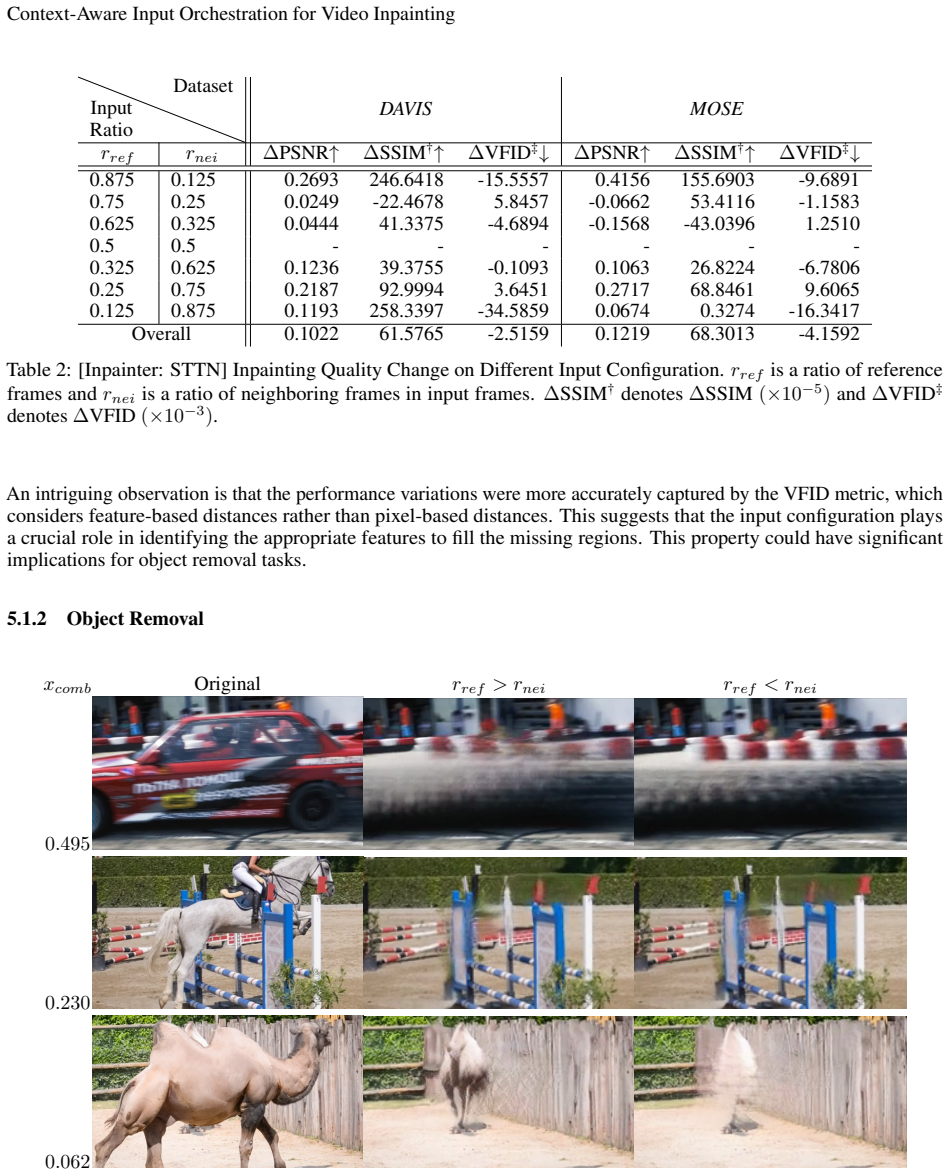
- [§4.2, §5, Figure 7, Table 1] The evaluation of AdaptIn is in-sample for the DAVIS results. The linear slopes (m_flow = -0.1644, m_mask = -0.1285) in Figure 4, the combined slope in Figure 7, and the seven bin boundaries with the assigned reference-frame ratios are all derived from the same DAVIS 2017 samples on which Table 1 and Table 2 later report improvements. Because the bin-to-ratio mapping is selected to match this data, the positive mean PSNR changes for DAVIS do not demonstrate generalization. The only out-of-sample set, MOSE, actually shows a negative overall PSNR change for the ProPainter baseline in Table 1 (-0.0591). The paper needs a held-out split, cross-validation, or a genuine train/evaluation separation before the central claim that AdaptIn improves quality can be supported.
- [§3.2, Figures 4 and 7] The linear trends that motivate the entire configuration are weak and exhibit high residual variance. RSS values of 0.5062 (flow), 0.6033 (mask), and 0.4586 (combined) indicate that most of the variance in the maximum change rate remains unexplained, and the slopes are small relative to the scatter. Given this noise, the specific seven-bin partition and the assigned reference-frame ratios in Figure 7 are underdetermined. A random or arbitrary assignment of ratios to bins under the same selection procedure could plausibly produce similar mean PSNR differences, especially when the per-bin differences in Tables 1 and 2 are on the order of 0.1 dB or less. The authors should provide confidence intervals, significance tests, or a permutation-based baseline to show that their bin assignment is not an artifact of the fitting procedure.
- [§5, Tables 1 and 2] The reported improvements are numerically very small, and the manuscript does not establish that they are statistically meaningful. The overall PSNR gains are about 0.1 dB on DAVIS, the SSIM differences are reported in units of 10^-5, and the VFID differences are in units of 10^-3. These magnitudes are close to typical metric noise, and no error bars, per-sequence variances, or significance tests are provided. The qualitative statement that 'performance variations were more accurately captured by the VFID metric' (§5.1.1) is not supported by any quantitative comparison across metrics. The authors should report variability over the 45 and 171 videos and test whether the 'Overall' row differs significantly from zero.
minor comments (4)
- [§3.2, Eq. (1)] The Signed Maximum Change Rate in Eq. (1) is not clearly defined in terms of the sampling of r. The set P is given as r in [0.125, 0.25, ..., 0.875], but the text later refers to intervals of 0 or more and below 0; please clarify whether the max/min in Eq. (1) are taken over the discrete set P, and define how the sign is computed when the maximum and minimum occur at multiple r.
- [§4.1, §4.2] The notation is inconsistent between x_comb in the text and xcomp in Figure 7; also, x_f low and x_mask are defined only verbally. Please introduce explicit normalized feature definitions with the same scales as in Figure 4.
- [§5.1.1, Tables 1 and 2] The table caption states that r_ref and r_nei are ratios, and the baseline is r_ref=0.5, r_nei=0.5. However, the rows list r_nei values such as 0.125, 0.25, 0.325, etc. It would be clearer to state that the tables report differences relative to the baseline, and to include the baseline row explicitly with zero entries rather than '-'. Also, the value 0.325 for 'rnei' should be 0.375 to be consistent with the set in §3.2; this appears to be a typo in both tables.
- [§5.2, Figure 9] The memory-quality tradeoff is claimed to vary the number of input frames from 11 to 5, but Figure 9's x-axis shows memory usage from 4 to 8 GB without a clear mapping to the number of frames. Please specify the frame-count-to-memory relationship and indicate where the 8-frame constraint of the main experiments lies on this axis.
Circularity Check
DAVIS evaluation of AdaptIn is in-sample: its slopes and bin ratios are fit to the same DAVIS PSNR curves used in Tables 1-2, so the reported gain partly reduces to the fit.
-
fitted input called prediction
[Section 4.2 (Input Configurator); Section 6 (Heuristic configuration); Section 5 Tables 1-2]
"To combine the analysis of optical flow and mask variations, we utilized the slope of Figure 4. The integration of optical flow (xf low) and mask variation (xmask) into a new variable xcomb is achieved by defining it as weighted arithmetic mean xcomb = mf lowxf low+mmaskxmask / mf low+mmask, where the slopes mf lowand mmask are extracted from the lines of linear regression in Figure 4a and 4b, respectively. ... Drawing insights from the linear trend depicted in Figure 7, we partitioned the range into seven segments. ..."
The decision rule of AdaptIn is estimated from DAVIS data: the regression slopes m_flow and m_mask come from Figure 4, which plots the signed maximum PSNR change rate measured on DAVIS 2017 samples, and the seven reference-frame-ratio bins in Figure 7 are manually chosen to follow the combined trend computed from the same samples. Section 5 then evaluates the resulting configuration on DAVIS (plus MOSE). Because the bin assignments were selected to match the already-observed direction of PSNR variation (lower reference ratios where the trend is negative, higher where it is non-negative), the DAVIS ΔPSNR values in Tables 1-2 are an in-sample fit rather than an out-of-sample prediction.
full rationale
The central AdaptIn rule is not circular in a definitional or self-citation sense: the paper does not rename a known result and no load-bearing self-citation appears in the reference list. The circularity is of the 'fitted input called prediction' type. Section 3 measures, on DAVIS 2017, how inpainting PSNR varies with the reference-frame ratio and regresses the signed maximum change rate on optical flow and mask change. Section 4.2 uses those regression slopes as weights and partitions the combined variable into seven bins with reference ratios drawn from the same trend. Section 5 then reports DAVIS ΔPSNR/ΔSSIM/ΔVFID for this exact configuration. Since the configuration was selected to match the effect already measured on DAVIS, Tables 1-2's DAVIS columns are an in-sample evaluation, and the positive DAVIS ΔPSNR is in part the fit itself. The paper explicitly labels the configuration heuristic and concedes the shaded ranges may change on another dataset, yet no held-out split or cross-validation is described. MOSE is the only out-of-sample dataset, but ProPainter's overall ΔPSNR on MOSE is -0.0591 and ΔVFID worsens, so MOSE does not independently confirm the central claim. The correlation analysis itself has independent empirical content, and no self-citation, uniqueness-theorem, or ansatz-smuggling circularity is present; the score of 6 reflects one partially load-bearing in-sample fit rather than a full derivation collapse.
Assumptions & free parameters
free parameters (5)
- m_flow (slope for optical flow) =
-0.1644
- m_mask (slope for mask variation) =
-0.1285
- xcomb bin boundaries and reference-frame ratios =
0.125, 0.25, 0.375, 0.5, 0.625, 0.75, 0.875
- normalization scales for optical flow and mask variation =
unspecified
- reference frame interval =
10 frames
assumptions (3)
- domain assumption PSNR is a valid proxy for inpainting quality
- domain assumption Optical flow and mask variation capture the visual dynamics relevant to inpainting
- standard math Linear least-squares fit is appropriate for the PSNR change vs. flow relationship
Cite this review
Pith. "Pith review of Context-Aware Input Orchestration for Video Inpainting." pith.science (2026). https://pith.science/paper/KK2DWMUE
@misc{pith2026241116926,
  author       = {Pith},
  title        = {Pith review of: Context-Aware Input Orchestration for Video Inpainting},
  year         = {2026},
  howpublished = {\url{https://pith.science/paper/KK2DWMUE}},
  note         = {Machine review of arXiv:2411.16926}
}
read the original abstract
Traditional neural network-driven inpainting methods struggle to deliver high-quality results within the constraints of mobile device processing power and memory. Our research introduces an innovative approach to optimize memory usage by altering the composition of input data. Typically, video inpainting relies on a predetermined set of input frames, such as neighboring and reference frames, often limited to five-frame sets. Our focus is to examine how varying the proportion of these input frames impacts the quality of the inpainted video. By dynamically adjusting the input frame composition based on optical flow and changes of the mask, we have observed an improvement in various contents including rapid visual context changes.
Figures


Figures from the paper (8 more)




Reference graph
Works this paper leans on
-
[1]
Dahun Kim, Sanghyun Woo, Joon-Young Lee, and In So Kweon. Deep video inpainting. In Proceedings of the IEEE Conference on Computer Vision and Pattern Recognition (CVPR) , pages 5792–5801, 2019. 10 Context-Aware Input Orchestration for Video Inpainting t t InpaintedVideoX-T Slice window size Figure 11: Temporal inconsistency with small windows. X-T slice s...
work page 2019
-
[2]
Flow-edge guided video completion
Chen Gao, Ayush Saraf, Jia-Bin Huang, and Johannes Kopf. Flow-edge guided video completion. In Proc. European Conference on Computer Vision (ECCV), 2020
2020
-
[3]
Learning joint spatial-temporal transformations for video inpainting
Yanhong Zeng, Jianlong Fu, and Hongyang Chao. Learning joint spatial-temporal transformations for video inpainting. In The Proceedings of the European Conference on Computer Vision (ECCV) , 2020
work page 2020
-
[4]
Fuseformer: Fusing fine-grained information in transformers for video inpainting
Rui Liu, Hanming Deng, Yangyi Huang, Xiaoyu Shi, Lewei Lu, Wenxiu Sun, Xiaogang Wang, Jifeng Dai, and Hongsheng Li. Fuseformer: Fusing fine-grained information in transformers for video inpainting. In International Conference on Computer Vision (ICCV), 2021
work page 2021
-
[5]
Towards an end-to-end framework for flow-guided video inpainting
Zhen Li, Cheng-Ze Lu, Jianhua Qin, Chun-Le Guo, and Ming-Ming Cheng. Towards an end-to-end framework for flow-guided video inpainting. In IEEE Conference on Computer Vision and Pattern Recognition (CVPR) , 2022
work page 2022
-
[6]
ProPainter: Improving propagation and transformer for video inpainting
Shangchen Zhou, Chongyi Li, Kelvin C.K Chan, and Chen Change Loy. ProPainter: Improving propagation and transformer for video inpainting. In Proceedings of IEEE International Conference on Computer Vision (ICCV) , 2023
work page 2023
-
[7]
The 2017 davis challenge on video object segmentation
Jordi Pont-Tuset, Federico Perazzi, Sergi Caelles, Pablo Arbeláez, Alex Sorkine-Hornung, and Luc Van Gool. The 2017 davis challenge on video object segmentation. arXiv preprint arXiv:1704.00675, 2017
arXiv 2017
-
[8]
Image quality metrics: Psnr vs
Alain Horé and Djemel Ziou. Image quality metrics: Psnr vs. ssim. In 2010 20th International Conference on Pattern Recognition, pages 2366–2369, 2010
work page 2010
Show all 19 references
-
[9]
Least squares methods
Åke Björck. Least squares methods. Handbook of numerical analysis , 1:465–652, 1990
1990
-
[10]
Raft: Recurrent all-pairs field transforms for optical flow
Zachary Teed and Jia Deng. Raft: Recurrent all-pairs field transforms for optical flow. In Andrea Vedaldi, Horst Bischof, Thomas Brox, and Jan-Michael Frahm, editors, Computer Vision – ECCV 2020 , pages 402–419, Cham,
2020
-
[11]
Chan, Shangchen Zhou, Xiangyu Xu, and Chen Change Loy
Kelvin C.K. Chan, Shangchen Zhou, Xiangyu Xu, and Chen Change Loy. Basicvsr++: Improving video super- resolution with enhanced propagation and alignment. In Proceedings of the IEEE/CVF Conference on Computer Vision and Pattern Recognition (CVPR), pages 5972–5981, June 2022
2022
-
[12]
MOSE: A new dataset for video object segmentation in complex scenes
Henghui Ding, Chang Liu, Shuting He, Xudong Jiang, Philip HS Torr, and Song Bai. MOSE: A new dataset for video object segmentation in complex scenes. In ICCV, 2023
2023
-
[13]
Cesar-Jr., Xiangyang Ji, and Xu-Cheng Yin
Henrique Morimitsu, Xiaobin Zhu, Roberto M. Cesar-Jr., Xiangyang Ji, and Xu-Cheng Yin. Rapidflow: Recurrent adaptable pyramids with iterative decoding for efficient optical flow estimation. In IEEE International Conference on Robotics and Automation (ICRA) , 2024
2024
-
[14]
Rethinking raft for efficient optical flow
Navid Eslami, Farnoosh Arefi, Amir M Mansourian, and Shohreh Kasaei. Rethinking raft for efficient optical flow. arXiv preprint arXiv:2401.00833, 2024. 11 Context-Aware Input Orchestration for Video Inpainting
2024 arXiv
-
[15]
On the sliding-window representation in digital signal processing
Martin Bastiaans. On the sliding-window representation in digital signal processing. IEEE transactions on acoustics, speech, and signal processing , 33(4):868–873, 1985
1985
-
[16]
Streamlining digital signal processing
Richard G Lyons. Streamlining digital signal processing. Wiley Online Library, 2012
2012
-
[17]
Lumiere: A space-time diffusion model for video generation, 2024
Omer Bar-Tal, Hila Chefer, Omer Tov, Charles Herrmann, Roni Paiss, Shiran Zada, Ariel Ephrat, Junhwa Hur, Guanghui Liu, Amit Raj, Yuanzhen Li, Michael Rubinstein, Tomer Michaeli, Oliver Wang, Deqing Sun, Tali Dekel, and Inbar Mosseri. Lumiere: A space-time diffusion model for ...
2024
-
[18]
Freelong: Training-free long video generation with spectralblend temporal attention
Yu Lu, Yuanzhi Liang, Linchao Zhu, and Yi Yang. Freelong: Training-free long video generation with spectralblend temporal attention. arXiv preprint arXiv:2407.19918, 2024. 12 Context-Aware Input Orchestration for Video Inpainting Supplementary Materials A More Inpainting Resul...
2024 arXiv
-
[2020]
Springer International Publishing
Reviewed August 12, 2026 · model on record in the stance chip above.
Discussion (0). Continue with ORCID to comment.