REVIEW 5 major objections 6 minor 53 references
The Radiance of Neural Fields: Democratizing Photorealistic and Dynamic Robotic Simulation
T0 review · 5 major / 6 minor · reviewed 2026-08-12 · deepseek-v4-flash
Pith's one-line read Neural radiance fields can replace hand-built 3D models as the core of a robotic simulator, rendering photorealistic environments and animated humans with realistic sensor data for vision-based testing.
desk verdict A genuine integration of NeRF, human animation, and social forces into a ROS2 simulator, but the fidelity evidence is too weak and the novel-view generalization is untested. read the letter →
The pith
A machine-rendered reading of the paper's core claim, the machinery that carries it, and where it could break.
The reading
What carries the argument
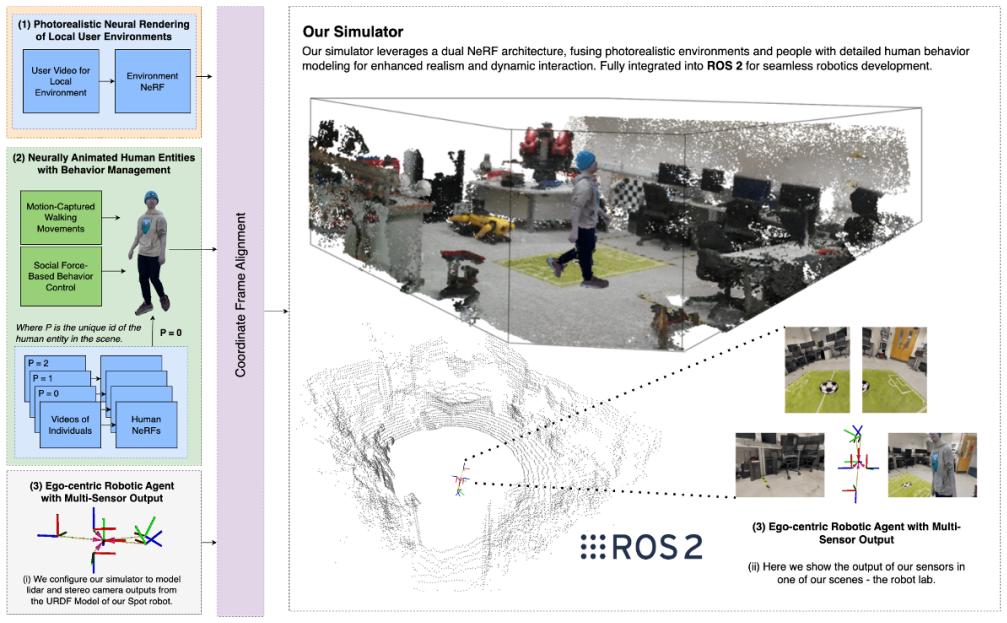
The load-bearing object is the dual-NeRF rendering stack. The background field uses a NeRF with multi-resolution hash encoding and a proposal-based sampler (so training is fast on one GPU), while the human field is a skeleton-conditioned NeRF that can be posed from motion-capture cycles. The mechanism that ties them together is classical volume rendering along rays cast from the robot's cameras and a rotating LiDAR sweep, producing photorealistic RGB, depth, and point clouds from the same implicit representation; a bounding-box visibility pass skips rendering humans outside the robot's field of view to keep the loop efficient.
What would settle it
Train the background NeRF on a robot-driven video tour of one indoor scene, then drive a second robot along a route that was not part of the training footage and capture real sensor data there; if simulated RGB, depth, or LiDAR along that novel route deviates sharply from the real capture, or if a vision pipeline's error in simulation diverges from its error in reality, the platform's claim to general photorealistic simulation is refuted.
Extended reading notes
Core claim
The paper's central claim is that a complete human-robot simulator can be powered entirely by neural rendering. A background NeRF, trained quickly on a single GPU from handheld video with metrically scaled poses, supplies the static scene; a skeleton-conditioned human NeRF trained on motion-capture data supplies photorealistic people; and a social force model controls their trajectories and reactions to the robot. The same implicit scene representation is volume-rendered from the robot's virtual cameras and LiDAR to produce photorealistic RGB, depth, and 360-degree point clouds. The authors report that ORBSLAM3 run on simulated camera images yields median trajectory errors only about 0.1 meters above the same run on real camera footage, and that object detectors achieve higher intersection-over-union in NeRF-rendered scenes than in 3D mesh reconstructions. They state that this is the first complete human-robot simulation system built on neural rendering.
Load-bearing premise
The platform assumes that a NeRF trained from recorded video renders accurate images, depth, and LiDAR for arbitrary new robot paths, so that testing on novel trajectories in simulation faithfully predicts real-robot behavior; the experiments only retrace paths that were recorded in the physical environment, so this generalization is asserted but not yet demonstrated.
Editorial extensions
If this is right
- Researchers can generate photorealistic, human-populated test scenes for vision-based navigation from short videos of ordinary indoor spaces, without CAD assets.
- Simulated camera and LiDAR outputs are close enough to real sensors that orbit a standard vision SLAM system's trajectory error differs by only about 0.1 meters from a real-robot run, suggesting sim-to-real transfer of vision pipelines may need less fine-tuning.
- Object detection networks achieve higher IoU in NeRF-rendered scenes than in 3D mesh reconstructions, indicating that neural rendering preserves the visual statistics detectors rely on more faithfully than meshes.
- Because human actors are neurally rendered and behavior-driven, the same platform can test human-aware navigation tasks such as yielding and crowd avoidance without pre-scripting actor paths.
Reading between the lines
- The evaluation retraces physically recorded trajectories inside the simulator, so the platform's promise for testing arbitrary novel robot paths is asserted rather than demonstrated; a direct test would hold out regions of a scene from training and measure rendering and SLAM degradation as the robot ventures off the captured routes.
- If the dual-NeRF pattern generalizes, the same approach could extend to multi-robot or outdoor scenes, amortizing the cost of a digital twin across any number of posed neural actors and environments.
- The bounding-box visibility culling hints at a scalable rendering strategy: precomputing which neural fields are visible from each vantage point would make per-frame cost proportional to visible content rather than total scene size, which could matter as scenes grow.
Editorial analysis
A structured set of objections, weighed in public.
Referee Report
Summary. This paper presents a ROS2-based robotic simulation platform that combines a background NeRF scene model, a NeuMan-based human NeRF, and a Social Force Model for pedestrian behavior, integrated with a Boston Dynamics Spot agent that provides RGB, depth, and LiDAR outputs. The authors evaluate environment rendering quality, sensor fidelity, ORBSLAM3 localization, and object detection, and they release the simulator code.
Significance. If the central claims hold, the paper would offer an accessible route to photorealistic, dynamic human-robot simulation from commodity video, with two concrete strengths. The project ships public code, and the evaluation uses external benchmarks (ScanNet++), real Spot trajectories, and standard metrics (PSNR/SSIM/LPIPS, ORBSLAM3 trajectory error). However, the evidence for the 'high-fidelity' and 'general-purpose' claims is currently incomplete: sensor validation is performed only on retraced trajectories, the simulated RGB camera quality in Table III is much lower than the scene-level numbers in Table I, and the human and Social Force Model components are not quantitatively evaluated. These gaps are fixable with additional experiments, but they are load-bearing.
major comments (5)
- [Section IV-C.1] The quantitative sensor and SLAM evaluations all retrace trajectories that were recorded in the physical environment and then replayed in simulation. Because these trajectories lie close to the views used to train the background NeRF, the results do not test the simulator's ability to render novel viewpoints for arbitrary robot paths. Please add a held-out evaluation in which the robot follows trajectories not used during NeRF training (e.g., randomly sampled paths or a separate mapping session), and report the same metrics for those views.
- [Table III] The simulated Spot RGB cameras achieve PSNR 9.4-11.8 dB, SSIM 0.28-0.49, and LPIPS 0.42-0.59, while the scene-level renderings in Table I reach PSNR 20.7-23.1 dB. The text states that this 'does not detract from the overall quality,' but these numbers are far below typical photorealistic standards and directly affect the claim of 'high-fidelity, photorealistic' sensor output. Please either improve the camera rendering, report the cause of the gap (e.g., camera model mismatch, resolution, exposure), or temper the claim with quantitative context.
- [Section IV-B] The neurally animated human entities are a central contribution, yet Section IV-B provides no quantitative evaluation: no PSNR/SSIM/LPIPS for rendered humans, no pose accuracy, and no comparison against ground-truth or baseline human rendering. Please add quantitative results on held-out poses and a validation of the Social Force Model behavior (e.g., trajectories compared to real pedestrian data or to standard SFM baselines).
- [Section IV-C.3] The object-detection experiment on ScanNet++ is summarized only by a qualitative figure without reporting mean IoU/AP, standard deviations, the number of views per scene, or the exact protocol for rendering and detection. Without these numbers, the claim that NeRF-based scenes 'consistently achieve higher IoU' is not verifiable. Please add a results table and a precise evaluation protocol.
- [Table II] The depth evaluation reports AbsRel up to 0.67 and δ.05 values around 0.21-0.26 across the Spot cameras. These errors are substantial for a claimed high-fidelity depth sensor; please discuss the acceptable error budget for the intended robotics tasks and compare with sensor noise or with depth outputs from standard simulators.
minor comments (6)
- [Section II-A] The CARLA citation appears as both [11] and [12] for the same work; please unify and check all reference numbering.
- [Equations (3)-(4)] The notation in Equations (3)-(4) is incomplete: the summation index and the transmittance product should be defined explicitly, and the upper limit N and sample spacing δ_i should be stated.
- [Algorithm 1] Algorithm 1 names the transformation T_robot→human but applies it as p_robot = T_robot→human · p_human; the notation is inconsistent and should be fixed.
- [Table II] Table II's column headers δ.05, δ.1, δ.25, δ.252, δ.253 are unclear; if these are δ<1.25, δ<1.25^2, δ<1.25^3, please label them explicitly.
- [Figure 5] Figure 5 lacks axis labels and a legend describing the detectors; please add them for readability.
- [General] Minor typographical issues include 'manipulation n' in Section II-A and inconsistent cross-reference capitalization (e.g., 'SECTION III-D'); please proofread.
Circularity Check
No significant circularity: the simulator is benchmarked against external data and external components; the in-sample trajectory reuse is a generalization caveat, not a definitional reduction.
full rationale
The paper's load-bearing claims are empirical and are evaluated against external data: real Spot RGB/depth/LiDAR captures, ScanNet++ scenes, ORBSLAM3, multiple object detectors, and the AMASS motion-capture corpus. The dual-NeRF simulator is assembled from published external components (NeRFacto [41], NeuMan [22], SoFM [19], HuNavSim [34]), so no central result reduces to an argument from the authors' own prior work. The only author-overlapping citation is [40] (Spencer, Russell, Hadfield, Bowden), used as the depth-error evaluation protocol; it contributes metrics (AbsRel and delta thresholds), not the measured values, and is therefore not load-bearing. The sensor/SLAM evaluation does retrace recorded trajectories: 'Spot was manually controlled to map the environment and then autonomously followed the recorded trajectory. In the simulation, we retraced these trajectories.' This means the background NeRF is evaluated near its training views, which limits support for novel-view generalization, but it is a validation gap rather than a circular reduction: rendered images are produced by volume rendering (Eqs. 2-4) rather than read out from the training captures, and the paper does not rename a fitted parameter as a prediction. RGB, depth, LiDAR, and object-detection numbers are reported against external models and datasets, leaving the central simulator claim with independent content. Verdict: no significant circularity.
Assumptions & free parameters
free parameters (3)
- Social Force Model parameters =
not reported, user-configurable defaults
- NeRF training hyperparameters =
not reported
- LiDAR beam and ray sampling configuration =
default 16 beams, -15 to 15 degree FoV, N rays over 360 degrees
assumptions (4)
- domain assumption A NeRF trained on a captured trajectory can render accurate novel views and sensor data for arbitrary robot paths without additional sim-to-real correction.
- domain assumption The NeuMan human NeRF can be driven by arbitrary AMASS or SoFM motion-capture poses and composited with the background NeRF in a shared metric coordinate frame without explicit occlusion handling.
- domain assumption The Social Force Model with predefined emotional states adequately represents human-robot social dynamics for navigation testing.
- domain assumption PolyCam or SfM metric-scale camera poses are accurate enough for robot sensor consistency.
Cite this review
Pith. "Pith review of The Radiance of Neural Fields: Democratizing Photorealistic and Dynamic Robotic Simulation." pith.science (2026). https://pith.science/paper/UBPC52YF
@misc{pith2026241116940,
  author       = {Pith},
  title        = {Pith review of: The Radiance of Neural Fields: Democratizing Photorealistic and Dynamic Robotic Simulation},
  year         = {2026},
  howpublished = {\url{https://pith.science/paper/UBPC52YF}},
  note         = {Machine review of arXiv:2411.16940}
}
read the original abstract
As robots increasingly coexist with humans, they must navigate complex, dynamic environments rich in visual information and implicit social dynamics, like when to yield or move through crowds. Addressing these challenges requires significant advances in vision-based sensing and a deeper understanding of socio-dynamic factors, particularly in tasks like navigation. To facilitate this, robotics researchers need advanced simulation platforms offering dynamic, photorealistic environments with realistic actors. Unfortunately, most existing simulators fall short, prioritizing geometric accuracy over visual fidelity, and employing unrealistic agents with fixed trajectories and low-quality visuals. To overcome these limitations, we developed a simulator that incorporates three essential elements: (1) photorealistic neural rendering of environments, (2) neurally animated human entities with behavior management, and (3) an ego-centric robotic agent providing multi-sensor output. By utilizing advanced neural rendering techniques in a dual-NeRF simulator, our system produces high-fidelity, photorealistic renderings of both environments and human entities. Additionally, it integrates a state-of-the-art Social Force Model to model dynamic human-human and human-robot interactions, creating the first photorealistic and accessible human-robot simulation system powered by neural rendering.
Figures


Figures from the paper (2 more)


Reference graph
Works this paper leans on
-
[1]
Katz, Claire Le Goues, and Christopher S
Afsoon Afzal, Deborah S. Katz, Claire Le Goues, and Christopher S. Timperley. A study on the challenges of using robotics simulators for testing. 4 2020
work page 2020
-
[2]
Anoop Aroor, Susan L. Epstein, and Raj Korpan. Mengeros: a crowd simulation tool for autonomous robot navigation. AAAI Fall Symposium - Technical Report, FS-17-01 - FS-17-05:123–125, 1 2018
work page 2018
-
[3]
Barron, Ben Mildenhall, Dor Verbin, Pratul P
Jonathan T. Barron, Ben Mildenhall, Dor Verbin, Pratul P. Srinivasan, and Peter Hedman. Mip-nerf 360: Unbounded anti-aliased neural radiance fields. 2022-June:5460–5469, 11 2021
work page 2022
-
[4]
Guy, Ming Lin, and Dinesh Manocha
Jur Van Den Berg, Stephen J. Guy, Ming Lin, and Dinesh Manocha. Reciprocal n-body collision avoidance. Springer Tracts in Advanced Robotics, 70:3–19, 2011
work page 2011
-
[5]
Nerf2real: Sim2real transfer of vision-guided bipedal motion skills using neural radiance fields
Arunkumar Byravan, Jan Humplik, Leonard Hasenclever, Arthur Brussee, Francesco Nori, Tuomas Haarnoja, Ben Moran, Steven Bo- hez, Fereshteh Sadeghi, Bojan Vujatovic, and Nicolas Heess Deep- mind. Nerf2real: Sim2real transfer of vision-guided bipedal motion skills using neural radiance fields. 10 2022
work page 2022
-
[6]
Carlos Campos, Richard Elvira, Juan J.Gomez Rodriguez, Jose M.M. Montiel, and Juan D. Tardos. Orb-slam3: An accurate open-source library for visual, visual-inertial, and multimap slam. IEEE Transac- tions on Robotics , 37:1874–1890, 12 2021
work page 2021
-
[7]
Mvsnerf: Fast generalizable radiance field reconstruction from multi-view stereo, 2021
Anpei Chen, Zexiang Xu, Fuqiang Zhao, Xiaoshuai Zhang, Fanbo Xiang, Jingyi Yu, and Hao Su. Mvsnerf: Fast generalizable radiance field reconstruction from multi-view stereo, 2021
work page 2021
-
[8]
A review of physics simulators for robotic applications
Jack Collins, Shelvin Chand, Anthony Vanderkop, and David Howard. A review of physics simulators for robotic applications. IEEE Access, 9:51416–51431, 2021
2021
Show all 53 references
-
[9]
Pedestrian simulation using geometric reasoning in velocity space
Sean Curtis and Dinesh Manocha. Pedestrian simulation using geometric reasoning in velocity space. Pedestrian and Evacuation Dynamics 2012, pages 875–890, 2014
2012
-
[10]
Depth- supervised nerf: Fewer views and faster training for free, 2022
Kangle Deng, Andrew Liu, Jun-Yan Zhu, and Deva Ramanan. Depth- supervised nerf: Fewer views and faster training for free, 2022
2022
-
[11]
Carla: An open urban driving simulator
Alexey Dosovitskiy, German Ros, Felipe Codevilla, Antonio Lopez, and Vladlen Koltun. Carla: An open urban driving simulator. pages 1–16. PMLR, 10 2017
2017
-
[12]
CARLA: An open urban driving simulator
Alexey Dosovitskiy, German Ros, Felipe Codevilla, Antonio Lopez, and Vladlen Koltun. CARLA: An open urban driving simulator. In Sergey Levine, Vincent Vanhoucke, and Ken Goldberg, editors, Pro- ceedings of the 1st Annual Conference on Robot Learning , volume 78 of Proceedings ...
2017
-
[13]
Glenn Jocher et. al. ultralytics/yolov5: v6.0 - YOLOv5n ’Nano’ models, Roboflow integration, TensorFlow export, OpenCV DNN support, October 2021
2021
-
[14]
Neural- sim: Learning to generate training data with nerf
Yunhao Ge, Harkirat Behl, Jiashu Xu, Suriya Gunasekar, Neel Joshi, Yale Song, Xin Wang, Laurent Itti, and Vibhav Vineet. Neural- sim: Learning to generate training data with nerf. Lecture Notes in Computer Science (including subseries Lecture Notes in Artificial Intelligence a...
2022
-
[15]
Fast r-cnn, 2015
Ross Girshick. Fast r-cnn, 2015
2015
-
[16]
Crowd against the machine: A simulation-based benchmark tool to evaluate and compare robot capa- bilities to navigate a human crowd
Fabien Grzeskowiak, David Gonon, Daniel Dugas, Diego Paez- Granados, Jen Jen Chung, Juan Nieto, Roland Siegwart, Aude Billard, Marie Babel, and Julien Pettr ´e. Crowd against the machine: A simulation-based benchmark tool to evaluate and compare robot capa- bilities to navigat...
2021
-
[17]
Blensor: Blender sensor simulation toolbox
Michael Gschwandtner, Roland Kwitt, Andreas Uhl, and Wolfgang Pree. Blensor: Blender sensor simulation toolbox. Lecture Notes in Computer Science (including subseries Lecture Notes in Artificial Intelligence and Lecture Notes in Bioinformatics) , 6939 LNCS:199– 208, 2011
2011
-
[18]
From nerfs to gaussian splats, and back, 2024
Siming He, Zach Osman, and Pratik Chaudhari. From nerfs to gaussian splats, and back, 2024
2024
-
[19]
Social force model for pedestrian dynamics
Dirk Helbing and Peter Molnar. Social force model for pedestrian dynamics. Physical Review E , 51:4282–4286, 5 1998
1998
-
[20]
Putting nerf on a diet: Semantically consistent few-shot view synthesis, 2021
Ajay Jain, Matthew Tancik, and Pieter Abbeel. Putting nerf on a diet: Semantically consistent few-shot view synthesis, 2021
2021
-
[21]
Editable free-viewpoint video using a layered neural representation
Zhang Jiakai, Liu Xinhang, Ye Xinyi, Zhao Fuqiang, Zhang Yanshun, Wu Minye, Zhang Yingliang, Xu Lan, and Yu Jingyi. Editable free-viewpoint video using a layered neural representation. In ACM SIGGRAPH, 2021
2021
-
[22]
Neuman: Neural human radiance field from a single video, 2022
Wei Jiang, Kwang Moo Yi, Golnoosh Samei, Oncel Tuzel, and Anurag Ranjan. Neuman: Neural human radiance field from a single video, 2022
2022
-
[23]
3d gaussian splatting for real-time radiance field rendering
Bernhard Kerbl, Georgios Kopanas, Thomas Leimk ¨uhler, and George Drettakis. 3d gaussian splatting for real-time radiance field rendering. ACM Transactions on Graphics , 42(4), July 2023
2023
-
[24]
Design and use paradigms for gazebo, an open-source multi-robot simulator
Nathan Koenig and Andrew Howard. Design and use paradigms for gazebo, an open-source multi-robot simulator. 2004 IEEE/RSJ International Conference on Intelligent Robots and Systems (IROS) , 3:2149–2154, 2004
2004
-
[25]
Focal loss for dense object detection, 2018
Tsung-Yi Lin, Priya Goyal, Ross Girshick, Kaiming He, and Piotr Doll´ar. Focal loss for dense object detection, 2018
2018
-
[26]
Troje, Gerard Pons- Moll, and Michael J
Naureen Mahmood, Nima Ghorbani, Nikolaus F. Troje, Gerard Pons- Moll, and Michael J. Black. AMASS: Archive of motion capture as surface shapes. In International Conference on Computer Vision , pages 5442–5451, October 2019
2019
-
[27]
Sajjadi, Jonathan T
Ricardo Martin-Brualla, Noha Radwan, Mehdi S.M. Sajjadi, Jonathan T. Barron, Alexey Dosovitskiy, and Daniel Duckworth. Nerf in the wild: Neural radiance fields for unconstrained photo collections. Proceedings of the IEEE Computer Society Conference on Computer Vision and Patte...
2020
-
[28]
Cyberbotics ltd
Olivier Michel. Cyberbotics ltd. webots™: Professional mobile robot simulation. International Journal of Advanced Robotic Systems , 1:39– 42, 3 2004
2004
-
[29]
Srinivasan, Matthew Tancik, Jonathan T
Ben Mildenhall, Pratul P. Srinivasan, Matthew Tancik, Jonathan T. Barron, Ravi Ramamoorthi, and Ren Ng. Nerf. Communications of the ACM, 65:99–106, 12 2021
2021
-
[30]
Instant neural graphics primitives with a multiresolution hash encod- ing
Thomas M ¨uller, Alex Evans, Christoph Schied, and Alexander Keller. Instant neural graphics primitives with a multiresolution hash encod- ing. ACM Transactions on Graphics , 41:102, 1 2022
2022
-
[31]
Isaac platform for robotic
NVIDIA. Isaac platform for robotic. https://www. nvidia.com/en-gb/deep-learning-ai/industries/ robotics/. (accessed: 29.04.2024)
2024
-
[32]
The opengl programming guide
OpenGL. The opengl programming guide. http://www. opengl-redbook.com/. (accessed: 29.04.2024)
2024
-
[33]
Parker, James Bigler, Andreas Dietrich, Heiko Friedrich, Jared Hoberock, David Luebke, David McAllister, Morgan McGuire, Keith Morley, Austin Robison, and Martin Stich
Steven G. Parker, James Bigler, Andreas Dietrich, Heiko Friedrich, Jared Hoberock, David Luebke, David McAllister, Morgan McGuire, Keith Morley, Austin Robison, and Martin Stich. Optix. ACM Transactions on Graphics (TOG) , 29, 7 2010
2010
-
[34]
Hunavsim: A ros 2 human navigation simulator for bench- marking human-aware robot navigation
No ´e P ´erez-Higueras, Roberto Otero, Fernando Caballero, and Luis Merino. Hunavsim: A ros 2 human navigation simulator for bench- marking human-aware robot navigation. 5 2023
2023
-
[35]
Yolov3: An incremental improve- ment, 2018
Joseph Redmon and Ali Farhadi. Yolov3: An incremental improve- ment, 2018
2018
-
[36]
Open Robotics. Gazebo. https://gazebosim.org/home. (accessed: 29.04.2024)
2024
-
[37]
Singh, and Marc Freese
Eric Rohmer, Surya P.N. Singh, and Marc Freese. V-rep: A versatile and scalable robot simulation framework. IEEE International Confer- ence on Intelligent Robots and Systems , pages 1321–1326, 2013
2013
-
[38]
Schonberger and Jan-Michael Frahm
Johannes L. Schonberger and Jan-Michael Frahm. Structure-from- motion revisited. In Proceedings of the IEEE Conference on Computer Vision and Pattern Recognition (CVPR) , June 2016
2016
-
[39]
Airsim: High-fidelity visual and physical simulation for autonomous vehicles
Shital Shah, Debadeepta Dey, Chris Lovett, and Ashish Kapoor. Airsim: High-fidelity visual and physical simulation for autonomous vehicles. Springer Proceedings in Advanced Robotics , 5:621–635, 2018
2018
-
[40]
Kick back & relax: Learning to reconstruct the world by watching slowtv, 2023
Jaime Spencer, Chris Russell, Simon Hadfield, and Richard Bowden. Kick back & relax: Learning to reconstruct the world by watching slowtv, 2023
2023
-
[41]
Nerfstudio: A modular framework for neural radiance field development
Matthew Tancik, Ethan Weber, Evonne Ng, Ruilong Li, Brent Yi, Justin Kerr, Terrance Wang, Alexander Kristoffersen, Jake Austin, Kamyar Salahi, Abhik Ahuja, David McAllister, and Angjoo Kanazawa. Nerfstudio: A modular framework for neural radiance field development. 2 2023
2023
-
[42]
Mujoco: A physics engine for model-based control
Emanuel Todorov, Tom Erez, and Yuval Tassa. Mujoco: A physics engine for model-based control. IEEE International Conference on Intelligent Robots and Systems , pages 5026–5033, 2012
2012
-
[43]
Sohn, Greg Schwartz, Subashri Ramesh, Mohamed Hussein, Anjali W
Nathan Tsoi, Alec Xiang, Peter Yu, Samuel S. Sohn, Greg Schwartz, Subashri Ramesh, Mohamed Hussein, Anjali W. Gupta, Mubbasir Kapadia, and Marynel Vazquez. Sean 2.0: Formalizing and generating social situations for robot navigation. IEEE Robotics and Automation Letters, 7:1104...
2022
-
[44]
Yolov8: A novel object detection algorithm with enhanced performance and robustness
Rejin Varghese and Sambath M. Yolov8: A novel object detection algorithm with enhanced performance and robustness. In 2024 Inter- national Conference on Advances in Data Engineering and Intelligent Computing Systems (ADICS) , pages 1–6, 2024
2024
-
[45]
Barron, and Pratul P
Dor Verbin, Peter Hedman, Ben Mildenhall, Todd Zickler, Jonathan T. Barron, and Pratul P. Srinivasan. Ref-nerf: Structured view-dependent appearance for neural radiance fields. Proceedings of the IEEE Com- puter Society Conference on Computer Vision and Pattern Recognition, 20...
2022
-
[46]
Suhani V ora, Noha Radwan, Klaus Greff, Henning Meyer, Kyle Genova, Mehdi S. M. Sajjadi, Etienne Pot, Andrea Tagliasacchi, and Daniel Duckworth. Nesf: Neural semantic fields for generalizable semantic segmentation of 3d scenes. 11 2021
2021
-
[47]
Clip-nerf: Text-and-image driven manipulation of neural radiance fields, 2022
Can Wang, Menglei Chai, Mingming He, Dongdong Chen, and Jing Liao. Clip-nerf: Text-and-image driven manipulation of neural radiance fields, 2022
2022
-
[48]
Yolov9: Learning what you want to learn using programmable gradient information
Chien-Yao Wang and Hong-Yuan Mark Liao. Yolov9: Learning what you want to learn using programmable gradient information. 2024
2024
-
[49]
Nerf–: Neural radiance fields without known camera parameters
Zirui Wang, Shangzhe Wu, Weidi Xie, Min Chen, and Victor Adrian Prisacariu. Nerf–: Neural radiance fields without known camera parameters. 2 2021
2021
-
[50]
Srinivasan, Jonathan T
Chung-Yi Weng, Brian Curless, Pratul P. Srinivasan, Jonathan T. Bar- ron, and Ira Kemelmacher-Shlizerman. HumanNeRF: Free-viewpoint rendering of moving people from monocular video. In Proceedings of the IEEE/CVF Conference on Computer Vision and Pattern Recogni- tion (CVPR), p...
2022
-
[51]
Scannet++: A high-fidelity dataset of 3d indoor scenes
Chandan Yeshwanth, Yueh-Cheng Liu, Matthias Nießner, and Angela Dai. Scannet++: A high-fidelity dataset of 3d indoor scenes. In Proceedings of the International Conference on Computer Vision (ICCV), 2023
2023
-
[52]
Nerf-editing: Geometry editing of neural radiance fields, 2022
Yu-Jie Yuan, Yang-Tian Sun, Yu-Kun Lai, Yuewen Ma, Rongfei Jia, and Lin Gao. Nerf-editing: Geometry editing of neural radiance fields, 2022
2022
-
[53]
Shuaifeng Zhi, Tristan Laidlow, Stefan Leutenegger, and Andrew J. Davison. In-place scene labelling and understanding with implicit scene representation, 2021
2021
Reviewed August 12, 2026 · model on record in the stance chip above.
Discussion (0). Continue with ORCID to comment.