REVIEW 3 major objections 7 minor 72 references
Electrical contact with dielectric breakdown of interfacial gap
T0 review · 3 major / 7 minor · reviewed 2026-08-12 · deepseek-v4-flash
Pith's one-line read Air breakdown outside the contact area removes the singular current density that classical theory predicts at the contact edge.
desk verdict Useful closed-form extension of ECR theory to discharging interfaces, but the quantitative predictions hang on an unvalidated voltage-clamp discharge model. read the letter →
The pith
A machine-rendered reading of the paper's core claim, the machinery that carries it, and where it could break.
The reading
What carries the argument
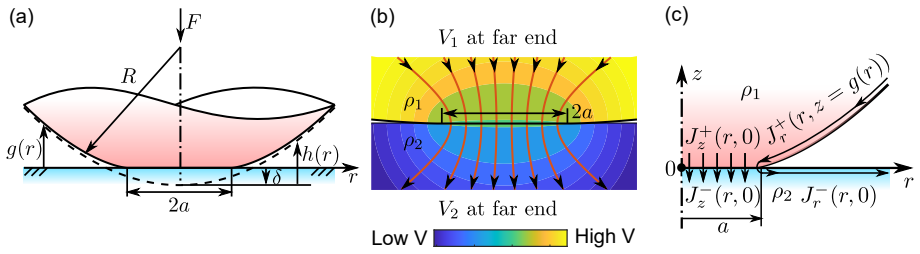
The argument runs on Barber's elastic-electrical analogy, which maps the electrostatic potential-drop/current-density problem onto the incremental elastic contact problem, plus an assumed Hertzian-like current density built as the difference of two circular patches, $J(r)=J_1\,\mathrm{Re}\,\sqrt{1-r^2/c^2} - J_0\,\mathrm{Re}\,\sqrt{1-r^2/a^2}$, with $c$ the outer radius of the discharge annulus. The modified Paschen boundary condition $V(r)=K g(r)$ inside the discharge zone (linear dielectric strength at micro-gaps) fixes $J_0$ and $c$ through the condition that the potential is constant on the contact area. The same analogy produces the explicit non-discharging solutions used as the baseline, and the linear complementarity problem solved by conjugate gradients verifies the closed forms.
What would settle it
An experiment with a copper sphere cathode and a transparent flat anode in nitrogen at low applied voltage should show a luminous discharge annulus whose outer radius follows $c = a\sqrt{R\,\Delta V/(K a^2)+1}$ and grows with $\sqrt{\Delta V}$; if imaging shows no such annulus, or if the current-voltage relation across the gap deviates from the modified Paschen law, the central claim would be contradicted.
Extended reading notes
Core claim
For a Hertzian circular contact at low applied voltage, incorporating dielectric breakdown of the interfacial gap governed by the modified Paschen law replaces the singular non-discharging current density with a finite distribution: inside the contact the current density grows monotonically to a finite value at $r=a$, then drops monotonically through the discharge zone $r\in(a,c)$. The discharge zone radius is $c/a = \sqrt{R\,\Delta V/(K a^2)+1}$, and the discharging contact resistance is $R_c = 3(c^2-a^2)\,\rho/(8(c^3-a^3))$, whose dimensionless form is always smaller than the classical $R_c=\rho/4a$ for $\delta^* \ge 0$. When the electrodes are separated by a gap $\delta<0$, conduction persists through a central discharge disk as long as $\Delta V + K\delta > 0$, with $R_c = 3\Delta V\,\rho/(8(\Delta V+K\delta)\,c)$.
Load-bearing premise
The load-bearing compromise is the artificially closed gap: inside the discharge zone current flows as if the electrodes touched, while the same nonzero gap is used to evaluate the breakdown voltage; a different real discharge current-voltage relation would change the annulus size and the quantitative resistance reductions.
Editorial extensions
If this is right
- Classical electrical contact resistance predictions are upper bounds whenever air outside the contact can break down; the true electrical contact resistance is lower.
- Solid-solid contacts can carry extra current through a discharge annulus, reducing the current density inside the contact and relieving the edge concentration.
- Separated electrodes with a small gap can still conduct through a central discharge zone, extending electrical contact theory to negative indentation and postponing the resistance divergence from $\delta^*\to 0^+$ to $\delta^*\to -1^+$.
- Rough-surface electrical contact models built from single-asperity solutions will predict lower resistance once discharge is included, so the stiffness-resistance analogy overestimates resistance in discharging contacts.
- At higher applied voltages the model predicts a second, outer annular discharge zone due to the non-monotonic modified Paschen law, a feature that needs experimental imaging to confirm.
Reading between the lines
- If the central claim holds, electrified bearings and gears may suffer discharge damage even when solid metallic contact exists, not only when a lubricant film fully separates the surfaces; current-leakage models should include the annulus.
- The artificial-closure approximation could be tested by coupling a local particle-in-cell/Monte Carlo collision discharge simulation at the gap to the macroscopic current solver; the resulting current-voltage relation would refine or replace the modified Paschen law used here.
- The predicted discharge-zone scaling $c/a = \sqrt{1+R\,\Delta V/(K a^2)}$ is a testable geometric signature: it could be verified by imaging a transparent anode or by measuring the size and areal density of electric-discharge-machining pits on bearing raceways under controlled voltage.
- For higher applied voltages where the standard Paschen branch matters, the secondary electron emission coefficient of the electrode material enters the breakdown voltage, so the annulus size and resistance reduction should vary between copper, steel, and lubricant-covered electrodes; ranking these variations is a natural extension of Eq. (33).
Editorial analysis
A structured set of objections, weighed in public.
Referee Report
Summary. The paper models the effect of dielectric breakdown of the interfacial air gap on electrical contact between a parabolic indenter and a rigid flat. Using a modified Paschen law Vb(g)=Kg for small gaps, the authors formulate the discharging contact problem as a linear complementarity problem and derive closed-form solutions in two low-voltage regimes: solid-solid contact and complete separation. The main claims are that breakdown removes the classical current-density singularity at the contact edge, that the discharging contact resistance is always below the non-discharging value in the contact phase, and that separated electrodes can still conduct through a central discharge zone. Dimensionless closed forms are given for current density, potential, and contact resistance in both phases.
Significance. If the idealized discharge model is accepted, the paper addresses a long-standing unphysical singularity in classical electrical contact theory and provides an analytical framework that could be useful for predicting electrically-induced bearing damage. The derivations are internally consistent, the elastic-electrical analogy is applied with care, and no parameter is fitted to the new ECR predictions. The paper also offers falsifiable predictions: finite current density at the contact periphery, reduced ECR, and conduction between separated electrodes. However, the numerical validation is partly self-referential because both the numerical and analytical models share the same artificial-closure and ideal-voltage-clamp assumptions, so the quantitative formulas are not independently validated.
major comments (3)
- [Section 3.2, Eqs. (15)-(17); Section 3.3.1, Eqs. (30)-(34)] The discharging boundary condition is implemented entirely as eV(r)=Vb(g(r))-V(r)=0 in the conductive region, with the current density J(r) then determined by current conservation alone. This is equivalent to modeling the discharge zone as an ideal zero-impedance voltage clamp with no current-voltage relation. Real micro-gap discharges follow strongly nonlinear I-V characteristics (e.g., field emission and Townsend processes, Ref. [52]); if the interface condition should be V=F(g,J) rather than V=Vb(g), the outer discharge radius c (Eq. (33)), the current density profile (Eqs. (30) and (47c)), and the contact-resistance formulas (Eqs. (34), (47d), (48d)) will all change. The numerical validation in Figs. 3 and 4 uses the same LCP and the same modified Paschen law, so it cannot detect this error. The central quantitative claims should be either validated against a PIC/MCC model or explicitly presented as predictions of the ideal voltage-clamp assumption, with a discussion of expected deviations.
- [Section 3.2 and Section 4 (artificial closure); Appendix A, Eq. (A.9)] The model treats the interfacial gap as artificially closed inside the discharge zone, so that current flows as if the electrodes were touching on the plane z=0, while the same non-zero gap g(r) is used to compute the breakdown voltage Vb(g). The potential V(r) in the discharge zone is therefore computed from the half-space Green's function (A.9), not from a finite conduction path through a gas layer. This inconsistent geometry is an acknowledged compromise, but it directly enters the determination of the discharge-zone size and the ECR magnitudes. A quantitative estimate of the error introduced by this approximation, or a comparison with a model that retains a finite gap in the current path, is needed to support the numerical values in Eqs. (43), (47d), and (48d).
- [Section 4, Fig. 5 (dual discharge zone)] The numerical model predicts a second, outer discharge annulus at ΔV=750 V, yet the manuscript itself states that there is a lack of physical evidence for this second annulus. Since the prediction follows from the same voltage-clamp ansatz and from a piecewise Paschen curve at gaps that may lie outside the validated linear field-emission branch, it should not be presented as a robust finding without experimental imaging or PIC/MCC verification. The authors should either add such support or clearly label the dual-zone result as a model prediction that is currently unverified.
minor comments (7)
- [Section 2, paragraph 1] The text contains a typo: "rigid fat" should read "rigid flat".
- [Appendix A.1] The phrase "Karesh-Khun-Tucker condition" should be corrected to "Karush-Kuhn-Tucker condition".
- [Section 3.3.1, Eq. (31)] The derivation leading from Eqs. (24)-(25) to Eq. (31) is too terse; the superposition of the two auxiliary potential solutions should be written out explicitly to make the result checkable.
- [Figure 2 caption] The caption contains an unclear fragment "C O D A O-B-C-D: A-B-C-D:" that does not introduce the marked regions; it should be clarified.
- [Section 3.3.3] The statement that equating Eq. (46c) and Eq. (47d) has no real root is given without supporting algebra; a brief derivation would make the proof more transparent.
- [Abstract and Conclusion] The phrases "theoretically proves" should be qualified by the model's ideal voltage-clamp and artificial-closure assumptions, as the manuscript itself acknowledges in Section 4.
- [Figs. 3 and 4] The agreement between numerical and analytical solutions is described as "nearly identical" without a quantitative error measure; reporting an RMS difference or a mesh-convergence study would improve the reproducibility of the validation.
Circularity Check
No significant circularity: the discharging boundary condition and modified Paschen constants are external inputs; the closed-form ECR results are solved from that boundary-value problem, not fitted to the predicted quantities.
full rationale
The derivation chain begins with the classic non-discharging ECR solution (Eqs. (4)-(6)), obtained from Barber's elastic-electrical analogy and Hertz contact geometry; the singular current density is a consequence of that known solution. The discharging model then modifies only the boundary condition: instead of Eqs. (7)-(8), it imposes eV = Vb(g) - V = 0 in the conductive region and eV > 0, J = 0 elsewhere (Eqs. (15)-(16)), with Vb given by the modified Paschen law (Eq. (14)) whose constants A, B, gamma_se, K are taken from ambient-air breakdown experiments and PIC/MCC literature, not fitted to ECR. The closed-form contact-phase solution starts from a superposition ansatz (Eq. (26)) and determines the two constants J0 and c by requiring V = 0 inside the contact and V = Vb = Kg in the discharge annulus (Eqs. (28)-(33)); similarly the separation-phase solution (Eqs. (35)-(39)) is fixed by matching the Hertzian-like current density to the specified potential. The claimed ECR inequality (non-discharging Rc* = 2/(3 sqrt(delta*)) versus discharging Rc* = [(1+delta*)^(3/2) - (delta*)^(3/2)]^-1) is then a direct algebraic comparison of two solutions of the same model, not a fit. The numerical LCP is solved with the same external boundary condition, so the agreement in Figs. 3-4 validates algebraic consistency, not the physics of the discharge I-V relation; the authors admit the 'artificially closed' gap and the lack of direct evidence for the annulus in Section 4 ('the conflicting usage of the interfacial gap is a compromising approach', 'a lack of direct evidence to support the existence of single and double annulus discharge regions'). These are stated limitations, not circular reductions. Self-citations (e.g., Refs. [10,16,17,19,31,46,47,49,57]) appear in motivation, rough-surface context, and a discretization formula; none supplies the central claim, which is solved from the stated boundary-value problem. No fitted parameter is renamed as a prediction and no uniqueness theorem from the authors' prior work is invoked. Therefore no step in the claimed derivation is equivalent to its input by construction.
Assumptions & free parameters
free parameters (1)
- Dielectric strength K for micro-gap air breakdown =
7 x 10^4 V/mm, chosen within the published range 6.5 x 10^4 to 1.1 x 10^5 V/mm
assumptions (4)
- domain assumption Small slope assumption d g/dr approx 0 near the contact area, so the interfacial gap and electrodes are treated as locally co-planar.
- domain assumption Modified Paschen law: Vb = K g for g <= g_c and the Townsend-Paschen form above g_c, for clean air at 1e5 Pa.
- ad hoc to paper Artificial closure of the interfacial gap in the discharge zone.
- domain assumption For the closed-form solutions, applied voltage is low, with delta V much smaller than min(Vb) about 244.8 V, so discharge follows the linear field-emission branch V = K g.
Cite this review
Pith. "Pith review of Electrical contact with dielectric breakdown of interfacial gap." pith.science (2026). https://pith.science/paper/D6PIGCW6
@misc{pith2026241116981,
  author       = {Pith},
  title        = {Pith review of: Electrical contact with dielectric breakdown of interfacial gap},
  year         = {2026},
  howpublished = {\url{https://pith.science/paper/D6PIGCW6}},
  note         = {Machine review of arXiv:2411.16981}
}
read the original abstract
Electrical contact is fundamental to almost every aspect of modern industry, including the fast-growing electric vehicle industry. In metallic contacts in atmospheric conditions, most of the electrical current passes via the micro-junctions formed between two electrodes. The classic electrical contact theory predicts an infinite current density at the circular contact periphery. In the present work, we explore the influence of the dielectric breakdown of air outside the contact area on the electrical contact interface. Incorporating the discharging boundary condition governed by the modified Paschen law, we develop the numerical model as well as two sets of closed-form solutions for low applied voltage cases where two electrodes are in solid-solid contact and complete separation, respectively. For Hertzian contact, the present work theoretically proves that the ignorance of discharge can lead to a singular current density at the contact periphery and an overestimation of the electrical contact resistance. The current density monotonically increases along the radial direction to a finite value at the contact area periphery, followed by a monotonic drop within the discharge zone. The present study serves as a foundation for the modeling of discharging rough surface electrical contact and sheds light on the machine element surface damages caused by the electrical discharge machining.
Figures


Figures from the paper (3 more)


Reference graph
Works this paper leans on
-
[52]
Microscale gas breakdown: ion-enhanced field emission and the modified Paschen’s curve,
Go, D. B. and Venkattraman, A., 2014, “Microscale gas breakdown: ion-enhanced field emission and the modified Paschen’s curve,” Journal of Physics D: Applied Physics, 47(50), p. 503001
work page 2014
-
[1]
Hybrid and electric vehicle tribology: a review,
Hemanth, G., Suresha, B., and Ananthapadmanabha, B., 2021, “Hybrid and electric vehicle tribology: a review,” Surface Topography: Metrology and Properties, 9(4), p. 26 043001
work page 2021
-
[2]
Bearing currents in wind turbine generators,
Whittle, M., Trevelyan, J., and Tavner, P., 2013, “Bearing currents in wind turbine generators,” Journal of Renewable and Sustainable Energy, 5, p. 053128
work page 2013
-
[3]
Influence of electric current on the wear topog- raphy of electrical contact surfaces,
Zuo, X., Xie, W., and Zhou, Y., 2022, “Influence of electric current on the wear topog- raphy of electrical contact surfaces,” Journal of Tribology, 144(7), p. 071702
work page 2022
-
[4]
Taheri, P., Hsieh, S., and Bahrami, M., 2011, “Investigating electrical contact resistance losses in lithium-ion battery assemblies for hybrid and electric vehicles,” Journal of Power Sources, 196(15), pp. 6525–6533
work page 2011
-
[5]
Holm, R., 2013, Electric contacts: theory and application, Springer Science & Business Media, Berlin
work page 2013
-
[6]
Zhang, X., Luo, C., Menga, N., Zhang, H., Li, Y., and Zhu, S. P., 2023, “Pressure and polymer selections for solid-state batteries investigated with high-throughput simula- tions,” Cell Reports Physical Science, 4(3), p. 101328
work page 2023
-
[7]
Wu, G., Dong, K., Xu, Z., Xiao, S., Wei, W., Chen, H., Li, J., et al., 2022, “Pantograph– catenary electrical contact system of high-speed railways: recent progress, challenges, and outlooks,” Railway Engineering Science, 30(4), pp. 437–467
work page 2022
Show all 72 references
-
[8]
A review of failure modes, condition monitoring and fault diagnosis methods for large-scale wind turbine bearings,
Liu, Z. and Zhang, L., 2020, “A review of failure modes, condition monitoring and fault diagnosis methods for large-scale wind turbine bearings,” Measurement, 149, p. 107002
2020
-
[9]
Diagnosis of rolling-element bearings failure by localized electri- cal current between track surfaces of races and rolling-elements,
Prashad, H., 2002, “Diagnosis of rolling-element bearings failure by localized electri- cal current between track surfaces of races and rolling-elements,” Journal of Tribology, 124(3), pp. 468–473
2002
-
[10]
Electrical contact during a rolling vibratory motion considering mixed lubrication,
Jackson, R. L. and Angadi, S., 2023, “Electrical contact during a rolling vibratory motion considering mixed lubrication,” Journal of Tribology, 145(8), p. 082201
2023
-
[11]
Llewellyn-Jones, F., 1957, The physics of electrical contacts, Clarendon Press, Oxford
1957
-
[12]
Making Electrical Contact to Layered Surfaces,
Malucci, R. D., 2021, “Making Electrical Contact to Layered Surfaces,” 2021 IEEE 66th Holm Conference on Electrical Contacts (HLM), IEEE, pp. 184–187
2021
-
[13]
Constriction resistance of conducting spots by the boundary element method,
Nakamura, M., 1993, “Constriction resistance of conducting spots by the boundary element method,” IEEE transactions on components, hybrids, and manufacturing tech- nology, 16(3), pp. 339–343
1993
-
[14]
A comprehensive study of the elasto-plastic contact of a sphere and a flat,
Ghaednia, H., Pope, S. A., Jackson, R. L., and Marghitu, D. B., 2016, “A comprehensive study of the elasto-plastic contact of a sphere and a flat,” Tribology International, 93, pp. 78–90. 27
2016
-
[15]
An electro-mechanical contact analysis of a three-dimensional sinusoidal surface against a rigid flat,
Shah, S., Krithivasan, V., and Jackson, R. L., 2011, “An electro-mechanical contact analysis of a three-dimensional sinusoidal surface against a rigid flat,” Wear, 270(11- 12), pp. 914–921
2011
-
[16]
A new method for the measurement of real area of contact by the adhesive transfer of thin Au film,
Xu, Y., Chen, Y., Zhang, A., Jackson, R. L., and Prorok, B. C., 2018, “A new method for the measurement of real area of contact by the adhesive transfer of thin Au film,” Tribology Letters, 66, pp. 1–20
2018
-
[17]
A comparison of nanoscale measurements with the theoretical models of real and nominal contact areas,
Xu, Y., Jackson, R. L., Chen, Y., Zhang, A., and Prorok, B. C., 2020, “A comparison of nanoscale measurements with the theoretical models of real and nominal contact areas,” Proceedings of the Institution of Mechanical Engineers, Part J: Journal of Engineering Tribology, 234(1...
2020
-
[18]
Electrical conduction in solids I. Influence of the passage of current on the contact between solids,
Bowden, F. P. and Williamson, J. B. P., 1958, “Electrical conduction in solids I. Influence of the passage of current on the contact between solids,” Proceedings of the Royal Society of London. Series A. Mathematical and Physical Sciences, 246(1244), pp. 1–12
1958
-
[19]
Rough surface electrical contact resistance considering scale dependent properties and quantum effects,
Jackson, R. L., Crandall, E. R., and Bozack, M. J., 2015, “Rough surface electrical contact resistance considering scale dependent properties and quantum effects,” Journal of Applied Physics, 117(19)
2015
-
[20]
Multi-spot model showing the effects of nano-spot sizes,
Malucci, R. D., 2005, “Multi-spot model showing the effects of nano-spot sizes,” Pro- ceedings of the Fifty-First IEEE Holm Conference on Electrical Contacts, 2005., IEEE, pp. 291–297
2005
-
[21]
The size effect and the non-local Boltzmann transport equation in orifice and disk geometry,
Wexler, G., 1966, “The size effect and the non-local Boltzmann transport equation in orifice and disk geometry,” Proceedings of the Physical Society, 89(4), p. 927
1966
-
[22]
On the possible method for studying fermi surfaces,
Sharvin, Y. V., 1965, “On the possible method for studying fermi surfaces,” Journal of Experimental and Theoretical Physics, 48, pp. 984–985
1965
-
[23]
Simulation of the current density dis- tribution within electrical contacts,
Leidner, M., Schmidt, H., and Myers, M., 2010, “Simulation of the current density dis- tribution within electrical contacts,” 2010 proceedings of the 56th IEEE Holm conference on electrical contacts, IEEE, pp. 1–9
2010
-
[24]
An efficient method for electro- thermo-mechanical coupling effect in electrical contact on rough surfaces,
Li, Y. H., Shen, F., G¨ uler, M. A., and Ke, L.-L., 2024, “An efficient method for electro- thermo-mechanical coupling effect in electrical contact on rough surfaces,” International Journal of Heat and Mass Transfer, 226, p. 125492
2024
-
[25]
An efficient method for solving elec- trical constriction resistance of rough surfaces,
Wang, W., Sui, Y., Ge, X., and Zhang, H., 2024, “An efficient method for solving elec- trical constriction resistance of rough surfaces,” Tribology International, 97, p. 109808
2024
-
[26]
Modeling 3D sliding electrical contact considering fully coupled thermal-mechanical-electrical effects,
Sui, Y., Wang, W., Zhang, H., and Xie, Y., 2023, “Modeling 3D sliding electrical contact considering fully coupled thermal-mechanical-electrical effects,” Tribology International, 184, p. 108491. 28
2023
-
[27]
Numerical simulation on the effect of current intensity on electrical contact performance of electrical connectors subject to micro-slip wear,
He, W., Feng, Y., Wu, S., Wu, K., Ye, J., and Wang, W., 2024, “Numerical simulation on the effect of current intensity on electrical contact performance of electrical connectors subject to micro-slip wear,” Wear, 542, p. 205270
2024
-
[28]
Constriction resistance and the real area of contact,
Greenwood, J. A., 1966, “Constriction resistance and the real area of contact,” British Journal of Applied Physics, 17(12), p. 1621
1966
-
[29]
Contact of nominally flat surfaces,
Greenwood, J. A. and Williamson, J. B. P., 1966, “Contact of nominally flat surfaces,” Proceedings of the royal society of London. Series A. Mathematical and physical sciences, 295(1442), pp. 300–319
1966
-
[30]
Electrical contact resistance theory for con- ductive rough surfaces separated by a thin insulating film,
Kogut, L. and Komvopoulos, K., 2004, “Electrical contact resistance theory for con- ductive rough surfaces separated by a thin insulating film,” Journal of Applied Physics, 95(2), pp. 576–585
2004
-
[31]
A simplified model of multiscale electrical contact resistance and comparison to existing closed form models,
Jackson, R. L., Malucci, R. D., Angadi, S., and Polchow, J. R., 2009, “A simplified model of multiscale electrical contact resistance and comparison to existing closed form models,” 2009 Proceedings of the 55th IEEE Holm Conference on Electrical Contacts, IEEE, pp. 28–35
2009
-
[32]
Three-level multi-scale modeling of electrical contacts sensitivity study and experimental validation,
Yastrebov, V. A., Cailletaud, G., Proudhon, H., Mballa, F. S. M., No¨ el, S., Test´ e, P., and Houz´ e, F., 2015, “Three-level multi-scale modeling of electrical contacts sensitivity study and experimental validation,” 2015 IEEE 61st Holm conference on electrical contacts (Hol...
2015
-
[33]
Volumetric contact theory to electrical contact between random rough surfaces,
Ta, W., Qiu, S., Wang, Y., Yuan, J., Gao, Y., and Zhou, Y., 2021, “Volumetric contact theory to electrical contact between random rough surfaces,” Tribology International, 160, p. 107007
2021
-
[34]
Bounds on the electrical resistance between contacting elastic rough bodies,
Barber, J., 2003, “Bounds on the electrical resistance between contacting elastic rough bodies,” Proceedings of the royal society of London. Series A: mathematical, physical and engineering sciences, 459(2029), pp. 53–66
2003
-
[35]
Interfacial electro- mechanical behaviour at rough surfaces,
Zhai, C., Hanaor, D., Proust, G., Brassart, L., and Gan, Y., 2016, “Interfacial electro- mechanical behaviour at rough surfaces,” Extreme Mechanics Letters, 9, pp. 422–429
2016
-
[36]
The electrical/thermal conductance of rough surfaces—-the Weierstrass–Archard multiscale model,
Ciavarella, M., Murolo, G., and Demelio, G., 2004, “The electrical/thermal conductance of rough surfaces—-the Weierstrass–Archard multiscale model,” International journal of solids and structures, 41(15), pp. 4107–4120
2004
-
[37]
Contact conductance of rough surfaces composed of modified RMD patches,
Paggi, M. and Barber, J., 2011, “Contact conductance of rough surfaces composed of modified RMD patches,” International Journal of Heat and Mass Transfer, 54(21-22), pp. 4664–4672
2011
-
[38]
On the electric contact resistance,
Persson, B., 2022, “On the electric contact resistance,” Tribology Letters, 70(3), p. 88. 29
2022
-
[39]
The impact of spot size and location on current density,
Malucci, R. D., 2009, “The impact of spot size and location on current density,” 2009 Proceedings of the 55th IEEE Holm Conference on Electrical Contacts, IEEE, pp. 208– 213
2009
-
[40]
The potential distribution in a constricted cylinder: An exact solution,
Rosenfeld, A. and Timsit, R., 1981, “The potential distribution in a constricted cylinder: An exact solution,” Quarterly of Applied Mathematics, 39(3), pp. 405–417
1981
-
[41]
A Method for Power Rating Contacts us- ing Voltage Drop,
Malucci, R. D. and Ruffino, F. R., 2008, “A Method for Power Rating Contacts us- ing Voltage Drop,” 2008 Proceedings of the 54th IEEE Holm Conference on Electrical Contacts, IEEE, pp. 225–231
2008
-
[42]
Single and multi-spot current density distribution,
Malucci, R. D., 2016, “Single and multi-spot current density distribution,” 2016 IEEE 62nd Holm Conference on Electrical Contacts (Holm), IEEE, pp. 100–104
2016
-
[43]
The impact on current density and constriction resistance from bridge structures in real contacts,
Malucci, R. D., 2017, “The impact on current density and constriction resistance from bridge structures in real contacts,” 2017 IEEE Holm Conference on Electrical Contacts, IEEE, pp. 59–62
2017
-
[44]
The Effects of Bridge Structures on Current Density and Tem- perature Distributions,
Malucci, R. D., 2018, “The Effects of Bridge Structures on Current Density and Tem- perature Distributions,” 2018 IEEE Holm Conference on Electrical Contacts, IEEE, pp. 43–47
2018
-
[45]
Electrical bearing failures in electric vehicles,
He, F., Xie, G., and Luo, J., 2020, “Electrical bearing failures in electric vehicles,” Friction, 8, pp. 4–28
2020
-
[46]
Exploring the Boundaries of Electrically Induced Bearing Damage in Grease-Lubricated Rolling Contacts,
Janik, J. R., Saha, S., Jackson, R. L., and Mills, G., 2024, “Exploring the Boundaries of Electrically Induced Bearing Damage in Grease-Lubricated Rolling Contacts,” Lubri- cants, 12(8), p. 268
2024
-
[47]
The influence of various grease compo- sitions and silver nanoparticle additives on electrically induced rolling-element bearing damage,
Bond, S., Jackson, R. L., and Mills, G., 2024, “The influence of various grease compo- sitions and silver nanoparticle additives on electrically induced rolling-element bearing damage,” Friction, 12(4), pp. 796–811
2024
-
[48]
Performance characteris- tics of lubricants in electric and hybrid vehicles: a review of current and future needs,
Chen, Y., Jha, S., Raut, A., Zhang, W., and Liang, H., 2020, “Performance characteris- tics of lubricants in electric and hybrid vehicles: a review of current and future needs,” Frontiers in Mechanical Engineering, 6, p. 571464
2020
-
[49]
A Statistical Prediction of Electri- cal Discharge Initiation and Semi-Analytical Transient Mixed Lubrication Model of a Rolling Element,
Jackson, R. L., Saha, S., and Janik, J. R., 2024, “A Statistical Prediction of Electri- cal Discharge Initiation and Semi-Analytical Transient Mixed Lubrication Model of a Rolling Element,” Journal of Tribology, pp. 1–27
2024
-
[50]
L., 1987, Contact mechanics, Cambridge University Press, Cambridge
Johnson, K. L., 1987, Contact mechanics, Cambridge University Press, Cambridge
1987
-
[51]
Surface energy and the contact of elastic solids,
Johnson, K. L., Kendall, K., and Roberts, A. D., 1971, “Surface energy and the contact of elastic solids,” Proceedings of the royal society of London. A. mathematical and physical sciences, 324(1558), pp. 301–313. 30
1971
-
[53]
Analysis of Paschen curves for air, N2 and SF6 using the Townsend breakdown equation,
Husain, E. and Nema, R., 1982, “Analysis of Paschen curves for air, N2 and SF6 using the Townsend breakdown equation,” IEEE transactions on electrical insulation, EI-17(4), pp. 350–353
1982
-
[54]
Electric field breakdown at micrometre separations,
Torres, J. and Dhariwal, R., 1999, “Electric field breakdown at micrometre separations,” Nanotechnology, 10(1), p. 102
1999
-
[55]
Arc erosion behaviour of silver electric contacts in a single arc discharge across a static gap,
Lee, R., Chung, H., and Chiou, Y., 2001, “Arc erosion behaviour of silver electric contacts in a single arc discharge across a static gap,” IEE Proceedings-Science, Measurement and Technology, 148(1), pp. 8–14
2001
-
[56]
Electrical breakdown in atmospheric air between closely spaced (0.2/spl mu/m-40/spl mu/m) electrical contacts,
Slade, P. G. and Taylor, E. D., 2002, “Electrical breakdown in atmospheric air between closely spaced (0.2/spl mu/m-40/spl mu/m) electrical contacts,” IEEE Transactions on components and packaging technologies, 25(3), pp. 390–396
2002
-
[57]
An adhesion model for contact electrifica- tion,
Xu, Y., Wu, S., Zhu, Y., and Wu, J., 2024, “An adhesion model for contact electrifica- tion,” International Journal of Mechanical Sciences, 272, p. 109280
2024
-
[58]
A numerical method for solving rough contact problems based on the multi-level multi-summation and conjugate gradient techniques,
Polonsky, I. and Keer, L., 1999, “A numerical method for solving rough contact problems based on the multi-level multi-summation and conjugate gradient techniques,” Wear, 231(2), pp. 206–219
1999
-
[59]
Optimization algorithms for the solution of the frictionless normal contact between rough surfaces,
Bemporad, A. and Paggi, M., 2015, “Optimization algorithms for the solution of the frictionless normal contact between rough surfaces,” International Journal of Solids and Structures, 69, pp. 94–105
2015
-
[60]
Linear complemen- tarity framework for 3D steady-state rolling contact problems including creepages with isotropic and anisotropic friction for circular Hertzian contact,
Xi, Y., Almqvist, A., Shi, Y., Mao, J., and Larsson, R., 2017, “Linear complemen- tarity framework for 3D steady-state rolling contact problems including creepages with isotropic and anisotropic friction for circular Hertzian contact,” Tribology Transactions, 60(5), pp. 832–844
2017
-
[61]
Electrode roughness effects on the breakdown of air-insulated apparatus,
Mahdy, A., Anis, H., and Ward, S., 1998, “Electrode roughness effects on the breakdown of air-insulated apparatus,” IEEE Transactions on Dielectrics and Electrical Insulation, 5(4), pp. 612–617
1998
-
[62]
An alternative to the Maugis model of adhesion between elastic spheres,
Greenwood, J. A. and Johnson, K. L., 1998, “An alternative to the Maugis model of adhesion between elastic spheres,” Journal of Physics D: Applied Physics, 31(22), p. 3279
1998
-
[63]
VI. The phenomena of rupture and flow in solids,
Griffith, A. A., 1921, “VI. The phenomena of rupture and flow in solids,” Philosophical transactions of the royal society of london. Series A, containing papers of a mathematical or physical character, 221(582-593), pp. 163–198. 31
1921
-
[64]
Yielding of steel sheets containing slits,
Dugdale, D. S., 1960, “Yielding of steel sheets containing slits,” Journal of the Mechanics and Physics of Solids, 8(2), pp. 100–104
1960
-
[65]
Adhesion of spheres: the JKR-DMT transition using a Dugdale model,
Maugis, D., 1992, “Adhesion of spheres: the JKR-DMT transition using a Dugdale model,” Journal of colloid and interface science, 150(1), pp. 243–269
1992
-
[66]
Electrical contact resistance considering multi-scale roughness,
Wilson, W. E., Angadi, S. V., and Jackson, R. L., 2008, “Electrical contact resistance considering multi-scale roughness,” 2008 Proceedings of the 54th IEEE Holm Conference on Electrical Contacts, IEEE, pp. 190–197
2008
-
[67]
Charge mo- saics on contact-electrified dielectrics result from polarity-inverting discharges,
Sobolev, Y. I., Adamkiewicz, W., Siek, M., and Grzybowski, B. A., 2022, “Charge mo- saics on contact-electrified dielectrics result from polarity-inverting discharges,” Nature Physics, 18(11), pp. 1347–1355
2022
-
[68]
Automotive e-motor bearing electrical discharge phenomena: An experimental and numerical investigation,
Bleger, A., Leighton, M., and Morris, N., 2024, “Automotive e-motor bearing electrical discharge phenomena: An experimental and numerical investigation,” Tribology Inter- national, 191, p. 109140
2024
-
[69]
Scaling analysis of a moving point heat source in steady-state on a semi-infinite solid,
Mendez, P. F., Lu, Y., and Wang, Y., 2018, “Scaling analysis of a moving point heat source in steady-state on a semi-infinite solid,” Journal of Heat Transfer, 140(8), p. 081301
2018
-
[70]
A concise treatment of axisymmetric indentation in elasticity,
Hill, R. and Stor ˚ akers, B. A., 1990, “A concise treatment of axisymmetric indentation in elasticity,” Elasticity: mathematical methods and applications, pp. 199–210
1990
-
[71]
Contact between an axisymmetric indenter and a viscoelastic half-space,
Greenwood, J. A., 2010, “Contact between an axisymmetric indenter and a viscoelastic half-space,” International Journal of Mechanical Sciences, 52(6), pp. 829–835
2010
-
[72]
A General Contact Model for Rough Surfaces Based on the Incremental Concept,
Liang, X., Chen, S., Li, C. Y., Niu, X., and Wang, G., 2024, “A General Contact Model for Rough Surfaces Based on the Incremental Concept,” Tribology International, 198, p. 109882. Appendix A. Barber’s elastic-electrical analogy Consider a general three-dimensional elastic con...
2024
Reviewed August 12, 2026 · model on record in the stance chip above.
Discussion (0). Continue with ORCID to comment.