REVIEW 4 major objections 5 minor 20 references
RED: Robust Environmental Design
T0 review · 4 major / 5 minor · reviewed 2026-08-12 · deepseek-v4-flash
Pith's one-line read Road-sign background redesign keeps classifiers at 99% under patch attacks.
desk verdict New idea, unproven defense: RED's robustness numbers come from attacks that ignore the majority-vote defense, so the 99% claim is not yet supported. read the letter →
The pith
A machine-rendered reading of the paper's core claim, the machinery that carries it, and where it could break.
The reading
What carries the argument
The central object is the per-class sign pattern $\alpha_y$, parameterized as a colored checkerboard grid and optimized by Algorithm 1: for each class, the pattern is composited onto the sign, the image is repeatedly ablated by masks $g_1,\dots,g_m$, and gradients of the classification loss are backpropagated through the composite to update both the pattern and the classifier. At inference, the same ablation functions generate masked views and a majority vote decides the label. The machinery relies on the (De)Randomized ablation defense, which removes most of the image so the patch either is excluded or is too small to dominate.
What would settle it
Run the same sticker and patch attacks with the loss computed on the majority-vote prediction over the ablation masks instead of on a single classifier output. If RED signs drop below, say, 90 percent accuracy at 10 percent patch coverage under that adaptive attack, the core claim would fail under its own threat model; if accuracy stays near 99 percent, the claim survives a stronger test.
Extended reading notes
Core claim
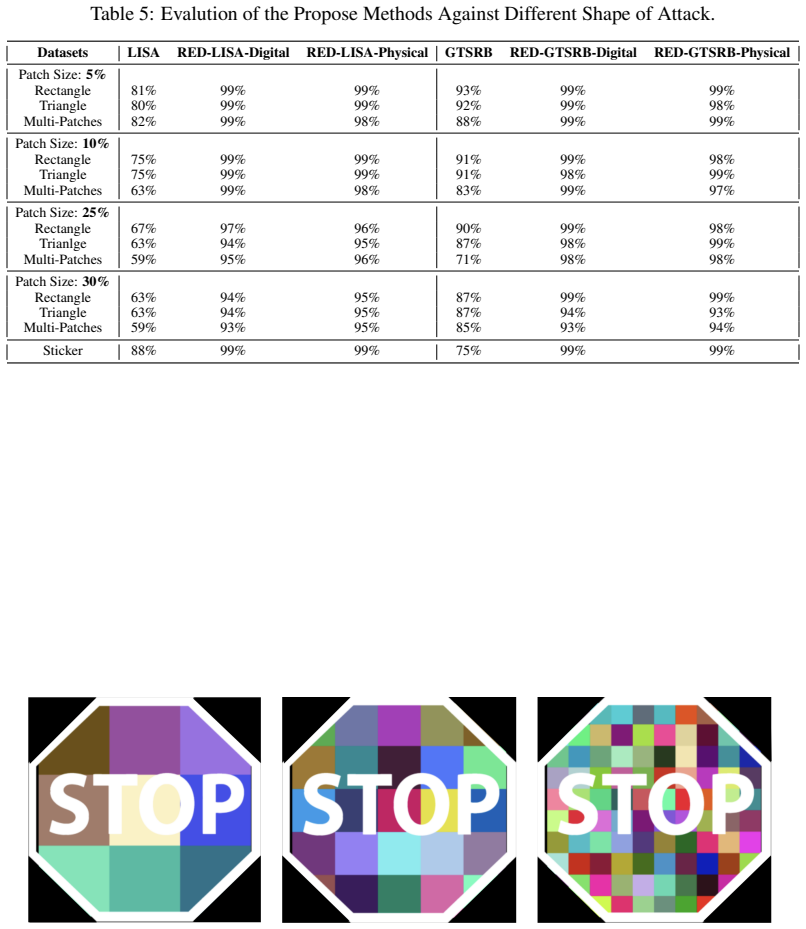
On its own terms, the paper's discovery is that a colorful grid pattern, optimized per class, makes every local patch of a road sign carry enough class-specific information for independent inference. RED jointly trains the pattern and a clean classifier over many ablated views of the sign, then at test time applies several ablations and takes a majority vote. In the reported experiments the redesigned signs reach 99 percent accuracy on clean data and 93 to 99 percent across sticker, rectangle, triangle, and multi-patch attacks at 10 and 30 percent patch sizes, in both digital and physical settings; the paper also reports that a 5x5 grid supports high accuracy even when only 13 percent of the image is visible. The core claim is that this robustness is achieved without simulating the attack, without adversarial training, and with a generic ablation defense.
Load-bearing premise
The experiments assume an attacker who optimizes a patch against the standalone classifier, not against the majority-vote inference pipeline; an adaptive attacker who targets the vote could erode the reported robustness.
Editorial extensions
If this is right
- Deployed road signs can be made robust to patch attacks without adversarial training of the recognition model; the model stays a clean-trained classifier.
- The same design principle transfers across two sign datasets and to physical prints photographed in varied real-world conditions, not just in simulation.
- Grid resolution matters: a 5x5 color grid preserves near-99 percent accuracy even when only 13 percent of the sign is visible, while current single-color designs drop to 48 to 50 percent at that mask size.
- Because the defense does not assume a patch shape or size, RED covers sticker attacks, rectangle and triangle patches, and multi-patch attacks aimed at ablation defenses.
- When the attacker is known, the paper's AA-RED variant combines RED with adversarial training to simulate the attacker's best response during pattern optimization.
Reading between the lines
- A natural next test is an adaptive attacker that optimizes the patch against the majority-vote inference itself; the paper's threat model optimizes against the classifier, so such an experiment would reveal how much of the reported margin is due to pattern redundancy rather than attack mismatch.
- Because RED requires editing objects at manufacture time, the principle extends to other manufactured objects with known labels such as packaging, gates, and airport signage, but not to uncontrolled objects like pedestrians or animals; the paper itself notes this limit.
- The learned patterns may carry a cost in human readability or aesthetics that the current experiments do not measure; a human-factors study could determine whether the patterns remain usable for human drivers.
Editorial analysis
A structured set of objections, weighed in public.
Referee Report
Summary. The paper proposes RED (Robust Environmental Design), a method that learns class-specific background patterns for road signs jointly with a classifier, so that at inference time a majority vote over predictions on ablated views of the image remains accurate under patch-based attacks. The authors report near-99% accuracy under sticker and patch attacks in digital experiments on LISA and GTSRB, and in a small physical pilot with printed signs, compared with 63% to 91% for a (De)Randomized defense on original signs. The manuscript also sketches an attacker-aware extension (AA-RED) in the appendix, but does not evaluate it.
Significance. If the claimed robustness were established, the work would open a useful new axis for adversarial robustness: modifying physical objects rather than only hardening classifiers. The formulation in Eq. (2) and Algorithm 1 is clean, and the empirical results in the digital setting are striking. The manuscript also includes a concrete inference procedure (Algorithm 3) and is transparent about deferring some content to an extended version. However, the central 'attacker-agnostic' claim is currently supported only against non-adaptive attacks, and the physical evidence is under-reported. The idea is interesting and the paper is clearly written, but the evidence does not yet meet the bar for the headline claim.
major comments (4)
- [Section 2, Eq. (1); Section 4, Tables 1, 3, 4, 5] The attack model in Eq. (1) optimizes a patch to fool the classifier f alone, but Section 3 and Algorithm 3 deploy the majority vote majVote(f∘g1,...,f∘gm) as the actual decision rule. All reported attacks (Sticker, PGD-inf rectangle/triangle/multi-patch) are therefore not adaptive to the deployed defense. An attacker who knows the ablation masks can craft a single patch that flips enough individual ablated predictions to change the majority, e.g., by maximizing a soft-vote surrogate with expectation over the ablation distribution; AA-RED in Algorithm 2 is exactly this adaptive threat but is never instantiated. As a result, the reported 99% (and 95%+ at 30% patch size) numbers in Tables 1, 3, 4, and 5 are evidence of attack-transfer failure, not of robustness against an adversary optimizing against the deployed inference. The 'attacker-agnostic' claim in the abstract and Section 1 is load-bearing and unsupported without such an evaluation.
- [Section 4, Physical Experiment, Table 3] The physical experiment uses about 50 images per sign, but the manuscript reports no clean accuracy on the physical signs, no error bars or confidence intervals, no per-sign breakdown, and no physical baseline for the (De)Randomized defense on original printed signs. Given the small sample size and uncontrolled conditions (location, weather, time of day), the 93–99% physical accuracies in Table 3 cannot be distinguished from chance variation or from classifier bias toward the majority class. The authors should report per-sign accuracy, error bars, and a matched physical baseline condition.
- [Appendix A, Algorithm 2 and the sentence 'We will show the empirical results for both methods in the next section.'] The appendix introduces AA-RED, the only procedure in the paper that optimizes a pattern against adversarial perturbations under the deployed pipeline (the min-max objective above Algorithm 2), and explicitly promises empirical results. However, Section B does not contain any AA-RED results, and no AA-RED experiments appear anywhere. Since Eq. (2) in Section 3 contains no adversarial term, the paper provides no evidence that RED patterns provide any worst-case guarantee. The omission is central because it leaves the adaptive-attack question unresolved.
- [Tables 1 and 4] Tables 1 and 4 report the same GTSRB (De)Randomized clean accuracy as 84% and 96%, respectively. This discrepancy in an overlapping condition suggests inconsistent experimental settings or reporting and undermines confidence in the tables' accuracy. All numeric results should be cross-checked and reported with error bars over multiple seeds and attack runs.
minor comments (5)
- [Throughout] There are multiple typos: 'segmenators' in Section 1, 'albetion' and 'ablution' in Appendix A and Algorithm 3, 'Evalution' and 'Trianlge' in Table 5, and 'Desing' in Algorithm 2. They should be corrected before publication.
- [Section 3] Figure 4 of the Appendix is referenced in the text but does not appear in the manuscript; please include the figure or remove the reference.
- [Section 4, Table 2] The sentence 'even small defense mask sizes result in high accuracy (e.g., 90% accuracy with mask size of only 13%)' is ambiguous because GTSRB-S3 at 13% mask size achieves only 61%; the claim should be stated per dataset and per grid size.
- [Abstract and Section 1] The term 'attacker-agnostic' is used in the abstract, but the paper actually describes defenses that are 'attack-agnostic' in the sense of not requiring knowledge of the attack. Please clarify the terminology to avoid implying robustness against all possible attackers.
- [References] The reference list contains a malformed entry for 'Chunyang Xiang' with a mixture of author names; the citation format should be corrected.
Circularity Check
Minor circularity: clean-ablation accuracy is the training objective; the main attack-robustness claim is independent but rests on non-adaptive attacks.
-
fitted input called prediction
[Section 3, Algorithm 1 / Eq. (2); Section 4, Table 2]
"Compute the total loss minα Σ^N_{i=1} Σ^m_{j=1} L(f(gj(Xαyi)), yi) ... Table 2: Ablation Analysis on Grid Size: Accuracy of defense mask across various grid sizes."
The training objective (Eq. 2 / Algorithm 1) directly minimizes the classification loss of f on ablated views gj(X_alpha). Table 2 reports exactly this quantity—accuracy of the defense mask over ablated views—as evidence that larger grid sizes make small patches class-informative. The RED rows in Table 2 are therefore the training objective evaluated at convergence, not an independent prediction. The 1x1-grid baseline is a legitimate contrast, but the RED improvement in clean-ablation accuracy is by construction. The central robustness claims under adversarial patches are separate and are not the training objective, so this is a minor circularity.
full rationale
The only reduction-by-construction I can exhibit is that Table 2's 'accuracy of defense mask' for RED rows is the same per-sample term minimized in Eq. (2)/Algorithm 1; reporting it as a grid-size finding is a restatement of the fit. The central robustness claim (near-99% under sticker/patch attacks) is not the training objective: attacks are generated separately via Eq. (1) against the classifier and then scored under the majority-vote pipeline, so those numbers are empirical and not forced by the loss. No self-citations are load-bearing, no uniqueness theorem from the authors is invoked, and no external benchmark is used in a circular way. The main weakness is that attacks are non-adaptive to the majority-vote defense (AA-RED in Algorithm 2 is never evaluated), which is a threat-model/correctness limitation rather than circularity. Overall score 2.
Assumptions & free parameters
free parameters (3)
- per-class background pattern alpha_y =
learned 3x3, 5x5, or 10x10 color grid per class, values not enumerated
- grid size (S3/S5/S10) =
3, 5, or 10 grid cells
- number of ablation samples m =
not reported
assumptions (3)
- domain assumption A patch attack can be defeated if every random ablation of the input image is classified correctly by the model.
- domain assumption Physically printed RED signs photographed outdoors lie on the same distribution as digitally composited training images.
- domain assumption The road sign label is known at manufacture time, so the background can be freely modified.
Cite this review
Pith. "Pith review of RED: Robust Environmental Design." pith.science (2026). https://pith.science/paper/FKEZAWIJ
@misc{pith2026241117026,
  author       = {Pith},
  title        = {Pith review of: RED: Robust Environmental Design},
  year         = {2026},
  howpublished = {\url{https://pith.science/paper/FKEZAWIJ}},
  note         = {Machine review of arXiv:2411.17026}
}
read the original abstract
The classification of road signs by autonomous systems, especially those reliant on visual inputs, is highly susceptible to adversarial attacks. Traditional approaches to mitigating such vulnerabilities have focused on enhancing the robustness of classification models. In contrast, this paper adopts a fundamentally different strategy aimed at increasing robustness through the redesign of road signs themselves. We propose an attacker-agnostic learning scheme to automatically design road signs that are robust to a wide array of patch-based attacks. Empirical tests conducted in both digital and physical environments demonstrate that our approach significantly reduces vulnerability to patch attacks, outperforming existing techniques.
Figures


Figures from the paper (2 more)

Reference graph
Works this paper leans on
-
[1]
Explaining and harnessing adversarial examples
Ian J Goodfellow, Jonathon Shlens, and Christian Szegedy. Explaining and harnessing adversarial examples. In International Conference on Learning Representations, 2014
work page 2014
-
[2]
Towards deep learning models resistant to adversarial attacks
Aleksander Madry, Aleksandar Makelov, Ludwig Schmidt, Dimitris Tsipras, and Adrian Vladu. Towards deep learning models resistant to adversarial attacks. arXiv preprint arXiv:1706.06083, 2017
arXiv 2017
-
[3]
Adversarial examples in the physical world
Alexey Kurakin, Ian Goodfellow, and Samy Bengio. Adversarial examples in the physical world. In Workshop at the International Conference on Learning Representations, 2016
work page 2016
-
[4]
Unadversarial examples: Designing objects for robust vision
Hadi Salman, Andrew Ilyas, Logan Engstrom, Sai Vemprala, Aleksander Madry, and Ashish Kapoor. Unadversarial examples: Designing objects for robust vision. Advances in Neural Information Processing Systems, 34: 0 15270--15284, 2021
work page 2021
-
[5]
Robust physical-world attacks on deep learning visual classification
Kevin Eykholt, Ivan Evtimov, Earlence Fernandes, Bo Li, Amir Rahmati, Chaowei Xiao, Atul Prakash, Tadayoshi Kohno, and Dawn Song. Robust physical-world attacks on deep learning visual classification. In Proceedings of the IEEE Conference on Computer Vision and Pattern Recognition, 2018
work page 2018
-
[6]
Patchattack: A black-box texture-based attack with reinforcement learning
Chenglin Yang, Adam Kortylewski, Cihang Xie, Yinzhi Cao, and Alan Yuille. Patchattack: A black-box texture-based attack with reinforcement learning. In Computer Vision--ECCV 2020: 16th European Conference, Glasgow, UK, August 23--28, 2020, Proceedings, Part XXVI, pages 681--698. Springer, 2020
work page 2020
-
[7]
Obfuscated gradients give a false sense of security: Circumventing defenses to adversarial examples
Anish Athalye, Nicholas Carlini, and David Wagner. Obfuscated gradients give a false sense of security: Circumventing defenses to adversarial examples. In International Conference on Machine Learning (ICML), pages 274--283. PMLR, 2018
work page 2018
-
[8]
Tom B Brown, Dandelion Mané, Aurko Roy, Martín Abadi, and Justin Gilmer. Adversarial patch. arXiv preprint arXiv:1712.09665, 2017
arXiv 2017
Show all 20 references
-
[9]
Delving into transferable adversarial examples and black-box attacks
Yanpei Liu, Xinyun Chen, Chang Liu, and Dawn Song. Delving into transferable adversarial examples and black-box attacks. arXiv preprint arXiv:1611.02770, 2018
2018 arXiv
-
[10]
Lavan: Localized and visible adversarial noise
Daniel Karmon, Daniel Zoran, and Yoav Goldberg. Lavan: Localized and visible adversarial noise. arXiv preprint arXiv:1801.02608, 2018
2018 arXiv
-
[11]
Robust patch attacks
Hang Zhang, Ingrid Daubechies, Tom Goldstein, and Christoph Studer. Robust patch attacks. arXiv preprint arXiv:1904.13053, 2019
1904 arXiv
-
[12]
Adversarial training for free! Advances in Neural Information Processing Systems (NeurIPS), 32, 2019
Ali Shafahi, Mahyar Najibi, Amin Ghiasi, Zheng Xu, John Dickerson, Larry Davis, Gavin Taylor, and Tom Goldstein. Adversarial training for free! Advances in Neural Information Processing Systems (NeurIPS), 32, 2019
2019
-
[13]
Certified adversarial robustness via randomized smoothing
Jeremy M Cohen, Elan Rosenfeld, and J Zico Kolter. Certified adversarial robustness via randomized smoothing. In International Conference on Machine Learning (ICML), pages 1310--1320, 2019
2019
-
[14]
Certified robustness to adversarial examples with differential privacy
Mathias Lecuyer, Vasileios Atlidakis, Roxana Geambasu, Daniel Hsu, and Suman Jana. Certified robustness to adversarial examples with differential privacy. IEEE Symposium on Security and Privacy (SP), pages 656--672, 2019
2019
-
[15]
Provably robust deep learning via adversarially trained smoothed classifiers
Hadi Salman, Greg Yang, Pengchuan Li, Ilya Zhang, Huan Zhang, Cho-Jui Zhang, Sebastien Bubeck, and I-Jui Zhang. Provably robust deep learning via adversarially trained smoothed classifiers. In Advances in Neural Information Processing Systems (NeurIPS), volume 32, 2019
2019
-
[16]
Patchguard: A provably robust defense against adversarial patches via small receptive fields and masking
Chong Xiang, Zhiyuan Xu, and Bo Li Zhu. Patchguard: A provably robust defense against adversarial patches via small receptive fields and masking. In Proceedings of the IEEE/CVF International Conference on Computer Vision (ICCV), pages 14565--14574, 2020
2020
-
[17]
Patchcleanser: Certifiably robust defense against adversarial patches for any image classifier
Chong Xiang, Yang Zhang, Z Gu, and Bo Zhu. Patchcleanser: Certifiably robust defense against adversarial patches for any image classifier. arXiv preprint arXiv:2203.08488, 2022
2022 arXiv
-
[18]
Patchzero: Defending against adversarial patch attacks by detecting and zeroing the patch
Ke Xu, Yao Xiao, Zhaoheng Zheng, Kaijie Cai, and Ram Nevatia. Patchzero: Defending against adversarial patch attacks by detecting and zeroing the patch. In Proceedings of the IEEE/CVF Winter Conference on Applications of Computer Vision, pages 4632--4641, 2023
2023
-
[19]
Benson, Aleksander Mądry, Elan Rosenfeld, and Zico Kolter
Chunyang Xiang, Austin R. Benson, Aleksander Mądry, Elan Rosenfeld, and Zico Kolter. Patchcleanser: Certifiably robust defense against adversarial patches for any image classifier. In Proceedings of the 38th International Conference on Machine Learning (ICML), pages 11260--112...
2021
-
[20]
(de) randomized smoothing for certifiable defense against patch attacks
Alexander Levine and Soheil Feizi. (de) randomized smoothing for certifiable defense against patch attacks. Advances in Neural Information Processing Systems, 33: 0 6465--6475, 2020
2020
Reviewed August 12, 2026 · model on record in the stance chip above.
Discussion (0). Continue with ORCID to comment.