REVIEW 3 major objections 7 minor 107 references
RAMBO I: Project introduction and first results with uGMRT
T0 review · 3 major / 7 minor · reviewed 2026-08-12 · deepseek-v4-flash
Pith's one-line read The paper reports the first detection of radio emission from the magnetic hot star HD55522 at 650 MHz, adding a new point to the rotation-powered radio luminosity correlation of the centrifugal breakout model.
desk verdict Solid new detection and honest upper limits, but the CBO-support claim rests on an untested SED assumption that could move HD55522 by an order of magnitude in luminosity. read the letter →
The pith
A machine-rendered reading of the paper's core claim, the machinery that carries it, and where it could break.
The reading
What carries the argument
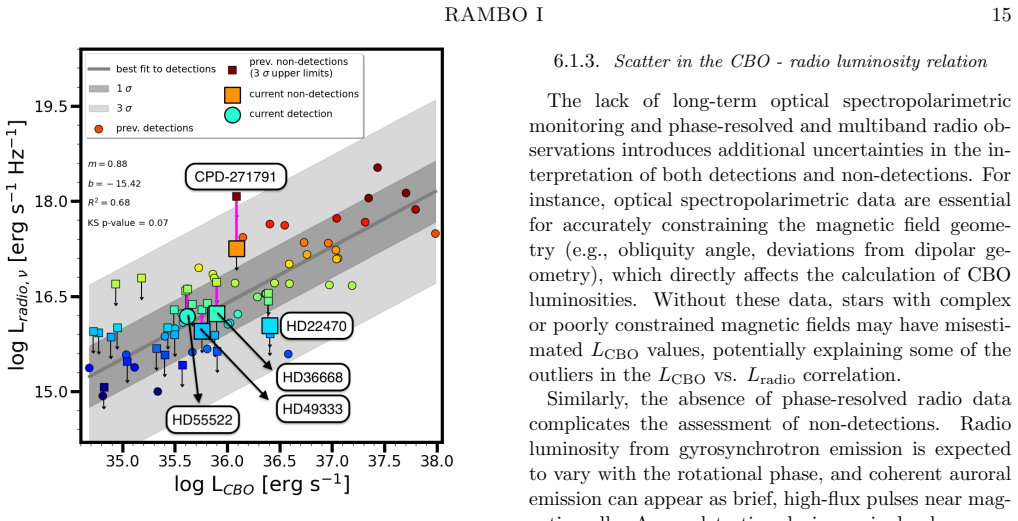
The carrying mechanism is the Centrifugal Breakout (CBO) luminosity, $L_{\rm CBO} = \dot{M}\,\Omega^{2} R_{\star}^{2}\,\eta_{c}^{1/p}$, the theoretical power released when plasma confined above the Kepler co-rotation radius reaches critical density and opens the magnetic field lines; for a split-monopole field ($p=1$) it reduces to $L_{\rm CBO} \propto B^{2} R_{\star}^{4} P_{\rm rot}^{-2}$, which is why the model ties radio emission to rotation period and field strength. The observed comparison quantity is the radio luminosity $L_{\rm radio} = 4\pi d^{2} F_{\rm peak}\Delta\nu$, with $\Delta\nu = 6.4\times10^{10}$ Hz from the trapezoidal SED of the comprehensive 2022 catalog, and the single-frequency measurement is treated as the SED peak. The argument then proceeds by placing the new measurement on the $L_{\rm radio}$ versus $L_{\rm CBO}$ regression (slope $m=0.88$, offset $b=-8.52$, $R^{2}=0.68$) built from previously detected stars.
What would settle it
Observe HD55522 at one or more additional radio frequencies (for instance 1 to 10 GHz with MeerKAT or the VLA) and at several rotation phases. If the spectrum does not have its flat peak spanning 650 MHz, or if the 650 MHz source fails to show the rotational modulation expected of gyrosynchrotron emission from a centrifugal magnetosphere, the inferred radio luminosity would shift by a factor of a few and the star's placement on the CBO correlation, together with the support the detection lends to the model, would need to be revised.
Extended reading notes
Core claim
The central claim is that HD55522, a helium-strong B-type star at 278 pc, is now a radio-bright magnetic hot star: the authors detect $F_{\nu=650\,{\rm MHz}} = (164 \pm 26)\,\mu$Jy at the star's position in uGMRT band 4 data and associate the emission with the star. Converting the flux to a radio luminosity with GAIA distances and the trapezoidal spectral energy distribution model, they find that HD55522 lands on the linear relation between observed radio luminosity and centrifugal breakout luminosity of previously detected stars; they therefore conclude that the detection 'aligns with predictions from the CBO model, supporting the role of stellar rotation as a mechanism powering the gyrosynchrotron radio emission.' A second epoch two days later, near magnetic null, did not reproduce the detection, with a $3\sigma$ upper limit of $96\,\mu$Jy, which the authors attribute to the expected factor-of-a-few rotational modulation of gyrosynchrotron emission. The four other targets remained undetected at $3\sigma$ upper limits of 91 to 657 $\mu$Jy.
Load-bearing premise
The load-bearing premise is that a single 650 MHz flux measurement equals the peak of HD55522's radio spectrum and that the spectrum follows the standard trapezoidal shape, so one number fixes the total radio luminosity; if the spectrum actually peaks elsewhere or declines toward 650 MHz, the inferred luminosity changes by a factor of a few and the star could move off the claimed correlation.
Editorial extensions
If this is right
- HD55522 joins the catalog of radio-bright magnetic hot stars, giving the CBO-radio luminosity correlation one more object in its predicted parameter space.
- The detection near magnetic maximum and the non-detection near magnetic null two days later are consistent with the factor-of-a-few rotational modulation the model expects for gyrosynchrotron emission.
- The author's judge their non-detections most likely due to insufficient sensitivity rather than absence of emission, implying that deeper observations of rapid rotators in this parameter space should uncover more gyrosynchrotron emitters.
- Under the CBO interpretation, stellar rotation rather than wind-driven reconnection is the energy source of the gyrosynchrotron emission, and the empirical $10^{-8}$ scaling that links $L_{\rm CBO}$ to $L_{\rm radio}$ is the main quantity still awaiting a physical explanation.
- With SKA-class sensitivity, an emission level like HD55522's would be detectable from stars roughly ten times farther away, expanding the sample volume by about a factor of 1000.
Reading between the lines
- A single additional frequency point, e.g., uGMRT band 5 or MeerKAT L-band, would directly test the SED-peak assumption: a spectrum that rises toward 650 MHz would lower the inferred luminosity and could pull HD55522 off the correlation.
- If the phase interpretation of the two epochs survives further monitoring, then scheduling future gyrosynchrotron searches of CBO candidates at magnetic maximum should sharply raise the detection rate.
- With only one of five CBO-preferred targets detected, the fixed $10^{-8}$ scaling factor is unlikely to be universal; measuring phase-resolved luminosities for a larger sample would turn that constant into a physically motivated function of wind density and field geometry.
- The same rotation-powered scaling may organize radio emission in other ordered magnetospheres, from ultracool dwarfs to exoplanets; a discriminating test is whether the slope of the $L_{\rm radio}$-$L_{\rm CBO}$ relation survives when those objects are added to the plane.
Editorial analysis
A structured set of objections, weighed in public.
Referee Report
Summary. The paper introduces the RAMBO project, a systematic radio survey of rapidly rotating magnetic hot stars, and presents first uGMRT band-4 (650 MHz) observations of five targets from the Shultz et al. (2022) catalog. The main result is a 6.3 sigma detection of HD55522 at 650 MHz in one epoch, followed by a non-detection in a second epoch, which the authors interpret as rotational phase variability of gyrosynchrotron emission. Four other stars (CPD-271791, HD22470, HD36668, HD49333) are reported as non-detections with improved 3 sigma upper limits. The detection is converted to a radio luminosity using the Shultz et al. (2022) trapezoidal SED under the assumption F_650 = F_peak, and the resulting point is placed on the L_CBO to L_radio diagram, where it lies close to the empirical regression for previous detections. The paper concludes that the detection supports the Centrifugal Breakout (CBO) model and rotation-powered gyrosynchrotron emission, and discusses future prospects with SKA.
Significance. If the detection and its interpretation hold, HD55522 becomes a new radio-bright magnetic hot star and adds one more object to the empirical L_CBO-L_radio correlation, which is currently the main observational support for the rotation-powered interpretation of gyrosynchrotron emission in these stars. The non-detections provide useful upper limits that are a factor of a few better than previous measurements for several targets. The paper is transparent about many of its assumptions, including the SED conversion, the empirical 10^-8 scaling factor, and the lack of phase-resolved data; this transparency is a strength. The central scientific claim, however, is the placement of HD55522 on the CBO correlation, and that placement currently rests on an SED assumption that the paper itself acknowledges to be problematic.
major comments (3)
- [Sec. 6.1.1, Eqs. (3)-(4), Table 2, Fig. 4] The luminosity conversion that places HD55522 on the CBO correlation assumes F_650 = F_peak, but the trapezoidal SED defined in Eqs. (3)-(4) rises linearly from zero at 0.6 GHz to unity at 1.5 GHz. At 650 MHz the model level is only about 5.6 percent of the flat-top, so a literal application of the adopted SED would require F_peak ~ 18 x 164 microJy ~ 3 mJy and would shift log(L_radio/L_sun) from -6.59 to about -5.3, moving HD55522 roughly 1.4 dex above the regression rather than onto it. The paper itself states that the trapezoid's zero-flux low-frequency cutoff is inconsistent with observed flat spectra at 0.6 GHz. The two interpretations bracket a factor of about 18 in luminosity, not the factor of few stated in Sec. 6.1.1. Since the conclusion that the detection supports the CBO model is a statement about where this single point falls in Fig. 4, this SED ambiguity is load-bearing and needs to be resolved or explicitly carried through the conclusion as a dominant systematic uncertainty.
- [Sec. 6.1.2 and Sec. 7] The conclusion that the detection aligns with predictions from the CBO model conflates the theoretical 10^-8 scaling with the empirical regression. As the paper states, HD55522 is perfectly in line with the linear relation for previous detections but below the theoretical CBO model prediction, assuming a scaling factor of 10^-8. Because the 10^-8 factor is an empirical correction calibrated on the same L_CBO-L_radio correlation used for comparison, the new detection supports the empirical correlation but does not constitute an independent confirmation of the CBO model's predictive scaling. The abstract and conclusions should be worded to distinguish these two statements.
- [Secs. 4.2, 5.5, 6] The paper identifies the HD55522 emission as gyrosynchrotron (e.g., We confirm the first detection of gyrosynchrotron radio emission from HD55522 in Sec. 6), but the data are single-band Stokes I only; SPAM does not support polarization (Sec. 4.2), and no spectral index is measured. The detection at 650 MHz is consistent with gyrosynchrotron emission in the CBO context, but the data alone do not establish the emission mechanism. The wording should be softened to non-thermal radio emission consistent with gyrosynchrotron unless additional evidence is presented.
minor comments (7)
- [Sec. 4.1] The text The utilises the wind-band data should read wide-band data.
- [Sec. 4.3] The software name is written as both WSClean and WSclean; please use a single consistent spelling.
- [Sec. 6.1.3] There is a typo beteween in the sentence describing the SED decline between 0.6 and 1.5 GHz.
- [Secs. 5.1 and 6.4] The star CPD-271791 is written as CPD-271719 in Sec. 6.4; this should be corrected.
- [Sec. 6.1.1] The sentence This is of the order of 10^11 Hz followed by Indeed, Delta-nu = 6.4 x 10^10 Hz is internally inconsistent; 6.4 x 10^10 Hz is not of order 10^11 Hz. Please revise.
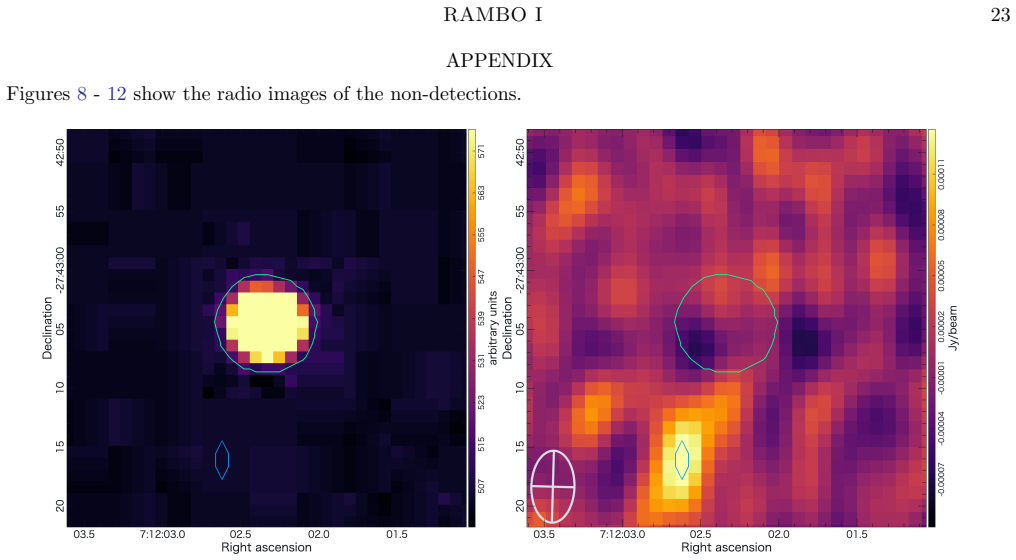
- [Sec. 4.3] The statement that the rms flux density is below the standard deviation is confusing; it should be clarified that the measured peak within the expected source region is below the image rms, leading to the reported 3-sigma upper limits.
- [Fig. 4 caption] The caption states that the bolometric solar luminosity is used as a constant scaling term for both axes but does not define whether L_radio is bolometric or frequency-integrated radio luminosity; please clarify the axes labels and the exact quantity plotted.
Circularity Check
No significant circularity: the HD55522 detection is an independent measurement, and the CBO comparison is an openly calibrated empirical scaling rather than a hidden reuse of the target's own data.
full rationale
The central claim is a new 650 MHz flux measurement, Fnu=650MHz = (164 +/- 26) microJy, reduced from uGMRT visibilities with standard calibration; this does not depend on the CBO model. The luminosity comparison uses LCBO from independent stellar parameters (Equation 5) and Lradio from the measured flux plus a stated SED convention (Equations 3-4). The 10^-8 factor in the CBO-radio relation is explicitly described in Section 2.4 as an empirical correction calibrated to previously detected sources, not derived in this paper; using it to place HD55522 on the same diagram is a calibration test with one new independent point, not a fit of the target. The paper also explicitly flags in Section 6.1.1 that the F650 = Fpeak assumption and the trapezoid SED's zero-flux low-frequency cutoff are inconsistent with observed low-frequency emission, so any resulting luminosity uncertainty is an acknowledged systematic effect rather than a circular step. There are no load-bearing self-citations: Shultz et al. (2022) and Owocki et al. (2022) are external works with no author overlap with the present paper's authors, and the locally cited works by Keszthelyi and Takahashi are not used to justify the CBO comparison. The model-support conclusion is therefore weaker than a first-principles prediction because the normalization is empirical, but it does not reduce to the paper's inputs by construction. Selection of targets in the CBO-preferred parameter space is a statistical and interpretive caveat, not circularity, since the detection itself is an independent observable.
Assumptions & free parameters
free parameters (4)
- CBO-to-radio luminosity scaling factor =
10^-8
- SED bandwidth Delta-nu =
6.4 x 10^10 Hz
- Assumed obliquity beta for CPD-271791 =
90 degrees
- Estimated inclination i for HD36668 =
60 degrees
assumptions (5)
- domain assumption The multipole index p=1 (split-monopole) is used in the CBO luminosity scaling (Eq. 5), following Shultz et al. (2022).
- domain assumption Stellar parameters (effective temperature, mass, radius, rotation period) and distances from the literature and GAIA are accurate to within stated uncertainties.
- domain assumption The radio source is at the phase center and is a point source, so the intensity I [Jy/beam] equals the flux density Fnu.
- domain assumption A dipole magnetic field geometry is assumed for reconstructing Bz phase curves and interpreting radio phases.
- domain assumption Flux density is constant over each observing epoch; variability is interpreted as rotational phase modulation rather than intrinsic stochastic flaring.
Cite this review
Pith. "Pith review of RAMBO I: Project introduction and first results with uGMRT." pith.science (2026). https://pith.science/paper/S7TKXEM6
@misc{pith2026241117032,
  author       = {Pith},
  title        = {Pith review of: RAMBO I: Project introduction and first results with uGMRT},
  year         = {2026},
  howpublished = {\url{https://pith.science/paper/S7TKXEM6}},
  note         = {Machine review of arXiv:2411.17032}
}
read the original abstract
Magnetic hot stars can emit both coherent and incoherent non-thermal radio emission. Understanding the nature of these emissions and their connection to stellar rotation and magnetic field characteristics remains incomplete. The RAdio Magnetospheres of B and O stars (RAMBO) project aims to address this gap by systematically detecting and characterizing gyrosynchrotron and cyclotron maser radio emission in rapidly rotating magnetic hot stars. Using the upgraded Giant Metrewave Radio Telescope, we present the first detection of radio emission from HD55522 at 650 MHz, confirming it as a new radio-bright magnetic hot star. This supports the predictions of the Centrifugal Breakout model, furthering its application in understanding particle acceleration mechanisms in centrifugal magnetospheres of hot stars. Additionally, we report non-detections for four other targets, improving sensitivity limits by a factor of a few compared to previous observations. These findings demonstrate the potential of RAMBO to uncover the complexities of radio emission in massive stars and highlight the need for broader, multi-wavelength observations to probe magnetospheric physics comprehensively. The sensitivity of the Square Kilometre Array will enable significant advancements.
Figures


Figures from the paper (9 more)





Reference graph
Works this paper leans on
-
[1]
, " * write output.state after.block = add.period write newline
ENTRY address archivePrefix author booktitle chapter doi edition editor eprint howpublished institution journal key month number organization pages publisher school series title misctitle type volume year version url label extra.label sort.label short.list INTEGERS output.state before.all mid.sentence after.sentence after.block FUNCTION init.state.consts ...
-
[2]
write newline
" write newline "" before.all 'output.state := FUNCTION format.url url empty "" new.block "" url * "" * if FUNCTION format.eprint eprint empty "" archivePrefix empty "" archivePrefix "arXiv" = new.block " " eprint * " " * new.block " " eprint * " " * if if if FUNCTION format.doi doi empty "" " " doi * " " * if FUNCTION format.pid doi empty eprint empty ur...
-
[3]
HWD?ދX赋R * (-t H& :! Mvw6z 9gΜ IOΙ960 | e ,C ` @X 2 ! e ,C ` @X& ?ti9sFiii*W*U͛+
thebibliography [1] 20pt to REFERENCES 6pt =0pt -12pt 10pt plus 3pt =0pt =0pt =1pt plus 1pt =0pt =0pt -12pt =13pt plus 1pt =20pt =13pt plus 1pt \@M =10000 =-1.0em =0pt =0pt 0pt =0pt =1.0em @enumiv\@empty 10000 10000 `\.\@m \@noitemerr \@latex@warning Empty `thebibliography' environment \@ifnextchar \@reference \@latexerr Missing key on reference command E...
2021
-
[4]
Adelman , S. J. 2000 a , , 146, 13, 10.1051/aas:2000261
-
[5]
2000 b , , 357, 548
---. 2000 b , , 357, 548
2000
-
[6]
J., & Boyce , P
Adelman , S. J., & Boyce , P. W. 1995, , 114, 253
1995
-
[7]
Aerts , C., Molenberghs , G., Kenward , M. G., & Neiner , C. 2014, , 781, 88, 10.1088/0004-637X/781/2/88
-
[8]
1997, , 323, 121
Babel , J., & Montmerle , T. 1997, , 323, 121
1997
Show all 107 references
-
[9]
D., & Izzo , C
Bagnulo , S., Fossati , L., Landstreet , J. D., & Izzo , C. 2015, , 583, A115, 10.1051/0004-6361/201526497
2015 doi
-
[10]
D., & Landstreet , J
Bailey , J. D., & Landstreet , J. D. 2013, , 551, A30, 10.1051/0004-6361/201220671
2013 doi
-
[11]
2020, , 493, 3293, 10.1093/mnras/staa462
Bernhard , K., H \"u mmerich , S., & Paunzen , E. 2020, , 493, 3293, 10.1093/mnras/staa462
2020 doi
-
[12]
2023, , 523, 5155, 10.1093/mnras/stad1756
Biswas , A., Das , B., Chandra , P., et al. 2023, , 523, 5155, 10.1093/mnras/stad1756
2023 doi
-
[13]
D., Ravi , V., Belov , K
Bochenek , C. D., Ravi , V., Belov , K. V., et al. 2020, , 587, 59, 10.1038/s41586-020-2872-x
2020 doi
-
[14]
2018, , 618, A110, 10.1051/0004-6361/201832722
Bodensteiner , J., Baade , D., Greiner , J., & Langer , N. 2018, , 618, A110, 10.1051/0004-6361/201832722
2018 doi
-
[15]
A., Landstreet , J
Bohlender , D. A., Landstreet , J. D., & Thompson , I. B. 1993, , 269, 355
1993
-
[16]
Borra , E. F. 1981, , 249, L39, 10.1086/183654
1981 doi
-
[17]
F., Landstreet , J
Borra , E. F., Landstreet , J. D., & Thompson , I. 1983, , 53, 151, 10.1086/190889
1983 doi
-
[18]
M., & Dorn-Wallenstein , T
Bowman , D. M., & Dorn-Wallenstein , T. Z. 2022, , 668, A134, 10.1051/0004-6361/202243545
2022 doi
-
[19]
M., Burssens , S., Pedersen , M
Bowman , D. M., Burssens , S., Pedersen , M. G., et al. 2019, Nature Astronomy, 3, 760, 10.1038/s41550-019-0768-1
2019 doi
-
[20]
Braithwaite , J., & Spruit , H. C. 2017, Royal Society Open Science, 4, 160271, 10.1098/rsos.160271
2017 doi
-
[21]
A., Keane , E., & Wagg , J
Braun , R., Bourke , T., Green , J. A., Keane , E., & Wagg , J. 2015, in Advancing Astrophysics with the Square Kilometre Array (AASKA14), 174, 10.22323/1.215.0174
2015 doi
-
[22]
2004, , 413, 273, 10.1051/0004-6361:20031450
Briquet , M., Aerts , C., L \"u ftinger , T., et al. 2004, , 413, 273, 10.1051/0004-6361:20031450
2004 doi
-
[23]
D., Bychkova , L
Bychkov , V. D., Bychkova , L. V., & Madej , J. 2021, , 652, A31, 10.1051/0004-6361/202040215
2021 doi
-
[24]
A., Sundqvist , J
Chandra , P., Wade , G. A., Sundqvist , J. O., et al. 2015, , 452, 1245, 10.1093/mnras/stv1378
2015 doi
-
[25]
C., Bandura , K
CHIME/FRB Collaboration , Andersen , B. C., Bandura , K. M., et al. 2020, , 587, 54, 10.1038/s41586-020-2863-y
2020 doi
-
[26]
2021, , 921, 9, 10.3847/1538-4357/ac1075
Das , B., & Chandra , P. 2021, , 921, 9, 10.3847/1538-4357/ac1075
2021 doi
- [27]
-
[28]
2022 a , , 515, 2008, 10.1093/mnras/stac1894
Das , B., Chandra , P., & Petit , V. 2022 a , , 515, 2008, 10.1093/mnras/stac1894
2022 doi
- [29]
-
[30]
E., et al
Das , B., Chandra , P., Shultz , M. E., et al. 2022 b , , 517, 5756, 10.1093/mnras/stac3123
2022 doi
-
[31]
E., & Wade , G
Das , B., Chandra , P., Shultz , M. E., & Wade , G. A. 2019, , 877, 123, 10.3847/1538-4357/ab1b12
2019 doi
-
[32]
Das , B., Chandra , P., & Wade , G. A. 2018, , 474, L61, 10.1093/mnrasl/slx193
2018 doi
- [33]
-
[34]
E., et al
Das , B., Chandra , P., Shultz , M. E., et al. 2022 c , , 925, 125, 10.3847/1538-4357/ac2576
2022 doi
-
[35]
2002, , 393, 965, 10.1051/0004-6361:20021068
De Cat , P., & Aerts , C. 2002, , 393, 965, 10.1051/0004-6361:20021068
2002 doi
-
[36]
E., Hall , P
Dewdney , P. E., Hall , P. J., Schilizzi , R. T., & Lazio , T. J. L. W. 2009, IEEE Proceedings, 97, 1482, 10.1109/JPROC.2009.2021005
2009
-
[37]
F., & Landstreet , J
Donati , J. F., & Landstreet , J. D. 2009, , 47, 333, 10.1146/annurev-astro-082708-101833
2009 doi
-
[38]
A., Abbott , D
Drake , S. A., Abbott , D. C., Bastian , T. S., et al. 1987, , 322, 902, 10.1086/165784
1987 doi
- [39]
-
[40]
2011, , 414, 2602, 10.1111/j.1365-2966.2011.18575.x
Dubath , P., Rimoldini , L., S \"u veges , M., et al. 2011, , 414, 2602, 10.1111/j.1365-2966.2011.18575.x
2011
-
[41]
1994, , 291, 919
Farthmann , M., Dreizler , S., Heber , U., & Hunger , K. 1994, , 291, 919
1994
-
[42]
2015, , 582, A45, 10.1051/0004-6361/201526725
Fossati , L., Castro , N., Sch \"o ller , M., et al. 2015, , 582, A45, 10.1051/0004-6361/201526725
2015 doi
-
[43]
F., Hiltner , W
Garrison , R. F., Hiltner , W. A., & Schild , R. E. 1977, , 35, 111, 10.1086/190468
1977 doi
-
[44]
A., et al
Geen , S., Agrawal , P., Crowther , P. A., et al. 2023, , 135, 021001, 10.1088/1538-3873/acb6b5
2023 doi
-
[45]
Glagolevskij , Y. V. 2010, Astrophysical Bulletin, 65, 34, 10.1134/S1990341310010049
2010 doi
-
[46]
Gontcharov , G. A. 2006, Astronomy Letters, 32, 759, 10.1134/S1063773706110065
2006 doi
-
[47]
H., Wade , G
Grunhut , J. H., Wade , G. A., Neiner , C., et al. 2017, , 465, 2432, 10.1093/mnras/stw2743
2017 doi
-
[48]
2022, , 665, A152, 10.1051/0004-6361/202243784
Hajduk , M., Leto , P., Vedantham , H., et al. 2022, , 665, A152, 10.1051/0004-6361/202243784
2022 doi
-
[49]
T., Jagannathan , P., Mooley , K
Intema , H. T., Jagannathan , P., Mooley , K. P., & Frail , D. A. 2017, , 598, A78, 10.1051/0004-6361/201628536
2017 doi
-
[50]
P., Hubrig , S., Ilyin , I., et al
J \"a rvinen , S. P., Hubrig , S., Ilyin , I., et al. 2018, , 618, L2, 10.1051/0004-6361/201833171
2018 doi
-
[51]
2024, , 531, 1776, 10.1093/mnras/stae1273
Kajan , M., Krti c ka , J., & Kub \'a t , J. 2024, , 531, 1776, 10.1093/mnras/stae1273
2024 doi
-
[52]
2023, Galaxies, 11, 40, 10.3390/galaxies11020040
Keszthelyi , Z. 2023, Galaxies, 11, 40, 10.3390/galaxies11020040
2023 doi
-
[53]
2019, , 485, 5843, 10.1093/mnras/stz772
Keszthelyi , Z., Meynet , G., Georgy , C., et al. 2019, , 485, 5843, 10.1093/mnras/stz772
2019 doi
-
[54]
E., et al
Keszthelyi , Z., Meynet , G., Shultz , M. E., et al. 2020, , 493, 518, 10.1093/mnras/staa237
2020 doi
-
[55]
2006, , 450, 763, 10.1051/0004-6361:20054596
Kochukhov , O., & Bagnulo , S. 2006, , 450, 763, 10.1051/0004-6361:20054596
2006 doi
-
[56]
2023, , 75, S138, 10.1093/pasj/psac098
Kurahara , K., Akahori , T., Kale , R., et al. 2023, , 75, S138, 10.1093/pasj/psac098
2023 doi
-
[57]
2017, , 465, 2160, 10.1093/mnras/stw2838
Kurapati , S., Chandra , P., Wade , G., et al. 2017, , 465, 2160, 10.1093/mnras/stw2838
2017 doi
-
[58]
R., Kaplan , D
Lenc , E., Murphy , T., Lynch , C. R., Kaplan , D. L., & Zhang , S. N. 2018, , 478, 2835, 10.1093/mnras/sty1304
2018 doi
-
[59]
S., Leone , F., & Umana , G
Leto , P., Trigilio , C., Buemi , C. S., Leone , F., & Umana , G. 2012, , 423, 1766, 10.1111/j.1365-2966.2012.20997.x
2012
-
[60]
S., Umana , G., & Leone , F
Leto , P., Trigilio , C., Buemi , C. S., Umana , G., & Leone , F. 2006, , 458, 831, 10.1051/0004-6361:20054511
2006 doi
-
[61]
2017, , 467, 2820, 10.1093/mnras/stx267
Leto , P., Trigilio , C., Oskinova , L., et al. 2017, , 467, 2820, 10.1093/mnras/stx267
2017 doi
-
[62]
M., et al
Leto , P., Trigilio , C., Oskinova , L. M., et al. 2018, , 476, 562, 10.1093/mnras/sty244
2018 doi
-
[63]
2021, , 507, 1979, 10.1093/mnras/stab2168
Leto , P., Trigilio , C., Krti c ka , J., et al. 2021, , 507, 1979, 10.1093/mnras/stab2168
2021 doi
-
[64]
M., Buemi , C
Leto , P., Oskinova , L. M., Buemi , C. S., et al. 2022, , 515, 5523, 10.1093/mnras/stac2163
2022 doi
-
[65]
A., & Linsky , J
Lim , J., Drake , S. A., & Linsky , J. L. 1996, in Astronomical Society of the Pacific Conference Series, Vol. 93, Radio Emission from the Stars and the Sun, ed. A. R. Taylor & J. M. Paredes , 324
1996
-
[66]
L., Drake , S
Linsky , J. L., Drake , S. A., & Bastian , T. S. 1989, in Bulletin of the American Astronomical Society, Vol. 21, 742
1989
-
[67]
L., Drake , S
Linsky , J. L., Drake , S. A., & Bastian , T. S. 1992, , 393, 341, 10.1086/171509
1992 doi
- [68]
-
[69]
2023, Research Notes of the American Astronomical Society, 7, 158, 10.3847/2515-5172/acebcf
Monier , R. 2023, Research Notes of the American Astronomical Society, 7, 158, 10.3847/2515-5172/acebcf
2023 doi
-
[70]
2014, , 215, 10, 10.1088/0067-0049/215/1/10
Naz \'e , Y., Petit , V., Rinbrand , M., et al. 2014, , 215, 10, 10.1088/0067-0049/215/1/10
2014 doi
-
[71]
M., North , P., & Hubrig , S
Netopil , M., Paunzen , E., Maitzen , H. M., North , P., & Hubrig , S. 2008, , 491, 545, 10.1051/0004-6361:200810325
2008 doi
-
[72]
R., McKinley , B., Hurley-Walker , N., et al
Offringa , A. R., McKinley , B., Hurley-Walker , N., et al. 2014, , 444, 606, 10.1093/mnras/stu1368
2014 doi
-
[73]
P., & Cranmer , S
Owocki , S. P., & Cranmer , S. R. 2018, , 474, 3090, 10.1093/mnras/stx2989
2018 doi
-
[74]
P., Shultz , M
Owocki , S. P., Shultz , M. E., ud-Doula , A., et al. 2022, , 513, 1449, 10.1093/mnras/stac341
2022 doi
- [75]
-
[76]
2021, , 504, 3758, 10.1093/mnras/stab1100
Paunzen , E., Sup \' kov \'a , J., Bernhard , K., H \"u mmerich , S., & Pri s egen , M. 2021, , 504, 3758, 10.1093/mnras/stab1100
2021 doi
-
[77]
1979, , 35, 313
Pedersen , H. 1979, , 35, 313
1979
-
[78]
1977, , 30, 11
Pedersen , H., & Thomsen , B. 1977, , 30, 11
1977
-
[79]
2014, , 126, 469, 10.1086/676976
Petit , P., Louge , T., Th \'e ado , S., et al. 2014, , 126, 469, 10.1086/676976
2014 doi
-
[80]
P., Wade , G
Petit , V., Owocki , S. P., Wade , G. A., et al. 2013, , 429, 398, 10.1093/mnras/sts344
2013 doi
-
[81]
2017, , 466, 1052, 10.1093/mnras/stw3126
Petit , V., Keszthelyi , Z., MacInnis , R., et al. 2017, , 466, 1052, 10.1093/mnras/stw3126
2017 doi
-
[82]
2023, , 958, 152, 10.3847/1538-4357/ad0295
Polisensky , E., Das , B., Peters , W., et al. 2023, , 958, 152, 10.3847/1538-4357/ad0295
2023 doi
-
[83]
M., & Adelman , S
Pyper , D. M., & Adelman , S. J. 2021, , 133, 084203, 10.1088/1538-3873/ac1ac0
2021 doi
-
[84]
Renson , P., & Catalano , F. A. 2001, , 378, 113, 10.1051/0004-6361:20011065
2001 doi
-
[85]
1981, , 44, 23
Renson , P., & Manfroid , J. 1981, , 44, 23
1981
-
[86]
I., Semenko , E
Romanyuk , I. I., Semenko , E. A., Moiseeva , A. V., Yakunin , I. A., & Kudryavtsev , D. O. 2021, Astrophysical Bulletin, 76, 39, 10.1134/S1990341321010090
2021 doi
-
[87]
I., Semenko , E
Romanyuk , I. I., Semenko , E. A., Yakunin , I. A., Kudryavtsev , D. O., & Moiseeva , A. V. 2017, Astrophysical Bulletin, 72, 165, 10.1134/S1990341317020079
2017 doi
-
[88]
Schneider , F. R. N., Ohlmann , S. T., Podsiadlowski , P., et al. 2020, , 495, 2796, 10.1093/mnras/staa1326
2020 doi
-
[89]
2023, , 955, 123, 10.3847/1538-4357/acf197
Shen , D.-X., Li , G., Abdusamatjan , I., et al. 2023, , 955, 123, 10.3847/1538-4357/acf197
2023 doi
-
[90]
E., Wade , G
Shultz , M. E., Wade , G. A., Rivinius , T., et al. 2018, , 475, 5144, 10.1093/mnras/sty103
2018 doi
- [91]
- [92]
-
[93]
E., Owocki , S., Rivinius , T., et al
Shultz , M. E., Owocki , S., Rivinius , T., et al. 2020, , 499, 5379, 10.1093/mnras/staa3102
2020 doi
-
[94]
E., Owocki , S
Shultz , M. E., Owocki , S. P., ud-Doula , A., et al. 2022, , 513, 1429, 10.1093/mnras/stac136
2022 doi
-
[95]
2021, , 655, A17, 10.1051/0004-6361/202039659
Stein , Y., Vollmer , B., Boch , T., et al. 2021, , 655, A17, 10.1051/0004-6361/202039659
2021 doi
-
[96]
2021, , 646, A19, 10.1051/0004-6361/202039253
Takahashi , K., & Langer , N. 2021, , 646, A19, 10.1051/0004-6361/202039253
2021 doi
- [97]
-
[98]
Topil'Skaya , G. P. 1993, Bulletin of the Special Astrophysics Observatory, 36, 52
1993
-
[99]
Townsend , R. H. D., & Owocki , S. P. 2005, , 357, 251, 10.1111/j.1365-2966.2005.08642.x
2005
-
[100]
Trigilio , C., Leto , P., Umana , G., Leone , F., & Buemi , C. S. 2004, , 418, 593, 10.1051/0004-6361:20040060
2004 doi
-
[101]
P., Russell , C., Gagn \'e , M., & Daley-Yates , S
ud-Doula , A., Owocki , S. P., Russell , C., Gagn \'e , M., & Daley-Yates , S. 2023, , 520, 3947, 10.1093/mnras/stad345
2023 doi
-
[102]
A., Neiner , C., Alecian , E., et al
Wade , G. A., Neiner , C., Alecian , E., et al. 2016, , 456, 2, 10.1093/mnras/stv2568
2016 doi
-
[103]
Walborn , N. R. 1983, , 268, 195, 10.1086/160944
1983 doi
-
[104]
M., & Pritchett , P
Winglee , R. M., & Pritchett , P. L. 1986, , 91, 13531, 10.1029/JA091iA12p13531
1986 doi
- [105]
- [106]
-
[107]
1999, , 345, 244
Zboril , M., & North , P. 1999, , 345, 244
1999
Reviewed August 12, 2026 · model on record in the stance chip above.
Discussion (0). Continue with ORCID to comment.