REVIEW 3 major objections 3 minor 47 references
Boulder migration in the Khonsu region of comet 67P/Churyumov-Gerasimenko
T0 review · 3 major / 3 minor · reviewed 2026-08-12 · deepseek-v4-flash
Pith's one-line read A ~30-meter boulder on comet 67P shifted ~140 meters within a 14-hour window on 2015 October 3, and the authors propose that uneven heating and outgassing of the boulder itself helped trigger the displacement.
desk verdict Useful and honest paper that narrows a 67P boulder migration to a 14-hour window, but the marquee claim sits on a 1.5-pixel visual identification against a shape model that contains the boulder at both locations—so the number is plausible but not yet airtight. read the letter →
The pith
A machine-rendered reading of the paper's core claim, the machinery that carries it, and where it could break.
The reading
What carries the argument
The central tool is synthetic-image matching against the stereo-photogrammetric SHAP7 shape model of comet 67P (~4 m horizontal resolution, 1 million vertices). Because the shape model was built from images spanning the whole mission, it contains the migrating boulder at both its original and final locations, so synthetic views with realistic ray-traced illumination can be blinked against actual low-resolution OSIRIS images (~20 m/pixel) to tell which side of the migration the boulder is on. The second component is a 1-D facet-wise thermophysical model that conserves energy and volatile mass, used to reconstruct the diurnal and orbital temperature and sublimation-flux history of the boulder's southern and northern sides. Together these yield the 14-hour timing constraint and the thermal asymmetry that underpins the proposed 'rocket force' mechanism.
What would settle it
If a reprojection of the October 3 09:26 or 22:49 images with a refined shape model or slightly different camera pointing placed the boulder's shadow on the opposite side of the migration, or if a higher-resolution image from the same day under better illumination showed the boulder absent from both locations, the 14-hour window would be falsified.
Extended reading notes
Core claim
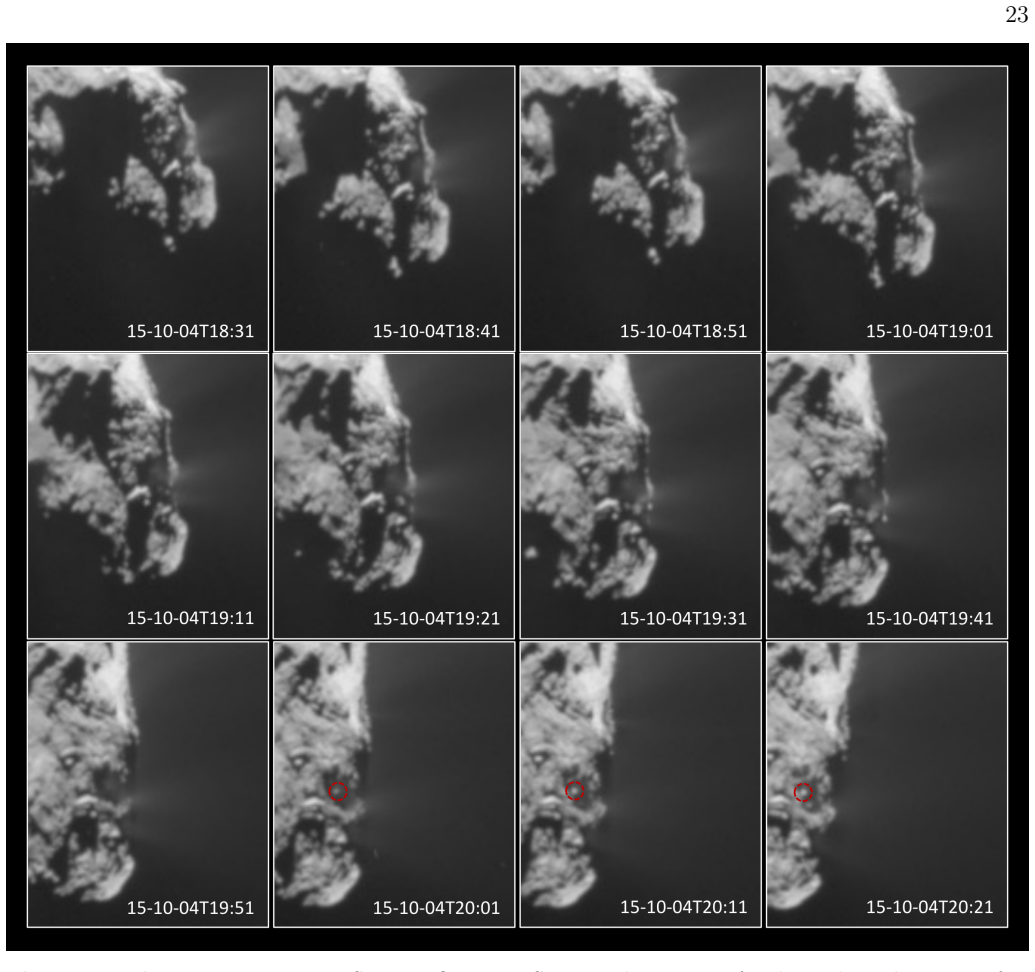
The paper establishes that the ~30-m boulder in Khonsu migrated ~140 m on 2015 October 3 between 09:26 and 22:49 UTC, a window of under 14 hours, by blinking OSIRIS NAC images against synthetic renders of the SHAP7 shape model. This makes the displacement a sudden event rather than a gradual process. The same analysis finds a mini-outburst at 19:30 UTC on the migration day emanating from near the boulder's new location, and another mini-outburst two rotations later, plus a jet on October 9. Facet-wise thermophysical modeling shows the boulder's southern side had been illuminated almost continuously for over 150 rotations, received roughly twice the cumulative insolation of the northern side, and reached orbital-maximum temperatures near 225 K at 10 cm depth at the time of migration, while the northern side was in a cold 'winter' state. The authors therefore argue that asymmetric sublimation from the boulder's own interior could have exerted a net propulsion toward the north, complementing the earlier hypotheses of direct outburst, erosion, or seismic destabilization; the actual trigger may have been a combination.
Load-bearing premise
The load-bearing premise is that the SHAP7 shape model, with its ~4-meter horizontal resolution, faithfully represents the 30-meter boulder and its surroundings in both the pre- and post-migration states, so that the boulder's shadow in ~20 m/pixel images can be trusted to place it at one location or the other.
Editorial extensions
If this is right
- The 14-hour constraint shows the boulder moved in a sudden, event-like displacement rather than through gradual creep, since the window is barely longer than one 12.4-hour rotation.
- Night-time mini-outbursts occurred on the migration day and the following rotation near the boulder's new position, indicating a spatial and temporal link between local dust activity and the displacement.
- Thermal modeling predicts that at migration time the boulder's southern side, 10 cm below the surface, was at its orbital maximum temperature (~225 K), a state favorable for sublimation of volatiles at depth.
- If uneven outgassing contributed, large boulders on comets can act as self-propelled objects, a mechanism that has not been considered for tens-of-meters-scale blocks before.
- The two Khonsu 'jumping boulders' may share a common triggering scenario, either ejection by an outburst or self-propulsion, though the other boulder's original position is unknown.
Reading between the lines
- If the migration truly happened in the afternoon of October 3, the peak in surface temperature on the boulder's southern side (~15:00 UTC) points to a thermal-stress or sublimation trigger; one could test this by checking whether other large boulder displacements on 67P cluster in local afternoon.
- The proposed self-propulsion mechanism would be most convincing if the boulder's actual shape produces a net force direction roughly downslope; a numerical simulation using the SHAP7 facet geometry and the modeled outgassing could show whether the estimated acceleration is sufficient to overcome static friction on a ~25° slope.
- The synthetic-image matching technique, treating a moving object as present at two locations in a single shape model, could be applied to other candidate surface changes on 67P (e.g., the other Khonsu boulder) to shrink their timing windows.
- A direct search for fresh albedo or exposure changes at the original site using the highest-resolution post-migration images, or a re-analysis with a shape model that excludes the boulder's dual presence, would test whether the identification at the new location is robust.
Editorial analysis
A structured set of objections, weighed in public.
Referee Report
Summary. The paper reanalyzes Rosetta/OSIRIS imaging to constrain the timing of a ~30 m boulder's ~140 m displacement in the Khonsu region of comet 67P. Using the SHAP7 stereo-photogrammetric shape model and synthetic-image matching, it claims the boulder was still at its original position at 09:26 UTC on 2015 October 3 and had arrived at its new position by 22:49 UTC, yielding a migration window of within 14 hours. The paper also reports night-time mini-outbursts near the new location, documents morphological changes in the surrounding area, and applies a 1-D thermophysical model (Hu & Shi 2021) to local facets. The model shows a pronounced insolation and temperature dichotomy between the boulder's southern and northern sides, and the authors propose that the boulder's own sublimation-driven activity may have contributed to or triggered the migration.
Significance. If the 14-hour timing claim withstands scrutiny, it would be the best-constrained large-boulder migration event observed on a cometary nucleus, demonstrating a sudden, burst-like displacement rather than gradual creep, and enabling a direct search for coincident activity. The paper exploits unique Rosetta data, provides a clear observational catalog in Table 1, and uses a published thermophysical model without tuning its parameters to reproduce the migration, which is a methodological strength. However, the central timing constraint rests on identifying a ~2-pixel boulder in ~20 m/pix images, and the synthetic comparisons are partly circular because the shape model contains the boulder at both its pre- and post-migration locations. The proposed self-propulsion mechanism is also quantitatively weak by the authors' own estimate. These issues need to be addressed before the central claims can be considered robust.
major comments (3)
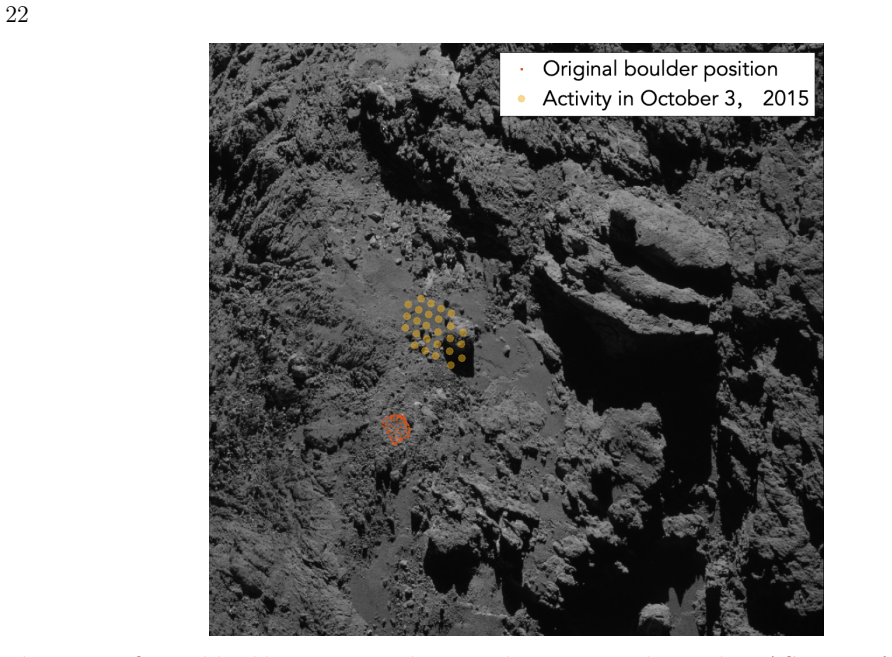
- [Sec. 3.1, Fig. 4; Sec. 3, Fig. 1a] The 14-hour migration window is based on visually matching ~20 m/pix NAC images against synthetic renderings of SHAP7, a shape model that contains the boulder at both its pre- and post-migration positions because it was derived from images spanning the migration (Sec. 3, Fig. 1a). Consequently, the synthetic image used for the 09:26 detection contains a boulder at the original location by construction, so agreement between the real and synthetic images does not independently establish the boulder's presence there at 09:26. The paper provides no quantitative match metric, residual map, or pointing/registration uncertainty for this key detection. If the 'lengthened shadow' at 09:26 is not uniquely attributable to the boulder, the constraint degrades to the Sep 26 - Oct 3 interval. Please add a quantitative registration analysis, for example by measuring residuals against fixed landmarks and by testing whether masking the boulder in the shape model removes the observed signal at the original location.
- [Sec. 3.3, Fig. 6a] The paper states that the source of the 19:30 mini-outburst is 'unclear whether the outburst is from the unilluminated boulder itself or its surroundings,' and that 'the identification of the boulder at its new location is subject to the accuracy of the shape model.' These admissions are important: the coincident dust activity on October 3 is not established to be directly associated with the migration, and the boulder's arrival at the new location by 22:49 is not as secure as the text in Sec. 3.1 implies. The timeline in Fig. 7 should visibly distinguish confirmed boulder locations from activity whose source is ambiguous, and the 'coincident activity' interpretation should be softened accordingly.
- [Sec. 4; Sec. 5.3] The proposed self-propulsion scenario (Scenario C) is not quantitatively supported by the paper's own numbers: a mean water-vapor flux of ~3.2 x 10^-5 kg m^-2 s^-1 at facet S yields an acceleration of ~2 x 10^-5 m s^-2, one order of magnitude smaller than the local gravitational acceleration of ~2 x 10^-4 m s^-2. The paper acknowledges this shortfall but nonetheless presents the mechanism as viable. To make Scenario C convincing, the authors need to show how the net force could exceed gravity, for example by invoking supervolatile (CO2) sublimation at depth or by computing the reduced force needed to initiate rolling on a ~25-degree slope. As written, Scenario C is a qualitative suggestion rather than a demonstrated mechanism.
minor comments (3)
- [Table 2] The symbol f0 is used for both the dust volume-filling fraction (0.2) and the initial ice volume fraction (0.1); please use distinct symbols to avoid ambiguity in the parameter definitions.
- [Sec. 3.1] The statement that the boulder 'extends over only two pixels' is slightly inconsistent with a ~30 m boulder at ~19-20 m/pix, which corresponds to roughly 1.5 pixels; please phrase this as 'one to two pixels.'
- [Eqs. (1)-(2) and Sec. 4] The model equations do not explicitly state the surface boundary condition that couples the sublimation flux to the surface energy balance; a pointer to Hu & Shi (2021) is given, but a short statement of the surface boundary condition would make the reported flux values in Fig. 10 reproducible by the reader.
Circularity Check
No significant circularity: the 14-hour migration window is an observational timing constraint, and the thermophysical model is a non-fitted interpretive tool.
full rationale
The paper's central result—that the Khonsu boulder migrated within about 14 hours on 2015 October 3—is an observational timing constraint. It is derived by comparing two NAC images (09:26 and 22:49 UTC) and identifying shadow signatures of the boulder, not by fitting a model to the displacement. The SHAP7 shape model is used as a template for synthetic image comparison, and the authors acknowledge the identification at the new location is 'subject to the accuracy of the shape model' (Sec. 3.3). Although SHAP7 contains the boulder at both pre- and post-migration locations because it was constructed from images spanning August 2014 to February 2016, that dual existence does not encode the 14-hour timing; the temporal assignment comes from the actual images and their shadow features. The thermophysical modeling uses a co-authored prior code (Hu & Shi 2021) as a general tool with fixed literature-based parameters (Table 2), and it is not calibrated to reproduce the observed migration. The sublimation flux and 'rocket force' estimates are model outputs, not fitted constants, and are presented as a speculative scenario (Scenario C); the computed acceleration is one order of magnitude below surface gravity, so it does not amount to a forced prediction. No fitted parameter is renamed as a prediction, and no uniqueness claim is imported from the authors' prior work. The only self-citations are instrumental and non-load-bearing for the main timing result. The low-resolution identification and unquantified registration errors are legitimate precision/robustness limitations, not circular reductions. Therefore the circularity score is 2, reflecting a minor non-load-bearing self-citation, with no circular step found.
Assumptions & free parameters
free parameters (3)
- Initial ice volume fraction =
0.1
- Dust volume-filling fraction =
0.2
- Compact dust density =
2000 kg m^-3
assumptions (5)
- domain assumption SHAP7 shape model accurately represents the boulder's location, size, and surrounding topography at both pre- and post-migration epochs.
- domain assumption SPICE-derived spacecraft position and camera pointing are accurate enough for image-to-model registration at ~20 m per pixel resolution.
- domain assumption The thermophysical model of Hu & Shi 2021 with Table 2 parameters simulates subsurface temperature and ice sublimation relevant to the boulder.
- domain assumption Large boulders on 67P contain significant subsurface volatile ices, so sublimation from the boulder itself is possible.
- standard math Standard energy and mass conservation equations (Eq. 1-2) apply to the porous cometary surface.
Cite this review
Pith. "Pith review of Boulder migration in the Khonsu region of comet 67P/Churyumov-Gerasimenko." pith.science (2026). https://pith.science/paper/H5DLTDWE
@misc{pith2026241117108,
  author       = {Pith},
  title        = {Pith review of: Boulder migration in the Khonsu region of comet 67P/Churyumov-Gerasimenko},
  year         = {2026},
  howpublished = {\url{https://pith.science/paper/H5DLTDWE}},
  note         = {Machine review of arXiv:2411.17108}
}
read the original abstract
European Space Agency's Rosetta mission is the only space mission that performed long-term monitoring of comet at close distances. Its over two years' rendezvous with comet 67P/Churyumov-Gerasimenko revealed diverse evolutionary processes of the cometary nucleus. One of the most striking events is the migration of a 30-m boulder in the southern hemisphere region of Khonsu. Previous works found the boulder's 140-m displacement occurred during the three months from August to October 2015, and several triggering mechanisms were proposed, including outburst at the boulder site, seismic vibrations from nearby activities, or surface erosion of the slope beneath the boulder. In this work, we further analyze this impressive event by analysing imaging data from Rosetta's OSIRIS camera. We constrained the boulder's migration time to within 14 hours and derived a detailed timeline of the boulder migration event and local dust activities. High-resolution thermophysical modelling shows significant dichotomy in the thermal history of the boulder's southern and northern sides, which could have triggered or facilitated its migration via its own volatile activity.
Figures


Figures from the paper (12 more)




Reference graph
Works this paper leans on
-
[1]
Acton, C., Bachman, N., Semenov, B., & Wright, E. 2016, The International Archives of the Photogrammetry, Remote Sensing and Spatial Information Sciences, 41, 357
work page 2016
-
[2]
Agarwal , J., A'Hearn , M. F., Vincent , J. B., et al. 2016, , 462, S78, 10.1093/mnras/stw2179
- [3]
-
[4]
Barrington, M. N., Birch, S. P. D., Jindal, A., et al. 2023, Journal of Geophysical Research: Planets, 128, e2022JE007723, 10.1029/2022JE007723
-
[5]
2020, , 636, A91, 10.1051/0004-6361/202037485
Cambianica , P., Fulle , M., Cremonese , G., et al. 2020, , 636, A91, 10.1051/0004-6361/202037485
-
[6]
C., Capaccioni , F., Ciarniello , M., et al
De Sanctis , M. C., Capaccioni , F., Ciarniello , M., et al. 2015, , 525, 500, 10.1038/nature14869
-
[7]
R., Groussin, O., Thomas, N., et al
El-Maarry, M. R., Groussin, O., Thomas, N., et al. 2017, Science, 355, 1392
2017
-
[8]
2019, Astronomy & Astrophysics, 630, A7
Fornasier, S., Hoang, V., Hasselmann, P., et al. 2019, Astronomy & Astrophysics, 630, A7
work page 2019
Show all 47 references
-
[9]
H., Hasselmann , P
Fornasier , S., Hoang , V. H., Hasselmann , P. H., et al. 2019, , 630, A7, 10.1051/0004-6361/201833803
2019 doi
-
[10]
2016, , 462, S220, 10.1093/mnras/stw2088
Gr \"u n , E., Agarwal , J., Altobelli , N., et al. 2016, , 462, S220, 10.1093/mnras/stw2088
2016 doi
-
[11]
C., Altwegg , K., Berthelier , J
Hansen , K. C., Altwegg , K., Berthelier , J. J., et al. 2016, , 462, S491, 10.1093/mnras/stw2413
2016 doi
-
[12]
H., Barucci, M
Hasselmann, P. H., Barucci, M. A., Fornasier, S., et al. 2019, Astronomy & Astrophysics, 630, A8
2019
-
[13]
2021, The Astrophysical Journal, 910, 10, 10.3847/1538-4357/abddbf
Hu, X., & Shi, X. 2021, The Astrophysical Journal, 910, 10, 10.3847/1538-4357/abddbf
2021 doi
-
[14]
2017 a , Astronomy & Astrophysics, 604, A114, 10.1051/0004-6361/201629910
Hu, X., Shi, X., Sierks, H., et al. 2017 a , Astronomy & Astrophysics, 604, A114, 10.1051/0004-6361/201629910
2017 doi
-
[15]
2017 b , Monthly Notices of the Royal Astronomical Society, 469, S295, 10.1093/mnras/stx1607
---. 2017 b , Monthly Notices of the Royal Astronomical Society, 469, S295, 10.1093/mnras/stx1607
2017 doi
-
[16]
U., Barbieri, C., Lamy, P., et al
Keller, H. U., Barbieri, C., Lamy, P., et al. 2007, Space Science Reviews, 128, 433, 10.1007/s11214-006-9128-4
2007 doi
-
[17]
U., Mottola, S., Hviid, S
Keller, H. U., Mottola, S., Hviid, S. F., et al. 2017, Monthly Notices of the Royal Astronomical Society, 469, S357
2017
-
[18]
Y., Hviid, S
Knollenberg, J., Lin, Z. Y., Hviid, S. F., et al. 2016, Astronomy & Astrophysics, 596, A89, 10.1051/0004-6361/201527744
2016 doi
-
[19]
2019, , 331, 179, 10.1016/j.icarus.2019.05.019
Michikami , T., Honda , C., Miyamoto , H., et al. 2019, , 331, 179, 10.1016/j.icarus.2019.05.019
2019 doi
-
[20]
J., et al
Miyamoto, H., Yano, H., Scheeres, D. J., et al. 2007, Science, 316, 1011, 10.1126/science.1134390
2007 doi
-
[21]
R., Altwegg , K., Berthelier , J.-J., et al
M \"u ller , D. R., Altwegg , K., Berthelier , J.-J., et al. 2024, , 529, 2763, 10.1093/mnras/stae622
2024 doi
-
[22]
2021, Journal of Geophysical Research (Planets), 126, e06594, 10.1029/2020JE006594
Nishiyama , G., Kawamura , T., Namiki , N., et al. 2021, Journal of Geophysical Research (Planets), 126, e06594, 10.1029/2020JE006594
2021 doi
-
[23]
M., Pajola, M., et al
Oklay, N., Sunshine, J. M., Pajola, M., et al. 2016, Monthly Notices of the Royal Astronomical Society, 462, S394
2016
-
[24]
2020, Nature, 586, 697, 10.1038/s41586-020-2834-3
O’Rourke, L., Heinisch, P., Blum, J., et al. 2020, Nature, 586, 697, 10.1038/s41586-020-2834-3
2020 doi
-
[25]
2015, Astronomy & Astrophysics, 583, A37
Pajola, M., Vincent, J.-B., G \"u ttler, C., et al. 2015, Astronomy & Astrophysics, 583, A37
2015
-
[26]
2017, Nature Astronomy, 1, 0092
Pajola, M., H \"o fner, S., Vincent, J.-B., et al. 2017, Nature Astronomy, 1, 0092
2017
-
[27]
2022, , 659, A171, 10.1051/0004-6361/202141953
Pfeifer , M., Agarwal , J., & Schr \"o ter , M. 2022, , 659, A171, 10.1051/0004-6361/202141953
2022 doi
-
[28]
R., et al
Pommerol, A., Thomas, N., El-Maarry, M. R., et al. 2015, Astronomy and Astrophysics, 583, A25, 10.1051/0004-6361/201525977
2015 doi
-
[29]
2017, Astronomy & Astrophysics, 607, L1, 10.1051/0004-6361/201731798
Preusker, F., Scholten, F., Matz, K.-D., et al. 2017, Astronomy & Astrophysics, 607, L1, 10.1051/0004-6361/201731798
2017 doi
-
[30]
E., Steckloff , J
Richardson , J. E., Steckloff , J. K., & Minton , D. A. 2020, , 347, 113811, 10.1016/j.icarus.2020.113811
2020
-
[31]
2023, Monthly Notices of the Royal Astronomical Society, 526, 4209, 10.1093/mnras/stad3005
Rubin, M., Altwegg, K., Berthelier, J.-J., et al. 2023, Monthly Notices of the Royal Astronomical Society, 526, 4209, 10.1093/mnras/stad3005
2023 doi
-
[32]
2016, Astronomy & Astrophysics, 586, A7
Shi, X., Hu, X., Sierks, H., et al. 2016, Astronomy & Astrophysics, 586, A7
2016
-
[33]
2018, Nature Astronomy, 2, 562, 10.1038/s41550-018-0481-5
Shi , X., Hu , X., Mottola , S., et al. 2018, Nature Astronomy, 2, 562, 10.1038/s41550-018-0481-5
2018 doi
-
[34]
2024, The Astrophysical Journal Letters, 961, L16
Shi, X., Hu, X., Agarwal, J., et al. 2024, The Astrophysical Journal Letters, 961, L16
2024
-
[35]
L., et al
Sierks , H., Barbieri , C., Lamy , P. L., et al. 2015, Science, 347, aaa1044, 10.1126/science.aaa1044
2015 doi
-
[36]
V., Rezac , L., Hartogh , P., Bazilevsky , A
Skorov , Y. V., Rezac , L., Hartogh , P., Bazilevsky , A. T., & Keller , H. U. 2016, , 593, A76, 10.1051/0004-6361/201628365
2016 doi
-
[37]
2017, Philosophical Transactions of the Royal Society A: Mathematical, Physical and Engineering Sciences, 375, 20160262
Taylor, M., Altobelli, N., Buratti, B., & Choukroun, M. 2017, Philosophical Transactions of the Royal Society A: Mathematical, Physical and Engineering Sciences, 375, 20160262
2017
-
[38]
R., et al
Thomas , N., Davidsson , B., El-Maarry , M. R., et al. 2015, , 583, A17, 10.1051/0004-6361/201526049
2015 doi
-
[39]
R., Theologou , P., et al
Thomas , N., El Maarry , M. R., Theologou , P., et al. 2018, , 164, 19, 10.1016/j.pss.2018.05.019
2018 doi
-
[40]
2015, Astronomy & Astrophysics, 583, A46, 10.1051/0004-6361/201525985
Tubiana, C., Güttler, C., Kovacs, G., et al. 2015, Astronomy & Astrophysics, 583, A46, 10.1051/0004-6361/201525985
2015 doi
-
[41]
2019, in EPSC-DPS Joint Meeting 2019, Vol
Vincent , J.-B., Birch , S., Hayes , A., et al. 2019, in EPSC-DPS Joint Meeting 2019, Vol. 2019, EPSC--DPS2019--502
2019
-
[42]
2015, Nature, 523, 63
Vincent, J.-B., Bodewits, D., Besse, S., et al. 2015, Nature, 523, 63
2015
-
[43]
2016 a , Astronomy & Astrophysics, 587, A14
Vincent, J.-B., Oklay, N., Pajola, M., et al. 2016 a , Astronomy & Astrophysics, 587, A14
2016
-
[44]
F., Lin, Z.-Y., et al
Vincent, J.-B., A'Hearn, M. F., Lin, Z.-Y., et al. 2016 b , Monthly Notices of the Royal Astronomical Society, 462, S184
2016
-
[45]
, " * write output.state after.block = add.period write newline
ENTRY address archivePrefix author booktitle chapter doi edition editor eprint howpublished institution journal key month number organization pages publisher school series title misctitle type volume year version url label extra.label sort.label short.list INTEGERS output.stat...
-
[46]
write newline
" write newline "" before.all 'output.state := FUNCTION format.url url empty "" new.block "" url * "" * if FUNCTION format.eprint eprint empty "" archivePrefix empty "" archivePrefix "arXiv" = new.block " " eprint * " " * new.block " " eprint * " " * if if if FUNCTION format.d...
-
[47]
e O|r]g )[З C 1ɿ7l ثm9u
thebibliography [1] 20pt to REFERENCES 6pt =0pt -12pt 10pt plus 3pt =0pt =0pt =1pt plus 1pt =0pt =0pt -12pt =13pt plus 1pt =20pt =13pt plus 1pt \@M =10000 =-1.0em =0pt =0pt 0pt =0pt =1.0em @enumiv\@empty 10000 10000 `\.\@m \@noitemerr \@latex@warning Empty `thebibliography' en...
2021
Reviewed August 12, 2026 · model on record in the stance chip above.
Discussion (0). Continue with ORCID to comment.