REVIEW 4 major objections 4 minor 68 references
Distilling Spectral Graph for Object-Context Aware Open-Vocabulary Semantic Segmentation
T0 review · 4 major / 4 minor · reviewed 2026-08-12 · deepseek-v4-flash
Pith's one-line read A training-free method called CASS distills the low-rank spectral structure of a vision foundation model's attention graph into CLIP's attention and refines text embeddings with an object-presence prior, raising average mIoU by 3.0 points…
desk verdict A genuinely new training-free OVSS method with solid ablations and SOTA numbers, but the core equation is underspecified: it adds attention graphs that live on different token grids (DINO B/8 vs CLIP B/16), and no alignment is described. read the letter →
The pith
A machine-rendered reading of the paper's core claim, the machinery that carries it, and where it could break.
The reading
What carries the argument
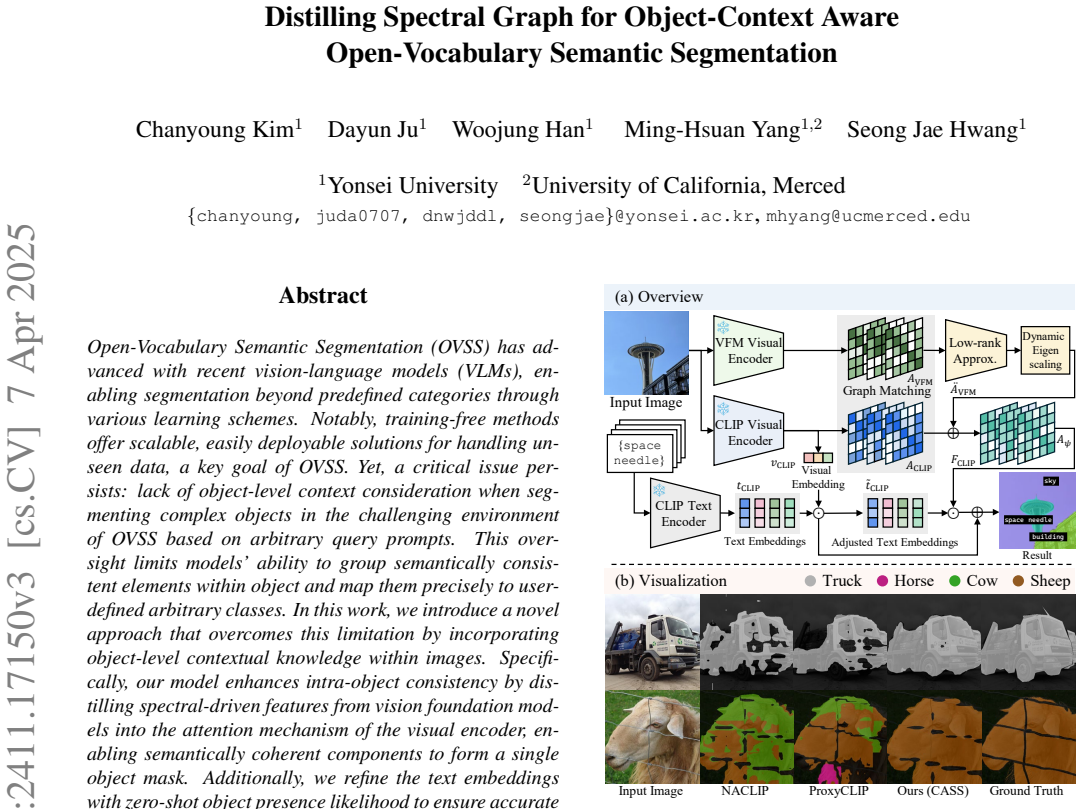
The central object is the VFM attention graph $A_{\mathrm{VFM}} = K_{\mathrm{VFM}}K_{\mathrm{VFM}}^{\top}$, treated as an adjacency matrix whose low-rank eigendecomposition is supposed to carry object-level grouping structure. The argument runs through complementary spectral graph matching: eigenvalues of each attention head of $A_{\mathrm{VFM}}$ and of CLIP's $A_{\mathrm{CLIP}}$ are normalized, compared by Wasserstein distance, and paired by Hungarian matching so that structurally contrasting heads are aggregated. The distilled head is $A^{j}_{\psi} = (w_{ij}\ddot{A}^{i}_{\mathrm{VFM}} + A^{j}_{\mathrm{CLIP}})/(w_{ij}+1)$, where $\ddot{A}^{i}_{\mathrm{VFM}}$ comes from an energy-based low-rank approximation with dynamic eigenscaling and $w_{ij}$ is the spectral distance. A second mechanism computes an object-presence prior $P(i) = t^{i}_{\mathrm{CLIP}} \cdot v_{\mathrm{CLIP}}$ from the CLIP [CLS] token, then uses it to cluster and shift text embeddings toward image-specific semantics and to blend patch-text similarities.
What would settle it
Run the full CASS pipeline on PASCAL VOC V21 with the complementary matching replaced by random head pairing or by maximum-similarity pairing, keeping low-rank eigenscaling and the object-presence modules unchanged; if the 65.8 mIoU result persists, complementary spectral matching is not the driver.
Extended reading notes
Core claim
The central claim is that object-level context can be transferred between two frozen models at inference time by treating attention maps as graphs and distilling their spectral backbone. Concretely, after matching VFM and CLIP attention heads by Wasserstein distance between their eigenvalue distributions, the method applies energy-based low-rank approximation and dynamic eigenscaling to the VFM graph, then aggregates it into CLIP's attention with a weight proportional to spectral distance. The resulting attention groups wheels, cargo, and body of a truck into one mask. Text embeddings are then nudged toward the average of the image patches most similar to the presence-likely class, and patch-text similarities are blended with the global object-presence prior. With only frozen CLIP ViT-B/16 and DINO ViT-B/8, the paper reports 65.8 mIoU on PASCAL VOC 21 and an average 44.4 mIoU and 68.9 pAcc across eight datasets.
Load-bearing premise
The matching step assumes that two attention heads whose eigenvalue patterns are most different are the ones that best complete each other's object-level picture; if that pairing is arbitrary, the distilled attention could be injecting noise and the reported gains would not come from the proposed mechanism.
Editorial extensions
If this is right
- CASS implies that training-free open-vocabulary segmentation can be improved by reweighting attention with spectral structure, without new training data or fine-tuning.
- Object-level context distilled from the VFM should make segmentation maps group parts of the same object into one class, which is visible in the 5.3 mIoU gain over the second-best model on PASCAL VOC 20.
- The object-presence prior refines arbitrary text prompts toward objects actually present, so user-defined classes such as 'space needle' align with the right image regions.
- Because the method is training-free and backbone-agnostic, the same distillation recipe transfers to CLIP ViT-B/32 and ViT-L/14, with average mIoU rising on both.
- Cleaner object masks should improve downstream applications such as image inpainting and object removal, since the whole object is masked rather than only fragments.
Reading between the lines
- The same spectral graph-matching recipe could be applied to other dense prediction tasks where a frozen CLIP-like encoder lacks object-level context, such as referring segmentation or video object segmentation, provided the head-pairing assumption holds.
- A testable extension would be to learn the head pairing from a few labeled images rather than relying on Wasserstein distance; if learned pairings beat spectral pairings, the complementarity criterion is not the full story.
- The reported 5.6 FPS suggests that faster low-rank or eigensolver approximations could determine whether the object-context gain is worth the cost in real-time settings.
Editorial analysis
A structured set of objections, weighed in public.
Referee Report
Summary. The manuscript proposes CASS, a training-free open-vocabulary semantic segmentation method that injects object-level context into CLIP. It has two components: (1) spectral distillation of low-rank VFM attention graphs into CLIP attention, using a complementary head-matching scheme based on Wasserstein distance between eigenvalue spectra, and (2) object-presence-driven text embedding adjustment and patch-text similarity refinement. The paper reports an average mIoU of 44.4 across eight datasets, outperforming the previous state of the art by 3.0 mIoU, and provides extensive ablations.
Significance. If the method is correct and reproducible, this is a solid contribution to training-free OVSS: it achieves strong results without additional training data, directly addresses object-level coherence (a known CLIP weakness), and includes thorough component analyses and honest discussion of computational limitations. The paper's central novelty—distilling low-rank spectral structure from VFM attention into CLIP—is conceptually interesting. However, the core equation defining the distillation is underspecified for the actual backbone pair, and several hyperparameters are tuned per dataset, so the reported results cannot currently be verified from the manuscript.
major comments (4)
- [Section 3.2.2, Eq. (7)] The aggregation A_psi^j = (w_ij * A_VFM_tilde^i + A_CLIP^j) / (w_ij + 1) requires A_VFM and A_CLIP to have the same spatial dimensions. With Sec. 4.1's backbone pair (DINO ViT-B/8, CLIP ViT-B/16) and a 224x224 input window, A_VFM per head is 784x784 while A_CLIP per head is 196x196. The paper never describes a resizing, interpolation, or positional alignment step that makes the addition well-defined. This is not a minor detail: the distilled attention matrix A_psi is the mechanism by which VFM context is transferred, and the choice of alignment (e.g., bilinear upsampling of CLIP attention vs. patch-correspondence pooling of DINO attention) changes which VFM structure is injected. The main quantitative results in Table 1 therefore cannot be reproduced from the text as it stands. Please specify the alignment, justify it, and confirm that the results are robust to reasonable alignment choices.
- [Section 4.3 / Table 11 (supplementary)] The paper claims 'strong generalizability across diverse datasets,' but the main experiments use different alpha and gamma for every dataset (Table 11). The selection procedure (validation split vs. test-set tuning) is not reported. Given that the individual component gains in Table 3 are often around 0.1-1.0 mIoU, per-dataset test-set tuning could materially change the reported 3.0 mIoU average improvement. Report how these hyperparameters were chosen and provide results with fixed values across all datasets, or with a principled validation strategy.
- [Sections 3.2.1, 3.2.2, and supplementary] Several parameters that determine the method's behavior are not specified: the top-n number of object-specific vectors in Eq. (8), the energy threshold eta and initial rank q0/step delta_q in Algorithm 1, the hierarchical clustering threshold h_threshold, and the number m of eigenvalues used in Eq. (5). Without these values, the method cannot be reimplemented, and some of them (e.g., n, eta) directly control how much object-level context is injected. Please report all hyperparameter values in the main text or supplementary.
- [Section 3.3, Eq. (8)] The object-guided text embedding adjustment selects the top-n patch vectors by cosine similarity to the original text embedding, then moves that text embedding toward their mean mu_n. This is self-referential: the most similar patches may simply be the ones that already match the text, so the refinement can reinforce the original bias rather than adding object-level information. A concrete control is to compare this selection against one based on the object-presence prior P (or against iterative refinement), and to show how results vary with n. Without such a control, the gains attributed to OTA in Table 3 are not clearly attributable to the proposed mechanism.
minor comments (4)
- [Section 3.2.1, Eq. (5) and following text] The Wasserstein distance D_W is written as a sum over i=1..h (the number of heads), but it should sum over the m selected eigenvalues; the notation is inconsistent.
- [Table 1] The meaning of the 'Fair' column is not clear from the caption alone; please clarify which methods are directly comparable to CASS and how the checks were assigned.
- [Figure 3] The symbol 'A_psi w/o LR' is used in the caption but not defined in the main text; please define all abbreviations in the caption or text.
- [Section 11.1] The limitations on computational efficiency and small-object performance are honestly reported, but they should also be mentioned in the abstract or introduction to avoid overstating the 'strong generalizability' claim.
Circularity Check
No load-bearing circularity: the spectral distillation and text-refinement modules are inference-time heuristics validated on external benchmarks; minor self-citations are not load-bearing, though Eq. (7) has an unstated spatial-alignment gap.
full rationale
The paper's derivation chain is not circular in a load-bearing way. The two proposed mechanisms are inference-time heuristics whose contributions are established by ablation against external ground-truth labels (Table 3), not by construction. The Object-Guided Text Embedding Adjustment (Eq. (8)) does select the top-n patch vectors by cosine similarity to the original text embedding and then recomputes patch-text similarity with the adjusted embedding in Eq. (4); however, the final logit for the adjusted class is the convex combination (1-alpha)*F_CLIP*t + alpha*F_CLIP*mu_n, so the original text term is retained and the added term is an image self-similarity prior. This is self-referential in an algorithmic sense but not a circular derivation: no quantity claimed as a prediction is identical to a fitted input, and the module's value is measured by whether it improves mIoU on held-out datasets. Similarly, the complementary spectral graph matching (Eqs. (5)-(7)) pairs heads by Wasserstein distance and weights the aggregation by that same distance; this is definitional, but the effectiveness of the strategy is tested empirically (Table 8, Fig. 8) rather than assumed. The paper contains self-citations ([23,24,25]) but none is load-bearing: the spectral-to-object-level premise is also supported by the independent Deep Spectral Methods paper [37], and the main evidence is external benchmarks. One non-circular verifiability concern should be flagged per the reviewing rule: Eq. (7) adds A_VFM and A_CLIP both written as R^{N x N}, while Sec. 4.1 uses DINO ViT-B/8 (28x28 patch grid) and CLIP ViT-B/16 (14x14 patch grid), and no spatial alignment or resizing is specified; this makes the central equation underspecified as written, but it is a correctness or implementation gap, not a case of the result reducing to its input. Overall, the central claim has independent content, so the circularity score is low.
Assumptions & free parameters
free parameters (6)
- alpha (per dataset) =
0.01 to 0.05 (Table 11)
- gamma (per dataset) =
0.10 to 0.40 (Table 11)
- epsilon (dynamic eigenscaling) =
1.5
- energy threshold eta (low-rank approximation) =
unspecified
- top-n object-specific vectors =
unspecified
- hierarchical clustering threshold =
unspecified
assumptions (4)
- domain assumption DINO attention keys encode object-level semantic structure that can be transferred to CLIP via low-rank eigendecomposition.
- domain assumption Wasserstein distance between eigenvalue spectra identifies complementary attention heads.
- domain assumption CLIP's zero-shot classification score on the full image is a reliable object presence prior.
- standard math Eigendecomposition, Hungarian matching, and Wasserstein distance are applied correctly as background mathematical tools.
Cite this review
Pith. "Pith review of Distilling Spectral Graph for Object-Context Aware Open-Vocabulary Semantic Segmentation." pith.science (2026). https://pith.science/paper/MTQT6YY3
@misc{pith2026241117150,
  author       = {Pith},
  title        = {Pith review of: Distilling Spectral Graph for Object-Context Aware Open-Vocabulary Semantic Segmentation},
  year         = {2026},
  howpublished = {\url{https://pith.science/paper/MTQT6YY3}},
  note         = {Machine review of arXiv:2411.17150}
}
read the original abstract
Open-Vocabulary Semantic Segmentation (OVSS) has advanced with recent vision-language models (VLMs), enabling segmentation beyond predefined categories through various learning schemes. Notably, training-free methods offer scalable, easily deployable solutions for handling unseen data, a key goal of OVSS. Yet, a critical issue persists: lack of object-level context consideration when segmenting complex objects in the challenging environment of OVSS based on arbitrary query prompts. This oversight limits models' ability to group semantically consistent elements within object and map them precisely to user-defined arbitrary classes. In this work, we introduce a novel approach that overcomes this limitation by incorporating object-level contextual knowledge within images. Specifically, our model enhances intra-object consistency by distilling spectral-driven features from vision foundation models into the attention mechanism of the visual encoder, enabling semantically coherent components to form a single object mask. Additionally, we refine the text embeddings with zero-shot object presence likelihood to ensure accurate alignment with the specific objects represented in the images. By leveraging object-level contextual knowledge, our proposed approach achieves state-of-the-art performance with strong generalizability across diverse datasets.
Figures


Figures from the paper (10 more)


Reference graph
Works this paper leans on
-
[1]
Single-Stage Semantic Segmentation from Image Labels
Nikita Araslanov and Stefan Roth. Single-Stage Semantic Segmentation from Image Labels. In CVPR, 2020. 2, 11
work page 2020
-
[2]
Single-stage semantic segmentation from image labels
Nikita Araslanov and Stefan Roth. Single-stage semantic segmentation from image labels. In CVPR, 2020. 7
work page 2020
-
[3]
Optimal shrinkage of sin- gular values under random data contamination
Danny Barash and Matan Gavish. Optimal shrinkage of sin- gular values under random data contamination. NeurIPS,
-
[4]
Fossil: Free open-vocabulary semantic seg- mentation through synthetic references retrieval
Luca Barsellotti, Roberto Amoroso, Lorenzo Baraldi, and Rita Cucchiara. Fossil: Free open-vocabulary semantic seg- mentation through synthetic references retrieval. In WACV,
-
[5]
Training-free open- vocabulary segmentation with offline diffusion-augmented prototype generation
Luca Barsellotti, Roberto Amoroso, Marcella Cornia, Lorenzo Baraldi, and Rita Cucchiara. Training-free open- vocabulary segmentation with offline diffusion-augmented prototype generation. In CVPR, 2024. 2, 6
work page 2024
-
[6]
Shrinkage Function And Its Applications In Matrix Approximation
Toby Boas, Aritra Dutta, Xin Li, Kathryn P Mercier, and Eric Niderman. Shrinkage function and its applications in matrix approximation. arXiv preprint arXiv:1601.07600, 2016. 5
work page Pith review arXiv 2016
-
[7]
Grounding everything: Emerging localiza- tion properties in vision-language transformers
Walid Bousselham, Felix Petersen, Vittorio Ferrari, and Hilde Kuehne. Grounding everything: Emerging localiza- tion properties in vision-language transformers. In CVPR,
-
[8]
COCO- Stuff: Thing and Stuff Classes in Context
Holger Caesar, Jasper Uijlings, and Vittorio Ferrari. COCO- Stuff: Thing and Stuff Classes in Context. In CVPR, 2018. 6, 7, 8, 2
work page 2018
Show all 68 references
-
[9]
Emerg- ing Properties in Self-Supervised Vision Transformers
Mathilde Caron, Hugo Touvron, Ishan Misra, Herv ´e J´egou, Julien Mairal, Piotr Bojanowski, and Armand Joulin. Emerg- ing Properties in Self-Supervised Vision Transformers. In ICCV, 2021. 2, 4, 6
2021
-
[10]
Learning To Generate Text-Grounded Mask for Open-World Semantic Segmentation From Only Image-Text Pairs
Junbum Cha, Jonghwan Mun, and Byungseok Roh. Learning To Generate Text-Grounded Mask for Open-World Semantic Segmentation From Only Image-Text Pairs. In CVPR, 2023. 1, 6
2023
-
[11]
Encoder-decoder with atrous separable convolution for semantic image segmentation
Liang-Chieh Chen, Yukun Zhu, George Papandreou, Florian Schroff, and Hartwig Adam. Encoder-decoder with atrous separable convolution for semantic image segmentation. In ECCV, 2018. 1, 3
2018
-
[12]
Cat-seg: Cost aggregation for open-vocabulary semantic segmenta- tion
Seokju Cho, Heeseong Shin, Sunghwan Hong, Anurag Arnab, Paul Hongsuck Seo, and Seungryong Kim. Cat-seg: Cost aggregation for open-vocabulary semantic segmenta- tion. In CVPR, 2024. 1
2024
-
[13]
Spectral graph theory
Fan RK Chung. Spectral graph theory . American Mathe- matical Soc., 1997. 5
1997
-
[14]
The Cityscapes Dataset for Semantic Urban Scene Understanding
Marius Cordts, Mohamed Omran, Sebastian Ramos, Timo Rehfeld, Markus Enzweiler, Rodrigo Benenson, Uwe Franke, Stefan Roth, and Bernt Schiele. The Cityscapes Dataset for Semantic Urban Scene Understanding. In CVPR,
-
[15]
An Image is Worth 16x16 Words: Transformers for Image Recognition at Scale
Alexey Dosovitskiy, Lucas Beyer, Alexander Kolesnikov, Dirk Weissenborn, Xiaohua Zhai, Thomas Unterthiner, Mostafa Dehghani, Matthias Minderer, Georg Heigold, Syl- vain Gelly, Jakob Uszkoreit, and Neil Houlsby. An Image is Worth 16x16 Words: Transformers for Image Recognition ...
2021
-
[16]
Everingham, L
M. Everingham, L. Van Gool, C. K. I. Williams, J. Winn, and A. Zisserman. The PASCAL Visual Object Classes Chal- lenge 2012 (VOC2012) Results, 2012. 6, 7, 8, 2
2012
-
[17]
Pay attention to your neighbours: Training-free open-vocabulary semantic segmentation
Sina Hajimiri, Ismail Ben Ayed, and Jose Dolz. Pay attention to your neighbours: Training-free open-vocabulary semantic segmentation. In WACV, 2025. 1, 2, 3, 6, 7, 8, 4, 9, 10
2025
-
[18]
Unsupervised semantic segmentation by distilling feature correspondences
Mark Hamilton, Zhoutong Zhang, Bharath Hariharan, Noah Snavely, and William T Freeman. Unsupervised semantic segmentation by distilling feature correspondences. arXiv preprint arXiv:2203.08414, 2022. 3
2022 arXiv
-
[19]
Complementary branch fusing class and semantic knowledge for robust weakly supervised semantic segmen- tation
Woojung Han, Seil Kang, Kyobin Choo, and Seong Jae Hwang. Complementary branch fusing class and semantic knowledge for robust weakly supervised semantic segmen- tation. Pattern Recognition, 2025. 1
2025
-
[20]
Unetr: Transformers for 3d med- ical image segmentation
Ali Hatamizadeh, Yucheng Tang, Vishwesh Nath, Dong Yang, Andriy Myronenko, Bennett Landman, Holger R Roth, and Daguang Xu. Unetr: Transformers for 3d med- ical image segmentation. In CVPR, 2022. 1, 3
2022
-
[21]
Clip- count: Towards text-guided zero-shot object counting
Ruixiang Jiang, Lingbo Liu, and Changwen Chen. Clip- count: Towards text-guided zero-shot object counting. In ACM Multimedia, 2023. 2, 5
2023
-
[22]
In defense of lazy visual grounding for open-vocabulary semantic segmentation
Dahyun Kang and Minsu Cho. In defense of lazy visual grounding for open-vocabulary semantic segmentation. In ECCV, 2024. 2, 6, 7, 8, 3, 4
2024
-
[23]
See what you are told: Visual attention sink in large multimodal models
Seil Kang, Jinyeong Kim, Junhyeok Kim, and Seong Jae Hwang. See what you are told: Visual attention sink in large multimodal models. In ICLR, 2025. 4
2025
-
[24]
Your large vision-language model only needs a few attention heads for visual grounding
Seil Kang, Jinyeong Kim, Junhyeok Kim, and Seong Jae Hwang. Your large vision-language model only needs a few attention heads for visual grounding. In CVPR, 2025. 2
2025
-
[25]
Eagle: Eigen aggregation learning for object-centric unsupervised semantic segmentation
Chanyoung Kim, Woojung Han, Dayun Ju, and Seong Jae Hwang. Eagle: Eigen aggregation learning for object-centric unsupervised semantic segmentation. In CVPR, 2024. 2, 3
2024
-
[26]
Segment any- thing
Alexander Kirillov, Eric Mintun, Nikhila Ravi, Hanzi Mao, Chloe Rolland, Laura Gustafson, Tete Xiao, Spencer White- head, Alexander C Berg, Wan-Yen Lo, et al. Segment any- thing. In ICCV, 2023. 3
2023
-
[27]
Efficient Inference in Fully Connected CRFs with Gaussian Edge Potentials
Philipp Kr ¨ahenb¨uhl and Vladlen Koltun. Efficient Inference in Fully Connected CRFs with Gaussian Edge Potentials. In NeurIPS, 2011. 7, 2
2011
-
[28]
The hungarian method for the assignment problem
Harold W Kuhn. The hungarian method for the assignment problem. Naval research logistics quarterly, 1955. 4
1955
-
[29]
Clearclip: Decom- posing clip representations for dense vision-language infer- ence
Mengcheng Lan, Chaofeng Chen, Yiping Ke, Xinjiang Wang, Litong Feng, and Wayne Zhang. Clearclip: Decom- posing clip representations for dense vision-language infer- ence. In ECCV, 2024. 1, 6
2024
-
[30]
Proxyclip: Proxy at- tention improves clip for open-vocabulary segmentation
Mengcheng Lan, Chaofeng Chen, Yiping Ke, Xinjiang Wang, Litong Feng, and Wayne Zhang. Proxyclip: Proxy at- tention improves clip for open-vocabulary segmentation. In ECCV, 2024. 1, 2, 3, 6, 7, 8, 5, 9, 10
2024
-
[31]
Clip surgery for better explainability with enhancement in open- vocabulary tasks
Yi Li, Hualiang Wang, Yiqun Duan, and Xiaomeng Li. Clip surgery for better explainability with enhancement in open- vocabulary tasks. arXiv preprint arXiv:2304.05653 , 2023. 2
2023 arXiv
-
[32]
How does attention work in vision transformers? a vi- sual analytics attempt
Yiran Li, Junpeng Wang, Xin Dai, Liang Wang, Chin- Chia Michael Yeh, Yan Zheng, Wei Zhang, and Kwan-Liu 9 Ma. How does attention work in vision transformers? a vi- sual analytics attempt. IEEE Transactions on Visualization and Computer Graphics, 2023. 4
2023
-
[33]
Open-vocabulary semantic segmentation with mask-adapted clip
Feng Liang, Bichen Wu, Xiaoliang Dai, Kunpeng Li, Yinan Zhao, Hang Zhang, Peizhao Zhang, Peter Vajda, and Diana Marculescu. Open-vocabulary semantic segmentation with mask-adapted clip. In CVPR, 2023. 1
2023
-
[34]
Emergent open-vocabulary semantic segmen- tation from off-the-shelf vision-language models
Jiayun Luo, Siddhesh Khandelwal, Leonid Sigal, and Boyang Li. Emergent open-vocabulary semantic segmen- tation from off-the-shelf vision-language models. In CVPR,
-
[35]
Clip4hoi: towards adapting clip for prac- tical zero-shot hoi detection
Yunyao Mao, Jiajun Deng, Wengang Zhou, Li Li, Yao Fang, and Houqiang Li. Clip4hoi: towards adapting clip for prac- tical zero-shot hoi detection. NeurIPS, 2023. 2, 5
2023
-
[36]
Im- proving semantic correspondence with viewpoint-guided spherical maps
Octave Mariotti, Oisin Mac Aodha, and Hakan Bilen. Im- proving semantic correspondence with viewpoint-guided spherical maps. In CVPR, 2024. 3
2024
-
[37]
Deep spectral methods: A surprisingly strong baseline for unsupervised semantic segmentation and localization
Luke Melas-Kyriazi, Christian Rupprecht, Iro Laina, and Andrea Vedaldi. Deep spectral methods: A surprisingly strong baseline for unsupervised semantic segmentation and localization. In CVPR, 2022. 2, 3
2022
-
[38]
The Role of Context for Object Detection and Semantic Segmentation in the Wild
Roozbeh Mottaghi, Xianjie Chen, Xiaobai Liu, Nam-Gyu Cho, Seong-Whan Lee, Sanja Fidler, Raquel Urtasun, and Alan Yuille. The Role of Context for Object Detection and Semantic Segmentation in the Wild. In CVPR, 2014. 6, 7, 8, 2, 9
2014
-
[39]
Dinov2: Learning robust visual features without supervision
Maxime Oquab, Timoth ´ee Darcet, Th ´eo Moutakanni, Huy V o, Marc Szafraniec, Vasil Khalidov, Pierre Fernandez, Daniel Haziza, Francisco Massa, Alaaeldin El-Nouby, et al. Dinov2: Learning robust visual features without supervision. arXiv preprint arXiv:2304.07193, 2023. 2
2023 arXiv
-
[40]
Learning Transferable Visual Models From Natural Language Super- vision
Alec Radford, Jong Wook Kim, Chris Hallacy, Aditya Ramesh, Gabriel Goh, Sandhini Agarwal, Girish Sastry, Amanda Askell, Pamela Mishkin, Jack Clark, et al. Learning Transferable Visual Models From Natural Language Super- vision. In ICML, 2021. 1, 2, 3, 5, 6, 7
2021
-
[41]
U-net: Convolutional networks for biomedical image segmentation
Olaf Ronneberger, Philipp Fischer, and Thomas Brox. U-net: Convolutional networks for biomedical image segmentation. In MICCAI, 2015. 1, 3
2015
-
[42]
Bridging the gap to real-world object-centric learning
Maximilian Seitzer, Max Horn, Andrii Zadaianchuk, Do- minik Zietlow, Tianjun Xiao, Carl-Johann Simon-Gabriel, Tong He, Zheng Zhang, Bernhard Sch¨olkopf, Thomas Brox, and Francesco Locatello. Bridging the gap to real-world object-centric learning. In ICLR, 2023. 3
2023
-
[43]
Leveraging hidden positives for unsupervised semantic segmentation
Hyun Seok Seong, WonJun Moon, SuBeen Lee, and Jae-Pil Heo. Leveraging hidden positives for unsupervised semantic segmentation. In CVPR, 2023. 3
2023
-
[44]
Open-vocabulary semantic segmentation with image embedding balancing
Xiangheng Shan, Dongyue Wu, Guilin Zhu, Yuanjie Shao, Nong Sang, and Changxin Gao. Open-vocabulary semantic segmentation with image embedding balancing. In CVPR,
-
[45]
Ex- plore the potential of clip for training-free open vocabulary semantic segmentation
Tong Shao, Zhuotao Tian, Hang Zhao, and Jingyong Su. Ex- plore the potential of clip for training-free open vocabulary semantic segmentation. In ECCV, 2024. 3, 6, 7
2024
-
[46]
ReCo: Re- trieve and Co-segment for Zero-shot Transfer
Gyungin Shin, Weidi Xie, and Samuel Albanie. ReCo: Re- trieve and Co-segment for Zero-shot Transfer. In NeurIPS,
-
[47]
Localizing objects with self-supervised transformers and no labels
Oriane Sim ´eoni, Gilles Puy, Huy V V o, Simon Roburin, Spyros Gidaris, Andrei Bursuc, Patrick P ´erez, Renaud Mar- let, and Jean Ponce. Localizing objects with self-supervised transformers and no labels. In BMVC, 2021. 3
2021
-
[48]
Clip as rnn: Segment countless visual concepts without training endeavor
Shuyang Sun, Runjia Li, Philip Torr, Xiuye Gu, and Siyang Li. Clip as rnn: Segment countless visual concepts without training endeavor. In CVPR, 2024. 2, 6
2024
-
[49]
Resolution-robust large mask inpainting with fourier convolutions
Roman Suvorov, Elizaveta Logacheva, Anton Mashikhin, Anastasia Remizova, Arsenii Ashukha, Aleksei Silvestrov, Naejin Kong, Harshith Goka, Kiwoong Park, and Victor Lempitsky. Resolution-robust large mask inpainting with fourier convolutions. In WACV, 2022. 4
2022
-
[50]
Sclip: Rethinking self-attention for dense vision-language inference
Feng Wang, Jieru Mei, and Alan Yuille. Sclip: Rethinking self-attention for dense vision-language inference. In ECCV,
-
[51]
Cut and Learn for Unsupervised Object Detection and In- stance Segmentation
Xudong Wang, Rohit Girdhar, Stella X Yu, and Ishan Misra. Cut and Learn for Unsupervised Object Detection and In- stance Segmentation. In CVPR, 2023. 3
2023
-
[52]
Self-supervised visual representation learning with semantic grouping
Xin Wen, Bingchen Zhao, Anlin Zheng, Xiangyu Zhang, and Xiaojuan Qi. Self-supervised visual representation learning with semantic grouping. NeurIPS, 2022. 3
2022
-
[53]
Image-text co- decomposition for text-supervised semantic segmentation
Ji-Jia Wu, Andy Chia-Hao Chang, Chieh-Yu Chuang, Chun-Pei Chen, Yu-Lun Liu, Min-Hung Chen, Hou-Ning Hu, Yung-Yu Chuang, and Yen-Yu Lin. Image-text co- decomposition for text-supervised semantic segmentation. In CVPR, 2024. 6
2024
-
[54]
Clip-dinoiser: Teaching clip a few dino tricks.arXiv preprint arXiv:2312.12359, 2023
Monika Wysocza ´nska, Oriane Sim´eoni, Micha¨el Ramamon- jisoa, Andrei Bursuc, Tomasz Trzci ´nski, and Patrick P ´erez. Clip-dinoiser: Teaching clip a few dino tricks.arXiv preprint arXiv:2312.12359, 2023. 6, 7
2023 arXiv
-
[55]
Sed: A simple encoder-decoder for open- vocabulary semantic segmentation
Bin Xie, Jiale Cao, Jin Xie, Fahad Shahbaz Khan, and Yanwei Pang. Sed: A simple encoder-decoder for open- vocabulary semantic segmentation. In CVPR, 2024. 1
2024
-
[56]
GroupViT: Semantic Segmentation Emerges From Text Supervision
Jiarui Xu, Shalini De Mello, Sifei Liu, Wonmin Byeon, Thomas Breuel, Jan Kautz, and Xiaolong Wang. GroupViT: Semantic Segmentation Emerges From Text Supervision. In CVPR, 2022. 1, 6
2022
-
[57]
Open-vocabulary panop- tic segmentation with text-to-image diffusion models
Jiarui Xu, Sifei Liu, Arash Vahdat, Wonmin Byeon, Xiao- long Wang, and Shalini De Mello. Open-vocabulary panop- tic segmentation with text-to-image diffusion models. In CVPR, 2023. 1
2023
-
[58]
Side adapter network for open-vocabulary semantic segmentation
Mengde Xu, Zheng Zhang, Fangyun Wei, Han Hu, and Xi- ang Bai. Side adapter network for open-vocabulary semantic segmentation. In CVPR, 2023. 1
2023
-
[59]
Semantic Un- derstanding of Scenes Through the ADE20K Dataset
Bolei Zhou, Hang Zhao, Xavier Puig, Tete Xiao, Sanja Fi- dler, Adela Barriuso, and Antonio Torralba. Semantic Un- derstanding of Scenes Through the ADE20K Dataset. IJCV,
-
[60]
Extract Free Dense Labels from CLIP
Chong Zhou, Chen Change Loy, and Bo Dai. Extract Free Dense Labels from CLIP. In ECCV, 2022. 1, 2, 6
2022
-
[61]
Weaktr: Exploring plain vision transformer for weakly-supervised semantic segmen- tation
Lianghui Zhu, Yingyue Li, Jiemin Fang, Yan Liu, Hao Xin, Wenyu Liu, and Xinggang Wang. Weaktr: Exploring plain vision transformer for weakly-supervised semantic segmen- tation. arXiv preprint arXiv:2304.01184, 2023. 4 10 Distilling Spectral Graph for Object-Context Aware Open-...
2023
-
[63]
The link to the project page is as follows: https://micv-yonsei.github.io/cass/
Additional Material: Project Page & Pre- sentation Video We have described our results in an easily accessible man- ner on our project page, where a brief presentation video is also available. The link to the project page is as follows: https://micv-yonsei.github.io/cass/
-
[64]
Detailed Method 7.1. Energy-based Low-rank Approximation Algorithm 1 Optimal Rank k Selection with Low-Rank Eigendecomposition Input: Adjacency matrix A ∈ Rn×n, energy threshold η, initial rank q0, step size ∆q Output: Optimal rank k, eigenvectors U, eigenvalues Σ Set qmax ← n...
-
[65]
Sequence
Additional Experiments 8.1. Additional Evaluation Results In this section, we provide additional evaluation results including qualitative evaluation (8.1.1), real-world open- vocabulary semantic segmentation result (10.2), and scale- up version of CASS (8.1.2). 8.1.1. Addition...
-
[66]
a photo of {prompt}
Implementation Details 9.1. Prompt Templates Following recent works [17, 22, 50], we employ a compre- hensive set of prompt templates to enhance the diversity of text embeddings (e.g., “a photo of {prompt}”). Specifi- Table 10. Examples of the prompt templates used for text em...
-
[67]
Toyota car
Application 10.1. Image Inpainting and Object Removal While our CASS can naturally be used for semantic segmen- tation directly based on user-provided prompts in real-world scenarios (see Sec. 10.2 for diverse examples), its ability to be object-level context-aware allows it t...
-
[68]
Limitations Our CASS introduces object-level contextual knowledge into training-free OVSS, enabling the effective grouping of object components into coherent semantic entities
Discussion 11.1. Limitations Our CASS introduces object-level contextual knowledge into training-free OVSS, enabling the effective grouping of object components into coherent semantic entities. By combining Energy-based Low-rank Approximation with ProxyCLIP Ours Ground Truth F...
-
[2024]
1, 2, 3, 6, 7, 8, 4, 9, 10
Reviewed August 12, 2026 · model on record in the stance chip above.
Discussion (0). Continue with ORCID to comment.