REVIEW 4 major objections 4 minor 65 references
Emergenet: A Digital Twin of Sequence Evolution for Scalable Emergence Risk Assessment of Animal Influenza A Strains
T0 review · 4 major / 4 minor · reviewed 2026-08-12 · deepseek-v4-flash
Pith's one-line read A sequence-only score ranks animal flu strains by pandemic potential
desk verdict Solid vaccine-strain backtest, but the emergence-risk scoring rests on an unproved factorization in Theorem 1, so the paper is only half supported. read the letter →
The pith
A machine-rendered reading of the paper's core claim, the machinery that carries it, and where it could break.
The reading
What carries the argument
The load-bearing object is the Emergenet: a forest of conditional inference trees, one per residue position, in which each tree predicts the amino acid at its position from the residues at other positions, keeping only statistically significant splits. From this forest the paper defines the E-distance $\rho(x,y)$ between two sequences as the average over positions of the square-root of the Jensen-Shannon divergence between the conditional distributions the two sequences' contexts induce. It also defines the persistence probability $\omega_y^Q = \prod_j \hat{P}^Q_j(y_{-j} \mid y_j)$, the model's estimate that strain $y$ reproduces itself. The proof of Theorem 1 combines Sanov's theorem with a refinement of Pinsker's inequality to show $\ln \Pr(x \to y)$ is within a constant of the persistence-adjusted E-distance, which is what licenses using $\rho$ as a proxy for jump probability and hence for emergence risk.
What would settle it
Take animal strains that later caused documented human infections or were selected as pandemic candidate vaccine viruses, and contemporaneous animal strains that never did; compute their emergence scores using models trained only on data available before each event. If the emerged strains do not cluster in the top percentiles of the score distribution, or if many never-emerged strains score higher, the central claim is refuted.
Extended reading notes
Core claim
The central discovery is that the evolutionary reachability of a strain from the current human-adapted population can be quantified from sequences alone, and that this quantity behaves like an emergence risk. Reachability is measured by the E-distance: for each residue position, the Emergenet's tree predicts a conditional distribution over amino acids given the rest of the sequence, and the distance between two strains is the average over positions of the square root of the Jensen-Shannon divergence between the conditional distribution assigned to one strain's context and that assigned to the other's. Theorem 1 states that the probability of a spontaneous jump $\Pr(x \to y)$ is bounded above and below by the persistence probability of the target times exponentials of $\pm c\,\rho(x,y)$, so a small E-distance to a well-adapted human strain implies high jump probability. The emergence score $\mathcal{E}_t(x) = -\log \min_{y,z \in H_t} \sqrt{\rho_r(x_H,y_H)\,\rho_s(x_N,z_N)}$ combines HA and NA. The authors treat the out-of-sample correlation of 0.721 with expert IRAT scores as evidence that this sequence-only ranking captures the same information as multi-assay expert assessment.
Load-bearing premise
The proof that small E-distance implies high jump probability assumes that the probability of one strain turning into another equals the product, over sequence positions, of the per-site conditional probabilities the model learns; the paper asserts this factorization rather than deriving it from a mechanistic model of influenza evolution.
Editorial extensions
If this is right
- Newly sequenced animal influenza strains can be risk-ranked in about 30 seconds per strain, which makes continuous, genome-scale surveillance for spillover candidates practical.
- Seasonal vaccine-strain nomination improves over official recommendations when two cluster-specific strains are reported, suggesting the framework could supply sequence-only vaccine-strain candidates each season.
- The method can score strains whose subtype combination has never been seen in humans, such as H14N12, by comparing each segment against existing human HA and NA models.
- The predicted high-risk set is dominated by swine and avian H5N1 strains, pointing toward animal hosts, especially pigs and poultry, as the natural targets for preemptive vaccination.
- Because scores are stable under random 75% resampling of the human strain pool, sparse wild-reservoir sampling does not by itself destabilize the rankings.
Reading between the lines
- If the E-distance-to-jump-probability link is right, the recipe is portable: learn position-wise conditional dependencies from a large sequence database, then measure a new strain's distance to the currently adapted human distribution; that same recipe could be applied to other rapidly mutating zoonotic viruses with sufficient sequence diversity.
- The IRAT correlation validates relative ordering, not absolute probability: a high score says a strain is evolutionarily close to currently circulating human strains, not that a pandemic is inevitable, and the paper says so explicitly but the caveat is easy to lose in the headline number.
- A decisive prospective test would freeze the model at each historical assessment date, score all then-available animal strains, and ask whether later human-isolated strains fall in the top percentiles; the paper's examples suggest this but do not fully demonstrate it.
Editorial analysis
A structured set of objections, weighed in public.
Referee Report
Summary. The paper introduces Emergenet, a sequence-based model of influenza A evolution built from conditional inference trees over HA and NA residues. The authors define an E-distance between strains and, via a claimed theorem (Theorem 1), assert that this distance bounds the log probability of one strain evolving into another. They use this to (i) recommend seasonal vaccine strains retrospectively and (ii) compute an emergence-risk score for animal strains, which they validate by correlation with CDC IRAT scores for 23 strains and then apply to 6,354 animal strains collected after 2020. The vaccine-strain backtests are extensive and the IRAT correlation is suggestive, but the central theoretical derivation of the probability bounds is not sound as written.
Significance. If the probabilistic bridge between E-distance and jump probability were valid, the paper would offer a notable new capability: scalable, sequence-only risk assessment for animal influenza strains before human spillover, with open-source software and inferred models made available. The 20-year WHO comparison is a substantial empirical exercise, and the SHAP-based residue analysis is a useful addition. However, the main emergence-risk claim depends on Theorem 1, and the proof of that theorem contains a load-bearing unjustified factorization, while the IRAT validation is computed on the calibration set rather than out of sample. These issues currently prevent the paper from supporting its headline claim.
major comments (4)
- [Methods & Materials, Proof of Probability Bounds, Eq. (20)] The proof of Theorem 1 begins by asserting Pr(x→y) = ∏_i P_i(x_{-i})(y_i), attributed to Sanov's theorem. Sanov's theorem is a large-deviation statement about empirical measures and does not imply this exact product form for single-sequence transition probabilities. Moreover, the Emergenet is defined in Definition 1 as a collection of conditional predictors, and Fig. 1b explicitly exhibits a cyclic dependency (14 depends on 63, 63 on 155, 155 on 223, 223 on 14); full conditional distributions from such a recursive structure need not be consistent with any joint distribution, so the product is not evidently a probability. Unless Eq. (20) is introduced as an explicit modeling assumption (a pseudo-likelihood), the Pinsker/JS manipulations that follow bound only a pseudo-likelihood ratio, not the jump probability Pr(x→y). Since Eq. (10) and Eq. (5) are then used to justify the risk score in Eq. (4), the probabilistic interpretation of the E-risk score is not established.
- [Methods & Materials, Proof of Probability Bounds, Eq. (27)] The replacement of a0, defined as the smallest nonzero per-site probability, by (1−α)/N is not derived. If a0 is the per-site probability of a 'failure' and α is the significance level, the equation 1−(1−a0)^N = α gives a0 ≈ α/N for large N, not (1−α)/N. Because a0 controls the constant C1 = sqrt(8)N^2/(1−α) in Eq. (10), the N^2 factor and the numerical constants in the claimed bounds are not justified.
- [Fig. 3 and Extended Data Table 8] The reported total least squares correlation r = 0.721 is computed after fitting the linear regression y = 0.47x + 2.77 to the same 23 IRAT strains. This is an in-sample measure of linear association, not an out-of-sample validation. The text states 'we find strong out-of-sample support,' but the presented analysis does not support that claim. A leave-one-out or independent validation set is needed before the predicted IRAT scores for the 6,354 animal strains can be interpreted as validated predictions.
- [Measure of Emergence Potential, Eqs. (4) and (18)] Theorem 1 gives |log Pr(x→y) − C0| ≤ C1 ρ(x,y), i.e., log probability is controlled by ρ, not by −log ρ. The negative-log-geometric-mean form of the risk score in Eq. (4) is therefore not a consequence of the theorem; it is an additional monotone transform chosen for calibration to IRAT scores. Even if Theorem 1 were repaired, Eq. (4) would need a separate argument linking its score to the probability bound.
minor comments (4)
- [Abstract and main text] There are several typographical errors, including 'Hemagglutinnin' in the abstract, 'are are based' in the Emergenet section, and 'clutser' in the Methods discussion around Eq. (14).
- [Proof of Probability Bounds, Eq. (23)] The inequality following Eq. (23) should state the absolute value explicitly; as written, the sign of 1 − Q_i(y_{-i})(y_i)/P_i(x_{-i})(y_i) is not handled, and the division requires that a0 be a valid lower bound on both the P and Q probabilities.
- [Theorem 1 statement] The theorem is stated 'at significance level α,' but α only enters through the heuristic replacement in Eq. (27). The statistical meaning of α in the bound should be clarified or the statement revised.
- [Theorem 1 proof] The proof refers to 'the q-distance between x,y' in the text after Eq. (19), but the term should be 'E-distance' for consistency with Definition 2 and the rest of the paper.
Circularity Check
Theorem 1's 'E-distance ↔ jump probability' link is definitional, and the IRAT 'validation' uses a regression fitted on the 23 IRAT strains to generate the 6,354 predicted scores.
-
self definitional
[Methods & Materials, 'Proof of Probability Bounds', Eq. (20); Definition 2 Eq. (8); Theorem 1 Eq. (19).]
"Using Sanov’s theorem28 on large deviations, we conclude that the probability of spontaneous jump from strain x 2 P to strain y 2 Q , with the possibility P , Q , is given by: P r ( x ! y ) = ∏ N i =1 ( φ P i ( x - i ) | y i ) (20)."
The per-site predictors φ_i are the same objects used in Definition 2 (Eq. 8) to define the E-distance as the average square-root Jensen-Shannon divergence between φ_i^P(x_{-i}) and φ_i^Q(y_{-i}). Eq. (20) defines Pr(x→y) as the product of those φ_i evaluated at the target residues y_i. Theorem 1's bound, |log Pr(x→y) - log ω^Q_y| ≤ C ρ(x,y), is then an algebraic consequence of this definition together with Pinsker/Jensen-Shannon inequalities, rather than an empirical or Sanov-derived fact about evolutionary jumps. Sanov's theorem governs large deviations of empirical measures, not this conditional-product identity. Thus the paper's central interpretive claim that E-distance scales as log Pr(x→y) is true by construction once Eq.
-
fitted input called prediction
[Main text, 'Estimating Emergence Risk of Non-human Strains'; Fig. 3a regression line; Extended Data Table 8.]
"Considering IRAT emergence scores of 23 strains published by the CDC, we find strong out-of-sample support (total least squares correlation: 0.721, p-value: 0.00010, Fig. 3) ... Finally, we estimate the IRAT scores of all 6,354 wild Influenza A animal viruses collected globally between January 2020 and January 2024 ... 413 strains turn out to have a predicted emergence score > 7."
The reported correlation r = 0.721 is computed on the same 23 CDC-IRAT scores that were used to fit the total-least-squares line shown in Fig. 3 (y = 0.47x + 2.77); no held-out IRAT set is described. The 'predicted emergence scores' listed for the 6,354 strains are then obtained by applying this fitted line to the E-risk values, so thresholds such as 7.7 are thresholds on a calibrated transformation of the same quantity that defined the fit. Because E-risk itself is computed from sequence data without IRAT labels, this is partial rather than complete circularity, but presenting the fitted transform as an independent 'predicted IRAT' validation conflates the fitted calibration with out-of-sample predictive evidence.
full rationale
The paper is not wholly circular: the E-risk score (Eq. 4) is computed from sequence-only Emergenet models without using IRAT labels, and the seasonal vaccine benchmark against WHO recommendations is an independent, self-contained test that gives the framework external empirical content. However, the central theoretical bridge in Theorem 1 is definitional. Eq. (20) sets the 'probability of spontaneous jump' equal to a product of the same per-site conditional distributions whose divergences define the E-distance (Eq. 8); consequently the bound in Eq. (19)/(10) follows from the construction of the model rather than from an independent biological law or from Sanov's theorem as invoked. Separately, the IRAT validation is partly circular: the same 23 CDC scores are used both to fit the regression line and to report the correlation, and the 'predicted IRAT emergence' values for 6,354 strains are calibrated rescalings of E-risk via that fitted line. These two issues affect the headline emergence-risk claim, but the WHO vaccine forecasting results and the variant-enrichment analysis provide independent support for the underlying sequence model, so a partial-circularity score of 6 is appropriate rather than a higher score.
Assumptions & free parameters
free parameters (4)
- Significance level alpha in Theorem 1 =
not reported
- IRAT calibration slope and intercept =
slope 0.47, intercept 2.77
- Minimum split significance for conditional inference trees =
not reported
- a0, smallest non-zero residue probability in Theorem 1 =
approximately (1-alpha)/N
assumptions (6)
- standard math Sanov's theorem and refined Pinsker inequality provide tight large-deviation bounds for single-sequence jumps.
- domain assumption Observed sequences in NCBI and GISAID are representative of circulating strains and have high replicative fitness.
- ad hoc to paper The probability of a strain-to-strain jump factorizes as the product of per-site conditional distributions.
- ad hoc to paper Well-adapted human strains have persistence probability close to 1, so small E-distance implies high jump probability.
- ad hoc to paper HA and NA contributions should be combined by geometric mean for emergence potential.
- domain assumption Selection pressure and host immunity are approximately stationary over the one-year prediction horizon.
Cite this review
Pith. "Pith review of Emergenet: A Digital Twin of Sequence Evolution for Scalable Emergence Risk Assessment of Animal Influenza A Strains." pith.science (2026). https://pith.science/paper/HMAJ6HUK
@misc{pith2026241117154,
  author       = {Pith},
  title        = {Pith review of: Emergenet: A Digital Twin of Sequence Evolution for Scalable Emergence Risk Assessment of Animal Influenza A Strains},
  year         = {2026},
  howpublished = {\url{https://pith.science/paper/HMAJ6HUK}},
  note         = {Machine review of arXiv:2411.17154}
}
abstract
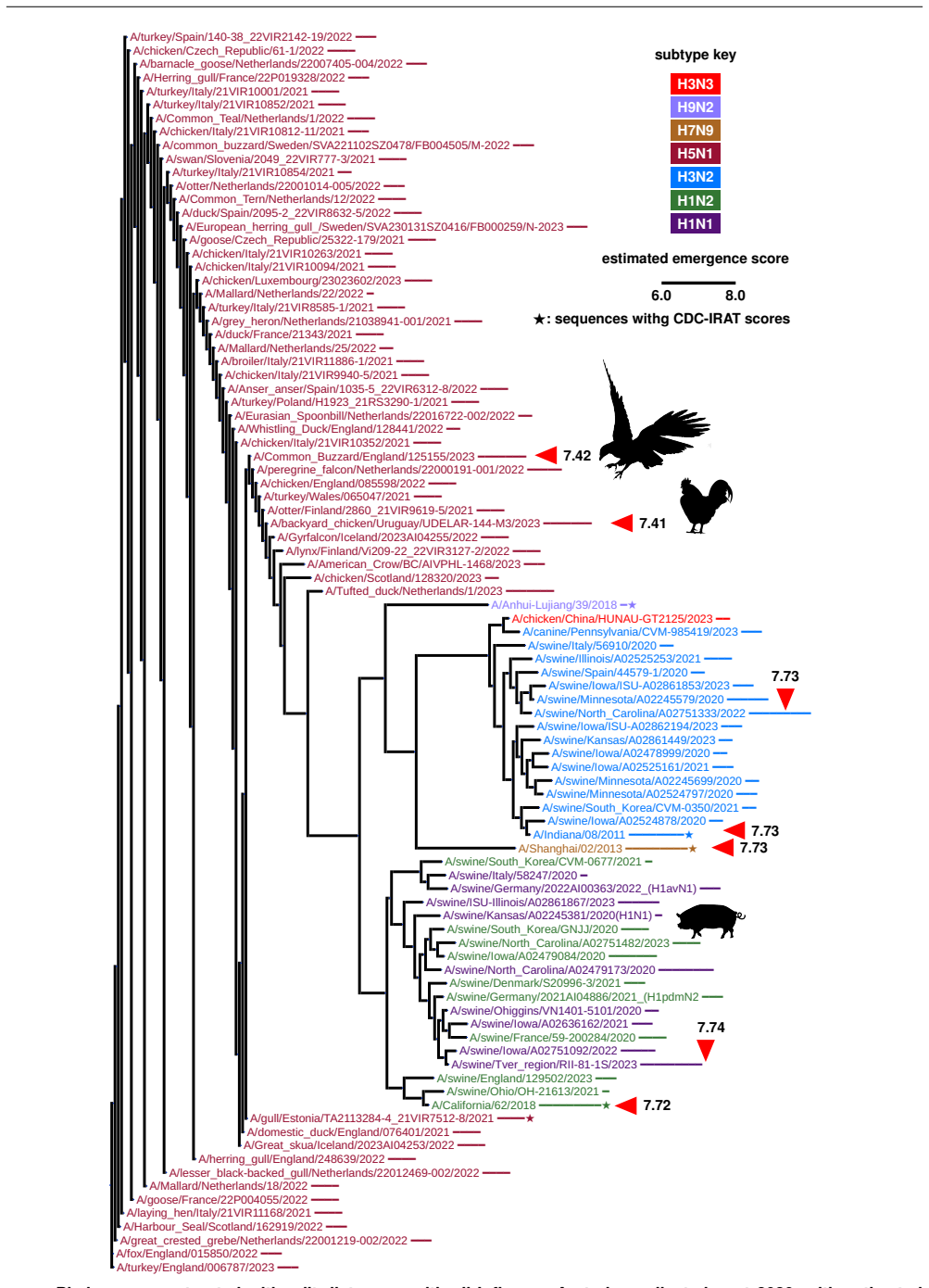
Despite having triggered devastating pandemics in the past, our ability to quantitatively assess the emergence potential of individual strains of animal influenza viruses remains limited. This study introduces Emergenet, a tool to infer a digital twin of sequence evolution to chart how new variants might emerge in the wild. Our predictions based on Emergenets built only using 220,151 Hemagglutinnin (HA) sequences consistently outperform WHO seasonal vaccine recommendations for H1N1/H3N2 subtypes over two decades (average match-improvement: 3.73 AAs, 28.40\%), and are at par with state-of-the-art approaches that use more detailed phenotypic annotations. Finally, our generative models are used to scalably calculate the current odds of emergence of animal strains not yet in human circulation, which strongly correlates with CDC's expert-assessed Influenza Risk Assessment Tool (IRAT) scores (Pearson's $r = 0.721, p = 10^{-4}$). A minimum five orders of magnitude speedup over CDC's assessment (seconds vs months) then enabled us to analyze 6,354 animal strains collected post-2020 to identify 35 strains with high emergence scores ($> 7.7$). The Emergenet framework opens the door to preemptive pandemic mitigation through targeted inoculation of animal hosts before the first human infection.
Figures


Figures from the paper (2 more)

Reference graph
Works this paper leans on
-
[1]
Shao, W., Li, X., Goraya, M. U., Wang, S. & Chen, J.-L. Evolution of influenza a virus by mutation and re- assortment. International journal of molecular sciences 18, 1650 (2017)
work page 2017
-
[2]
Mills, C. E., Robins, J. M. & Lipsitch, M. Transmissibility of 1918 pandemic influenza. Nature 432, 904–906 (2004)
work page 2004
-
[3]
Reid, A. H. & Taubenberger, J. K. The origin of the 1918 pandemic influenza virus: a continuing enigma. Journal of general virology 84, 2285–2292 (2003)
work page 2003
-
[4]
Landolt, G. A. & Olsen, C. W. Up to new tricks–a review of cross-species transmission of influenza a viruses. Animal Health Research Reviews 8, 1–21 (2007)
work page 2007
-
[5]
Dos Santos, G., Neumeier, E. & Bekkat-Berkani, R. Influenza: Can we cope better with the unpredictable? Human vaccines & immunotherapeutics 12, 699–708 (2016)
work page 2016
-
[6]
Huddleston, J. et al. Integrating genotypes and phenotypes improves long-term forecasts of seasonal influenza a/h3n2 evolution. Elife 9, e60067 (2020)
work page 2020
-
[7]
Boni, M. F . Vaccination and antigenic drift in influenza. Vaccine 26, C8–C14 (2008)
work page 2008
-
[8]
Tricco, A. C. et al. Comparing influenza vaccine efficacy against mismatched and matched strains: a systematic review and meta-analysis. BMC medicine 11, 153 (2013)
work page 2013
Show all 65 references
-
[9]
A., Russell, C
Neher, R. A., Russell, C. A. & Shraiman, B. I. Predicting evolution from the shape of genealogical trees. Elife 3, e03568 (2014)
2014
-
[10]
Vergara-Alert, J. et al. The ns segment of h5n1 avian influenza viruses (aiv) enhances the virulence of an h7n1 aiv in chickens. Veterinary research 45, 1–11 (2014)
2014
-
[11]
& Zeileis, A
Hothorn, T., Hornik, K. & Zeileis, A. Unbiased recursive partitioning: A conditional inference framework.JOURNAL OF COMPUTATIONAL AND GRAPHICAL STATISTICS15, 651–674 (2006)
2006
-
[12]
Wille, M., Geoghegan, J. L. & Holmes, E. C. How accurately can we assess zoonotic risk? PLoS biology 19, e3001135 (2021)
2021
-
[13]
Pulliam, J. R. & Dushoff, J. Ability to replicate in the cytoplasm predicts zoonotic transmission of livestock viruses. The Journal of infectious diseases 199, 565–568 (2009)
2009
-
[14]
Grewelle, R. E. Larger viral genome size facilitates emergence of zoonotic diseases. bioRxiv (2020)
2020
-
[15]
Grange, Z. L. et al. Ranking the risk of animal-to-human spillover for newly discovered viruses. Proceedings of the National Academy of Sciences 118, e2002324118 (2021)
2021
-
[16]
Influenza risk assessment tool (irat)
CDC. Influenza risk assessment tool (irat). https://www.cdc.gov/flu/pandemic-resources/national-strategy/ risk-assessment.htm (2020). (Accessed on 02/20/2024)
2020
-
[17]
Gamblin, S. J. & Skehel, J. J. Influenza hemagglutinin and neuraminidase membrane glycoproteins. Journal of Biological Chemistry 285, 28403–28409 (2010)
2010
-
[18]
& Crandall, K
Posada, D. & Crandall, K. A. Modeltest: testing the model of dna substitution. Bioinformatics (Oxford, England) 14, 817–818 (1998)
1998
-
[19]
L., Tong, J
Eng, C. L., Tong, J. C. & Tan, T. W. Predicting host tropism of influenza a virus proteins using random forest.BMC medical genomics 7, 1–11 (2014)
2014
-
[20]
Rna-dependent rna polymerases, viruses, and rna silencing
Ahlquist, P . Rna-dependent rna polymerases, viruses, and rna silencing. Science 296, 1270–1273 (2002)
2002
-
[21]
& Holmes, E
Chen, R. & Holmes, E. C. Avian influenza virus exhibits rapid evolutionary dynamics. Molecular biology and evolution 23, 2336–2341 (2006). 11
2006
-
[22]
G., van Dorp, C
Woolthuis, R. G., van Dorp, C. H., Kes ¸mir, C., de Boer, R. J. & van Boven, M. Long-term adaptation of the influenza a virus by escaping cytotoxic t-cell recognition. Scientific reports 6, 1–8 (2016)
2016
-
[23]
Fan, K. et al. Role of itk signalling in the interaction between influenza a virus and t-cells. Journal of general virology 93, 987–997 (2012)
2012
-
[24]
van de Sandt, C. E. et al. Differential recognition of influenza a viruses by m158–66 epitope-specific cd8+ t cells is determined by extraepitopic amino acid residues. Journal of virology 90, 1009–1022 (2016)
2016
-
[25]
& Rimmelzwaan, G
Berkhoff, E., Geelhoed-Mieras, M., Fouchier, R., Osterhaus, A. & Rimmelzwaan, G. Assessment of the extent of variation in influenza a virus cytotoxic t-lymphocyte epitopes by using virus-specific cd8+ t-cell clones. Journal of General Virology 88, 530–535 (2007)
2007
-
[26]
E., Kreijtz, J
Van de Sandt, C. E., Kreijtz, J. H. & Rimmelzwaan, G. F . Evasion of influenza a viruses from innate and adaptive immune responses. Viruses 4, 1438–1476 (2012)
2012
-
[27]
Wood, J. M. et al. Reproducibility of serology assays for pandemic influenza h1n1: collaborative study to evaluate a candidate who international standard. Vaccine 30, 210–217 (2012)
2012
-
[28]
Cover, T. M. & Thomas, J. A. Elements of Information Theory (Wiley Series in Telecommunications and Signal Processing) (Wiley-Interscience, New Y ork, NY , USA, 2006)
2006
-
[29]
& Gerhard, W
Caton, A., Brownlee, G., Y ewdell, J. & Gerhard, W. The antigenic structure of the influenza virus a/pr/8/34 hemagglutinin (h1 subtype). Cell 31, 417–427 (1982)
1982
-
[30]
& Pascual, M
Koelle, K., Cobey, S., Grenfell, B. & Pascual, M. Epochal evolution shapes the phylodynamics of interpandemic influenza a (h3n2) in humans. Science 314, 1898–1903 (2006)
2006
-
[31]
& Gehrke, J
Lou, Y ., Caruana, R. & Gehrke, J. Intelligible models for classification and regression. In Proceedings of the 18th ACM SIGKDD International Conference on Knowledge Discovery and Data Mining, 150–158 (Association for Computing Machinery, New Y ork, NY , USA, 2012)
2012
-
[32]
Lundberg, S. M. & Lee, S.-I. A unified approach to interpreting model predictions. InAdvances in neural information processing systems, vol. 30, 4765–4774 (2017)
2017
-
[33]
Shapley, L. S. A value for n-person games. In Contributions to the Theory of Games , vol. 2, 307–317 (Princeton University Press, 1953)
1953
-
[34]
Agor, J. K. & ¨Ozaltın, O. Y . Models for predicting the evolution of influenza to inform vaccine strain selection. Human vaccines & immunotherapeutics 14, 678–683 (2018)
2018
-
[35]
& Pongor, S
Carugo, O. & Pongor, S. A normalized root-mean-spuare distance for comparing protein three-dimensional structures. Protein science 10, 1470–1473 (2001)
2001
-
[36]
& Filippini, F
Righetto, I., Milani, A., Cattoli, G. & Filippini, F . Comparative structural analysis of haemagglutinin proteins from type a influenza viruses: conserved and variable features. BMC bioinformatics 15, 363 (2014)
2014
-
[37]
of Public Health, C. D. Annual immunization report 2017-2018 (2018). URL https://www.cdph.ca.gov/Programs/ CID/DCDC/CDPH%20Document%20Library/Immunization/Annual2017-18.pdf. Accessed: 2024-05-31
2018
-
[38]
Summary of influenza a (h1) candidate vaccine viruses for pan- demic preparedness (2023)
World Health Organization. Summary of influenza a (h1) candidate vaccine viruses for pan- demic preparedness (2023). URL https://cdn.who.int/media/docs/default-source/influenza/cvvs/ cvv-zoonotic---southern-hemisphere-2023/summary a h1v cvv 20220928.pdf?sfvrsn=c9567a3c 5. Acce...
2023
-
[39]
Ma, W., Kahn, R. E. & Richt, J. A. The pig as a mixing vessel for influenza viruses: human and veterinary implications. Journal of molecular and genetic medicine: an international journal of biomedical research 3, 158 (2009)
2009
-
[40]
mixing vessel
Nelson, M. I. & Worobey, M. Origins of the 1918 pandemic: revisiting the swine “mixing vessel” hypothesis. American journal of epidemiology 187, 2498–2502 (2018)
2018
-
[41]
M., Foni, E., Klenk, H.-D
Baumann, J., Kouassi, N. M., Foni, E., Klenk, H.-D. & Matrosovich, M. H1N1 Swine Influenza Viruses Differ from Avian Precursors by a Higher pH Optimum of Membrane Fusion. Journal of virology (2015)
2015
-
[42]
& Prevention
for Disease Control, C. & Prevention. Cdc reports human case of h5n1 (2024). URL https://www.cdc.gov/media/ releases/2024/s0522-human-case-h5.html. Accessed: 2024-05-25
2024
-
[43]
Goldberger, A. L. & Peng, C.-K. Genomic classification using an information-based similarity index: application to the sars coronavirus. Journal of Computational Biology 12, 1103–1116 (2005)
2005
-
[44]
Huelsenbeck, J. P . & Crandall, K. A. Phylogeny estimation and hypothesis testing using maximum likelihood. Annual Review of Ecology and systematics 28, 437–466 (1997)
1997
-
[45]
van der Meer, F . J. U. M., Orsel, K. & Barkema, H. W. The new influenza A H1N1 virus: balancing on the interface of humans and animals. The Canadian veterinary journal = La revue veterinaire canadienne 51, 56–62 (2010)
2010
-
[46]
Smith, G. J. D. et al. Origins and evolutionary genomics of the 2009 swine-origin H1N1 influenza A epidemic. Nature 459, 1122–1125 (2009)
2009
-
[47]
Mollentze, N., Babayan, S. A. & Streicker, D. G. Identifying and prioritizing potential human-infecting viruses from their genome sequences. PLoS biology 19, e3001390 (2021)
2021
-
[48]
Maher, M. C. et al. Predicting the mutational drivers of future sars-cov-2 variants of concern.Science Translational Medicine 14, eabk3445 (2022)
2022
-
[49]
Hern ´andez-Orozco, S., Kiani, N. A. & Zenil, H. Algorithmically probable mutations reproduce aspects of evolution, such as convergence rate, genetic memory and modularity. Royal Society open science 5, 180399 (2018)
2018
-
[50]
Random fields: analysis and synthesis (World scientific, 2010)
Vanmarcke, E. Random fields: analysis and synthesis (World scientific, 2010)
2010
-
[51]
D., Manning, C
Manning, C. D., Manning, C. D. & Sch ¨utze, H. Foundations of statistical natural language processing (MIT press, 1999). 12
1999
-
[52]
Varadhan, S. S. Large deviations. In Proceedings of the International Congress of Mathematicians 2010 (ICM
2010
-
[53]
Carreira-Perpin ´an, M. A. A review of mean-shift algorithms for clustering. arXiv preprint arXiv:1503.00687 (2015)
2015 arXiv
-
[54]
A., Harremo ¨es, P
Fedotov, A. A., Harremo ¨es, P . & Topsoe, F . Refinements of pinsker’s inequality.IEEE Transactions on Information Theory 49, 1491–1498 (2003)
2003
-
[55]
Hatcher, E. L. et al. Virus variation resource–improved response to emergent viral outbreaks. Nucleic acids research 45, D482–D490 (2017)
2017
-
[56]
Bogner, P ., Capua, I., Lipman, D. J. & Cox, N. J. A global initiative on sharing avian flu data.Nature 442, 981–981 (2006)
2006
-
[57]
Wu, N. C. & Wilson, I. A. Influenza hemagglutinin structures and antibody recognition. Cold Spring Harbor perspectives in medicine 10, a038778 (2020)
2020
-
[58]
Tzarum, N. et al. Structure and receptor binding of the hemagglutinin from a human h6n1 influenza virus. Cell host & microbe 17, 369–376 (2015)
2015
-
[59]
K., Szczepi ´nska, T
Lazniewski, M., Dawson, W. K., Szczepi ´nska, T. & Plewczynski, D. The structural variability of the influenza a hemagglutinin receptor-binding site. Briefings in functional genomics 17, 415–427 (2018)
2018
-
[60]
K., Guttman, M., Ebner, J
Garcia, N. K., Guttman, M., Ebner, J. L. & Lee, K. K. Dynamic changes during acid-induced activation of influenza hemagglutinin. Structure 23, 665–676 (2015)
2015
-
[61]
Yin, J. et al. Effects of ambient temperature on influenza-like illness: A multicity analysis in shandong province, china, 2014–2017. Frontiers in Public Health 10 (2023). URL https://www.frontiersin.org/articles/10.3389/fpubh. 2022.1095436
2023
-
[62]
Sun, H. et al. Prevalent eurasian avian-like h1n1 swine influenza virus with 2009 pandemic viral genes facilitating human infection. Proceedings of the National Academy of Sciences 117, 17204–17210 (2020). URL https: //www.pnas.org/doi/abs/10.1073/pnas.1921186117. https://www....
2020 doi
-
[63]
Estimated flu-related illnesses, medical visits, hospitalizations, and deaths in the united states — 2017–2018 flu season
CDC. Estimated flu-related illnesses, medical visits, hospitalizations, and deaths in the united states — 2017–2018 flu season. https://www.cdc.gov/flu/about/burden/2017-2018.htm (2021). (Accessed on 06/25/2023)
2021
-
[64]
jump away
Kile, J. C. et al. Update: Increase in human infections with novel asian lineage avian influenza a(h7n9) viruses during the fifth epidemic — china, october 1, 2016–august 7, 2017. http://dx.doi.org/10.15585/mmwr.mm6635a2 (2017). ACKNOWLEDGMENTS This work has been partly funded...
2017
-
[2010]
I: Plenary Lectures and Ceremonies Vols
(In 4 Volumes) Vol. I: Plenary Lectures and Ceremonies Vols. II–IV: Invited Lectures , 622–639 (World Scientific, 2010)
2010
Reviewed August 12, 2026 · model on record in the stance chip above.
Discussion (0). Continue with ORCID to comment.