REVIEW 5 major objections 6 minor 50 references
Motion Free B-frame Coding for Neural Video Compression
T0 review · 5 major / 6 minor · reviewed 2026-08-12 · deepseek-v4-flash
Pith's one-line read A neural video codec that skips motion coding beats motion-based rivals at a third the size.
desk verdict A plausible motion-free B-frame codec with a clean kernel-synthesis decoder, but the evidence is too thin to back the 'motion coding is unnecessary' claim. read the letter →
The pith
A machine-rendered reading of the paper's core claim, the machinery that carries it, and where it could break.
The reading
What carries the argument
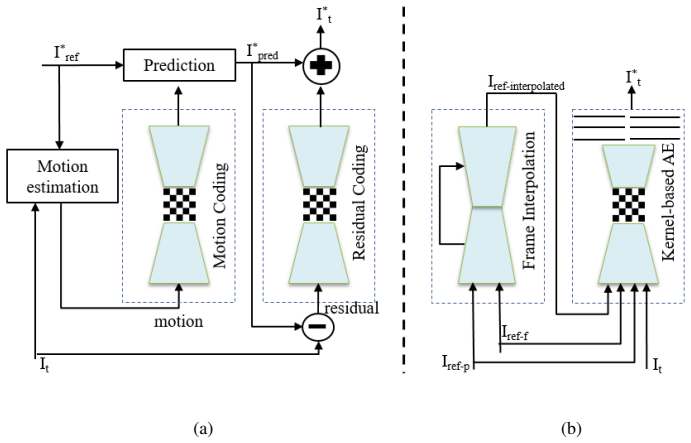
The load-bearing object is the kernel-based motion-free autoencoder: instead of a symmetric decoder that directly upsamples a latent feature map, the last decoder layer emits six 1D convolution kernels of length 31 for each output pixel, one vertical/horizontal pair per reference frame. Each kernel pair is convolved with a $31 \times 31$ patch from its corresponding reference (predecessor, successor, or interpolated) and the three scalar outputs are summed to give the pixel value. Because the kernels are pixel-dependent, a single mechanism absorbs both motion and appearance information, while the interpolated reference — generated by a frozen IFRnet at both encoder and decoder — supplies the temporally closest prediction. A hierarchical B-frame GoP structure with level-dependent $\lambda$ values distributes bitrate across frames. The whole pipeline uses a hyperprior entropy model for latent coding, and no motion vector is ever estimated or transmitted.
What would settle it
Run the proposed codec and a motion-based codec such as SSF on a high-motion test set (or on sequences where a frozen IFRnet's interpolated frame is demonstrably poor, e.g., fast camera pans, heavy occlusion, or domain-shifted content), and compare rate-distortion at matched quality. If the motion-free model's bitrate advantage over the motion-based model shrinks or reverses as interpolation error grows, the claim that motion components can be removed without sacrificing efficiency would be falsified.
Extended reading notes
Core claim
The paper's central discovery is that a B-frame can be coded without any motion estimation, motion compensation, or motion coding, and that convolutional kernel synthesis can replace the symmetric decoder's upsampling for the final reconstruction. The encoder takes the current frame plus three reference frames — the reconstructed predecessor, the reconstructed successor, and an intermediate frame produced by a frozen video-frame-interpolation network — and compresses them into a latent representation. The decoder estimates, per output pixel, three pairs of vertical/horizontal 1D kernels and applies them to patches from the three references; the sum of the three convolution results is the reconstructed pixel. The authors report that this kernel-based motion-free autoencoder outperforms state-of-the-art learned video codecs on HEVC-class B, is competitive on UVG and MCL-JCV, reduces blur artifacts compared with the symmetric motion-based SSF autoencoder, and runs faster than SSF while having a much smaller model.
Load-bearing premise
The argument rests on the frozen frame-interpolation network producing an intermediate reference close enough to the current frame that a 31-pixel local kernel can reconstruct it; if interpolation fails on large motion, occlusion, or out-of-distribution content, the latent code must carry all missing information, and there is no motion model to fall back on.
Editorial extensions
If this is right
- Motion estimation, compensation, and coding can be removed from learned B-frame codecs; the reported HEVC-class B results indicate the motion-free approach is not merely a complexity trade-off but a coding-efficiency gain.
- Model size drops to 13.8M parameters, roughly four times smaller than B-EPIC and three times smaller than TLZMC, with 0.65 M/px MACs versus 1.50 M/px for TLZMC.
- Decoder-side kernel synthesis alleviates the blur artifact typical of symmetric autoencoders, visible in periodic and noisy regions such as BQTerrace.
- The approach runs about 1.7 times faster than the motion-based SSF model at full HD resolution on the same hardware.
- The hierarchical B-frame structure with an interpolated reference opens a random-access coding configuration that does not require explicit motion vectors.
Reading between the lines
- If the motion-free principle transfers beyond B-frames, the same kernel-synthesis mechanism could be applied to P-frame or long-GoP coding, where the temporal distance between references is larger and interpolation quality varies more.
- The reported sensitivity to kernel size (31 vs 51 pixels showing little change) suggests the bottleneck is not kernel reach but the quality of the interpolated reference; a stronger or adaptively selected interpolation network could extend the operating range without changing the framework.
- A direct comparison against classical codecs such as HEVC or VVC would be needed to place the claimed savings in a broader context, since the reported BD-rate figures are relative to the learned SSF anchor.
- The method's dependence on a frozen interpolator implies a testable extension: jointly fine-tuning or learning the interpolation network with the compression loss might improve reconstruction in occlusion-heavy regions, but it would also add back some of the training complexity the motion-free design removes.
Editorial analysis
A structured set of objections, weighed in public.
Referee Report
Summary. The manuscript proposes a motion-free B-frame neural video codec. The encoder consumes the current frame together with three reference frames (predecessor, successor, and an interpolated frame produced by a frozen IFRnet) and transmits a hyperprior-coded latent. The decoder reconstructs each pixel as a sum of three separable 1D kernel convolutions over local patches of the three references, as in Eq. (1). The model is trained end-to-end with a hierarchical-lambda rate-distortion loss. Experiments compare with FVC, DCVC, B-EPIC, TLZMC, and SSF on HEVC-B, UVG, and MCL-JCV, reporting RD curves, a BD-rate table versus B-EPIC, runtime, model size, and MACs. The conclusions state that explicit motion coding is unnecessary and that kernel-based synthesis reduces blur.
Significance. If the reported results are reproducible, the motion-free kernel-synthesis idea is a conceptually valuable departure from the dominant motion-plus-residual learned codec design. The proposed model is compact (13.8M parameters), runs faster than SSF on an A100, and reports competitive RD performance on three full-HD datasets. The paper provides component-level parameter counts and runtime measurements, which strengthens the complexity claims. However, the current evidence is not sufficient to support the broad 'outperforms SOTA' conclusion: key comparisons, numerical BD-rate numbers for HEVC-B, quantitative blur metrics, and robustness checks are missing.
major comments (5)
- [§1, §4.3, Table 1] The abstract and conclusion claim that the proposed method 'outperforms the SOTA deep neural video compression networks on the HEVC-class B dataset', but Section 4.3 reports that TLZMC performs better on UVG and that the method is only 'competitive' with B-EPIC on MCL-JCV. The central BD-rate table (Table 1) covers only UVG and MCL-JCV, and no numerical BD-rate or BD-PSNR values are given for HEVC-B. Please provide per-dataset BD-rate tables against every compared codec and align the abstract and conclusion wording with the actual numbers.
- [§3.1, Eq. (1)] The reconstructed pixel is a weighted sum of local 31x31 patches taken from three reference frames; there is no residual term or direct-latent injection. Consequently, the latent representation can only reshape local linear filters and cannot introduce content that is absent from all references, such as newly exposed areas in occlusions. The claim that motion coding can be removed without efficiency loss therefore rests on the frozen IFRnet interpolation being accurate for the tested content. The kernel-size ablation (31 vs 51) in §4.4 only establishes closeness on the tested datasets. Please add an evaluation on sequences with large motion and heavy occlusion, or explicitly discuss this limitation, and consider adding a residual or non-local synthesis path to make the architecture robust.
- [§4.3, §4.4] The comparison set is incomplete for the strong 'SOTA' claim. The paper compares with FVC, DCVC, B-EPIC, TLZMC, and SSF, but not with standard hybrid codecs such as HM or VTM, nor with recent learned codecs such as DCVC-FM and DCVC-DC. Without these comparisons, the practical coding-efficiency claim is not established. Please add standard-codec anchors and at least one recent SOTA learned codec to the RD curves and BD-rate tables.
- [Table 1] The headline BD-rate comparison with B-EPIC ('-31.07% vs -26.36% relative to SSF') is computed from B-EPIC's published numbers. It is not a paired evaluation: the RD operating points, GoP size, lambda schedule, and the color space used for PSNR (the table caption says 'RGB PSNR' while the test sequences are YUV420) may differ. Please run B-EPIC under the same protocol as the proposed model, or clearly state the protocol differences and justify why the comparison remains valid.
- [§4.4, Figure 6] The second contribution claims that the kernel-based decoder alleviates blur artifacts, but Figure 6 is the only support and it is qualitative. A quantitative blur or perceptual metric (e.g., LPIPS, DISTS, or a sharpness index) over the test datasets is needed, especially since the paper argues that blur reduction is a major advantage over symmetric auto-encoders. Please report such metrics with per-sequence values.
minor comments (6)
- [Eq. (2)] Equation (2) has missing symbolic definitions after 'is the quantized encoded feature' and 'is the bitrate estimated'; the sentence is incomplete and should be rewritten.
- [§4.2] Please specify whether training is performed in RGB and whether test sequences are converted to RGB before computing PSNR and BD-rate, and describe the YUV420-to-RGB conversion used.
- [Table 2] There is a typo in the dataset name: 'MCL-JVC' should be 'MCL-JCV'.
- [Figure 4] The coding-structure figure and the text 'coding type I0B2B1B2I0' should be reconciled; the figure shows a GoP size of 8 while the text says training uses a GoP size of 5, so please clarify the display and coding order.
- [Abstract] The last sentence of the abstract is a run-on and should be split into two sentences for clarity.
- [§4.4] The statement that 'the interpolated frame is quite close to the current encoding frame' is an inference from one kernel-size ablation; it should be phrased as a dataset-dependent observation rather than a general property.
Circularity Check
No meaningful circularity: end-to-end learning with held-out benchmarks; the sole self-citation [44] supplies only a hierarchical lambda training schedule and is not load-bearing.
full rationale
The paper's derivation is self-contained and benchmark-driven. The central reconstruction rule, Eq. (1), is a learned kernel-synthesis decoder: the six 1-D kernels are produced by sub-networks from the decoded latent, and all components (frame auto-encoder, hyperprior, kernel sub-networks) are trained jointly with the rate-distortion loss of Eq. (2) on Vimeo90K and evaluated on held-out UVG, HEVC-B, and MCL-JCV sequences. No fitted parameter is renamed as a prediction: the BD-rate figures are computed from rate-distortion curves on test data, and the anchor SSF comparisons use an external pretrained checkpoint from compressAI. The frozen IFRnet is an independently trained interpolation module, not a parameter fit to the reported results. The only author self-citation, [44], is used in Section 3.3 to motivate the hierarchical lambda schedule (lambda1=0.85*lambda0, lambda2=0.7*lambda0); this is a training-weight detail and does not carry the central claim that motion-free kernel synthesis is efficient. The ablation of kernel size 31 vs 51 is an empirical observation, not a definitional equivalence. Accordingly no step reduces by construction to its input, and there is no significant circularity; the minor self-citation is not load-bearing.
Assumptions & free parameters
free parameters (5)
- Rate-distortion tradeoff lambda =
0.5e-2, 1e-2, 3e-2, 5e-2
- Hierarchical lambda multipliers =
1.0 (I), 0.85 (level 1), 0.7 (level 2)
- Kernel size KS =
31
- Network widths M, N, K =
M=128, N=96, K=64
- GoP size (train) =
5
assumptions (5)
- domain assumption The frozen IFRnet, pretrained on Vimeo90K, produces an interpolated reference frame sufficiently close to the current frame under large motion and occlusion for the kernel synthesizer to succeed.
- domain assumption The three reference frames (two reconstructed neighbors plus one interpolated) contain all temporal information needed to synthesize the current frame via local 31x31 separable kernels.
- domain assumption The hyperprior entropy model [4] provides an accurate estimate of the true bitrate.
- domain assumption Evaluating on YUV420 sequences while training on RGB is a valid procedure; the reported PSNR is comparable across codecs.
- standard math Standard backpropagation and stochastic optimization work as expected for this architecture.
Cite this review
Pith. "Pith review of Motion Free B-frame Coding for Neural Video Compression." pith.science (2026). https://pith.science/paper/N7TR3HBH
@misc{pith2026241117160,
  author       = {Pith},
  title        = {Pith review of: Motion Free B-frame Coding for Neural Video Compression},
  year         = {2026},
  howpublished = {\url{https://pith.science/paper/N7TR3HBH}},
  note         = {Machine review of arXiv:2411.17160}
}
read the original abstract
Typical deep neural video compression networks usually follow the hybrid approach of classical video coding that contains two separate modules: motion coding and residual coding. In addition, a symmetric auto-encoder is often used as a normal architecture for both motion and residual coding. In this paper, we propose a novel approach that handles the drawbacks of the two typical above-mentioned architectures, we call it kernel-based motion-free video coding. The advantages of the motion-free approach are twofold: it improves the coding efficiency of the network and significantly reduces computational complexity thanks to eliminating motion estimation, motion compensation, and motion coding which are the most time-consuming engines. In addition, the kernel-based auto-encoder alleviates blur artifacts that usually occur with the conventional symmetric autoencoder. Consequently, it improves the visual quality of the reconstructed frames. Experimental results show the proposed framework outperforms the SOTA deep neural video compression networks on the HEVC-class B dataset and is competitive on the UVG and MCL-JCV datasets. In addition, it generates high-quality reconstructed frames in comparison with conventional motion coding-based symmetric auto-encoder meanwhile its model size is much smaller than that of the motion-based networks around three to four times.
Figures


Figures from the paper (3 more)


Reference graph
Works this paper leans on
-
[44]
Hierarchical random access coding for deep neural video compression
Nguyen Van Thang and Le Van Bang. Hierarchical random access coding for deep neural video compression. IEEE Ac- cess, 2023. 5
work page 2023
-
[1]
Scale-space flow for end-to-end optimized video compression
Eirikur Agustsson, David Minnen, Nick Johnston, Johannes Balle, Sung Jin Hwang, and George Toderici. Scale-space flow for end-to-end optimized video compression. In Pro- ceedings of the IEEE/CVF Conference on Computer Vision and Pattern Recognition, pages 8503–8512, 2020. 2, 3, 5, 6, 7
work page 2020
-
[2]
Hierarchical b-frame video coding using two-layer canf without motion coding
David Alexandre, Hsueh-Ming Hang, and Wen-Hsiao Peng. Hierarchical b-frame video coding using two-layer canf without motion coding. In Proceedings of the IEEE/CVF Conference on Computer Vision and Pattern Recognition , pages 10249–10258, 2023. 3, 6, 7
work page 2023
-
[3]
End-to-end optimized image compression
Johannes Ball ´e, Valero Laparra, and Eero P Simoncelli. End-to-end optimized image compression. arXiv preprint arXiv:1611.01704, 2016. 2
arXiv 2016
-
[4]
Variational image compression with a scale hyperprior
Johannes Ball ´e, David Minnen, Saurabh Singh, Sung Jin Hwang, and Nick Johnston. Variational image compression with a scale hyperprior. arXiv preprint arXiv:1802.01436 ,
-
[5]
Compressai: a pytorch library and evalua- tion platform for end-to-end compression research
Jean B ´egaint, Fabien Racap ´e, Simon Feltman, and Akshay Pushparaja. Compressai: a pytorch library and evalua- tion platform for end-to-end compression research. arXiv preprint arXiv:2011.03029, 2020. 6, 7
arXiv 2011
-
[6]
Calculation of average psnr differences between rd-curves
Gisle Bjontegaard. Calculation of average psnr differences between rd-curves. ITU SG16 Doc. VCEG-M33, 2001. 6
work page 2001
-
[7]
Common test conditions and software reference configurations
Frank Bossen et al. Common test conditions and software reference configurations. JCTVC-L1100, 12(7):1, 2013. 5
work page 2013
Show all 50 references
-
[8]
Explicitly minimizing the blur error of variational autoencoders
Gustav Bredell, Kyriakos Flouris, Krishna Chaitanya, Er- tunc Erdil, and Ender Konukoglu. Explicitly minimizing the blur error of variational autoencoders. arXiv preprint arXiv:2304.05939, 2023. 2
2023 arXiv
-
[9]
Overview of the versatile video coding (vvc) standard and its applications
Benjamin Bross, Ye-Kui Wang, Yan Ye, Shan Liu, Jianle Chen, Gary J Sullivan, and Jens-Rainer Ohm. Overview of the versatile video coding (vvc) standard and its applications. IEEE Transactions on Circuits and Systems for Video Tech- nology, 31(10):3736–3764, 2021. 1, 2
2021
-
[10]
Advances in video compression sys- tem using deep neural network: A review and case studies
Dandan Ding, Zhan Ma, Di Chen, Qingshuang Chen, Zoe Liu, and Fengqing Zhu. Advances in video compression sys- tem using deep neural network: A review and case studies. Proceedings of the IEEE, 109(9):1494–1520, 2021. 1, 2
2021
-
[11]
Task-aware encoder control for deep video com- pression
Xingtong Ge, Jixiang Luo, Xinjie Zhang, Tongda Xu, Guo Lu, Dailan He, Jing Geng, Yan Wang, Jun Zhang, and Hong- wei Qin. Task-aware encoder control for deep video com- pression. In Proceedings of the IEEE/CVF Conference on Computer Vision and Pattern Recognition , pages 26036–...
2024
-
[12]
A technical overview of av1
Jingning Han, Bohan Li, Debargha Mukherjee, Ching-Han Chiang, Adrian Grange, Cheng Chen, Hui Su, Sarah Parker, Sai Deng, Urvang Joshi, et al. A technical overview of av1. Proceedings of the IEEE, 109(9):1435–1462, 2021. 1
2021
-
[13]
Elic: Efficient learned image compres- sion with unevenly grouped space-channel contextual adap- tive coding
Dailan He, Ziming Yang, Weikun Peng, Rui Ma, Hongwei Qin, and Yan Wang. Elic: Efficient learned image compres- sion with unevenly grouped space-channel contextual adap- tive coding. In Proceedings of the IEEE/CVF Conference on Computer Vision and Pattern Recognition , pages 57...
2022
-
[14]
Checkerboard context model for effi- cient learned image compression
Dailan He, Yaoyan Zheng, Baocheng Sun, Yan Wang, and Hongwei Qin. Checkerboard context model for effi- cient learned image compression. In Proceedings of the IEEE/CVF Conference on Computer Vision and Pattern Recognition, pages 14771–14780, 2021. 2
2021
-
[15]
Block merging for quadtree-based parti- tioning in hevc
Philipp Helle, Simon Oudin, Benjamin Bross, Detlev Marpe, M Oguz Bici, Kemal Ugur, Joel Jung, Gordon Clare, and Thomas Wiegand. Block merging for quadtree-based parti- tioning in hevc. IEEE Transactions on Circuits and Systems for Video Technology, 22(12):1720–1731, 2012. 1
2012
-
[16]
Coarse-to-fine hyper-prior modeling for learned image compression
Yueyu Hu, Wenhan Yang, and Jiaying Liu. Coarse-to-fine hyper-prior modeling for learned image compression. In Proceedings of the AAAI Conference on Artificial Intelli- gence, volume 34, pages 11013–11020, 2020. 2
2020
-
[17]
Improving deep video com- pression by resolution-adaptive flow coding
Zhihao Hu, Zhenghao Chen, Dong Xu, Guo Lu, Wanli Ouyang, and Shuhang Gu. Improving deep video com- pression by resolution-adaptive flow coding. In Computer Vision–ECCV 2020: 16th European Conference, Glasgow, UK, August 23–28, 2020, Proceedings, Part II 16 , pages 193–209. Spr...
2020
-
[18]
Coarse-to-fine deep video coding with hyperprior- guided mode prediction
Zhihao Hu, Guo Lu, Jinyang Guo, Shan Liu, Wei Jiang, and Dong Xu. Coarse-to-fine deep video coding with hyperprior- guided mode prediction. In Proceedings of the IEEE/CVF Conference on Computer Vision and Pattern Recognition , pages 5921–5930, 2022. 2, 3
2022
-
[19]
Fvc: A new framework towards deep video compression in feature space
Zhihao Hu, Guo Lu, and Dong Xu. Fvc: A new framework towards deep video compression in feature space. In Pro- ceedings of the IEEE/CVF Conference on Computer Vision and Pattern Recognition, pages 1502–1511, 2021. 2, 3, 6
2021
-
[20]
Con- trolling rate, distortion, and realism: Towards a single com- prehensive neural image compression model
Shoma Iwai, Tomo Miyazaki, and Shinichiro Omachi. Con- trolling rate, distortion, and realism: Towards a single com- prehensive neural image compression model. In Proceed- ings of the IEEE/CVF Winter Conference on Applications of Computer Vision, pages 2900–2909, 2024. 2
2024
-
[21]
Super slomo: High quality estimation of multiple intermediate frames for video interpolation
Huaizu Jiang, Deqing Sun, Varun Jampani, Ming-Hsuan Yang, Erik Learned-Miller, and Jan Kautz. Super slomo: High quality estimation of multiple intermediate frames for video interpolation. In Proceedings of the IEEE conference on computer vision and pattern recognition , pages ...
2018
-
[22]
Neural image compres- sion using masked sparse visual representation
Wei Jiang, Wei Wang, and Yue Chen. Neural image compres- sion using masked sparse visual representation. In Proceed- ings of the IEEE/CVF Winter Conference on Applications of Computer Vision, pages 4189–4197, 2024. 2
2024
-
[23]
Joint global and local hierarchical priors for learned image com- pression
Jun-Hyuk Kim, Byeongho Heo, and Jong-Seok Lee. Joint global and local hierarchical priors for learned image com- pression. In Proceedings of the IEEE/CVF Conference on Computer Vision and Pattern Recognition , pages 5992– 6001, 2022. 2
2022
-
[24]
Auto-encoding varia- tional bayes
Diederik P Kingma and Max Welling. Auto-encoding varia- tional bayes. arXiv preprint arXiv:1312.6114, 2013. 2
2013 arXiv
-
[25]
Ifrnet: Intermediate feature refine network for efficient frame interpolation
Lingtong Kong, Boyuan Jiang, Donghao Luo, Wenqing Chu, Xiaoming Huang, Ying Tai, Chengjie Wang, and Jie Yang. Ifrnet: Intermediate feature refine network for efficient frame interpolation. In Proceedings of the IEEE/CVF Conference on Computer Vision and Pattern Recognition , p...
1969
-
[26]
Deep contextual video com- pression
Jiahao Li, Bin Li, and Yan Lu. Deep contextual video com- pression. Advances in Neural Information Processing Sys- tems, 34:18114–18125, 2021. 3, 6
2021
-
[27]
Hybrid spatial-temporal en- tropy modelling for neural video compression
Jiahao Li, Bin Li, and Yan Lu. Hybrid spatial-temporal en- tropy modelling for neural video compression. In Proceed- ings of the 30th ACM International Conference on Multime- dia, pages 1503–1511, 2022. 2, 3
2022
-
[28]
Neural video compression with feature modulation
Jiahao Li, Bin Li, and Yan Lu. Neural video compression with feature modulation. In Proceedings of the IEEE/CVF Conference on Computer Vision and Pattern Recognition , pages 26099–26108, 2024. 3
2024
-
[29]
Learned video compression via joint spatial- temporal correlation exploration
Haojie Liu, Han Shen, Lichao Huang, Ming Lu, Tong Chen, and Zhan Ma. Learned video compression via joint spatial- temporal correlation exploration. In Proceedings of the AAAI Conference on Artificial Intelligence, volume 34, pages 11580–11587, 2020. 2
2020
-
[30]
Learned image compression with mixed transformer-cnn architectures
Jinming Liu, Heming Sun, and Jiro Katto. Learned image compression with mixed transformer-cnn architectures. In Proceedings of the IEEE/CVF Conference on Computer Vi- sion and Pattern Recognition, pages 14388–14397, 2023. 2, 5
2023
-
[31]
Dvc: An end-to-end deep video com- pression framework
Guo Lu, Wanli Ouyang, Dong Xu, Xiaoyun Zhang, Chunlei Cai, and Zhiyong Gao. Dvc: An end-to-end deep video com- pression framework. In Proceedings of the IEEE/CVF Con- ference on Computer Vision and Pattern Recognition, pages 11006–11015, 2019. 1, 2
2019
-
[32]
An end-to-end learning framework for video compression
Guo Lu, Xiaoyun Zhang, Wanli Ouyang, Li Chen, Zhiyong Gao, and Dong Xu. An end-to-end learning framework for video compression. IEEE transactions on pattern analysis and machine intelligence, 43(10):3292–3308, 2020. 1, 2
2020
-
[33]
Video frame interpolation with transformer
Liying Lu, Ruizheng Wu, Huaijia Lin, Jiangbo Lu, and Jiaya Jia. Video frame interpolation with transformer. In Proceed- ings of the IEEE/CVF Conference on Computer Vision and Pattern Recognition, pages 3532–3542, 2022. 3
2022
-
[34]
Uvg dataset: 50/120fps 4k sequences for video codec analysis and development
Alexandre Mercat, Marko Viitanen, and Jarno Vanne. Uvg dataset: 50/120fps 4k sequences for video codec analysis and development. In Proceedings of the 11th ACM Multimedia Systems Conference, pages 297–302, 2020. 5
2020
-
[35]
Joint autoregressive and hierarchical priors for learned im- age compression
David Minnen, Johannes Ball ´e, and George D Toderici. Joint autoregressive and hierarchical priors for learned im- age compression. Advances in neural information processing systems, 31, 2018. 2
2018
-
[36]
Video frame in- terpolation via adaptive convolution
Simon Niklaus, Long Mai, and Feng Liu. Video frame in- terpolation via adaptive convolution. In Proceedings of the IEEE Conference on Computer Vision and Pattern Recogni- tion, pages 670–679, 2017. 3
2017
-
[37]
Video frame in- terpolation via adaptive separable convolution
Simon Niklaus, Long Mai, and Feng Liu. Video frame in- terpolation via adaptive separable convolution. In Proceed- ings of the IEEE international conference on computer vi- sion, pages 261–270, 2017. 3
2017
-
[38]
Extending neural p-frame codecs for b-frame coding
Reza Pourreza and Taco Cohen. Extending neural p-frame codecs for b-frame coding. In Proceedings of the IEEE/CVF International Conference on Computer Vision, pages 6680– 6689, 2021. 3, 6, 7
2021
-
[39]
Entroformer: A transformer-based entropy model for learned image compression
Yichen Qian, Ming Lin, Xiuyu Sun, Zhiyu Tan, and Rong Jin. Entroformer: A transformer-based entropy model for learned image compression. arXiv preprint arXiv:2202.05492, 2022. 2, 5
2022 arXiv
-
[40]
Video frame interpolation transformer
Zhihao Shi, Xiangyu Xu, Xiaohong Liu, Jun Chen, and Ming-Hsuan Yang. Video frame interpolation transformer. In Proceedings of the IEEE/CVF Conference on Computer Vision and Pattern Recognition, pages 17482–17491, 2022. 3
2022
-
[41]
Overview of the high efficiency video coding (hevc) standard
Gary J Sullivan, Jens-Rainer Ohm, Woo-Jin Han, and Thomas Wiegand. Overview of the high efficiency video coding (hevc) standard. IEEE Transactions on circuits and systems for video technology, 22(12):1649–1668, 2012. 1, 2
2012
-
[42]
Lossy image compression with compressive autoen- coders
Lucas Theis, Wenzhe Shi, Andrew Cunningham, and Ferenc Husz´ar. Lossy image compression with compressive autoen- coders. arXiv preprint arXiv:1703.00395, 2017. 2
2017 arXiv
-
[43]
Mobilenvc: Real-time 1080p neural video compression on a mobile de- vice
Ties van Rozendaal, Tushar Singhal, Hoang Le, Guillaume Sautiere, Amir Said, Krishna Buska, Anjuman Raha, Dim- itris Kalatzis, Hitarth Mehta, Frank Mayer, et al. Mobilenvc: Real-time 1080p neural video compression on a mobile de- vice. In Proceedings of the IEEE/CVF Winter Con...
2024
-
[45]
The jpeg still picture compression stan- dard
Gregory K Wallace. The jpeg still picture compression stan- dard. Communications of the ACM, 34(4):30–44, 1991. 2
1991
-
[46]
Mcl-jcv: a jnd-based h
Haiqiang Wang, Weihao Gan, Sudeng Hu, Joe Yuchieh Lin, Lina Jin, Longguang Song, Ping Wang, Ioannis Katsavouni- dis, Anne Aaron, and C-C Jay Kuo. Mcl-jcv: a jnd-based h. 264/avc video quality assessment dataset. In 2016 IEEE international conference on image processing (ICIP),...
2016
-
[47]
Overview of the h
Thomas Wiegand, Gary J Sullivan, Gisle Bjontegaard, and Ajay Luthra. Overview of the h. 264/avc video coding stan- dard. IEEE Transactions on circuits and systems for video technology, 13(7):560–576, 2003. 1, 2
2003
-
[48]
Video compression through image interpolation
Chao-Yuan Wu, Nayan Singhal, and Philipp Krahenbuhl. Video compression through image interpolation. InProceed- ings of the European conference on computer vision (ECCV), pages 416–431, 2018. 3
2018
-
[49]
Video enhancement with task-oriented flow
Tianfan Xue, Baian Chen, Jiajun Wu, Donglai Wei, and William T Freeman. Video enhancement with task-oriented flow. International Journal of Computer Vision, 127:1106– 1125, 2019. 5
2019
-
[50]
Transformer- based transform coding
Yinhao Zhu, Yang Yang, and Taco Cohen. Transformer- based transform coding. In International Conference on Learning Representations, 2021. 2 10
2021
Reviewed August 12, 2026 · model on record in the stance chip above.
Discussion (0). Continue with ORCID to comment.