REVIEW 4 major objections 4 minor 65 references
MAT: Multi-Range Attention Transformer for Efficient Image Super-Resolution
T0 review · 4 major / 4 minor · reviewed 2026-08-12 · deepseek-v4-flash
Pith's one-line read The paper claims that a Transformer for image super-resolution can get a larger effective receptive field and richer features by mixing regional attention over several neighborhood sizes with sparse, dilated global attention—reaching…
desk verdict New architecture, strong ablations, but the SOTA claim is contradicted by their own Table VII on Manga109 x4. read the letter →
The pith
A machine-rendered reading of the paper's core claim, the machinery that carries it, and where it could break.
The reading
What carries the argument
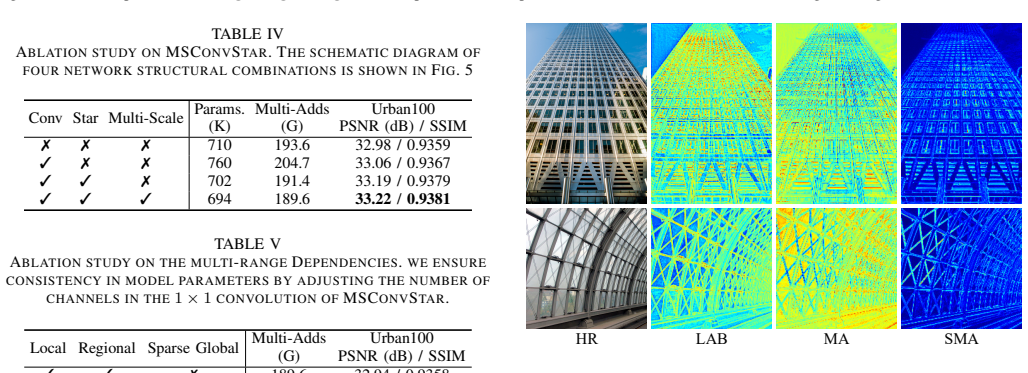
The load-bearing object is sparse multi-range attention (SMA), defined in Eqs. (8)–(10): for range size $k$ and dilation rate $\delta$, the key-value set for pixel $(i,j)$ contains only positions $(i+x\delta,\ j+y\delta)$ with $-k/2 \le x,y \le k/2$, so the number of attended keys stays roughly $k^2$ while the covered area grows by about $\delta$. Multi-range attention (MA) is the non-sparse companion: several heads compute regional attention over different $k$ values and their outputs are concatenated and fused. A Local Aggregation Block uses depth-wise convolutions and channel attention for local features, and the MSConvStar module replaces the standard feed-forward network with parallel multi-scale depth-wise convolutions plus a star operation. The dilation schedule in the paper sets $\delta$ as the floor division of the $64\times64$ patch size by the range size, i.e., $\{9,7,5\}$ for ranges $\{7,9,11\}$, which lets SMA reach across the whole training patch at roughly constant cost.
What would settle it
Train MAT-light with the same parameter and compute budget but with dense global attention in place of SMA, or evaluate the model on inputs whose patch size is $128\times128$ while recomputing the dilation schedule; if the dense version matches or beats MAT, or if performance drops sharply when the schedule is re-derived for a different patch size, the multi-range sparse design is not doing the claimed work. A complementary test is to construct images whose repeating texture has a period not commensurate with the dilation step and check whether SMA misses those matches.
Extended reading notes
Core claim
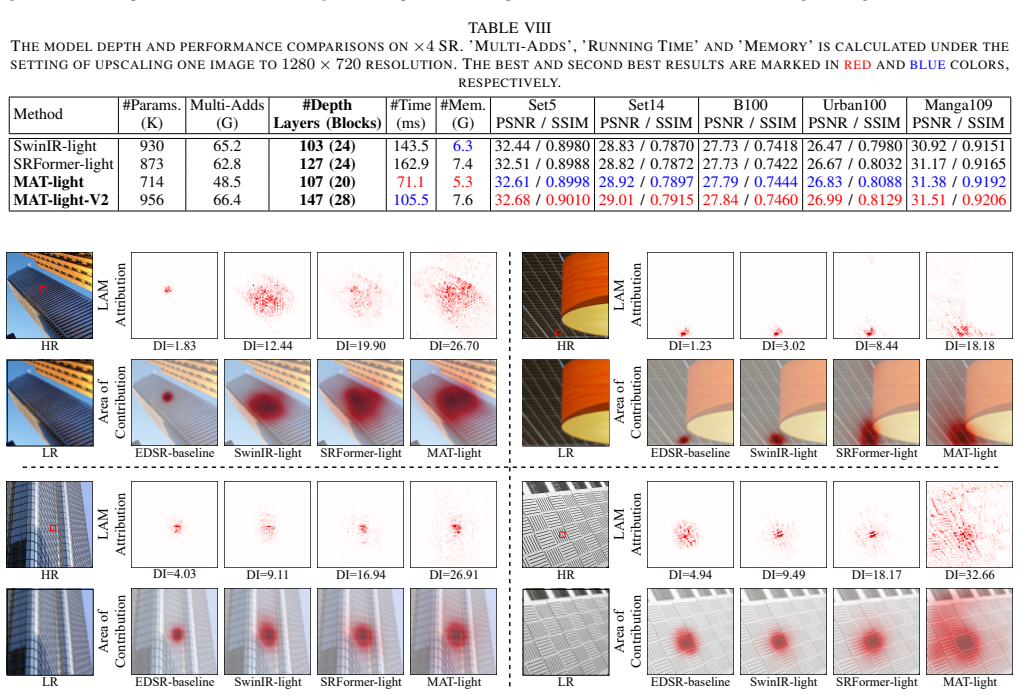
On the paper's own terms, the central discovery is that dilation can be transplanted from convolutions into self-attention to make a Transformer's receptive field flexible without raising its compute. Multi-range attention applies regional attention at several range sizes across different heads, and sparse multi-range attention samples keys on a grid stepped by a dilation rate, so a $k\times k$ set of keys spreads across a far larger spatial footprint. Combined with a local aggregation block and the MSConvStar feed-forward module, this yields a model whose effective receptive field, measured by LAM diffusion index, covers nearly the whole input image. The paper reports that this design outperforms fixed-window transformers such as SwinIR-light and SRFormer-light on all five benchmarks at $\times2$, $\times3$, and $\times4$, with the largest gains on Urban100 and Manga109, while using fewer parameters, Multi-Adds, inference time, and GPU memory.
Load-bearing premise
The argument hinges on the idea that a sparse, evenly spaced sample of distant pixels preserves the useful non-local information that dense attention would find, at the specific dilation ratios chosen for $64\times64$ training patches; if informative matches fall between the sampled positions, the efficiency claim loses its performance basis.
Editorial extensions
If this is right
- Lightweight super-resolution can match or beat fixed-window Transformer accuracy with much less compute: MAT-light reports $26.83$ dB on Urban100 at $\times4$ with 714K parameters and 48.5G Multi-Adds.
- Scaling the same multi-range recipe works: the $9.6$M-parameter classical MAT outperforms or ties SwinIR, HAT-S, ART-S, DAT-S, SRFormer and MambaIR on most benchmark and scale combinations.
- The receptive-field gain is attributable to sparse global attention: ablations show that removing SMA lowers the LAM diffusion index and PSNR more than removing MA or LAB.
- The MSConvStar feed-forward module improves feature diversity while reducing parameters relative to a plain MLP or ConvFFN baseline.
- Because the design avoids large padded windows, it is faster in practice: MAT-light runs about $3.3\times$ faster than SRFormer-light and uses about 24% less GPU memory at $1536^2$ output.
Reading between the lines
- Because the gain is tied to a dilation schedule fixed by the training patch size, a natural testable extension is to make dilation rates learned or resolution-adaptive; the paper does not report such a variant.
- The same sparse-sampling logic should transfer to other dense prediction tasks such as denoising, deblurring, or segmentation, since the underlying redundancy argument concerns natural image statistics rather than super-resolution specifically.
- If the benefit comes from covering a larger footprint with the same number of attended keys, then very high resolutions will thin the sampled grid and may require more range levels; the paper's experiments stop at $1536^2$ output, so this scaling behavior remains unshown.
- The paper's own 'not all global dependencies are equally valuable' framing suggests that a learned gating mechanism over ranges could outperform the fixed two-heads-per-range allocation, a variant the authors leave untested.
Editorial analysis
A structured set of objections, weighed in public.
Referee Report
Summary. The paper proposes MAT, a transformer architecture for single-image super-resolution that replaces fixed-window self-attention with multi-range attention (MA) and sparse multi-range attention (SMA), and introduces the MSConvStar module for multi-range representation learning. The authors evaluate lightweight and classical variants of MAT on five benchmarks, reporting state-of-the-art PSNR/SSIM with lower parameter counts and Multi-Adds, and support the design with component ablations, LAM visualizations, ERF measurements, and runtime comparisons.
Significance. If the empirical results are reproducible, MAT is a genuinely useful efficient SR architecture: the sparse dilated attention in SMA provides a larger effective receptive field at the same computational cost, and the reported 714K-parameter lightweight model reaches 26.83 dB on Urban100 x4, outperforming SRFormer-light with lower Multi-Adds. The paper's strengths are its component-by-component ablations (Tables I-V), the LAM/ERF analyses, the public code release, and the breadth of benchmark comparisons. However, the classical-SR state-of-the-art claim is not fully established because one baseline entry in Table VII is better in PSNR, and the reported gains are single-run values without variance; the precise magnitude of the claimed advantages is therefore uncertain.
major comments (4)
- [§IV-D, Table VII] The statement in §IV-D that "MAT achieves superior performance across all five benchmark datasets and scale factors" is contradicted by Table VII: on the x4 Manga109 row, MambaIR has PSNR 33.32 dB while MAT+ has 32.49 dB, a 0.83 dB deficit for the proposed method on the primary metric. Because PSNR is the standard comparison metric in SR, this sentence is false as written. The claim should be corrected or qualified (e.g., per-dataset exceptions or parameter-efficiency framing), and the MambaIR value should be verified against the original MambaIR publication because it is considerably higher than neighboring entries such as HAT-S (32.35 dB) and SwinIR (32.03 dB).
- [§IV-A, Tables VI-VII] The benchmark tables report single-run PSNR/SSIM without variance. Several of the headline gains are in the 0.08-0.16 dB range, e.g., Urban100 x4: MAT-light 26.83 vs. SRFormer-light 26.67, and Manga109 x4: MAT-light 31.38 vs. SRFormer-light 31.17; in this regime training noise of 0.1-0.2 dB is common. Please provide mean plus/minus standard deviation over at least three training runs for the main lightweight comparisons, or otherwise report seed variability, so that the claimed improvements can be distinguished from training noise.
- [§IV-G, Fig. 16] The abstract's "3.3x faster" claim is taken from the largest resolution shown in Fig. 16 (1536x1536), but at the 1280x720 setting used in Table VIII the speedup is only 162.9/71.1 about 2.29x, and the Multi-Adds ratio is 62.8/48.5 about 1.29x. The paper should state the speedup at the standard benchmark resolution and clearly qualify that the factor depends on image resolution; otherwise the headline efficiency claim is misleading.
- [Eq. (9), §IV-A] The dilation schedule delta = {9,7,5} is defined as the floor division of the 64x64 training patch size by the range sizes, and Eq. (9) samples keys at positions offset by multiples of delta. The paper does not specify how SMA is applied at test-time resolutions that are not 64x64, nor how boundary positions are handled (padding versus masking). Because the model is evaluated on arbitrary image sizes, an explicit boundary description and an experiment at a different resolution or patch size are needed to support the generalization claim for the multi-range design.
minor comments (4)
- [Figures 3, 5, 15 and Table IV] There are several typographical errors: "MSCvonStar" in Fig. 3 should be "MSConvStar", "MSC ONV STAR" in the Table IV heading should be "MSConvStar", and "efective" in the Fig. 15 caption should be "effective".
- [§IV-A] The text says "the the number of RMAG, MAB and channel increase" with a duplicated article; also "Flicker2K" should read "Flickr2K".
- [Table VII caption] The caption says Multi-Adds are calculated for "upscaling one image to 2562 resolution", which appears to be a typo; the intended resolution should be stated consistently with Table VIII, where 1280x720 is used.
- [Tables VI-VII, References] Some method entries in the tables have compound venue labels (e.g., CRAFT as "ICCV23&PAMI25" and SRFormer cited with both ICCV and journal years); the reference list should identify the primary venue unambiguously.
Circularity Check
No significant circularity: MAT's performance and efficiency claims are empirical benchmark comparisons and direct measurements, not derivations from fitted targets or self-cited premises.
full rationale
The paper is an empirical architecture study. Its central claims are PSNR/SSIM values on standard benchmarks obtained by training fixed architectures with standard L1 loss and comparing against published baselines. No parameter is fitted to the target benchmark numbers, and the reported gains are not constructed from those numbers. The design choices, such as range sizes 7x7/9x9/11x11 and dilation rates set to floor division of the 64x64 patch by the range sizes, are motivated by ablations on Urban100 x2 (Tables I-V), which is a model-selection procedure rather than a circular derivation of the final SOTA claim. Equation (9) defines the sparse sampling pattern, and its effectiveness is tested empirically against alternatives in Table III; it is not a renaming of a known result. The efficiency claim of ~3.3x faster than SRFormer-light is a direct runtime measurement (Fig. 16). Self-citations [2] and [15] appear only in related work as examples of CNN-based SR approaches and are not load-bearing; no uniqueness theorem is invoked to forbid alternatives. The apparent conflict in Table VII, where MambaIR reaches 33.32 dB while MAT+ reaches 32.49 dB on Manga109 x4, is a correctness or comparison issue, not a circularity issue, because the claim does not reduce to its inputs by definition. Overall, the derivation chain is self-contained and externally benchmarked.
Assumptions & free parameters
free parameters (5)
- MA and SMA range sizes =
7x7, 9x9, 11x11 (lightweight); 13x13, 15x15, 17x17 (classical)
- SMA dilation rates =
5, 7, 9 (lightweight), derived as floor(64 / range)
- Attention head allocation per range =
2 heads per range, 6 heads total
- MSConvStar depth-wise kernel sizes =
1x1, 3x3, 5x5, 7x7
- Network depth and width =
RMAG/MAB/channel = 4/2/60 (lightweight), 6/3/156 (classical)
assumptions (4)
- domain assumption Natural images contain hierarchical features at multiple spatial scales and exhibit self-similarity/redundancy.
- domain assumption Sparse sampled global attention at stride delta retains the essential non-local dependencies.
- standard math Scaled dot-product attention with softmax and learnable relative position bias provides effective feature aggregation.
- domain assumption Training on DIV2K/DF2K with L1 loss transfers to the five benchmark test sets.
Cite this review
Pith. "Pith review of MAT: Multi-Range Attention Transformer for Efficient Image Super-Resolution." pith.science (2026). https://pith.science/paper/O3B2QII6
@misc{pith2026241117214,
  author       = {Pith},
  title        = {Pith review of: MAT: Multi-Range Attention Transformer for Efficient Image Super-Resolution},
  year         = {2026},
  howpublished = {\url{https://pith.science/paper/O3B2QII6}},
  note         = {Machine review of arXiv:2411.17214}
}
read the original abstract
Image super-resolution (SR) has significantly advanced through the adoption of Transformer architectures. However, conventional techniques aimed at enlarging the self-attention window to capture broader contexts come with inherent drawbacks, especially the significantly increased computational demands. Moreover, the feature perception within a fixed-size window of existing models restricts the effective receptive field (ERF) and the intermediate feature diversity. We demonstrate that a flexible integration of attention across diverse spatial extents can yield significant performance enhancements. In line with this insight, we introduce Multi-Range Attention Transformer (MAT) for SR tasks. MAT leverages the computational advantages inherent in dilation operation, in conjunction with self-attention mechanism, to facilitate both multi-range attention (MA) and sparse multi-range attention (SMA), enabling efficient capture of both regional and sparse global features. Combined with local feature extraction, MAT adeptly capture dependencies across various spatial ranges, improving the diversity and efficacy of its feature representations. We also introduce the MSConvStar module, which augments the model's ability for multi-range representation learning. Comprehensive experiments show that our MAT exhibits superior performance to existing state-of-the-art SR models with remarkable efficiency (~3.3 faster than SRFormer-light).
Figures


Figures from the paper (13 more)






Reference graph
Works this paper leans on
-
[1]
Reconstructing an image from its local descriptors,
P. Weinzaepfel, H. J ´egou, and P. P ´erez, “Reconstructing an image from its local descriptors,” in CVPR. IEEE, 2011, pp. 337–344. 1
work page 2011
-
[2]
Boosting single image super-resolution via partial channel shifting,
X. Zhang, T. Li, and X. Zhao, “Boosting single image super-resolution via partial channel shifting,” in ICCV, 2023, pp. 13 223–13 232. 1, 2
work page 2023
-
[3]
Matching local self-similarities across images and videos,
E. Shechtman and M. Irani, “Matching local self-similarities across images and videos,” in CVPR, 2007, pp. 1–8. 1
work page 2007
-
[4]
Super-resolution from a single image,
D. Glasner, S. Bagon, and M. Irani, “Super-resolution from a single image,” in ICCV, 2009, pp. 349–356. 1
work page 2009
-
[5]
Y . Hu, J. Li, Y . Huang, and X. Gao, “Image super-resolution with self- similarity prior guided network and sample-discriminating learning,” TCSVT, vol. 32, no. 4, pp. 1966–1985, Apr. 2022. 1
work page 1966
-
[6]
Single image super-resolution from transformed self-exemplars,
J.-B. Huang, A. Singh, and N. Ahuja, “Single image super-resolution from transformed self-exemplars,” in CVPR, 2015, pp. 5197–5206. 1, 5
work page 2015
-
[7]
Image super-resolution using deep convolutional networks,
C. Dong, C. C. Loy, K. He, and X. Tang, “Image super-resolution using deep convolutional networks,” IEEE TPAMI, vol. 38, no. 2, pp. 295–307,
-
[8]
Accurate image super-resolution using very deep convolutional networks,
J. Kim, J. K. Lee, and K. M. Lee, “Accurate image super-resolution using very deep convolutional networks,” in CVPR, 2016, pp. 1646–1654. 1, 2
work page 2016
Show all 65 references
-
[9]
Photo-realistic single im- age super-resolution using a generative adversarial network,
C. Ledig, L. Theis, F. Husz ´ar, J. Caballero, A. Cunningham, A. Acosta, A. Aitken, A. Tejani, J. Totz, Z. Wang et al., “Photo-realistic single im- age super-resolution using a generative adversarial network,” in CVPR, 2017, pp. 4681–4690. 1
2017
-
[10]
Enhanced deep resid- ual networks for single image super-resolution,
B. Lim, S. Son, H. Kim, S. Nah, and K. Mu Lee, “Enhanced deep resid- ual networks for single image super-resolution,” in CVPR Workshops, 2017, pp. 136–144. 1, 2, 5, 7, 8, 9, 10, 11
2017
-
[11]
Residual dense network for image super-resolution,
Y . Zhang, Y . Tian, Y . Kong, B. Zhong, and Y . Fu, “Residual dense network for image super-resolution,” in CVPR, 2018, pp. 2472–2481. 2
2018
-
[12]
Multi-grained attention networks for single image super-resolution,
H. Wu, Z. Zou, J. Gui, W.-J. Zeng, J. Ye, J. Zhang, H. Liu, and Z. Wei, “Multi-grained attention networks for single image super-resolution,” IEEE TCSVT, vol. 31, no. 2, pp. 512–522, 2021. 2
2021
-
[13]
Lightweight image super- resolution with information multi-distillation network,
Z. Hui, X. Gao, Y . Yang, and X. Wang, “Lightweight image super- resolution with information multi-distillation network,” in ACM MM , 2019, pp. 2024–2032. 2, 3, 7, 8
2019
-
[14]
Blueprint separable residual network for efficient image super-resolution,
Z. Li, Y . Liu, X. Chen, H. Cai, J. Gu, Y . Qiao, and C. Dong, “Blueprint separable residual network for efficient image super-resolution,” in CVPR Workshops, 2022, pp. 833–843. 2
2022
-
[15]
Large kernel distillation network for efficient single image super-resolution,
C. Xie, X. Zhang, L. Li, H. Meng, T. Zhang, T. Li, and X. Zhao, “Large kernel distillation network for efficient single image super-resolution,” in CVPR Workshops, 2023, pp. 1283–1292. 2
2023
-
[16]
Image super- resolution using very deep residual channel attention networks,
Y . Zhang, K. Li, K. Li, L. Wang, B. Zhong, and Y . Fu, “Image super- resolution using very deep residual channel attention networks,” in ECCV, 2018, pp. 286–301. 2, 3, 5, 9
2018
-
[17]
Residual feature aggregation network for image super-resolution,
J. Liu, W. Zhang, Y . Tang, J. Tang, and G. Wu, “Residual feature aggregation network for image super-resolution,” in CVPR, 2020, pp. 2359–2368. 2
2020
-
[18]
Image super-resolution with non-local sparse attention,
Y . Mei, Y . Fan, and Y . Zhou, “Image super-resolution with non-local sparse attention,” in CVPR, 2021, pp. 3517–3526. 2, 4, 9
2021
-
[19]
Attention is all you need,
A. Vaswani, N. Shazeer, N. Parmar, J. Uszkoreit, L. Jones, A. N. Gomez, Ł. Kaiser, and I. Polosukhin, “Attention is all you need,” NeurIPS, vol. 30, 2017. 2, 4, 5
2017
-
[20]
Interpreting super-resolution networks with local attribution maps,
J. Gu and C. Dong, “Interpreting super-resolution networks with local attribution maps,” in CVPR, 2021, pp. 9199–9208. 2, 6, 7, 11
2021
-
[21]
Swinir: Image restoration using swin transformer,
J. Liang, J. Cao, G. Sun, K. Zhang, L. Van Gool, and R. Timofte, “Swinir: Image restoration using swin transformer,” in ICCV Workshops, 2021, pp. 1833–1844. 2, 3, 4, 5, 6, 7, 8, 9, 10, 11 IEEE TRANSACTIONS ON CIRCUITS AND SYSTEMS FOR VIDEO TECHNOLOGY 12
2021
-
[22]
Activating more pixels in image super-resolution transformer,
X. Chen, X. Wang, J. Zhou, Y . Qiao, and C. Dong, “Activating more pixels in image super-resolution transformer,” in CVPR, 2023, pp. 22 367–22 377. 2, 3, 9
2023
-
[23]
Srformer: Permuted self-attention for single image super-resolution,
Y . Zhou, Z. Li, C.-L. Guo, S. Bai, M.-M. Cheng, and Q. Hou, “Srformer: Permuted self-attention for single image super-resolution,” in ICCV, 2023, pp. 12 780–12 791. 2, 3, 4, 5, 6, 7, 8, 9, 10, 11
2023
-
[24]
Scaling up your kernels to 31x31: Revisiting large kernel design in cnns,
X. Ding, X. Zhang, J. Han, and G. Ding, “Scaling up your kernels to 31x31: Revisiting large kernel design in cnns,” in CVPR, 2022, pp. 11 963–11 975. 2, 11
2022
-
[25]
Efficient and explicit modelling of image hierarchies for image restoration,
Y . Li, Y . Fan, X. Xiang, D. Demandolx, R. Ranjan, R. Timofte, and L. Van Gool, “Efficient and explicit modelling of image hierarchies for image restoration,” in CVPR, 2023, pp. 18 278–18 289. 2, 3
2023
-
[26]
Rethinking atrous convolution for semantic image segmentation,
L.-C. Chen, G. Papandreou, F. Schroff, and H. Adam, “Rethinking atrous convolution for semantic image segmentation,” arXiv preprint arXiv:1706.05587, 2017. 2
2017 arXiv
-
[27]
Understanding convolution for semantic segmentation,
P. Wang, P. Chen, Y . Yuan, D. Liu, Z. Huang, X. Hou, and G. Cottrell, “Understanding convolution for semantic segmentation,” in WACV, 2018, pp. 1451–1460. 2
2018
-
[28]
Rewrite the stars,
X. Ma, X. Dai, Y . Bai, Y . Wang, and Y . Fu, “Rewrite the stars,” in CVPR, Jun. 2024, pp. 5694–5703. 2, 5
2024
-
[29]
Ntire 2017 challenge on single image super-resolution: Dataset and study,
E. Agustsson and R. Timofte, “Ntire 2017 challenge on single image super-resolution: Dataset and study,” in CVPR Workshops , 2017, pp. 126–135. 2, 5
2017
-
[30]
Batch normalization: Accelerating deep network training by reducing internal covariate shift,
S. Ioffe and C. Szegedy, “Batch normalization: Accelerating deep network training by reducing internal covariate shift,” in ICML, vol. 37, Jul. 2015, pp. 448–456. 2
2015
-
[31]
Cross-scale internal graph neural network for image super-resolution,
S. Zhou, J. Zhang, W. Zuo, and C. C. Loy, “Cross-scale internal graph neural network for image super-resolution,” NeurIPS, vol. 33, pp. 3499– 3509, 2020. 2, 9
2020
-
[32]
Feedback pyramid attention networks for single image super-resolution,
H. Wu, J. Gui, J. Zhang, J. T. Kwok, and Z. Wei, “Feedback pyramid attention networks for single image super-resolution,” IEEE TCSVT , vol. 33, no. 9, pp. 4881–4892, Sep. 2023. 2
2023
-
[33]
Non-local neural net- works,
X. Wang, R. Girshick, A. Gupta, and K. He, “Non-local neural net- works,” in CVPR, 2018, pp. 7794–7803. 2
2018
-
[34]
An image is worth 16x16 words: Transformers for image recognition at scale,
A. Dosovitskiy, L. Beyer, A. Kolesnikov, D. Weissenborn, X. Zhai, T. Unterthiner, M. Dehghani, M. Minderer, G. Heigold, S. Gelly et al., “An image is worth 16x16 words: Transformers for image recognition at scale,” in ICLR, 2021. 3, 4
2021
-
[35]
Swin transformer: Hierarchical vision transformer using shifted windows,
Z. Liu, Y . Lin, Y . Cao, H. Hu, Y . Wei, Z. Zhang, S. Lin, and B. Guo, “Swin transformer: Hierarchical vision transformer using shifted windows,” in ICCV, 2021, pp. 10 012–10 022. 3, 4
2021
-
[36]
Segformer: Simple and efficient design for semantic segmentation with transformers,
E. Xie, W. Wang, Z. Yu, A. Anandkumar, J. M. Alvarez, and P. Luo, “Segformer: Simple and efficient design for semantic segmentation with transformers,” NeurIPS, vol. 34, pp. 12 077–12 090, 2021. 3
2021
-
[37]
End-to-end object detection with transformers,
N. Carion, F. Massa, G. Synnaeve, N. Usunier, A. Kirillov, and S. Zagoruyko, “End-to-end object detection with transformers,” in ECCV, 2020, pp. 213–229. 3
2020
-
[38]
Restormer: Efficient transformer for high-resolution image restoration,
S. W. Zamir, A. Arora, S. Khan, M. Hayat, F. S. Khan, and M.-H. Yang, “Restormer: Efficient transformer for high-resolution image restoration,” in CVPR, 2022, pp. 5728–5739. 3, 5
2022
-
[39]
Egocentric early action prediction via multimodal transformer-based dual action prediction,
W. Guan, X. Song, K. Wang, H. Wen, H. Ni, Y . Wang, and X. Chang, “Egocentric early action prediction via multimodal transformer-based dual action prediction,” IEEE TCSVT , vol. 33, no. 9, pp. 4472–4483,
-
[40]
Msvt: Multiple spatiotemporal views transformer for deepfake video detection,
Y . Yu, R. Ni, Y . Zhao, S. Yang, F. Xia, N. Jiang, and G. Zhao, “Msvt: Multiple spatiotemporal views transformer for deepfake video detection,” IEEE TCSVT, vol. 33, no. 9, pp. 4462–4471, Sep. 2023. 3
2023
-
[41]
Lightweight image super-resolution with pyramid clustering transformer,
M. Li, B. Ma, and Y . Zhang, “Lightweight image super-resolution with pyramid clustering transformer,” IEEE TCSVT, 2023. 3
2023
-
[42]
Hybrid attention- based u-shaped network for remote sensing image super-resolution,
J. Wang, B. Wang, X. Wang, Y . Zhao, and T. Long, “Hybrid attention- based u-shaped network for remote sensing image super-resolution,” IEEE TGRS, vol. 61, pp. 1–15, 2023. 3
2023
-
[43]
Cross-spatial pixel integration and cross-stage feature fusion- based transformer network for remote sensing image super-resolution,
Y . Lu, L. Min, B. Wang, L. Zheng, X. Wang, Y . Zhao, L. Yang, and T. Long, “Cross-spatial pixel integration and cross-stage feature fusion- based transformer network for remote sensing image super-resolution,” IEEE TGRS, vol. 61, pp. 1–16, 2023. 3
2023
-
[44]
Omni aggregation networks for lightweight image super-resolution,
H. Wang, X. Chen, B. Ni, Y . Liu, and J. Liu, “Omni aggregation networks for lightweight image super-resolution,” in CVPR, 2023, pp. 22 378–22 387. 3, 7, 8
2023
-
[45]
Accurate image restoration with attention retractable transformer,
J. Zhang, Y . Zhang, J. Gu, Y . Zhang, L. Kong, and X. Yuan, “Accurate image restoration with attention retractable transformer,” in ICLR, 2023. 3, 6, 9
2023
-
[46]
Transformer-based dual-branch multiscale fusion network for pan-sharpening remote sensing images,
Z. Li, J. Li, L. Ren, and Z. Chen, “Transformer-based dual-branch multiscale fusion network for pan-sharpening remote sensing images,” IEEE JSTARS, vol. 17, pp. 614–632, 2023. 3
2023
-
[47]
Slide-transformer: Hierarchical vision transformer with local self-attention,
X. Pan, T. Ye, Z. Xia, S. Song, and G. Huang, “Slide-transformer: Hierarchical vision transformer with local self-attention,” in CVPR, 2023, pp. 2082–2091. 3
2023
-
[48]
Dilateformer: Multi-scale dilated transformer for visual recognition,
J. Jiao, Y .-M. Tang, K.-Y . Lin, Y . Gao, A. J. Ma, Y . Wang, and W.-S. Zheng, “Dilateformer: Multi-scale dilated transformer for visual recognition,” TMM, vol. 25, pp. 8906–8919, 2023. 3
2023
-
[49]
Real-time single image and video super- resolution using an efficient sub-pixel convolutional neural network,
W. Shi, J. Caballero, F. Husz ´ar, J. Totz, A. P. Aitken, R. Bishop, D. Rueckert, and Z. Wang, “Real-time single image and video super- resolution using an efficient sub-pixel convolutional neural network,” in CVPR, 2016, pp. 1874–1883. 3
2016
-
[50]
Efficient non- local contrastive attention for image super-resolution,
B. Xia, Y . Hang, Y . Tian, W. Yang, Q. Liao, and J. Zhou, “Efficient non- local contrastive attention for image super-resolution,” in AAAI, vol. 36, 2022, pp. 2759–2767. 4
2022
-
[51]
Stand-alone self-attention in vision models,
P. Ramachandran, N. Parmar, A. Vaswani, I. Bello, A. Levskaya, and J. Shlens, “Stand-alone self-attention in vision models,” NeurIPS, vol. 32, 2019. 4
2019
-
[52]
Neighborhood attention transformer,
A. Hassani, S. Walton, J. Li, S. Li, and H. Shi, “Neighborhood attention transformer,” in CVPR, 2023, pp. 6185–6194. 4
2023
-
[53]
Scaling local self-attention for parameter efficient visual backbones,
A. Vaswani, P. Ramachandran, A. Srinivas, N. Parmar, B. Hechtman, and J. Shlens, “Scaling local self-attention for parameter efficient visual backbones,” in CVPR, 2021, pp. 12 894–12 904. 4
2021
-
[54]
Exploring frequency-inspired optimization in transformer for efficient single image super-resolution,
A. Li, L. Zhang, Y . Liu, and C. Zhu, “Exploring frequency-inspired optimization in transformer for efficient single image super-resolution,” IEEE TPAMI, pp. 1–18, 2025. 5, 7, 8
2025
-
[55]
Low- complexity single-image super-resolution based on nonnegative neighbor embedding,
M. Bevilacqua, A. Roumy, C. Guillemot, and M. L. Alberi-Morel, “Low- complexity single-image super-resolution based on nonnegative neighbor embedding,” in BMVC, 2012. 5
2012
-
[56]
On single image scale-up using sparse-representations,
R. Zeyde, M. Elad, and M. Protter, “On single image scale-up using sparse-representations,” in Curves and Surfaces , 2012, pp. 711–730. 5
2012
-
[57]
A database of human segmented natural images and its application to evaluating segmentation algorithms and measuring ecological statistics,
D. Martin, C. Fowlkes, D. Tal, and J. Malik, “A database of human segmented natural images and its application to evaluating segmentation algorithms and measuring ecological statistics,” in ICCV, vol. 2, 2001, pp. 416–423. 5
2001
-
[58]
Sketch-based manga retrieval using manga109 dataset,
Y . Matsui, K. Ito, Y . Aramaki, A. Fujimoto, T. Ogawa, T. Yamasaki, and K. Aizawa, “Sketch-based manga retrieval using manga109 dataset,” Multimed Tools Appl, vol. 76, pp. 21 811–21 838, 2017. 5
2017
-
[59]
Adam: A method for stochastic optimization,
D. P. Kingma and J. Ba, “Adam: A method for stochastic optimization,” arXiv preprint arXiv:1412.6980 , 2014. 5
2014 arXiv
-
[60]
Latticenet: Towards lightweight image super-resolution with lattice block,
X. Luo, Y . Xie, Y . Zhang, Y . Qu, C. Li, and Y . Fu, “Latticenet: Towards lightweight image super-resolution with lattice block,” in ECCV, 2020, pp. 272–289. 7, 8
2020
-
[61]
N-gram in swin transformers for efficient lightweight image super-resolution,
H. Choi, J. Lee, and J. Yang, “N-gram in swin transformers for efficient lightweight image super-resolution,” in CVPR, 2023, pp. 2071–2081. 7, 8
2023
-
[62]
Mambair: A simple baseline for image restoration with state-space model,
H. Guo, J. Li, T. Dai, Z. Ouyang, X. Ren, and S.-T. Xia, “Mambair: A simple baseline for image restoration with state-space model,” in ECCV,
-
[63]
Srconvnet: A transformer-style convnet for lightweight image super-resolution,
F. Li, R. Cong, J. Wu, H. Bai, M. Wang, and Y . Zhao, “Srconvnet: A transformer-style convnet for lightweight image super-resolution,” IJCV, vol. 133, no. 1, pp. 173–189, 2025. 7, 8
2025
-
[64]
Dual aggregation transformer for image super-resolution,
Z. Chen, Y . Zhang, J. Gu, L. Kong, X. Yang, and F. Yu, “Dual aggregation transformer for image super-resolution,” in ICCV, 2023, pp. 12 312–12 321. 9
2023
-
[65]
Image super- resolution via efficient transformer embedding frequency decomposition with restart,
Y . Zuo, W. Yao, Y . Hu, Y . Fang, W. Liu, and Y . Peng, “Image super- resolution via efficient transformer embedding frequency decomposition with restart,” IEEE TIP, vol. 33, pp. 4670–4685, 2024. 9
2024
Reviewed August 12, 2026 · model on record in the stance chip above.
Discussion (0). Continue with ORCID to comment.