REVIEW 2 major objections 6 minor 54 references
Event Ellipsometer: Event-based Mueller-Matrix Video Imaging
T0 review · 2 major / 6 minor · reviewed 2026-08-12 · deepseek-v4-flash
Pith's one-line read Rotating quarter-wave plates and an event camera estimate the normalized Mueller matrix per pixel at 30 fps.
desk verdict Clever combination of event cameras and rotating retarders for 30 fps Mueller-matrix imaging; the printed derivative drops the ω factor, and 'dynamic' really means quasi-static within each frame. read the letter →
The pith
A machine-rendered reading of the paper's core claim, the machinery that carries it, and where it could break.
The reading
What carries the argument
The central object is the dual-rotating-retarder ellipsometer arrangement: a linear polarizer and quarter-wave plate in front of the light source, and another quarter-wave plate and linear polarizer in front of the event camera, with the camera-side wave plate rotating five times faster than the source-side one. This continuous rotation encodes the sixteen Mueller-matrix elements into the temporal intensity profile seen by the event camera. The key identity is the event-camera threshold relation $\partial \log I_t / \partial t = p_k C / \Delta t_k$, which converts measured inter-event time differences into linear equations in the unknown Mueller matrix, so the camera's asynchronous events are used directly as the measurement signal.
What would settle it
Move a known polarimetric target, such as a linear polarizer, fast enough that motion-induced events outnumber modulation-induced events, reconstruct the Mueller matrix from that frame, and check whether the mean-squared error against the known ground truth exceeds the 0.045 reported for static scenes.
Extended reading notes
Core claim
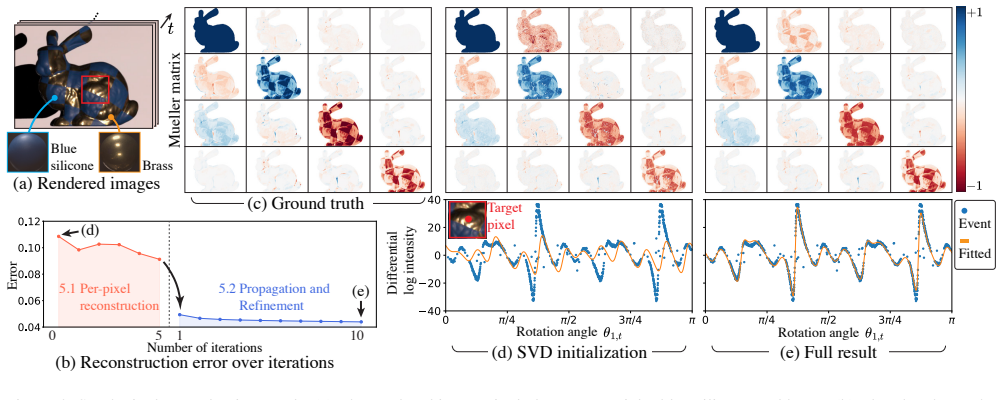
The paper establishes that the asynchronous event stream of a dual rotating quarter-wave-plate ellipsometer is sufficient to estimate the normalized Mueller matrix per pixel. In the image formation model $I_t = A_t \hat{M}$, $\hat{M}$ is the vectorized Mueller matrix and $A_t$ captures the time-varying polarimetric modulation; because the event camera responds to $\partial \log I_t / \partial t$, the observed time differences $\Delta t_k$ of events satisfy $B_{t_k} \hat{M} = 0$ for a known system matrix $B$. Stacking these constraints over events in one frame gives a weighted least-squares problem, solved by SVD, then refined by Cloude's physical-validity projection and a spatiotemporal propagation scheme. The result is a 30 fps Mueller-matrix video for non-planar, dynamic, and high-dynamic-range scenes, reconstructed from 33 ms of events per frame rather than many minutes of frame-based capture.
Load-bearing premise
The load-bearing premise is that within each 33 ms frame the scene's Mueller matrix is constant and that the rotating wave plates, not object motion, dominate event generation.
Editorial extensions
If this is right
- Mueller-matrix imaging extends from static samples to dynamic scenes, because capture time per frame drops from minutes to 33 ms.
- Non-planar objects can be measured without sacrificing sensor spatial resolution, unlike snapshot metasurface-based approaches.
- High-dynamic-range scenes are captured in a single event stream, without bracketed exposures.
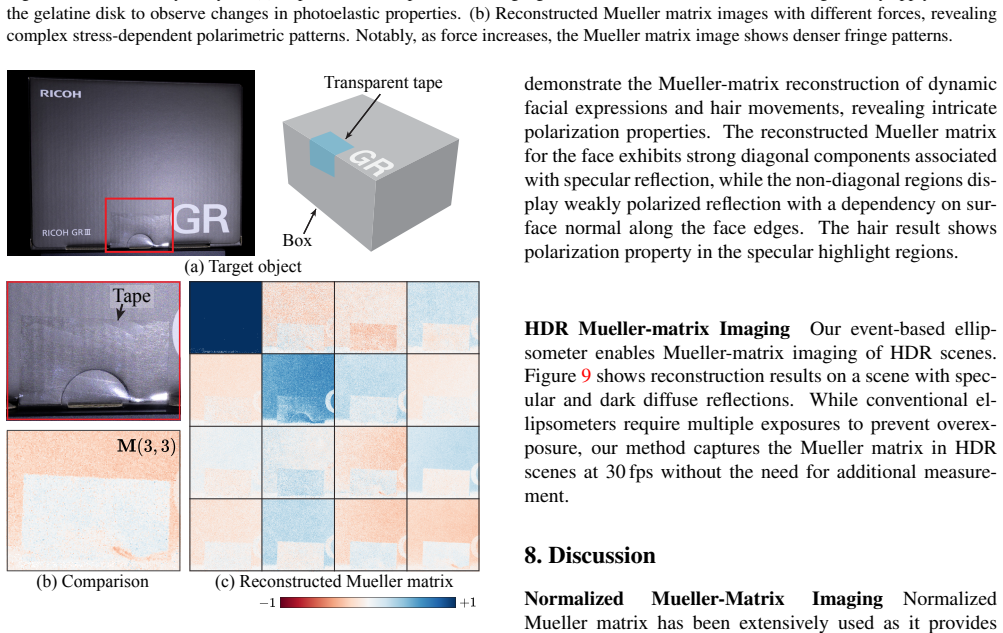
- Demonstrated applications include photoelastic stress visualization in transparent materials, transparent tape detection, and polarimetric capture of human faces and hair.
- The reconstructed quantity is the normalized Mueller matrix $M/M_{00}$, and recovering absolute scale is left as future work.
Reading between the lines
- Pairing this event camera with a conventional intensity sensor could recover the absolute, unnormalized Mueller matrix, since the missing scale is exactly the intensity the event camera discards.
- The fixed 33 ms frame boundary could become an adaptive window that detects when motion-induced events dominate, yielding a motion-aware confidence per pixel.
- Adding a narrow bandpass filter would remove the wavelength-dependent mixing of the white LED and monochrome sensor, at the cost of lower light levels.
- A GPU implementation of the reconstruction would likely close the gap between 30 fps capture and the current offline reconstruction time, making live ellipsometric video feasible.
Editorial analysis
A structured set of objections, weighed in public.
Referee Report
Summary. This paper presents Event Ellipsometer, a Mueller-matrix video imaging system that pairs a Prophesee EVK4 event camera with two fast-rotating quarter-wave plates (QWPs), one in the illumination path and one in the detection path, plus fixed linear polarizers. The authors derive a Stokes-Mueller image formation model in which the logarithmic intensity derivative is expressed as a ratio of linear forms in the vectorized Mueller matrix (Eqs. (4)-(7)), and they formulate reconstruction as a per-pixel weighted least-squares SVD with Cloude physical-validity filtering followed by spatio-temporal propagation and refinement. A one-time calibration estimates the per-pixel contrast threshold and the QWP offset angles. Experiments include synthetic validation, real measurements of known optical elements and a metal plate, and demonstrations on photoelasticity, transparent tape detection, dynamic human face/hair, and HDR scenes. The paper claims Mueller-matrix video capture at 30 fps, i.e., a 33 ms frame duration, and reports mean-squared errors on the order of 0.013-0.020 for known elements.
Significance. The contribution is potentially significant: if the 30 fps capture claim holds, it would extend Mueller-matrix ellipsometry from static samples requiring minutes of acquisition to dynamic scenes, opening new applications in material inspection, photoelasticity, and human capture. The paper provides a substantial amount of engineering detail (hardware prototype, part list, motor synchronization, calibration procedures) that would aid reproducibility, and it clearly identifies limitations such as the non-real-time reconstruction pipeline. The synthetic validation and the comparison with a frame-based method in the supplement are useful. However, the significance hinges on two points: the correctness of the derivative in Eq. (5), which as printed is wrong, and the validity of the dynamic-scene claim, which is only weakly supported.
major comments (2)
- [Section 4, Eq. (5)] The printed expression for dA_t/dt omits the angular velocity factors from every nonzero entry. For example, the derivative of α1^2 is -4ω α1α2, but the paper lists -4α1α2; similarly the α3/α4 terms miss the factor 5ω. With ω = 30π rad/s, the derivative term in Eq. (7) is consequently smaller by two orders of magnitude than it should be, and the units of the B_tk matrix become inconsistent. Because Eq. (7) is the basis of the entire reconstruction (Section 5) and the reported experimental MSE values, the results cannot be reproduced from the equations as written. The authors must correct Eq. (5) (and any dependent equations in the supplement) and confirm whether the implementation used the corrected formula.
- [Sections 3 and 7; Supplement 5.3] The paper's headline claim is Mueller-matrix video imaging at 30 fps for dynamic scenes, but the method assumes that the scene Mueller matrix is constant within each 33 ms frame (Eq. (4)) and that event generation is dominated by the rotating QWPs. Supplement 5.3 explicitly states that reconstruction accuracy degrades when object motion dominates event generation and reports motion artifacts in the human hair scene. Yet the paper offers no quantitative evaluation of how reconstruction error depends on motion amplitude, motion speed, or the ratio of motion-induced to polarization-induced events. The dynamic demonstrations (facial expression change, head rotation) therefore show that plausible images can be produced, not that correct Mueller matrices are recovered under the demonstrated dynamics. Please add a controlled motion experiment (e.g., a known Mueller-matrix target undergoing translations or rotations with varying speed) or substantially weaken the dynamic-scene claim to quasi-static scenes.
minor comments (6)
- [Introduction and Section 7] The introduction states 'achieving a mean-squared error of 0.045 for materials with known Mueller matrices,' but Figure 5(a) reports MSEs of 0.016, 0.015, 0.013, 0.020, and 0.020; please clarify which number is the reported MSE and harmonize the text.
- [Supplement 3.5] The depolarization factor α is set to 0.8 for the reference QWP model without a sensitivity analysis; please report how the calibration error varies with α or justify the choice.
- [Supplement 4.6, Eq. (17)] The polarization preservation formula reads ρ = 1/3(M∆,11 + M∆,20 + M∆,11), which appears to contain a typo (likely M∆,22 instead of M∆,20); please correct.
- [Section 5.2, Eq. (12)] The notation '1' for the all-ones matrix and N for the Gaussian perturbation should be defined more explicitly to avoid confusion with the identity matrix.
- [Figure 2(b)] The timeline schematic is hard to read at the current size; the event markers and the log-intensity trace should be enlarged for legibility.
- [Section 2] The statement that existing event-based vision methods cannot capture full polarization reflectance properties as a Mueller-matrix image would benefit from a citation to the most recent works in event-based polarimetry.
Circularity Check
No significant circularity: the Mueller-matrix reconstruction is an independent inverse solve of B_t M = 0 using separately calibrated sensor parameters, and the central claims are validated on analytic optical elements, synthetic data, and a frame-based comparison.
full rationale
The derivation chain is self-contained. The forward model starts from physical Mueller calculus: I_t = [L(0)Q(θ2,t)MQ(θ1,t)L(0)s]_0 (Eq. 1), which is rearranged exactly into the linear system I_t = A_t M̂ (Eq. 2). Differentiating the logarithm gives Eq. (4), and equating it with the event camera's standard contrast-threshold relation p_k C/Δt_k (Eq. 6) yields the homogeneous reconstruction system B_t M̂ = 0 (Eq. 7). The reconstructed M̂ is the weighted least-squares/robust solution of these equations; no target Mueller matrix of any validation object is used during reconstruction. The two calibrated quantities, C and (i1, i2), are obtained independently: C is fit from an LED intensity ramp via Δt = pC(t + b/a) (Supplement 3.4), and the QWP offset angles are found by grid search against a reference QWP with known fast axis (Supplement 3.5). The reported MSE of 0.045 on known optical elements is therefore a genuine independent check rather than a fitted value reported as a prediction. The only circularity-adjacent concern is that a QWP is used both for offset-angle calibration and as one of the validation targets; even if the same optical element were reused, the two fitted offset scalars do not determine the 16 entries of the validation Mueller matrix, and validation on air, linear polarizers at 0° and 45°, synthetic ground truth, and a frame-based comparison provides independent support. The motion-artifact admission in Supplement 5.3 is a scope limitation on the dynamic-scene claim, not a circular reduction: it identifies when the time-invariant-M assumption in Eq. (4) breaks down, but the reconstruction itself does not presuppose the correctness of the claimed Mueller-matrix output.
Assumptions & free parameters
free parameters (4)
- Contrast threshold C =
C=0.14 (on), 0.19 (off) for one example pixel; per-pixel calibrated
- QWP offset angles i1, i2 (phi_calib1, phi_calib2) =
Not reported numerically; found by grid search
- Depolarization factor alpha in calibration =
0.8
- Rotation speeds and ratio =
omega = 30pi rad/s, camera QWP at 5x speed
assumptions (5)
- domain assumption Event camera threshold relation d log I/dt = p C / Delta t holds via first-order Taylor expansion
- domain assumption Scene Mueller matrix M is constant within each 33 ms frame and motion-induced events are negligible
- domain assumption The optical train can be described by ideal LP/QWP Mueller matrices with a single effective wavelength
- domain assumption Motor rotation angles are known synchronously via encoder triggers at constant speed
- domain assumption Cloude filtering projects onto physically realizable Mueller matrices and does not distort the estimate
Cite this review
Pith. "Pith review of Event Ellipsometer: Event-based Mueller-Matrix Video Imaging." pith.science (2026). https://pith.science/paper/U75YPHW2
@misc{pith2026241117313,
  author       = {Pith},
  title        = {Pith review of: Event Ellipsometer: Event-based Mueller-Matrix Video Imaging},
  year         = {2026},
  howpublished = {\url{https://pith.science/paper/U75YPHW2}},
  note         = {Machine review of arXiv:2411.17313}
}
read the original abstract
Light-matter interactions modify both the intensity and polarization state of light. Changes in polarization, represented by a Mueller matrix, encode detailed scene information. Existing optical ellipsometers capture Mueller-matrix images; however, they are often limited to capturing static scenes due to long acquisition times. Here, we introduce Event Ellipsometer, a method for acquiring a Mueller-matrix video for dynamic scenes. Our imaging system employs fast-rotating quarter-wave plates (QWPs) in front of a light source and an event camera that asynchronously captures intensity changes induced by the rotating QWPs. We develop an ellipsometric-event image formation model, a calibration method, and an ellipsometric-event reconstruction method. We experimentally demonstrate that Event Ellipsometer enables Mueller-matrix video imaging at 30fps, extending ellipsometry to dynamic scenes.
Figures


Figures from the paper (20 more)




Reference graph
Works this paper leans on
-
[1]
write newline
" write newline "" before.all 'output.state := FUNCTION fin.entry add.period write newline FUNCTION new.block output.state before.all = 'skip after.block 'output.state := if FUNCTION new.sentence output.state after.block = 'skip output.state before.all = 'skip after.sentence 'output.state := if if FUNCTION not #0 #1 if FUNCTION and 'skip pop #0 if FUNCTIO...
-
[2]
write newline
" write newline "" before.all 'output.state := FUNCTION n.dashify 't := "" t empty not t #1 #1 substring "-" = t #1 #2 substring "--" = not "--" * t #2 global.max substring 't := t #1 #1 substring "-" = "-" * t #2 global.max substring 't := while if t #1 #1 substring * t #2 global.max substring 't := if while FUNCTION format.date year duplicate empty "emp...
-
[3]
Application of ellipsometry techniques to biological materials
Hans Arwin. Application of ellipsometry techniques to biological materials. Thin Solid Films, 519 0 (9): 0 2589--2592, 2011
work page 2011
-
[4]
High-res facial appearance capture from polarized smartphone images
Dejan Azinovi \'c , Olivier Maury, Christophe Hery, Matthias Nie ner, and Justus Thies. High-res facial appearance capture from polarized smartphone images. In Proceedings of the IEEE/CVF Conference on Computer Vision and Pattern Recognition, pages 16836--16846, 2023
work page 2023
-
[5]
Photopolarimetric measurement of the mueller matrix by fourier analysis of a single detected signal
RMA Azzam. Photopolarimetric measurement of the mueller matrix by fourier analysis of a single detected signal. Optics Letters, 2 0 (6): 0 148--150, 1978
work page 1978
-
[6]
Stokes-vector and mueller-matrix polarimetry
Rasheed MA Azzam. Stokes-vector and mueller-matrix polarimetry. JOSA A, 33 0 (7): 0 1396--1408, 2016
work page 2016
-
[7]
Polarimetric spatio-temporal light transport probing
Seung-Hwan Baek and Felix Heide. Polarimetric spatio-temporal light transport probing. ACM Transactions on Graphics (TOG), 40 0 (6): 0 1--18, 2021
work page 2021
-
[8]
All-photon polarimetric time-of-flight imaging
Seung-Hwan Baek and Felix Heide. All-photon polarimetric time-of-flight imaging. In Proceedings of the IEEE/CVF Conference on Computer Vision and Pattern Recognition, pages 17876--17885, 2022
work page 2022
Show all 54 references
-
[9]
Simultaneous acquisition of polarimetric svbrdf and normals
Seung-Hwan Baek, Daniel S Jeon, Xin Tong, and Min H Kim. Simultaneous acquisition of polarimetric svbrdf and normals. ACM Trans. Graph., 37 0 (6): 0 268, 2018
2018
-
[10]
Image-based acquisition and modeling of polarimetric reflectance
Seung-Hwan Baek, Tizian Zeltner, Hyunjin Ku, Inseung Hwang, Xin Tong, Wenzel Jakob, and Min H Kim. Image-based acquisition and modeling of polarimetric reflectance. ACM Trans. Graph., 39 0 (4): 0 139, 2020
2020
-
[11]
Polarization-based visual computing
Seung-Hwan Baek, Ramesh Raskar, Jinwei Ye, Akshat Dave, Achuta Kadambi, and Huaijin Chen. Polarization-based visual computing. In ACM SIGGRAPH 2023 Courses, pages 1--1, 2023
2023
-
[12]
Patchmatch: A randomized correspondence algorithm for structural image editing
Connelly Barnes, Eli Shechtman, Adam Finkelstein, and Dan B Goldman. Patchmatch: A randomized correspondence algorithm for structural image editing. ACM Trans. Graph., 28 0 (3): 0 24, 2009
2009
-
[13]
Patchmatch stereo-stereo matching with slanted support windows
Michael Bleyer, Christoph Rhemann, and Carsten Rother. Patchmatch stereo-stereo matching with slanted support windows. In Bmvc, pages 1--11, 2011
2011
-
[14]
Snapshot imaging mueller matrix polarimeter using modified savart polariscopes
Qizhi Cao, Min Jiang, Chenling Jia, Siyue Jiang, Jing Zhang, Baoli Yao, Mingwu Jin, Edward Dehoog, Lian Duan, Huahua Wang, et al. Snapshot imaging mueller matrix polarimeter using modified savart polariscopes. Applied Optics, 62 0 (8): 0 2124--2129, 2023
2023
-
[15]
Spincam: High-speed imaging via a rotating point-spread function
Dorian Chan, Mark Sheinin, and Matthew O'Toole. Spincam: High-speed imaging via a rotating point-spread function. In Proceedings of the IEEE/CVF International Conference on Computer Vision, pages 10789--10799, 2023
2023
-
[16]
Polarization and phase-shifting for 3d scanning of translucent objects
Tongbo Chen, Hendrik PA Lensch, Christian Fuchs, and Hans-Peter Seidel. Polarization and phase-shifting for 3d scanning of translucent objects. In 2007 IEEE conference on computer vision and pattern recognition, pages 1--8. IEEE, 2007
2007
-
[17]
Indoor lighting estimation using an event camera
Zehao Chen, Qian Zheng, Peisong Niu, Huajin Tang, and Gang Pan. Indoor lighting estimation using an event camera. In Proceedings of the IEEE/CVF Conference on Computer Vision and Pattern Recognition, pages 14760--14770, 2021
2021
-
[18]
Conditions for the physical realisability of matrix operators in polarimetry
Shane R Cloude. Conditions for the physical realisability of matrix operators in polarimetry. In Polarization Considerations for Optical Systems II, pages 177--187. SPIE, 1990
1990
-
[19]
Field guide to polarization
Edward Collett. Field guide to polarization. Spie Bellingham, 2005
2005
-
[20]
Nest: Neural stress tensor tomography by leveraging 3d photoelasticity
Akshat Dave, Tianyi Zhang, Aaron Young, Ramesh Raskar, Wolfgang Heidrich, and Ashok Veeraraghavan. Nest: Neural stress tensor tomography by leveraging 3d photoelasticity. arXiv preprint arXiv:2406.10212, 2024
2024 arXiv
-
[21]
Acquiring the reflectance field of a human face
Paul Debevec, Tim Hawkins, Chris Tchou, Haarm-Pieter Duiker, Westley Sarokin, and Mark Sagar. Acquiring the reflectance field of a human face. In Proceedings of the 27th annual conference on Computer graphics and interactive techniques, pages 145--156, 2000
2000
-
[22]
Spectroscopic ellipsometry: principles and applications
Hiroyuki Fujiwara. Spectroscopic ellipsometry: principles and applications. John Wiley & Sons, 2007
2007
-
[23]
u ck, Garrick Orchard, Chiara Bartolozzi, Brian Taba, Andrea Censi, Stefan Leutenegger, Andrew J Davison, J \
Guillermo Gallego, Tobi Delbr \"u ck, Garrick Orchard, Chiara Bartolozzi, Brian Taba, Andrea Censi, Stefan Leutenegger, Andrew J Davison, J \"o rg Conradt, Kostas Daniilidis, et al. Event-based vision: A survey. IEEE transactions on pattern analysis and machine intelligence, 4...
2020
-
[24]
Massively parallel multiview stereopsis by surface normal diffusion
Silvano Galliani, Katrin Lasinger, and Konrad Schindler. Massively parallel multiview stereopsis by surface normal diffusion. In Proceedings of the IEEE international conference on computer vision, pages 873--881, 2015
2015
-
[25]
Tissue polarimetry: concepts, challenges, applications, and outlook
Nirmalya Ghosh and I Alex Vitkin. Tissue polarimetry: concepts, challenges, applications, and outlook. Journal of biomedical optics, 16 0 (11): 0 110801--110801, 2011
2011
-
[26]
High-fidelity event-radiance recovery via transient event frequency
Jin Han, Yuta Asano, Boxin Shi, Yinqiang Zheng, and Imari Sato. High-fidelity event-radiance recovery via transient event frequency. In Proceedings of the IEEE/CVF Conference on Computer Vision and Pattern Recognition, pages 20616--20625, 2023
2023
-
[27]
Event-based imaging polarimeter
Michael Hawks and Michael Dexter. Event-based imaging polarimeter. Optical Engineering, 61 0 (5): 0 053101--053101, 2022
2022
-
[28]
Microsaccade-inspired event camera for robotics
Botao He, Ze Wang, Yuan Zhou, Jingxi Chen, Chahat Deep Singh, Haojia Li, Yuman Gao, Shaojie Shen, Kaiwei Wang, Yanjun Cao, et al. Microsaccade-inspired event camera for robotics. Science Robotics, 9 0 (90): 0 eadj8124, 2024
2024
-
[29]
Sparse ellipsometry: portable acquisition of polarimetric svbrdf and shape with unstructured flash photography
Inseung Hwang, Daniel S Jeon, Adolfo Munoz, Diego Gutierrez, Xin Tong, and Min H Kim. Sparse ellipsometry: portable acquisition of polarimetric svbrdf and shape with unstructured flash photography. ACM Transactions on Graphics (TOG), 41 0 (4): 0 1--14, 2022
2022
-
[30]
Spiders: Structured polarization for invisible depth and reflectance sensing
Tomoki Ichikawa, Shohei Nobuhara, and Ko Nishino. Spiders: Structured polarization for invisible depth and reflectance sensing. In Proceedings of the IEEE/CVF Conference on Computer Vision and Pattern Recognition, pages 25077--25085, 2024
2024
-
[31]
Mitsuba 3 renderer, 2022
Wenzel Jakob, Sébastien Speierer, Nicolas Roussel, Merlin Nimier-David, Delio Vicini, Tizian Zeltner, Baptiste Nicolet, Miguel Crespo, Vincent Leroy, and Ziyi Zhang. Mitsuba 3 renderer, 2022. https://mitsuba-renderer.org
2022
-
[32]
Crystallographic orientation of uniaxial calcite and dolomite determined using reflection generalized ellipsometry
GE Jellison, Donovan N Leonard, Lawrence M Anovitz, Chad M Parish, Eliot D Specht, and TM Rosseel. Crystallographic orientation of uniaxial calcite and dolomite determined using reflection generalized ellipsometry. Journal of Applied Physics, 124 0 (22), 2018
2018
-
[33]
Polarized 3d: High-quality depth sensing with polarization cues
Achuta Kadambi, Vage Taamazyan, Boxin Shi, and Ramesh Raskar. Polarized 3d: High-quality depth sensing with polarization cues. In Proceedings of the IEEE international conference on computer vision, pages 3370--3378, 2015
2015
-
[34]
Deep polarization cues for transparent object segmentation
Agastya Kalra, Vage Taamazyan, Supreeth Krishna Rao, Kartik Venkataraman, Ramesh Raskar, and Achuta Kadambi. Deep polarization cues for transparent object segmentation. In Proceedings of the IEEE/CVF Conference on Computer Vision and Pattern Recognition, pages 8602--8611, 2020
2020
-
[35]
Snapshot imaging mueller matrix polarimeter using polarization gratings
Michael W Kudenov, Michael J Escuti, Nathan Hagen, Eustace L Dereniak, and Kazuhiko Oka. Snapshot imaging mueller matrix polarimeter using polarization gratings. Optics letters, 37 0 (8): 0 1367--1369, 2012
2012
-
[36]
Dvs-voltmeter: Stochastic process-based event simulator for dynamic vision sensors
Songnan Lin, Ye Ma, Zhenhua Guo, and Bihan Wen. Dvs-voltmeter: Stochastic process-based event simulator for dynamic vision sensors. In European Conference on Computer Vision, pages 578--593. Springer, 2022
2022
-
[37]
Polarimetric light transport analysis for specular inter-reflection
Ryota Maeda and Shinsaku Hiura. Polarimetric light transport analysis for specular inter-reflection. IEEE Transactions on Computational Imaging, 10: 0 876--887, 2024
2024
-
[38]
Polarization-based inverse rendering from a single view
Miyazaki, Tan, Hara, and Ikeuchi. Polarization-based inverse rendering from a single view. In Proceedings Ninth IEEE International Conference on Computer Vision, pages 982--987. IEEE, 2003
2003
-
[39]
Event-based shape from polarization
Manasi Muglikar, Leonard Bauersfeld, Diederik Paul Moeys, and Davide Scaramuzza. Event-based shape from polarization. In Proceedings of the IEEE/CVF Conference on Computer Vision and Pattern Recognition, pages 1547--1556, 2023
2023
-
[40]
The influences of roughness on film thickness measurements by mueller matrix ellipsometry
David A Ramsey and Kenneth C Ludema. The influences of roughness on film thickness measurements by mueller matrix ellipsometry. Review of scientific instruments, 65 0 (9): 0 2874--2881, 1994
1994
-
[41]
Review of photoelastic image analysis applied to structural birefringent materials: glass and polymers
Michele Scafidi, Giuseppe Pitarresi, Andrea Toscano, Giovanni Petrucci, Sabina Alessi, and Augusto Ajovalasit. Review of photoelastic image analysis applied to structural birefringent materials: glass and polymers. Optical Engineering, 54 0 (8): 0 081206--081206, 2015
2015
-
[42]
Uncontrolled modulation imaging
Yoav Y Schechner and Shree K Nayar. Uncontrolled modulation imaging. In Proceedings of the 2004 IEEE Computer Society Conference on Computer Vision and Pattern Recognition, 2004. CVPR 2004., pages II--II. IEEE, 2004
2004
-
[43]
Polarization-based decorrelation of transparent layers: The inclination angle of an invisible surface
Yoav Y Schechner, Joseph Shamir, and Nahum Kiryati. Polarization-based decorrelation of transparent layers: The inclination angle of an invisible surface. In Proceedings of the seventh IEEE international conference on computer vision, pages 814--819. IEEE, 1999
1999
-
[44]
Instant dehazing of images using polarization
Yoav Y Schechner, Srinivasa G Narasimhan, and Shree K Nayar. Instant dehazing of images using polarization. In Proceedings of the 2001 IEEE Computer Society Conference on Computer Vision and Pattern Recognition. CVPR 2001, pages I--I. IEEE, 2001
2001
-
[45]
Polarization wavefront lidar: Learning large scene reconstruction from polarized wavefronts
Dominik Scheuble, Chenyang Lei, Seung-Hwan Baek, Mario Bijelic, and Felix Heide. Polarization wavefront lidar: Learning large scene reconstruction from polarized wavefronts. In Proceedings of the IEEE/CVF Conference on Computer Vision and Pattern Recognition, pages 21241--21250, 2024
2024
-
[46]
Optimization of a dual-rotating-retarder mueller matrix polarimeter
Matthew H Smith. Optimization of a dual-rotating-retarder mueller matrix polarimeter. Applied optics, 41 0 (13): 0 2488--2493, 2002
2002
-
[47]
Event-based bispectral photometry using temporally modulated illumination
Tsuyoshi Takatani, Yuzuha Ito, Ayaka Ebisu, Yinqiang Zheng, and Takahito Aoto. Event-based bispectral photometry using temporally modulated illumination. In Proceedings of the IEEE/CVF Conference on Computer Vision and Pattern Recognition, pages 15638--15647, 2021
2021
-
[48]
Active polarization descattering
Tali Treibitz and Yoav Y Schechner. Active polarization descattering. IEEE transactions on pattern analysis and machine intelligence, 31 0 (3): 0 385--399, 2008
2008
-
[49]
The mechanical and photoelastic properties of 3d printable stress-visualized materials
Li Wang, Yang Ju, Heping Xie, Guowei Ma, Lingtao Mao, and Kexin He. The mechanical and photoelastic properties of 3d printable stress-visualized materials. Scientific reports, 7 0 (1): 0 10918, 2017
2017
-
[50]
Eventps: Real-time photometric stereo using an event camera
Bohan Yu, Jieji Ren, Jin Han, Feishi Wang, Jinxiu Liang, and Boxin Shi. Eventps: Real-time photometric stereo using an event camera. In Proceedings of the IEEE/CVF Conference on Computer Vision and Pattern Recognition, 2024
2024
-
[51]
Metasurface-enabled single-shot and complete mueller matrix imaging
Aun Zaidi, Noah A Rubin, Maryna L Meretska, Lisa W Li, Ahmed H Dorrah, Joon-Suh Park, and Federico Capasso. Metasurface-enabled single-shot and complete mueller matrix imaging. Nature Photonics, pages 1--9, 2024
2024
-
[52]
Spectral and polarization vision: Spectro-polarimetric real-world dataset
Yujin Jeon, Eunsue Choi, Youngchan Kim, Yunseong Moon, Khalid Omer, Felix Heide, and Seung-Hwan Baek. Spectral and polarization vision: Spectro-polarimetric real-world dataset. In Proceedings of the IEEE/CVF Conference on Computer Vision and Pattern Recognition, pages 22098--2...
2024
-
[53]
Seeing motion at nighttime with an event camera
Haoyue Liu, Shihan Peng, Lin Zhu, Yi Chang, Hanyu Zhou, and Luxin Yan. Seeing motion at nighttime with an event camera. In Proceedings of the IEEE/CVF Conference on Computer Vision and Pattern Recognition, pages 25648--25658, 2024
2024
-
[54]
Interpretation of mueller matrices based on polar decomposition
Shih-Yau Lu and Russell A Chipman. Interpretation of mueller matrices based on polar decomposition. JOSA A, 13 0 (5): 0 1106--1113, 1996
1996
Reviewed August 12, 2026 · model on record in the stance chip above.
Discussion (0). Continue with ORCID to comment.