REVIEW 4 major objections 8 minor 1 cited by
Towards Intention Recognition for Robotic Assistants Through Online POMDP Planning
T0 review · 4 major / 8 minor · reviewed 2026-08-12 · deepseek-v4-flash
Pith's one-line read This paper proposes a flat POMDP model for online active intention recognition and shows that relevance-based planning improves on standard MCTS in two simulated robotic-assistant domains.
desk verdict Promising preliminary framework for online active goal recognition, but the formal POMDP model as written contradicts the experiments it reports. read the letter →
The pith
A machine-rendered reading of the paper's core claim, the machinery that carries it, and where it could break.
The reading
What carries the argument
The central object is the online active intention recognition tuple $\langle \Sigma, s_0, \pi_T, G_T \rangle$, in which $\pi_T$ is a stochastic target simulator that acts as a generative replacement for a plan library. The POMDP is kept flat: states are the product of observer and target variables, observations combine target activities and ordinary sensor readings, and the transition model is $T(s,a,s')\pi_T(s_T)$ with reward $R = R(s,a,s') + R(s_T,a,s'_T)$. The performance improvement comes from the PGS reward-shaping function $F(h_t,h_{t+1}) = \gamma\varphi(h_{t+1}) - \varphi(h_t)$ with $\varphi(h) = \alpha p(h)$, plus the rollout policy $A(h) = \arg\max_a p(h \cup \{a, \omega\})$, which directs simulation toward histories that meet goal conditions.
What would settle it
Run simulated episodes in which the target deviates from $\pi_T$, for example by switching goals mid-episode, choosing a different plan, or changing its action probabilities over time, and check whether the observer's policy still restocks the correct parts and reaches positive terminal returns. If RAGE's return drops to POMCP levels or the terminal state becomes unreachable in these runs, the central claim fails. A second direct test is to vary sensor noise and worker expertise systematically; if the RAGE advantage reverses or disappears under moderate parameter changes, the claimed improvement is not robust.
Extended reading notes
Core claim
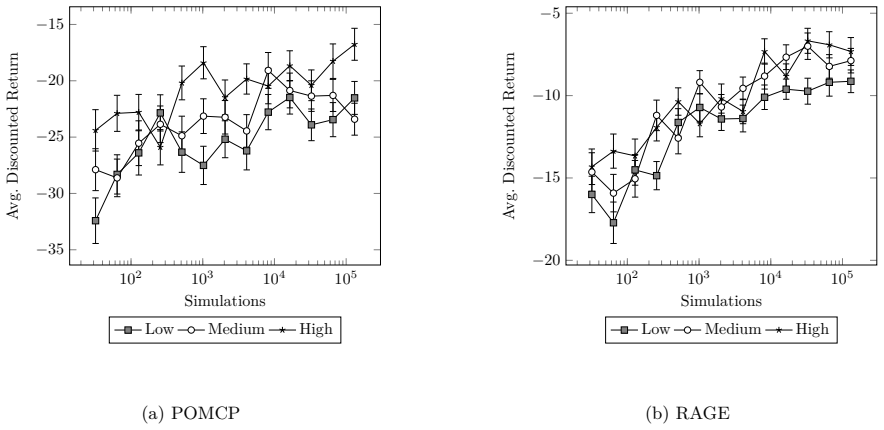
On its own terms, the paper claims that active goal and intention recognition problems can be represented as a flat POMDP whose state includes both observer and target variables, where the target follows a known stochastic policy $\pi_T$ and the observer maximizes discounted return, and that solving this POMDP online with MCTS-style planners works. The additional finding is that augmenting planning with partial goal satisfaction (PGS) reward shaping, which assigns points to transitions that satisfy target goal conditions $G_T$, yields significantly better and more stable returns than uniformly random MCTS in the maintenance and assembly domains, including an assembly state space larger than $10^{11}$ states. The paper is careful to call these results preliminary and notes that the incremental refinement (IRE) component of the relevance-based approach was incorporated but not thoroughly tested.
Load-bearing premise
The observer must know the worker's stochastic policy $\pi_T$ and goal conditions $G_T$ in advance, and the worker must actually follow them. If the worker deviates, changes goals, or learns over time, the model has no mechanism to detect or correct the mismatch, and the claimed recognition capability collapses.
Editorial extensions
If this is right
- Active intention recognition can be tackled as ordinary online POMDP planning without factored state representations or hand-coded plan libraries.
- A stochastic generative target model is sufficient to encode the human worker's behavior in these domains, with goal conditions supplied in advance.
- Relevance-based planning, specifically PGS reward shaping, improves both average discounted return and variance relative to POMCP in both tested domains.
- With a sufficient simulation budget, both planners reach the terminal state in the larger assembly domain, indicating scalability to state spaces over $10^{11}$.
- The observer's action preferences can be generated online from goal-proximity scoring rather than hand-made rules.
Reading between the lines
- The paper assumes $\pi_T$ is fixed and correct; a natural extension is an online belief over possible target policies, allowing the assistant to detect when the worker's behavior deviates from the modeled plan and revise its assistance accordingly.
- PGS's shaping bonus may transfer to other delayed-reward human-robot collaboration tasks, such as eldercare or logistics, where the reward signal arrives only after the human completes a dependent step.
- Since IRE was not thoroughly tested, a direct ablation experiment separating PGS and IRE could identify which mechanism drives RAGE's advantage and whether it persists under sensor-noise and worker-expertise variations.
- The authors' future-work idea of combining POMDP goal reasoning with hierarchical task-network planning suggests a concrete test: measure whether decomposing "bring tool" into platform-specific actions preserves the planning advantage seen in simulation.
Editorial analysis
A structured set of objections, weighed in public.
Referee Report
Summary. This paper proposes a partially observable Markov decision process (POMDP) formulation for active intention recognition, in which a target agent (a human worker) is simulated by a stochastic model π_T and an observer (a robot) plans online with Monte-Carlo tree search. The authors introduce RAGE, a relevance-based planner that uses Partial Goal Satisfaction (PGS) reward shaping and a goal-driven rollout policy, and compare it with standard POMCP on two simulated domains: a maintenance task and a toy-truck assembly task. Across 100 episodes, RAGE reports higher average discounted returns and lower standard errors than POMCP in both domains. The authors conclude that active intention recognition tasks can be modeled and solved online with their proposal and that relevance-based planning can improve performance without highly specialized planners or extensive domain knowledge.
Significance. If the results hold, the paper contributes a practical, flat POMDP formulation for active goal recognition that avoids factored representations and plan libraries, and it provides an initial demonstration that the RAGE planner can outperform POMCP on two simulated assistant tasks. The authors are appropriately cautious in calling the results preliminary, and they explicitly state the limitation that the IRE component was not thoroughly tested. However, the significance is substantially weakened by (i) an inconsistency between the formal transition model and the experimental setup, (ii) the unablated reward shaping in the RAGE comparison, and (iii) missing reproducibility details. The conceptual direction — using a generative target model and online POMDP planning for active intention recognition — is timely and worth further development.
major comments (4)
- [Section 4, transition model] The formal transition model states that target variables s'_T = s' ∩ S_T are determined by π_T(s_T), making the target's evolution independent of the observer's actions and observer-controlled state. Yet the experiments in Sections 5.1 and 5.2 rely on the opposite: the worker 'depends on the robot's intervention to provide tools and a spare relay' (5.1) and 'the robot must continually monitor both the environment and the worker activities' because the worker 'may be unable to complete their task without the robot's help' (5.2). The paper never specifies a coupling mechanism by which observer actions affect s_T or the target's ability to achieve G_T. This is a load-bearing inconsistency: either the implementation uses a different transition model than the one formally defined, or the proposed model cannot represent the assistance loop that the experiments claim to evaluate. Please correct the transition model to include the necessary dependence of target transitions on observer state and actions, and provide code or a precise implementation specification to confirm that the model and experiments match.
- [Section 4.1 and Section 5.3] The reported advantage of RAGE over POMCP is confounded by the PGS reward-shaping term F = γφ(h_{t+1}) − φ(h_t) with φ(h) = α p(h). As the paper states in 5.3, this shaping is applied only during planning and simulation, not during execution, while POMCP is run with the original reward signal. The improvement attributed to relevance-based planning may instead be caused by this internal, non-executed reward bonus. The paper should include an ablation in which POMCP is given the same shaping during planning, and should report the values of α and the PGS point assignments. Additionally, the text in 4.1 says the IRE component was 'incorporated but did not thoroughly test'; please state explicitly whether IRE was active in the RAGE runs that produced Table 1, since an untested component could influence the reported results.
- [Section 4.1 and Section 6] The conclusion that the approach avoids 'large amounts of domain knowledge' is undercut by the design of p(h), which assigns hand-chosen points to the goal conditions G_T given in advance, and by the scaling factor α that must be tuned per problem. The paper does not describe how the point values and α were selected, nor does it report sensitivity to these choices. This is not a logical circularity in the sense of using the hidden goal to build the model, because G_T is part of the problem specification, but the claim about minimal domain knowledge is unsupported without evidence that performance is robust to reasonable variations in these hand-tuned parameters. Please either temper the claim or provide a sensitivity analysis.
- [Section 5] The experimental section omits numerous parameters needed to reproduce the numerical results: exact transition probabilities for the target models, sensor accuracies, the values of expertise levels in the reward distributions, the discount factor γ, MCTS exploration constants, particle counts, and the precise '3 types of random variations' used to prevent particle deprivation in 5.2. No code is released. These details are essential for verifying the 100-episode averages and standard errors in Table 1 and Figures 1–2. Please provide a complete experimental specification or release the simulator and planner code.
minor comments (8)
- [Page 1 (title)] The word 'Through' is misspelled as 'Throu gh' in the title on the first page.
- [Section 4] The transition rule 'T = T(s,a,s')π_T(s_T)' is notationally ambiguous; please define whether this denotes a product of probabilities and specify how the observer and target transitions are combined.
- [Section 4] π_T is called a 'policy' but is defined as a stochastic process with a transition function T(s_T, ω_T, s'_T); please clarify whether π_T outputs actions or next states.
- [Section 5.1] The sentence 'Visual compartment inspections succeed with probability, as do using the screwdriver but the multimeter always returns the correct relay status' is incomplete; a concrete probability or formula is needed.
- [Section 5.2] The worker simulation is described as a deterministic loop over 'assemble' actions; please state where stochasticity enters the target model besides part availability.
- [Section 5.3] Starting the performance plots at 32 simulations for maintenance and 256 for assembly can obscure failures at lower planning budgets; please report the full curves or justify the truncation.
- [Table 1] The paper reports standard errors but no hypothesis tests; a paired or two-sample test across the 100 episodes would substantiate the wording 'significant improvements.'
- [Section 2] The statement that 'recent papers' recommend online POMDP planning for AGR is supported only by references [11] and [1]; please expand or rephrase to make the attribution precise.
Circularity Check
No significant circularity: RAGE's performance gain is an empirical planner comparison, not a construction; known G_T and PGS shaping are explicit, while the model's target-independence inconsistency is a correctness concern rather than an input-output reduction.
full rationale
The central claim is an algorithmic comparison: RAGE, which implements PGS/IRE from the authors' prior work [19,20], attains a higher discounted return than POMCP on two simulated active goal-recognition domains. This is not circular. The PGS reward-shaping function (Eqs. 2-3) is explicitly defined using the target goal conditions G_T, and G_T is indeed given in advance as part of Definition 1; however, the paper never presents the experiments as an empirical prediction of an unknown goal. Both planners receive the same task rewards, and Section 5.3 states that 'reward bonuses in RAGE apply only during the planning and simulation stages; once an action is selected and executed (in this case, also simulated) all agents perceive rewards in the same, problem-defined range.' The reported averages therefore measure the real task objective, not the shaping bonus itself. The known-G_T assumption is a scope limitation, not a circular input-output equivalence. The self-citations [19,20] introduce the planner and the relevance-based components, but the experimental comparison in this paper is new and self-contained, so the citations are not load-bearing as evidence for the present result. A separate, non-circular concern: Section 4 defines the transition model as T = T(s,a,s')π_T(s_T) with target variables 'determined by π_T(s_T)', making target transitions formally independent of observer actions, while the maintenance and assembly experiments require the worker's success to depend on robot-provided tools and restocking. This is an internal inconsistency or omitted coupling that undermines the model description, but it is not a reduction of the claimed result to its inputs. Overall, no significant circularity; the score reflects only a minor, non-load-bearing reliance on the authors' prior planner work.
Assumptions & free parameters
free parameters (6)
- alpha (PGS reward shaping scale) =
not reported
- PGS point values =
+1/-1 in Maintenance; +1/-0.5/-1 in Assembly
- Reward weights =
-10 wrong tool, -2 missing tool, -0.5 perceive, +5 correct tool, +10 terminal; -0.5 inspect, -2 restock, -5 capacity…
- Worker expertise levels =
0.5, 0.75, 0.9
- Particle-deprivation transformation rules =
3 types of random variations over containers, worker observations, truck type
- Discount factor gamma =
not reported
assumptions (4)
- domain assumption The target's stochastic policy pi_T and goal set G_T are known to the observer in advance and are correct
- domain assumption The target cannot achieve its goals without the observer's intervention
- standard math The standard POMDP Bellman equation and MCTS value approximation apply to the proposed flat model
- ad hoc to paper Reward shaping of the form F = gamma phi(h_{t+1}) - phi(h_t) preserves the ordering of policies under partial observability
Cite this review
Pith. "Pith review of Towards Intention Recognition for Robotic Assistants Through Online POMDP Planning." pith.science (2026). https://pith.science/paper/5MXTNEB6
@misc{pith2026241117326,
  author       = {Pith},
  title        = {Pith review of: Towards Intention Recognition for Robotic Assistants Through Online POMDP Planning},
  year         = {2026},
  howpublished = {\url{https://pith.science/paper/5MXTNEB6}},
  note         = {Machine review of arXiv:2411.17326}
}
read the original abstract
Intention recognition, or the ability to anticipate the actions of another agent, plays a vital role in the design and development of automated assistants that can support humans in their daily tasks. In particular, industrial settings pose interesting challenges that include potential distractions for a decision-maker as well as noisy or incomplete observations. In such a setting, a robotic assistant tasked with helping and supporting a human worker must interleave information gathering actions with proactive tasks of its own, an approach that has been referred to as active goal recognition. In this paper we describe a partially observable model for online intention recognition, show some preliminary experimental results and discuss some of the challenges present in this family of problems.
Figures

Forward citations
Cited by 1 Pith paper
-
Uncertainty-Resilient Active Intention Recognition for Robotic Assistants
An integrated POMDP-based planning framework enables a mobile robot to proactively fetch missing assembly parts for a human worker despite sensor noise and without explicit commands.
Reference graph
Works this paper leans on
-
[1]
Christopher Amato and Andrea Baisero. Active goal recognition. arXiv preprint arXiv:1909.11173, 2019
arXiv 1909
-
[2]
An epsilon-optimal grid-based al- gorithm for partially observable markov deci- sion processes
Blai Bonet. An epsilon-optimal grid-based al- gorithm for partially observable markov deci- sion processes. In Proc. of the 19th Intl. Con- ference on Machine Learning, ICML ’02, pages 51–58, San Francisco, CA, USA, 2002. Morgan Kaufmann Publishers Inc
work page 2002
-
[3]
Cassandra, Leslie Pack Kaelbling, and Michael L
Anthony R. Cassandra, Leslie Pack Kaelbling, and Michael L. Littman. Acting Optimally in Partially Observable Stochastic Domains. In Proc. of the 12th National Conference on Ar- tificial Intelligence, Seattle, W A, USA, July 31 - August 4, 1994, Volume 2. , pages 1023–1028, 1994
work page 1994
-
[4]
Anthony R. Cassandra, Michael L. Littman, and Nevin Lianwen Zhang. Incremental Prun- ing: A Simple, Fast, Exact Method for Par- tially Observable Markov Decision Processes. In Proc. of the 13th Conference on Uncer- tainty in Artificial Intelligence, Brown Univer- sity, Providence, Rhode Island, USA, August 1-3, 1997 , UAI’97, pages 54–61, 1997
work page 1997
-
[5]
In- tegration of planning with recognition for re- sponsive interaction using classical planners
Richard Freedman and Shlomo Zilberstein. In- tegration of planning with recognition for re- sponsive interaction using classical planners. In Proc. of the AAAI Conference on Artificial Intelligence, volume 31, 2017
work page 2017
-
[6]
A unifying perspective of plan, activity, and intent recognition
Richard G Freedman and Shlomo Zilberstein. A unifying perspective of plan, activity, and intent recognition. In Proc. of the AAAI Workshops: Plan, Activity, Intent Recognition (Honolulu, HI) , pages 1–8, 2019
work page 2019
-
[7]
Christopher Geib. Lexicalized reasoning. In Proc. of the 3rd Annual Conference on Ad- vances in Cognitive Systems ACS , page 19, 2015
work page 2015
-
[8]
A probabilistic plan recognition algo- rithm based on plan tree grammars
Christopher W Geib and Robert P Gold- man. A probabilistic plan recognition algo- rithm based on plan tree grammars. Artificial Intelligence, 173(11):1101–1132, 2009
work page 2009
Show all 31 references
-
[9]
Automated handwashing assistance for persons with dementia using video and a partially observable markov decision process
Jesse Hoey, Pascal Poupart, Axel von Bertoldi, Tammy Craig, Craig Boutilier, and Alex Mi- hailidis. Automated handwashing assistance for persons with dementia using video and a partially observable markov decision process. Computer Vision and Image Understanding , 114(5):503–519, 2010
2010
-
[10]
SARSOP: Efficient Point-Based POMDP Planning by Approximating Optimally Reach- able Belief Spaces
Hanna Kurniawati, David Hsu, and Wee Sun Lee. SARSOP: Efficient Point-Based POMDP Planning by Approximating Optimally Reach- able Belief Spaces. In Oliver Brock, Jeff Trin- kle, and Fabio Ramos, editors, Robotics: Sci- ence and Systems . The MIT Press, 2008
2008
-
[11]
Active goal recognition using intention aware motion plan- ning
Jean Massardi and Éric Beaudry. Active goal recognition using intention aware motion plan- ning. In Plan, Activity and Intent Recognition (PAIR) 2021, 2021
2021
-
[12]
Gordon, and Sebas- tian Thrun
Joelle Pineau, Geoffrey J. Gordon, and Sebas- tian Thrun. Point-based value iteration: An anytime algorithm for POMDPs. In IJCAI- 03, Proc. of the 18th Intl. Joint Conference on Artificial Intelligence, Acapulco, Mexico, Au- gust 9-15, 2003 , pages 1025–1032, 2003
2003
-
[13]
Gordon, and Sebas- tian Thrun
Joelle Pineau, Geoffrey J. Gordon, and Sebas- tian Thrun. Anytime Point-Based Approxima- tions for Large POMDPs. J. Artif. Int. Res. , 27:335–380, 2006
2006
-
[14]
Towards robotic assistants in nursing homes: Challenges and results
Joelle Pineau, Michael Montemerlo, Martha Pollack, Nicholas Roy, and Sebastian Thrun. Towards robotic assistants in nursing homes: Challenges and results. Robotics and au- tonomous systems , 42(3-4):271–281, 2003
2003
-
[15]
Value- directed compression of POMDPs
Pascal Poupart and Craig Boutilier. Value- directed compression of POMDPs. In Proc. of the 15th Intl. Conference on Neural Informa- tion Processing Systems, NIPS’02, pages 1579– 1586, Cambridge, MA, USA, 2002. MIT Press
2002
-
[16]
From activity recognition to in- tention recognition for assisted living within smart homes
Joseph Rafferty, Chris D Nugent, Jun Liu, and Liming Chen. From activity recognition to in- tention recognition for assisted living within smart homes. IEEE Transactions on Human- Machine Systems , 47(3):368–379, 2017
2017
-
[17]
Proba- bilistic plan recognition using off-the-shelf clas- sical planners
Miquel Ramírez and Hector Geffner. Proba- bilistic plan recognition using off-the-shelf clas- sical planners. In Proc. of the Conference of the Association for the Advancement of Arti- ficial Intelligence (AAAI 2010) , pages 1121–
2010
-
[18]
Goal recognition over pomdps: Inferring the inten- tion of a pomdp agent
Miquel Ramírez and Hector Geffner. Goal recognition over pomdps: Inferring the inten- tion of a pomdp agent. In IJCAI, pages 2009–
2009
-
[19]
Efficient planning under uncertainty with in- cremental refinement
Juan Carlos Saborío and Joachim Hertzberg. Efficient planning under uncertainty with in- cremental refinement. In Proc. of the 35th Conference on Uncertainty in Artificial In- telligence, Tel Aviv, Israel, July 22-25, 2019 , UAI’19, page 112, 2019
2019
-
[20]
Planning Under Uncertainty Through Goal- Driven Action Selection
Juan Carlos Saborío and Joachim Hertzberg. Planning Under Uncertainty Through Goal- Driven Action Selection. In Jaap van den Herik and Ana Paula Rocha, editors, Agents and Artificial Intelligence , pages 182–201, Cham,
-
[21]
Seiler, Hanna Kurniawati, and Surya P
Konstantin M. Seiler, Hanna Kurniawati, and Surya P. N. Singh. An online and approx- imate solver for POMDPs with continuous action space. In IEEE Intl. Conference on Robotics and Automation, ICRA 2015, Seattle, W A, USA, 26-30 May, 2015, pages 2290–2297, 2015
2015
-
[22]
Monte-Carlo Planning in Large POMDPs
David Silver and Joel Veness. Monte-Carlo Planning in Large POMDPs. In Advances in Neural Information Processing Systems 23 , pages 2164–2172, 2010
2010
-
[23]
Smallwood and Edward J
Richard D. Smallwood and Edward J. Sondik. The Optimal Control of Partially Observable Markov Processes over a Finite Horizon. Op- erations Research, 21(5):1071–1088, 1973
1973
-
[24]
Heuristic Search Value Iteration for POMDPs
Trey Smith and Reid Simmons. Heuristic Search Value Iteration for POMDPs. In Proc. of the 20th Conference on Uncertainty in Arti- ficial Intelligence , UAI ’04, pages 520–527, Ar- lington, Virginia, United States, 2004. AUAI Press
2004
-
[25]
Plan recognition as planning revisited
Shirin Sohrabi, Anton V Riabov, and Octavian Udrea. Plan recognition as planning revisited. In IJCAI, pages 3258–3264. New York, NY, 2016
2016
-
[26]
DESPOT: Online POMDP plan- ning with regularization
Adhiraj Somani, Nan Ye, David Hsu, and Wee Sun Lee. DESPOT: Online POMDP plan- ning with regularization. In C. J. C. Burges, L. Bottou, M. Welling, Z. Ghahramani, and K. Q. Weinberger, editors, Advances in Neu- ral Information Processing Systems 26 , pages 1772–1780. Curran As...
2013
-
[27]
Matthijs T. J. Spaan and Nikos A. Vlassis. Perseus: Randomized Point-based Value Iter- ation for POMDPs. J. Artif. Int. Res. , 24:195– 220, 2005
2005
-
[28]
Plan, activity, and intent recognition: Theory and practice
Gita Sukthankar, Christopher Geib, Hung Bui, David Pynadath, and Robert P Goldman. Plan, activity, and intent recognition: Theory and practice. Newnes, 2014
2014
-
[29]
Sunberg and Mykel J
Zachary N. Sunberg and Mykel J. Kochender- fer. Online algorithms for POMDPs with con- tinuous state, action, and observation spaces. In Proc. of the 28th Intl. Conference on Auto- mated Planning and Scheduling, ICAPS 2018, Delft, The Netherlands, June 24-29, 2018. , pages 259...
2018
-
[30]
Compressing POMDPs using locality pre- serving non-negative matrix factorization
Georgios Theocharous and Sridhar Mahade- van. Compressing POMDPs using locality pre- serving non-negative matrix factorization. In Proc. of the 24th AAAI Conference on Arti- ficial Intelligence, AAAI 2010, Atlanta, Geor- gia, USA, July 11-15, 2010 , 2010. 10
2010
-
[2019]
Springer International Publishing
Reviewed August 12, 2026 · model on record in the stance chip above.
Discussion (0). Continue with ORCID to comment.