REVIEW 4 major objections 5 minor 1 cited by
Joint Combinatorial Node Selection and Resource Allocations in the Lightning Network using Attention-based Reinforcement Learning
T0 review · 4 major / 5 minor · reviewed 2026-08-12 · deepseek-v4-flash
Pith's one-line read Transformer RL beats heuristics at Lightning channel placement.
desk verdict A solid RL-for-Lightning-Network contribution where the revenue results are plausible in simulation, but the decentralization claim is not supported by the present experiment. read the letter →
The pith
A machine-rendered reading of the paper's core claim, the machinery that carries it, and where it could break.
The reading
What carries the argument
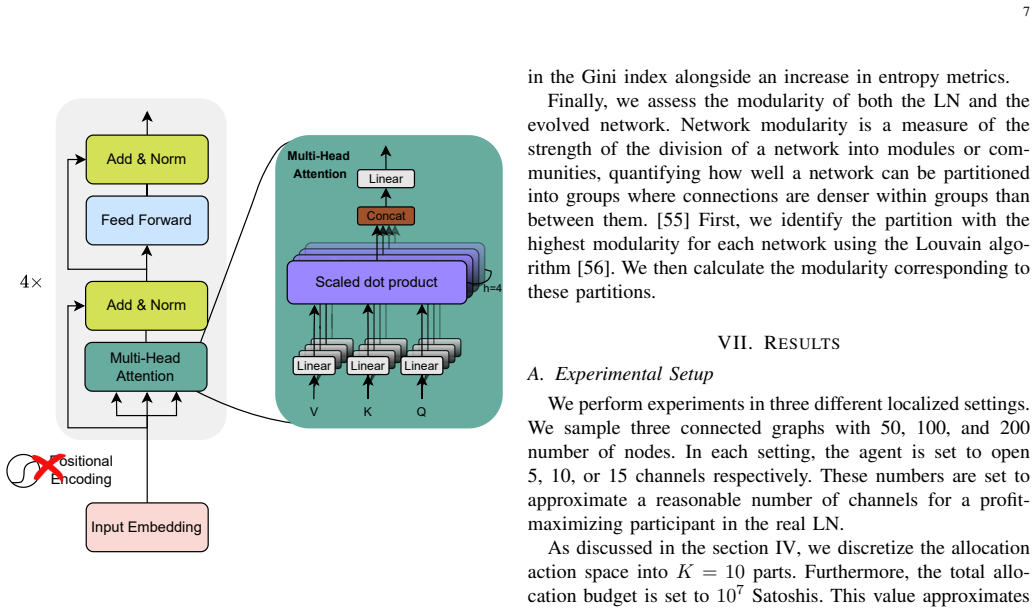
The load-bearing mechanism is a transformer encoder over node feature vectors, with two appended readout tokens: one for state value and one for allocation. The node-scoring head produces a softmax distribution for selecting a node, and the allocation head produces a distribution over $K$ discrete capacity shares; both are trained with PPO's clipped surrogate objective. Because node selection and capacity allocation are decomposed into per-step decisions, the action space is $N \times K$ instead of $(N \times K)^T$. The simulator that feeds this policy uses forest-fire sampling to localize the 2021 snapshot, simulates transactions in three discrete amounts, and updates channel balances after every routed payment, which the paper argues makes the environment compatible with the JCNSRA problem.
What would settle it
Deploy the trained policy on a live Lightning node or replay it against recorded real payment flows, and compare collected fees with those of uniform-allocation and top-k heuristics; if the agent's revenue advantage shrinks or reverses outside the simulator, the central claim fails.
Extended reading notes
Core claim
On the paper's own terms, the central discovery is that a transformer-based PPO policy, using node degree, provider status, transaction flow, and allocated share as state features, can outperform both learned baselines and traditional top-k attachment heuristics at maximizing routing-fee revenue in a Lightning Network simulator. The paper further claims that the same revenue-driven agent, run over 2,000 episodes on a 2021 snapshot, shifts the network toward decentralization: Shannon and Rényi entropies rise for betweenness, eigenvector, and closeness centrality, the Gini index falls for most measures, and modularity drops from 0.3970 to 0.3754. The authors interpret this as evidence that there is no conflict between an individual node's profit motive and the network's decentralization goal.
Load-bearing premise
The load-bearing premise is that the simulator behaves like the real Lightning Network; it generates random transactions in only three amounts, routes them with a modified Dijkstra over a 2021 snapshot, and is never validated against real payment data, so all revenue and decentralization conclusions inherit that fidelity assumption.
Editorial extensions
If this is right
- If the result holds, a single node operator can replace top-k betweenness or degree attachment with a learned policy that combines node choice and capacity split, and expect higher routing-fee revenue in simulation.
- The statistically significant gap between the full transformer and the transformer with uniform allocation implies that smart capacity allocation, not just node choice, is a measurable source of revenue.
- The bottom-k heuristics outperforming top-k heuristics suggests that hub attachment is not the best revenue strategy in this routing model, a claim the paper says contradicts prevailing maneuvers in the literature.
- The reported centrality changes imply that rational revenue-seeking channel openings need not accelerate Lightning Network centralization, and may reduce modularity by connecting previously separate communities.
- Because the method is compatible with new Lightning Network snapshots, the same training pipeline could be rerun on current network data to produce updated channel-opening recommendations.
Reading between the lines
- Editorial inference: the paper's bottom-k result is only tested in simulation with uniform allocation; if it generalizes, it would argue against preferential attachment to hubs, but a direct field test is needed before treating that as a design rule.
- Editorial inference: the claimed compatibility between profit and decentralization is conditional on the simulator's transaction model; a real-world test on recorded payment flows would be the decisive check.
- Editorial inference: an agent trained with the same architecture but with a reward that includes a decentralization penalty might reveal how much of the reported effect comes from the reward signal versus the architecture, a comparison the paper does not run.
Editorial analysis
A structured set of objections, weighed in public.
Referee Report
Summary. The paper formulates the Joint Combinatorial Node Selection and Resource Allocation (JCNSRA) problem for a Lightning Network (LN) node as a Markov Decision Process, and proposes a transformer-based PPO agent that selects nodes and allocates channel capacities in discrete shares. The authors extend a prior simulator (DyFEn) with forest-fire localization and per-transaction balance updates, evaluate the agent against MLP, GNN, GNN+Transformer, and several degree/betweenness heuristics in 50-, 100-, and 200-node localized settings, and then analyze LN decentralization by deploying the trained agents for 2,000 episodes on a 2021 snapshot and comparing centrality entropies, the Gini index, and modularity with the original graph. The paper claims superior revenue performance and a positive association between revenue-maximizing behavior and decentralization.
Significance. If fully substantiated, the contribution would be valuable: the JCNSRA problem is a realistic joint discrete-continuous optimization task, the proposed attention-based actor-critic architecture is a reasonable candidate solution, and the agent-based study of LN evolution addresses an active debate. The paper's strengths include a clear MDP formulation, an improved simulation environment with structural sampling, a broad set of baselines, and the interesting empirical observation that bottom-k attachment heuristics outperform top-k ones. The authors also acknowledge compute limitations and constant-fee assumptions in Section VIII. However, the evidence as presented does not yet support the strongest claims: the headline performance comparison lacks error bars and inferential statistics for most pairs, and the decentralization conclusion is drawn from a single before/after comparison without counterfactual controls. The paper is therefore a promising contribution that currently falls short of its stated conclusions.
major comments (4)
- [Section VII-E, Table I] The central claim of 'clear superiority in overall performance among other models and heuristics' is not statistically established. Table I reports only a single average normalized reward per setting, with no standard deviations, confidence intervals, or number of seeds; the only inferential test is the t-test in Table II, which compares the proposed transformer only against Transformer-Node-Selector. The statement in Section VII-F that 'additional statistical tests were deemed unnecessary' is not a valid justification, because the comparisons against GNN, MLP, Random, and the heuristics are exactly the comparisons that need uncertainty quantification. Please report mean and standard deviation over repeated training seeds, and paired statistical tests (or effect sizes) across the 1,000 evaluation graphs for all model pairs, with a stated hypothesis about one- versus two-sided tests and independence assumptions.
- [Section VII-G and Table III] The decentralization conclusion rests on a single before/after comparison: the original 2021 LN snapshot versus one evolved network produced by deploying the proposed agents over 2,000 episodes. Because each episode adds a node and channels, the evolved graph is larger and structurally different by construction, and entropy/Gini/modularity metrics are mechanically sensitive to growth and peripheral attachment. Without control evolutions (e.g., random attachment, degree-based preferential attachment, or a heuristic 'bottom-k' attachment run) and without repeated independent evolution runs with error bars, the observed changes in Table III cannot be attributed to the agent's revenue-seeking policy. Please add counterfactual controls and repeated seeds, or explicitly reframe the result as a descriptive case study rather than a causal claim.
- [Sections V-A, VII-A, and IX] All conclusions are drawn inside a synthetic simulator that has not been validated against real LN payment data. The environment uses a 2021 snapshot, randomly generated transactions at only three discrete amounts, and a modified Dijkstra routing mechanism with online balance updates; there is no comparison with empirical payment statistics, routing success rates, or real fee revenues. This is a substantial threat to the external validity of both the revenue comparison and the decentralization analysis. The conclusion in Section IX that the LN 'naturally tends towards decentralization' and is 'decentralized by design and incentive-compatible' goes well beyond what a simulation study can support. Please either validate the simulator against public LN data or substantially qualify the external claims as statements about the simulated environment.
- [Section VI and Section VII-G] The network-evolution experiment is not fully specified. The paper states that agents are selected 'with probabilities designed to maintain the ratio of additional channels and nodes consistent with the LN evolution trend,' but does not specify these probabilities, the per-episode node/channel addition procedure, how the localized graph is chosen for deployment, or how the evolving graph is carried across episodes. This makes the experiment irreproducible and complicates the interpretation of Table III. Please provide the full deployment procedure, including the update rule for the graph after each episode and the precise mechanism by which the 50/100/200-node agents are applied.
minor comments (5)
- [Section IV-B] The sentence 'we first calculate the intended allocation values by normalizing c′vts by their and then scale these allocation shares' is incomplete; it should read 'by their sum'.
- [Section VII-G] The text says 'Each centrality-metric pair score is detailed in Table III,' but Table III reports only entropy and Gini-index differences, not the raw centrality values or distributions; please clarify what the table summarizes.
- [Section VII-A] The experimental setup does not state the number of training steps, learning rate, discount factor, PPO clipping parameter, or the number of simulated transactions per step beyond the three amount types; a full hyperparameter table would improve reproducibility.
- [Figure 3] Figure 3 includes a 'PositionalEncoding' block, but Section V-B states that 'Positional embeddings are intentionally omitted'; this inconsistency should be corrected.
- [Section VII-F, Table II] The p-values in Table II (0.0218-0.0324) are reported without stating whether they are one-sided or two-sided, and without discussion of the non-independence of the 1,000 evaluation graphs sampled from the same underlying LN snapshot; please provide this information.
Circularity Check
No significant circularity: performance and decentralization claims are empirically measured, not derived from their inputs.
full rationale
The paper's central claims are empirical evaluations inside a purpose-built simulator, not derivations from the claim. The transformer/PPO agent maximizes the fee-based reward R(G', u) defined in Eq. (11), and its reported scores in Table I are the same simulated reward averaged over 1,000 sampled graphs; this is a within-simulator benchmark against independent heuristics and architectures, not a fitted quantity renamed as a prediction. The decentralization analysis (Section VI and Table III) measures Shannon/Renyi entropy, Gini index, and modularity of the evolved graph against the 2021 snapshot; those metrics are not the agent's reward, so the observed changes are not true by construction. The absence of a control evolution and the reliance on a random-transaction simulator are real external-validity and causal-inference concerns, but they are not circularity: no equation reduces to another by definition, and no fitted parameter is relabeled as a prediction. The paper cites a co-authored prior environment (DyFEn, [7]) as the starting point, but the environment is described as re-implemented and extended with forest-fire localization and per-transaction balance updates, and the main performance comparisons include external heuristics and other model classes, so this self-citation is not load-bearing in the derivation of the central results.
Assumptions & free parameters
free parameters (6)
- Discrete allocation size K =
10
- Total allocation budget C =
10^7 satoshis
- Transaction amounts =
10000, 50000, 100000 satoshis
- Number of channels per episode =
5, 10, 15
- Reward normalization constant =
unspecified
- Forest-fire sampling parameters =
unspecified
assumptions (5)
- domain assumption The simulated transaction generation approximates real LN payment flows
- domain assumption The routing mechanism approximates LN's source-based Dijkstra routing with fee and capacity constraints
- domain assumption The 2021 LN snapshot is a representative basis for training and evaluation
- domain assumption The MDP formulation with the given state features captures the information relevant to routing revenue
- domain assumption Deploying the trained agent in the simulator measures the effect of revenue-maximizing behavior on network decentralization
Cite this review
Pith. "Pith review of Joint Combinatorial Node Selection and Resource Allocations in the Lightning Network using Attention-based Reinforcement Learning." pith.science (2026). https://pith.science/paper/65IDSTI6
@misc{pith2026241117353,
  author       = {Pith},
  title        = {Pith review of: Joint Combinatorial Node Selection and Resource Allocations in the Lightning Network using Attention-based Reinforcement Learning},
  year         = {2026},
  howpublished = {\url{https://pith.science/paper/65IDSTI6}},
  note         = {Machine review of arXiv:2411.17353}
}
abstract
The Lightning Network (LN) has emerged as a second-layer solution to Bitcoin's scalability challenges. The rise of Payment Channel Networks (PCNs) and their specific mechanisms incentivize individuals to join the network for profit-making opportunities. According to the latest statistics, the total value locked within the Lightning Network is approximately \$500 million. Meanwhile, joining the LN with the profit-making incentives presents several obstacles, as it involves solving a complex combinatorial problem that encompasses both discrete and continuous control variables related to node selection and resource allocation, respectively. Current research inadequately captures the critical role of resource allocation and lacks realistic simulations of the LN routing mechanism. In this paper, we propose a Deep Reinforcement Learning (DRL) framework, enhanced by the power of transformers, to address the Joint Combinatorial Node Selection and Resource Allocation (JCNSRA) problem. We have improved upon an existing environment by introducing modules that enhance its routing mechanism, thereby narrowing the gap with the actual LN routing system and ensuring compatibility with the JCNSRA problem. We compare our model against several baselines and heuristics, demonstrating its superior performance across various settings. Additionally, we address concerns regarding centralization in the LN by deploying our agent within the network and monitoring the centrality measures of the evolved graph. Our findings suggest not only an absence of conflict between LN's decentralization goals and individuals' revenue-maximization incentives but also a positive association between the two.
Figures


Figures from the paper (3 more)


Forward citations
Cited by 1 Pith paper
-
Predicting Channel Closures in the Lightning Network with Machine Learning
Using two years of Lightning Network gossip data, a simple MLP predicts channel closure type (open/mutual/forced) with 0.38 macro F1, outperforming graph-based models.
Reference graph
Works this paper leans on
-
[1]
The bitcoin lightning network: Scalable off-chain instant payments,
J. Poon and T. Dryja, “The bitcoin lightning network: Scalable off-chain instant payments,” 2016
2016
-
[2]
Bitcoin: A peer-to-peer electronic cash system,
S. Nakamoto, “Bitcoin: A peer-to-peer electronic cash system,” Satoshi Nakamoto, 2008
2008
-
[3]
A quantitative analysis of security, anonymity and scalability for the lightning network,
S. Tikhomirov, P. Moreno-Sanchez, and M. Maffei, “A quantitative analysis of security, anonymity and scalability for the lightning network,” in 2020 IEEE European Symposium on Security and Privacy Workshops (EuroS&PW). IEEE, 2020, pp. 387–396
work page 2020
-
[4]
How to profit from payments channels,
O. Ersoy, S. Roos, and Z. Erkin, “How to profit from payments channels,” in International Conference on Financial Cryptography and Data Security. Springer, 2020, pp. 284–303
work page 2020
-
[5]
Rational economic be- haviours in the bitcoin lightning network,
A. Carotti, C. Sguanci, and A. Sidiropoulos, “Rational economic be- haviours in the bitcoin lightning network,” in 2024 IEEE International Conference on Blockchain and Cryptocurrency (ICBC) . IEEE, 2024, pp. 594–601
work page 2024
-
[6]
Incentives on the lightning network: A blockchain-based payment network,
L. Bertucci, “Incentives on the lightning network: A blockchain-based payment network,” in Proceedings of Paris December 2020 Finance Meeting EUROFIDAI-ESSEC, 2020
work page 2020
-
[7]
DyFEn: Agent-Based Fee Setting in Payment Channel Networks
K. Asgari, A. A. Mohammadian, and M. Tefagh, “Dyfen: Agent- based fee setting in payment channel networks,” arXiv preprint arXiv:2210.08197, 2022
work page Pith review arXiv 2022
-
[8]
A payment channel net- work fee allocation strategy integrating auction theory,
J. Zhang, S. Xiao, W. Wu, and J. Zhou, “A payment channel net- work fee allocation strategy integrating auction theory,” in 2023 IEEE International Conference on Metaverse Computing, Networking and Applications (MetaCom). IEEE, 2023, pp. 648–652. 12
work page 2023
Show all 61 references
-
[9]
Learning a scalable algorithm for improving betweenness in the lightning network,
V . Davis and B. Harrison, “Learning a scalable algorithm for improving betweenness in the lightning network,” in 2022 Fourth International Conference on Blockchain Computing and Applications (BCCA). IEEE, 2022, pp. 119–126
2022
-
[10]
Hubs, rebalancing and service providers in the lightning network,
M. Conoscenti, A. Vetro, and J. C. De Martin, “Hubs, rebalancing and service providers in the lightning network,” IEEE Access , vol. 7, pp. 132 828–132 840, 2019
2019
-
[11]
Combinatorial pure exploration of multi-armed bandits,
S. Chen, T. Lin, I. King, M. R. Lyu, and W. Chen, “Combinatorial pure exploration of multi-armed bandits,” Advances in neural information processing systems, vol. 27, 2014
2014
-
[12]
Combinatorial feature selection problems,
M. Charikar, V . Guruswami, R. Kumar, S. Rajagopalan, and A. Sahai, “Combinatorial feature selection problems,” in Proceedings 41st Annual Symposium on Foundations of Computer Science. IEEE, 2000, pp. 631– 640
2000
-
[13]
The design of mechanisms for resource allocation,
L. Hurwicz, “The design of mechanisms for resource allocation,” The American Economic Review , vol. 63, no. 2, pp. 1–30, 1973
1973
-
[14]
Attention is all you need,
A. Vaswani, “Attention is all you need,” Advances in Neural Information Processing Systems, 2017
2017
-
[15]
Topological analysis and simulations on centrality in the lightning network,
A. Pili, “Topological analysis and simulations on centrality in the lightning network,” Ph.D. dissertation, Politecnico di Torino, 2021
2021
-
[16]
Prox- imal policy optimization algorithms,
J. Schulman, F. Wolski, P. Dhariwal, A. Radford, and O. Klimov, “Prox- imal policy optimization algorithms,” arXiv preprint arXiv:1707.06347, 2017
2017 arXiv
-
[17]
Emergent routing strategies in the lightning network,
J.-J. Markstedt, “Emergent routing strategies in the lightning network,” 2019
2019
-
[18]
Aodv–based routing for payment channel networks,
P. Hoenisch and I. Weber, “Aodv–based routing for payment channel networks,” in Blockchain–ICBC 2018: First International Conference, Held as Part of the Services Conference Federation, SCF 2018, Seattle, WA, USA, June 25-30, 2018, Proceedings 1 . Springer, 2018, pp. 107– 124
2018
-
[19]
Flare: An approach to routing in lightning network,
P. Prihodko, S. Zhigulin, M. Sahno, A. Ostrovskiy, and O. Osuntokun, “Flare: An approach to routing in lightning network,” White Paper, vol. 144, 2016
2016
-
[20]
A note on two problems in connexion with graphs,
E. W. Dijkstra, “A note on two problems in connexion with graphs,” in Edsger Wybe Dijkstra: his life, work, and legacy , 2022, pp. 287–290
2022
-
[21]
Understanding the lightning network capability to route payments,
D. ˇSatcs, “Understanding the lightning network capability to route payments,” B.S. thesis, University of Twente, 2020
2020
-
[22]
Towards bitcoin payment networks,
P. McCorry, M. M ¨oser, S. F. Shahandasti, and F. Hao, “Towards bitcoin payment networks,” in Information Security and Privacy: 21st Australasian Conference, ACISP 2016, Melbourne, VIC, Australia, July 4-6, 2016, Proceedings, Part I 21 . Springer, 2016, pp. 57–76
2016
-
[23]
Reinforcement learning: An introduction,
R. S. Sutton and A. G. Barto, “Reinforcement learning: An introduction,” Robotica, vol. 17, no. 2, pp. 229–235, 1999
1999
-
[24]
High- dimensional continuous control using generalized advantage estimation,
J. Schulman, P. Moritz, S. Levine, M. Jordan, and P. Abbeel, “High- dimensional continuous control using generalized advantage estimation,” arXiv preprint arXiv:1506.02438 , 2015
2015 arXiv
-
[25]
A survey of transformers,
T. Lin, Y . Wang, X. Liu, and X. Qiu, “A survey of transformers,” AI open, vol. 3, pp. 111–132, 2022
2022
-
[26]
Semi-supervised classification with graph convolutional networks,
T. N. Kipf and M. Welling, “Semi-supervised classification with graph convolutional networks,” arXiv preprint arXiv:1609.02907 , 2016
2016 arXiv
-
[27]
Graph attention networks,
P. Veli ˇckovi´c, G. Cucurull, A. Casanova, A. Romero, P. Lio, and Y . Ben- gio, “Graph attention networks,” arXiv preprint arXiv:1710.10903, 2017
2017 arXiv
-
[28]
Inductive representation learning on large graphs,
W. Hamilton, Z. Ying, and J. Leskovec, “Inductive representation learning on large graphs,” Advances in neural information processing systems, vol. 30, 2017
2017
-
[29]
Neural message passing for quantum chemistry,
J. Gilmer, S. S. Schoenholz, P. F. Riley, O. Vinyals, and G. E. Dahl, “Neural message passing for quantum chemistry,” in International conference on machine learning . PMLR, 2017, pp. 1263–1272
2017
-
[30]
Self-attention graph pooling,
J. Lee, I. Lee, and J. Kang, “Self-attention graph pooling,” in Interna- tional conference on machine learning . pmlr, 2019, pp. 3734–3743
2019
-
[31]
Hierarchical graph representation learning with differentiable pooling,
Z. Ying, J. You, C. Morris, X. Ren, W. Hamilton, and J. Leskovec, “Hierarchical graph representation learning with differentiable pooling,” Advances in neural information processing systems , vol. 31, 2018
2018
-
[32]
An end-to-end deep learning architecture for graph classification,
M. Zhang, Z. Cui, M. Neumann, and Y . Chen, “An end-to-end deep learning architecture for graph classification,” in Proceedings of the AAAI conference on artificial intelligence , vol. 32, no. 1, 2018
2018
-
[33]
A survey of graph neural networks in real world: Imbalance, noise, privacy and ood challenges,
W. Ju, S. Yi, Y . Wang, Z. Xiao, Z. Mao, H. Li, Y . Gu, Y . Qin, N. Yin, S. Wang et al. , “A survey of graph neural networks in real world: Imbalance, noise, privacy and ood challenges,” arXiv preprint arXiv:2403.04468, 2024
2024
-
[34]
The graph neural network model,
F. Scarselli, M. Gori, A. C. Tsoi, M. Hagenbuchner, and G. Monfar- dini, “The graph neural network model,” IEEE transactions on neural networks, vol. 20, no. 1, pp. 61–80, 2008
2008
-
[35]
A cryptoeconomic traffic anal- ysis of bitcoin’s lightning network,
F. B ´eres, I. A. Seres, and A. A. Bencz ´ur, “A cryptoeconomic traffic anal- ysis of bitcoin’s lightning network,” arXiv preprint arXiv:1911.09432 , 2019
1911 arXiv
-
[36]
Cloth: A lightning network simulator,
M. Conoscenti, A. Vetr `o, and J. C. De Martin, “Cloth: A lightning network simulator,” SoftwareX, vol. 15, p. 100717, 2021
2021
-
[37]
Controlling graph dynamics with reinforcement learning and graph neural networks,
E. Meirom, H. Maron, S. Mannor, and G. Chechik, “Controlling graph dynamics with reinforcement learning and graph neural networks,” in International Conference on Machine Learning . PMLR, 2021, pp. 7565–7577
2021
-
[38]
Discharged payment chan- nels: Quantifying the lightning network’s resilience to topology-based attacks,
E. Rohrer, J. Malliaris, and F. Tschorsch, “Discharged payment chan- nels: Quantifying the lightning network’s resilience to topology-based attacks,” in 2019 IEEE european symposium on security and privacy workshops (EuroS&PW). IEEE, 2019, pp. 347–356
2019
-
[39]
The evolving topology of the lightning network: Centralization, efficiency, robustness, synchronization, and anonymity,
S. Martinazzi and A. Flori, “The evolving topology of the lightning network: Centralization, efficiency, robustness, synchronization, and anonymity,” Plos one, vol. 15, no. 1, p. e0225966, 2020
2020
-
[40]
Little ball of fur: a python library for graph sampling,
B. Rozemberczki, O. Kiss, and R. Sarkar, “Little ball of fur: a python library for graph sampling,” in Proceedings of the 29th ACM interna- tional conference on information & knowledge management , 2020, pp. 3133–3140
2020
-
[41]
Sampling from large graphs,
J. Leskovec and C. Faloutsos, “Sampling from large graphs,” in Proceed- ings of the 12th ACM SIGKDD international conference on Knowledge discovery and data mining , 2006, pp. 631–636
2006
-
[42]
Openai gym,
G. Brockman, V . Cheung, L. Pettersson, J. Schneider, J. Schul- man, J. Tang, and W. Zaremba, “Openai gym,” arXiv preprint arXiv:1606.01540, 2016
2016 arXiv
-
[43]
Stable-baselines3: Reliable reinforcement learning implementa- tions,
A. Raffin, A. Hill, A. Gleave, A. Kanervisto, M. Ernestus, and N. Dor- mann, “Stable-baselines3: Reliable reinforcement learning implementa- tions,” Journal of Machine Learning Research, vol. 22, no. 268, pp. 1–8, 2021
2021
-
[44]
Analyzing and mitigating the centralization tendency of the lightning network,
G. F. Camilo, “Analyzing and mitigating the centralization tendency of the lightning network,” Ph.D. dissertation, Universidade Federal do Rio de Janeiro, 2023
2023
-
[45]
The evolution of lightning network’s topology during its first year and the influence over its core values,
S. Martinazzi, “The evolution of lightning network’s topology during its first year and the influence over its core values,” arXiv preprint arXiv:1902.07307, 2019
1902 arXiv
-
[46]
An analysis of the decentralization and effectiveness of lightning network,
L. Perik, “An analysis of the decentralization and effectiveness of lightning network,” B.S. thesis, University of Twente, 2022
2022
-
[47]
A centrality analysis of the lightning network,
P. Zabka, K.-T. F ¨orster, C. Decker, and S. Schmid, “A centrality analysis of the lightning network,” Telecommunications Policy, vol. 48, no. 2, p. 102696, 2024
2024
-
[48]
On the impact of attachment strategies for payment channel networks,
K. Lange, E. Rohrer, and F. Tschorsch, “On the impact of attachment strategies for payment channel networks,” in 2021 IEEE International Conference on Blockchain and Cryptocurrency (ICBC) . IEEE, 2021, pp. 1–9
2021
-
[49]
Some effects of unequal distribution of information upon group performance in various communication nets
M. E. Shaw, “Some effects of unequal distribution of information upon group performance in various communication nets.” The journal of abnormal and social psychology , vol. 49, no. 4p1, p. 547, 1954
1954
-
[50]
A set of measures of centrality based on betweenness,
L. Freeman, “A set of measures of centrality based on betweenness,” Sociometry, 1977
1977
-
[51]
Rethinking centrality: Methods and examples,
K. Stephenson and M. Zelen, “Rethinking centrality: Methods and examples,” Social networks, vol. 11, no. 1, pp. 1–37, 1989
1989
-
[52]
Communication patterns in task-oriented groups,
A. Bavelas, “Communication patterns in task-oriented groups,” The journal of the acoustical society of America, vol. 22, no. 6, pp. 725–730, 1950
1950
-
[53]
Shannon entropy, renyi entropy, and information,
P. Bromiley, N. Thacker, and E. Bouhova-Thacker, “Shannon entropy, renyi entropy, and information,” Statistics and Inf. Series (2004-004) , vol. 9, no. 2004, pp. 2–8, 2004
2004
-
[54]
The estimation of the lorenz curve and gini index,
J. L. Gastwirth, “The estimation of the lorenz curve and gini index,” The review of economics and statistics , pp. 306–316, 1972
1972
-
[55]
A new definition of modularity for community detection in complex networks,
Z.-Q. Ye, K. Zhang, S.-N. Hu, and J. Yu, “A new definition of modularity for community detection in complex networks,” Chinese Physics Letters, vol. 29, no. 9, p. 098901, 2012
2012
-
[56]
Generalized louvain method for community detection in large networks,
P. De Meo, E. Ferrara, G. Fiumara, and A. Provetti, “Generalized louvain method for community detection in large networks,” in 2011 11th international conference on intelligent systems design and applications . IEEE, 2011, pp. 88–93
2011
-
[57]
How attentive are graph attention networks?
S. Brody, U. Alon, and E. Yahav, “How attentive are graph attention networks?” 2022. [Online]. Available: https://arxiv.org/abs/2105.14491
2022 arXiv
-
[58]
Emergence of scaling in random net- works,
A.-L. Barab ´asi and R. Albert, “Emergence of scaling in random net- works,” science, vol. 286, no. 5439, pp. 509–512, 1999
1999
-
[59]
is the barabasi albert model a reasonable choice for the autopilot,
R. Pickhardt, “is the barabasi albert model a reasonable choice for the autopilot,” 2018
2018
-
[60]
Designing and evaluating rebalancing algorithms for payment channel networks,
Y . van Engelshoven, “Designing and evaluating rebalancing algorithms for payment channel networks,” 2019
2019
-
[61]
Topological analysis of bitcoin’s lightning network,
I. A. Seres, L. Guly ´as, D. A. Nagy, and P. Burcsi, “Topological analysis of bitcoin’s lightning network,” in Mathematical Research for Blockchain Economy: 1st International Conference MARBLE 2019, Santorini, Greece. Springer, 2020, pp. 1–12
2019
Reviewed August 12, 2026 · model on record in the stance chip above.
Discussion (0). Continue with ORCID to comment.