REVIEW 3 major objections 4 minor 1 cited by
A link between rocky exoplanet composition and stellar age
T0 review · 3 major / 4 minor · reviewed 2026-08-12 · deepseek-v4-flash
Pith's one-line read Denser, more iron-rich rocky planets are found around younger stars.
desk verdict Plausible new age-composition correlation, but the unquantified RV selection function is the gap that needs closing before this is solid. read the letter →
The pith
A machine-rendered reading of the paper's core claim, the machinery that carries it, and where it could break.
The reading
What carries the argument
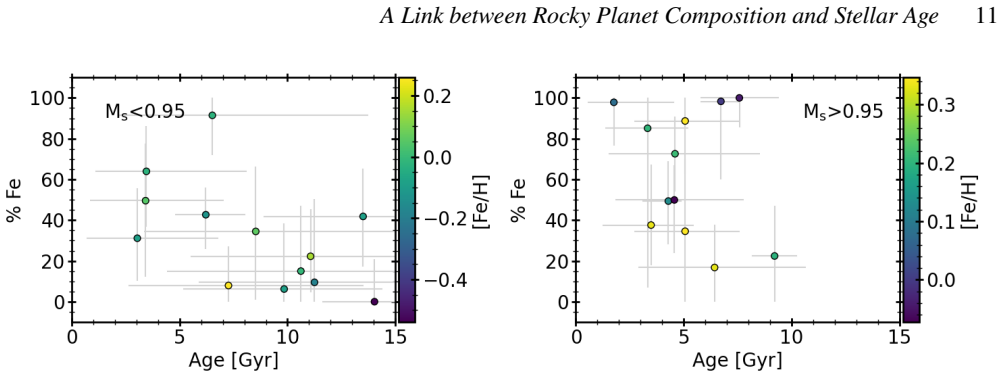
The argument is carried by a homogeneous re-characterisation of host stars: a grid-based Bayesian stellar modelling code takes space-based astrometry, photometry, and spectroscopy as inputs and returns stellar masses, radii, and ages with relative precision of roughly 2 Gyr. Planet radii and masses are recomputed from transit depths and radial-velocity semi-amplitudes using these stellar values, and only planets below the radius valley, the observed gap near 1.8 Earth radii that separates rocky super-Earths from sub-Neptunes, are kept. Each planet's iron mass fraction is obtained by linearly interpolating its mass-radius position on a grid of rocky interior models. The statistical quantity that carries the discovery is the negative correlation between inferred iron fraction and age, with a Pearson coefficient of $-0.62$ and a Bayesian regression slope of $\alpha=-8.0^{+4.6}_{-5.0}$ percent iron per gigayear.
What would settle it
An injection-recovery test that adds synthetic low-density planets to the radial-velocity data of young, active stars and measures how detection completeness varies with stellar age would settle the matter: if completeness declines steeply toward younger ages and the trend disappears after correction, the central claim is an artifact. A larger sample with asteroseismic ages that shows a flat density–age relation would also refute it.
Extended reading notes
Core claim
The central claim is that rocky planet composition correlates with host-star age: planets that are denser and inferred to be richer in iron orbit younger stars. The paper reports correlation coefficients of $-0.62$ (Pearson) and $-0.63$ (Spearman), and a Bayesian linear-regression slope of $\alpha=-8.0^{+4.6}_{-5.0}$ percent iron per gigayear, with the trend confirmed by an orthogonal distance regression. It interprets this as the first observational link between rocky exoplanet composition and stellar age, driven by galactic chemical evolution: younger stars are more iron-rich and less $\alpha$-enhanced, and the material from which their planets formed follows the same enrichment. The paper argues the trend is not simply an effect of stellar mass or metallicity, because the correlation with age is stronger and the age-metallicity relation is flat until about 10 Gyr.
Load-bearing premise
The load-bearing premise is that the observed density–age trend is not created by an age-dependent selection effect in the radial-velocity mass measurements; the paper acknowledges that younger, more active stars may be less sensitive to low-density planets, but provides no completeness model to rule this out.
Editorial extensions
If this is right
- Rocky exoplanet composition becomes a clock: denser, more iron-rich planets form in more recent epochs of galactic chemical evolution.
- Planets forming today in the solar neighbourhood may have larger iron cores, higher surface gravity, and different internal heat and magnetic-dynamo behaviour than Earth, which formed several gigayears ago.
- Old stars, above about 8 Gyr, may be unable to produce rocky planets with more than roughly 50 percent iron, narrowing the range of possible compositions around ancient systems.
- The absence of a strong planet-composition–metallicity correlation is consistent with the trend being driven by alpha-element abundances and age rather than by [Fe/H] alone.
- Future samples with precise asteroseismic ages, such as those expected from PLATO, should recover the same age–density relation and refine its slope.
Reading between the lines
- If the trend survives a completeness correction, the average density of rocky planets in a survey volume could be used as an independent probe of the local star-formation and chemical-enrichment history.
- A direct test of the interpretation would be to compare the compositions of debris accreted onto old and young white dwarfs: the cooling age of the white dwarf should correlate with the iron content of the accreted rocky material.
- Extending the analysis to M dwarfs and pre-main-sequence stars with gyrochronological ages would show whether the relation continues below about 2 Gyr or flattens.
- The paper itself notes a possible selection effect: young, active stars may hide low-density planets in radial-velocity mass measurements, and an injection-recovery study quantifying that completeness is the most direct way to separate the physical trend from an observational one.
Editorial analysis
A structured set of objections, weighed in public.
Referee Report
Summary. The paper presents a homogeneous re-analysis of 26 transiting rocky exoplanets (R_p < 4 R_Earth, below the radius valley) and their host stars, using Gaia DR3 GSP-Spec parameters, parallaxes, and photometry as inputs to the BASTA stellar-modelling code. It recalculates planet radii and masses from the updated stellar parameters, infers iron mass fractions from the Zeng et al. (2019) interior grid, and reports a statistically significant negative correlation between inferred planet iron fraction and stellar age (Pearson r = -0.62, Spearman rho = -0.63, Bayesian linear-regression slope alpha = -8.0^{+4.6}_{-5.0} percent Fe per Gyr). The authors interpret the trend as evidence that rocky planets formed around younger, more iron-rich stars are denser and more iron-rich, linking exoplanet composition to Galactic chemical evolution.
Significance. If the trend is real, it is an important new demographic result: it would be the first homogeneous, sample-level evidence that rocky exoplanet composition depends on host-star age, connecting exoplanet interiors to Galactic chemical evolution and with consequences for the interpretation of planet formation and habitability. The paper's strengths are the careful homogenisation of stellar parameters, the multi-method age validation in Appendix A2 (asteroseismology, gyrochronology, kinematics, and chemical abundances), the use of established external interior and radius-valley models, and the explicit discussion of observational biases. The correlation is measured rather than derived, so circularity is not a concern. However, the sample is small (26 planets), the selection-function caveat in Section 4.4.2 is not quantified, and the statistical evidence is not reported in full; the result is therefore promising but not yet established at the strength the paper claims.
major comments (3)
- [Section 4.4.2, Fig. 12] The central claim requires the sample to be representative in planet density across stellar age, but the acknowledged 'decreasing sensitivity to lower density planets towards younger ages' is not quantified. The mass-versus-age panel in Fig. 12 is not a sufficient null test: because the radial-velocity semi-amplitude scales as K ∝ M_p^(2/3) P^(-1/3) M_*^(-2/3) (Eq. 7), a selection in detectable K at fixed transit radius translates into a selection in density, not in mass alone. The authors should provide an RV completeness model (e.g., injection-recovery into the actual K uncertainties and activity levels) or a forward model that injects the proposed age-density relation and demonstrates that the observed r = -0.62 is recovered. Without this, the trend could be produced entirely by removing low-%Fe planets from the young-age end of the sample.
- [Section 4.1, Fig. 5] The assignment of %Fe = 0 to every planet whose best-fit mass and radius fall above the pure-rock track is a censoring step whose effect on the regression is not reported. The authors should state how many of the 26 planets receive this boundary value, show the distribution of the pre-truncation interpolated values, and rerun the linmix and ODR fits treating those measurements as upper limits (e.g., with a censored regression or a model that allows negative inferred Fe). This is needed to demonstrate that the slope and correlation are not artifacts of piling points up at the %Fe = 0 boundary.
- [Section 4.2] The statement that the correlation is 'highly significant' is not backed by a reported p-value or a permutation/bootstrap test. With N = 26 and typical age uncertainties of several Gyr, the linmix posterior alone is not a substitute for a robustness analysis. The authors should report p-values for the Pearson and Spearman coefficients, perform leave-one-out or bootstrap resampling, and show that the slope is not driven by the cluster of high-%Fe points at young ages in the upper-left of Fig. 5.
minor comments (4)
- [Section 4.1] The text near Fig. 3 says 'we plot the stellar density as a function of age'; this should read 'planet density'.
- [Section 2.3, Eq. (4)] The weighting term x_Θ in the marginalized posterior is not defined; a brief definition would make the Bayesian computation reproducible.
- [Section 5 and Abstract] The causal interpretation in terms of Galactic chemical evolution is plausible but is not directly tested (e.g., no Mg/Si or alpha-abundance measurements are used for the planet hosts); consider softening the causal language in the abstract and conclusions.
- [Data availability] The paper states that all data are in Tables 1-3, but it does not provide the posterior draws for the inferred %Fe values or the BASTA age posteriors; making these available as machine-readable files would improve reproducibility.
Circularity Check
No significant circularity: the age-composition trend is a measured correlation with independently determined variables.
full rationale
The paper's central claim is an observed correlation between host-star age and inferred rocky planet iron fraction, not a derived quantity that reduces to its inputs. The two sides of the correlation are produced by independent chains: stellar ages come from BASTA fits to Gaia parallax, photometry, Teff, and [M/H] against stellar evolution models, while planet %Fe is interpolated from mass and radius using the Zeng et al. (2019) interior grid. Neither chain uses the other variable: the BASTA ages never use planet density or composition, and the %Fe interpolation never uses age. The correlation coefficients and linear regressions are descriptive statistics, not predictions from a fitted model, so there is no fitted-input-called-prediction step. The radius valley selection uses the prior empirical relation from Ho & Van Eylen (2023); while a co-author of the present paper is also an author of that relation, the relation is an external, published result that does not encode a density-age trend, and it is not fitted to this sample. The BASTA code is similarly a prior, publicly available tool, and the paper validates its ages against asteroseismology, gyrochronology, kinematics, and detailed abundances, including an independent Kepler LEGACY sample. The main weakness acknowledged in Section 4.4.2, namely a possible decreasing sensitivity to lower-density planets toward younger ages, is a selection-effect concern about whether the measured correlation is physically real; it is not a circularity because the paper does not claim to have corrected for it and the correlation is not constructed from that assumption. Overall, the derivation is self-contained as a measurement, and none of the load-bearing steps are equivalent to the paper's own inputs by construction.
Assumptions & free parameters
assumptions (5)
- domain assumption Garstec stellar evolution models and BASTA inference produce accurate relative stellar ages for solar-type stars from Gaia DR3 input parameters.
- domain assumption The Zeng et al. (2019) interior model grid, linearly interpolated in mass-radius space, maps measured planet mass and radius to iron mass fraction.
- domain assumption The radius valley location of Ho and Van Eylen (2023) correctly separates rocky super-Earths from volatile-rich sub-Neptunes.
- domain assumption Planet age equals host star age because protoplanetary disks dissipate within a few million years.
- domain assumption Galactic chemical evolution produces a relation between stellar age and element abundances such that younger stars are more iron-rich and less alpha-enhanced.
Cite this review
Pith. "Pith review of A link between rocky exoplanet composition and stellar age." pith.science (2026). https://pith.science/paper/KTBXITUK
@misc{pith2026241117358,
  author       = {Pith},
  title        = {Pith review of: A link between rocky exoplanet composition and stellar age},
  year         = {2026},
  howpublished = {\url{https://pith.science/paper/KTBXITUK}},
  note         = {Machine review of arXiv:2411.17358}
}
read the original abstract
Interior compositions are key for our understanding of Earth-like exoplanets. The composition of the core can influence the presence of a magnetic dynamo and the strength of gravity on the planetary surface, both of which heavily impact thermal and possible biological processes and thus the habitability for life and its evolution on the planet. However, detailed measurements of the planetary interiors are extremely challenging for small exoplanets, and existing data suggest a wide diversity in planet compositions. Hitherto, only certain photospheric chemical abundances of the host stars have been considered as tracers to explain the diversity of exoplanet compositions. Here we present a homogeneous analysis of stars hosting rocky exoplanets, with ages between 2 and 14 Gyr, revealing a correlation between rocky exoplanet compositions and the ages of the planetary systems. Denser rocky planets are found around younger stars. This suggests that the compositional diversity of rocky exoplanets can be linked to the ages of their host stars. We interpret this to be a result of chemical evolution of stars in the Milky Way, which modifies the material out of which stars and planets form. The results imply that rocky planets which form today, at similar galactocentric radii, may have different formation conditions, and thus different properties than planets which formed several billion years ago, such as the Earth.
Figures


Figures from the paper (8 more)




Forward citations
Cited by 1 Pith paper
-
Modelling chemical clocks -- Theoretical evidences of the space and time evolution of [s/alpha] in the Galactic disc with Gaia-ESO survey
Current s-process yields fail to explain the steep [Ba/Si] vs age increase in inner-disc open clusters, requiring roughly half again as much barium in the last 3 Gyr.
Reference graph
Works this paper leans on
-
[1]
Adams E. R., et al., 2021, @doi [ ] 10.3847/PSJ/ac0ea0 , https://ui.adsabs.harvard.edu/abs/2021PSJ.....2..152A 2, 152
-
[2]
Adibekyan V., et al., 2021, @doi [Science] 10.1126/science.abg8794 , https://ui.adsabs.harvard.edu/abs/2021Sci...374..330A 374, 330
-
[3]
Aguirre B rsen-Koch V., et al., 2022, @doi [ ] 10.1093/mnras/stab2911 , 509, 4344
-
[4]
Akeson R. L., et al., 2013, @doi [ ] 10.1086/672273 , https://ui.adsabs.harvard.edu/abs/2013PASP..125..989A 125, 989
doi:10.1086/672273 2013
-
[5]
Alibert Y., 2014, @doi [ ] 10.1051/0004-6361/201322293 , https://ui.adsabs.harvard.edu/abs/2014A&A...561A..41A 561, A41
-
[6]
Almenara J. M., D \' az R. F., Bonfils X., Udry S., 2016, @doi [ ] 10.1051/0004-6361/201629770 , https://ui.adsabs.harvard.edu/abs/2016A&A...595L...5A 595, L5
-
[7]
Angulo C., et al., 1999, @doi [ ] 10.1016/S0375-9474(99)00030-5 , https://ui.adsabs.harvard.edu/abs/1999NuPhA.656....3A 656, 3
-
[8]
Antonov I., Saleev V., 1980, USSR Computational Mathematics and Mathematical Physics, 19, 252
1980
Show all 160 references
-
[9]
J., Scott P., 2009, @doi [ ] 10.1146/annurev.astro.46.060407.145222 , https://ui.adsabs.harvard.edu/abs/2009ARA&A..47..481A 47, 481
Asplund M., Grevesse N., Sauval A. J., Scott P., 2009, @doi [ ] 10.1146/annurev.astro.46.060407.145222 , https://ui.adsabs.harvard.edu/abs/2009ARA&A..47..481A 47, 481
2009
-
[10]
Astropy Collaboration et al., 2013, @doi [ ] 10.1051/0004-6361/201322068 , https://ui.adsabs.harvard.edu/abs/2013A&A...558A..33A 558, A33
2013 doi
-
[11]
Azevedo Silva T., et al., 2022, @doi [ ] 10.1051/0004-6361/202141520 , https://ui.adsabs.harvard.edu/abs/2022A&A...657A..68A 657, A68
2022 doi
-
[12]
Bashi D., Helled R., Zucker S., Mordasini C., 2017, @doi [ ] 10.1051/0004-6361/201629922 , https://ui.adsabs.harvard.edu/abs/2017A&A...604A..83B 604, A83
2017 doi
-
[13]
L., Raymond S
Bean J. L., Raymond S. N., Owen J. E., 2021, @doi [Journal of Geophysical Research (Planets)] 10.1029/2020JE006639 , https://ui.adsabs.harvard.edu/abs/2021JGRE..12606639B 126, e06639
2021 doi
-
[14]
K., Bedell M., 2018, @doi [ ] 10.3847/1538-4357/aae07f , https://ui.adsabs.harvard.edu/abs/2018ApJ...867...31B 867, 31
Beane A., Ness M. K., Bedell M., 2018, @doi [ ] 10.3847/1538-4357/aae07f , https://ui.adsabs.harvard.edu/abs/2018ApJ...867...31B 867, 31
2018 doi
-
[15]
Bedell M., et al., 2018, @doi [ ] 10.3847/1538-4357/aad908 , https://ui.adsabs.harvard.edu/abs/2018ApJ...865...68B 865, 68
2018 doi
-
[16]
Belokurov V., et al., 2020, @doi [ ] 10.1093/mnras/staa1522 , https://ui.adsabs.harvard.edu/abs/2020MNRAS.496.1922B 496, 1922
2020 doi
-
[17]
A., Huber D., Gaidos E., van Saders J
Berger T. A., Huber D., Gaidos E., van Saders J. L., 2018, @doi [ ] 10.3847/1538-4357/aada83 , https://ui.adsabs.harvard.edu/abs/2018ApJ...866...99B 866, 99
2018 doi
-
[18]
A., Huber D., van Saders J
Berger T. A., Huber D., van Saders J. L., Gaidos E., Tayar J., Kraus A. L., 2020, @doi [ ] 10.3847/1538-3881/159/6/280 , https://ui.adsabs.harvard.edu/abs/2020AJ....159..280B 159, 280
2020 doi
- [19]
- [20]
-
[21]
Boggs P. T., E. R. J., 1989, Contemporary Mathematics, 112, 186
1989
-
[22]
B \"o hm-Vitense E., 1958, , https://ui.adsabs.harvard.edu/abs/1958ZA.....46..108B 46, 108
1958
-
[23]
S., et al., 2023, @doi [ ] 10.1051/0004-6361/202346211 , https://ui.adsabs.harvard.edu/abs/2023A&A...677A..33B 677, A33
Bonomo A. S., et al., 2023, @doi [ ] 10.1051/0004-6361/202346211 , https://ui.adsabs.harvard.edu/abs/2023A&A...677A..33B 677, A33
2023 doi
-
[24]
Bourrier V., et al., 2018, @doi [ ] 10.1051/0004-6361/201833154 , https://ui.adsabs.harvard.edu/abs/2018A&A...619A...1B 619, A1
2018 doi
-
[25]
Bourrier V., et al., 2022, @doi [ ] 10.1051/0004-6361/202243778 , https://ui.adsabs.harvard.edu/abs/2022A&A...668A..31B 668, A31
2022 doi
-
[26]
Bovy J., 2015, @doi [ ] 10.1088/0067-0049/216/2/29 , https://ui.adsabs.harvard.edu/abs/2015ApJS..216...29B 216, 29
2015 doi
-
[27]
Bratley P., Fox B., 1988, ACM Transactions on Mathematical Software, 14, 88
1988
-
[28]
L., et al., 2023, @doi [ ] 10.3847/1538-3881/acad83 , https://ui.adsabs.harvard.edu/abs/2023AJ....165...88B 165, 88
Brinkman C. L., et al., 2023, @doi [ ] 10.3847/1538-3881/acad83 , https://ui.adsabs.harvard.edu/abs/2023AJ....165...88B 165, 88
2023 doi
-
[29]
Brinkman C., Polanski A., Huber D., Weiss L., Valencia D., Plotnykov M., 2024, in AAS/Division for Extreme Solar Systems Abstracts. p. 301.03
2024
-
[30]
M., Bayliss D., 2022, @doi [ ] 10.3847/1538-3881/ac58ff , https://ui.adsabs.harvard.edu/abs/2022AJ....163..197B 163, 197
Bryant E. M., Bayliss D., 2022, @doi [ ] 10.3847/1538-3881/ac58ff , https://ui.adsabs.harvard.edu/abs/2022AJ....163..197B 163, 197
2022 doi
-
[31]
J., et al., 2014, @doi [ ] 10.1088/0067-0049/210/2/19 , https://ui.adsabs.harvard.edu/abs/2014ApJS..210...19B 210, 19
Burke C. J., et al., 2014, @doi [ ] 10.1088/0067-0049/210/2/19 , https://ui.adsabs.harvard.edu/abs/2014ApJS..210...19B 210, 19
2014 doi
-
[32]
Cabral N., Guilbert-Lepoutre A., Bitsch B., Lagarde N., Diakite S., 2023, @doi [ ] 10.1051/0004-6361/202243882 , https://ui.adsabs.harvard.edu/abs/2023A&A...673A.117C 673, A117
2023 doi
-
[33]
Chen J., Kipping D., 2017, @doi [ ] 10.3847/1538-4357/834/1/17 , https://ui.adsabs.harvard.edu/abs/2017ApJ...834...17C 834, 17
2017 doi
-
[34]
Chen D.-C., et al., 2021, @doi [ ] 10.3847/1538-3881/ac0f08 , https://ui.adsabs.harvard.edu/abs/2021AJ....162..100C 162, 100
2021 doi
-
[35]
Chen D.-C., et al., 2022, @doi [ ] 10.3847/1538-3881/ac641f , https://ui.adsabs.harvard.edu/abs/2022AJ....163..249C 163, 249
2022 doi
-
[36]
Christensen-Dalsgaard J., 2008, @doi [ ] 10.1007/s10509-007-9689-z , https://ui.adsabs.harvard.edu/abs/2008Ap&SS.316..113C 316, 113
2008 doi
-
[37]
R., Grand R
Ciuc a I., Kawata D., Miglio A., Davies G. R., Grand R. J. J., 2021, @doi [ ] 10.1093/mnras/stab639 , https://ui.adsabs.harvard.edu/abs/2021MNRAS.503.2814C 503, 2814
2021 doi
- [38]
-
[39]
Cropper M., et al., 2018, @doi [ ] 10.1051/0004-6361/201832763 , https://ui.adsabs.harvard.edu/abs/2018A&A...616A...5C 616, A5
2018 doi
-
[40]
G., Mihalas B
Daeppen W., Mihalas D., Hummer D. G., Mihalas B. W., 1988, @doi [ ] 10.1086/166650 , https://ui.adsabs.harvard.edu/abs/1988ApJ...332..261D 332, 261
1988 doi
-
[41]
N., Zeng L., 2019, @doi [ ] 10.3847/1538-4357/ab3a3b , https://ui.adsabs.harvard.edu/abs/2019ApJ...883...79D 883, 79
Dai F., Masuda K., Winn J. N., Zeng L., 2019, @doi [ ] 10.3847/1538-4357/ab3a3b , https://ui.adsabs.harvard.edu/abs/2019ApJ...883...79D 883, 79
2019 doi
-
[42]
Dai F., et al., 2021, @doi [ ] 10.3847/1538-3881/ac02bd , https://ui.adsabs.harvard.edu/abs/2021AJ....162...62D 162, 62
2021 doi
-
[43]
Demory B.-O., Gillon M., Madhusudhan N., Queloz D., 2016, @doi [ ] 10.1093/mnras/stv2239 , https://ui.adsabs.harvard.edu/abs/2016MNRAS.455.2018D 455, 2018
2016 doi
-
[44]
Dorn C., Khan A., Heng K., Connolly J. A. D., Alibert Y., Benz W., Tackley P., 2015, @doi [ ] 10.1051/0004-6361/201424915 , https://ui.adsabs.harvard.edu/abs/2015A&A...577A..83D 577, A83
2015 doi
-
[45]
D., et al., 2015, @doi [ ] 10.1088/0004-637X/800/2/135 , https://ui.adsabs.harvard.edu/abs/2015ApJ...800..135D 800, 135
Dressing C. D., et al., 2015, @doi [ ] 10.1088/0004-637X/800/2/135 , https://ui.adsabs.harvard.edu/abs/2015ApJ...800..135D 800, 135
2015 doi
-
[46]
K., Tremblay P.-E., G \"a nsicke B
Elms A. K., Tremblay P.-E., G \"a nsicke B. T., Koester D., Hollands M. A., Gentile Fusillo N. P., Cunningham T., Apps K., 2022, @doi [ ] 10.1093/mnras/stac2908 , https://ui.adsabs.harvard.edu/abs/2022MNRAS.517.4557E 517, 4557
2022 doi
-
[47]
G., Guinan E
Engle S. G., Guinan E. F., 2023, @doi [ ] 10.3847/2041-8213/acf472 , https://ui.adsabs.harvard.edu/abs/2023ApJ...954L..50E 954, L50
2023 doi
-
[48]
Espinoza N., et al., 2020, @doi [ ] 10.1093/mnras/stz3150 , https://ui.adsabs.harvard.edu/abs/2020MNRAS.491.2982E 491, 2982
2020 doi
-
[49]
W., Alexander D
Ferguson J. W., Alexander D. R., Allard F., Barman T., Bodnarik J. G., Hauschildt P. H., Heffner-Wong A., Tamanai A., 2005, @doi [ ] 10.1086/428642 , https://ui.adsabs.harvard.edu/abs/2005ApJ...623..585F 623, 585
2005 doi
-
[50]
Fogtmann-Schulz A., Hinrup B., Van Eylen V., Christensen-Dalsgaard J., Kjeldsen H., Silva Aguirre V., Tingley B., 2014, @doi [ ] 10.1088/0004-637X/781/2/67 , https://ui.adsabs.harvard.edu/abs/2014ApJ...781...67F 781, 67
2014 doi
-
[51]
Formicola A., et al., 2004, @doi [Physics Letters B] https://doi.org/10.1016/j.physletb.2004.03.092 , 591, 61
2004 doi
-
[52]
Fox B., 1986, ACM Transactions on Mathematical Software, 12, 362
1986
-
[53]
Fridlund M., et al., 2017, @doi [ ] 10.1051/0004-6361/201730822 , https://ui.adsabs.harvard.edu/abs/2017A&A...604A..16F 604, A16
2017 doi
-
[54]
Frustagli G., et al., 2020, @doi [ ] 10.1051/0004-6361/201936689 , https://ui.adsabs.harvard.edu/abs/2020A&A...633A.133F 633, A133
2020 doi
-
[55]
J., Petigura E
Fulton B. J., Petigura E. A., 2018, @doi [ ] 10.3847/1538-3881/aae828 , https://ui.adsabs.harvard.edu/abs/2018AJ....156..264F 156, 264
2018 doi
-
[56]
J., et al., 2017, @doi [ ] 10.3847/1538-3881/aa80eb , https://ui.adsabs.harvard.edu/abs/2017AJ....154..109F 154, 109
Fulton B. J., et al., 2017, @doi [ ] 10.3847/1538-3881/aa80eb , https://ui.adsabs.harvard.edu/abs/2017AJ....154..109F 154, 109
2017 doi
-
[57]
J., Petigura E
Fulton B. J., Petigura E. A., Blunt S., Sinukoff E., 2018, @doi [ ] 10.1088/1538-3873/aaaaa8 , https://ui.adsabs.harvard.edu/abs/2018PASP..130d4504F 130, 044504
2018 doi
-
[58]
Ginsburg A., et al., 2019, @doi [ ] 10.3847/1538-3881/aafc33 , https://ui.adsabs.harvard.edu/abs/2019AJ....157...98G 157, 98
2019 doi
-
[59]
Ginski C., et al., 2016, @doi [ ] 10.1093/mnras/stw049 , https://ui.adsabs.harvard.edu/abs/2016MNRAS.457.2173G 457, 2173
2016 doi
-
[60]
M., Schlafly E., Zucker C., Speagle J
Green G. M., Schlafly E., Zucker C., Speagle J. S., Finkbeiner D., 2019, @doi [ ] 10.3847/1538-4357/ab5362 , https://ui.adsabs.harvard.edu/abs/2019ApJ...887...93G 887, 93
2019 doi
-
[61]
W., et al., 2017, @doi [ ] 10.1051/0004-6361/201730885 , https://ui.adsabs.harvard.edu/abs/2017A&A...608A..93G 608, A93
Guenther E. W., et al., 2017, @doi [ ] 10.1051/0004-6361/201730885 , https://ui.adsabs.harvard.edu/abs/2017A&A...608A..93G 608, A93
2017 doi
-
[62]
E., 2019, @doi [ ] 10.1093/mnras/stz1230 , https://ui.adsabs.harvard.edu/abs/2019MNRAS.487...24G 487, 24
Gupta A., Schlichting H. E., 2019, @doi [ ] 10.1093/mnras/stz1230 , https://ui.adsabs.harvard.edu/abs/2019MNRAS.487...24G 487, 24
2019 doi
-
[63]
J., Lada E
Haisch Karl E. J., Lada E. A., Lada C. J., 2001, @doi [ ] 10.1086/320685 , https://ui.adsabs.harvard.edu/abs/2001ApJ...553L.153H 553, L153
2001 doi
-
[64]
Hammer J., et al., 2005, @doi [Nuclear Physics A] https://doi.org/10.1016/j.nuclphysa.2005.05.066 , 758, 363
2005 doi
-
[65]
Hartmann L., Calvet N., Gullbring E., D'Alessio P., 1998, @doi [ ] 10.1086/305277 , https://ui.adsabs.harvard.edu/abs/1998ApJ...495..385H 495, 385
1998 doi
-
[66]
L., et al., 2018, @doi [The Astrophysical Journal] 10.3847/1538-4357/aab158 , 856, 125
Hidalgo S. L., et al., 2018, @doi [The Astrophysical Journal] 10.3847/1538-4357/aab158 , 856, 125
2018 doi
-
[67]
Hidalgo D., et al., 2020, @doi [ ] 10.1051/0004-6361/201937080 , https://ui.adsabs.harvard.edu/abs/2020A&A...636A..89H 636, A89
2020 doi
-
[68]
Ho C. S. K., Van Eylen V., 2023, @doi [ ] 10.1093/mnras/stac3802 , https://ui.adsabs.harvard.edu/abs/2023MNRAS.519.4056H 519, 4056
2023 doi
-
[69]
A., Tremblay P.-E., G \"a nsicke B
Hollands M. A., Tremblay P.-E., G \"a nsicke B. T., Koester D., Gentile-Fusillo N. P., 2021, @doi [Nature Astronomy] 10.1038/s41550-020-01296-7 , https://ui.adsabs.harvard.edu/abs/2021NatAs...5..451H 5, 451
2021 doi
-
[70]
Huber D., et al., 2013, @doi [ ] 10.1088/0004-637X/767/2/127 , https://ui.adsabs.harvard.edu/abs/2013ApJ...767..127H 767, 127
2013 doi
-
[71]
Huber D., et al., 2022, @doi [ ] 10.3847/1538-3881/ac3000 , https://ui.adsabs.harvard.edu/abs/2022AJ....163...79H 163, 79
2022 doi
-
[72]
G., Mihalas D., 1988, @doi [ ] 10.1086/166600 , https://ui.adsabs.harvard.edu/abs/1988ApJ...331..794H 331, 794
Hummer D. G., Mihalas D., 1988, @doi [ ] 10.1086/166600 , https://ui.adsabs.harvard.edu/abs/1988ApJ...331..794H 331, 794
1988 doi
-
[73]
D., 2007, @doi [Computing in Science & Engineering] 10.1109/MCSE.2007.55 , 9, 90
Hunter J. D., 2007, @doi [Computing in Science & Engineering] 10.1109/MCSE.2007.55 , 9, 90
2007 doi
-
[74]
A., Rogers F
Iglesias C. A., Rogers F. J., 1996, @doi [ ] 10.1086/177381 , https://ui.adsabs.harvard.edu/abs/1996ApJ...464..943I 464, 943
1996 doi
-
[75]
R., Carter B., Howard A
Isaacson H., Kane S. R., Carter B., Howard A. W., Weiss L., Petigura E. A., Fulton B., 2024, @doi [ ] 10.3847/1538-4357/ad077b , https://ui.adsabs.harvard.edu/abs/2024ApJ...961...85I 961, 85
2024 doi
-
[76]
Joe S., Kuo F., 2003, ACM Transactions on Mathematical Software, 29, 49
2003
-
[77]
A., Collier Cameron A., Wilson T
John A. A., Collier Cameron A., Wilson T. G., 2022, @doi [ ] 10.1093/mnras/stac1814 , https://ui.adsabs.harvard.edu/abs/2022MNRAS.515.3975J 515, 3975
2022 doi
-
[78]
C., 2007, @doi [ ] 10.1086/519947 , https://ui.adsabs.harvard.edu/abs/2007ApJ...665.1489K 665, 1489
Kelly B. C., 2007, @doi [ ] 10.1086/519947 , https://ui.adsabs.harvard.edu/abs/2007ApJ...665.1489K 665, 1489
2007 doi
-
[79]
Kempton E. M. R., et al., 2023, @doi [ ] 10.1038/s41586-023-06159-5 , https://ui.adsabs.harvard.edu/abs/2023Natur.620...67K 620, 67
2023 doi
-
[80]
Springer Berlin, @doi 10.1007/978-3-642-30304-3
Kippenhahn R., Weigert A., Weiss A., 2012, Stellar Structure and Evolution. Springer Berlin, @doi 10.1007/978-3-642-30304-3
2012 doi
-
[81]
S., Fegley Bruce J., Schaefer L., Ford E
Kite E. S., Fegley Bruce J., Schaefer L., Ford E. B., 2020, @doi [ ] 10.3847/1538-4357/ab6ffb , https://ui.adsabs.harvard.edu/abs/2020ApJ...891..111K 891, 111
2020 doi
-
[82]
R., et al., 2019, @doi [ ] 10.3847/1538-3881/aafe83 , https://ui.adsabs.harvard.edu/abs/2019AJ....157..116K 157, 116
Kosiarek M. R., et al., 2019, @doi [ ] 10.3847/1538-3881/aafe83 , https://ui.adsabs.harvard.edu/abs/2019AJ....157..116K 157, 116
2019 doi
-
[83]
Kreidberg L., et al., 2014, @doi [ ] 10.1038/nature12888 , https://ui.adsabs.harvard.edu/abs/2014Natur.505...69K 505, 69
2014 doi
-
[84]
Lacedelli G., et al., 2021, @doi [ ] 10.1093/mnras/staa3728 , https://ui.adsabs.harvard.edu/abs/2021MNRAS.501.4148L 501, 4148
2021 doi
-
[85]
Lam K. W. F., et al., 2021, @doi [Science] 10.1126/science.aay3253 , https://ui.adsabs.harvard.edu/abs/2021Sci...374.1271L 374, 1271
2021 doi
-
[86]
V., et al., 2021, @doi [ ] 10.3847/1538-3881/ac0d06 , https://ui.adsabs.harvard.edu/abs/2021AJ....162...75L 162, 75
Lester K. V., et al., 2021, @doi [ ] 10.3847/1538-3881/ac0d06 , https://ui.adsabs.harvard.edu/abs/2021AJ....162...75L 162, 75
2021 doi
-
[87]
Lim O., et al., 2023, @doi [ ] 10.3847/2041-8213/acf7c4 , https://ui.adsabs.harvard.edu/abs/2023ApJ...955L..22L 955, L22
2023 doi
-
[88]
Lindegren L., 2018, R e-normalising the astrometric chi-square in G aia D R 2, GAIA-C3-TN-LU-LL-124, http://www.rssd.esa.int/doc_fetch.php?id=3757412
2018
-
[89]
Lindegren L., et al., 2021, @doi [ ] 10.1051/0004-6361/202039653 , https://ui.adsabs.harvard.edu/abs/2021A&A...649A...4L 649, A4
2021 doi
-
[90]
D., Fortney J
Lopez E. D., Fortney J. J., 2014, @doi [ ] 10.1088/0004-637X/792/1/1 , https://ui.adsabs.harvard.edu/abs/2014ApJ...792....1L 792, 1
2014 doi
-
[91]
L \'o pez-Morales M., et al., 2016, @doi [ ] 10.3847/0004-6256/152/6/204 , https://ui.adsabs.harvard.edu/abs/2016AJ....152..204L 152, 204
2016 doi
-
[92]
N., et al., 2017, @doi [ ] 10.3847/1538-4357/835/2/172 , https://ui.adsabs.harvard.edu/abs/2017ApJ...835..172L 835, 172
Lund M. N., et al., 2017, @doi [ ] 10.3847/1538-4357/835/2/172 , https://ui.adsabs.harvard.edu/abs/2017ApJ...835..172L 835, 172
2017 doi
-
[93]
Lundin R., Lammer H., Ribas I., 2007, @doi [ ] 10.1007/s11214-007-9176-4 , https://ui.adsabs.harvard.edu/abs/2007SSRv..129..245L 129, 245
2007 doi
-
[94]
W., et al., 2014, @doi [ ] 10.1088/0067-0049/210/2/20 , https://ui.adsabs.harvard.edu/abs/2014ApJS..210...20M 210, 20
Marcy G. W., et al., 2014, @doi [ ] 10.1088/0067-0049/210/2/20 , https://ui.adsabs.harvard.edu/abs/2014ApJS..210...20M 210, 20
2014 doi
-
[95]
M., Marinoni S., Fabrizio M., Altavilla G., 2019, @doi [ ] 10.1051/0004-6361/201834142 , https://ui.adsabs.harvard.edu/abs/2019A&A...621A.144M 621, A144
Marrese P. M., Marinoni S., Fabrizio M., Altavilla G., 2019, @doi [ ] 10.1051/0004-6361/201834142 , https://ui.adsabs.harvard.edu/abs/2019A&A...621A.144M 621, A144
2019 doi
-
[96]
F., Yoshizaki T., 2021, @doi [Progress in Earth and Planetary Science] 10.1186/s40645-021-00429-4 , https://ui.adsabs.harvard.edu/abs/2021PEPS....8...39M 8, 39
McDonough W. F., Yoshizaki T., 2021, @doi [Progress in Earth and Planetary Science] 10.1186/s40645-021-00429-4 , https://ui.adsabs.harvard.edu/abs/2021PEPS....8...39M 8, 39
2021 doi
-
[97]
Mel \'e ndez J., Asplund M., Gustafsson B., Yong D., 2009, @doi [ ] 10.1088/0004-637X/704/1/L66 , https://ui.adsabs.harvard.edu/abs/2009ApJ...704L..66M 704, L66
2009 doi
-
[98]
G., 1988, @doi [ ] 10.1086/166601 , https://ui.adsabs.harvard.edu/abs/1988ApJ...331..815M 331, 815
Mihalas D., Dappen W., Hummer D. G., 1988, @doi [ ] 10.1086/166601 , https://ui.adsabs.harvard.edu/abs/1988ApJ...331..815M 331, 815
1988 doi
-
[99]
G., Mihalas B
Mihalas D., Hummer D. G., Mihalas B. W., Daeppen W., 1990, @doi [ ] 10.1086/168383 , https://ui.adsabs.harvard.edu/abs/1990ApJ...350..300M 350, 300
1990 doi
-
[100]
Mikal-Evans T., et al., 2023, @doi [ ] 10.3847/1538-3881/aca90b , https://ui.adsabs.harvard.edu/abs/2023AJ....165...84M 165, 84
2023 doi
-
[101]
Mugrauer M., 2019, @doi [ ] 10.1093/mnras/stz2673 , https://ui.adsabs.harvard.edu/abs/2019MNRAS.490.5088M 490, 5088
2019 doi
-
[102]
Murgas F., et al., 2022, @doi [ ] 10.1051/0004-6361/202244459 , https://ui.adsabs.harvard.edu/abs/2022A&A...668A.158M 668, A158
2022 doi
-
[103]
Müller R., Mather B., Dutkiewicz A. e. a., 2022, @doi [Nature] doi.org/10.1038/s41586-022-04420-x , 605, 629
2022 doi
-
[104]
O'Neill C., Lowman J., Wasiliev J., 2020, @doi [ ] 10.1016/j.icarus.2020.114025 , https://ui.adsabs.harvard.edu/abs/2020Icar..35214025O 352, 114025
2020
-
[105]
F., Bouchy F., Helled R., 2020, @doi [ ] 10.1051/0004-6361/201936482 , https://ui.adsabs.harvard.edu/abs/2020A&A...634A..43O 634, A43
Otegi J. F., Bouchy F., Helled R., 2020, @doi [ ] 10.1051/0004-6361/201936482 , https://ui.adsabs.harvard.edu/abs/2020A&A...634A..43O 634, A43
2020 doi
-
[106]
E., Wu Y., 2013, @doi [ ] 10.1088/0004-637X/775/2/105 , https://ui.adsabs.harvard.edu/abs/2013ApJ...775..105O 775, 105
Owen J. E., Wu Y., 2013, @doi [ ] 10.1088/0004-637X/775/2/105 , https://ui.adsabs.harvard.edu/abs/2013ApJ...775..105O 775, 105
2013 doi
-
[107]
Ram \' rez I., Mel \'e ndez J., Asplund M., 2009, @doi [ ] 10.1051/0004-6361/200913038 , https://ui.adsabs.harvard.edu/abs/2009A&A...508L..17R 508, L17
2009 doi
-
[108]
Rauer H., et al., 2014, @doi [Experimental Astronomy] 10.1007/s10686-014-9383-4 , https://ui.adsabs.harvard.edu/abs/2014ExA....38..249R 38, 249
2014 doi
-
[109]
Recio-Blanco A., et al., 2016, @doi [ ] 10.1051/0004-6361/201425030 , https://ui.adsabs.harvard.edu/abs/2016A&A...585A..93R 585, A93
2016 doi
-
[110]
Recio-Blanco A., et al., 2023, @doi [ ] 10.1051/0004-6361/202243750 , https://ui.adsabs.harvard.edu/abs/2023A&A...674A..29R 674, A29
2023 doi
-
[111]
A., 2015, @doi [ ] 10.1088/0004-637X/801/1/41 , https://ui.adsabs.harvard.edu/abs/2015ApJ...801...41R 801, 41
Rogers L. A., 2015, @doi [ ] 10.1088/0004-637X/801/1/41 , https://ui.adsabs.harvard.edu/abs/2015ApJ...801...41R 801, 41
2015 doi
-
[112]
J., Iglesias C
Rogers F. J., Iglesias C. A., 1992, @doi [ ] 10.1086/191659 , https://ui.adsabs.harvard.edu/abs/1992ApJS...79..507R 79, 507
1992 doi
-
[113]
J., Nayfonov A., 2002, @doi [ ] 10.1086/341894 , https://ui.adsabs.harvard.edu/abs/2002ApJ...576.1064R 576, 1064
Rogers F. J., Nayfonov A., 2002, @doi [ ] 10.1086/341894 , https://ui.adsabs.harvard.edu/abs/2002ApJ...576.1064R 576, 1064
2002 doi
-
[114]
J., Swenson F
Rogers F. J., Swenson F. J., Iglesias C. A., 1996, @doi [ ] 10.1086/176705 , https://ui.adsabs.harvard.edu/abs/1996ApJ...456..902R 456, 902
1996 doi
- [115]
-
[116]
Salaris M., Chieffi A., Straniero O., 1993, @doi [ ] 10.1086/173105 , https://ui.adsabs.harvard.edu/abs/1993ApJ...414..580S 414, 580
1993 doi
-
[117]
E., 1955, @doi [ ] 10.1086/145971 , https://ui.adsabs.harvard.edu/abs/1955ApJ...121..161S 121, 161
Salpeter E. E., 1955, @doi [ ] 10.1086/145971 , https://ui.adsabs.harvard.edu/abs/1955ApJ...121..161S 121, 161
1955 doi
-
[118]
C., et al., 2013, @doi [ ] 10.1051/0004-6361/201321286 , https://ui.adsabs.harvard.edu/abs/2013A&A...556A.150S 556, A150
Santos N. C., et al., 2013, @doi [ ] 10.1051/0004-6361/201321286 , https://ui.adsabs.harvard.edu/abs/2013A&A...556A.150S 556, A150
2013 doi
-
[119]
C., et al., 2017, @doi [ ] 10.1051/0004-6361/201731359 , https://ui.adsabs.harvard.edu/abs/2017A&A...608A..94S 608, A94
Santos N. C., et al., 2017, @doi [ ] 10.1051/0004-6361/201731359 , https://ui.adsabs.harvard.edu/abs/2017A&A...608A..94S 608, A94
2017 doi
-
[120]
A., Militzer B., 2007, @doi [ ] 10.1086/521346 , https://ui.adsabs.harvard.edu/abs/2007ApJ...669.1279S 669, 1279
Seager S., Kuchner M., Hier-Majumder C. A., Militzer B., 2007, @doi [ ] 10.1086/521346 , https://ui.adsabs.harvard.edu/abs/2007ApJ...669.1279S 669, 1279
2007 doi
-
[121]
Selsis F., et al., 2007, @doi [ ] 10.1016/j.icarus.2007.04.010 , https://ui.adsabs.harvard.edu/abs/2007Icar..191..453S 191, 453
2007 doi
-
[122]
Shah O., Helled R., Alibert Y., Mezger K., 2022, @doi [ ] 10.3847/1538-4357/ac410d , https://ui.adsabs.harvard.edu/abs/2022ApJ...926..217S 926, 217
2022 doi
-
[123]
Silva Aguirre V., et al., 2015, @doi [ ] 10.1093/mnras/stv1388 , https://ui.adsabs.harvard.edu/abs/2015MNRAS.452.2127S 452, 2127
2015 doi
-
[124]
Silva Aguirre V., et al., 2017, @doi [ ] 10.3847/1538-4357/835/2/173 , https://ui.adsabs.harvard.edu/abs/2017ApJ...835..173S 835, 173
2017 doi
-
[125]
N., Haywood M., Di Matteo P., Lehnert M
Snaith O. N., Haywood M., Di Matteo P., Lehnert M. D., Combes F., Katz D., G \'o mez A., 2014, @doi [ ] 10.1088/2041-8205/781/2/L31 , https://ui.adsabs.harvard.edu/abs/2014ApJ...781L..31S 781, L31
2014 doi
-
[126]
D., Combes F., Katz D., G \'o mez A., 2015, @doi [ ] 10.1051/0004-6361/201424281 , https://ui.adsabs.harvard.edu/abs/2015A&A...578A..87S 578, A87
Snaith O., Haywood M., Di Matteo P., Lehnert M. D., Combes F., Katz D., G \'o mez A., 2015, @doi [ ] 10.1051/0004-6361/201424281 , https://ui.adsabs.harvard.edu/abs/2015A&A...578A..87S 578, A87
2015 doi
-
[127]
Sobol I., 1977, USSR Computational Mathematics and Mathematical Physics, 16, 236
1977
-
[128]
Sobol I., Levithan Y., 1976, IPM Akademii Nauk SSSR
1976
-
[129]
R., 2010, @doi [ ] 10.1146/annurev-astro-081309-130806 , https://ui.adsabs.harvard.edu/abs/2010ARA&A..48..581S 48, 581
Soderblom D. R., 2010, @doi [ ] 10.1146/annurev-astro-081309-130806 , https://ui.adsabs.harvard.edu/abs/2010ARA&A..48..581S 48, 581
2010 doi
-
[130]
Sotin C., Grasset O., Mocquet A., 2007, @doi [ ] 10.1016/j.icarus.2007.04.006 , https://ui.adsabs.harvard.edu/abs/2007Icar..191..337S 191, 337
2007 doi
-
[131]
G., et al., 2019, @doi [ ] 10.1093/mnras/stz664 , https://ui.adsabs.harvard.edu/abs/2019MNRAS.485.3981S 485, 3981
Sousa S. G., et al., 2019, @doi [ ] 10.1093/mnras/stz664 , https://ui.adsabs.harvard.edu/abs/2019MNRAS.485.3981S 485, 3981
2019 doi
-
[132]
G., et al., 2021, @doi [ ] 10.1051/0004-6361/202141584 , https://ui.adsabs.harvard.edu/abs/2021A&A...656A..53S 656, A53
Sousa S. G., et al., 2021, @doi [ ] 10.1051/0004-6361/202141584 , https://ui.adsabs.harvard.edu/abs/2021A&A...656A..53S 656, A53
2021 doi
-
[133]
R., Huber D., van Saders J., 2022, @doi [ ] 10.3847/1538-4357/ac4bbc , https://ui.adsabs.harvard.edu/abs/2022ApJ...927...31T 927, 31
Tayar J., Claytor Z. R., Huber D., van Saders J., 2022, @doi [ ] 10.3847/1538-4357/ac4bbc , https://ui.adsabs.harvard.edu/abs/2022ApJ...927...31T 927, 31
2022 doi
-
[134]
B., 1963, @doi [Proceedings of the Royal Society of London Series A] 10.1098/rspa.1963.0130 , https://ui.adsabs.harvard.edu/abs/1963RSPSA.274..274T 274, 274
Taylor J. B., 1963, @doi [Proceedings of the Royal Society of London Series A] 10.1098/rspa.1963.0130 , https://ui.adsabs.harvard.edu/abs/1963RSPSA.274..274T 274, 274
1963
-
[135]
Toledo-Padr \'o n B., et al., 2020, @doi [ ] 10.1051/0004-6361/202038187 , https://ui.adsabs.harvard.edu/abs/2020A&A...641A..92T 641, A92
2020 doi
-
[136]
L., Asplund M., 2016, @doi [ ] 10.1051/0004-6361/201527848 , https://ui.adsabs.harvard.edu/abs/2016A&A...590A..32T 590, A32
Tucci Maia M., Ram \' rez I., Mel \'e ndez J., Bedell M., Bean J. L., Asplund M., 2016, @doi [ ] 10.1051/0004-6361/201527848 , https://ui.adsabs.harvard.edu/abs/2016A&A...590A..32T 590, A32
2016 doi
-
[137]
Ulla A., et al., 2022, Gaia DR3 documentation Chapter 11: Astrophysical parameters , https://gea.esac.esa.int/archive/documentation/GDR3/index.html
2022
-
[138]
T., Panero W
Unterborn C. T., Panero W. R., 2017, @doi [ ] 10.3847/1538-4357/aa7f79 , https://ui.adsabs.harvard.edu/abs/2017ApJ...845...61U 845, 61
2017 doi
-
[139]
T., Kabbes J
Unterborn C. T., Kabbes J. E., Pigott J. S., Reaman D. M., Panero W. R., 2014, @doi [ ] 10.1088/0004-637X/793/2/124 , https://ui.adsabs.harvard.edu/abs/2014ApJ...793..124U 793, 124
2014 doi
-
[140]
T., Foley B
Unterborn C. T., Foley B. J., Desch S. J., Young P. A., Vance G., Chiffelle L., Kane S. R., 2022, @doi [ ] 10.3847/2041-8213/ac6596 , https://ui.adsabs.harvard.edu/abs/2022ApJ...930L...6U 930, L6
2022 doi
-
[141]
D., O'Connell R
Valencia D., Sasselov D. D., O'Connell R. J., 2007, @doi [ ] 10.1086/519554 , https://ui.adsabs.harvard.edu/abs/2007ApJ...665.1413V 665, 1413
2007 doi
-
[142]
Vallenari A., et al., 2022, Gaia DR3 documentation Chapter 19: Performance verification , https://gea.esac.esa.int/archive/documentation/GDR3/index.html
2022
-
[143]
S., Kjeldsen H., Owen J
Van Eylen V., Agentoft C., Lundkvist M. S., Kjeldsen H., Owen J. E., Fulton B. J., Petigura E., Snellen I., 2018, @doi [ ] 10.1093/mnras/sty1783 , https://ui.adsabs.harvard.edu/abs/2018MNRAS.479.4786V 479, 4786
2018 doi
-
[144]
Van Eylen V., et al., 2021, @doi [ ] 10.1093/mnras/stab2143 , https://ui.adsabs.harvard.edu/abs/2021MNRAS.507.2154V 507, 2154
2021 doi
-
[145]
Vanderburg A., et al., 2016, @doi [ ] 10.3847/2041-8205/829/1/L9 , https://ui.adsabs.harvard.edu/abs/2016ApJ...829L...9V 829, L9
2016 doi
-
[146]
Viscasillas V \'a zquez C., et al., 2022, @doi [ ] 10.1051/0004-6361/202142937 , https://ui.adsabs.harvard.edu/abs/2022A&A...660A.135V 660, A135
2022 doi
-
[147]
M., Marcy G
Weiss L. M., Marcy G. W., 2014, @doi [ ] 10.1088/2041-8205/783/1/L6 , https://ui.adsabs.harvard.edu/abs/2014ApJ...783L...6W 783, L6
2014 doi
-
[148]
Weiss A., Schlattl H., 2008, @doi [ ] 10.1007/s10509-007-9606-5 , http://adsabs.harvard.edu/abs/2008Ap26SS.316...99W 316, 99
2008 doi
-
[149]
M., et al., 2013, @doi [ ] 10.1088/0004-637X/768/1/14 , https://ui.adsabs.harvard.edu/abs/2013ApJ...768...14W 768, 14
Weiss L. M., et al., 2013, @doi [ ] 10.1088/0004-637X/768/1/14 , https://ui.adsabs.harvard.edu/abs/2013ApJ...768...14W 768, 14
2013 doi
-
[150]
M., et al., 2021, @doi [ ] 10.3847/1538-3881/abd409 , https://ui.adsabs.harvard.edu/abs/2021AJ....161...56W 161, 56
Weiss L. M., et al., 2021, @doi [ ] 10.3847/1538-3881/abd409 , https://ui.adsabs.harvard.edu/abs/2021AJ....161...56W 161, 56
2021 doi
-
[151]
N., et al., 2011, @doi [ ] 10.1088/2041-8205/737/1/L18 , https://ui.adsabs.harvard.edu/abs/2011ApJ...737L..18W 737, L18
Winn J. N., et al., 2011, @doi [ ] 10.1088/2041-8205/737/1/L18 , https://ui.adsabs.harvard.edu/abs/2011ApJ...737L..18W 737, L18
2011 doi
-
[152]
A., Ford E
Wolfgang A., Rogers L. A., Ford E. B., 2016, @doi [ ] 10.3847/0004-637X/825/1/19 , https://ui.adsabs.harvard.edu/abs/2016ApJ...825...19W 825, 19
2016 doi
-
[153]
D., Abbot D
Yang H., Komacek T. D., Abbot D. S., 2019, @doi [ ] 10.3847/2041-8213/ab1d60 , https://ui.adsabs.harvard.edu/abs/2019ApJ...876L..27Y 876, L27
2019 doi
-
[154]
Yang J.-Y., et al., 2023, @doi [ ] 10.3847/1538-3881/ad0368 , https://ui.adsabs.harvard.edu/abs/2023AJ....166..243Y 166, 243
2023 doi
-
[155]
Zeng L., Seager S., 2008, @doi [ ] 10.1086/591807 , https://ui.adsabs.harvard.edu/abs/2008PASP..120..983Z 120, 983
2008 doi
-
[156]
D., Jacobsen S
Zeng L., Sasselov D. D., Jacobsen S. B., 2016, @doi [ ] 10.3847/0004-637X/819/2/127 , https://ui.adsabs.harvard.edu/abs/2016ApJ...819..127Z 819, 127
2016 doi
-
[157]
Zeng L., et al., 2019, @doi [Proceedings of the National Academy of Science] 10.1073/pnas.1812905116 , https://ui.adsabs.harvard.edu/abs/2019PNAS..116.9723Z 116, 9723
2019 doi
-
[158]
Zieba S., et al., 2023, @doi [ ] 10.1038/s41586-023-06232-z , https://ui.adsabs.harvard.edu/abs/2023Natur.620..746Z 620, 746
2023 doi
-
[159]
write newline
" write newline "" before.all 'output.state := FUNCTION fin.entry write newline FUNCTION new.block output.state before.all = 'skip after.block 'output.state := if FUNCTION new.sentence output.state after.block = 'skip output.state before.all = 'skip after.sentence 'output.stat...
-
[160]
write newline
" write newline "" before.all 'output.state := FUNCTION fin.entry write newline FUNCTION new.block output.state before.all = 'skip after.block 'output.state := if FUNCTION new.sentence output.state after.block = 'skip output.state before.all = 'skip after.sentence 'output.stat...
Reviewed August 12, 2026 · model on record in the stance chip above.
Discussion (0). Continue with ORCID to comment.