REVIEW 3 major objections 4 minor 47 references
Robust Bayesian Optimization via Localized Online Conformal Prediction
T0 review · 3 major / 4 minor · reviewed 2026-08-12 · deepseek-v4-flash
Pith's one-line read LOCBO recalibrates Bayesian-optimization surrogates with localized online conformal prediction, giving a probabilistic certificate that estimated utility is a lower bound on true utility at queried points, even under misspecified models…
desk verdict Useful algorithm and honest experiments, but the advertised utility certificate (Theorem 1) is unproven: the 'C=0 WLOG' step fails for the nonnegative expected-improvement utility actually used. read the letter →
The pith
A machine-rendered reading of the paper's core claim, the machinery that carries it, and where it could break.
The reading
What carries the argument
The load-bearing object is the localized online conformal prediction threshold λt(x) = gt(x) + ct, with gt drawn from an RKHS defined by a kernel; this threshold produces input-dependent intervals for the noisy observation. The update rules adjust the constant and the function online from the observed miscoverage events, and the interval is converted into a calibrated likelihood that is flat inside the set and proportional to the GP likelihood outside it. That calibrated likelihood is then marginalized against the GP posterior in closed form, producing the calibrated posterior used in the acquisition function. The localization kernel's length scale controls how much calibration specializes to each region of the input space, and setting it to infinity recovers standard online conformal prediction.
What would settle it
Run LOCBO on a known objective with a deliberately misspecified GP (for example, wrong lengthscale or mean) under heavy-tailed or skewed noise, and measure the empirical frequency over T of the event u(xt, f(xt), Dt−1) ≥ 2 aLOCBO(xt|Dt−1)/(αϵ), along with the empirical coverage of f by the intervals. If, for large T, that frequency is less than the claimed lower bound 1 − (1/bξ)(α + β/√T + κ), or if the coverage of f is worse than the Lemma 2 bound, the central claim is falsified. A direct check of Assumption 4 is to compute the GP posterior c.d.f. at y for all queried pairs and see whether its minimum is bounded away from zero.
Extended reading notes
Core claim
LOCBO replaces the GP likelihood with a likelihood calibrated by localized online conformal prediction, producing an input-dependent prediction interval at each step, and then integrates the GP posterior over that interval to obtain a calibrated posterior for the unobserved objective f. The paper's Theorem 1 states that, under assumptions on kernel regularity, noise symmetry, bounded increasing utility, and a uniform positive lower bound on the GP posterior cumulative distribution, the average probability that the true utility of the queried points is at least 2 aLOCBO/(αϵ) is at least 1 − (1/bξ)(α + β/√T + κ). Lemma 2 establishes that the intervals cover f itself in long-run average, with the miscoverage rate inflated by 1/bξ relative to the noisy-observation guarantee. The guarantees hold for the unobserved objective, not just the noisy observations, and recover earlier noiseless results when localization is switched off.
Load-bearing premise
The proof of the utility certificate requires Assumption 4: the GP posterior must assign probability at least some fixed ε>0 to the event that the objective lies below any observed value y, for every input, every history, and every observation, and the paper never quantifies ε or shows misspecified GPs satisfy it.
Editorial extensions
If this is right
- If Theorem 1 holds, the acquisition function computed from the calibrated posterior is a meaningful guide: a point with large estimated utility cannot be, with high frequency, a point with small true utility.
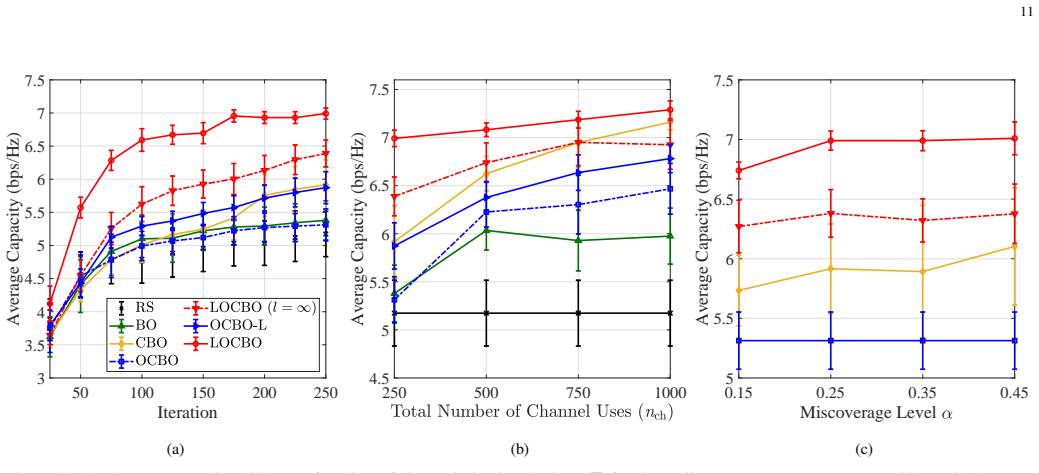
- The guarantee is localized, so calibration effort concentrates near promising regions, which the synthetic and UAV-network experiments show cuts simple regret roughly in half versus non-localized calibration under heteroscedastic noise.
- With localization switched off, LOCBO recovers the noiseless OCBO guarantee, making the new result a strict extension to noisy and misspecified observation models.
- The choice of miscoverage level α interacts with the GP conservativeness ϵ: setting α proportional to ϵ keeps the multiplicative gap between estimated and true utility stable, giving a practical design rule for α.
Reading between the lines
- A natural extension the paper does not pursue is to learn the localization length scale online from observed miscoverage events, which could remove the current sensitivity to that hyperparameter and make the method adaptive to local smoothness.
- The certificate's dependence on 1/bξ suggests the method should degrade gracefully as noise becomes imbalanced; a testable prediction is that replacing symmetric noise with skewed noise of equal variance inflates the measured miscoverage rate of the intervals by roughly the predicted factor.
- The same localized calibration plus denoising recipe could be applied to other surrogate-based sequential decision problems, such as active learning with misspecified priors, wherever the posterior can be evaluated cheaply.
- The closed-form expression of the calibrated posterior means the algorithm's per-iteration cost stays comparable to standard GP inference plus one kernel online gradient update, so the robustness gain does not require inner Monte Carlo loops at each query.
Editorial analysis
A structured set of objections, weighed in public.
Referee Report
Summary. The paper proposes LOCBO, a Bayesian optimization algorithm that calibrates the GP likelihood with localized online conformal prediction and then denoises it to obtain a calibrated posterior over the objective function. The main theoretical claims are Lemma 2, a long-run coverage guarantee for the unobserved objective under a noise-symmetry condition, and Theorem 1, a probabilistic certificate that the estimated acquisition utility lower-bounds the true utility of LOCBO's iterates. The method is evaluated against BO, CBO, OCBO, and an OCBO-L variant on a synthetic Ackley function and a UAV radio-resource-management problem, with code made publicly available.
Significance. If Theorem 1 were valid, the paper would make a useful contribution: it would extend online-CP calibration to noisy observations with localized, input-dependent coverage and connect the calibrated posterior to a performance certificate for the acquisition function. The empirical study covers relevant baselines and includes a real-world engineering problem, and the availability of code is a strength. However, the central utility certificate is not established for the implemented algorithm, and the proof contains a nonlocal error; the contribution as stated is therefore not yet supported.
major comments (3)
- [Section IV-E / Appendix E, Eqs. (53)-(54)] The theorem's phrase 'setting, without loss of generality, C=0' is not a valid normalization. Assumption 3 only bounds u above; subtracting C from u changes the acquisition function aLOCBO in Eq. (30), so a bound proved for u-C does not transfer to the original u. Inequality (54) drops the integral over f>f'; this is an upper bound only when u is non-positive. For the expected-improvement utility used in Section V-A, u(f)=max(0,f-τ) is nonnegative, so the dropped term is nonnegative and inequality (54) reverses. Concretely, take f' below the threshold τ; then u(x,f',Dt)=0, the right-hand side of (54) is 0, while aLOCBO(x|Dt) is strictly positive for a nondegenerate posterior. Moreover, EI is unbounded above as f grows, so it does not satisfy the boundedness part of Assumption 3 even before any shift. Thus Theorem 1 is unproven for the algorithm actually implemented and benchmarked.
- [Appendix E, Eqs. (60)-(61)] The step 'which implies f' not in Γ by construction (28)' is not justified. Equation (28) fixes the total mass outside ΓLOCBO to be α, but it does not control how that mass is split between the left and right tails. The left endpoint L of the interval can have CDF below α/2 while still belonging to Γ, so ∫_{-∞}^{f'} pLOCBO(y|x,Dt) dy < α/2 does not imply f' is outside the interval. This breaks the reduction to Lemma 2 even for the non-positive-utility version of the proof.
- [Assumption 4, Eq. (36)] Assumption 4 is load-bearing for Theorem 1 because ϵ appears in the denominator of the certificate, but the paper gives no argument that a misspecified GP posterior satisfies a uniform lower bound of size ϵ>0 over all histories and all pairs (x,y). For a GP posterior conditioned on an observation y at x, the CDF at y can be arbitrarily close to zero with sufficiently large observation noise or a conflicting prior, so the assumption may hold only with ϵ=0, in which case the theorem's inequality is vacuous. The assumption should be derived from concrete GP and noise conditions, or replaced by a quantitative statement with a lower bound on ϵ.
minor comments (4)
- [Assumption 4, Eq. (36)] The notation in Eq. (36) is unclear: the integrand p(y'|Dt∪{(x,y)}) uses y' as both the integration variable and the conditioning observation; it should be written as p(f(x)=y'|Dt∪{(x,y)}) or clarified with a different symbol.
- [Lemma 1 / Section V-B] Lemma 1 contains an additive kernel-norm term κ in the miscoverage bound, and the text says this radius vanishes 'in the absence of localization (κ=0)'. But in the experiments, localization is controlled by the RBF length scale l, with κ a fixed scaling parameter, while Lemma 1's κ is the kernel upper bound from Assumption 1. Setting κ=0 in Lemma 1 is not the same as the non-localized limit l=∞ used in Section V, so the connection between the theory and the localization sweep in Figure 6 is not made precise.
- [Lemma 3, Eq. (45)] The closed-form expression for pLOCBOα(f(x)|Dt) in Eq. (45) is typeset as one unbroken equation and is very difficult to verify; please split it into labeled components and define all symbols before the display.
- [Section V-A] The experimental comparison reports means and 70% confidence intervals over only 5 or 7 trials; no significance tests are reported, so it is unclear whether the observed improvements of LOCBO over OCBO-L and OCBO are stable across seeds.
Circularity Check
No significant circularity: Theorem 1 is a genuine derivation from external coverage guarantees, not a fit relabeled as a prediction.
full rationale
The paper's derivation chain is not circular. The central utility certificate in Theorem 1 is proved from Lemma 2, which in turn follows from Lemma 1 via an external inequality from [40] and the localized online CP guarantee. No fitted parameter is renamed as a prediction and no equation reduces to its own input by construction. Lemma 1 is imported from the authors' prior work [13], which is a self-citation, but [13] is an independently published, peer-reviewed theorem whose stated assumptions do not include the target result, so it counts as real evidence rather than circular support. The main caveats are correctness concerns rather than circularity: the proof of Theorem 1 contains an invalid 'without loss of generality, C = 0' step in Appendix E, since the expected-improvement utility used in the experiments is nonnegative and inequality (54) reverses when the positive part of the utility integral is discarded; and Assumption 4 never quantifies epsilon, leaving the constant in the utility bound unspecified. These gaps affect the soundness of the stated guarantee, but they do not make the claimed derivation equivalent to its inputs.
Assumptions & free parameters
free parameters (6)
- target miscoverage level α =
0.2 (Section V-C), 0.25 (Section V-D)
- regularization hyperparameter λ =
4e-3 (Sections V-B, V-C), 1e-4 (Section V-D)
- initial learning rate η0 =
5e-3
- learning-rate decay w =
5e-2 (theory requires 1/2)
- localization kernel scale κ =
5, 4 (Section V-C), 2 (Section V-D)
- localization length scale l =
5 (Section V-C), 1/3 (Section V-D)
assumptions (6)
- domain assumption Localized online CP risk bound from [13, Theorem 2]
- domain assumption Assumption 1: kernel kg is stationary, ρ-Lipschitz, upper bounded by κ, and coercive
- domain assumption Assumption 2: bξ > 0, i.e., observation noise is not maximally imbalanced
- domain assumption Assumption 3: utility u is bounded and increasing in f
- ad hoc to paper Assumption 4: there exists a uniform ϵ>0 with ∫_{-∞}^y p(f(x)|D_t∪{(x,y)}) df ≥ ϵ for all histories and pairs
- domain assumption Proposition 2.3 of [40]: Pr[f∉Γ] ≤ Pr[y∉Γ]/bξ
Cite this review
Pith. "Pith review of Robust Bayesian Optimization via Localized Online Conformal Prediction." pith.science (2026). https://pith.science/paper/RFZH3QC2
@misc{pith2026241117387,
  author       = {Pith},
  title        = {Pith review of: Robust Bayesian Optimization via Localized Online Conformal Prediction},
  year         = {2026},
  howpublished = {\url{https://pith.science/paper/RFZH3QC2}},
  note         = {Machine review of arXiv:2411.17387}
}
read the original abstract
Bayesian optimization (BO) is a sequential approach for optimizing black-box objective functions using zeroth-order noisy observations. In BO, Gaussian processes (GPs) are employed as probabilistic surrogate models to estimate the objective function based on past observations, guiding the selection of future queries to maximize utility. However, the performance of BO heavily relies on the quality of these probabilistic estimates, which can deteriorate significantly under model misspecification. To address this issue, we introduce localized online conformal prediction-based Bayesian optimization (LOCBO), a BO algorithm that calibrates the GP model through localized online conformal prediction (CP). LOCBO corrects the GP likelihood based on predictive sets produced by LOCBO, and the corrected GP likelihood is then denoised to obtain a calibrated posterior distribution on the objective function. The likelihood calibration step leverages an input-dependent calibration threshold to tailor coverage guarantees to different regions of the input space. Under minimal noise assumptions, we provide theoretical performance guarantees for LOCBO's iterates that hold for the unobserved objective function. These theoretical findings are validated through experiments on synthetic and real-world optimization tasks, demonstrating that LOCBO consistently outperforms state-of-the-art BO algorithms in the presence of model misspecification.
Figures


Figures from the paper (3 more)


Reference graph
Works this paper leans on
-
[1]
Tight regret bounds for noisy optimization of a Brownian motion,
Z. Wang, V . Y . Tan, and J. Scarlett, “Tight regret bounds for noisy optimization of a Brownian motion,” IEEE Transactions on Signal Processing, vol. 70, pp. 1072–1087, 2022
work page 2022
-
[2]
Y . Zhang, O. Simeone, S. T. Jose, L. Maggi, and A. Valcarce, “Bayesian and multi-armed contextual meta-optimization for efficient wireless radio resource management,” IEEE Transactions on Cognitive Commu- nications and Networking , vol. 9, no. 5, pp. 1282–1295, 2023
work page 2023
-
[3]
Input warping for Bayesian optimization of non-stationary functions,
J. Snoek, K. Swersky, R. Zemel, and R. Adams, “Input warping for Bayesian optimization of non-stationary functions,” in International conference on machine learning , Beijing, China, 2014
work page 2014
-
[4]
Modulating surrogates for Bayesian optimization,
E. Bodin, M. Kaiser, I. Kazlauskaite, Z. Dai, N. Campbell, and C. H. Ek, “Modulating surrogates for Bayesian optimization,” in International Conference on Machine Learning , 2020
work page 2020
-
[5]
Misspecified Gaussian process bandit optimization,
I. Bogunovic and A. Krause, “Misspecified Gaussian process bandit optimization,” Advances in neural information processing systems, 2021
work page 2021
-
[6]
Achieving robustness to aleatoric uncertainty with heteroscedastic Bayesian optimisation,
R.-R. Griffiths, A. A. Aldrick, M. Garcia-Ortegon, V . Lalchand et al. , “Achieving robustness to aleatoric uncertainty with heteroscedastic Bayesian optimisation,” Machine Learning: Science and Technology , vol. 3, no. 1, p. 015004, 2021
work page 2021
-
[7]
Heteroscedastic Bayesian optimisation for stochastic model predictive control,
R. Guzman, R. Oliveira, and F. Ramos, “Heteroscedastic Bayesian optimisation for stochastic model predictive control,” IEEE Robotics and Automation Letters, vol. 6, no. 1, pp. 56–63, 2021
work page 2021
-
[8]
Quantifying mismatch in Bayesian optimization,
E. Schulz, M. Speekenbrink, J. M. Hern ´andez-Lobato, Z. Ghahramani, and S. J. Gershman, “Quantifying mismatch in Bayesian optimization,” in Nips workshop on bayesian optimization: Black-box optimization and beyond, 2016
work page 2016
Show all 47 references
-
[9]
Taking the human out of the loop: A review of Bayesian optimization,
B. Shahriari, K. Swersky, Z. Wang, R. P. Adams, and N. De Freitas, “Taking the human out of the loop: A review of Bayesian optimization,” Proceedings of the IEEE , vol. 104, no. 1, pp. 148–175, 2015
2015
-
[10]
Uncertainty quantification using mar- tingales for misspecified Gaussian processes,
W. Neiswanger and A. Ramdas, “Uncertainty quantification using mar- tingales for misspecified Gaussian processes,” in Algorithmic learning theory, 2021
2021
-
[11]
Bayesian optimization with conformal prediction sets,
S. Stanton, W. Maddox, and A. G. Wilson, “Bayesian optimization with conformal prediction sets,” in International Conference on Artificial Intelligence and Statistics , Valencia, Spain, 2023
2023
-
[12]
Online calibrated and conformal prediction improves Bayesian optimization,
S. Deshpande, C. Marx, and V . Kuleshov, “Online calibrated and conformal prediction improves Bayesian optimization,” in International Conference on Artificial Intelligence and Statistics , Valencia, Spain, 2024
2024
-
[13]
Localized adaptive risk control,
M. Zecchin and O. Simeone, “Localized adaptive risk control,” in Advances in neural information processing systems, Vancouver, Canada, 2024
2024
-
[14]
Physics-constrained bayesian optimization for optimal actuators placement in composite structures assembly,
A. AlBahar, I. Kim, X. Wang, and X. Yue, “Physics-constrained bayesian optimization for optimal actuators placement in composite structures assembly,” IEEE Transactions on Automation Science and Engineering , vol. 20, no. 4, pp. 2772–2783, 2022
2022
-
[15]
Warped gaussian processes and derivative-based sequential designs for func- tions with heterogeneous variations,
S. Marmin, D. Ginsbourger, J. Baccou, and J. Liandrat, “Warped gaussian processes and derivative-based sequential designs for func- tions with heterogeneous variations,” SIAM/ASA Journal on Uncertainty Quantification, vol. 6, no. 3, pp. 991–1018, 2018
2018
-
[16]
Bayesian active meta-learning for black- box optimization,
I. Nikoloska and O. Simeone, “Bayesian active meta-learning for black- box optimization,” in 2022 IEEE 23rd International Workshop on Signal Processing Advances in Wireless Communication (SPAWC), Oulu, Finland, 2022
2022
-
[17]
Meta-learning acquisition functions for transfer learning in Bayesian optimization,
M. V olpp, L. P. Fr¨ohlich, K. Fischer, A. Doerr, S. Falkner, F. Hutter, and C. Daniel, “Meta-learning acquisition functions for transfer learning in Bayesian optimization,” arXiv preprint arXiv:1904.02642 , 2019
1904 arXiv
-
[18]
Meta-learning priors for safe Bayesian optimization,
J. Rothfuss, C. Koenig, A. Rupenyan, and A. Krause, “Meta-learning priors for safe Bayesian optimization,” inConference on Robot Learning, Atlanta, USA, 2023
2023
-
[19]
Active learning for misspecified models,
M. Sugiyama, “Active learning for misspecified models,” Advances in neural information processing systems , vol. 18, 2005
2005
-
[20]
Active learning with a misspecified prior,
D. Fudenberg, G. Romanyuk, and P. Strack, “Active learning with a misspecified prior,” Theoretical Economics , vol. 12, no. 3, pp. 1155– 1189, 2017
2017
-
[21]
Active emulation of computer codes with gaussian processes–application to remote sensing,
D. H. Svendsen, L. Martino, and G. Camps-Valls, “Active emulation of computer codes with gaussian processes–application to remote sensing,” Pattern Recognition, vol. 100, p. 107103, 2020
2020
-
[22]
Adaptive quadrature schemes for bayesian inference via active learning,
F. L. Fern ´andez, L. Martino, V . Elvira, D. Delgado, and J. L ´opez- Santiago, “Adaptive quadrature schemes for bayesian inference via active learning,” IEEE Access, vol. 8, pp. 208 462–208 483, 2020
2020
-
[23]
V ovk, A
V . V ovk, A. Gammerman, and G. Shafer, Algorithmic learning in a random world. Springer, 2005, vol. 29
2005
-
[24]
A gentle introduction to confor- mal prediction and distribution-free uncertainty quantification,
A. N. Angelopoulos and S. Bates, “A gentle introduction to confor- mal prediction and distribution-free uncertainty quantification,” arXiv preprint arXiv:2107.07511, 2021
2021 arXiv
-
[25]
Adaptive conformal inference under distribu- tion shift,
I. Gibbs and E. Candes, “Adaptive conformal inference under distribu- tion shift,” Advances in Neural Information Processing Systems , 2021
2021
-
[26]
Online conformal prediction with decaying step sizes,
A. N. Angelopoulos, R. F. Barber, and S. Bates, “Online conformal prediction with decaying step sizes,” arXiv preprint arXiv:2402.01139 , 2024
2024 arXiv
-
[27]
Achieving risk control in online learning settings,
S. Feldman, L. Ringel, S. Bates, and Y . Romano, “Achieving risk control in online learning settings,” arXiv preprint arXiv:2205.09095 , 2022
2022 arXiv
-
[28]
Confor- mal prediction under covariate shift,
R. J. Tibshirani, R. Foygel Barber, E. Candes, and A. Ramdas, “Confor- mal prediction under covariate shift,” in Advances in neural information processing systems, Vancouver, Canada, 2019
2019
-
[29]
Conformal prediction with localization,
L. Guan, “Conformal prediction with localization,” arXiv preprint arXiv:1908.08558, 2019
1908 arXiv
-
[30]
Conformal inference for online prediction with arbitrary distribution shifts,
I. Gibbs and E. Cand `es, “Conformal inference for online prediction with arbitrary distribution shifts,” arXiv preprint arXiv:2208.08401 , 2022
2022 arXiv
-
[31]
Conformal prediction with local weights: ran- domization enables local guarantees,
R. Hore and R. F. Barber, “Conformal prediction with local weights: ran- domization enables local guarantees,” arXiv preprint arXiv:2310.07850, 2023
2023 arXiv
-
[32]
Hierarchically-partitioned gaussian process approximation,
B.-J. Lee, J. Lee, and K.-E. Kim, “Hierarchically-partitioned gaussian process approximation,” in Artificial Intelligence and Statistics. PMLR, 2017, pp. 822–831
2017
-
[33]
Scalable global optimization via local Bayesian optimization,
D. Eriksson, M. Pearce, J. Gardner, R. D. Turner, and M. Poloczek, “Scalable global optimization via local Bayesian optimization,” in Ad- vances in neural information processing systems , Vancouver, Canada, 2019
2019
-
[34]
Virtual library of simulation ex- periments: Test functions and datasets,
S. Surjanovic and D. Bingham, “Virtual library of simulation ex- periments: Test functions and datasets,” in Simon Fraser University, Burnaby, BC, Canada, accessed May , vol. 13, 2013
2013
-
[35]
Designing cellular networks for uav corridors via bayesian optimization,
M. Benzaghta, G. Geraci, D. L ´opez-P´erez, and A. Valcarce, “Designing cellular networks for uav corridors via bayesian optimization,” in IEEE Global Communications Conference , Kuala Lumpur, Malaysia, 2023, pp. 4552–4557
2023
-
[36]
C. K. Williams and C. E. Rasmussen, Gaussian processes for machine learning. MIT press Cambridge, MA, 2006, vol. 2, no. 3
2006
-
[37]
Gaussian process optimization in the bandit setting: No regret and experimental design,
N. Srinivas, A. Krause, S. M. Kakade, and M. Seeger, “Gaussian process optimization in the bandit setting: No regret and experimental design,” arXiv preprint arXiv:0912.3995 , 2009
2009 arXiv
-
[38]
The reparameterization trick for acquisition functions,
J. T. Wilson, R. Moriconi, F. Hutter, and M. P. Deisenroth, “The reparameterization trick for acquisition functions,” arXiv preprint arXiv:1712.00424, 2017
2017 arXiv
-
[39]
Online learning with kernels,
J. Kivinen, A. J. Smola, and R. C. Williamson, “Online learning with kernels,” IEEE transactions on signal processing , vol. 52, no. 8, pp. 2165–2176, 2004
2004
-
[40]
From conformal predictions to confidence regions,
C. Guille-Escuret and E. Ndiaye, “From conformal predictions to confidence regions,” arXiv preprint arXiv:2405.18601 , 2024
2024 arXiv
-
[41]
Practical Bayesian optimiza- tion of machine learning algorithms,
J. Snoek, H. Larochelle, and R. P. Adams, “Practical Bayesian optimiza- tion of machine learning algorithms,” in Advances in neural information processing systems, Lake Tahoe, USA, 2012
2012
-
[42]
A tutorial on Bayesian optimization,
P. I. Frazier, “A tutorial on Bayesian optimization,” arXiv preprint arXiv:1807.02811, 2018
2018 arXiv
-
[43]
Bayesian learning via stochastic gradient langevin dynamics,
M. Welling and Y . W. Teh, “Bayesian learning via stochastic gradient langevin dynamics,” in International Conference on Machine Learning , Bellevue, USA, 2011
2011
-
[44]
Max-value entropy search for efficient Bayesian optimization,
Z. Wang and S. Jegelka, “Max-value entropy search for efficient Bayesian optimization,” in International Conference on Machine Learn- ing, Sydney, Australia, 2017
2017
-
[45]
Study on channel model for frequencies from 0.5 to 100 GHz (Release 16),
3GPP, “Study on channel model for frequencies from 0.5 to 100 GHz (Release 16),” 3rd Generation Partnership Project (3GPP), TR 38.901, Dec. 2019
2019
-
[46]
Conformal pid control for time series prediction,
A. Angelopoulos, E. Candes, and R. J. Tibshirani, “Conformal pid control for time series prediction,” in Advances in neural information processing systems, Vancouver, Candada, 2024
2024
-
[47]
Multi-fidelity Bayesian opti- mization with across-task transferable max-value entropy search,
Y . Zhang, S. Park, and O. Simeone, “Multi-fidelity Bayesian opti- mization with across-task transferable max-value entropy search,” arXiv preprint arXiv:2403.09570, 2024. APPENDIX A. Closed-Form Expression of LOCBO’s Posterior The following lemma describes the result of the i...
2024 arXiv
Reviewed August 12, 2026 · model on record in the stance chip above.
Discussion (0). Continue with ORCID to comment.