REVIEW 3 major objections 5 minor 61 references
Dual-Representation Interaction Driven Image Quality Assessment with Restoration Assistance
T0 review · 3 major / 5 minor · reviewed 2026-08-12 · deepseek-v4-flash
Pith's one-line read Splitting a single encoder's features into degradation and quality halves lets a no-reference IQA model outrank prior state-of-the-art on synthetic and real-world benchmarks.
desk verdict Reasonable incremental NR-IQA paper; the dual-representation idea is sensible and the synthetic-dataset results are good, but the restoration-assistance contributions are supported mostly by sub-noise ablation deltas and the RS Loss mechanism is under-specified. read the letter →
The pith
A machine-rendered reading of the paper's core claim, the machinery that carries it, and where it could break.
The reading
What carries the argument
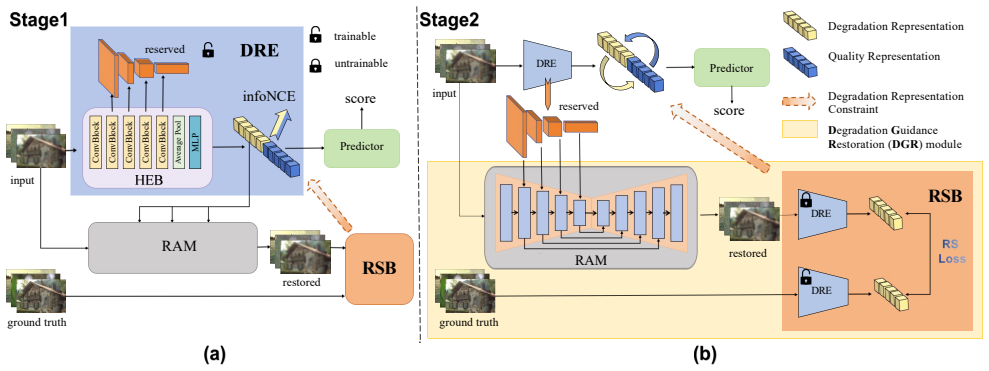
The Dual-Representation Extractor (DRE): a single five-layer hybrid encoder whose output is split into an upper degradation-aware half and a lower quality-aware half, trained with InfoNCE contrastive loss; the Restoration Assistance Module (RAM), which feeds the degradation representation into NAFNet to restore the image and thereby forces the degradation half to encode restoration-relevant information; and the Representation-based Semantic Loss (RS Loss), an L2 penalty between the degradation representations of the restored image and the clean reference. The split representation is the load-bearing object: it lets one forward pass carry both kinds of information, and the paper argues the two halves interact implicitly through shared layers and losses.
What would settle it
Retrain the V2, V3, and Proposed variants (dual-representation only, plus NAFNet, plus RS Loss) on PIPAL and KonIQ-10k with, say, ten seeds each and report per-seed SROCC/PLCC distributions; if the mean deltas fall inside one standard deviation of each other, the paper's component-wise attribution collapses.
Extended reading notes
Core claim
The central claim, stated on the paper's own terms, is that dual-representation interaction makes a no-reference IQA model perform favorably against existing state-of-the-art models on both synthetic and real-world datasets, and that restoration assistance plus a representation-based semantic loss are what make the degradation information useful to the score predictor. The mechanism: one hybrid encoder produces a shared representation whose upper half is trained to be degradation-aware and whose lower half is quality-aware, using InfoNCE contrastive pairs; in a second stage, the degradation half guides NAFNet through a Restoration Assistance Module, and an RS Loss pulls the degradation representation of restored images toward that of the clean reference, implicitly sharpening the quality representation. On the evaluated benchmarks the model reports the best SROCC/PLCC pairs on LIVE, KADID-10K, and KonIQ-10k, and its ablation attributes the gains to the dual-representation split, the restoration module, and the RS Loss in turn.
Load-bearing premise
The claim stands on the assumption that the averaged correlation gains from adding restoration assistance and the RS Loss—deltas of roughly 0.001 to 0.007—are real improvements rather than run-to-run noise, since the paper reports five-seed averages without standard deviations.
Editorial extensions
If this is right
- If the central claim holds, NR-IQA methods no longer need to choose between quality-aware and degradation-aware features; a single encoder can supply both.
- The restoration-assistance setup implies that any restoration network with an encoder-decoder structure can be plugged in to supply degradation guidance, so the approach is not tied to NAFNet itself.
- Because the DRE is pretrained only on a small hybrid-degraded set drawn from DIV2K and Flickr2K, the results imply that strong IQA performance does not require ImageNet-scale pretraining.
- The RS Loss, by penalizing degradation-representation differences between restored and clean images, gives a training signal that directly targets the artifacts restoration models introduce—an issue the paper identifies in GAN-based restorers.
Reading between the lines
- The dual-representation split is a generic inductive bias: the same half-degradation/half-quality design could transfer to other image-understanding tasks where content and nuisance factors need separate handling, such as face recognition under noise or medical image screening.
- The reported gains from RAM and RS Loss are small in absolute terms (at most 0.007 in correlation); unless variance over seeds is tiny, those specific components may not generalize beyond the reported datasets even if the dual-representation split itself carries most of the benefit.
- A testable extension would be to swap NAFNet for a GAN-based restoration network—which the paper lists as future work—to probe whether RS Loss's degradation-pulling effect remains useful on restorations that are perceptually strong but structurally different, exactly where the paper notes GAN artifacts fool quality predictors.
- Because DRE is trained on high-quality natural images only, the method likely inherits a content bias; cross-dataset transfer tests (e.g., train on KonIQ-10k, test on LIVEC) would show whether the dual representation captures dataset-agnostic degradation factors.
Editorial analysis
A structured set of objections, weighed in public.
Referee Report
Summary. The paper proposes DRI-IQA, a no-reference image quality assessment method built around a Dual-Representation Extractor (DRE) that splits one encoder's feature vector into a degradation-aware half and a quality-aware half using contrastive learning. In a second stage, a NAFNet restoration network is used as an auxiliary module, and a Representation-based Semantic Loss (RS Loss) is defined between the degradation representations of restored and reference images. Experiments report SROCC and PLCC on LIVE, KADID-10K, KonIQ-10k, LIVEC, and PIPAL, with the paper claiming favorable performance against state-of-the-art on both synthetic and real-world datasets. The evaluation uses external human-MOS benchmarks, so the primary performance comparison is not circular.
Significance. If the claimed results hold, the paper offers a useful contribution: a compact contrastively pretrained dual-representation encoder that avoids large-scale ImageNet pretraining, an interpretable separation of degradation and quality information, and a restoration-assisted scoring pipeline. Table 2 shows strong results on LIVE, KADID-10K, and KonIQ-10k, and the use of external MOS benchmarks makes the core comparison non-circular. The significance is tempered, however, by the LIVEC result where the method trails QPT, by the lack of statistical support for the two headline components in Table 3, and by an under-specified gradient path for RS Loss. The paper also promises code release, which would help reproducibility, but the code is not currently available.
major comments (3)
- [§4.5, Table 2] The abstract and §4.5 claim the method 'performs favorably against existing state-of-the-art models on both synthetic and real-world datasets,' but on LIVEC, QPT reports SROCC 0.895 / PLCC 0.914 while DRI-IQA reports 0.861 / 0.886. This is a large gap and it is not discussed anywhere in the paper; it directly undermines the real-world portion of the central claim. Please report this result and either temper the claim or provide an analysis of why DRI-IQA lags on LIVEC.
- [§4.6, Table 3] The evidence that restoration assistance and RS Loss improve IQA accuracy is not statistically supported. In Table 3, V3 vs V2 changes PIPAL SROCC/PLCC by +0.003/+0.003 and KonIQ-10k SROCC by +0.000; Proposed vs V3 changes PIPAL SROCC/PLCC by +0.002/+0.007 and KonIQ-10k SROCC/PLCC by +0.002/+0.000. The paper states that results are averaged over 5 seeds (§4.2) but gives no standard deviations or significance tests, so these differences cannot be distinguished from training noise. Please report per-seed results with standard deviations and a significance test, or explicitly weaken the conclusions about the contributions of RAM and RS Loss.
- [§3.4, Eqs. (4)-(6), Figure 2] The mechanism by which RS Loss improves the score predictor is not established by the text as written. Equation (6) is computed between degradation representations of the restored and reference images using the 'fixed DRE' described in §3.1 and Figure 2, so under that description gradients from L_RS update only NAFNet, and NAFNet's output is not fed to the MOS predictor. If the main-path DRE is actually trainable in Stage 2, the phrase 'fixed DRE' is misleading and the paper must describe the gradient path through which RS Loss affects the quality representation; if the DRE is truly fixed, the +0.002 SROCC gain in Table 3 cannot be caused by RS Loss and should be attributed to noise or to an unstated mechanism. Please clarify whether the DRE used in RSB is a frozen copy or the same trainable encoder, and show explicitly how L_RS influences the scoring path.
minor comments (5)
- [§4.5] The numerical gains reported for KonIQ-10k are inconsistent with Table 2: the text says DRI-IQA gains 0.004, 0.017, and 0.025 SROCC over QPT, Re-IQA, and CONTRIQUE, but the table shows 0.009, 0.022, and 0.042. The text also contains the typo 'KoiIQ-10k'.
- [§4.6] The text says V2 gains 0.03 SROCC and 0.06 PLCC on PIPAL compared to V1, but Table 3 shows 0.003 and 0.006. Please correct the decimal values and ensure the prose matches the table.
- [§4.2, Table 3] The experimental protocol says results are 'averaged by 10 times split' and averaged over 5 seeds, but the split procedure is not fully specified. Please describe the train/test split protocol, report standard deviations for Table 2 as well as Table 3, and state which results were copied from prior work versus obtained under this protocol.
- [§3.3, Related Work] Since the score predictor in DRI-IQA is based on MANIQA [50], including MANIQA in Table 2 would clarify the gain attributable to the DRI, RAM, and RS Loss modules over the backbone predictor. Currently MANIQA is discussed in the text but absent from the comparison table.
- [References and Table 2] Reference [32] is listed as TIP2002 but BRISQUE was published in TIP 2012, and reference [33] duplicates the same paper under a different title entry. Please correct the citation metadata and remove the duplicate. Also, 'Flicker2K' in §4.1 should be 'Flickr2K'.
Circularity Check
No significant circularity: DRI-IQA is validated on external MOS benchmarks; RS Loss is a training regularizer, not a manufactured prediction.
full rationale
The paper's central performance claim (DRI-IQA outperforms state-of-the-art methods on LIVE, KADID-10K, KonIQ-10k, CLIVE, and PIPAL) is evaluated against external human-MOS datasets using standard SROCC and PLCC metrics, so the reported scores are not manufactured from the model's own definitions. The DRE is pre-trained with InfoNCE on randomly synthetically degraded DIV2K/Flickr2K pairs, the score predictor is trained with MSE on dataset MOS labels, and the restoration network is trained with L2 and perceptual losses against pristine references; none of these steps is a fitted parameter renamed as a prediction. The RS Loss of Eq. (6) is a feature-matching regularizer between DRE outputs for restored and reference images; although it uses the model's own DRE as the metric space, making the target self-referential, it is a training objective rather than a way of deriving the reported test scores. The ablation in Table 3 attributes +0.003 and +0.002 SROCC to the restoration module and RS Loss without reporting standard deviations, so those attributions are statistically fragile, and the text's 'fixed DRE' in Section 3.1 versus 'the complete network joins in training' in the Figure 2 caption is ambiguous; these are support and consistency concerns, not circularity. Self-citations such as [26]-[28] appear in Related Work but are not load-bearing for the central claim, and no circular step can be exhibited as a quoted reduction of an equation to its own inputs.
Assumptions & free parameters
free parameters (3)
- lambda (perceptual loss weight) =
0.01
- representation split ratio =
0.5 (upper half degradation, lower half quality)
- max degradation iterations N =
6
assumptions (3)
- domain assumption MOS scores in benchmark datasets are reliable ground truth for image quality
- ad hoc to paper The upper and lower halves of a single encoder's feature vector can be learned to represent degradation and quality independently
- domain assumption Synthetic degradations applied to DIV2K/Flickr2K transfer to real-world and GAN-restored distortions
Cite this review
Pith. "Pith review of Dual-Representation Interaction Driven Image Quality Assessment with Restoration Assistance." pith.science (2026). https://pith.science/paper/EJJTWOJ6
@misc{pith2026241117390,
  author       = {Pith},
  title        = {Pith review of: Dual-Representation Interaction Driven Image Quality Assessment with Restoration Assistance},
  year         = {2026},
  howpublished = {\url{https://pith.science/paper/EJJTWOJ6}},
  note         = {Machine review of arXiv:2411.17390}
}
read the original abstract
No-Reference Image Quality Assessment for distorted images has always been a challenging problem due to image content variance and distortion diversity. Previous IQA models mostly encode explicit single-quality features of synthetic images to obtain quality-aware representations for quality score prediction. However, performance decreases when facing real-world distortion and restored images from restoration models. The reason is that they do not consider the degradation factors of the low-quality images adequately. To address this issue, we first introduce the DRI method to obtain degradation vectors and quality vectors of images, which separately model the degradation and quality information of low-quality images. After that, we add the restoration network to provide the MOS score predictor with degradation information. Then, we design the Representation-based Semantic Loss (RS Loss) to assist in enhancing effective interaction between representations. Extensive experimental results demonstrate that the proposed method performs favorably against existing state-of-the-art models on both synthetic and real-world datasets.
Figures


Figures from the paper (3 more)


Reference graph
Works this paper leans on
-
[1]
Simple baselines for image restoration.arXiv preprint, 2022
Liangyu Chen, Xiaojie Chu, Xiangyu Zhang, and Jian Sun. Simple baselines for image restoration.arXiv preprint, 2022. 2204.04676. 1, 5
arXiv 2022
-
[2]
When vision transformers outperform resnets without pretrain- ing or strong data augmentations
Xiangning Chen, Cho-Jui Hsieh, and Boqing Gong. When vision transformers outperform resnets without pretrain- ing or strong data augmentations. arXiv preprint , 2021. 2106.01548. 2
arXiv 2021
-
[3]
Un- paired deep image deraining using dual contrastive learning
Xiang Chen, Jinshan Pan, Kui Jiang, Yufeng Li, Yufeng Huang, Caihua Kong, Longgang Dai, and Zhentao Fan. Un- paired deep image deraining using dual contrastive learning. In CVPR, 2022. 1, 2, 8
work page 2022
-
[4]
Massive online crowdsourced study of subjective and objective picture qual- ity
Ghadiyaram Deepti and Alan C Bovik. Massive online crowdsourced study of subjective and objective picture qual- ity. IEEE Trans. Image Process., 2015. 5, 6
work page 2015
-
[5]
Bert: Pre-training of deep bidirectional trans- formers for language understanding
Jacob Devlin. Bert: Pre-training of deep bidirectional trans- formers for language understanding. arXiv preprint, 2018. 1810.04805. 1
arXiv 2018
-
[6]
Learning a deep convolutional network for image super-resolution
Chao Dong, Chen Change Loy, Kaiming He, and Xiaoou Tang. Learning a deep convolutional network for image super-resolution. In ECCV, 2014. 1
work page 2014
-
[7]
An image is worth 16x16 words: Transformers for image recognition at scale
Alexey Dosovitskiy, Lucas Beyer, Alexander Kolesnikov, Dirk Weissenborn, Xiaohua Zhai, Thomas Unterthiner, Mostafa Dehghani, Matthias Minderer, Georg Heigold, Syl- vain Gelly, Jakob Uszkoreit, and Neil Houlsby. An image is worth 16x16 words: Transformers for image recognition at scale. In Pattern Recognition, 2021. 2
work page 2021
-
[8]
Ntire 2017 challenge on single image super-resolution: Dataset and study
Agustsson Eirikur and Timofte Radu. Ntire 2017 challenge on single image super-resolution: Dataset and study. In CVPR, 2017. 4, 5
work page 2017
Show all 61 references
-
[9]
No-reference image quality assessment via transformers, rel- ative ranking, and self-consistency
S Alireza Golestaneh, Saba Dadsetan, and Kris M Kitani. No-reference image quality assessment via transformers, rel- ative ranking, and self-consistency. In WACV, 2022. 6, 7, 8
2022
-
[10]
Multiscale natural scene sta- tistical analysis for no-reference quality evaluation of dibr- synthesized views
Ke Gu, Junfei Qiao, Sanghoon Lee, Hantao Liu, Weisi Lin, and Patrick Le Callet. Multiscale natural scene sta- tistical analysis for no-reference quality evaluation of dibr- synthesized views. IEEE Transactions on Broadcasting ,
-
[11]
Deep residual learning for image recognition
Kaiming He, Xiangyu Zhang, Shaoqing Ren, and Jian Sun. Deep residual learning for image recognition. In CVPR,
-
[12]
Pipal: a large-scale image quality assessment dataset for perceptual image restoration
Gu Jinjin, Cai Haoming, Chen Haoyu, Ye Xiaoxing, Jimmy S Ren, and Dong Chao. Pipal: a large-scale image quality assessment dataset for perceptual image restoration. In ECCV, 2020. 5, 6
2020
-
[13]
Perceptual losses for real-time style transfer and super-resolution
Justin Johnson, Alexandre Alahi, and Li Fei-Fei. Perceptual losses for real-time style transfer and super-resolution. In ECCV, 2016. 3, 5
2016
-
[14]
Momentum contrast for unsupervised visual rep- resentation learning
He Kaiming, Fan Haoqi, Wu Yuxin, Xie Saining, and Gir- shick Ross. Momentum contrast for unsupervised visual rep- resentation learning. arXiv preprint, 2019. 1911.05722. 4, 5, 7
2019 arXiv
-
[15]
Convolu- tional neural networks for no-reference image quality assess- ment
Le Kang, Peng Ye, Yi Li, and David Doermann. Convolu- tional neural networks for no-reference image quality assess- ment. In CVPR, 2014. 1
2014
-
[16]
Transformers are rnns: Fast autoregressive transformers with linear attention
Angelos Katharopoulos, Apoorv Vyas, Nikolaos Pappas, and Franc ¸ois Fleuret. Transformers are rnns: Fast autoregressive transformers with linear attention. In ICML, 2020. 1
2020
-
[17]
Musiq: Multi-scale image quality transformer
Junjie Ke, Qifei Wang, Yilin Wang, Peyman Milanfar, and Feng Yang. Musiq: Multi-scale image quality transformer. In ICCV, 2021. 2, 6, 7, 8
2021
-
[18]
Supervised contrastive learning
Prannay Khosla, Piotr Teterwak, Chen Wang, Aaron Sarna, Yonglong Tian, Phillip Isola, Aaron Maschinot, Ce Liu, and Dilip Krishnan. Supervised contrastive learning. In Adv. Neural Inform. Process. Syst., 2020. 3
2020
-
[19]
Accurate image super-resolution using very deep convolutional net- works
Jiwon Kim, Jung Kwon Lee, and Kyoung Mu Lee. Accurate image super-resolution using very deep convolutional net- works. In CVPR, 2016. 1
2016
-
[20]
Imagenet classification with deep convolutional neural net- works
Alex Krizhevsky, Ilya Sutskever, and Geoffrey E Hinton. Imagenet classification with deep convolutional neural net- works. Adv. Neural Inform. Process. Syst., 2012. 2
2012
-
[21]
Deblurgan-v2: Deblurring (orders-of-magnitude) faster and better
Orest Kupyn, Tetiana Martyniuk, Junru Wu, and Zhangyang Wang. Deblurgan-v2: Deblurring (orders-of-magnitude) faster and better. In ICCV, 2019. 2
2019
-
[22]
All-in-one image restoration for unknown cor- ruption
Boyun Li, Xiao Liu, Peng Hu, Zhongqin Wu, Jiancheng Lv, and Xi Peng. All-in-one image restoration for unknown cor- ruption. In CVPR, 2022. 3
2022
-
[23]
Asymmetric mask scheme for self- supervised real image denoising
Xiangyu Liao, Tianheng Zheng, Jiayu Zhong, Pingping Zhang, and Chao Ren. Asymmetric mask scheme for self- supervised real image denoising. In ECCV, 2025. 2
2025
-
[24]
Enhanced deep residual networks for single image super-resolution
Bee Lim, Sanghyun Son, Heewon Kim, Seungjun Nah, and Kyoung Mu Lee. Enhanced deep residual networks for single image super-resolution. In CVPRW, 2017. 1
2017
-
[25]
Kadid-10k: A large-scale artificially distorted iqa database
Hanhe Lin, Vlad Hosu, and Dietmar Saupe. Kadid-10k: A large-scale artificially distorted iqa database. In QoMEX,
-
[26]
Unsupervised image denoising in real-world scenarios via self-collaboration parallel generative adversarial branches
Xin Lin, Chao Ren, Xiao Liu, Jie Huang, and Yinjie Lei. Unsupervised image denoising in real-world scenarios via self-collaboration parallel generative adversarial branches. In ICCV, 2023. 1, 2
2023
-
[27]
Dual degradation representation for joint deraining and low-light enhancement in the dark
Xin Lin, Jingtong Yue, Sixian Ding, Chao Ren, Lu Qi, and Ming-Hsuan Yang. Dual degradation representation for joint deraining and low-light enhancement in the dark. IEEE Trans. Circuit Syst. Video Technol., 2024. 2
2024
-
[28]
Re-boosting self- collaboration parallel prompt gan for unsupervised image restoration
Xin Lin, Yuyan Zhou, Jingtong Yue, Chao Ren, Kelvin CK Chan, Lu Qi, and Ming-Hsuan Yang. Re-boosting self- collaboration parallel prompt gan for unsupervised image restoration. arXiv preprint, 2024. 2408.09241. 1
2024 arXiv
-
[29]
Image quality assessment us- ing contrastive learning
Pavan C Madhusudana, Neil Birkbeck, Yilin Wang, Balu Adsumilli, and Alan C Bovik. Image quality assessment us- ing contrastive learning. arXiv preprint, 2021. 2110.13266. 6, 8
2021 arXiv
-
[30]
No-reference image quality assessment in the spa- tial domain
Anish Mittal, Anush Krishna Moorthy, and Alan Conrad Bovik. No-reference image quality assessment in the spa- tial domain. IEEE Trans. Image Process., 2012. 1
2012
-
[31]
No-reference image quality assessment in the spa- tial domain
Anish Mittal, Anush Krishna Moorthy, and Alan Conrad Bovik. No-reference image quality assessment in the spa- tial domain. IEEE Trans. Image Process., 2012. 2
2012
-
[32]
No-reference image quality assessment in the spa- tial domain
Anish Mittal, Anush Krishna Moorthy, and Alan Conrad Bovik. No-reference image quality assessment in the spa- tial domain. IEEE Trans. Image Process., 2012. 6, 7
2012
-
[33]
completely blind
Anish Mittal, Rajiv Soundararajan, and Alan C Bovik. Mak- ing a “completely blind” image quality analyzer. IEEE Sign. Process. Letters, 2012. 2
2012
-
[34]
Real image denoising via guided residual estima- tion and noise correction
Yizhong Pan, Chao Ren, Xiaohong Wu, Jie Huang, and Xi- aohai He. Real image denoising via guided residual estima- tion and noise correction. IEEE Trans. Circuit Syst. Video Technol., 2022. 2
2022
-
[35]
No-reference image quality assessment via multibranch convolutional neural networks
Zhaoqing Pan, Feng Yuan, Xu Wang, Long Xu, Xiao Shao, and Sam Kwong. No-reference image quality assessment via multibranch convolutional neural networks. IEEE Transac- tions on Artificial Intelligence, 2022. 1
2022
-
[36]
Timofte Radu, Agustsson Eirikur, Van Gool Luc, Yang MingHsuan, Zhang Lei, and Lim et al. Bee. Ntire 2017 chal- lenge on single image super-resolution: Methods and results. In CVPR, 2017. 4, 5
2017
-
[37]
Blind image quality assessment: A natural scene statistics approach in the dct domain
Michele A Saad, Alan C Bovik, and Christophe Charrier. Blind image quality assessment: A natural scene statistics approach in the dct domain. IEEE Trans. Image Process. ,
-
[38]
Re-iqa: Unsupervised learning for image quality assessment in the wild
Avinab Saha, Sandeep Mishra, and Alan C Bovik. Re-iqa: Unsupervised learning for image quality assessment in the wild. In CVPR, 2023. 2, 6, 7, 8
2023
-
[39]
No-reference quality assessment using natural scene statis- tics: Jpeg2000
Hamid R Sheikh, Alan C Bovik, and Lawrence Cormack. No-reference quality assessment using natural scene statis- tics: Jpeg2000. IEEE Trans. Image Process., 2005. 2
2005
-
[40]
An information fidelity criterion for image quality assess- ment using natural scene statistics
Hamid R Sheikh, Alan C Bovik, and Gustavo De Veciana. An information fidelity criterion for image quality assess- ment using natural scene statistics. IEEE Trans. Image Pro- cess., 2005. 2
2005
-
[41]
A statistical evaluation of recent full reference image quality assessment algorithms
Hamid R Sheikh, Muhammad F Sabir, and Alan C Bovik. A statistical evaluation of recent full reference image quality assessment algorithms. IEEE Trans. Image Process., 2006. 5
2006
-
[42]
Very deep convo- lutional networks for large-scale image recognition
Karen Simonyan and Andrew Zisserman. Very deep convo- lutional networks for large-scale image recognition. arXiv preprint, 2014. 2
2014
-
[43]
How to train your vit? data, augmentation, and regularization in vision transformers
Andreas Steiner, Alexander Kolesnikov, Xiaohua Zhai, Ross Wightman, Jakob Uszkoreit, and Lucas Beyer. How to train your vit? data, augmentation, and regularization in vision transformers. arXiv preprint, 2021. 2106.10270. 2
2021 arXiv
-
[44]
Blindly assess image qual- ity in the wild guided by a self-adaptive hyper network
Shaolin Su, Qingsen Yan, Yu Zhu, Cheng Zhang, Xin Ge, Jinqiu Sun, and Yanning Zhang. Blindly assess image qual- ity in the wild guided by a self-adaptive hyper network. In CVPR, 2020. 2, 6
2020
-
[45]
Mlp-mixer: An all-mlp ar- chitecture for vision
Ilya Tolstikhin, Neil Houlsby, Alexander Kolesnikov, Lu- cas Beyer, Xiaohua Zhai, Thomas Unterthiner, Jessica Yung, Andreas Steiner, Daniel Keysers, Jakob Uszkoreit, Mario Lucic, and Alexey Dosovitskiy. Mlp-mixer: An all-mlp ar- chitecture for vision. arXiv preprint, 2021. 210...
2021 arXiv
-
[46]
Koniq-10k: An ecologically valid database for deep learn- ing of blind image quality assessment
Hosu Vlad, Lin Hanhe, Sziranyi Tamas, and Saupe Dietmar. Koniq-10k: An ecologically valid database for deep learn- ing of blind image quality assessment. IEEE Trans. Image Process., 2020. 5, 6
2020
-
[47]
Unsuper- vised degradation representation learning for blind super- resolution
Longguang Wang, Yingqian Wang, Xiaoyu Dong, Qingyu Xu, Jungang Yang, Wei An, and Yulan Guo. Unsuper- vised degradation representation learning for blind super- resolution. In CVPR, 2021. 3
2021
-
[48]
Blind image quality assessment using a deep bilin- ear convolutional neural network
Zhang Weixia, Ma Kede, Yan Jia, Deng Dexiang, and Wang Zhou. Blind image quality assessment using a deep bilin- ear convolutional neural network. IEEE Trans. Circuit Syst. Video Technol., 2018. 6, 7
2018
-
[49]
Desra: detect and delete the artifacts of gan-based real-world super-resolution models
Liangbin Xie, Xintao Wang, Xiangyu Chen, Gen Li, Ying Shan, Jiantao Zhou, and Chao Dong. Desra: detect and delete the artifacts of gan-based real-world super-resolution models. arXiv preprint, 2023. 2307.02457. 2
2023 arXiv
-
[50]
Maniqa: Multi-dimension attention network for no-reference image quality assessment
Sidi Yang, Tianhe Wu, Shuwei Shi, Shanshan Lao, Yuan Gong, Mingdeng Cao, Jiahao Wang, and Yujiu Yang. Maniqa: Multi-dimension attention network for no-reference image quality assessment. In CVPR, 2022. 2, 4, 6, 7
2022
-
[51]
Un- supervised feature learning framework for no-reference im- age quality assessment
Peng Ye, Jayant Kumar, Le Kang, and David Doermann. Un- supervised feature learning framework for no-reference im- age quality assessment. In CVPR, 2012. 6, 7
2012
-
[52]
From patches to pic- tures (paq-2-piq): Mapping the perceptual space of picture quality
Zhenqiang Ying, Haoran Niu, Praful Gupta, Dhruv Mahajan, Deepti Ghadiyaram, and Alan Bovik. From patches to pic- tures (paq-2-piq): Mapping the perceptual space of picture quality. arXiv preprint, 2019. 1912.10088. 6
2019 arXiv
-
[53]
A probabilistic quality representation approach to deep blind image quality prediction
Hui Zeng, Lei Zhang, and Alan C Bovik. A probabilistic quality representation approach to deep blind image quality prediction. arXiv preprint, 2017. 1708.08190. 6
2017 arXiv
-
[54]
Lit: Zero-shot transfer with locked-image text tuning
Xiaohua Zhai, Xiao Wang, Basil Mustafa, Andreas Steiner, Daniel Keysers, Alexander Kolesnikov, and Lucas Beyer. Lit: Zero-shot transfer with locked-image text tuning. In CVPR, 2022. 2
2022
-
[55]
All-in-one multi-degradation image restoration network via hierarchical degradation representation
Cheng Zhang, Yu Zhu, Qingsen Yan, Jinqiu Sun, and Yan- ning Zhang. All-in-one multi-degradation image restoration network via hierarchical degradation representation. arXiv preprint, 2023. 2308.03021. 3
2023 arXiv
-
[56]
Ingredient-oriented multi- degradation learning for image restoration
Jinghao Zhang, Jie Huang, Mingde Yao, Zizheng Yang, Hu Yu, Man Zhou, and Feng Zhao. Ingredient-oriented multi- degradation learning for image restoration. In CVPR, 2023. 3
2023
-
[57]
Quality-aware pre-trained models for blind image quality as- sessment
Kai Zhao, Kun Yuan, Ming Sun, Mading Li, and Xing Wen. Quality-aware pre-trained models for blind image quality as- sessment. In CVPR, 2023. 1, 6, 7, 8
2023
-
[58]
Learning conditional knowledge distillation for degraded-reference image quality assessment
Heliang Zheng, Jianlong Fu, Yanhong Zeng, Zheng-Jun Zha, and Jiebo Luo. Learning conditional knowledge distillation for degraded-reference image quality assessment. In ICCV,
-
[59]
Animation from blur: Multi- modal blur decomposition with motion guidance
Zhihang Zhong, Xiao Sun, Zhirong Wu, Yinqiang Zheng, Stephen Lin, and Imari Sato. Animation from blur: Multi- modal blur decomposition with motion guidance. In ECCV,
-
[60]
Metaiqa: Deep meta-learning for no- reference image quality assessment
Hancheng Zhu, Leida Li, Jinjian Wu, Weisheng Dong, and Guangming Shi. Metaiqa: Deep meta-learning for no- reference image quality assessment. In CVPR, 2020. 1
2020
-
[61]
Surrogate gap minimization improves sharpness-aware training
Juntang Zhuang, Boqing Gong, Liangzhe Yuan, Yin Cui, Hartwig Adam, Nicha Dvornek, Sekhar Tatikonda, James Duncan, and Ting Liu. Surrogate gap minimization improves sharpness-aware training. In Pattern Recognition, 2022. 2
2022
Reviewed August 12, 2026 · model on record in the stance chip above.
Discussion (0). Continue with ORCID to comment.