REVIEW 3 major objections 5 minor 45 references
Superactivation of memory effects in a classical Markov environment
T0 review · 3 major / 5 minor · reviewed 2026-08-12 · deepseek-v4-flash
Pith's one-line read A classical Markov chain can superactivate memory effects in two-qubit collisions.
desk verdict Useful collision-model construction of SBFI in a classical environment, but the discrete-time witness is asserted rather than constructed; Appendix F has a fixable bias-parameter typo. read the letter →
The pith
A machine-rendered reading of the paper's core claim, the machinery that carries it, and where it could break.
The reading
What carries the argument
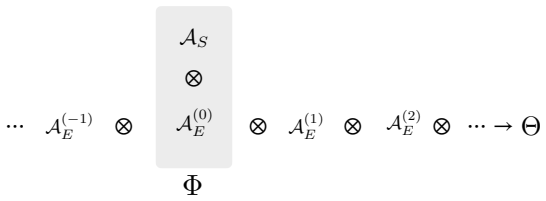
The central object is the collisional model on the algebra $A_S\otimes A_E$, where a completely positive unital map $\Phi[O_S\otimes A_{i_0}]=\sum_i \phi_i[O_S]\otimes \Pi_i A_{i_0}\Pi_i$ acts at site $0$ and is followed by a right shift $\Theta$ along the infinite chain. The reduced dynamics is $\Lambda_n[\rho_S]=\sum_{i[1,n]}p_{i[1,n]}\phi^{\ddagger}_{i[1,n]}[\rho_S]$, with Pauli eigenvalues $\lambda_n^{(j)}$ obeying recurrences (24) and (25). The load-bearing step is the intertwiner $\Lambda_{n,n-1}=\Lambda_n\circ\Lambda_{n-1}^{-1}$: P-divisibility of one qubit is equivalent to $|\lambda_{n,n-1}^{(j)}|\le 1$, while positivity of $\Lambda_{n,n-1}\otimes\Lambda_{n,n-1}$ is decided by acting on $P_+^2$ and checking the Choi condition (B17). The algebraic formulation also gives the system-environment mutual information, whose decrease with time provides the stated physical interpretation of SBFI.
What would settle it
One can settle the discrete-time claim by searching, for $r=0$ and $Q>1/2$, for two-qubit density matrices $\rho$ and $\sigma$ such that $\Lambda_n^{-1}\otimes\Lambda_n^{-1}[\mu\rho-(1-\mu)\sigma]$ is the non-contracting direction growing under the intertwiner; if no such Helstrom pair exists at any finite $n$, the norm increase would be unphysical.
Extended reading notes
Core claim
In the collision model with Pauli maps $\phi_k[\sigma_j]=\varphi^{1-\delta_{jk}}\sigma_j$, $\varphi=-1$, a four-state Markov chain with transition matrix carrying nearest-neighbour correlation $\Delta$, invariant probabilities $(p_0,2p,r)$, and $r=0$, the single-qubit dynamics $\Lambda_n$ is P-divisible for all $0\le p\ll 1$. The two-qubit dynamics $\Lambda_n\otimes\Lambda_n$ is P-divisible at leading order only if $Q=\Delta/p\le 1/2$. For $Q>1/2$, the intertwined step $\Lambda_{n,n-1}\otimes\Lambda_{n,n-1}$ fails to be positive: applied to the totally symmetric projector $P_+^2$ it gives trace-norm excess $4p^2(2Q-1)>0$. Because $\Lambda_n\otimes\Lambda_n$ is invertible, the authors conclude that the collisional dynamics of two qubits exhibits SBFI, with a suitably constructed Helstrom pair as witness. The same mechanism appears in a stroboscopic continuous-time limit whose generator has one negative rate, and the authors prove a general bound relating the Helstrom-norm increase to the discord of the Helstrom ensemble.
Load-bearing premise
The two-qubit backflow conclusion rests on the assumption that the non-contracting Hermitian matrix produced by $\Lambda_{n,n-1}\otimes\Lambda_{n,n-1}$ can always be reached from a genuine pair of two-qubit states; the discrete-time paper asserts this through invertibility rather than constructing the pair.
Editorial extensions
If this is right
- If the central claim is correct, P-divisibility of a single-qubit dynamics no longer rules out memory effects once tensor products are considered; each bipartite extension must be checked separately.
- Environment correlations become a quantitative resource: in the unitary model, SBFI appears exactly when $Q=\Delta/p>1/2$, so the threshold can be compared with other collision models.
- The decrease of system-environment mutual information during SBFI gives a concrete direction of information flow: correlations with the chain are consumed to build two-qubit correlations.
- The continuous-time limit with a negative Pauli rate shows that the discrete-time mechanism is not an artefact of stroboscopic time, and connects the model to the familiar eternally non-Markovian evolution.
- Because separable Helstrom ensembles suffice, experiments looking for SBFI do not need entangled probes, only ensembles whose quantum-classical state has nonzero discord.
Reading between the lines
- The same algebraic collision framework could be used to test longer-range or multi-site chain correlations, which may lower the threshold for SBFI or change the divisibility hierarchy.
- Because the environment is classical and stationary while the system is quantum, the model offers a controlled setting to separate information genuinely released to the system from information merely reshuffled among classical degrees of freedom.
- The discord-based bound in Proposition 4 suggests a family of monotonicity inequalities: any measure of ensemble quantumness that is non-increasing under local operations would provide analogous upper bounds for other multipartite Helstrom witnesses.
- A direct numerical scan over two-qubit states in the discrete-time regime with $Q>1/2$ would produce an explicit Helstrom pair and turn the norm inequality into a ready-to-run experimental witness.
Editorial analysis
A structured set of objections, weighed in public.
Referee Report
Summary. The paper proposes a collisional model in which two open qubits each interact with an independent but identically prepared classical Markov chain environment. The reduced single-qubit dynamics is shown to be P-divisible for a range of parameters, while the two-qubit tensor-product dynamics is claimed to exhibit superactivation of backflow of information (SBFI). The authors derive explicit recurrences for the Pauli eigenvalues (Proposition 2), give necessary and sufficient conditions for P-, CP-, and tensor-power-P-divisibility (Proposition 3), and interpret the effect through system-chain mutual information. A continuous-time stroboscopic limit is also analyzed, and a general bound relating SBFI to the quantumness of the Helstrom ensemble is proved (Proposition 4). The paper concludes with an explicit construction intended to show that SBFI does not require entanglement.
Significance. If the SBFI claim is fully established, the paper provides a valuable microscopic model of superactivation with a classical environment, backed by analytic divisibility conditions and mutual information calculations. The derivations of the eigenvalue recurrences and divisibility thresholds are self-contained and detailed, and the proposed physical interpretation in terms of system-environment correlations is clearly articulated. The bound in Proposition 4 is a useful general result connecting SBFI to the quantumness of the Helstrom ensemble. The paper also makes a conceptual contribution by providing a classical-environment realization of a phenomenon previously studied mainly through abstract arguments.
major comments (3)
- [§2.1.1] The inference from non-contractivity of the intertwiner Λ_{n,n−1}⊗Λ_{n,n−1} to the existence of SBFI is not justified as written. The operator P_+^2 on which non-contractivity is demonstrated is positive semidefinite, so it is not a valid Helstrom matrix for any μ∈(0,1); a Helstrom matrix must have both positive and negative spectral parts unless μ=1, in which case the distinguishability is trivially constant. Invertibility of Λ_n only guarantees a Hermitian preimage under Λ_{n−1}⊗Λ_{n−1}, but it does not ensure that this preimage can be written as μρ−(1−μ)σ for physical states ρ,σ. The paper should either construct an explicit two-qubit Helstrom pair whose distinguishability increases between times n−1 and n, or provide a rigorous existence argument that the non-contractive direction can be chosen within the set of Helstrom matrices.
- [Appendix F] The stated bias μ(a)=a/(1−a) does not make Λ_s⊗Λ_s[Δ_μ(a)] proportional to P_+^2. Solving the condition that the identity component vanishes in μ(a)ρ_a − (1−μ(a))I/4 gives μ(a)=1/(2−a), not a/(1−a). With the value printed in the paper, an identity component survives, so the subsequent norm-increase calculation (F10) does not follow. The construction appears repairable by replacing μ(a) with 1/(2−a), but as written the explicit witness without entanglement is incorrect.
- [§2.1.1 and Appendix B] The small-p expansion leading to the conclusion that Λ_{n,n−1} is contractive for a single qubit is stated without giving the explicit coefficients K_1 and K_2(Δ). Since the central claim requires contractivity for all time steps n, the uniformity of the remainder o(p^2) in n should be made precise; otherwise the claim that there is no single-qubit BFI in the regime 0≤Δ≤p≪1 rests on an uncontrolled truncation. This issue is secondary to the missing Helstrom witness but still needs attention for a complete proof.
minor comments (5)
- [Eq. (17)] The composition order in the definition of ϕ‡_{i[1,n]} should be clarified; the text writes ϕ‡_{i[1,n]} = ϕ‡_{i_n}⋯ϕ‡_{i_1}, which may be ambiguous about the order of application.
- [Eq. (19)] The exponent φ1−δjk is typographically ambiguous; it should be written as φ^{1−δ_{jk}} to avoid confusion with a product of φ and an index.
- [Section 2.1.1] After Eq. (41), the statement 'λ1 = λ2 = α' relies on the specific choice Δ=(1−2p)/2; this is correct but would benefit from a brief derivation to help the reader, since the formula for λ_2 in (32) is not immediately transparent.
- [Appendix D] The stroboscopic limit sends p→1/2 and r→0, which makes p0=0; the resulting transition matrix in Eq. (E3) has zero rows for states 1 and 4. This is consistent with the invariant distribution but could be mentioned explicitly to avoid the impression of a non-stochastic matrix.
- [Numerous places] There are several typographical errors and inconsistent notations, e.g., 'µ(j) k = φ1−δjk' in (19) and the use of both Λ_{n,n−1} and Λ_{n−1,n} to denote intertwiners. A careful proofreading pass is recommended.
Circularity Check
No significant circularity: the SBFI threshold and divisibility conditions are derived from the Markov-chain model; self-citations [13,14] are framing only. Appendix F contains a parameter error, but that is a correctness issue, not circularity.
full rationale
The central derivation is self-contained. Proposition 2, Proposition 3, and the perturbative analysis in Section 2.1.1 compute the single- and two-qubit Pauli eigenvalues directly from the transition matrix (22) and the Pauli ansatz (19); no parameter is fitted and then renamed as a prediction. The step from non-positivity of Lambda_{n,n-1} tensor Lambda_{n,n-1} to SBFI is the standard invertibility-plus-rescaling argument: any Hermitian operator on which the intertwiner increases the trace norm can be scaled down to a valid Helstrom matrix, so the paper's terse statement that being Lambda_n tensor Lambda_n invertible certainly exhibits SBFI does not reduce to its own input. The self-citations [13,14] frame the phenomenon and supply the external theorem that invertible P-divisible non-CP maps have non-P tensor powers; that theorem is parameter-free and its assumptions do not include this collision model, so it constitutes independent support rather than load-bearing circularity. The apparent error in Appendix F, where the stated bias mu(a)=a/(1-a) does not make Lambda_s tensor Lambda_s[Delta_mu(a)] proportional to P+2 (mu=1/(2-a) would), is a genuine correctness gap in an illustrative explicit witness, but it concerns the proof of a physical-state construction, not the logical equivalence of the claim to its inputs. No uniqueness theorem is imported from the authors' prior work to force the model choice, and no fitted input is later presented as a prediction. Therefore the paper has no significant circularity, with only a minor deduction for reliance on the authors' own prior framework in the presentation.
Assumptions & free parameters
free parameters (6)
- p =
0 <= p <= 1/2; small-p limit (e.g., p = 1/4 + epsilon)
- Delta =
0 <= Delta <= p; Q = Delta/p
- r =
r = 0 in main examples
- phi =
phi = -1 (unitary) or phi = exp(-2 gamma tau) (dissipative)
- kappa =
kappa >= 0; kappa = 0 for eternally non-Markovian case
- gamma, tau =
gamma > 0, tau > 0
assumptions (7)
- standard math Standard CPTP map, divisibility, and trace-norm contractivity theory for open quantum systems.
- domain assumption The environment is a commutative quantum spin chain with a stationary Markov-chain state, Eqs. (11) and (12).
- ad hoc to paper The system-environment coupling has the unital Pauli controlled form in Eqs. (13) and (19).
- domain assumption Initial system-environment state is factorized and the environment state is shift-invariant.
- standard math Theorem of Benatti-Filippov [13]: for invertible P-divisible but not CP-divisible maps, the tensor square is not P-divisible and shows SBFI.
- standard math Criterion [45]: for qubit Pauli maps, Lambda tensor Lambda is positive iff Lambda^2 is completely positive.
- ad hoc to paper Specific parameter choices p = 1/4 + epsilon, r = 0, Delta = (1 - 2p)/2 for the entropy example.
Cite this review
Pith. "Pith review of Superactivation of memory effects in a classical Markov environment." pith.science (2026). https://pith.science/paper/VZPCAGJE
@misc{pith2026241117396,
  author       = {Pith},
  title        = {Pith review of: Superactivation of memory effects in a classical Markov environment},
  year         = {2026},
  howpublished = {\url{https://pith.science/paper/VZPCAGJE}},
  note         = {Machine review of arXiv:2411.17396}
}
read the original abstract
We investigate a phenomenon known as Superactivation of Backflow of Information (SBFI); namely, the fact that the tensor product of a non-Markovian dynamics with itself exhibits Backflow of Information (BFI) from environment to system even if the single dynamics does not. Such an effect is witnessed by the non-monotonic behaviour of the Helstrom norm and emerges in the open dynamics of two independent, but statistically coupled, parties. We physically interpret SBFI by means of the discrete-time non-Markovian dynamics of two open qubits collisionally coupled to an environment described by a classical Markov chain. In such a scenario SBFI can be ascribed to the decrease of the qubit-qubit-environment correlations in favour of those of the two qubits, only. We further prove that the same mechanism at the roots of SBFI also holds in a suitable continuous-time limit. We also show that SBFI does not require entanglement to be witnessed, but only the quantumness of the Helstrom ensemble.
Figures

Reference graph
Works this paper leans on
-
[1]
Dynamical maps beyond Markovian regime
D. Chruściński. “Dynamical maps beyond Markovian regime”. In: Physics Reports 992 (2022), pp. 1–85.doi: 10.1016/j.physrep.2022.09.003
-
[2]
Concepts of quantum non-Markovianity: A hierar- chy
L. Li, M. J. Hall, and H. M. Wiseman. “Concepts of quantum non-Markovianity: A hierar- chy”. In:Physics Reports759 (2018), pp. 1–51.doi: 10.1016/j.physrep.2018.07.001
-
[3]
EntanglementandNon-MarkovianityofQuantum Evolutions
Á.Rivas, S.F.Huelga, andM.B.Plenio.“EntanglementandNon-MarkovianityofQuantum Evolutions”. In:Phys. Rev. Lett.105 (5 July 2010), p. 050403.doi: 10.1103/PhysRevLett. 105.050403
-
[4]
Assessing Non-Markovian Quantum Dynamics
M. M. Wolf et al. “Assessing Non-Markovian Quantum Dynamics”. In:Phys. Rev. Lett. 101.15 (Oct. 2008), p. 150402.doi: 10.1103/PhysRevLett.101.150402
-
[5]
Measure for the Degree of Non-Markovian Behavior of Quantum Processes in Open Systems
H.-P. Breuer, E.-M. Laine, and J. Piilo. “Measure for the Degree of Non-Markovian Behavior of Quantum Processes in Open Systems”. In:Phys. Rev. Lett.103 (21 Nov. 2009), p. 210401. doi: 10.1103/PhysRevLett.103.210401
-
[6]
Dynamical role of system-environment correlations in non-Markovian dynamics
L. Mazzola et al. “Dynamical role of system-environment correlations in non-Markovian dynamics”. In: Phys. Rev. A 86 (1 July 2012), p. 010102. doi: 10.1103/PhysRevA.86. 010102
-
[7]
Witness for Initial System-Environment Correla- tions in Open-System Dynamics
E.-M. Laine, J. Piilo, and H.-P. Breuer. “Witness for Initial System-Environment Correla- tions in Open-System Dynamics”. In:Europhysics Letters92.6 (Jan. 2011), p. 60010.doi: 10.1209/0295-5075/92/60010. 24
-
[8]
Entropic bounds on information backflow
N. Megier, A. Smirne, and B. Vacchini. “Entropic bounds on information backflow”. In: Phys. Rev. Lett.127.3 (2021), p. 030401.doi: 10.1103/PhysRevLett.127.030401
Show all 45 references
-
[9]
Holevo skew divergence for the characterization of information backflow
A. Smirne, N. Megier, and B. Vacchini. “Holevo skew divergence for the characterization of information backflow”. In:Phys. Rev. A106 (1 July 2022), p. 012205.doi: 10.1103/ PhysRevA.106.012205
2022
-
[10]
Mixing-induced quantum non-Markovianity and information flow
H.-P. Breuer, G. Amato, and B. Vacchini. “Mixing-induced quantum non-Markovianity and information flow”. In:New Journal of Physics20.4 (Apr. 2018), p. 043007.doi: 10.1088/ 1367-2630/aab2f9
2018
-
[11]
Degree of Non-Markovianity of Quantum Evolution
D. Chruściński and S. Maniscalco. “Degree of Non-Markovianity of Quantum Evolution”. In: Phys. Rev. Lett.112 (12 Mar. 2014), p. 120404.doi: PhysRevLett.112.120404
2014
-
[12]
Generalized trace-distance measure connecting quantum and classical non-Markovianity
S. Wißmann, H.-P. Breuer, and B. Vacchini. “Generalized trace-distance measure connecting quantum and classical non-Markovianity”. In:Phys. Rev. A92 (4 Oct. 2015), p. 042108
2015
-
[13]
Tensorpowerofdynamicalmapsandpositiveversuscompletely positive divisibility
F.Benatti, andS.Filippov.“Tensorpowerofdynamicalmapsandpositiveversuscompletely positive divisibility”. In:Phys. Rev. A95 (1 2017), p. 012112.doi: 10.1103/PhysRevA.95. 012112
2017 doi
-
[14]
Open Quantum Dynamics: Memory Effects and Superactivation of Backflow of Information
F. Benatti and G. Nichele. “Open Quantum Dynamics: Memory Effects and Superactivation of Backflow of Information”. In:Mathematics 12.1 (1 2023), p. 37.doi: math12010037
2023
-
[15]
Eternal non-Markovianity: from random unitary to Markov chain realisa- tions
N. Megier et al. “Eternal non-Markovianity: from random unitary to Markov chain realisa- tions”. In: Scientific reports7.1 (1 2017), p. 6379.doi: 10.1038/s41598-017-06059-5
2017 doi
-
[16]
Revival of quantum correlations without system-environment back- action
R. Lo Franco et al. “Revival of quantum correlations without system-environment back- action”. In: Physical Review A—Atomic, Molecular, and Optical Physics85.3 (1 2012), p. 032318. doi: 10.1103/PhysRevA.85.032318
2012 doi
- [17]
-
[18]
Information backflow may not indicate quantum memory
M. Banacki et al. “Information backflow may not indicate quantum memory”. In:Phys. Rev. A107.3 (1 2023), p. 032202.doi: 10.1103/PhysRevA.106.012205
2023 doi
-
[19]
Local disclosure of quantum memory in non- Markovian dynamics
C. Bäcker, K. Beyer, and W. T. Strunz. “Local disclosure of quantum memory in non- Markovian dynamics”. In: Physical Review Letters 132.6 (1 2024), p. 060402. doi: 10. 1103/PhysRevLett.132.060402
2024
-
[20]
Quantum collision models: Open system dynamics from repeated in- teractions
F. Ciccarello et al. “Quantum collision models: Open system dynamics from repeated in- teractions”. In: Physics Reports 954 (1 2022), pp. 1–70.doi: 10.1016/j.physrep.2022. 01.001
2022 doi
-
[21]
Collision Models in Open System Dynamics: A Versatile Tool for Deeper Insights?
S. Campbell and B. Vacchini. “Collision Models in Open System Dynamics: A Versatile Tool for Deeper Insights?” In: Europhysics Letters 133.6 (1 May 2021), p. 60001. doi: 10.1209/0295-5075/133/60001
2021 doi
-
[22]
Collision model for non-Markovian quantum dynamics
S. Kretschmer, K. Luoma, and W. T. Strunz. “Collision model for non-Markovian quantum dynamics”. In: Physical Review A94.1 (1 2016), p. 012106.doi: 10.1103/PhysRevA.94. 012106
2016 doi
-
[23]
Divisibility of quantum dynamical maps and collision models
S. N. Filippov et al. “Divisibility of quantum dynamical maps and collision models”. In: Phys. Rev. A96 (3 Sept. 2017), p. 032111.doi: 10.1103/PhysRevA.96.032111. 25
2017 doi
-
[24]
Multipartite correlations in quantum collision models
S. Filippov. “Multipartite correlations in quantum collision models”. In:Entropy 24.4 (1 2022), p. 508.doi: 10.3390/e24040508
2022 doi
-
[25]
A scattering theory for Markov chains
B. Kümmerer and H. Maassen. “A scattering theory for Markov chains”. In:Infinite Di- mensional Analysis, Quantum Probability and Related Topics3.01 (1 2000), pp. 161–176. doi: 10.1142/S0219025700000091
-
[26]
Simulation of Indivisible Qubit Channels in Collision Models
T. Rybár et al. “Simulation of Indivisible Qubit Channels in Collision Models”. In:Journal of Physics B: Atomic, Molecular and Optical Physics45.15 (1 Aug. 2012), p. 154006.doi: 10.1088/0953-4075/45/15/154006
2012 doi
-
[27]
Environmental correlations and Markovian to non-Markovian transitions in collisional models
N. K. Bernardes et al. “Environmental correlations and Markovian to non-Markovian transitions in collisional models”. In: Phys. Rev. A 90 (3 Sept. 2014), p. 032111. doi: 10.1103/PhysRevA.90.032111
2014 doi
-
[28]
Bratteli and D
O. Bratteli and D. W. Robinson.Operator Algebras and Quantum Statistical Mechanics 1. Vol. 95. Berlin, Heidelberg: Springer, 1987, p. 012112.doi: 10.1007/978-3-662-02520-8
1987 doi
-
[29]
Unitarity, feedback, interactions—dynamics emergent from repeated measurements
N. Altamirano et al. “Unitarity, feedback, interactions—dynamics emergent from repeated measurements”. In: New Journal of Physics 19.1 (1 2017), p. 013035. doi: 10.1088/ 1367-2630/aa551b
2017
-
[30]
P. M. Alberti and A. Uhlmann.Stochasticity and partial order. Vol. 95. Deutscher Verlag der Wissenschaften Berlin, 1982, p. 012112.doi: 10.1007/BF00419927
1982 doi
-
[31]
Characterizing the dynamical semigroups that do not de- crease a quantum entropy
P. Aniello and D. Chruściński. “Characterizing the dynamical semigroups that do not de- crease a quantum entropy”. In:Journal of Physics A: Mathematical and Theoretical49.34 (1 2016), p. 345301.doi: 10.1088/1751-8113/49/34/345301
2016 doi
-
[32]
Monotonicity of the Quantum Relative Entropy Un- der Positive Maps
A. Müller-Hermes and D. Reeb. “Monotonicity of the Quantum Relative Entropy Un- der Positive Maps”. In: Ann. Henri Poincaré 95 (18 2017), 1777–1788. doi: 10.1007/ s00023-017-0550-9
2017
-
[33]
Canonical form of master equations and characterization of non- Markovianity
M. J. W. Hall et al. “Canonical form of master equations and characterization of non- Markovianity”. In:Phys. Rev. A89 (4 Apr. 2014), p. 042120.doi: 10.1103/PhysRevA.89. 042120
2014 doi
-
[34]
Colloquium: non-Markovian dynamics in open quantum systems
H.-P. Breuer et al. “Colloquium: non-Markovian dynamics in open quantum systems”. In: Rev. Mod. Phys.88 (2 Apr. 2016), p. 021002.doi: 10.1103/RevModPhys.88.021002
2016 doi
- [35]
-
[36]
How quantum is a quantum ensemble?
S. Luo, N. Li, and W. Sun. “How quantum is a quantum ensemble?” In:Quantum Infor- mation Processing9 (1 2010), pp. 711–726.doi: 10.1007/s11128-010-0162-5
2010 doi
-
[37]
Quantumness of quantum ensembles
S. Luo, N. Li, and S. Fu. “Quantumness of quantum ensembles”. In:Theoretical and Math- ematical Physics169 (1 2011), pp. 1724–1739.doi: 10.1007/s11232-011-0147-2
2011 doi
-
[38]
Measures and applications of quantum correlations
G. Adesso, T. R. Bromley, and M. Cianciaruso. “Measures and applications of quantum correlations”. In: Journal of Physics A: Mathematical and Theoretical49.47 (1 2016), p. 473001. doi: 10.1088/1751-8113/49/47/473001
2016 doi
-
[39]
Quantumness of Correlations, Quantum- ness of Ensembles and Quantum Data Hiding
M. Piani, V. Narasimhachar, and J. Calsamiglia. “Quantumness of Correlations, Quantum- ness of Ensembles and Quantum Data Hiding”. In:New Journal of Physics16.11 (1 Oct. 2014), p. 113001.doi: 10.1088/1367-2630/16/11/113001. 26
2014 doi
-
[40]
J. Watrous. The Theory of Quantum Information. Vol. 95. Cambridge University Press, 2018, p. 012112.doi: 10.1017/9781316848142
2018 doi
-
[41]
Precursors of non-Markovianity
S. Campbell et al. “Precursors of non-Markovianity”. In:New Journal of Physics21.5 (1 2019), p. 053036.doi: 10.1088/1367-2630/ab1ed6
2019 doi
-
[42]
Equivalence between divisibility and monotonic decrease of information in classical and quantum stochastic processes
F. Buscemi and N. Datta. “Equivalence between divisibility and monotonic decrease of information in classical and quantum stochastic processes”. In:Phys. Rev. A93 (1 Jan. 2016), p. 012101.doi: 10.1103/PhysRevA.93.012101
2016 doi
-
[43]
Constructive method for detecting the information backflow of non-Markovian dynamics
B. Bylicka, M. Johansson, and A. Acin. “Constructive method for detecting the information backflow of non-Markovian dynamics”. In:Phys. Rev. Lett.118.12 (1 2017), p. 120501.doi: 10.1103/PhysRevLett.118.120501
2017 doi
-
[44]
C-Finite Sequences
M. Kauers and P. Paule. “C-Finite Sequences”. In: The Concrete Tetrahedron: Sym- bolic Sums, Recurrence Equations, Generating Functions, Asymptotic Estimates. Vol. 95. Springer Vienna, 2011, p. 012112.doi: 10.1007/978-3-7091-0445-3_4
2011 doi
-
[45]
Positive Tensor Products of Maps and N-Tensor-Stable Positive Qubit Maps
S. N. Filippov and K. Y. Magadov. “Positive Tensor Products of Maps and N-Tensor-Stable Positive Qubit Maps”. In:Journal of Physics A: Mathematical and Theoretical50.5 (1 Jan. 2017), p. 055301.doi: 10.1088/1751-8121/aa5301. 27
2017 doi
Reviewed August 12, 2026 · model on record in the stance chip above.
Discussion (0). Continue with ORCID to comment.