REVIEW 3 major objections 5 minor 28 references
Learning-Based On-Track System Identification for Scaled Autonomous Racing in Under a Minute
T0 review · 3 major / 5 minor · reviewed 2026-08-12 · deepseek-v4-flash
Pith's one-line read This paper claims that a race car's tire model can be identified on the track in under a minute from 30 seconds of driving data and 3 seconds of neural-network training.
desk verdict A practical hybrid NN+Pacejka identification loop that mostly works, with one unverified steady-state assumption in the virtual data generation. read the letter →
The pith
A machine-rendered reading of the paper's core claim, the machinery that carries it, and where it could break.
The reading
What carries the argument
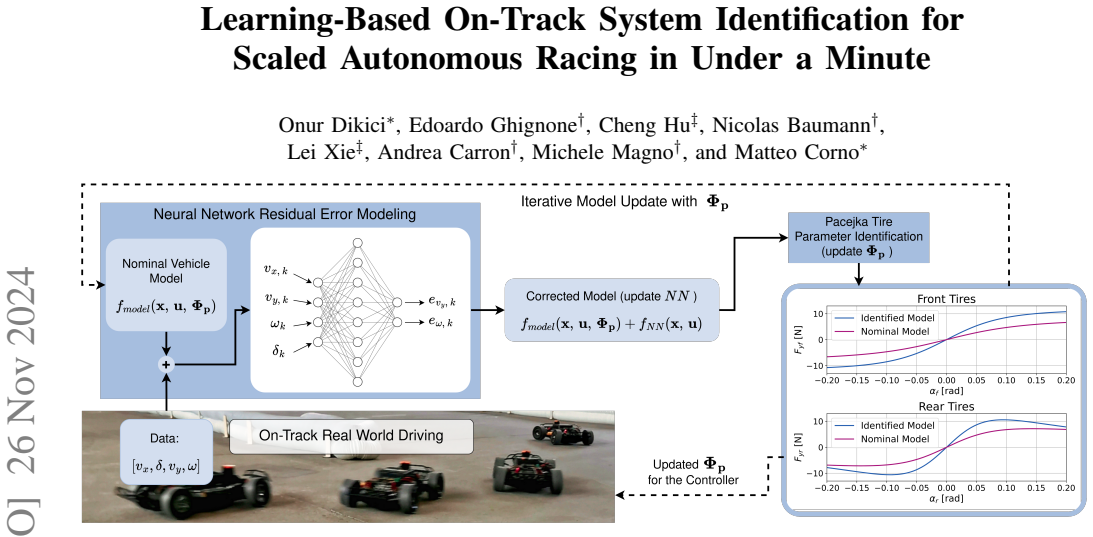
The method's load-bearing mechanism is the iterated corrected vehicle model: a nominal single-track vehicle model with the Pacejka Magic Formula (an empirical tire-force curve $F_y = D\sin(C\arctan(B\alpha - E(B\alpha - \arctan(B\alpha))))$) combined with a feed-forward neural network of 58 parameters that predicts the one-step residual error $e_k = x_{k+1} - \hat{x}_{k+1}$. The corrected model is simulated in a virtual steady-state maneuver at constant speed with steering angle ramping from 0 to 0.4 radians, and the steady-state assumption $\dot{v}_y = 0$, $\dot{\omega} = 0$ lets the lateral forces be read off from the states, so the Pacejka parameters can be refit by least squares. Repeating the loop — new nominal parameters, new residual network, new virtual steady-state fit — is what transfers the on-track dynamic data into a traditional identification problem while keeping the neural network operating in-distribution.
What would settle it
In simulation with known ground-truth Pacejka parameters, train the residual network only on data from a trajectory with a restricted slip-angle range, then generate the virtual steady-state ramp and compare recovered $B$ and $C$ parameters to the ground truth; systematic bias as the training range narrows would confirm that the virtual manifold goes out-of-distribution and that the recovered parameters do not reflect the true tire.
Extended reading notes
Core claim
The central discovery is that combining a neural-network residual corrector with classical steady-state identification lets you recover tire parameters on a race track from a short, unscripted data collection. The neural network, trained on prediction errors of a nominal model, is used to simulate a virtual steady-state maneuver — a linearly increasing steering angle at constant speed — and the resulting force-slip-angle pairs are fed to a least-squares fit of the Pacejka Magic Formula. Reinitializing the nominal model with each newly identified parameter set and repeating the process removes the need for an accurate initial model and prevents the neural network from overfitting to a particular dynamic regime. The result, shown on a 1:10 scaled vehicle, is a tire model with accuracy comparable to the established steady-state identification procedure, achieved in roughly 33 seconds total and robust to the measurement noise that makes classical on-track nonlinear least squares fail.
Load-bearing premise
The neural network, trained on dynamic driving data, must also be accurate on the virtual steady-state trajectory (constant speed, linearly increasing steering) used to extract the Pacejka parameters; if it extrapolates poorly there, the identified parameters are biased even when the corrected model predicts well on the training distribution.
Editorial extensions
If this is right
- Tire models can be identified directly on a race track with a model-free Pure Pursuit controller, removing the need for dedicated steady-state experiments in large open spaces.
- The method's robustness to noise (3.3x lower one-step RMSE than NLS in simulation) makes on-track identification viable under real-world measurement noise where classical NLS fails.
- With 30 seconds of data and 3 seconds of training, the approach is fast enough to adapt mid-session to changing tire conditions, as shown by the hard-to-soft tire adaptation in about 1 second.
- The identified Pacejka models support a model-based lateral controller that achieves competitive lap times and low deviation, matching the performance of models from the steady-state gold-standard baseline.
- Because the procedure is data-driven and does not require prior parameters, it can be applied to a new track or surface without re-calibration experiments.
Reading between the lines
- The virtual steady-state ramp is generated at the average longitudinal speed of the training data, so the identified parameters may be biased if tire behavior varies strongly with speed; testing on a track with heterogeneous speed profiles would probe this.
- The paper does not quantify the distribution shift between the dynamic training data and the virtual steady-state manifold; an explicit diagnostic comparing NN prediction error on the virtual ramp vs. held-out dynamic data would show how much trust to place in the simulated steady-state points.
- The iterative update of both the Pacejka parameters and the neural network suggests a family of hybrid system-identification schemes; one testable extension is replacing the fixed six-iteration schedule with a stopping rule based on the residual decrease between iterations.
- The same residual-correction-plus-virtual-data loop could be transferred to other physical systems (e.g., aerial or marine robots) whose nominal models have a parametric core and a residual error, as long as a cheap virtual steady-state manifold can be simulated.
Editorial analysis
A structured set of objections, weighed in public.
Referee Report
Summary. The paper presents an iterative on-track system identification algorithm for a scaled autonomous race car (F1TENTH). A neural network is trained to predict residual errors of a nominal dynamic single-track vehicle model with Pacejka tire model from data collected with a Pure Pursuit controller. The NN-corrected model is then simulated under a virtual constant-speed, ramped-steering scenario; the resulting data are treated as steady-state, and Pacejka parameters are refit using equilibrium force equations. The process is repeated, taking about 3 seconds for six iterations on 30 seconds of driving data. The authors report simulation results showing robustness to artificial Gaussian noise (10 repeated trials) and real-world experiments where the identified model matches a steady-state identification baseline and enables similar lap times, while a nonlinear least-squares baseline fails in closed loop.
Significance. The proposed method addresses a practical problem: obtaining tire parameters for model-based controllers without dedicated steady-state experiments in large open spaces. The iterative combination of a residual NN and a physical model is a promising way to leverage the expressiveness of ML while retaining the interpretability of a Pacejka model. The paper includes open-source code, repeated simulation trials, and real hardware validation on an F1TENTH platform, which are strengths. If the virtual steady-state generation is verified as sound, the method would be a valuable contribution to scaled autonomous racing and potentially to other robotic platforms.
major comments (3)
- [Section III.E.2-III.E.3] The virtual steady-state data generation is never verified to actually produce steady-state trajectories. The paper simulates the NN-corrected model at constant vx with a linearly ramped steering angle, then applies the equilibrium equations (8) that assume ˙vy = 0 and ˙ω = 0. The NN was trained on one-step prediction errors from dynamic Pure Pursuit data, and multi-step recursive rollout on the virtual ramp is a different input distribution. If the simulated trajectory has non-negligible ˙vy or ˙ω, the force–slip points used in the Pacejka fit do not correspond to true lateral forces, and the identified parameters are biased. Please quantify the residuals from equilibrium along the virtual trajectory (e.g., max and RMS of |˙vy| and |˙ω|) and, ideally, compare the virtual curve against a true steady-state solution of the final corrected model over the applicable slip range.
- [Section IV.D / Table I] The real-world validation rests on a single run per method, with no error bars or repeated trials. Since the simulation study uses 10 repeats, the claim that the proposed approach achieves comparable accuracy to steady-state identification should be supported by multiple real-world trials or at least a sensitivity analysis over initializations or data splits. The single 'N.C.' entry for NLS also requires a precise definition of the failure criterion and the number of attempts.
- [Section V] The paper admits in the Conclusions that the one-step prediction RMSE 'has proven to be not entirely indicative of Pacejka parameters identification performance.' This undermines the use of one-step RMSE as the primary quantitative comparison against NLS in Section IV.C. Please connect the reported RMSE improvements to the quality of the identified Pacejka model, or augment the simulation study with metrics that directly assess the fitted force–slip curves or closed-loop performance.
minor comments (5)
- [Abstract / Section I] The phrase 'without prior knowledge' is stronger than what the algorithm actually requires; a nominal single-track model and initial Pacejka parameters are still needed (Sections III.A and III.F). Please rephrase to 'without an accurate initial model' or similar.
- [Section III.E.2] Please report the average longitudinal velocity used for virtual data generation and discuss its relation to the real-world steady-state experiments (2–3 m/s), since the identified tire parameters may be sensitive to this choice.
- [Section III.F] The convergence criterion 'further iterations do not yield significant improvements' is not quantified. Please provide a quantitative stopping rule or show the per-iteration change in the identified parameters.
- [Section IV.C.2] The 3.3x RMSE improvement is stated after averaging performance across vy and ω; please report the individual RMSE values and define the averaging procedure to make the comparison reproducible.
- [Figure 6] The color gradient in the left subplots is described as 'shades of blue' but not linked to iteration numbers; a colorbar or explicit iteration labels would improve readability.
Circularity Check
No significant circularity: the Pacejka identification is validated against held-out data and closed-loop lap times, and the NN-to-Pacejka distillation is an extrapolation assumption rather than a definitional loop.
full rationale
The derivation chain is not circular. The NN is trained on one-step residual errors ek = x_{k+1} − x̂_{k+1} (Eq. 5) computed from real on-track data collected with a model-free Pure Pursuit controller. The corrected model (Eq. 7) is simulated under a virtual ramp-steering maneuver (Section III.E.2), and Pacejka parameters are fitted to force-slip points obtained from the equilibrium equations (8). The final Pacejka model is not identical to the NN or to the nominal model by construction; it is an indirect parametric distillation whose accuracy is checked on a separate test run (one-step RMSE, Section IV.B.1) and in closed-loop MAP-controller lap performance (Table I). The main risk is the steady-state assumption in Section III.E.2: the NN-corrected rollout may not actually lie on the steady-state manifold, and the paper does not quantify v̇y or ω̇ along the virtual trajectory. That is a distribution-shift/extrapolation concern about the validity of the identified parameters, not a circular reduction of the result to its inputs. Self-references to [1] and [4] concern the open-source race stack and the evaluation controller and are not load-bearing for the identification claim. The paper's own admission that the RMSE metric is 'not entirely indicative of Pacejka parameters identification performance' (Section V) is a correctness caveat, not evidence of circularity.
Assumptions & free parameters
free parameters (4)
- Initial nominal Pacejka parameters =
Not specified
- Neural network architecture and learning rate =
MLP 4-8-2, LeakyReLU, Adam lr=5e-4
- Virtual steady-state simulation settings =
10 s, dt=0.02 s, steering ramp 0 to 0.4 rad, vx = mean training vx
- Number of iterations =
6
assumptions (4)
- domain assumption Single-track vehicle model with no load transfer and longitudinal/lateral decoupling
- domain assumption Pacejka Magic Formula is the correct tire model structure
- ad hoc to paper The NN's error predictions are valid when simulating the corrected model over the virtual trajectory
- ad hoc to paper The ramped steering simulation approximates steady-state conditions such that equations (8) hold
Cite this review
Pith. "Pith review of Learning-Based On-Track System Identification for Scaled Autonomous Racing in Under a Minute." pith.science (2026). https://pith.science/paper/NOM4W5MC
@misc{pith2026241117508,
  author       = {Pith},
  title        = {Pith review of: Learning-Based On-Track System Identification for Scaled Autonomous Racing in Under a Minute},
  year         = {2026},
  howpublished = {\url{https://pith.science/paper/NOM4W5MC}},
  note         = {Machine review of arXiv:2411.17508}
}
read the original abstract
Accurate tire modeling is crucial for optimizing autonomous racing vehicles, as state-of-the-art (SotA) model-based techniques rely on precise knowledge of the vehicle's parameters. Yet, system identification in dynamic racing conditions is challenging due to varying track and tire conditions. Traditional methods require extensive operational ranges, often impractical in racing scenarios. Machine learning (ML)-based methods, while improving performance, struggle with generalization and depend on accurate initialization. This paper introduces a novel on-track system identification algorithm, incorporating a neural network (NN) for error correction, which is then employed for traditional system identification with virtually generated data. Crucially, the process is iteratively reapplied, with tire parameters updated at each cycle, leading to notable improvements in accuracy in tests on a scaled vehicle. Experiments show that it is possible to learn a tire model without prior knowledge with only 30 seconds of driving data and 3 seconds of training time. This method demonstrates greater one-step prediction accuracy than the baseline nonlinear least squares (NLS) method under noisy conditions, achieving a 3.3x lower root mean square error (RMSE), and yields tire models with comparable accuracy to traditional steady-state system identification. Furthermore, unlike steady-state methods requiring large spaces and specific experimental setups, the proposed approach identifies tire parameters directly on a race track in dynamic racing environments.
Figures


Figures from the paper (3 more)


Reference graph
Works this paper leans on
-
[1]
N. Baumann, E. Ghignone, J. Kühne, N. Bastuck, J. Becker, N. Imholz, T. Kränzlin, T. Y . Lim, M. Lötscher, L. Schwarzenbach et al. , “Forzaeth race stack-scaled autonomous head-to-head racing on fully commercial off- the-shelf hardware,” arXiv preprint arXiv:2403.11784 , 2024
work page Pith review arXiv 2024
-
[2]
Autonomous vehicles on the edge: A survey on autonomous vehicle racing,
J. Betz, H. Zheng, A. Liniger, U. Rosolia, P. Karle, M. Behl, V . Krovi, and R. Mangharam, “Autonomous vehicles on the edge: A survey on autonomous vehicle racing,” IEEE Open Journal of Intelligent Transportation Systems, vol. 3, pp. 458–488, 2022
2022
-
[3]
H. B. Pacejka and E. Bakker, “The magic formula tyre model,” Vehicle system dynamics , vol. 21, no. S1, pp. 1–18, 1992
work page 1992
-
[4]
Model-and acceleration- based pursuit controller for high-performance au- tonomous racing,
J. Becker, N. Imholz, L. Schwarzenbach, E. Ghignone, N. Baumann, and M. Magno, “Model-and acceleration- based pursuit controller for high-performance au- tonomous racing,” in 2023 IEEE International Confer- ence on Robotics and Automation (ICRA) . IEEE, 2023, pp. 5276–5283
work page 2023
-
[5]
Learning model predictive control with error dynam- ics regression for autonomous racing,
H. Xue, E. L. Zhu, J. M. Dolan, and F. Borrelli, “Learning model predictive control with error dynam- ics regression for autonomous racing,” in 2024 IEEE International Conference on Robotics and Automation (ICRA), 2024, pp. 13 250–13 256
work page 2024
-
[6]
J. Chrosniak, J. Ning, and M. Behl, “Deep dynamics: Vehicle dynamics modeling with a physics-constrained neural network for autonomous racing,” IEEE Robotics and Automation Letters , vol. 9, no. 6, pp. 5292–5297, 2024
work page 2024
-
[7]
AMZ driverless: The full autonomous racing system,
J. Kabzan, M. I. Valls, V . J. F. Reijgwart, H. F. C. Hendrikx, C. Ehmke, M. Prajapat, A. Bühler, N. Gos- ala, M. Gupta, R. Sivanesan, A. Dhall, E. Chisari, N. Karnchanachari, S. Brits, M. Dangel, I. Sa, R. Dubé, A. Gawel, M. Pfeiffer, A. Liniger, J. Lygeros, and R. Siegwart, “AMZ driverless: The full autonomous racing system,” J. field robot., no. rob.21...
2020
-
[8]
Indy autonomous challenge – autonomous race cars at the handling limits,
A. Wischnewski, M. Geisslinger, J. Betz, T. Betz, F. Fent, A. Heilmeier, L. Hermansdorfer, T. Herrmann, S. Huch, P. Karle, F. Nobis, L. Ögretmen, M. Rowold, F. Sauerbeck, T. Stahl, R. Trauth, M. Lienkamp, and B. Lohmann, “Indy autonomous challenge – autonomous race cars at the handling limits,” 2022. [Online]. Available: https://arxiv.org/abs/2202.03807
arXiv 2022
Show all 28 references
-
[9]
Optimization- based autonomous racing of 1:43 scale rc cars,
A. Liniger, A. Domahidi, and M. Morari, “Optimization- based autonomous racing of 1:43 scale rc cars,” Optimal Control Applications and Methods , vol. 36, no. 5, p. 628–647, Jul 2014. [Online]. Available: http://dx.doi.org/10.1002/oca.2123
2014 doi
-
[10]
Analysis and control of high sideslip manoeuvres,
C. V oser, R. Y . Hindiyeh, and J. C. Gerdes, “Analysis and control of high sideslip manoeuvres,” Vehicle System Dynamics, vol. 48, no. sup1, pp. 317–336, 2010. [Online]. Available: https://doi.org/10.1080/00423111003746140
2010 doi
-
[11]
Motion planning and control for multi vehicle au- tonomous racing at high speeds,
A. Raji, A. Liniger, A. Giove, A. Toschi, N. Musiu, D. Morra, M. Verucchi, D. Caporale, and M. Bertogna, “Motion planning and control for multi vehicle au- tonomous racing at high speeds,” in 2022 IEEE 25th International Conference on Intelligent Transportation Systems (ITSC),...
2022
-
[12]
Model parameter identification via a hyperparameter optimization scheme for autonomous racing systems,
H. Seong, C. Chung, and D. H. Shim, “Model parameter identification via a hyperparameter optimization scheme for autonomous racing systems,” IEEE Control Systems Letters, vol. 7, pp. 1652–1657, 2023
2023
-
[13]
Rajamani, Vehicle Dynamics and Control , 01 2006
R. Rajamani, Vehicle Dynamics and Control , 01 2006
2006
-
[14]
Repetitive learning model predictive control: An au- tonomous racing example,
M. Brunner, U. Rosolia, J. Gonzales, and F. Borrelli, “Repetitive learning model predictive control: An au- tonomous racing example,” in 2017 IEEE 56th Annual Conference on Decision and Control (CDC) , 2017, pp. 2545–2550
2017
-
[15]
Optimization-based system identification and moving horizon estimation using low-cost sensors for a miniature car-like robot,
S. Bodmer, L. V ogel, S. Muntwiler, A. Hansson, T. Bodewig, J. Wahlen, M. N. Zeilinger, and A. Carron, “Optimization-based system identification and moving horizon estimation using low-cost sensors for a miniature car-like robot,” arXiv preprint arXiv:2404.08362 , 2024
2024 arXiv
-
[16]
Learning-based model predictive control for autonomous racing,
J. Kabzan, L. Hewing, A. Liniger, and M. N. Zeilinger, “Learning-based model predictive control for autonomous racing,” IEEE Robotics and Automation Letters , vol. 4, no. 4, pp. 3363–3370, 2019
2019
-
[17]
Linear system identification versus physical modeling of lateral–longitudinal vehicle dynamics,
B. A. H. Vicente, S. S. James, and S. R. Anderson, “Linear system identification versus physical modeling of lateral–longitudinal vehicle dynamics,” IEEE Trans- actions on Control Systems Technology , vol. 29, no. 3, pp. 1380–1387, 2021
2021
-
[18]
Bayesrace: Learning to race autonomously using prior experience,
A. Jain, M. O’Kelly, P. Chaudhari, and M. Morari, “Bayesrace: Learning to race autonomously using prior experience,” in Proceedings of the 2020 Conference on Robot Learning , ser. Proceedings of Machine Learning Research, J. Kober, F. Ramos, and C. Tomlin, Eds., vol. 155. PMLR...
2020
-
[19]
Ensemble gaussian processes for adaptive autonomous driving on multi-friction surfaces,
T. Nagy, A. Amine, T. X. Nghiem, U. Rosolia, Z. Zang, and R. Mangharam, “Ensemble gaussian processes for adaptive autonomous driving on multi-friction surfaces,” IFAC-PapersOnLine, vol. 56, no. 2, pp. 494–500, 2023, 22nd IFAC World Congress. [Online]. Available: https://www.sc...
2023
-
[20]
Cautious NMPC with gaussian process dynamics for miniature race cars,
L. Hewing, A. Liniger, and M. N. Zeilinger, “Cautious NMPC with gaussian process dynamics for miniature race cars,” CoRR, vol. abs/1711.06586, 2017. [Online]. Available: http://arxiv.org/abs/1711.06586
2017 arXiv
-
[21]
Adaptive planning and control with time-varying tire models for autonomous racing using extreme learning machine,
D. Kalaria, Q. Lin, and J. M. Dolan, “Adaptive planning and control with time-varying tire models for autonomous racing using extreme learning machine,”
-
[22]
End-to-end neural network for vehicle dynamics model- ing,
L. Hermansdorfer, R. Trauth, J. Betz, and M. Lienkamp, “End-to-end neural network for vehicle dynamics model- ing,” in 2020 6th IEEE Congress on Information Science and Technology (CiSt), 2020, pp. 407–412
2020
-
[23]
Online adaptation of learned vehicle dynamics model with meta-learning approach,
Y . Tsuchiya, T. Balch, P. Drews, and G. Rosman, “Online adaptation of learned vehicle dynamics model with meta-learning approach,” 2024. [Online]. Available: https://arxiv.org/abs/2409.14950
2024 arXiv
-
[24]
Agile mobility with rapid online adaptation via meta-learning and uncertainty-aware mppi,
D. Kalaria, H. Xue, W. Xiao, T. Tao, G. Shi, and J. M. Dolan, “Agile mobility with rapid online adaptation via meta-learning and uncertainty-aware mppi,” 2024. [Online]. Available: https://arxiv.org/abs/2410.06565
2024 arXiv
-
[25]
Anycar to anywhere: Learning universal dynamics model for agile and adaptive mobility,
W. Xiao, H. Xue, T. Tao, D. Kalaria, J. M. Dolan, and G. Shi, “Anycar to anywhere: Learning universal dynamics model for agile and adaptive mobility,” 2024. [Online]. Available: https://arxiv.org/abs/2409.15783
2024 arXiv
-
[26]
A survey of vehicle dynamics modeling methods for autonomous racing: Theoretical models, physical/vir- tual platforms, and perspectives,
T. Zhang, Y . Sun, Y . Wang, B. Li, Y . Tian, and F.-Y . Wang, “A survey of vehicle dynamics modeling methods for autonomous racing: Theoretical models, physical/vir- tual platforms, and perspectives,” IEEE Transactions on Intelligent Vehicles, vol. 9, no. 3, pp. 4312–4334, 2024
2024
-
[27]
Automatic steering methods for autonomous automobile path tracking,
J. M. Snider, “Automatic steering methods for autonomous automobile path tracking,” 2009. [Online]. Available: https://api.semanticscholar.org/ CorpusID:17512121
2009
-
[2023]
Available: https://arxiv.org/abs/2303
[Online]. Available: https://arxiv.org/abs/2303. 08235
Reviewed August 12, 2026 · model on record in the stance chip above.
Discussion (0). Continue with ORCID to comment.