REVIEW 3 major objections 5 minor 28 references
BESTAnP: Bi-Step Efficient and Statistically Optimal Estimator for Acoustic-n-Point Problem
T0 review · 3 major / 5 minor · reviewed 2026-08-12 · deepseek-v4-flash
Pith's one-line read The acoustic-n-point problem is solved in closed form by separating ranges and azimuths, with one Gauss-Newton step reaching the Cramer-Rao bound.
desk verdict Real new AnP solver with strong experiments, but the optimality proof is outsourced to an unreviewed preprint and the coplanar degeneracy is unaddressed. read the letter →
The pith
A machine-rendered reading of the paper's core claim, the machinery that carries it, and where it could break.
The reading
What carries the argument
The carrying object is the $6 \times 6$ matrix $\mathbf{Q}_{BE} = (1/n)\mathbf{B}^\top\mathbf{B} - \hat{\sigma}_\theta^2 \mathbf{S}$, where the rows of $\mathbf{B}$ are $[\tan\theta_i(\mathbf{W}p_i - \hat{\mathbf{t}}_{BE})^\top,\ (\hat{\mathbf{t}}_{BE} - \mathbf{W}p_i)^\top]$ and $\mathbf{S}$ contains the sample scatter of the translated 3D points. Its noise-free counterpart $\mathbf{Q}^*$ has a nullspace containing $\mathbf{r}^* = [\mathbf{r}_1^{*\top},\ \mathbf{r}_2^{*\top}]^\top$, so the unit eigenvector of the smallest eigenvalue of $\mathbf{Q}_{BE}$ is the consistent estimate of the rotation rows; subtracting $\hat{\sigma}_\theta^2 \mathbf{S}$ removes the bias caused by angle noise. Translation comes separately from the bias-eliminated linear least-squares problem $\min_{\mathbf{x}\in\mathbb{R}^4}\|\mathbf{A}\mathbf{x}-\mathbf{b}\|^2$ with $\mathbf{A} = [-2\mathbf{W}p_i^\top,\ 1]$ and $b_i = d_i^2 - \|\mathbf{W}p_i\|^2$.
What would settle it
Run the method on synthetic scenes where all 3D points lie in a single plane while the sonar looks at them with realistic pose and noise levels. If BESTAnP's translation RMSE no longer decreases at the predicted rate with more points, or the rotation estimate stays biased while the plane geometry is held fixed, the non-coplanarity premise is doing the work; if the RMSE still tracks the Cramer-Rao bound on coplanar configurations, the premise can be relaxed.
Extended reading notes
Core claim
The paper's central claim is that the measured partial spherical coordinates split the acoustic-n-point problem cleanly: the true distance $d_i^* = \|\mathbf{W}p_i - \mathbf{t}^*\|$ makes translation a range-only localization problem, while the azimuth relation $\tan\theta_i^* = \mathbf{r}_2^*(\mathbf{W}p_i - \mathbf{t}^*) / \mathbf{r}_1^*(\mathbf{W}p_i - \mathbf{t}^*)$ turns rotation into a linear null-space problem once translation is fixed. The paper constructs a bias-eliminated matrix $\mathbf{Q}_{BE} = \mathbf{Q} - \hat{\sigma}_\theta^2 \mathbf{S}$ whose smallest eigenvector yields the first two rows of the rotation matrix consistently, then projects the result onto $SO(3)$. It proves $\sqrt{n}$-consistency of both the translation and rotation estimators and shows that a single Gauss-Newton iteration from this start is asymptotically equivalent to the maximum-likelihood estimate, so the covariance reaches the Cramer-Rao lower bound as $n$ grows.
Load-bearing premise
The central claim rests on the 3D points being spatially non-coplanar and in generic positions, because the translation step needs a unique sphere intersection and the rotation step needs the azimuth matrix's nullspace to be exactly one-dimensional; near-coplanar point sets, which occur naturally with walls and floors underwater, are not analyzed.
Editorial extensions
If this is right
- Full six-degree sonar pose estimation becomes practical on embedded platforms, since the closed-form core uses only linear least squares and an eigendecomposition, with a single Gauss-Newton refinement step.
- The accuracy of acoustic pose estimation approaches the Cramer-Rao lower bound in the large-point regime, giving users a statistically grounded baseline rather than an ad hoc iterative solution.
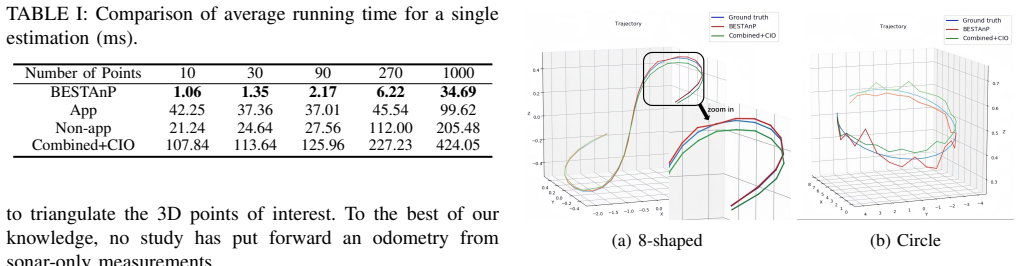
- Sonar-only odometry becomes feasible: the paper demonstrates trajectories estimated by alternately running AnP pose tracking and 3D triangulation without external sensors.
- Existing AnP methods that iterate on part of the translation or rely on planar or weak-perspective approximations are no longer needed for full-pose accuracy in generic scenes.
Reading between the lines
- A natural extension the paper leaves implicit is a minimal-point version of the AnP solver: the nullspace structure of $\mathbf{Q}_{BE}$ suggests that a small set of correspondences could seed RANSAC-style robust estimation, analogous to minimal solvers in the PnP literature.
- The non-coplanarity premise means planar underwater structures such as walls, floors, and flat ship hulls are a degeneracy risk; the paper does not analyze this regime, so a practical system would need to detect and fall back to constrained models for such scenes.
- The decoupling logic may transfer to any range-and-single-angle sensor, such as radar or ultrawideband localization, where distance and one angle are measured but elevation is unavailable; the same two-step bias-eliminated estimator could apply after adapting the measurement model.
- The paper's comparison treats angle noise as added to $\tan\theta$; for sonars with wide azimuth apertures or high noise levels, the equivalence to direct angle noise weakens, so a useful extension would be a bias correction that works directly on $\theta$ residuals.
Editorial analysis
A structured set of objections, weighed in public.
Referee Report
Summary. The manuscript proposes BESTAnP, a two-step estimator for the acoustic-n-point (AnP) problem. The first step estimates the sonar translation from distance-only measurements via a bias-eliminated linear least-squares formulation, and the second step estimates the rotation by eigendecomposition of a bias-corrected Gram matrix built from azimuth observations. A single Gauss-Newton iteration is then applied to refine the pose. The paper claims that the two-step estimator is √n-consistent, that one GN iteration yields an estimator with the same asymptotic distribution as the maximum-likelihood estimator, that the covariance approaches the Cramér-Rao lower bound, and that the method is the first closed-form six-degree-of-freedom AnP solver. The claims are supported by Monte Carlo simulations, a Raspberry Pi timing study, real pool experiments, and an embedded sonar-based odometry demonstration.
Significance. If the technical claims hold, BESTAnP would be a practically valuable AnP solver: it is non-iterative up to a single GN refinement, has an explicit consistency analysis, and is demonstrated to be over ten times faster than state-of-the-art methods while matching their accuracy. The manuscript is commendable for shipping open-source code and for validating the algorithm in both synthetic and real underwater scenarios, including a sonar-only odometry pipeline. The main caveats are that the headline statistical-optimality result is not proved in this paper, the CRLB is used without derivation, and the non-coplanarity/generic-position assumption behind the closed-form solution is stated only locally and is not analyzed as a degeneracy limitation.
major comments (3)
- [Section IV-C, Theorem 3] The closed-form translation step inverts A^T A in Eq. (6), and the rotation step requires rank(B*)=5 in Eq. (9). The manuscript states, immediately before Eq. (6), that the 3D points must be spatially non-coplanar, and it assumes 'generic positions' after Eq. (9), but the abstract and Section III present the six-degree closed-form solution and the asymptotic-optimality claim without these preconditions. For coplanar point sets, such as a sonar observing a wall or floor, A is rank-deficient and \hat t_BE in Eq. (7) is not uniquely defined; for near-coplanar sets the estimator is ill-conditioned. This is a load-bearing restriction on the central claim. Please state the assumption in the problem formulation and abstract, and add a degeneracy/conditioning analysis or a fallback procedure for planar scenes.
- [Section V-A, Figs. 2–6] Theorem 3 is the basis for the 'statistically optimal' and 'covariance approaching the CRLB' claims, but its proof is not contained in this manuscript. The text says 'For the proof of Theorem 3, please refer to the proof of Theorem 7 in [27]', where [27] is the authors' own arXiv preprint on camera-robot pose estimation from points and lines. Because the observation model, parameterization, and estimation problem differ from the AnP likelihood (5), the reduction is not immediate. Please either provide a self-contained proof of Theorem 3 or state precisely the mapping from the AnP problem to Theorem 7 of [27], including all regularity conditions that must be verified.
- [Section IV-A, Eq. (7)] The CRLB curves in Figs. 2–6 are displayed without a definition or derivation. The paper does not give the CRLB expression for the observation model (4), nor does it state the conditions under which the single-GN estimator attains it. Since 'statistically optimal' is a headline contribution, please include the CRLB formula (or a precise citation with the exact expression) and explain how it is computed for the plotted experiments.
minor comments (5)
- [Algorithm 1] The first sentence reads 'We has introduced the noise-free sonar measurement model'; it should be 'We have introduced'.
- [Appendix A] The input list includes only 'azimuth angle measurements tan θi', but step 4 determines the sign by checking cos θ_i and the reprojected cos θ̂_i. Please specify whether the signed azimuth angle (or its cosine) is available as input, since tan alone does not determine the sign of cos.
- [Fig. 8 caption] The proof of Lemma 1 refers to 'Lemma 3' before Lemma 3 has been stated (it appears in Appendix B); please reorder or renumber the lemmas for readability.
- [Section V-A.3] The caption contains the typo 'Dual-palne'; it should be 'Dual-plane'.
- The sentence 'the App method performs even better than the CRLB' should be clarified as an effect of bias in the App estimator, since the CRLB is a bound for unbiased estimators; otherwise the statement may confuse readers.
Circularity Check
The AnP-specific decoupling is independent, but the paper's headline statistical-optimality claim is delegated to a theorem from the authors' own prior work, making the support partially self-citational.
-
self citation load bearing
[Section IV-C, Theorem 3]
"For the proof of Theorem 3, please refer to the proof of Theorem 7 in [27]. Theorem 3 implies that ˆRGN and ˆtGN have the same asymptotic property that ˆRML and ˆtML possess. In other words, ˆRGN and ˆtGN are statistically optimal and can asymptotically reach the CRLB as n increases."
The paper's second headline contribution—statistical optimality with covariance approaching the CRLB—is not proved in this manuscript. The proof is entirely delegated to Theorem 7 of [27], which is prior work by the same research group. The assumptions and regularity conditions of that theorem are not restated or verified for the specific AnP maximum-likelihood problem (5), including its noise model on tan θ and its Gauss-Newton Jacobian in Appendix C. The central claim therefore rests on a self-citation chain rather than on a self-contained derivation. This is load-bearing because the abstract and introduction promote the CRLB-approaching property as a main result, even though the AnP-specific decoupling and the closed-form estimators themselves are independent contributions.
full rationale
BESTAnP's core AnP-specific derivation is not circular: the translation estimator (6)-(7) is constructed from range-only least squares, the rotation estimator (9)-(11) is constructed from azimuth-only least squares plus eigendecomposition, and the bias-eliminated matrix QBE = Q − σ̂θ² S is derived from the measurement statistics rather than defined to yield the target pose. The resulting closed-form estimates are benchmarked against external methods and against the CRLB, so the main algorithmic content has independent substance. No fitted parameter is renamed as a prediction, and no known result is merely relabeled. The most serious concern is Theorem 3, where the optimality result is imported by reference to Theorem 7 of the authors' own prior paper [27] without proof or condition checking in this manuscript; Theorem 1 and the supporting lemmas from [26] are also self-citations, though they concern standard range-localization consistency and are less central to the novelty. These self-citations raise the circularity score to 4 but do not make the whole derivation equivalent to its inputs. The degeneracy of coplanar point sets is a correctness and robustness limitation, not a circularity, so it is not counted here.
Assumptions & free parameters
free parameters (1)
- Outlier rejection threshold (reprojection error) in sonar-based odometry =
not stated
assumptions (5)
- domain assumption The 3D points are spatially non-coplanar and in generic position, so A has rank 4 and B* has rank 5.
- domain assumption Gaussian noise is added to tan theta_i rather than theta_i, with constant variance and independent of distance noise.
- domain assumption Theorem 1 of [26], Lemmas 2 and 3 of [26]/[27], and Theorem 7 of [27] are valid as stated.
- standard math Eigendecomposition and SVD projection are continuous, so sqrt(n)-consistency is preserved.
- domain assumption The Cramer-Rao lower bound for model (4) exists and is the relevant lower bound.
Cite this review
Pith. "Pith review of BESTAnP: Bi-Step Efficient and Statistically Optimal Estimator for Acoustic-n-Point Problem." pith.science (2026). https://pith.science/paper/RYLCBSO7
@misc{pith2026241117521,
  author       = {Pith},
  title        = {Pith review of: BESTAnP: Bi-Step Efficient and Statistically Optimal Estimator for Acoustic-n-Point Problem},
  year         = {2026},
  howpublished = {\url{https://pith.science/paper/RYLCBSO7}},
  note         = {Machine review of arXiv:2411.17521}
}
read the original abstract
We consider the acoustic-n-point (AnP) problem, which estimates the pose of a 2D forward-looking sonar (FLS) according to n 3D-2D point correspondences. We explore the nature of the measured partial spherical coordinates and reveal their inherent relationships to translation and orientation. Based on this, we propose a bi-step efficient and statistically optimal AnP (BESTAnP) algorithm that decouples the estimation of translation and orientation. Specifically, in the first step, the translation estimation is formulated as the range-based localization problem based on distance-only measurements. In the second step, the rotation is estimated via eigendecomposition based on azimuth-only measurements and the estimated translation. BESTAnP is the first AnP algorithm that gives a closed-form solution for the full six-degree pose. In addition, we conduct bias elimination for BESTAnP such that it owns the statistical property of consistency. Through simulation and real-world experiments, we demonstrate that compared with the state-of-the-art (SOTA) methods, BESTAnP is over ten times faster and features real-time capacity in resource-constrained platforms while exhibiting comparable accuracy. Moreover, for the first time, we embed BESTAnP into a sonar-based odometry which shows its effectiveness for trajectory estimation.
Figures


Figures from the paper (6 more)




Reference graph
Works this paper leans on
-
[27]
Optimal camera-robot pose estimation in linear time from points and lines
G. Zeng, B. Mu, Q. Zeng, Y . Song, C. Dai, G. Shi, and J. Wu, “Optimal camera-robot pose estimation in linear time from points and lines,” arXiv preprint arXiv:2407.16151 , 2024
work page Pith review arXiv 2024
-
[26]
Global and asymptotically efficient localization from range measurements,
G. Zeng, B. Mu, J. Chen, Z. Shi, and J. Wu, “Global and asymptotically efficient localization from range measurements,” IEEE Transactions on Signal Processing, vol. 70, pp. 5041–5057, 2022
2022
-
[1]
2d forward looking sonar in underwater navigation aiding: an aukf-based strategy for auvs,
M. Franchi, A. Ridolfi, and L. Zacchini, “2d forward looking sonar in underwater navigation aiding: an aukf-based strategy for auvs,” IFAC- PapersOnLine, vol. 53, no. 2, pp. 14 570–14 575, 2020
work page 2020
-
[2]
Object recognition in forward looking sonar images using transfer learning,
L. R. Fuchs, A. G ¨allstr¨om, and J. Folkesson, “Object recognition in forward looking sonar images using transfer learning,” in 2018 IEEE/OES Autonomous Underwater Vehicle Workshop (AUV). IEEE, 2018, pp. 1–6
work page 2018
-
[3]
A. A. Aal, A. El Barkooky, M. Gerrits, H. Meyer, M. Schwander, and H. Zaki, “Tectonic evolution of the eastern mediterranean basin and its significance for hydrocarbon prospectivity in the ultradeepwater of the nile delta,” The Leading Edge , vol. 19, no. 10, pp. 1086–1102, 2000
work page 2000
-
[4]
Acoustic-n-point for solving 2d forward looking sonar pose estima- tion,
Y . Wang, Y . Ji, H. Tsuchiya, J. Ota, H. Asama, and A. Yamashita, “Acoustic-n-point for solving 2d forward looking sonar pose estima- tion,” IEEE Robotics and Automation Letters , 2024
work page 2024
-
[5]
Planar anp: A solution to acoustic-n-point problem on planar target,
Y . Wang, Y . Ji, H. Woo, Y . Tamura, H. Tsuchiya, A. Yamashita, and H. Asama, “Planar anp: A solution to acoustic-n-point problem on planar target,” in Global Oceans 2020: Singapore–US Gulf Coast . IEEE, 2020, pp. 1–6
work page 2020
-
[6]
Epnp: An accurate o (n) solution to the p n p problem,
V . Lepetit, F. Moreno-Noguer, and P. Fua, “Epnp: An accurate o (n) solution to the p n p problem,” International Journal of Computer Vision, vol. 81, pp. 155–166, 2009
work page 2009
Show all 28 references
-
[7]
A direct least-squares (dls) method for pnp,
J. A. Hesch and S. I. Roumeliotis, “A direct least-squares (dls) method for pnp,” in 2011 International Conference on Computer Vision. IEEE, 2011, pp. 383–390
2011
-
[8]
Revisiting the pnp problem: A fast, general and optimal solution,
Y . Zheng, Y . Kuang, S. Sugimoto, K. Astrom, and M. Okutomi, “Revisiting the pnp problem: A fast, general and optimal solution,” in Proceedings of the IEEE International Conference on Computer Vision, 2013, pp. 2344–2351
2013
-
[9]
An efficient and accurate algorithm for the perspecitve-n-point problem,
L. Zhou and M. Kaess, “An efficient and accurate algorithm for the perspecitve-n-point problem,” in 2019 IEEE/RSJ International Conference on Intelligent Robots and Systems (IROS) . IEEE, 2019, pp. 6245–6252
2019
-
[10]
6- dof object pose from semantic keypoints,
G. Pavlakos, X. Zhou, A. Chan, K. G. Derpanis, and K. Daniilidis, “6- dof object pose from semantic keypoints,” in 2017 IEEE international conference on robotics and automation (ICRA) . IEEE, 2017, pp. 2011–2018
2017
-
[11]
E. K. Chong, W.-S. Lu, and S. H. Zak, An Introduction to Optimization: With Applications to Machine Learning . John Wiley & Sons, 2023
2023
-
[12]
Mlpnp-a real-time maximum likeli- hood solution to the perspective-n-point problem,
S. Urban, J. Leitloff, and S. Hinz, “Mlpnp-a real-time maximum likeli- hood solution to the perspective-n-point problem,” arXiv:1607.08112, 2016
2016 arXiv
-
[13]
Cpnp: Consistent pose estimator for perspective-n-point problem with bias elimination,
G. Zeng, S. Chen, B. Mu, G. Shi, and J. Wu, “Cpnp: Consistent pose estimator for perspective-n-point problem with bias elimination,” in 2023 IEEE International Conference on Robotics and Automation (ICRA). IEEE, 2023, pp. 1940–1946
2023
-
[14]
On 3-d motion estimation from feature tracks in 2-d fs sonar video,
S. Negahdaripour, “On 3-d motion estimation from feature tracks in 2-d fs sonar video,” IEEE Transactions on Robotics, vol. 29, no. 4, pp. 1016–1030, 2013
2013
-
[15]
Incremental data association for acoustic structure from motion,
T. A. Huang and M. Kaess, “Incremental data association for acoustic structure from motion,” in 2016 IEEE/RSJ International Conference on Intelligent Robots and Systems (IROS) . IEEE, 2016, pp. 1334–1341
2016
-
[16]
Bundle adjustment for 3-d motion and structure estimation from 2-d optical and sonar views,
S. Negahdaripour and A. Taatian, “Bundle adjustment for 3-d motion and structure estimation from 2-d optical and sonar views,” inOCEANS
-
[17]
Application of forward-scan sonar stereo for 3-d scene reconstruction,
S. Negahdaripour, “Application of forward-scan sonar stereo for 3-d scene reconstruction,” IEEE Journal of Oceanic Engineering , vol. 45, no. 2, pp. 547–562, 2018
2018
-
[18]
Dense, sonar-based reconstruction of underwater scenes,
P. V . Teixeira, D. Fourie, M. Kaess, and J. J. Leonard, “Dense, sonar-based reconstruction of underwater scenes,” in 2019 IEEE/RSJ International Conference on Intelligent Robots and Systems (IROS) . IEEE, 2019, pp. 8060–8066
2019
-
[19]
Contour based reconstruction of underwater structures using sonar, visual, inertial, and depth sensor,
S. Rahman, A. Q. Li, and I. Rekleitis, “Contour based reconstruction of underwater structures using sonar, visual, inertial, and depth sensor,” in 2019 IEEE/RSJ International Conference on Intelligent Robots and Systems (IROS). IEEE, 2019, pp. 8054–8059
2019
-
[20]
Active slam using 3d submap saliency for underwater volumetric exploration,
S. Suresh, P. Sodhi, J. G. Mangelson, D. Wettergreen, and M. Kaess, “Active slam using 3d submap saliency for underwater volumetric exploration,” in 2020 IEEE International Conference on Robotics and Automation (ICRA). IEEE, 2020, pp. 3132–3138
2020
-
[21]
Feature-based slam for imaging sonar with under-constrained landmarks,
E. Westman, A. Hinduja, and M. Kaess, “Feature-based slam for imaging sonar with under-constrained landmarks,” in 2018 IEEE International Conference on Robotics and Automation (ICRA) . IEEE, 2018, pp. 3629–3636
2018
-
[22]
Degeneracy-aware imaging sonar si- multaneous localization and mapping,
E. Westman and M. Kaess, “Degeneracy-aware imaging sonar si- multaneous localization and mapping,” IEEE Journal of Oceanic Engineering, vol. 45, no. 4, pp. 1280–1294, 2019
2019
-
[23]
Svin2: A multi-sensor fusion-based underwater slam system,
S. Rahman, A. Quattrini Li, and I. Rekleitis, “Svin2: A multi-sensor fusion-based underwater slam system,” The International Journal of Robotics Research, vol. 41, no. 11-12, pp. 1022–1042, 2022
2022
-
[24]
Source localization in wireless sensor networks from signal time-of-arrival measurements,
E. Xu, Z. Ding, and S. Dasgupta, “Source localization in wireless sensor networks from signal time-of-arrival measurements,” IEEE Transactions on Signal Processing , vol. 59, no. 6, pp. 2887–2897, 2011
2011
-
[25]
Distance- based cooperative relative localization for leader-following control of mavs,
T.-M. Nguyen, Z. Qiu, T. H. Nguyen, M. Cao, and L. Xie, “Distance- based cooperative relative localization for leader-following control of mavs,” IEEE Robotics and Automation Letters, vol. 4, no. 4, pp. 3641– 3648, 2019
2019
-
[28]
A tutorial on quantitative trajectory evaluation for visual (-inertial) odometry,
Z. Zhang and D. Scaramuzza, “A tutorial on quantitative trajectory evaluation for visual (-inertial) odometry,” in 2018 IEEE/RSJ Interna- tional Conference on Intelligent Robots and Systems (IROS) . IEEE, 2018, pp. 7244–7251
2018
Reviewed August 12, 2026 · model on record in the stance chip above.
Discussion (0). Continue with ORCID to comment.