REVIEW 3 major objections 5 minor 42 references
Box for Mask and Mask for Box: weak losses for multi-task partially supervised learning
T0 review · 3 major / 5 minor · reviewed 2026-08-12 · deepseek-v4-flash
Pith's one-line read Weak label transfer between detection and segmentation improves COCO multi-task learning
desk verdict Useful MTPSL paper with a genuinely new Mask-for-Box refinement, but the headline COCO comparison is confounded by an un-ablated attention module added to the segmentation head. read the letter →
The pith
A machine-rendered reading of the paper's core claim, the machinery that carries it, and where it could break.
The reading
What carries the argument
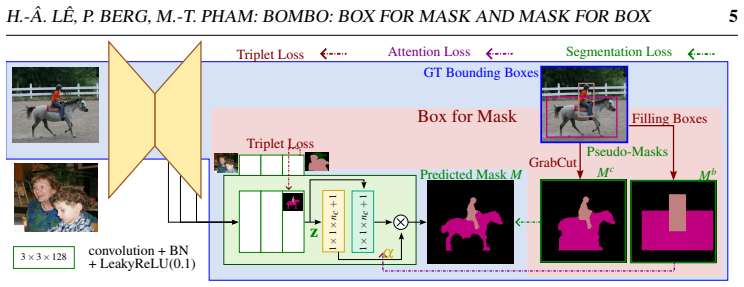
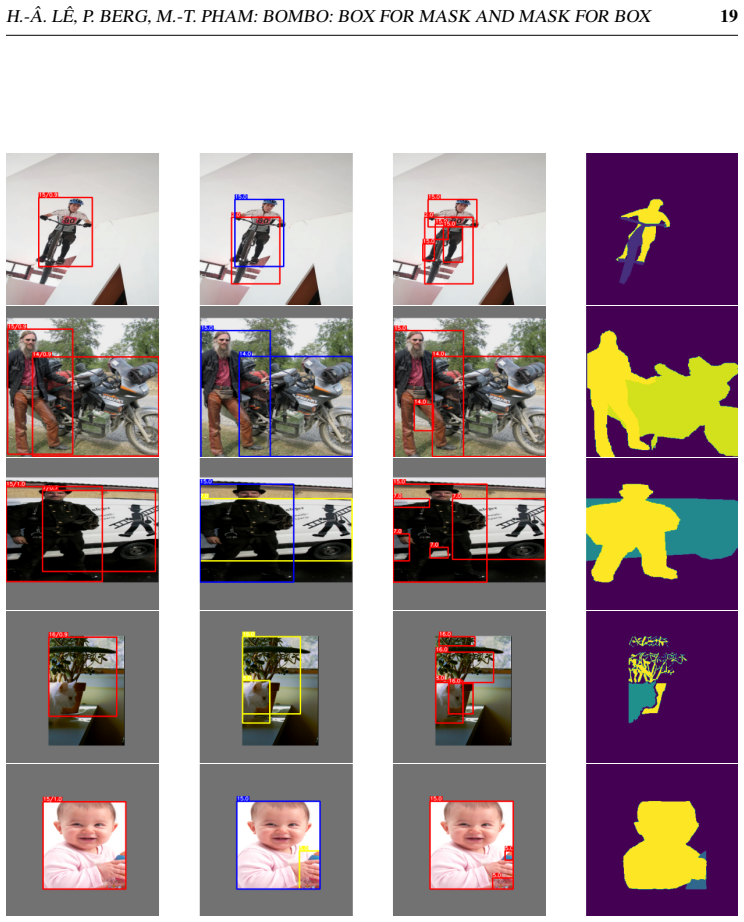
The load-bearing mechanism is a pair of label-refinement modules that convert one task's ground truth into targets for the other task's head. Mask-for-Box uses a matching and refining algorithm: reference boxes are extracted as circumscribed rectangles of connected components in the ground-truth mask; predicted boxes with confidence above thresholds are matched to references, used to split multi-instance references, merge fragmented ones into a smallest covering box, or kept as is, and the surviving refined boxes are filtered by non-maximum suppression; only the localization loss is applied. Box-for-Mask generates two pseudo-masks from each ground-truth box, a box-shaped mask of filled categories that trains an auxiliary attention map via mean-squared error, and a coarse mask restricted to the box interior that trains the main cross-entropy loss, plus a triplet loss that anchors each box's mean embedding of correctly predicted pixels to a same-class key and pushes it away from a different-class key. The attention-modulated prediction $M = M_l \otimes \alpha$ is what lets the noisy pseudo-masks improve segmentation instead of degrading it.
What would settle it
Run BoMBo on two datasets with disjoint or only partially overlapping class sets, for example COCO detection with Cityscapes segmentation, keeping everything else fixed; if the gains on COCO disappear or turn negative, the shared-class-space assumption is what carries the result. Alternatively, replace the refined pseudo-boxes with the unrefined circumscribed rectangles of the ground-truth masks and check whether the detection margin on COCO collapses, isolating the contribution of the refining step.
Extended reading notes
Core claim
On the paper's own terms, the central discovery is that cross-task weak supervision works in multi-task partially supervised learning if the transfer is designed around what each annotation type can and cannot say. A ground-truth mask gives correct categories and an object's extent but not instance boundaries, so Mask-for-Box takes the circumscribed rectangles of connected components, which may be fragmented or contain many instances, and re-localizes them using the network's predicted boxes, splitting, merging, or keeping boxes according to overlap and a two-sided touch criterion, then supervises the detection head with only the localization loss, because adding classification loss hurts. A ground-truth box gives the object's category and an upper bound on its extent but no pixel-level boundary, so Box-for-Mask generates a box-shaped mask used to train an attention map, a coarse pseudo-mask used for cross-entropy, and a triplet loss pulling embeddings of pixels inside a box toward same-class embeddings and away from other classes; the segmentation prediction is the logits modulated by the learned attention. Combining the two losses with lambda equal to 2, BoMBo outperforms the multi-task baseline on COCO for detection and segmentation on every backbone tested, while on VOC it improves both tasks only for Swin-L and is mixed otherwise.
Load-bearing premise
The central assumption is that the detection and segmentation datasets share the same semantic class space and come from the same image domain, because the pseudo-targets inherit their category labels from the other task's ground truth; if the class sets differ, the weak losses would train wrong categories.
Editorial extensions
If this is right
- In partially annotated settings where detection and segmentation datasets share a class space, one task's annotations can genuinely expand the other's training data, improving both tasks on COCO at one-eighth data scale.
- Classification supervision on pseudo-boxes is counterproductive; the useful signal from mask-derived boxes is their localization, which should be trained with the localization loss only.
- Box-derived pseudo-masks do not help when they directly drive the segmentation cross-entropy; they work only when mediated by an attention map trained on the box-shaped filling.
- The gains transfer across backbones on COCO, from ResNet18 and ResNet50 to Swin-T, Swin-B, and Swin-L, suggesting the mechanism is not tied to one architecture.
- Combining both modules requires balancing the tasks, with lambda set to 2, and the mixed VOC results indicate the balance interacts with dataset difficulty or domain closeness.
Reading between the lines
- If the shared-class-space assumption holds, the same recipe could be tried for other task pairs with complementary annotation granularity, such as instance segmentation and depth, where one task's dense ground truth could be converted into box-like or mask-like targets for the other.
- The localization-only finding hints that pseudo-targets should carry only the information the target task lacks, not the full supervision; a testable extension would be to decay the classification weight on pseudo-boxes gradually as the network's own classifiers mature.
- The mixed VOC results suggest a concrete diagnostic: measure the per-class overlap between the detection and segmentation label distributions, and use that overlap to gate whether BoMBo modules are switched on for a given class.
- Because Mask-for-Box improves most on miss and false-negative errors, it could be attached to a detector that is already strong at classification but weak at recall, using segmentation data to grow recall without touching classifier training.
Editorial analysis
A structured set of objections, weighed in public.
Referee Report
Summary. The paper studies multi-task partially supervised learning (MTPSL) for object detection and semantic segmentation, where each training image is annotated for only one of the two tasks. It proposes two modules: Mask-for-Box (M4B), which refines circumscribed rectangles of ground-truth mask connected components using predicted boxes to generate localization-only pseudo-labels for the detector, and Box-for-Mask (B4M), which builds pseudo-masks from ground-truth boxes (box-filling plus GrabCut) and trains the segmentation head with a cross-entropy loss on the coarse pseudo-mask, an attention loss on box-shaped masks, and a triplet loss on embeddings. The two modules are combined into BoMBo and evaluated on VOC and COCO with ResNet and Swin backbones. The reported COCO results show consistent gains over the multi-task baseline, while VOC results are mixed.
Significance. If the reported gains are robust, the work is a useful contribution to exploiting heterogeneous partially annotated datasets in multi-task learning, building on prior MTPSL work. The paper contains several strengths: design-level ablations for each module (Tables 1, 3, 4), a TIDE error analysis for the detection component, experiments across multiple backbones, and a commitment to release source code and data splits. However, the main COCO comparison is confounded by an architectural change (an added attention module) that is not present in the baseline, and the VOC results are not consistently favorable, so the evidence for the central claim is currently partial.
major comments (3)
- [Section 6, Table 5] The comparison between BoMBo and the MTL baseline in Table 5 is confounded by an architectural change. Section 6 states that the network is 'kept unchanged from [16] except an additional attention module in the segmentation head.' The MTL baseline (from [16]) therefore lacks this attention module. The reported COCO segmentation improvements (e.g., ResNet50 from 54.535 to 58.466) could stem from the additional module alone, independently of the proposed cross-task losses. A necessary control experiment is an MTL baseline with the attention module added but without any Box-for-Mask or Mask-for-Box objectives. Without this control, the attribution of the COCO gains to the weak losses is not established. The same confound affects Table 4, where the '+Lα' row adds both the attention module and the attention loss relative to the baseline, so the effect of Lα is not isolated.
- [Table 5] The VOC results do not support the abstract's implication of generally favorable performance. On VOC, BoMBo improves both tasks only for SwinL; on ResNet50 both detection mAP and segmentation IoU decrease (55.174 to 54.885 and 75.658 to 74.861), and on SwinT/SwinB the segmentation IoU decreases despite detection gains. The paper notes an 'imbalance problem' in passing, but does not analyze why the combination helps on COCO and hurts on VOC, or why the effect is backbone-dependent. Since the central claim is that cross-task weak losses improve MTPSL, the VOC results are a load-bearing inconsistency that needs either a technical explanation (e.g., dataset-domain shift, class-space mismatch) or a tempered statement of the claim.
- [Section 4.1] All experimental numbers are reported from a single run with no error bars or multiple seeds. This is particularly concerning for the small differences in Table 5, such as VOC SwinB detection (58.267 vs 58.259) and the mixed VOC segmentation changes. Without variance estimates, the reader cannot assess whether any of the gains or losses are statistically meaningful. At least the main BoMBo versus MTL comparisons should be repeated with multiple seeds and the mean and standard deviation reported.
minor comments (5)
- [Abstract] There is a typo in the abstract: 'Bo x-for-Mask' should read 'Box-for-Mask'.
- [Eq. (4)] The summation notation 'k∈0...nB' is ambiguous; it should be 'k = 0, ..., nB−1'.
- [Section 3.3] The paper does not specify how the triplet-loss keys are stored and updated across batches, beyond stating that the EMA network is used. Clarify whether the keys are embeddings from the EMA network on previous-batch images and how the key bank is maintained.
- [Algorithm 1] The thresholds in the Mask-for-Box algorithm (IoU 0.6/0.8, confidence 0.1/0.4/0.5, NMS 0.4) are introduced without justification or sensitivity analysis. A small study varying these parameters would improve confidence in the method's robustness.
- [Section 3.2] The informal phrase 'a predicted box should have at least 2 sides touching those of a reference box' is only made precise in Algorithm 1's touch function. The main text should refer explicitly to the algorithm's definition to help the reader.
Circularity Check
No significant circularity: the weak losses are heuristic and evaluated on standard benchmarks; the only self-citation ([16]) is used as a baseline/implementation and is not load-bearing for the new claim.
full rationale
The paper's central claim is that cross-task weak losses (Mask-for-Box and Box-for-Mask) improve multi-task partially supervised learning. These losses are defined directly from ground-truth masks/boxes and network predictions (Eqs. 1-4); they are not defined in terms of the final detection mAP or segmentation IoU, and the final numbers are measured on standard VOC/COCO splits, so no fitted-to-test circularity is present. The stated limitation in Section 5 ('One limitation of the study is the assumptions of the same data domain and shared class space between the two tasks') is a generality caveat, not a circular step. The main self-citation is to [16], which supplies the MTPSL baseline, data split, and base architecture; while this is a same-author citation, the new weak-loss modules are independently ablated and compared, so the citation is not load-bearing for the central claim. One experimental concern, visible in Section 6 ('kept unchanged from [16] except an additional attention module in the segmentation head'), is that the BoMBo comparison in Table 5 adds an attention module absent from the MTL baseline; this could confound attribution of the COCO gains to the weak losses. That is an internal-validity/control issue, not a definitional circularity, because the weak-loss effect is not imposed by construction. The M4B refinement's use of the model's own predicted boxes to refine pseudo-boxes is a standard self-training/pseudo-labeling mechanism anchored in GT masks; it is self-referential in an engineering sense but not a logical reduction of the claimed result to its inputs. Overall, no equation or definition in the paper makes a prediction equivalent to its input by construction.
Assumptions & free parameters
free parameters (3)
- loss balancing weight lambda =
2
- triplet margin gamma =
0.1
- M4B thresholds (IoU 0.6/0.8, confidence 0.1/0.4/0.5, NMS 0.4) =
Various (see Algorithm 1)
assumptions (4)
- domain assumption Detection and segmentation datasets share the same class space and image domain.
- domain assumption Ground truth boxes provide the upper limit of the object's extent, so pixels outside boxes are background.
- domain assumption Predicted boxes from a partially trained detector carry useful instance cues for splitting and merging.
- domain assumption The circumscribed rectangles of connected components in semantic masks provide reliable class and rough location priors.
Cite this review
Pith. "Pith review of Box for Mask and Mask for Box: weak losses for multi-task partially supervised learning." pith.science (2026). https://pith.science/paper/G7ITJ6PW
@misc{pith2026241117536,
  author       = {Pith},
  title        = {Pith review of: Box for Mask and Mask for Box: weak losses for multi-task partially supervised learning},
  year         = {2026},
  howpublished = {\url{https://pith.science/paper/G7ITJ6PW}},
  note         = {Machine review of arXiv:2411.17536}
}
read the original abstract
Object detection and semantic segmentation are both scene understanding tasks yet they differ in data structure and information level. Object detection requires box coordinates for object instances while semantic segmentation requires pixel-wise class labels. Making use of one task's information to train the other would be beneficial for multi-task partially supervised learning where each training example is annotated only for a single task, having the potential to expand training sets with different-task datasets. This paper studies various weak losses for partially annotated data in combination with existing supervised losses. We propose Box-for-Mask and Mask-for-Box strategies, and their combination BoMBo, to distil necessary information from one task annotations to train the other. Ablation studies and experimental results on VOC and COCO datasets show favorable results for the proposed idea. Source code and data splits can be found at https://github.com/lhoangan/multas.
Figures


Figures from the paper (5 more)



Reference graph
Works this paper leans on
-
[16]
Hoàng-Ân Lê and Minh-Tan Pham. Data exploitation: multi-task learning of object detection and semantic segmentation on partially annotated data. In British Machine Vision Conference (BMVC), 2023
work page 2023
-
[1]
Multiscale Combinatorial Grouping
Pablo Arbeláez, Jordi Pont-Tuset, Jon Barron, Ferran Marques, and Jitendra Malik. Multiscale Combinatorial Grouping. In 2014 IEEE Conference on Computer Vision and Pattern Recognition, pages 328–335, 2014
work page 2014
-
[2]
TIDE: A General Toolbox for Identifying Object Detection Errors
Daniel Bolya, Sean Foley, James Hays, and Judy Hoffman. TIDE: A General Toolbox for Identifying Object Detection Errors. In ECCV, 2020
work page 2020
-
[3]
Felix J S Bragman, Ryutaro Tanno, Sebastien Ourselin, Daniel C Alexander, and Jorge Cardoso. Stochastic Filter Groups for Multi-Task CNNs: Learning Specialist and Gen- eralist Convolution Kernels. InProceedings of the IEEE/CVF International Conference on Computer Vision (ICCV), oct 2019
work page 2019
-
[4]
Automated Search for Resource-Efficient Branched Multi-Task Networks
David Brüggemann, Menelaos Kanakis, Stamatios Georgoulis, and Luc Van Gool. Automated Search for Resource-Efficient Branched Multi-Task Networks. In BMVC, 2020
work page 2020
-
[5]
Just Pick a Sign: Optimizing Deep Multitask Mod- els with Gradient Sign Dropout
Zhao Chen, Jiquan Ngiam, Yanping Huang, Thang Luong, Henrik Kretzschmar, Yun- ing Chai, and Dragomir Anguelov. Just Pick a Sign: Optimizing Deep Multitask Mod- els with Gradient Sign Dropout. In H Larochelle, M Ranzato, R Hadsell, M F Balcan, and H Lin, editors, Advances in Neural Information Processing Systems , volume 33, pages 2039–2050. Curran Associa...
work page 2020
-
[6]
A Multi-Task Mean Teacher for Semi-Supervised Shadow Detection
Zhihao Chen, Lei Zhu, Liang Wan, Song Wang, Wei Feng, and Pheng-Ann Heng. A Multi-Task Mean Teacher for Semi-Supervised Shadow Detection. In Proceedings of the IEEE/CVF Conference on Computer Vision and Pattern Recognition (CVPR) , jun 2020
work page 2020
-
[7]
The Pascal Visual Object Classes (VOC) Challenge
M Everingham, L Van ∼Gool, C K I Williams, J Winn, and A Zisserman. The Pascal Visual Object Classes (VOC) Challenge. ijcv, 88(2):303–338, jun 2010
work page 2010
Show all 42 references
-
[8]
NDDR-CNN: Lay- erwise Feature Fusing in Multi-Task CNNs by Neural Discriminative Dimensionality Reduction
Yuan Gao, Jiayi Ma, Mingbo Zhao, Wei Liu, and Alan L Yuille. NDDR-CNN: Lay- erwise Feature Fusing in Multi-Task CNNs by Neural Discriminative Dimensionality Reduction. In Proceedings of the IEEE/CVF Conference on Computer Vision and Pat- tern Recognition (CVPR), jun 2019
2019
-
[9]
Dynamic Task Prioritization for Multitask Learning
Michelle Guo, Albert Haque, De-An Huang, Serena Yeung, and Li Fei-Fei. Dynamic Task Prioritization for Multitask Learning. InProceedings of the European Conference on Computer Vision (ECCV), sep 2018
2018
-
[10]
Semantic contours from inverse detectors
Bharath Hariharan, Pablo Arbeláez, Lubomir Bourdev, Subhransu Maji, and Jitendra Malik. Semantic contours from inverse detectors. In 2011 International Conference on Computer Vision, pages 991–998, 2011
2011
-
[11]
Partly Supervised Multi-Task Learning
Abdullah-Al-Zubaer Imran, Chao Huang, Hui Tang, Wei Fan, Yuan Xiao, Dingjun Hao, Zhen Qian, and Demetri Terzopoulos. Partly Supervised Multi-Task Learning. In2020 19th IEEE International Conference on Machine Learning and Applications (ICMLA) , pages 769–774, 2020
2020
-
[12]
The distribution of the Flora in the Alpine Zone
Paul Jaccard. The distribution of the Flora in the Alpine Zone. 1. New Phytologist, 1912. 12 H.-Â. LÊ, P . BERG, M.-T. PHAM: BOMBO: BOX FOR MASK AND MASK FOR BOX
1912
-
[13]
Panoptic Segmentation
Alexander Kirillov, Kaiming He, Ross Girshick, Carsten Rother, and Piotr Dollar. Panoptic Segmentation. In CVPR, 2019
2019
-
[14]
Efficient inference in fully connected CRFs with Gaussian edge potentials
Philipp Krähenbühl and Vladlen Koltun. Efficient inference in fully connected CRFs with Gaussian edge potentials. In Proceedings of the 24th International Conference on Neural Information Processing Systems , NIPS’11, pages 109–117, Red Hook, NY , USA, 2011. Curran Associates Inc
2011
-
[15]
Box2Seg: Attention Weighted Loss and Discriminative Feature Learning for Weakly Supervised Segmentation
Viveka Kulharia, Siddhartha Chandra, Amit Agrawal, Philip Torr, and Ambrish Tyagi. Box2Seg: Attention Weighted Loss and Discriminative Feature Learning for Weakly Supervised Segmentation. In ECCV, 2020
2020
-
[17]
PseCo: Pseudo Labeling and Consistency Training for Semi-Supervised Object Detection
Gang Li, Xiang Li, Yujie Wang, Shanshan Zhang, Yichao Wu, and Ding Liang. PseCo: Pseudo Labeling and Consistency Training for Semi-Supervised Object Detection. arXiv preprint arXiv:2203.16317, 2022
2022 arXiv
-
[18]
Knowledge Distillation for Multi-task Learning
Wei-Hong Li and Hakan Bilen. Knowledge Distillation for Multi-task Learning. In eccvw, 2020
2020
-
[19]
Learning Multiple Dense Prediction Tasks from Partially Annotated Data
Wei-Hong Li, Xialei Liu, and Hakan Bilen. Learning Multiple Dense Prediction Tasks from Partially Annotated Data. In IEEE/CVF International Conference on Computer Vision and Pattern Recognition (CVPR), jun 2022
2022
-
[20]
Microsoft COCO: Common Objects in Context
Tsung-Yi Lin, Michael Maire, Serge Belongie, James Hays, Pietro Perona, Deva Ra- manan, Piotr Dollar, and C Lawrence Zitnick. Microsoft COCO: Common Objects in Context. In David Fleet, Tomas Pajdla, Bernt Schiele, and Tinne Tuytelaars, editors, eccv, pages 740–755, Cham, 2014....
2014
-
[21]
Feature Pyramid Networks for Object Detection
Tsung-Yi Lin, Piotr Dollar, Ross Girshick, Kaiming He, Bharath Hariharan, and Serge Belongie. Feature Pyramid Networks for Object Detection. In Proceedings of the IEEE Conference on Computer Vision and Pattern Recognition (CVPR) , jul 2017
2017
-
[22]
Focal Loss for Dense Object Detection
Tsung-Yi Lin, Priya Goyal, Ross Girshick, Kaiming He, and Piotr Dollar. Focal Loss for Dense Object Detection. In Proceedings of the IEEE International Conference on Computer Vision (ICCV), oct 2017
2017
-
[23]
End-To-End Multi-Task Learning With Attention
Shikun Liu, Edward Johns, and Andrew J Davison. End-To-End Multi-Task Learning With Attention. In Proceedings of the IEEE/CVF Conference on Computer Vision and Pattern Recognition (CVPR), jun 2019
2019
-
[24]
Path Aggregation Network for Instance Segmentation
Shu Liu, Lu Qi, Haifang Qin, Jianping Shi, and Jiaya Jia. Path Aggregation Network for Instance Segmentation. In Proceedings of the IEEE Conference on Computer Vision and Pattern Recognition (CVPR), jun 2018
2018
-
[25]
Unbiased Teacher for Semi-Supervised Object Detection
Yen-Cheng Liu, Chih-Yao Ma, Zijian He, Chia-Wen Kuo, Kan Chen, Peizhao Zhang, Bichen Wu, Zsolt Kira, and Peter Vajda. Unbiased Teacher for Semi-Supervised Object Detection. In ICLR, 2021. H.-Â. LÊ, P . BERG, M.-T. PHAM: BOMBO: BOX FOR MASK AND MASK FOR BOX 13
2021
-
[26]
Unbiased Teacher v2: Semi-Supervised Object Detection for Anchor-Free and Anchor-Based Detectors
Yen-Cheng Liu, Chih-Yao Ma, and Zsolt Kira. Unbiased Teacher v2: Semi-Supervised Object Detection for Anchor-Free and Anchor-Based Detectors. In Proceedings of the IEEE/CVF Conference on Computer Vision and Pattern Recognition (CVPR) , pages 9819–9828, jun 2022
2022
-
[27]
Swin Transformer V2: Scaling Up Capacity and Resolution
Ze Liu, Han Hu, Yutong Lin, Zhuliang Yao, Zhenda Xie, Yixuan Wei, Jia Ning, Yue Cao, Zheng Zhang, Li Dong, Furu Wei, and Baining Guo. Swin Transformer V2: Scaling Up Capacity and Resolution. In International Conference on Computer Vision and Pattern Recognition (CVPR), 2022
2022
-
[28]
Taskology: Utilizing Task Relations at Scale
Yao Lu, Soren Pirk, Jan Dlabal, Anthony Brohan, Ankita Pasad, Zhao Chen, Vincent Casser, Anelia Angelova, and Ariel Gordon. Taskology: Utilizing Task Relations at Scale. In Proceedings of the IEEE/CVF Conference on Computer Vision and Pattern Recognition (CVPR), pages 8700–870...
2021
-
[29]
Libra R-CNN: Towards Balanced Learning for Object Detection
Jiangmiao Pang, Kai Chen, Jianping Shi, Huajun Feng, Wanli Ouyang, and Dahua Lin. Libra R-CNN: Towards Balanced Learning for Object Detection. In IEEE Conference on Computer Vision and Pattern Recognition, 2019
2019
-
[30]
Efficient Parametrization of Multi-Domain Deep Neural Networks
Sylvestre-Alvise Rebuffi, Hakan Bilen, and Andrea Vedaldi. Efficient Parametrization of Multi-Domain Deep Neural Networks. In Proceedings of the IEEE Conference on Computer Vision and Pattern Recognition (CVPR), jun 2018
2018
-
[31]
GrabCut: Interactive Fore- ground Extraction Using Iterated Graph Cuts
Carsten Rother, Vladimir Kolmogorov, and Andrew Blake. GrabCut: Interactive Fore- ground Extraction Using Iterated Graph Cuts. ACM Transactions on Graphics (SIG- GRAPH), 23(3):309–314, aug 2004. ISSN 0730-0301
2004
-
[32]
Learning To Relate Depth and Semantics for Unsupervised Domain Adaptation
Suman Saha, Anton Obukhov, Danda Pani Paudel, Menelaos Kanakis, Yuhua Chen, Stamatios Georgoulis, and Luc Van Gool. Learning To Relate Depth and Semantics for Unsupervised Domain Adaptation. In Proceedings of the IEEE/CVF Conference on Computer Vision and Pattern Recognition (...
2021
-
[33]
Box-Driven Class- Wise Region Masking and Filling Rate Guided Loss for Weakly Supervised Semantic Segmentation
Chunfeng Song, Yan Huang, Wanli Ouyang, and Liang Wang. Box-Driven Class- Wise Region Masking and Filling Rate Guided Loss for Weakly Supervised Semantic Segmentation. In Proceedings of the IEEE/CVF Conference on Computer Vision and Pattern Recognition (CVPR), jun 2019
2019
-
[34]
Weakly Supervised Semantic Segmentation via Box-Driven Masking and Filling Rate Shifting
Chunfeng Song, Wanli Ouyang, and Zhaoxiang Zhang. Weakly Supervised Semantic Segmentation via Box-Driven Masking and Filling Rate Shifting. TPAMI, (12), 2023
2023
-
[35]
ZipIt! Merging Models from Different Tasks without Training
George Stoica, Daniel Bolya, Jakob Bjorner, Taylor Hearn, and Judy Hoffman. ZipIt! Merging Models from Different Tasks without Training. International Conference on Learning Representations (ICLR), 2024
2024
-
[36]
Multi-Task Learning for Dense Prediction Tasks: A Survey
S Vandenhende, S Georgoulis, W Van Gansbeke, M Proesmans, D Dai, and L Van Gool. Multi-Task Learning for Dense Prediction Tasks: A Survey. IEEE Transac- tions on Pattern Analysis and Machine Intelligence, 44(07):3614–3633, jul 2022. ISSN 1939-3539
2022
-
[37]
Semi-supervised Object Detection: A Survey on Recent Research and Progress, 2023
Yanyang Wang, Zhaoxiang Liu, and Shiguo Lian. Semi-supervised Object Detection: A Survey on Recent Research and Progress, 2023. 14 H.-Â. LÊ, P . BERG, M.-T. PHAM: BOMBO: BOX FOR MASK AND MASK FOR BOX
2023
-
[38]
De- tectron2, 2019
Yuxin Wu, Alexander Kirillov, Francisco Massa, Wan-Yen Lo, and Ross Girshick. De- tectron2, 2019
2019
-
[39]
End-to-End Semi-Supervised Object Detection With Soft Teacher
Mengde Xu, Zheng Zhang, Han Hu, Jianfeng Wang, Lijuan Wang, Fangyun Wei, Xi- ang Bai, and Zicheng Liu. End-to-End Semi-Supervised Object Detection With Soft Teacher. In Proceedings of the IEEE/CVF International Conference on Computer Vi- sion (ICCV), pages 3060–3069, oct 2021
2021
-
[40]
Robust Learning Through Cross-Task Consistency
Amir R Zamir, Alexander Sax, Nikhil Cheerla, Rohan Suri, Zhangjie Cao, Jitendra Malik, and Leonidas J Guibas. Robust Learning Through Cross-Task Consistency. In Proceedings of the IEEE/CVF Conference on Computer Vision and Pattern Recognition (CVPR), jun 2020
2020
-
[41]
Joint Task-Recursive Learning for Semantic Segmentation and Depth Estimation
Zhenyu Zhang, Zhen Cui, Chunyan Xu, Zequn Jie, Xiang Li, and Jian Yang. Joint Task-Recursive Learning for Semantic Segmentation and Depth Estimation. In Vitto- rio Ferrari, Martial Hebert, Cristian Sminchisescu, and Yair Weiss, editors, Computer Vision – ECCV 2018, pages 238–2...
2018
-
[42]
Instant-Teaching: An End-to-End Semi-Supervised Object Detection Framework
Qiang Zhou, Chaohui Yu, Zhibin Wang, Qi Qian, and Hao Li. Instant-Teaching: An End-to-End Semi-Supervised Object Detection Framework. In Proceedings of the IEEE/CVF Conference on Computer Vision and Pattern Recognition (CVPR) , pages 4081–4090, jun 2021. H.-Â. LÊ, P . BERG, M....
2021
Reviewed August 12, 2026 · model on record in the stance chip above.
Discussion (0). Continue with ORCID to comment.