REVIEW 4 major objections 6 minor 1 references
Data-driven development of cycle prediction models for lithium metal batteries using multi modal mining
T0 review · 4 major / 6 minor · reviewed 2026-08-12 · deepseek-v4-flash
Pith's one-line read The paper claims that an automated text-and-graph mining pipeline can assemble a literature-derived database of 8,074 lithium metal battery cells and train models that predict capacity and stability with experimental confirmation.
desk verdict A real pipeline with real validation, but the stability model labels right-censored tests as failures, undercutting the headline prediction claim. read the letter →
The pith
A machine-rendered reading of the paper's core claim, the machinery that carries it, and where it could break.
The reading
What carries the argument
The load-bearing object is the ABC platform itself, specifically the fusion of two extraction channels: an LLM-based text-mining agent that pulls 29 entities (cell composition, material composition, operating conditions) from captions, results, and methods, and the Material Graph Digitizer (MatGD), which separates cycle-graph data lines by RGB color, removes Coulombic-efficiency lines using a rule-based threshold, and exports point-by-point capacity data. An LLM-powered merging stage then pairs each graph label with its cell name to produce the final database. The machine learning models are downstream consumers of this database; their input features are one-hot SMILES encodings of materials plus numerical operating conditions, which is what lets the same pipeline be reused for other cell chemistries.
What would settle it
Manually digitize a random sample of the 5,156 cells that the graph miner failed to extract, retrain the capacity model on the combined set, and compare error and feature rankings; if they move materially, the unbiased-database assumption fails.
Extended reading notes
Core claim
The authors' central claim is that the ABC platform can automatically construct a literature-scale database in which every cell has both a material description and a cycle-dependent capacity curve, and that machine learning models trained on this database predict battery behavior that has not yet been measured. They report mining 15,398 cells from text with 0.964 F1 for cell extraction, digitizing 10,242 cycle curves from graphs, and merging them into a final database of 8,074 cells. Using random forest and gradient boosting models, they predict initial capacity for NCM/LFP cells (MAE 10.70 mAh/g), capacity at target cycles for NCM/LFP/sulfur cells (MAE 66.21-74.99 mAh/g, $R^2$ 0.884-0.804), and stability for NCM/LFP cells (accuracy 0.816-0.715). They frame this as the first model of its kind and support it with 16 experimental cells whose measured capacities track the predictions, with four outlier cells attributed to assembly anomalies rather than model failure.
Load-bearing premise
The load-bearing premise is that the final 8,074-cell database is an unbiased sample of lithium-metal-battery literature, including the assumption that the roughly 5,000 missing graphs and the roughly 7,800 unvalidated text-graph merges do not systematically distort what the models learn.
Editorial extensions
If this is right
- Researchers could screen candidate electrolytes, cathodes, and operating conditions for lithium metal batteries by computing predicted capacity at the 100th-300th cycle instead of running months of cycling tests.
- The 8,074-cell database with standardized material features gives the battery community a reusable training set for further prediction tasks, not just the three demonstrated here.
- The same ABC pipeline is claimed to transfer to other devices and materials, potentially combining with reinforcement learning or autonomous experimentation for closed-loop discovery.
- For sulfur cathodes, the model's failure mode identifies host-material encoding as the specific missing piece needed to predict initial capacity of lithium-sulfur batteries.
- Publication bias toward stable cells is visible in the stability classifier's behavior, meaning future models need to account for unreported failed experiments explicitly.
Reading between the lines
- Because graph mining missed 5,156 cells and the color-based exclusion is unlikely to be random, retraining on a manually digitized complement would likely shift the reported errors; the magnitude of that shift is an open, testable quantity.
- The merging step's manual validation on 265 matches leaves label-pairing error for the other roughly 7,800 cells unquantified; a larger audit would either confirm or bound the noise that the machine learning labels currently inherit.
- The stability classifier's accuracy is probably optimistic: the 100th-cycle test set is majority-stable and the model learns to predict 'stable,' so a balanced external test set collected from intentionally failed cells would be a stricter evaluation.
- If the sulfur capacity model works only when initial capacity is fed in, then the learned signal is largely a degradation rule conditioned on starting point, not a physics of the host; encoding host structure explicitly should improve both initial-capacity and cycle-capacity predictions.
Editorial analysis
A structured set of objections, weighed in public.
Referee Report
Summary. The paper introduces the Automatic Battery data Collector (ABC), a multi-modal pipeline that combines an LLM-based text-mining agent with the MatGD graph-digitization tool to extract battery cell composition, operating conditions, and cycling data from the lithium-metal-battery (LMB) literature. The pipeline yields a database of 8,074 cells, on which the authors train machine learning models for three tasks: predicting initial specific capacity (RF, MAE 10.70 mAh/g for NCM/LFP), predicting capacity at 100/200/300 cycles (GBR, R² 0.884/0.846/0.804), and predicting stability at those cycles (GBC/RF, accuracy up to 0.816). The models are tested on fresh in-house cells with qualitative agreement, aside from four cells attributed post hoc to assembly issues. The paper claims these are the first-ever models for such predictions.
Significance. If the methodological concerns are resolved, this work represents a valuable contribution to automated battery database construction and data-driven LMB performance prediction. The text-mining accuracy is evaluated against manual ground truth with strong F1 scores (0.964 overall), the code has been made publicly available, and the in-house experimental validation is a commendable effort that goes beyond purely computational benchmarks. The database itself, spanning 8,074 cells with composition and cycling features, could serve as a resource for the community. However, the headline predictive claims are weakened by two censoring-related issues: the capacity-at-target-cycle models are trained only on cells that survived to that cycle, and the stability labels treat right-censored tests as failures. Both issues directly affect the validity of the paper’s central claims and require substantive reanalysis.
major comments (4)
- [Section 2 ('Prediction of capacity at target cycle')] The models are trained using only cells that have measured capacity at the target cycle ('We trained each model using only the cells that had corresponding values at the target cycle'), giving 1,252 data points at 100 cycles, 752 at 200, and 498 at 300. This conditions on survival: the model learns to predict capacity among cells that already reached the target cycle, not the capacity of an arbitrary new cell that may fail earlier. In deployment, the user does not know in advance whether the cell will survive; for cells that die before the target cycle, the actual capacity is effectively below the viability threshold, yet the model will return a high capacity value. The experimental validation in Fig. 6d-f appears to compare only cells with measured values at the target cycle, so it inherits the same selection. The paper should treat pre-target failures as having zero (or below-threshold) capacity, use a survival-based model, or explicitly reframe the claim as predicting capacity conditional on the cell reaching the target cycle and temper the headline accordingly.
- [Section 3 ('Prediction of stability at target cycle')] The definition of instability states: 'cases where the maximum number of cycles was less than the target cycle being classified as unstable.' This treats right-censored experiments as failures: a cell that was only tested to 150 cycles with capacity above 80% of initial is labeled unstable at 200 and 300 simply because the authors stopped testing. At the 300-cycle task, 206 of 295 cells are labeled unstable; without separating censored from genuinely failed cells, the GBC/RF classifier may be learning a proxy for 'papers that report fewer cycles' (which correlates with publication year, test protocol, and cathode type) rather than intrinsic material-driven instability. The paper acknowledges class imbalance but not this truncation-induced label error. Please redo the stability analysis with censoring-aware labels (e.g., excluding censored cells or applying survival analysis), and report how the accuracy and confusion matrices change.
- [Table 1 and 'Mining Performance for the Extracted Data'] The graph-mining recall of 0.655 is computed using the text-mining output as the truth ('the number of battery cells extracted through the text mining procedure were used as truth values'), not an independent manual ground truth, and graph-mining precision is not reported. Since the text-mining cell-level F1 is 0.964 (not 1.0), the recall estimate is relative to a noisy reference and cannot be interpreted as a clean measure of completeness. More importantly, the 5,156 cells not extracted by MatGD may be systematically different (e.g., complex graph layouts, similar line colors), which could bias the final 8,074-cell database. The paper should evaluate graph mining against an independent set of manually labeled graphs and analyze whether the excluded cells differ in cathode type, cycle length, or other features that could affect the ML models.
- [Section 2 ('Prediction of capacity at target cycle'), Fig. 6] Four of the sixteen experimental validation cells (indices 3, 9, 11, 15) are excluded post hoc after observing that their predictions differ strongly, with the explanation that cycling profiles show 'assembly issues.' Because the outlier criterion is not prespecified, the reported agreement in Fig. 6d-f is optimistic. Please report validation metrics both including and excluding these cells, and discuss whether assembly issues could be identified from features available at the time of prediction (e.g., initial capacity anomalies) rather than from the full cycling curve.
minor comments (6)
- [Abstract and Introduction] The claim that these are 'the first-ever model developed to achieve such predictions' is not supported by a comparative literature search; previous data-driven battery lifetime models (e.g., Severson et al., 2019) exist, and the novelty for LMB-specific multi-component prediction should be stated more carefully with baseline comparisons.
- [Table 1 and 'Database construction agent'] The merging step is validated on only 265 matches from 100 randomly selected papers, whereas the final database contains 8,074 cells; please provide confidence intervals for the recall/F1 or discuss why this sample is representative of the full merging workload.
- ['Mining Performance for the Extracted Data'] The sentence 'all of the extracted data were manually verified' is ambiguous: please clarify whether all 10,242 graph-mined cells or only a sample were manually checked, and who performed the verification.
- [Methods, 'Graph Mining'] The rule-based CE removal threshold is described only as 'based on the observation that CE values typically stabilize around 100% after a few cycles'; please specify the actual threshold value and how it was tuned.
- [Methods, 'Materials and electrochemical measurements'] There is a likely typo: 'Super P C67' should probably be 'Super P C65'.
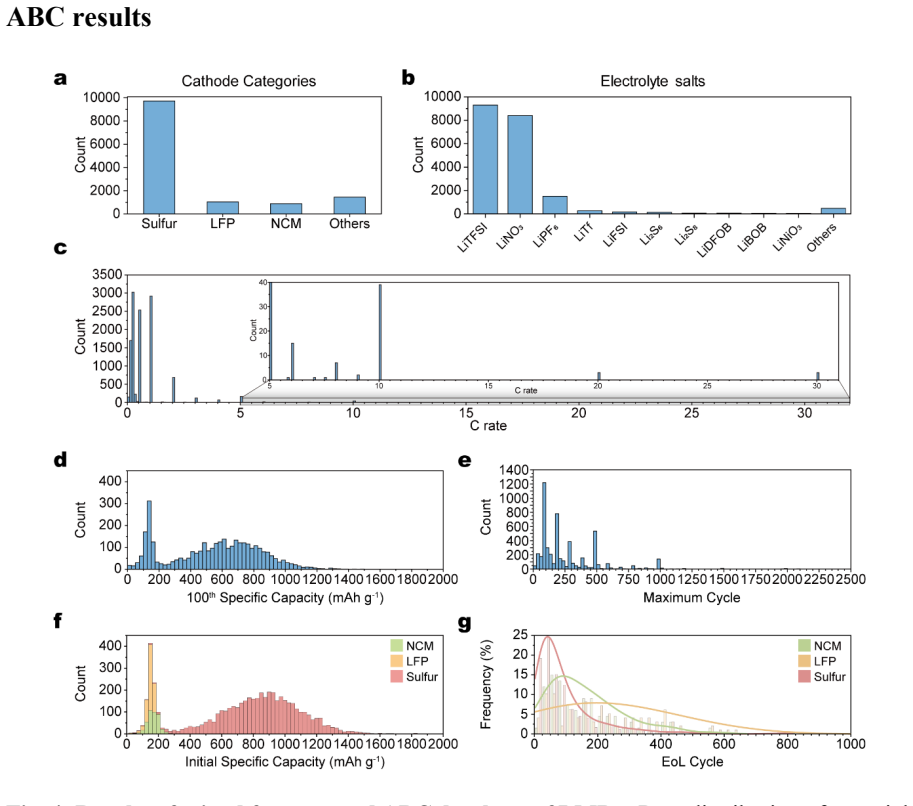
- [Figure 4] The histogram in Fig. 4f is described as 'initial capacity (8,687 cells)', but the text says the merged database has 1,736 cells after RT filtering; please reconcile these numbers or label the figure more clearly.
Circularity Check
Graph-mining recall is evaluated against the text-mining output rather than an independent ground truth, but the central ML predictions rest on independent experimental validation.
-
self definitional
[Results, 'Mining Performance for the Extracted Data' (Table 1 discussion)]
"Due to the high accuracy of the text mining agent, the number of battery cells extracted through the text mining procedure were used as truth values to evaluate the recall values of the graph mining results. Out of 15,398 cells, 10,242 cyclability data were extracted by MatGD, resulting in a recall value of 0.655."
The reported graph-mining recall is not defined against an independent ground truth; by construction it is the ratio of cells recovered by MatGD to cells recovered by the text-mining step (10,242/15,398). Any omission or error in the text-mining extraction is therefore baked into the denominator, making the metric a measure of agreement between two self-built pipeline stages rather than external correctness. This is a self-referential evaluation, though it is not load-bearing for the paper's main ML predictions because the final database entries were manually verified and the ML models were validated on independent in-house cells.
full rationale
The core derivation chain is: literature mining with the ABC platform, database construction, ML training, and experimental validation. The ML predictions are not circular: capacity and stability models are trained on mined data and then tested on 15-16 independently fabricated cells that were not part of the training set, which provides external evidence for the predictive claims. No fitted parameter is renamed as a prediction, and no uniqueness theorem or ansatz is smuggled in via self-citation. The only notable self-referential element is the evaluation of graph-mining recall using the text-mining output as truth values; this is transparently acknowledged and does not by itself force the paper's central results. A second concern, the labeling of right-censored cycle tests as unstable, is a label-definition issue rather than circular reasoning, and it does not reduce the stability model's output to its input features. Overall, the paper's main predictions retain independent content, so the circularity score is low.
Assumptions & free parameters
assumptions (3)
- domain assumption Manually verified graph-mining data are accurate; all extracted cyclability values used in ML were manually checked
- domain assumption The restriction to pure Celgard separators and room-temperature cells yields a dataset that supports the claimed predictive scope
- domain assumption One-hot encodings of SMILES-converted materials plus concentrations and operating conditions capture the chemical features relevant to cycle life
Cite this review
Pith. "Pith review of Data-driven development of cycle prediction models for lithium metal batteries using multi modal mining." pith.science (2026). https://pith.science/paper/FJM6QIFS
@misc{pith2026241117625,
  author       = {Pith},
  title        = {Pith review of: Data-driven development of cycle prediction models for lithium metal batteries using multi modal mining},
  year         = {2026},
  howpublished = {\url{https://pith.science/paper/FJM6QIFS}},
  note         = {Machine review of arXiv:2411.17625}
}
read the original abstract
Recent advances in data-driven research have shown great potential in understanding the intricate relationships between materials and their performances. Herein, we introduce a novel multi modal data-driven approach employing an Automatic Battery data Collector (ABC) that integrates a large language model (LLM) with an automatic graph mining tool, Material Graph Digitizer (MatGD). This platform enables state-of-the-art accurate extraction of battery material data and cyclability performance metrics from diverse textual and graphical data sources. From the database derived through the ABC platform, we developed machine learning models that can accurately predict the capacity and stability of lithium metal batteries, which is the first-ever model developed to achieve such predictions. Our models were also experimentally validated, confirming practical applicability and reliability of our data-driven approach.
Figures


Figures from the paper (4 more)


Reference graph
Works this paper leans on
-
[1]
1 Liu, B., Zhang, J.-G. & Xu, W. Advancing lithium metal batteries. Joule 2, 833-845, (2018). 2 Liu, J. et al. Pathways for practical high-energy long-cycling lithium metal batteries. Nature Energy 4, 180-186, (2019). 3 Xiao, J. et al. Understanding and applying coulombic efficiency in lithium metal batteries. Nature energy 5, 561-568, (2020). 4 Chen, Y. ...
arXiv 2018
Reviewed August 12, 2026 · model on record in the stance chip above.
Discussion (0). Continue with ORCID to comment.