REVIEW 3 major objections 4 minor 63 references
Quantity versus Diversity: Influence of Data on Detecting EEG Pathology with Advanced ML Models
T0 review · 3 major / 4 minor · reviewed 2026-08-12 · deepseek-v4-flash
Pith's one-line read The paper argues that data volume can compensate for data heterogeneity in EEG pathology detection, with the best models extrapolating to an asymptotic AUC of about 91%, roughly the level they already reach on homogeneous single-hospital…
desk verdict Worth reading for the new multi-hospital EEG benchmark and careful comparisons, but the headline 'quantity compensates diversity' claim rests on an extrapolated power-law fit that the authors themselves call speculative. read the letter →
The pith
A machine-rendered reading of the paper's core claim, the machinery that carries it, and where it could break.
The reading
What carries the argument
The load-bearing object is the saturation power law $AUC(n) = AUC_\infty - \alpha n^{-\beta}$, fitted by least squares to the mean cross-validated AUC of each model on the five nested ELM subsets (ELM1, ELM2, ELM4, ELM8, ELM19). The fitted asymptote $AUC_\infty$ is the theoretical performance at infinite data, and the better-behaved AUC fits carry the conclusion. The second piece of machinery is the dataset design: the ELM subsets are stratified by hospital, sex, and pathology so that only size changes between them, while the SZC subset matches TUH in size and class balance but comes from a single hospital with a broader range of conditions. The meta-model, a logistic regression over the outputs of the gradient-boosted ensemble, the attention network MINetP, and the transformer TransNetP, is the best-performing system and the one whose asymptote (91.3% ± 1.1% AUC) drives the headline conclusion.
What would settle it
Retrain the meta-model and TransNetP under the same protocol on a heterogeneous corpus two to four times the size of ELM19 (roughly 110,000 to 220,000 recordings) and compare the observed AUC with the band predicted by the power law fitted on the five smaller subsets. If the observed values fall below that band, or if refitting the power law moves the asymptotic estimate $AUC_\infty$ down significantly, the claim that very large data volumes compensate for heterogeneity is falsified. A cheaper check is to refit the curve while omitting each dataset size in turn: the paper already notes that one model's fit (miNetN) failed to converge, so the stability of the 91% value across these refits is itself informative.
Extended reading notes
Core claim
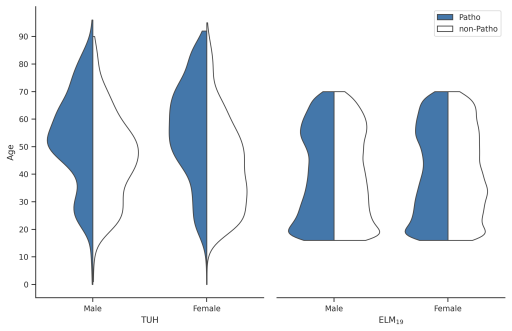
The central claim is that data quantity can compensate for data diversity in EEG pathology detection. The paper introduces ELM19, a 55,787-recording corpus from 39 hospitals that is about 19 times the size of the TUH benchmark, and compares eleven models: a random forest, a Riemannian-geometry classifier, a gradient-boosted ensemble, several multiple-instance neural networks with attention, a transformer-based network, and a meta-model that blends the best of these. Every model's AUC drops sharply from TUH to a size-matched single-hospital subset (SZC) and again to a size-matched multi-hospital subset (ELM1), isolating the costs of broader pathology and of multi-site protocol variation. As the multi-hospital data grow from ELM1 to ELM19, performance climbs steadily, and the attention- and transformer-based networks keep improving with no sign of saturation. Extrapolating the fitted power law $AUC(n) = AUC_\infty - \alpha n^{-\beta}$ to infinite data gives an asymptote of about 91% AUC for the meta-model, comparable to its 91.7% AUC on homogeneous TUH data, which supports the conclusion that very large volumes of heterogeneous data may eventually match homogeneous-data performance. The paper itself cautions that these predictions are to some extent speculative.
Load-bearing premise
The headline conclusion rests on the assumption that the saturation power law $AUC(n) = AUC_\infty - \alpha n^{-\beta}$ correctly describes how performance grows with dataset size, and that fitting it to just five dataset sizes, the largest being 55,787 recordings, supports extrapolation to infinite data; if the curve is misspecified or bends differently, quantity may not fully compensate for diversity.
Editorial extensions
If this is right
- If the 91% asymptote holds, attention- and transformer-based models trained on corpora of a few hundred thousand heterogeneous recordings should reach roughly the same accuracy as models trained on homogeneous single-hospital data.
- On small homogeneous data, architecture barely matters: nearly all models perform equivalently on TUH, and statistically meaningful differences between models emerge only as the dataset grows.
- The gradient-boosted ensemble saturates early because it is limited to handcrafted features, while networks that learn features from raw signals keep improving; the meta-model that blends both outperforms every single model on the largest dataset (88.7% AUC on ELM19).
- The fitted $N_{DB}$ values imply that tens to hundreds of thousands of recordings are needed for the best models to approach their limits, which justifies continued collection of large multi-hospital EEG corpora.
- If the asymptotic ceiling is set by inter-rater labeling noise rather than by data heterogeneity, then labeling recordings with averaged ratings from several experts (fuzzy labels) is the proposed route to push past the current ceiling.
Reading between the lines
- The 91% asymptote is an extrapolation from five dataset sizes, so the cleanest test is empirical: when a heterogeneous corpus of roughly 100,000–400,000 recordings becomes available, refit the power law and check whether observed AUC lands on the predicted curve, or whether the asymptote moves.
- The power-law form is not derived from any theory of learning, so the 'quantity compensates diversity' claim should be tested on other clinical signal tasks, such as ECG or polysomnography, where cross-site heterogeneity can be measured the same way.
- The paper's three-way comparison (TUH, SZC, ELM1) separates two heterogeneity costs, broader pathology versus multi-site protocol variation; if the multi-site cost is the larger one at fixed size, then standardizing recording protocols may be a cheaper lever than collecting ever more data, a reading the paper's data support but do not develop.
- If labeling noise sets the ceiling, adding data without improving label quality should show diminishing returns; a direct check would be to measure inter-rater agreement on a subsample of ELM19 and compare it with the fitted asymptote.
Editorial analysis
A structured set of objections, weighed in public.
Referee Report
Summary. The paper compares machine-learning models for EEG pathology detection on the small homogeneous TUH dataset (2,993 recordings) and the larger multi-hospital ELM19 dataset (55,787 recordings), including several nested subsets. The authors find that model performance drops with data heterogeneity but improves with data quantity, and they fit a saturation power law (Eq. 2) to estimate asymptotic AUC. Their central claim is that the meta-model could reach roughly 91% AUC with infinite heterogeneous data, comparable to finite-sample TUH performance, implying that very large data volumes can compensate for diversity.
Significance. If the asymptotic claim held, the paper would provide a valuable scaling law and a strong argument for building very large multi-hospital EEG corpora. The study has genuine strengths: it reproduces Gemein et al. (2020) on TUH within one standard error (Table 3), uses a stratified 6-fold protocol with a separate validation fold, reports uncertainties, and introduces a large multi-hospital dataset that is a potential community resource. The observed degradation from TUH to SZC to ELM1 and the improvement across ELM subsets are well supported by the present results. However, the headline quantity-compensates-diversity conclusion rests on an extrapolation that is not yet validated, and the meta-model protocol is incompletely specified.
major comments (3)
- [Section 4.3, Eq. (2), Table 4] The asymptotic AUC_infinity values, in particular META AUC_infinity = 91.3 +/- 1.1, are fitted parameters of a three-parameter power law fitted to five nested ELM subset means (n = 2,993 to 55,787). Because the subsets are nested, the five points are not independent, and the functional form is not independently validated; the high R^2 values in Table 4 do not establish that the extrapolation to infinity is correct. The paper itself states that the law is 'not fully rooted in fundamental principles' and the predictions are 'to some extent, speculative' (Sections 4.3 and 5). The observed ELM19 gap (META 88.7 vs TUH 91.7, Table B.5) is closed only by this extrapolation, so the central claim that 'very large amounts of data can eventually compensate for data heterogeneity' (Conclusions) is not supported at the stated confidence.
- [Section 4.3 and Conclusions] The conclusion that the asymptotic result is 'comparable to the results for homogeneous datasets' compares the fitted heterogeneous asymptote (AUC_infinity = 91.3 +/- 1.1) with the finite-sample TUH meta-model AUC (91.7 +/- 1.1, Table B.5). No homogeneous asymptotic curve is provided; if TUH-like data also improve with dataset size, as suggested by Kiessner et al. (2024) for ACC, the asymptotic gap between homogeneous and heterogeneous performance may remain. Please provide a like-for-like comparison, e.g., a scaling fit on homogeneous subsets of larger data, or explicitly frame the claim as a conditional extrapolation.
- [Sections 3.3.3 and 3.4] The meta-model is described as logistic regression on the three component-model probabilities, but the fitting procedure is not specified as nested inside the 6-fold cross-validation. It is not stated whether the logistic regression weights are trained only on predictions from the training folds (or with an inner CV) and then evaluated on the test fold, or whether the probabilities from all folds, including the test fold, are used to fit the regressor. If the latter, the META AUC values in Table B.5 and the extrapolation in Section 4.3 would be affected by leakage. Please clarify the exact protocol and, if necessary, rerun the analysis with proper nesting.
minor comments (4)
- [Abstract and Data availability] The abstract calls the ELM19 dataset 'the largest publicly available EEG corpus,' but the data availability statement says it is available 'upon reasonable request.' Please reconcile this with the actual sharing terms and specify the access conditions.
- [Table 4] NDB values are reported to three significant figures, but they are derived from extrapolated fits with large uncertainties; consider reporting orders of magnitude or confidence intervals instead.
- [Section 4.3, Eq. (2)] Equation (2) is written for ACC, and Section 4.3 says the fit was also performed for AUC 'substituting AUC in place of ACC.' Please write the equation generically or define both forms to avoid confusion.
- [Figures 12 and 13 captions] The captions of Figures 12 and 13 mention the vertical NDB line, but the definition of NDB appears only in the main text; please define it in the captions or refer explicitly to the relevant paragraph.
Circularity Check
The 91% asymptotic claim is the fitted AUC∞ parameter from Eq. (2) restated as a prediction; observed data still show a gap.
-
fitted input called prediction
[Section 4.3, Eq. (2), Table 4; Section 6 Conclusions]
"For each of our models, we fitted the saturation power law (2) to the cross-validation ACC values for the ELM19 subsets using the standard least-squares procedure. ... we also fitted the power law (2) to the cross-validation AUC values, substituting AUC in place of ACC. Our best model, the meta-model, could theoretically achieve an AUC score of roughly 91%, which is about the mean value reached by all our models on the TUH database. ..."
Table 4 reports META AUC∞ = 91.3 ± 1.1. This is the fitted parameter of Eq. (2), estimated by least-squares from the five nested ELM subset means (ELM1–ELM19); it is not a held-out result. The paper then restates that fitted value as a prediction ('may theoretically achieve AUC scores of approximately 91%') and compares it with the finite-sample TUH meta AUC (91.7 ± 1.1 at n=2,993), not with a homogeneous asymptotic curve. Since the observed ELM19 META AUC is 88.7 ± 0.5, the claim that quantity can compensate for diversity rests entirely on the extrapolated fit.
full rationale
The paper's central model-comparison results come from a 6-fold cross-validation protocol with held-out test folds, so the rankings of models and the observed ELM19-vs-TUH gap are empirically grounded. The circularity is confined to the asymptotic 'quantity compensates diversity' claim. In Section 4.3, Eq. (2) is fitted to the five ELM subset means, and the fitted parameter AUC∞ for the meta-model is 91.3 ± 1.1. The abstract and conclusions convert that same fitted parameter into a theoretical prediction ('approximately 91%'), then compare it with the finite-sample TUH value rather than with a homogeneous asymptotic curve. The observed data alone (META 88.7 on ELM19 vs. 91.7 on TUH) still show a gap, so the headline conclusion reduces to the extrapolated fit. There is no load-bearing self-citation: the cited scaling-law work (Kiessner et al., 2024; Gemein et al., 2020) has no author overlap with the present paper and is used as external prior art. The score is 6 because a central 'prediction' is a fitted parameter renamed as an asymptotic result, while the model-comparison and dataset-effect findings retain independent content.
Assumptions & free parameters
free parameters (4)
- Asymptotic AUC_infinity and ACC_infinity per model =
e.g., META AUC_infinity=91.3 +/- 1.1%, ACC_infinity=86.0 +/- 5.2%
- Power-law exponent beta and scale alpha =
Not tabulated individually
- GBE hyperparameters =
iterations=700, learning_rate=0.085195, depth=6, l2_leaf_reg=1.1030, colsample_bylevel=0.019947
- Meta-model logistic regression C =
C=7.9059
assumptions (4)
- domain assumption Saturation power law ACC(n)=ACC_infinity - alpha * n^(-beta) applies to these models and datasets and extrapolates beyond observed sizes
- domain assumption ELM19 binary labels derived from manual review of Polish clinical descriptions are reliable
- domain assumption The 6-fold CV split prevents information leakage for the meta-model
- standard math EEGNet encoder reimplementation from Gemein et al. (2020) is faithful
Cite this review
Pith. "Pith review of Quantity versus Diversity: Influence of Data on Detecting EEG Pathology with Advanced ML Models." pith.science (2026). https://pith.science/paper/VAS6LAWN
@misc{pith2026241117709,
  author       = {Pith},
  title        = {Pith review of: Quantity versus Diversity: Influence of Data on Detecting EEG Pathology with Advanced ML Models},
  year         = {2026},
  howpublished = {\url{https://pith.science/paper/VAS6LAWN}},
  note         = {Machine review of arXiv:2411.17709}
}
read the original abstract
This study investigates the impact of quantity and diversity of data on the performance of various machine-learning models for detecting general EEG pathology. We utilized an EEG dataset of 2,993 recordings from Temple University Hospital and a dataset of 55,787 recordings from Elmiko Biosignals sp. z o.o. The latter contains data from 39 hospitals and a diverse patient set with varied conditions. Thus, we introduce the Elmiko dataset - the largest publicly available EEG corpus. Our findings show that small and consistent datasets enable a wide range of models to achieve high accuracy; however, variations in pathological conditions, recording protocols, and labeling standards lead to significant performance degradation. Nonetheless, increasing the number of available recordings improves predictive accuracy and may even compensate for data diversity, particularly in neural networks based on attention mechanism or transformer architecture. A meta-model that combined these networks with a gradient-boosting approach using handcrafted features demonstrated superior performance across varied datasets.
Figures


Figures from the paper (9 more)


Reference graph
Works this paper leans on
-
[1]
author L. Yang , author J. He , author D. Liu , author W. Zheng , author Z. Song , title EEG microstate features as an automatic recognition model of high-density epileptic EEG using support vector machine , journal Brain Sciences volume 12 ( year 2022 ) pages 1731
work page 2022
-
[2]
author W. Klonowski , author E. Olejarczyk , author R. Stepien , title Complexity of EEG -signal in time domain-possible biomedical application , in: booktitle AIP Conference Proceedings , volume volume 622 , organization American Institute of Physics , year 2002 , pp. pages 155--162
work page 2002
-
[3]
author S. Ahrens , author J. D. Twanow , author J. Vidaurre , author S. Gedela , author M. Moore-Clingenpeel , author A. P. Ostendorf , title Electroencephalography technologist inter-rater agreement and interpretation of pediatric critical care electroencephalography , journal Pediatric neurology volume 115 ( year 2021 ) pages 66--71
work page 2021
-
[4]
author J. J. Halford , author D. Shiau , author J. Desrochers , author B. Kolls , author B. Dean , author C. Waters , author N. Azar , author K. Haas , author E. Kutluay , author G. Martz , et al., title Inter-rater agreement on identification of electrographic seizures and periodic discharges in ICU EEG recordings , journal Clinical Neurophysiology volum...
work page 2015
-
[5]
author F. A. Nascimento , author R. Katyal , author M. Olandoski , author H. Gao , author S. Yap , author R. Matthews , author S. Rampp , author W. Tatum , author R. Strowd , author S. Beniczky , title Expert accuracy and inter-rater agreement of “must-know” EEG findings for adult and child neurology residents , journal Epileptic Disorders volume 26 ( yea...
work page 2024
-
[6]
Lopez de Diego , title Automated interpretation of abnormal adult electroencephalography
author S. Lopez de Diego , title Automated interpretation of abnormal adult electroencephalography. , year 2017 . https://isip.piconepress.com/publications/ms_theses/2017/abnormal/thesis/, note master Thesis, Temple University
work page 2017
-
[7]
author R. T. Schirrmeister , author J. T. Springenberg , author L. D. J. Fiederer , author M. Glasstetter , author K. Eggensperger , author M. Tangermann , author F. Hutter , author W. Burgard , author T. Ball , title Deep learning with convolutional neural networks for EEG decoding and visualization , journal Human brain mapping volume 38 ( year 2017 ) p...
work page 2017
-
[8]
author S. Roy , author I. Kiral-Kornek , author S. Harrer , title Chrononet: A deep recurrent neural network for abnormal EEG identification , in: booktitle Artificial Intelligence in Medicine: 17th Conference on Artificial Intelligence in Medicine, AIME 2019, Poznan, Poland, June 26--29, 2019, Proceedings 17 , organization Springer , year 2019 , pp. pages 47--56
work page 2019
Show all 63 references
-
[9]
Van Leeuwen , author H
author K. Van Leeuwen , author H. Sun , author M. Tabaeizadeh , author A. Struck , author M. Van Putten , author M. Westover , title Detecting abnormal electroencephalograms using deep convolutional networks , journal Clinical neurophysiology volume 130 ( year 2019 ) pages 77--84
2019
-
[10]
author L. A. Gemein , author R. T. Schirrmeister , author P. Chrab a szcz , author D. Wilson , author J. Boedecker , author A. Schulze-Bonhage , author F. Hutter , author T. Ball , title Machine-learning-based diagnostics of EEG pathology , journal NeuroImage volume 220 ( year...
2020
-
[11]
Western , author T
author D. Western , author T. Weber , author R. Kandasamy , author F. May , author S. Taylor , author Y. Zhu , author L. Canham , title Automatic report-based labelling of clinical EEG s for classifier training , in: booktitle 2021 IEEE Signal Processing in Medicine and Biolog...
2021
-
[12]
author H. A. Khan , author R. Ul Ain , author A. M. Kamboh , author H. T. Butt , author S. Shafait , author W. Alamgir , author D. Stricker , author F. Shafait , title The NMT scalp EEG dataset: an open-source annotated dataset of healthy and pathological EEG recordings for pr...
2022
-
[13]
Wilson , author R
author D. Wilson , author R. T. Schirrmeister , author L. A. W. Gemein , author T. Ball , title Deep riemannian networks for EEG decoding , journal arXiv preprint arXiv:2212.10426 ( year 2022 )
2022 arXiv
-
[14]
Kiessner , author R
author A.-K. Kiessner , author R. T. Schirrmeister , author L. A. Gemein , author J. Boedecker , author T. Ball , title An extended clinical EEG dataset with 15,300 automatically labelled recordings for pathology decoding , journal NeuroImage: Clinical volume 39 ( year 2023 ) ...
2023
-
[15]
Kiessner , author R
author A.-K. Kiessner , author R. T. Schirrmeister , author J. Boedecker , author T. Ball , title Reaching the ceiling? empirical scaling behaviour for deep EEG pathology classification , journal Computers in Biology and Medicine ( year 2024 ) pages 108681
2024
-
[16]
Faust , author Y
author O. Faust , author Y. Hagiwara , author T. J. Hong , author O. S. Lih , author U. R. Acharya , title Deep learning for healthcare applications based on physiological signals: A review , journal Computer methods and programs in biomedicine volume 161 ( year 2018 ) pages 1--13
2018
-
[17]
Miotto , author F
author R. Miotto , author F. Wang , author S. Wang , author X. Jiang , author J. T. Dudley , title Deep learning for healthcare: review, opportunities and challenges , journal Briefings in bioinformatics volume 19 ( year 2018 ) pages 1236--1246
2018
-
[18]
Craik , author Y
author A. Craik , author Y. He , author J. L. Contreras-Vidal , title Deep learning for electroencephalogram ( EEG ) classification tasks: a review , journal Journal of neural engineering volume 16 ( year 2019 ) pages 031001
2019
-
[19]
Roy , author H
author Y. Roy , author H. Banville , author I. Albuquerque , author A. Gramfort , author T. H. Falk , author J. Faubert , title Deep learning-based electroencephalography analysis: a systematic review , journal Journal of neural engineering volume 16 ( year 2019 ) pages 051001
2019
-
[20]
Merlin Praveena , author D
author D. Merlin Praveena , author D. Angelin Sarah , author S. Thomas George , title Deep learning techniques for EEG signal applications--a review , journal IETE journal of Research volume 68 ( year 2022 ) pages 3030--3037
2022
-
[21]
author I. E. Tibermacine , author S. Russo , author A. Tibermacine , author A. Rabehi , author B. Nail , author K. Kadri , author C. Napoli , title Riemannian geometry-based EEG approaches: A literature review , journal arXiv preprint arXiv:2407.20250 ( year 2024 )
2024 arXiv
-
[22]
Obeid , author J
author I. Obeid , author J. Picone , title The T emple U niversity H ospital EEG data corpus , journal Frontiers in neuroscience volume 10 ( year 2016 ) pages 196
2016
-
[23]
Y ld r m , author U
author \"O . Y ld r m , author U. B. Baloglu , author U. R. Acharya , title A deep convolutional neural network model for automated identification of abnormal EEG signals , journal Neural Computing and Applications volume 32 ( year 2020 ) pages 15857--15868
2020
-
[24]
Albaqami , author G
author H. Albaqami , author G. M. Hassan , author A. Subasi , author A. Datta , title Automatic detection of abnormal EEG signals using wavelet feature extraction and gradient boosting decision tree , journal Biomedical Signal Processing and Control volume 70 ( year 2021 ) pag...
2021
-
[25]
author K. P. Ayodele , author W. O. Ikezogwo , author M. A. Komolafe , author P. Ogunbona , title Supervised domain generalization for integration of disparate scalp EEG datasets for automatic epileptic seizure detection , journal Computers in biology and medicine volume 120 (...
2020
-
[26]
Roques , author S
author F. Roques , author S. Nashef , author P. Michel , author E. Gauducheau , author C. De Vincentiis , author E. Baudet , author J. Cortina , author M. David , author A. Faichney , author F. Gavrielle , et al., title Risk factors and outcome in european cardiac surgery: ana...
1999
-
[27]
author J. P. Greving , author M. J. Wermer , author R. D. Brown , author A. Morita , author S. Juvela , author M. Yonekura , author T. Ishibashi , author J. C. Torner , author T. Nakayama , author G. J. Rinkel , et al., title Development of the phases score for prediction of r...
2014
-
[28]
Aerts , author G
author M. Aerts , author G. Minalu , author S. B \"o sner , author F. Buntinx , author B. Burnand , author J. Haasenritter , author L. Herzig , author J. A. Knottnerus , author S. Nilsson , author W. Renier , et al., title Pooled individual patient data from five countries wer...
2017
-
[29]
author N. A. Hilkens , author A. Algra , author H.-C. Diener , author J. B. Reitsma , author P. M. Bath , author L. Csiba , author W. Hacke , author L. J. Kappelle , author P. J. Koudstaal , author D. Leys , et al., title Predicting major bleeding in patients with noncardioemb...
2017
-
[30]
Schinkel , author F
author M. Schinkel , author F. C. Bennis , author A. W. Boerman , author W. J. Wiersinga , author P. W. Nanayakkara , title Embracing cohort heterogeneity in clinical machine learning development: a step toward generalizable models , journal Scientific reports volume 13 ( year...
2023
-
[31]
Tayebi Arasteh , author C
author S. Tayebi Arasteh , author C. Kuhl , author M.-J. Saehn , author P. Isfort , author D. Truhn , author S. Nebelung , title Enhancing domain generalization in the AI -based analysis of chest radiographs with federated learning , journal Scientific Reports volume 13 ( year...
2023
-
[32]
Gao , author F
author Y. Gao , author F. Sun , title Batch normalization followed by merging is powerful for phenotype prediction integrating multiple heterogeneous studies , journal PLOS Computational Biology volume 19 ( year 2023 ) pages e1010608
2023
-
[33]
author S. R. Benbadis , title The tragedy of over-read EEG s and wrong diagnoses of epilepsy , journal Expert review of neurotherapeutics volume 10 ( year 2010 ) pages 343--346
2010
-
[34]
Kemp , author A
author B. Kemp , author A. V \"a rri , author A. C. Rosa , author K. D. Nielsen , author J. Gade , title A simple format for exchange of digitized polygraphic recordings , journal Electroencephalography and clinical neurophysiology volume 82 ( year 1992 ) pages 391--393
1992
-
[35]
a m \"a l \
author A. Gramfort , author M. Luessi , author E. Larson , author D. A. Engemann , author D. Strohmeier , author C. Brodbeck , author R. Goj , author M. Jas , author T. Brooks , author L. Parkkonen , author M. S. H \"a m \"a l \"a inen , title MEG and EEG data analysis with MN...
2013
-
[36]
Congedo , author A
author M. Congedo , author A. Barachant , author A. Andreev , title A new generation of brain-computer interface based on riemannian geometry , journal arXiv preprint arXiv:1310.8115 ( year 2013 )
2013
-
[37]
author M. Moakher , title A differential geometric approach to the geometric mean of symmetric positive-definite matrices , journal SIAM Journal on Matrix Analysis and Applications volume 26 ( year 2005 ) pages 735--747
2005
-
[38]
Lotte , author L
author F. Lotte , author L. Bougrain , author A. Cichocki , author M. Clerc , author M. Congedo , author A. Rakotomamonjy , author F. Yger , title A review of classification algorithms for EEG -based brain--computer interfaces: a 10 year update , journal Journal of neural engi...
2018
-
[39]
author D. J. Thomson , title Spectrum estimation and harmonic analysis , journal Proceedings of the IEEE volume 70 ( year 1982 ) pages 1055--1096
1982
-
[40]
Pedregosa , author G
author F. Pedregosa , author G. Varoquaux , author A. Gramfort , author V. Michel , author B. Thirion , author O. Grisel , author M. Blondel , author P. Prettenhofer , author R. Weiss , author V. Dubourg , author J. Vanderplas , author A. Passos , author D. Cournapeau , author...
2011
-
[41]
author A. V. Dorogush , author V. Ershov , author A. Gulin , title Catboost: Gradient boosting with categorical features support. arxiv 2018 , journal arXiv preprint arXiv:1810.11363 ( year 2018 )
2018 arXiv
-
[42]
Bergstra , author D
author J. Bergstra , author D. Yamins , author D. Cox , title Making a science of model search: Hyperparameter optimization in hundreds of dimensions for vision architectures , in: booktitle International conference on machine learning , organization PMLR , year 2013 , pp. pag...
2013
-
[43]
author V. J. Lawhern , author A. J. Solon , author N. R. Waytowich , author S. M. Gordon , author C. P. Hung , author B. J. Lance , title EEGNet : a compact convolutional neural network for EEG -based brain--computer interfaces , journal Journal of neural engineering volume 15...
2018
-
[44]
author T. G. Dietterich , author R. H. Lathrop , author T. Lozano-P \'e rez , title Solving the multiple instance problem with axis-parallel rectangles , journal Artificial intelligence volume 89 ( year 1997 ) pages 31--71
1997
-
[45]
Andrews , author I
author S. Andrews , author I. Tsochantaridis , author T. Hofmann , title Support vector machines for multiple-instance learning , journal Advances in neural information processing systems volume 15 ( year 2002 )
2002
-
[46]
Wang , author Y
author X. Wang , author Y. Yan , author P. Tang , author X. Bai , author W. Liu , title Revisiting multiple instance neural networks , journal Pattern Recognition volume 74 ( year 2018 ) pages 15--24
2018
-
[47]
Ramon , author L
author J. Ramon , author L. De Raedt , title Multi instance neural networks , in: booktitle ICML-2000 Workshop on Attribute-Value and Relational Learning , year 2000 , pp. pages 53--60
2000
-
[48]
Zhou , author M.-L
author Z.-H. Zhou , author M.-L. Zhang , title Neural networks for multi-instance learning , in: booktitle Proceedings of the International Conference on Intelligent Information Technology, Beijing, China , organization Citeseer , year 2002 , pp. pages 455--459
2002
-
[49]
Ilse , author J
author M. Ilse , author J. Tomczak , author M. Welling , title Attention-based deep multiple instance learning , in: booktitle International conference on machine learning , organization PMLR , year 2018 , pp. pages 2127--2136
2018
-
[50]
Vaswani , title Attention is all you need , journal Advances in Neural Information Processing Systems ( year 2017 )
author A. Vaswani , title Attention is all you need , journal Advances in Neural Information Processing Systems ( year 2017 )
2017
-
[51]
Bahdanau , title Neural machine translation by jointly learning to align and translate , journal arXiv preprint arXiv:1409.0473 ( year 2014 )
author D. Bahdanau , title Neural machine translation by jointly learning to align and translate , journal arXiv preprint arXiv:1409.0473 ( year 2014 )
2014 arXiv
-
[52]
Raffel , author D
author C. Raffel , author D. P. Ellis , title Feed-forward networks with attention can solve some long-term memory problems , journal arXiv preprint arXiv:1512.08756 ( year 2015 )
2015 arXiv
-
[53]
author J. R. Beck , author E. K. Shultz , title The use of relative operating characteristic (roc) curves in test performance evaluation. , journal Archives of pathology & laboratory medicine volume 110 ( year 1986 ) pages 13--20
1986
-
[54]
Bellazzi , author B
author R. Bellazzi , author B. Zupan , title Intelligent data analysis in medicine and pharmacology: a position statement , in: booktitle IDAMAP Workshop Notes at the 13th European Conference on Artificial Intelligence, ECAI , volume volume 98 , year 1998
1998
-
[55]
author F. J. Provost , author T. Fawcett , author R. Kohavi , et al., title The case against accuracy estimation for comparing induction algorithms. , in: booktitle ICML , volume volume 98 , year 1998 , pp. pages 445--453
1998
-
[56]
Langley , title Crafting papers on machine learning , in: booktitle ICML , year 2000 , pp
author P. Langley , title Crafting papers on machine learning , in: booktitle ICML , year 2000 , pp. pages 1207--1216
2000
-
[57]
Liu , author H
author L. Liu , author H. Jiang , author P. He , author W. Chen , author X. Liu , author J. Gao , author J. Han , title On the variance of the adaptive learning rate and beyond , journal arXiv preprint arXiv:1908.03265 ( year 2019 )
1908 arXiv
-
[58]
Dem s ar , title Statistical comparisons of classifiers over multiple data sets , journal The Journal of Machine Learning Research volume 7 ( year 2006 ) pages 1--30
author J. Dem s ar , title Statistical comparisons of classifiers over multiple data sets , journal The Journal of Machine Learning Research volume 7 ( year 2006 ) pages 1--30
2006
-
[59]
author W. H. Kruskal , author W. A. Wallis , title Use of ranks in one-criterion variance analysis , journal Journal of the American statistical Association volume 47 ( year 1952 ) pages 583--621
1952
-
[60]
author W. J. Conover , author R. L. Iman , title On Multiple-Comparisons Procedures , type Technical Report number LA-7677-MS , Los Alamos Scientific Laboratory, year 1979
1979
-
[61]
Benjamini , author Y
author Y. Benjamini , author Y. Hochberg , title Controlling the false discovery rate: a practical and powerful approach to multiple testing , journal J. Roy. Statist. Soc. Ser. B volume 57 ( year 1995 ) pages 289--300 . http://links.jstor.org/sici?sici=0035-9246(1995)57:1<289...
1995
-
[62]
author V. D. Naganur , author S. Kusmakar , author Z. Chen , author M. S. Palaniswami , author P. Kwan , author T. J. O'Brien , title The utility of an automated and ambulatory device for detecting and differentiating epileptic and psychogenic non-epileptic seizures , journal ...
2019
-
[63]
Verma , author A
author V. Verma , author A. Lamb , author C. Beckham , author A. Najafi , author I. Mitliagkas , author D. Lopez-Paz , author Y. Bengio , title Manifold mixup: Better representations by interpolating hidden states , in: booktitle International conference on machine learning , ...
2019
Reviewed August 12, 2026 · model on record in the stance chip above.
Discussion (0). Continue with ORCID to comment.