REVIEW 4 major objections 6 minor 83 references
HypDAE: Hyperbolic Diffusion Autoencoders for Hierarchical Few-shot Image Generation
T0 review · 4 major / 6 minor · reviewed 2026-08-12 · deepseek-v4-flash
Pith's one-line read The paper claims that a diffusion autoencoder whose semantic codes live in a Poincaré disk can turn one image of an unseen category into diverse, high-quality images, with the code's distance from the disk center acting as a continuous…
desk verdict Solid integration of DiffAE and hyperbolic latent editing with stronger few-shot numbers, but the distinctive radius-to-abstraction control is qualitatively validated and needs a targeted attribute-level test. read the letter →
The pith
A machine-rendered reading of the paper's core claim, the machinery that carries it, and where it could break.
The reading
What carries the argument
The load-bearing object is the hyperbolic diffusion autoencoder: a semantic encoder $c=\mathrm{MLP}(\mathrm{CLIP}(\mathcal{A}(x)))$ that compresses an augmented image into a single CLIP class token, a stochastic encoder that obtains the subcode $z_T$ from the frozen Stable Diffusion model by DDIM inversion, and a trainable hyperbolic encoder-decoder built from exponential and logarithmic maps and Möbius layers that projects $c$ into the Poincaré disk. A hyperbolic multinomial logistic regression loss arranges codes hierarchically, a reconstruction loss keeps them decodable, and geodesic interpolation and radius rescaling provide the edit operations. The machinery buys a single scalar—the hyperbolic distance to the origin—that the paper claims tracks the level of semantic abstraction, turning diversity control into a radius dial.
What would settle it
Take a fixed set of reference images with known identity attributes, rescale their hyperbolic codes to several fixed radii between the disk edge and center, generate images at each radius, and run a pre-trained attribute classifier on the outputs. If identity-relevant attribute labels change as much at large radii as at small ones, or if identity-irrelevant attributes stay unchanged at small radii, the radius-to-abstraction map is not what the paper claims.
Extended reading notes
Core claim
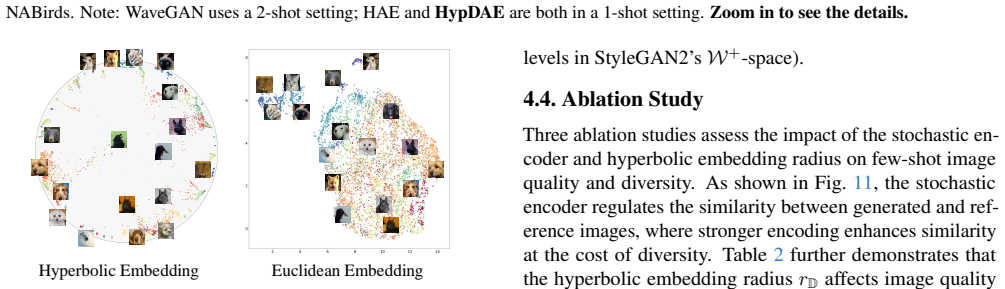
HypDAE's central discovery is that the semantic space of a diffusion autoencoder can be re-organized as a hierarchy by pushing codes into a Poincaré disk with a hyperbolic classification loss. Fine-grained, unambiguous images land near the disk's edge; abstract, ambiguous images land near the center. Because distances in the disk grow exponentially with radius, the learned radius $r_{\mathbb{D}}$ of a code becomes a proxy for semantic specificity, and editing a code—rescaling it, interpolating along a geodesic, or fusing two codes at a shared radius—produces images that vary first in identity-irrelevant attributes and only later in identity, as the code approaches the center. The paper then uses this radius control to generate diverse one-shot images of unseen categories, reporting better FID and LPIPS than prior GAN-based methods and a user-study preference.
Load-bearing premise
The load-bearing premise is that, after training, the learned distance of a semantic code to the disk center really indexes semantic abstraction, so that rescaling to a smaller radius edits identity-irrelevant attributes before identity-relevant ones; the paper validates this mainly with qualitative visualizations rather than a controlled quantitative test.
Editorial extensions
If this is right
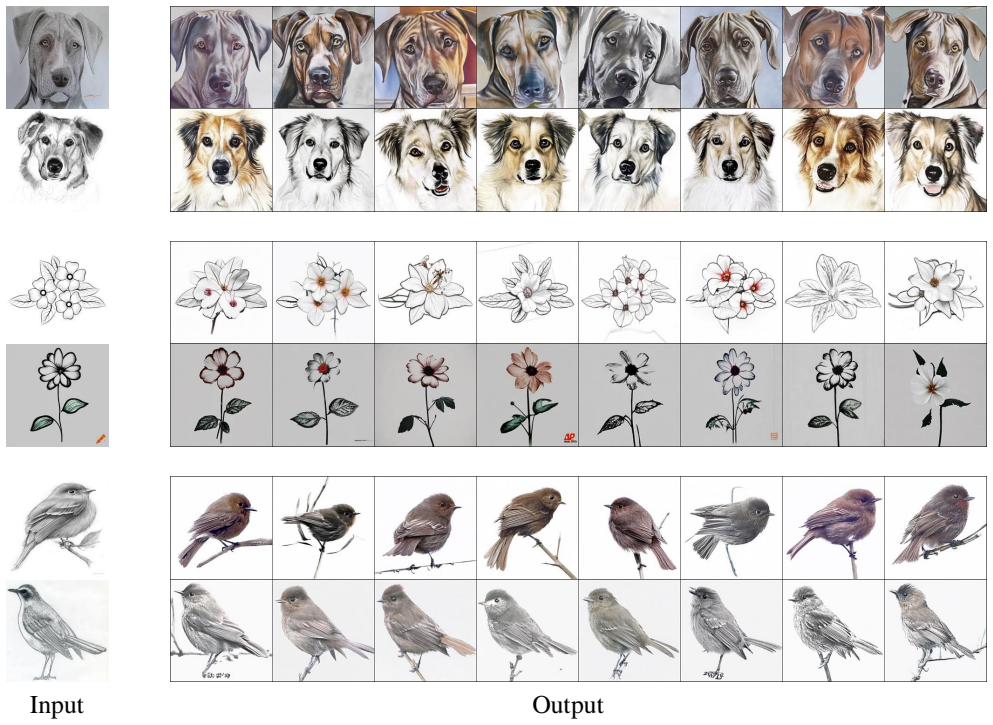
- From one reference image, varying the stochastic subcode or shifting the semantic code along an identity-irrelevant geodesic direction yields diverse images that preserve category identity in a one-shot setting without test-time fine-tuning.
- Rescaling a code to smaller radii increases semantic diversity, with identity-relevant changes appearing below roughly $r_{\mathbb{D}}\approx 2.0$ and identity-irrelevant changes above roughly $r_{\mathbb{D}}\approx 5.0$; the best quality-diversity trade-off is near $r_{\mathbb{D}}\approx 5.5$.
- Smooth geodesic interpolation in hyperbolic space changes identity-irrelevant attributes before identity-relevant ones, whereas Euclidean interpolation changes both together.
- Pseudo-labels from a pre-trained vision-language model suffice: HypDAE with pseudo-labels matches or beats the real-label variant, so human-annotated labels are not required for learning the hierarchy.
- The same radius mechanism gives continuous attribute fusion at arbitrary semantic levels, whereas GAN-based generators support only finite fusion levels.
Reading between the lines
- Inference: the radius-as-abstraction claim would be much stronger if tested with a controlled perceptual-attribute probe; without one, $r_{\mathbb{D}}$ could be confounded with CLIP embedding confidence or norm, since the paper's own ablations show diversity still increasing at small radii where identity drift also appears.
- Inference: because the method relies on a frozen CLIP image encoder, the hierarchy is inherited from CLIP's pretraining; replacing CLIP with a different general-purpose image encoder and checking whether radius semantics survive would reveal how much of the hierarchy is geometric versus representation-specific.
- Inference: the pseudo-label result suggests that label noise may act as a regularizer for hierarchy learning; a testable extension is to corrupt real labels at increasing rates and compare FID and LPIPS against the pseudo-label run, which would separate the effect of noise from the effect of CLIP's class-name priors.
- Inference: the same disk-radius mechanism could apply beyond image categories, such as controlling the granularity of generated 3D shapes or video frames, since the hyperbolic decoder is agnostic to the data modality, though the paper does not demonstrate this.
Editorial analysis
A structured set of objections, weighed in public.
Referee Report
Summary. The paper introduces HypDAE, a two-stage diffusion autoencoder for few-shot image generation in which a high-level semantic subcode is mapped into hyperbolic space via a learned encoder and used as a conditioning signal for a frozen Stable Diffusion decoder, while a stochastic subcode captures low-level variation. The method is evaluated on Animal Faces, Flowers, VGGFaces, NABirds, and FFHQ, reporting FID and LPIPS improvements over GAN-based baselines, with additional user-study and qualitative evaluations. The central claim is that the hyperbolic radius r_D of a semantic code indexes the level of semantic abstraction, so that rescaling a code toward the center of the Poincaré disk edits identity-relevant attributes before identity-irrelevant ones, thereby providing interpretable control over diversity. The authors also propose replacing human class labels with CLIP-based pseudo-labels and report that HypDAE with pseudo-labels outperforms HypDAE with real labels on most datasets.
Significance. If the central claim holds, HypDAE would be a substantive advance: it brings diffusion-based generation to the few-shot setting while adding a continuous, interpretable control over semantic diversity, and it weakens the requirement for human-annotated labels through pseudo-labeling. The paper's strengths include the use of a strong, recently-proposed base model (Stable Diffusion), a clear two-stage pipeline with sensible objectives, ablations over the main hyperparameters (r_D, CFG scale, encoding strength, λ), and the release of code. The quantitative gains over prior GAN-based methods in Table 1 are large and the qualitative figures show plausible improvements in fidelity and diversity. However, the paper's most distinctive claim, that r_D corresponds to semantic abstraction level, is supported only by qualitative visualizations and aggregate similarity metrics, not by a controlled attribute-level test; and the pseudo-label results raise a serious question about whether the hyperbolic classification loss is actually responsible for the observed behavior. These issues are central to the contribution and must be addressed before the claim can be accepted.
major comments (4)
- [Sec. 3.1, Sec. 4.3, Table 3] The assertion that r_D indexes semantic abstraction level is load-bearing but is not quantitatively established. Sec. 4.3 claims that 'identity-relevant attributes change below r_D≈2.0, while identity-irrelevant attributes vary above r_D≈5.0', yet the only evidence is the UMAP visualization (Fig. 10), qualitative samples (Figs. 5, 12), and aggregate FID/LPIPS/CLIP-S/CLIP-P sweeps (Tabs. 2, 3, 5). Table 3 shows that decreasing r_D moves generated images away from the reference and toward a perturbed image in CLIP space, which is consistent with any latent-perturbation magnitude effect and does not identify which attributes change. A controlled test is needed, for example measuring per-attribute classification accuracy (gender, age, expression, hairstyle, etc.) as a function of r_D on the same input identity, or using a paired human evaluation that asks annotators which attributes changed at each radius. Without such a test, the hierarchy-specific editing claim reduces to a generic scaling of a latent perturbation.
- [Sec. 4.4, Sec. 6 (supp.), Table 1] The pseudo-label results are internally puzzling and undermine the interpretation that the radial ordering is learned from the classification loss. The reported pseudo-label accuracies are 48.9% on Animal Faces, 41.5% on VGGFaces, and 39.1% on NABirds, yet HypDAE(Pseudo) outperforms HypDAE(Real) on most benchmarks in Table 1. With such noisy supervision, the hyperbolic encoder trained with Eq. (5) should not learn a reliable semantic hierarchy, so the improvement suggests that the radial behavior of r_D may be driven by the rescaling operation itself rather than by the learned hierarchy. The paper needs an explicit test of this, for example training Stage II with shuffled labels or with no classification loss at all and checking whether the r_D sweep in Tabs. 2 and 3 still exhibits the same monotonic trends. If it does, the contribution's central controllability claim is not supported by the current experiments.
- [Sec. 4.4, Tabs. 1–7] The final reported numbers use hyperparameters selected on the same datasets that are then reported as the state-of-the-art table. The values r_D=5.5, encoding strength 0.95, and CFG=1.3 are chosen from ablations on Animal Faces and Flowers (Tabs. 2, 3, 5, 6, 7) and then applied to all datasets in Table 1. No seeds, error bars, or significance tests are reported, so the headline differences—for example 23.96 vs. 24.43 FID on Flowers—cannot be assessed for statistical reliability. At minimum, the authors should report results across multiple seeds (or fixed seeds for the baselines) and ideally hold out a validation split for hyperparameter selection. This is essential for a paper claiming 'state-of-the-art' performance.
- [Table 1, Fig. 9, Sec. 14 (supp.)] The comparison protocol is not uniform across baselines. Table 1 lists DAWSON/F2GAN/WaveGAN/F2DGAN under a 3-shot setting, DeltaGAN/SAGE/HAE/LSO under 1-shot, and Fig. 9/Table 4 note that WaveGAN actually uses a 2-shot setting. The VGGFaces footnote further reports different numbers of unseen categories per baseline (e.g., 552 vs. 96 vs. 497 vs. 572), which can materially change FID. The authors should either align all methods to the same number of shots and unseen categories, or explicitly justify why the mixed protocol is fair. Without this, the magnitude of the reported gains is not reliable.
minor comments (6)
- [Eq. (3)] There is a mismatched parenthesis in Eq. (3): the expression '∥ϵ−ϵ θ (zt, t,c))∥2^2' contains an extra closing parenthesis before the norm.
- [Sec. 4.2] The text states VGGFaces has 64×64 resolution and then says FFHQ is used to fine-tune and visualize, but Table 1 reports FID on VGGFaces; please clarify at which resolution the FID is computed and whether all baselines use the same pre-processing.
- [Sec. 6 (supp.)] The pseudo-labeling description for VGGFaces says 'DeepFace predicts pseudo-labels by comparing the face embedding of an image with embeddings of known identities,' but it is not specified whether the reference database uses one image per class and how that interacts with the 572 unseen categories; a clearer description of the label space would help.
- [Sec. 4.3] The phrase 'infinite semantic levels for attribute fusion' (Sec. 4.3) is an overstatement; the paper demonstrates a continuous parameter sweep, not an infinite capacity for distinct attribute levels.
- [Sec. 9 (supp.), Fig. 15] The figure showing the λ ablation is referenced but the caption does not specify whether the plotted values are FID, LPIPS, or both; please label the axes.
- [Sec. 14 (supp.)] The user study uses 30 volunteers and 20 original images, but no inter-annotator agreement or confidence intervals are reported; please add such statistics or at least state the raw score distributions.
Circularity Check
No significant circularity: HypDAE's radius-control claim is an empirical finding validated by external benchmarks, not a quantity fitted to its own output.
full rationale
The paper's central claim is that the Poincaré radius r_D correlates with semantic abstraction, so rescaling a code to smaller radii increases diversity while eventually changing identity. This is not circular: r_D is defined purely geometrically as the hyperbolic distance to the disk center (Sec. 3.4, Eq. 2), while 'semantic diversity' is measured independently by LPIPS, FID, CLIP-S/CLIP-P, and a user study. The mapping from small radius to high diversity is established empirically by sweeping r_D (Tables 2, 3, 5) and by qualitative/UMAP visualization; it is not baked into the loss functions (Eqs. 5-7), which supervise classification and reconstruction but not the radius-diversity relationship. The comparison to HAE [37] is a self-citation by the first author, but it is used only as motivation and as a baseline to be outperformed in Table 1; the method's own results are measured against external FID/LPIPS and a randomized user study, so the self-citation is not load-bearing. The pseudo-labeling results similarly rely on FID/LPIPS, not on CLIP's own similarity metrics, so the finding that HypDAE(Pseudo) beats HypDAE(Real) is not definitional. The weakest point of the paper is evidential, not circular: the claim that identity-relevant attributes change only below r_D≈2.0 and identity-irrelevant ones above r_D≈5.0 is supported mainly by qualitative samples rather than a controlled attribute-level test. That is a validity/evidence concern, not a reduction of the claim to its inputs, and under the circularity criteria it does not warrant a nonzero score.
Assumptions & free parameters
free parameters (4)
- Hyperbolic radius r_D for generation =
5.5
- Encoding strength of stochastic encoder =
0.95
- Classifier-free guidance scale =
1.3
- Loss trade-off parameter lambda =
0.1
assumptions (5)
- domain assumption Hyperbolic space (Poincaré disk) is a natural, low-distortion embedding for image semantic hierarchies.
- domain assumption CLIP zero-shot pseudo-labels are accurate enough to train a useful hyperbolic classifier.
- domain assumption Pre-trained Stable Diffusion V2.1 can decode category-level semantic codes into novel images in this setting.
- standard math Standard Riemannian geometry identities (exponential/logarithmic maps, Möbius operations, hyperbolic MLR) are correct as used.
- ad hoc to paper The chosen hyperparameters (r_D=5.5, encoding strength=0.95, CFG=1.3) transfer across datasets.
Cite this review
Pith. "Pith review of HypDAE: Hyperbolic Diffusion Autoencoders for Hierarchical Few-shot Image Generation." pith.science (2026). https://pith.science/paper/MFXNYLEM
@misc{pith2026241117784,
  author       = {Pith},
  title        = {Pith review of: HypDAE: Hyperbolic Diffusion Autoencoders for Hierarchical Few-shot Image Generation},
  year         = {2026},
  howpublished = {\url{https://pith.science/paper/MFXNYLEM}},
  note         = {Machine review of arXiv:2411.17784}
}
read the original abstract
Few-shot image generation aims to generate diverse and high-quality images for an unseen class given only a few examples in that class. A key challenge in this task is balancing category consistency and image diversity, which often compete with each other. Moreover, existing methods offer limited control over the attributes of newly generated images. In this work, we propose Hyperbolic Diffusion Autoencoders (HypDAE), a novel approach that operates in hyperbolic space to capture hierarchical relationships among images from seen categories. By leveraging pre-trained foundation models, HypDAE generates diverse new images for unseen categories with exceptional quality by varying stochastic subcodes or semantic codes. Most importantly, the hyperbolic representation introduces an additional degree of control over semantic diversity through the adjustment of radii within the hyperbolic disk. Extensive experiments and visualizations demonstrate that HypDAE significantly outperforms prior methods by achieving a better balance between preserving category-relevant features and promoting image diversity with limited data. Furthermore, HypDAE offers a highly controllable and interpretable generation process.
Figures


Figures from the paper (24 more)






Reference graph
Works this paper leans on
-
[1]
Data augmentation generative adversarial networks.arXiv preprint arXiv:1711.04340, 2017
Antreas Antoniou, Amos Storkey, and Harrison Edwards. Data augmentation generative adversarial networks.arXiv preprint arXiv:1711.04340, 2017. 1
arXiv 2017
-
[2]
Sergey Bartunov and Dmitry P. Vetrov. Few-shot generative modelling with generative matching networks. InAISTATS,
-
[3]
Stochastic gradient descent on riemannian manifolds.IEEE Transactions on Automatic Control, 58(9): 2217–2229, 2013
Silvère Bonnabel. Stochastic gradient descent on riemannian manifolds.IEEE Transactions on Automatic Control, 58(9): 2217–2229, 2013. 3
2013
-
[4]
Riemannian adaptive optimization methods
Gary Bécigneul and Octavian-Eugen Ganea. Riemannian adaptive optimization methods. InICLR, 2019. 3
2019
-
[5]
Masactrl: Tuning-free mutual self-attention control for consistent image synthesis and edit- ing
Mingdeng Cao, Xintao Wang, Zhongang Qi, Ying Shan, Xi- aohu Qie, and Yinqiang Zheng. Masactrl: Tuning-free mutual self-attention control for consistent image synthesis and edit- ing. InICCV, pages 22560–22570, 2023. 1, 2
work page 2023
-
[6]
Hyperbolic graph convolutional neural networks
Ines Chami, Rex Ying, Christopher Ré, and Jure Leskovec. Hyperbolic graph convolutional neural networks. InNeurIPS, page 4868–4879, 2019. 3, 4
work page 2019
-
[7]
Wenhu Chen, Hexiang Hu, Yandong Li, Nataniel Ruiz, Xuhui Jia, Ming-Wei Chang, and William W. Cohen. Subject- driven text-to-image generation via apprenticeship learning. InNeurIPS, 2023. 3
work page 2023
-
[8]
Figr: Few-shot image generation with reptile.arXiv preprint arXiv:1901.02199,
Louis Clouâtre and Marc Demers. Figr: Few-shot image generation with reptile.arXiv preprint arXiv:1901.02199,
arXiv 1901
Show all 83 references
-
[9]
Learning joint latent space ebm prior model for multi-layer generator
Jiali Cui, Ying Nian Wu, and Tian Han. Learning joint latent space ebm prior model for multi-layer generator. InCVPR, pages 3603–3612, 2023. 2
2023
-
[10]
Giannis Daras and Alexandros G. Dimakis. Multiresolution textual inversion. InNeurIPS Workshop, 2022. 2
2022
-
[11]
Hyper- bolic image-text representations
Karan Desai, Maximilian Nickel, Tanmay Rajpurohit, Justin Johnson, and Shanmukha Ramakrishna Vedantam. Hyper- bolic image-text representations. InICML, pages 7694–7731. PMLR, 2023. 3
2023
-
[12]
Embedding text in hyperbolic spaces.arXiv preprint arXiv:1806.04313, 2018
Bhuwan Dhingra, Chris Shallue, Mohammad Norouzi, An- drew Dai, and George Dahl. Embedding text in hyperbolic spaces.arXiv preprint arXiv:1806.04313, 2018. 2
2018 arXiv
-
[13]
Attribute group editing for reliable few-shot image generation
Guanqi Ding, Xinzhe Han, Shuhui Wang, Shuzhe Wu, Xin Jin, Dandan Tu, and Qingming Huang. Attribute group editing for reliable few-shot image generation. InCVPR, pages 11184– 11193, 2022. 1, 2
2022
-
[14]
Stable attribute group edit- ing for reliable few-shot image generation.arXiv preprint arXiv:2302.00179, 2023
Guanqi Ding, Xinzhe Han, Shuhui Wang, Xin Jin, Dan- dan Tu, and Qingming Huang. Stable attribute group edit- ing for reliable few-shot image generation.arXiv preprint arXiv:2302.00179, 2023. 1, 2, 6, 7, 12, 17
2023 arXiv
-
[15]
Dreamartist: Towards controllable one-shot text-to-image generation via positive- negative prompt-tuning.arXiv preprint arXiv:2211.11337,
Ziyi Dong, Pengxu Wei, and Liang Lin. Dreamartist: Towards controllable one-shot text-to-image generation via positive- negative prompt-tuning.arXiv preprint arXiv:2211.11337,
-
[16]
Hyperbolic neural networks
Octavian-Eugen Ganea, Gary Bécigneul, and Thomas Hof- mann. Hyperbolic neural networks. InNeurIPS, pages 5345– 5355, 2018. 3, 5, 11
2018
-
[17]
Hyperbolic contrastive learning for visual representations beyond objects
Songwei Ge, Shlok Mishra, Simon Kornblith, Chun-Liang Li, and David Jacobs. Hyperbolic contrastive learning for visual representations beyond objects. InCVPR, 2023. 8
2023
-
[18]
Hyperbolic groups
Michael Gromov. Hyperbolic groups. InEssays in group theory, 1987. 3
1987
-
[19]
Lofgan: Fusing local representations for fewshot image gen- eration
Zheng Gu, Wenbin Li, Jing Huo, Lei Wang, and Yang Gao. Lofgan: Fusing local representations for fewshot image gen- eration. InICCV, 2021. 1, 2
2021
-
[20]
Highly personalized text embedding for image manipulation by stable diffusion.arXiv preprint arXiv:2303.08767, 2023
Inhwa Han, Serin Yang, Taesung Kwon, and Jong Chul Ye. Highly personalized text embedding for image manipulation by stable diffusion.arXiv preprint arXiv:2303.08767, 2023. 2
2023 arXiv
-
[21]
Svdiff: Compact parameter space for diffusion fine-tuning
Ligong Han, Yinxiao Li, Han Zhang, Peyman Milanfar, Dim- itris Metaxas, and Feng Yang. Svdiff: Compact parameter space for diffusion fine-tuning. InCVPR, 2023. 3
2023
-
[22]
Gans trained by a two time-scale update rule converge to a local nash equilibrium
Martin Heusel, Hubert Ramsauer, Thomas Unterthiner, Bern- hard Nessler, and Sepp Hochreiter. Gans trained by a two time-scale update rule converge to a local nash equilibrium. InNeurIPS, 2017. 8
2017
-
[23]
Classifier-free diffusion guidance
Jonathan Ho and Tim Salimans. Classifier-free diffusion guidance. InNIPS Workshop, 2022. 14
2022
-
[24]
Denoising dif- fusion probabilistic models
Jonathan Ho, Ajay Jain, and Pieter Abbeel. Denoising dif- fusion probabilistic models. InNeurIPS, pages 6840–6851,
-
[25]
Deltagan: Towards diverse few-shot image generation with sample-specific delta
Yan Hong, Li Niu, Jianfu Zhang, Jing Liang, and Liqing Zhang. Deltagan: Towards diverse few-shot image generation with sample-specific delta. InCVPR, 2020. 1
2020
-
[26]
Match- inggan: Matching-based few-shot image generation
Yan Hong, Li Niu, Jianfu Zhang, and Liqing Zhang. Match- inggan: Matching-based few-shot image generation. In2020 IEEE International Conference on Multimedia and Expo (ICME), pages 1–6, 2020. 1, 2
2020
-
[27]
F2gan: Fusing-and-filling gan for few- shot image generation
Yan Hong, Li Niu, Jianfu Zhang, Weijie Zhao, Chen Fu, and Liqing Zhang. F2gan: Fusing-and-filling gan for few- shot image generation. InProceedings of the 28th ACM International Conference on Multimedia, page 2535–2543. Association for Computing Machinery, 2020. 1, 2, 7
2020
-
[28]
Deltagan: Towards diverse few-shot image generation with sample-specific delta
Yan Hong, Li Niu, Jianfu Zhang, Jing Liang, and Liqing Zhang. Deltagan: Towards diverse few-shot image generation with sample-specific delta. InECCV, 2022. 1, 2, 7
2022
-
[29]
Few-shot image generation using discrete content representation
Yan Hong, Li Niu, Jianfu Zhang, and Liqing Zhang. Few-shot image generation using discrete content representation. In Proceedings of the 30th ACM International Conference on Multimedia, page 2796–2804, New York, NY , USA, 2022. Association for Computing Machinery. 1, 2
2022
-
[30]
A style-based generator architecture for generative adversarial networks
Tero Karras, Samuli Laine, and Timo Aila. A style-based generator architecture for generative adversarial networks. In CVPR, pages 4217–4228, 2019. 6, 11, 12
2019
-
[31]
Hyperbolic image embeddings
Valentin Khrulkov, Leyla Mirvakhabova, Evgeniya Ustinova, Ivan Oseledets, and Victor Lempitsky. Hyperbolic image embeddings. InCVPR, pages 6417–6427, 2020. 2, 3, 13
2020
-
[32]
Adam: A method for stochastic optimization.arXiv:1412.6980, 2014
Diederik P Kingma and Jimmy Ba. Adam: A method for stochastic optimization.arXiv:1412.6980, 2014. 12
2014 arXiv
-
[33]
Multi-concept customization of text- to-image diffusion
Nupur Kumari, Bingliang Zhang, Richard Zhang, Eli Shecht- man, and Jun-Yan Zhu. Multi-concept customization of text- to-image diffusion. InCVPR, 2023. 1, 2
2023
-
[34]
Riemannian manifolds: an introduction to cur- vature.Springer Science & Business Media, 176, 2006
John M Lee. Riemannian manifolds: an introduction to cur- vature.Springer Science & Business Media, 176, 2006. 5
2006
-
[35]
Springer,
John M Lee.Introduction to Smooth Manifolds. Springer,
-
[36]
Hypersdfusion: Bridging hierarchical structures in language and geometry for enhanced 3d text2shape genera- tion
Zhiying Leng, Tolga Birdal, Xiaohui Liang, and Federico Tombari. Hypersdfusion: Bridging hierarchical structures in language and geometry for enhanced 3d text2shape genera- tion. InCVPR, pages 19691–19700, 2024. 3
2024
-
[37]
The euclidean space is evil: Hyperbolic attribute editing for few-shot image generation
Lingxiao Li, Yi Zhang, and Shuhui Wang. The euclidean space is evil: Hyperbolic attribute editing for few-shot image generation. InICCV, pages 22714–22724, 2023. 1, 2, 3, 6, 7, 8, 11, 12, 17
2023
-
[38]
Dawson: A do- main adaptive few shot generation framework.arXiv preprint arXiv:2001.00576, 2020
Weixin Liang, Zixuan Liu, and Can Liu. Dawson: A do- main adaptive few shot generation framework.arXiv preprint arXiv:2001.00576, 2020. 1, 2, 7
2001 arXiv
-
[39]
Few-shot unsueprvised image-to-image translation
Ming-Yu Liu, Xun Huang, Arun Mallya, Tero Karras, Timo Aila, Jaakko Lehtinen, and Jan Kautz. Few-shot unsueprvised image-to-image translation. InICCV, 2019. 6, 11, 12, 15
2019
-
[40]
Umap: Uniform manifold approximation and projection.The Journal of Open Source Software, 3(29):861,
Leland McInnes, John Healy, Nathaniel Saul, and Lukas Grossberger. Umap: Uniform manifold approximation and projection.The Journal of Open Source Software, 3(29):861,
-
[41]
Generative visual manipulation on the natural image manifold
Maximillian Nickel and Douwe Kiela. Generative visual manipulation on the natural image manifold. InECCV, 2017. 2, 3
2017
-
[42]
Learning continuous hierarchies in the lorentz model of hyperbolic geometry
Maximillian Nickel and Douwe Kiela. Learning continuous hierarchies in the lorentz model of hyperbolic geometry. In ICML, 2018. 3
2018
-
[43]
Automated flower classification over a large number of classes
Maria-Elena Nilsback and Andrew Zisserman. Automated flower classification over a large number of classes. In2008 Sixth Indian Conference on Computer Vision, Graphics & Image Processing, pages 722–729, 2008. 6, 11, 12, 15
2008
-
[44]
Unsupervised hyperbolic representation learning via message passing auto-encoders
Jiwoong Park, Junho Cho, Hyung Jin Chang, and Jin Young Choi. Unsupervised hyperbolic representation learning via message passing auto-encoders. InCVPR, pages 5512–5522,
-
[45]
Parkhi, Andrea Vedaldi, and Andrew Zisserman
Omkar M. Parkhi, Andrea Vedaldi, and Andrew Zisserman. Deep face recognition. InBritish Machine Vision Conference,
-
[46]
Moment matching for multi-source domain adaptation
Xingchao Peng, Qinxun Bai, Xide Xia, Zijun Huang, Kate Saenko, and Bo Wang. Moment matching for multi-source domain adaptation. InICCV, 2019. 15
2019
-
[47]
Diffusion autoencoders: Toward a meaningful and decodable representation
Konpat Preechakul, Nattanat Chatthee, Suttisak Wizad- wongsa, and Supasorn Suwajanakorn. Diffusion autoencoders: Toward a meaningful and decodable representation. InCVPR,
-
[48]
Learning transferable visual models from natural language supervision
Alec Radford, Jong Wook Kim, Chris Hallacy, Aditya Ramesh, Gabriel Goh, Sandhini Agarwal, Girish Sastry, Amanda Askell, Pamela Mishkin, Jack Clark, et al. Learning transferable visual models from natural language supervision. InICML, 2021. 2, 4
2021
-
[49]
Hierarchical text-conditional image genera- tion with clip latents.arXiv:2204.06125, 2022
Aditya Ramesh, Prafulla Dhariwal, Alex Nichol, Casey Chu, and Mark Chen. Hierarchical text-conditional image genera- tion with clip latents.arXiv:2204.06125, 2022. 1
2022 arXiv
-
[50]
High-resolution image synthesis with latent diffusion models
Robin Rombach, Andreas Blattmann, Dominik Lorenz, Patrick Esser, and Björn Ommer. High-resolution image synthesis with latent diffusion models. InCVPR, pages 10684– 10695, 2022. 1, 2, 6, 11
2022
-
[51]
Dreambooth: Fine tuning text-to-image diffusion models for subject-driven gen- eration
Nataniel Ruiz, Yuanzhen Li, Varun Jampani, Yael Pritch, Michael Rubinstein, and Kfir Aberman. Dreambooth: Fine tuning text-to-image diffusion models for subject-driven gen- eration. InCVPR, pages 22500–22510, 2023. 1, 2
2023
-
[52]
In- stantbooth: Personalized text-to-image generation without test-time finetuning
Jing Shi, Wei Xiong, Zhe Lin, and Hyun Joon Jung. In- stantbooth: Personalized text-to-image generation without test-time finetuning. InCVPR, 2024. 3
2024
-
[53]
Denoising diffusion implicit models
Jiaming Song, Chenlin Meng, and Stefano Ermon. Denoising diffusion implicit models. InICLR, 2021. 4
2021
-
[54]
Score-based generative modeling through stochastic differential equations
Yang Song, Jascha Sohl-Dickstein, Diederik P Kingma, Ab- hishek Kumar, Stefano Ermon, and Ben Poole. Score-based generative modeling through stochastic differential equations. InICLR, 2021. 1
2021
-
[55]
Learning the predictability of the future
Dídac Surís, Ruoshi Liu, and Carl V ondrick. Learning the predictability of the future. InCVPR, pages 12602–12612,
-
[56]
Improved vector quantized diffusion models
Zhicong Tang, Shuyang Gu, Jianmin Bao, Dong Chen, and Fang Wen. Improved vector quantized diffusion models. arXiv:2205.16007, 2022. 14
2022 arXiv
-
[57]
Poincaré glove: Hyperbolic word embeddings
Alexandru Tifrea, Gary Bécigneul, and OctavianEugen Ganea. Poincaré glove: Hyperbolic word embeddings. InICLR, 2019. 2, 3
2019
-
[58]
Building a bird recognition app and large scale dataset with citizen scientists: The fine print in fine-grained dataset collection
Grant Van Horn, Steve Branson, Ryan Farrell, Scott Haber, Jessie Barry, Panos Ipeirotis, Pietro Perona, and Serge Be- longie. Building a bird recognition app and large scale dataset with citizen scientists: The fine print in fine-grained dataset collection. InCVPR, 2015. 6, 11, 12, 15
2015
-
[59]
P+: Extended textual conditioning in text-to-image generation.arXiv preprint arXiv:2303.09522, 2023
Andrey V oynov, Qinghao Chu, Daniel Cohen-Or, and Kfir Aberman. P+: Extended textual conditioning in text-to-image generation.arXiv preprint arXiv:2303.09522, 2023. 2
2023 arXiv
-
[60]
Paint by ex- ample: Exemplar-based image editing with diffusion models
Binxin Yang, Shuyang Gu, Bo Zhang, Ting Zhang, Xuejin Chen, Xiaoyan Sun, Dong Chen, and Fang Wen. Paint by ex- ample: Exemplar-based image editing with diffusion models. InCVPR, pages 18381–18391, 2023. 11
2023
-
[61]
Wavegan: Frequency-aware gan for high-fidelity few-shot image generation
Mengping Yang, Zhe Wang, Ziqiu Chi, and Wenyi Feng. Wavegan: Frequency-aware gan for high-fidelity few-shot image generation. InECCV, pages 1–17. Springer, 2022. 1, 2, 7, 8, 11, 17
2022
-
[62]
Ip- adapter: Text compatible image prompt adapter for text-to- image diffusion models.arXiv preprint arxiv:2308.06721,
Hu Ye, Jun Zhang, Sibo Liu, Xiao Han, and Wei Yang. Ip- adapter: Text compatible image prompt adapter for text-to- image diffusion models.arXiv preprint arxiv:2308.06721,
-
[63]
Adding conditional control to text-to-image diffusion models
Lvmin Zhang, Anyi Rao, and Maneesh Agrawala. Adding conditional control to text-to-image diffusion models. In CVPR, pages 3813–3824, 2023. 14
2023
-
[64]
The unreasonable effectiveness of deep features as a perceptual metric
Richard Zhang, Phillip Isola, Alexei A Efros, Eli Shechtman, and Oliver Wang. The unreasonable effectiveness of deep features as a perceptual metric. InCVPR, pages 586–595,
-
[65]
Where is my spot? few-shot image generation via latent subspace optimization
Chenxi Zheng, Bangzhen Liu, Huaidong Zhang, Xuemiao Xu, and Shengfeng He. Where is my spot? few-shot image generation via latent subspace optimization. InCVPR, pages 3272–3281, 2023. 2, 7
2023
-
[66]
Exact fusion via feature distribution match- ing for few-shot image generation
Yingbo Zhou, Yutong Ye, Pengyu Zhang, Xian Wei, and Mingsong Chen. Exact fusion via feature distribution match- ing for few-shot image generation. InCVPR, pages 8383– 8392, 2024. 1, 7 Supplementary Material Overview This appendix is organized as follows: Sec. 6 gives more impl...
2024
-
[67]
Implementation Details and Analysis Stage I.As mentioned in Sec 3.2, this stage does not require class labels for the images. To promote diversity, we use only the CLIP image encoder’s class token (dimension 1×1024 ) for a compact representation, aligning it with the CLIP text...
-
[69]
forward process
Additional Background - Diffusion Models Diffusion Denoising Probabilistic Models (DDPM) [24] are generative latent variable models that aim to model a distri- bution pθ(x0) that approximates the data distribution q(x0) and easy to sample from. DDPMs model a “forward process” ...
-
[70]
children
Hyperbolic Neural Networks For hyperbolic spaces, since the metric is different from Euclidean space, the corresponding calculation operators also differ from Euclidean space. In this section, we start by defining two basic operations: Möbius addition and Möbius scalar multipl...
-
[71]
parent” im- ages,HypDAEcontrols the semantic diversity of gener- ated images (Fig. 24), where the “parent
Ablation Study There are a few hyperparameters ofHypDAEthat control the generation quality and diversity. We conduct ablation studies on each of them in this section. Hyperbolic Radius.By varying the radii of “parent” im- ages,HypDAEcontrols the semantic diversity of gener- at...
-
[72]
Comparison with Euclidean space In this section, we present a detailed comparison of different latent spaces, as shown in Fig. 18. Compared to classical Eu- clidean space, hyperbolic space enables smoother transitions between two given images. In hyperbolic space, identity- ir...
-
[73]
painting
Out-of-distribution Few-shot Image Gener- ation In Sec 4.2 of the main paper, we mentioned we fine-tuned the model trained with VGGFaces using the FFHQ dataset. The model shows exceptional out-of-distribution general- ization ability on the FFHQ dataset. To further verify the ...
-
[74]
children
Hierarchical Image Generation In this section, we provide additional examples of images generated byHypDAEat varying radii in the Poincaré disk. 𝑥𝑟𝑒𝑓 Latent Space Interpolation 𝑥𝑟𝑒𝑓′ Figure 19.More results of interpolation in hyperbolic spaceon FFHQ, NABirds, and Flowers datas...
-
[75]
As shown in Fig
Comparison with State-of-the-art Few-shot Image Generation Method We compare images generated by state-of-the-art methods, including WaveGAN [ 61], HAE [ 37], and our proposed method, across four datasets. As shown in Fig. 27, Wave- GAN produces high-fidelity images, but the d...
-
[76]
Results are shown in the main text
User Study As mentioned, we conducted an extensive user study with a fully randomized survey. Results are shown in the main text. Specifically, we comparedHypDAEwith three other models WaveGAN [61], HAE [37], and SAGE [14]:
-
[77]
Overall, there were 20 original images and 60 generated variants in total
We randomly chose 5 images from four datasets, and for each image, we then generated 3 variants in 1-shot setting (WaveGAN used 2-shot setting), respectively. Overall, there were 20 original images and 60 generated variants in total
-
[78]
We then shuffled the orders for all images
For each sample of each model, we present one masked background image, a reference object, and the generated image to annotators. We then shuffled the orders for all images
-
[79]
Fidelity
We recruited 30 volunteers from diverse backgrounds and provided detailed guidelines and templates for evaluation. Annotators rated the images on a scale of 1 to 4 across three criteria: “Fidelity”, “Quality”, and “Diversity”. “Fi- delity” evaluates identity preservation, whil...
-
[80]
28 and Fig
Additional Examples Generated by Hyp- DAE Finally, we provide more examples generated byHypDAE in Fig. 28 and Fig. 29 for four datasets. The results show that our method achieves a balance between the quality and diver- sity of the generated images which significantly outperfo...
-
[81]
Fidelity: If the generated image preserves its original input category/identity
-
[82]
Quality: If the quality of the generated images is good (with details and looks like real images)
-
[83]
Diversity: If the generated images have novel views or poses Problem 1: Input the score for Fidelity Problem 2: Input the score for Quality Problem 3: Input the score for Diversity 0 0 0 Figure 30.The illustration of the user study interface
-
[256]
(7) in the main paper is selected as 0.1
The λ in Eq. (7) in the main paper is selected as 0.1. We choose the AdamW [32] optimizer and set the learning rate as 1e−3. A linear learning rate scheduler is used with a step size equal to 5000, with a multiplier γ= 0.5 . We train about 1e5 steps to get the model to converg...
Reviewed August 12, 2026 · model on record in the stance chip above.
Discussion (0). Continue with ORCID to comment.