REVIEW 4 major objections 5 minor 51 references
Low-rank Adaptation-based All-Weather Removal for Autonomous Navigation
T0 review · 4 major / 5 minor · reviewed 2026-08-12 · deepseek-v4-flash
Pith's one-line read The paper claims that a pre-trained all-weather restoration model can learn a novel weather degradation with roughly 1% of its parameters trainable via LoRA, and that an SVD-based alignment variant preserves its performance on the…
desk verdict A solid application of LoRA to all-weather restoration, with a plausible but unverified alignment mechanism; the evaluation is single-task and the spectral assumption needs checking. read the letter →
The pith
A machine-rendered reading of the paper's core claim, the machinery that carries it, and where it could break.
The reading
What carries the argument
The central mechanism is Low-Rank Adaptation (LoRA): the pre-trained weight matrix $W$ is frozen and only a low-rank update $\Delta W = AB$ with small rank $r$ is learned. LoRA-Align adds an SVD-based alignment loop: after each LoRA iteration, it decomposes both $W$ and $W_{\mathrm{new}} = W + \Delta W$, resolves the SVD sign ambiguity by flipping the top-$k$ singular vectors of $W_{\mathrm{new}}$ when $\|u_i - u_i^{\mathrm{new}}\|_2 / \|u_i + u_i^{\mathrm{new}}\|_2$ exceeds a threshold $T$, and then penalizes the diagonal of $I - U_{\mathrm{new}}^T U$ and $I - V_{\mathrm{new}}^T V$ with the loss $L_{\mathrm{align}} = 0.5(\mathrm{Mean}(\mathrm{Diag}(I - U_{\mathrm{new}}^T U)^2) + \mathrm{Mean}(\mathrm{Diag}(I - V_{\mathrm{new}}^T V)^2))$. The total loss is $L_1$ plus a weighted alignment term, so the model is pulled to keep the new task's restoration quality while preserving the pre-trained task's singular structure.
What would settle it
Train LoRA-A on a novel degradation whose optimal low-rank update is known to rotate the top singular subspace of $W$, for instance a degradation requiring a fundamentally different filter orientation or a task where the best rank-4 update has low overlap with $W$'s top-16 singular vectors, and measure whether the alignment loss hurts novel-task PSNR relative to plain LoRA. If such a rotation exists and LoRA-A loses more than the roughly 0.28 dB seen for raindrops, the one-to-one alignment assumption fails. A cheaper check is to compute the principal angles between the top-$k$ singular subspaces of $W$ and $W_{\mathrm{new}}$ after plain LoRA training on several novel tasks; if the angles are large, the diagonal alignment loss is comparing misaligned directions.
Extended reading notes
Core claim
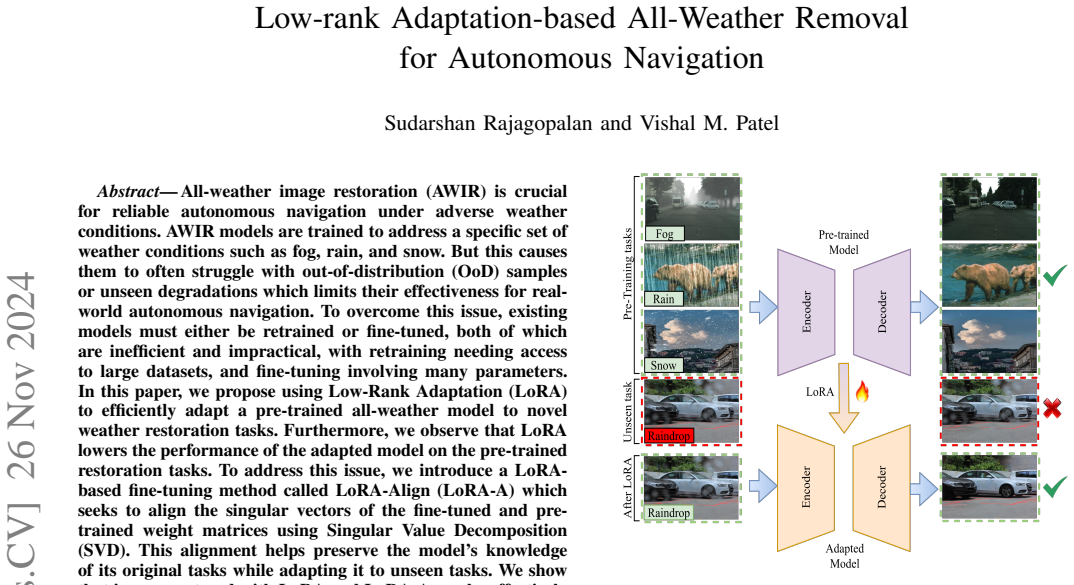
On the paper's own terms, the central discovery is that the weight updates needed to teach an all-weather restoration network a new degradation are low-rank, so LoRA alone matches full fine-tuning on the novel task while learning only about 0.55M of PromptIR's 35.4M parameters (about 1.55%) and 0.26M of TransWeather's 38.31M parameters (about 0.68%). The second discovery is LoRA-Align: after each LoRA iteration, decompose the updated weight matrix $W_{\mathrm{new}}$ and the frozen pre-trained weight $W$ via SVD, resolve the sign ambiguity of singular vectors, and add a loss that pulls the top-$k$ left and right singular vectors of $W_{\mathrm{new}}$ toward those of $W$. This preserves the model's knowledge of its original tasks, recovering on average over 1.38 dB for PromptIR and 1.35 dB for TransWeather on pre-trained tasks, with a small trade-off of about 0.28 dB on the novel raindrop-removal task. The paper also finds that adapting both attention and MLP layers in both encoder and decoder at rank 4 gives the best balance, and that larger $k$ in the alignment loss improves pre-trained task retention at the cost of novel-task performance.
Load-bearing premise
The load-bearing premise is that the top singular vectors of the adapted weight matrix remain roughly aligned, up to sign, with the corresponding singular vectors of the pre-trained matrix; if adaptation rotates or reorders the top singular subspaces, the sign-correction heuristic and the diagonal alignment loss compare unrelated directions and the method over-constrains the new task.
Editorial extensions
If this is right
- An autonomous vehicle could carry one frozen all-weather restoration backbone and swap in a tiny LoRA adapter for each newly encountered weather condition, rather than retraining or storing multiple full models.
- LoRA adaptation of an AWIR model reaches the same raindrop-removal quality as full fine-tuning with about 1.55% (PromptIR) or 0.68% (TransWeather) of the parameters, and at rank 32 or 64 it slightly exceeds full fine-tuning on the novel task.
- LoRA-Align recovers most pre-trained task performance, on average 1.38 dB (PromptIR) and 1.35 dB (TransWeather) over plain LoRA, with only about 0.28 dB loss on the novel task.
- Restoring images with LoRA- or LoRA-A-adapted models improves downstream Mask2Former semantic segmentation and Depth Anything depth estimation on both the novel raindrop task and the pre-trained fog task.
- LoRA's effectiveness does not depend on which three weather tasks were used for pre-training; across four task combinations the adapted model is competitive with full fine-tuning on the held-out fourth task.
Reading between the lines
- The paper does not test the sign-correction assumption under a novel degradation whose optimal low-rank update strongly rotates the top singular subspaces; if such a rotation occurs, the diagonal alignment loss in Eq. (3) could compare unrelated directions and over-constrain the new task. Testing on a corruption with a very different filter structure, such as motion blur or nighttime glare, would
- The alignment loss is architecture-agnostic in principle, so the same SVD-alignment idea could be applied to LoRA fine-tuning of other vision backbones that must retain source-task knowledge, for instance adapting a segmentation or depth model to a new domain while keeping its old-domain accuracy.
- The reported optimal hyperparameters ($k=16$, threshold $T=7$, alignment weight 100) are tuned on PromptIR and TransWeather; for other restoration architectures or larger ranks, these constants would likely need re-tuning, and the paper does not show a rule for choosing them.
Editorial analysis
A structured set of objections, weighed in public.
Referee Report
Summary. The paper proposes using Low-Rank Adaptation (LoRA) to adapt pre-trained all-weather image restoration (AWIR) models to novel degradation tasks, and introduces LoRA-Align (LoRA-A), an SVD-based method that aligns the top singular vectors of the adapted weight matrices with those of the pre-trained model in order to preserve performance on the original tasks. Experiments on PromptIR and TransWeather show that LoRA reaches near full fine-tuning performance on raindrop removal with roughly 1% of the trainable parameters, that LoRA-A recovers part of the pre-trained task performance at a small cost on the novel task, and that images restored by the adapted models improve downstream semantic segmentation and depth estimation.
Significance. The LoRA-based result is a useful and fairly well-supported contribution: it demonstrates that parameter-efficient adaptation is viable for low-level vision tasks such as all-weather restoration, and the comparisons against full fine-tuning and re-training are informative. The LoRA-A idea is interesting, and the paper is transparent about its ablations and evaluation protocol. However, the current evidence for the LoRA-A mechanism is narrower than the paper's claims: it is tested on only one novel degradation, its central alignment assumption is not verified, and several hyperparameters appear to be selected on the same test sets used for the final numbers. If these points are addressed, the paper would be a solid empirical contribution to efficient adaptation for image restoration.
major comments (4)
- [Sec. III-B, Eq. (3)] The alignment loss in Eq. (3) is diagonal and implicitly assumes that each top singular vector of Wnew is either approximately equal to or sign-flipped from the corresponding singular vector of W. The sign-correction rule in steps 2 and 3 only handles near-antipodal pairs: with T=7, R_i becomes large only when the angle between ui and uinew is close to 180 degrees, so moderate rotations or reorderings of near-degenerate singular subspaces are not corrected. A rank-4 update can rotate or reorder such subspaces even when ||Delta W|| is small, and the paper does not report spectral gaps for W or check the assumed one-to-one correspondence during training. Since the claimed preservation mechanism is precisely this vector alignment, please provide empirical evidence that the correspondence holds (for example, correlations of the top-k singular vectors over training, or subspace distances) or soften the interpretation; as written, Eq. (3) may over-constrain Wnew and explains the consistent small novel-task drops in Table I.
- [Sec. IV-C, Tables I and II] LoRA-A is validated only on raindrop removal as the novel task, whereas Table II, which tests three different pre-training/target task combinations, reports results only for fine-tuning and LoRA. Consequently, the claim that LoRA-A preserves pre-trained task performance while adapting to unseen degradations is not supported beyond a single task. Please add LoRA-A results to Table II or evaluate it on at least one additional novel degradation before making the general claim.
- [Sec. IV-D and Sec. IV-A] The hyperparameters k, walign, and T appear to have been selected using the same test datasets reported in the final tables. In particular, Table VI varies k and reports test PSNR on Raindrop and Rain100L, and the chosen k=16 is justified by those test numbers; no separate validation split is described. This test-set tuning can make the reported trade-off optimistic. Please specify a validation protocol, or at least report the final test numbers from a single configuration chosen before test evaluation, and ideally include multiple seeds to assess variance.
- [Sec. IV-E, Tables VII and VIII] The downstream navigation evaluation uses pseudo-ground-truth: Mask2Former predictions on clean images are used as ground truth for semantic segmentation on Raindrop, and Depth Anything predictions on clean images are used as ground truth for depth estimation on both raindrop removal and defogging. This makes the downstream claim dependent on the quality and bias of these downstream models. The paper should state this limitation more prominently and, if feasible, include at least one evaluation with real annotations or an additional error analysis to show that the reported improvements are not an artifact of the pseudo-ground-truth.
minor comments (5)
- [Sec. III-B, Eq. (3)] The expression Mean(Diag(I - S)^2) should clarify that the squaring is element-wise on the diagonal entries before averaging; otherwise the notation is ambiguous.
- [Sec. IV-C] The phrase 'recovers over 1.38 dB of performance (on the average)' is unclear; please specify how the average is computed across the pre-trained tasks and report the individual task values.
- [Sec. IV-D, Table VI] The paper does not provide error bars or multiple-seed results, and several reported differences are small (for example, 29.63 versus 29.35 dB on the novel task). Adding variance information would help the reader judge whether the differences are meaningful.
- [Sec. IV-A] The choice of T=7 is not justified, and the paper does not report how sensitive the LoRA-A results are to this threshold; a short sensitivity study or a sentence explaining the choice would strengthen the paper.
- [General] The project page is mentioned but no code repository link is provided; releasing code would improve reproducibility and is especially helpful for a method whose central mechanism is a new loss term.
Circularity Check
No significant circularity: LoRA-A's alignment loss is a training objective and its task-preservation claims are independently measured on external benchmarks.
full rationale
The derivation chain is self-contained. LoRA-A's alignment loss Lalign (Eq. 3) directly minimizes differences between singular vectors of Wnew and W, but the paper never presents 'alignment' as a prediction; alignment is an explicit optimization objective. The load-bearing claims are that adding this regularizer preserves pre-trained task PSNR while adapting to raindrop removal, and those outcomes are measured on external test sets (Table I) rather than implied by the loss definition. The sign-correction and one-to-one correspondence assumption in Sec. III-B is a stated heuristic that may fail under subspace rotation, but an unsupported or fragile assumption is a correctness risk, not circularity. Self-citations such as TransWeather [13] and dehazing works [1,2] by author Patel are used as backbone models and related work, not as evidence for the LoRA-A mechanism or as an imported uniqueness theorem. No fitted parameter is renamed as a prediction, no ansatz is smuggled through citation, and no known result is merely renamed. The central empirical claims are grounded against external benchmarks, so the circularity score is 0.
Assumptions & free parameters
free parameters (5)
- LoRA rank r =
4
- k (number of singular vectors aligned) =
16
- walign (alignment loss weight) =
100
- T (sign-flip threshold) =
7
- adaptation subset size =
1000 images
assumptions (4)
- domain assumption LoRA assumption that task-specific weight updates during AWIR fine-tuning are low-rank.
- domain assumption Top-k singular vectors of W and Wnew correspond one-to-one after sign correction.
- domain assumption Alignment loss on singular vectors transfers to PSNR/SSIM preservation on original tasks.
- domain assumption Clean-image pseudo-ground-truth from Mask2Former and Depth Anything is a valid proxy for navigation performance.
Cite this review
Pith. "Pith review of Low-rank Adaptation-based All-Weather Removal for Autonomous Navigation." pith.science (2026). https://pith.science/paper/FJYLIQZJ
@misc{pith2026241117814,
  author       = {Pith},
  title        = {Pith review of: Low-rank Adaptation-based All-Weather Removal for Autonomous Navigation},
  year         = {2026},
  howpublished = {\url{https://pith.science/paper/FJYLIQZJ}},
  note         = {Machine review of arXiv:2411.17814}
}
read the original abstract
All-weather image restoration (AWIR) is crucial for reliable autonomous navigation under adverse weather conditions. AWIR models are trained to address a specific set of weather conditions such as fog, rain, and snow. But this causes them to often struggle with out-of-distribution (OoD) samples or unseen degradations which limits their effectiveness for real-world autonomous navigation. To overcome this issue, existing models must either be retrained or fine-tuned, both of which are inefficient and impractical, with retraining needing access to large datasets, and fine-tuning involving many parameters. In this paper, we propose using Low-Rank Adaptation (LoRA) to efficiently adapt a pre-trained all-weather model to novel weather restoration tasks. Furthermore, we observe that LoRA lowers the performance of the adapted model on the pre-trained restoration tasks. To address this issue, we introduce a LoRA-based fine-tuning method called LoRA-Align (LoRA-A) which seeks to align the singular vectors of the fine-tuned and pre-trained weight matrices using Singular Value Decomposition (SVD). This alignment helps preserve the model's knowledge of its original tasks while adapting it to unseen tasks. We show that images restored with LoRA and LoRA-A can be effectively used for computer vision tasks in autonomous navigation, such as semantic segmentation and depth estimation.
Figures


Figures from the paper (2 more)


Reference graph
Works this paper leans on
-
[1]
Joint transmission map estimation and dehazing using deep networks,
H. Zhang, V . Sindagi, and V . M. Patel, “Joint transmission map estimation and dehazing using deep networks,” IEEE Transactions on Circuits and Systems for Video Technology , vol. 30, no. 7, pp. 1975– 1986, 2020
work page 1975
-
[2]
Densely connected pyramid dehazing network,
H. Zhang and V . M. Patel, “Densely connected pyramid dehazing network,” in 2018 IEEE/CVF Conference on Computer Vision and Pattern Recognition (CVPR), 2018, pp. 3194–3203
work page 2018
-
[3]
Contrastive learning for compact single image dehazing,
H. Wu, Y . Qu, S. Lin, J. Zhou, R. Qiao, Z. Zhang, Y . Xie, and L. Ma, “Contrastive learning for compact single image dehazing,” in 2021 IEEE/CVF Conference on Computer Vision and Pattern Recognition (CVPR), 2021, pp. 10 546–10 555
work page 2021
-
[4]
Spatial attentive single-image deraining with a high quality real rain dataset,
T. Wang, X. Yang, K. Xu, S. Chen, Q. Zhang, and R. W. Lau, “Spatial attentive single-image deraining with a high quality real rain dataset,” in 2019 IEEE/CVF Conference on Computer Vision and Pattern Recognition (CVPR), 2019, pp. 12 262–12 271
work page 2019
-
[5]
Semi-supervised transfer learning for image rain removal,
W. Wei, D. Meng, Q. Zhao, Z. Xu, and Y . Wu, “Semi-supervised transfer learning for image rain removal,” in 2019 IEEE/CVF Confer- ence on Computer Vision and Pattern Recognition (CVPR) , 2019, pp. 3872–3881
work page 2019
-
[6]
Removing raindrops and rain streaks in one go,
R. Quan, X. Yu, Y . Liang, and Y . Yang, “Removing raindrops and rain streaks in one go,” in 2021 IEEE/CVF Conference on Computer Vision and Pattern Recognition (CVPR) , 2021, pp. 9143–9152
work page 2021
-
[7]
Deep dense multi-scale network for snow removal using semantic and depth priors,
K. Zhang, R. Li, Y . Yu, W. Luo, and C. Li, “Deep dense multi-scale network for snow removal using semantic and depth priors,” IEEE Transactions on Image Processing , vol. 30, pp. 7419–7431, 2021
work page 2021
-
[8]
W.-T. Chen, H.-Y . Fang, J.-J. Ding, C.-C. Tsai, and S.-Y . Kuo, “Jstasr: Joint size and transparency-aware snow removal algorithm based on modified partial convolution and veiling effect removal.” Berlin, Heidelberg: Springer-Verlag, 2020. [Online]. Available: https://doi.org/10.1007/978-3-030-58589-1 45
Show all 51 references
-
[9]
Restormer: Efficient transformer for high-resolution image restoration,
S. W. Zamir, A. Arora, S. Khan, M. Hayat, F. S. Khan, and M.- H. Yang, “Restormer: Efficient transformer for high-resolution image restoration,” in CVPR, 2022
2022
-
[10]
Multi-stage progressive image restoration,
S. W. Zamir, A. Arora, S. Khan, M. Hayat, F. S. Khan, M.-H. Yang, and L. Shao, “Multi-stage progressive image restoration,” in CVPR, 2021
2021
-
[11]
Swinir: Image restoration using swin transformer,
J. Liang, J. Cao, G. Sun, K. Zhang, L. Van Gool, and R. Timofte, “Swinir: Image restoration using swin transformer,” in2021 IEEE/CVF International Conference on Computer Vision Workshops (ICCVW) , 2021, pp. 1833–1844
2021
-
[12]
All in one bad weather removal using architectural search,
R. Li, R. T. Tan, and L.-F. Cheong, “All in one bad weather removal using architectural search,” in 2020 IEEE/CVF Conference on Com- puter Vision and Pattern Recognition (CVPR) , 2020, pp. 3172–3182
2020
-
[13]
Transweather: Transformer-based restoration of images degraded by adverse weather conditions,
J. J. Valanarasu, R. Yasarla, and V . M. Patel, “Transweather: Transformer-based restoration of images degraded by adverse weather conditions,” in 2022 IEEE/CVF Conference on Computer Vision and Pattern Recognition (CVPR), 2022, pp. 2343–2353
2022
-
[14]
All-in-one image restoration for unknown corruption,
B. Li, X. Liu, P. Hu, Z. Wu, J. Lv, and X. Peng, “All-in-one image restoration for unknown corruption,” in 2022 IEEE/CVF Conference on Computer Vision and Pattern Recognition (CVPR) , 2022, pp. 17 431–17 441
2022
-
[15]
Promptir: Prompting for all-in-one image restoration,
V . Potlapalli, S. W. Zamir, S. Khan, and F. Khan, “Promptir: Prompting for all-in-one image restoration,” in Thirty-seventh Conference on Neural Information Processing Systems , 2023
2023
-
[16]
Multi- weather image restoration via domain translation,
P. W. Patil, S. Gupta, S. Rana, S. Venkatesh, and S. Murala, “Multi- weather image restoration via domain translation,” in Proceedings of the IEEE/CVF International Conference on Computer Vision (ICCV) , October 2023, pp. 21 696–21 705
2023
-
[17]
Lora: Low-rank adaptation of large language models,
E. J. Hu, Y . Shen, P. Wallis, Z. Allen-Zhu, Y . Li, S. Wang, L. Wang, and W. Chen, “Lora: Low-rank adaptation of large language models,” arXiv preprint arXiv:2106.09685 , 2021
2021 arXiv
-
[18]
Parameter-efficient transfer learning for nlp,
N. Houlsby, A. Giurgiu, S. Jastrzebski, B. Morrone, Q. De Laroussilhe, A. Gesmundo, M. Attariyan, and S. Gelly, “Parameter-efficient transfer learning for nlp,” in International conference on machine learning . PMLR, 2019, pp. 2790–2799
2019
-
[19]
Adapter- fusion: Non-destructive task composition for transfer learning,
J. Pfeiffer, A. Kamath, A. R ¨uckl´e, K. Cho, and I. Gurevych, “Adapter- fusion: Non-destructive task composition for transfer learning,” arXiv preprint arXiv:2005.00247, 2020
2005 arXiv
-
[20]
Pre-train, prompt, and predict: A systematic survey of prompting methods in natural language processing,
P. Liu, W. Yuan, J. Fu, Z. Jiang, H. Hayashi, and G. Neubig, “Pre-train, prompt, and predict: A systematic survey of prompting methods in natural language processing,” ACM Comput. Surv., vol. 55, no. 9, jan 2023. [Online]. Available: https://doi.org/10.1145/3560815
2023 doi
-
[21]
Chain-of-thought prompting elicits reasoning in large language models,
J. Wei, X. Wang, D. Schuurmans, M. Bosma, F. Xia, E. Chi, Q. V . Le, D. Zhou, et al., “Chain-of-thought prompting elicits reasoning in large language models,” Advances in neural information processing systems, vol. 35, pp. 24 824–24 837, 2022
2022
-
[22]
Lora+: Efficient low rank adaptation of large models,
S. Hayou, N. Ghosh, and B. Yu, “Lora+: Efficient low rank adaptation of large models,” arXiv preprint arXiv:2402.12354 , 2024
2024 arXiv
-
[23]
Adalora: Adaptive budget allocation for parameter-efficient fine-tuning,
Q. Zhang, M. Chen, A. Bukharin, N. Karampatziakis, P. He, Y . Cheng, W. Chen, and T. Zhao, “Adalora: Adaptive budget allocation for parameter-efficient fine-tuning,” arXiv preprint arXiv:2303.10512 , 2023
2023 arXiv
-
[24]
A survey on lora of large language models,
Y . Mao, Y . Ge, Y . Fan, W. Xu, Y . Mi, Z. Hu, and Y . Gao, “A survey on lora of large language models,” 2024. [Online]. Available: https://arxiv.org/abs/2407.11046
2024 arXiv
-
[25]
Teaching struc- tured vision & language concepts to vision & language models,
S. Doveh, A. Arbelle, S. Harary, E. Schwartz, R. Herzig, R. Giryes, R. Feris, R. Panda, S. Ullman, and L. Karlinsky, “Teaching struc- tured vision & language concepts to vision & language models,” in Proceedings of the IEEE/CVF Conference on Computer Vision and Pattern Recogni...
2023
-
[26]
Low-rank few-shot adaptation of vision- language models,
M. Zanella and I. Ben Ayed, “Low-rank few-shot adaptation of vision- language models,” in Proceedings of the IEEE/CVF Conference on Computer Vision and Pattern Recognition , 2024, pp. 1593–1603
2024
-
[27]
Explora: Parameter-efficient extended pre-training to adapt vision transformers under domain shifts,
S. Khanna, M. Irgau, D. B. Lobell, and S. Ermon, “Explora: Parameter-efficient extended pre-training to adapt vision transformers under domain shifts,” 2024. [Online]. Available: https://arxiv.org/abs/ 2406.10973
2024
-
[28]
Single image haze removal using dark channel prior,
K. He, J. Sun, and X. Tang, “Single image haze removal using dark channel prior,” in 2009 IEEE Conference on Computer Vision and Pattern Recognition, 2009, pp. 1956–1963
2009
-
[29]
Fields of experts: a framework for learning image priors,
S. Roth and M. Black, “Fields of experts: a framework for learning image priors,” in 2005 IEEE Computer Society Conference on Com- puter Vision and Pattern Recognition (CVPR’05) , vol. 2, 2005, pp. 860–867 vol. 2
2005
-
[30]
Automatic single-image-based rain streaks removal via image decomposition,
L.-W. Kang, C.-W. Lin, and Y .-H. Fu, “Automatic single-image-based rain streaks removal via image decomposition,” IEEE Transactions on Image Processing, vol. 21, no. 4, pp. 1742–1755, 2012
2012
-
[31]
Recurrent squeeze-and- excitation context aggregation net for single image deraining,
X. Li, J. Wu, Z. Lin, H. Liu, and H. Zha, “Recurrent squeeze-and- excitation context aggregation net for single image deraining,” in European Conference on Computer Vision. Springer, 2018, pp. 262– 277
2018
-
[32]
I can see clearly now: Im- age restoration via de-raining,
H. Porav, T. Bruls, and P. Newman, “I can see clearly now: Im- age restoration via de-raining,” in 2019 International Conference on Robotics and Automation (ICRA) , 2019, pp. 7087–7093
2019
-
[33]
Enhanced pix2pix dehazing network,
Y . Qu, Y . Chen, J. Huang, and Y . Xie, “Enhanced pix2pix dehazing network,” in 2019 IEEE/CVF Conference on Computer Vision and Pattern Recognition (CVPR), 2019, pp. 8152–8160
2019
-
[34]
Desnownet: Context-aware deep network for snow removal,
Y .-F. Liu, D.-W. Jaw, S.-C. Huang, and J.-N. Hwang, “Desnownet: Context-aware deep network for snow removal,” IEEE Transactions on Image Processing , vol. 27, no. 6, pp. 3064–3073, 2018
2018
-
[35]
All snow removed: Single image desnowing algorithm using hierarchical dual-tree complex wavelet representation and contradict channel loss,
W.-T. Chen, H.-Y . Fang, C.-L. Hsieh, C.-C. Tsai, I.-H. Chen, J.-J. Ding, and S.-Y . Kuo, “All snow removed: Single image desnowing algorithm using hierarchical dual-tree complex wavelet representation and contradict channel loss,” in 2021 IEEE/CVF International Con- ference o...
2021
-
[36]
Learning multiple adverse weather removal via two-stage knowledge learning and multi-contrastive regularization: Toward a unified model,
W.-T. Chen, Z.-K. Huang, C.-C. Tsai, H.-H. Yang, J.-J. Ding, and S.- Y . Kuo, “Learning multiple adverse weather removal via two-stage knowledge learning and multi-contrastive regularization: Toward a unified model,” 2022
2022
-
[37]
Learning weather-general and weather-specific features for image restoration under multiple adverse weather conditions,
Y . Zhu, T. Wang, X. Fu, X. Yang, X. Guo, J. Dai, Y . Qiao, and X. Hu, “Learning weather-general and weather-specific features for image restoration under multiple adverse weather conditions,” in 2023 IEEE/CVF Conference on Computer Vision and Pattern Recognition (CVPR), 2023,...
2023
-
[38]
Restoring vision in adverse weather conditions with patch-based denoising diffusion models,
O. ¨Ozdenizci and R. Legenstein, “Restoring vision in adverse weather conditions with patch-based denoising diffusion models,” IEEE Trans- actions on Pattern Analysis and Machine Intelligence, pp. 1–12, 2023
2023
-
[39]
Llama: Open and efficient foundation language models,
H. Touvron, T. Lavril, G. Izacard, X. Martinet, M.-A. Lachaux, T. Lacroix, B. Rozi`ere, N. Goyal, E. Hambro, F. Azhar, et al., “Llama: Open and efficient foundation language models,” arXiv preprint arXiv:2302.13971, 2023
2023 arXiv
-
[40]
Visual prompt tuning,
M. Jia, L. Tang, B.-C. Chen, C. Cardie, S. Belongie, B. Hariharan, and S.-N. Lim, “Visual prompt tuning,” in European Conference on Computer Vision. Springer, 2022, pp. 709–727
2022
-
[41]
Segment anything,
A. Kirillov, E. Mintun, N. Ravi, H. Mao, C. Rolland, L. Gustafson, T. Xiao, S. Whitehead, A. C. Berg, W.-Y . Lo, et al. , “Segment anything,” in Proceedings of the IEEE/CVF International Conference on Computer Vision , 2023, pp. 4015–4026
2023
-
[42]
T2i- adapter: Learning adapters to dig out more controllable ability for text- to-image diffusion models,
C. Mou, X. Wang, L. Xie, Y . Wu, J. Zhang, Z. Qi, and Y . Shan, “T2i- adapter: Learning adapters to dig out more controllable ability for text- to-image diffusion models,” in Proceedings of the AAAI Conference on Artificial Intelligence , vol. 38, no. 5, 2024, pp. 4296–4304
2024
-
[43]
Vera: Vector-based random matrix adaptation,
D. J. Kopiczko, T. Blankevoort, and Y . M. Asano, “Vera: Vector-based random matrix adaptation,” arXiv preprint arXiv:2310.11454 , 2023
2023 arXiv
-
[44]
Dora: Weight-decomposed low-rank adaptation,
S.-Y . Liu, C.-Y . Wang, H. Yin, P. Molchanov, Y .-C. F. Wang, K.- T. Cheng, and M.-H. Chen, “Dora: Weight-decomposed low-rank adaptation,” arXiv preprint arXiv:2402.09353 , 2024
2024 arXiv
-
[45]
Semantic understanding of foggy scenes with purely synthetic data,
M. Hahner, D. Dai, C. Sakaridis, J.-N. Zaech, and L. V . Gool, “Semantic understanding of foggy scenes with purely synthetic data,” in 2019 IEEE Intelligent Transportation Systems Conference (ITSC) , 2019, pp. 3675–3681
2019
-
[46]
Deep joint rain detection and removal from a single image,
W. Yang, R. T. Tan, J. Feng, J. Liu, Z. Guo, and S. Yan, “Deep joint rain detection and removal from a single image,” in 2017 IEEE Conference on Computer Vision and Pattern Recognition (CVPR) , 2017, pp. 1685–1694
2017
-
[47]
Attentive generative adversarial network for raindrop removal from a single image,
R. Qian, R. T. Tan, W. Yang, J. Su, and J. Liu, “Attentive generative adversarial network for raindrop removal from a single image,” in The IEEE Conference on Computer Vision and Pattern Recognition (CVPR), June 2018
2018
-
[48]
Automatic differen- tiation in pytorch,
A. Paszke, S. Gross, S. Chintala, G. Chanan, E. Yang, Z. DeVito, Z. Lin, A. Desmaison, L. Antiga, and A. Lerer, “Automatic differen- tiation in pytorch,” 2017
2017
-
[49]
Masked-attention mask transformer for universal image segmenta- tion,
B. Cheng, I. Misra, A. G. Schwing, A. Kirillov, and R. Girdhar, “Masked-attention mask transformer for universal image segmenta- tion,” in Proceedings of the IEEE/CVF conference on computer vision and pattern recognition , 2022, pp. 1290–1299
2022
-
[50]
Depth anything: Unleashing the power of large-scale unlabeled data,
L. Yang, B. Kang, Z. Huang, X. Xu, J. Feng, and H. Zhao, “Depth anything: Unleashing the power of large-scale unlabeled data,” in CVPR, 2024
2024
-
[51]
Depth map prediction from a single image using a multi-scale deep network,
D. Eigen, C. Puhrsch, and R. Fergus, “Depth map prediction from a single image using a multi-scale deep network,” in Proceedings of the 27th International Conference on Neural Information Processing Systems - Volume 2, ser. NIPS’14. Cambridge, MA, USA: MIT Press, 2014, p. 2366–2374
2014
Reviewed August 12, 2026 · model on record in the stance chip above.
Discussion (0). Continue with ORCID to comment.