REVIEW 3 major objections 5 minor 32 references
ESS-ReduNet: Enhancing Subspace Separability of ReduNet via Dynamic Expansion with Bayesian Inference
T0 review · 3 major / 5 minor · reviewed 2026-08-12 · deepseek-v4-flash
Pith's one-line read Dynamic expansion weighting plus Bayesian membership correction makes ReduNet converge in about a tenth of the layers and yields better-separated, more classifiable features.
desk verdict Promising plug-in fixes for ReduNet, but the headline speedup relies on an unfair stopping-rule comparison and needs re-benchmarking. read the letter →
The pith
A machine-rendered reading of the paper's core claim, the machinery that carries it, and where it could break.
The reading
What carries the argument
The central object is the per-layer ReduNet update $z_{\ell+1}\propto z_\ell+\eta(E_\ell z_\ell-\sum_j\gamma_j C_\ell^j z_\ell \hat{\pi}_j(z_\ell))$, where $E_\ell=\alpha(I+\alpha Z_\ell Z_\ell^T)^{-1}$ is the expansion operator (shown to be approximately the ridge-regression residual, i.e., projection onto the complement of the spanned space) and $C_\ell^j$ are compression operators. ESS-ReduNet's mechanism is the weighted expansion $w(\tau_\ell)E_\ell z_\ell$ with $w(\tau)=\min(\exp(\tau),u)$ and $\tau$ incremented by 0.1 on every layer with estimation errors, combined with Bayesian-corrected memberships $p_c^i(z_\ell)$ defined through the confusion posterior $P(z\in C_i\mid z\to C_j)$. A condition number $\sigma_{\max}/\sigma_{\min}$ of the matrices in $E_\ell$ and $C_\ell^j$ serves as an auxiliary early-stopping signal. Together these pieces enlarge the overall spanned space so class subspaces decouple, and correct the membership estimates so samples move toward the right subspace.
What would settle it
Train ESS-ReduNet on a dataset whose intrinsic dimension equals the lifted feature dimension, leaving no orthogonal complement for the expansion operator to enlarge the span; if the estimation-function errors still vanish and convergence remains rapid, the expansion schedule is not the operative mechanism, whereas a stall would confirm the paper's causal story.
Extended reading notes
Core claim
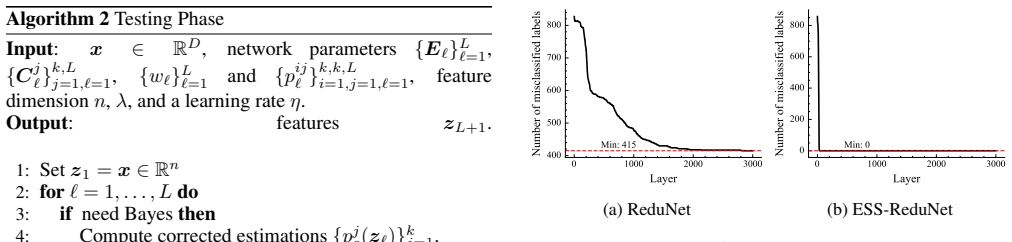
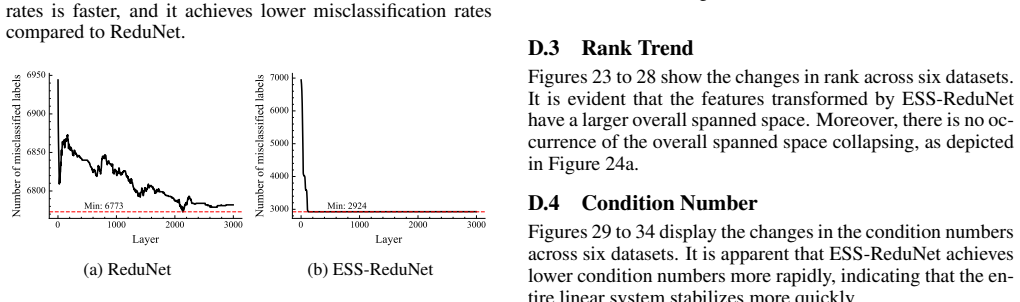
ReduNet builds each layer's parameters from the features of the previous layer, updating features by a gradient step of a maximal coding rate reduction objective. Its expansion operator $E_\ell$ pushes features into the complement of the spanned space, and its compression operators $C_\ell^j$ pull samples toward the subspace of class $j$, using estimated memberships instead of labels. ESS-ReduNet modifies this update in two ways: it multiplies the expansion term by a truncated exponential weight $w(\tau_\ell)=\min(\exp(\tau_\ell),u)$ that grows whenever the estimation function misclassifies a sample, and it replaces the raw membership estimate with a Bayesian posterior $p_c^i(z)=\sum_j P(z\in C_i\mid z\to C_j)\,\hat{\pi}_j(z)$ that is computed during training by comparing estimates with labels and then reused at test time. The paper reports that this joint modification reduces the number of layers needed for convergence from over 3000 to roughly 100 to 300 on four benchmark datasets, and on the ESR dataset it reduces misclassified membership estimates to zero by layer 19 while lifting SVM accuracy on the transformed features from 0.65 to 0.96.
Load-bearing premise
The claimed speedup rests on the unproved assumption that the hand-tuned rule for strengthening the expansion term, increasing its weight by a fixed amount every time any sample is misclassified, reliably separates class subspaces and never steers feature updates in the wrong direction, on any dataset.
Editorial extensions
If this is right
- ReduNet training becomes practical: instead of thousands of layers, a few hundred suffice for convergence on standard benchmarks, cutting the compute and storage of parameters.
- The plug-in modules, weighted expansion and Bayesian correction, carry over to the Fourier version of ReduNet and improve its accuracy as well.
- The condition-number halting rule gives a cheap stopping signal that prevents the feature-quality degradation seen when a poorly constructed network trains too long.
- Downstream classifiers such as SVM, KNN, and NSC benefit from the more orthogonalized features, with large gains on datasets that were previously challenging, including the ESR SVM accuracy jump from 0.65 to 0.96.
Reading between the lines
- The Bayesian posterior effectively converts training-time estimation errors into a confusion matrix, so ESS-ReduNet behaves like a self-training procedure that injects label information only when the unsupervised estimates are unreliable; the same correction could apply to other iterative subspace-clustering or self-supervised methods with soft memberships.
- The fixed schedule $\tau_{\ell+1}=\tau_\ell+0.1$ is a single global knob; on datasets with more classes or different scales, the same increment may overshoot or undershoot, so a dataset-dependent schedule driven by the observed misclassification rate is a natural testable extension.
- The geometric reading of the expansion operator as a residual projection suggests a convergence proof could be attempted under a margin condition on the class subspaces; the paper does not provide one, leaving a formal guarantee open.
- Because the condition number stabilizes earlier than the objective function, this stopping heuristic could serve as a general diagnostic for layer-wise-constructed white-box networks beyond ReduNet.
Editorial analysis
A structured set of objections, weighed in public.
Referee Report
Summary. This paper proposes ESS-ReduNet, a modification of the white-box ReduNet architecture that aims to improve subspace separability and accelerate convergence. Two main mechanisms are introduced: a Bayesian-inference correction of the class-membership estimates used in the layer-wise updates (so that label information can be reused at test time without inconsistency), and a dynamically weighted expansion operator that is strengthened when the training appears to stagnate. A condition-number-based stopping rule is also proposed as an auxiliary convergence criterion. The paper reports experiments on seven datasets, claiming more than a 10-fold reduction in the number of layers needed for convergence on four of them and large gains in SVM/KNN/NSC accuracy of the transformed features (e.g., 0.65 to 0.96 SVM accuracy on ESR). An ablation study indicates that both the Bayesian module and the dynamic expansion module contribute to the improvement.
Significance. If the reported gains are robust, the paper would make ReduNet training substantially more practical and would provide a useful case study in combining white-box, layer-wise constructed networks with label-derived Bayesian corrections. The geometric interpretation of the expansion operator (Section 4.2 and Appendix A) is a coherent and useful addition, and the ablation in Figure 9 provides evidence that both proposed modules are active ingredients. However, the central quantitative claims (10x layer reduction and 47% accuracy gain) are currently supported only under a comparison protocol that does not apply matched stopping rules to the baseline, and the hand-crafted expansion schedule is not analyzed for sensitivity. The paper does not release code or report multiple seeds, which limits the reproducibility of the empirical claims.
major comments (3)
- [Section 5.3, Table 1; Section 3, Figure 3d] The comparison between ESS-ReduNet and ReduNet is not made under matched stopping conditions. On the ESR dataset, Figure 3d shows ReduNet's condition number stabilizing around layer 1600, and the text in Section 3 explicitly says that further training of a poorly constructed network degrades feature quality. Yet Table 1 reports ReduNet's convergence layer as '>3000' and evaluates its SVM accuracy (0.65) at that over-run endpoint, while ESS-ReduNet is stopped at layer 199 by the condition-number criterion. This mismatched protocol inflates both the '>10x speedup' and the '47% SVM accuracy gain' claimed in the abstract. The authors should report ReduNet's accuracy at its own condition-number plateau (or at the same layer count as ESS-ReduNet) and apply the identical stopping rule to both methods across all datasets.
- [Section 4.2, Eq. (11); Algorithm 1 lines 10-13] The expansion schedule w(tau)=min(exp(tau),u) with tau incremented by 0.1 per error layer introduces two free parameters (the increment and the cap u) that are fixed without sensitivity analysis. The paper asserts that this schedule robustly enlarges the spanned space to decouple class subspaces, but no ablation over these parameters is given, and no convergence guarantee is provided. To support the claim that the method is not overly sensitive to hand-tuned dynamics, the authors should report results for at least a few values of the increment and cap, or justify their chosen values with a principled derivation.
- [Section 5 (all experiments)] All experimental results appear to be single runs with no error bars, multiple seeds, or significance testing, and no code is released. Since the paper's central claims are quantitative (layer reduction and accuracy improvement), the authors should release code and report statistics over multiple random initializations and train/test splits, or justify why single runs are sufficient for these claims.
minor comments (5)
- [Appendix A] The phrase 'spannd space' appears; it should be 'spanned space'.
- [Section 2.2] The word 'compresssion' should be 'compression' in the sentence about white-box transformers.
- [Figure 9a] The legend entries 'Bayes_1' through 'Bayes_9' and 'ReduNet_1' through 'ReduNet_9' are not explained in the text; the caption should state that they correspond to different channel numbers Nc.
- [Section 4.1, Eq. (7)] The subscripts in the posterior notation p_ij and P(z in C_i | z -> C_j) are not clearly defined; please specify the direction of the conditional (i.e., which index corresponds to the observed class and which to the true class) in the text.
- [Section 4.3] The stopping criterion 'no change on condition number' is not quantified; the authors should define the tolerance and the number of layers over which the change is checked, so that the stopping rule is reproducible.
Circularity Check
No significant circularity: the ESS-ReduNet updates are explicit supervised modifications of ReduNet, and the reported gains are empirical. The unmatched stopping rule is an experimental fairness concern, not a circular derivation.
full rationale
ESS-ReduNet's core updates (Algorithm 1 lines 10-13) combine a hand-set expansion weight w(τ)=min(exp(τ),u) with a Bayesian-corrected membership estimate p_c. These are defined independently of the downstream metrics (SVM/KNN/NSC accuracy, layer counts), so no output is fed back to define an input. The Bayesian correction (Eqs. 7-9) is a calibration of the estimator using training labels; using labels in training and then evaluating on the same task is standard supervised practice, not circular. The geometric reading of E_ℓ z_ℓ as a ridge-regression residual (Eqs. 10 and 12) is a standard Woodbury identity, not a self-referential derivation. Citations to Chan et al. (2022) supply the external ReduNet baseline; the cited Yu et al. (2020) concerns evaluation protocols; none of the load-bearing cited results are authored by the present paper's authors. One experimental-fairness issue should be distinguished from circularity: Section 3 says ReduNet's condition number 'stabilizes around the 1600th layer', yet Table 1 reports ReduNet's convergence layer as '> 3000' while ESS-ReduNet stops at 199. This may inflate the '>10x' speedup and the 47% SVM gain, but the layer counts are chosen evaluation endpoints rather than equation-level reductions of the claimed result to its inputs. Hence no significant circularity.
Assumptions & free parameters
free parameters (6)
- Expansion weight cap u =
10
- Expansion increment Δτ =
0.1
- Condition number stopping tolerance
- Estimation function parameter λ
- Channel number Nc
- Learning rate η and distortion ε² =
η=0.1, ε²=0.1
assumptions (5)
- domain assumption ReduNet's MCR2 objective and layer construction produce useful representations.
- ad hoc to paper Increasing the weight of the expansion operator improves subspace separability and estimation accuracy.
- domain assumption The posterior confusion matrix estimated on training labels at each layer is a valid correction for test samples.
- domain assumption Condition-number stability is a safe stopping criterion.
- standard math The Woodbury identity and the ridge-regression residual form in Appendix A are valid.
Cite this review
Pith. "Pith review of ESS-ReduNet: Enhancing Subspace Separability of ReduNet via Dynamic Expansion with Bayesian Inference." pith.science (2026). https://pith.science/paper/WW6PHLUS
@misc{pith2026241117961,
  author       = {Pith},
  title        = {Pith review of: ESS-ReduNet: Enhancing Subspace Separability of ReduNet via Dynamic Expansion with Bayesian Inference},
  year         = {2026},
  howpublished = {\url{https://pith.science/paper/WW6PHLUS}},
  note         = {Machine review of arXiv:2411.17961}
}
read the original abstract
ReduNet is a deep neural network model that leverages the principle of maximal coding rate \textbf{redu}ction to transform original data samples into a low-dimensional, linear discriminative feature representation. Unlike traditional deep learning frameworks, ReduNet constructs its parameters explicitly layer by layer, with each layer's parameters derived based on the features transformed from the preceding layer. Rather than directly using labels, ReduNet uses the similarity between each category's spanned subspace and the data samples for feature updates at each layer. This may lead to features being updated in the wrong direction, impairing the correct construction of network parameters and reducing the network's convergence speed. To address this issue, based on the geometric interpretation of the network parameters, this paper presents ESS-ReduNet to enhance the separability of each category's subspace by dynamically controlling the expansion of the overall spanned space of the samples. Meanwhile, label knowledge is incorporated with Bayesian inference to encourage the decoupling of subspaces. Finally, stability, as assessed by the condition number, serves as an auxiliary criterion for halting training. Experiments on the ESR, HAR, Covertype, and Gas datasets demonstrate that ESS-ReduNet achieves more than 10x improvement in convergence compared to ReduNet. Notably, on the ESR dataset, the features transformed by ESS-ReduNet achieve a 47\% improvement in SVM classification accuracy.
Figures


Figures from the paper (22 more)





Reference graph
Works this paper leans on
- [1]
-
[7]
[Fang et al., 2021] Cong Fang, Hangfeng He, Qi Long, and Weijie J. Su. Exploring deep neural networks via layer- peeled model: Minority collapse in imbalanced train- ing. Proceedings of the National Academy of Sciences , 118(43):e2103091118, October
work page 2021
-
[10]
[He et al., 2016] Kaiming He, Xiangyu Zhang, Shaoqing Ren, and Jian Sun
arXiv:2010.03697 [cs]. [He et al., 2016] Kaiming He, Xiangyu Zhang, Shaoqing Ren, and Jian Sun. Deep residual learning for image recog- nition. In Proceedings of the IEEE conference on computer vision and pattern recognition, pages 770–778,
arXiv 2010
-
[11]
[Hinton and Salakhutdinov, 2006] G. E. Hinton and R. R. Salakhutdinov. Reducing the Dimensionality of Data with Neural Networks. Science, 313(5786):504–507, July
work page 2006
-
[12]
Deep subspace clustering net- works
[Ji et al., 2017] Pan Ji, Tong Zhang, Hongdong Li, Mathieu Salzmann, and Ian Reid. Deep subspace clustering net- works. Advances in neural information processing sys- tems, 30,
work page 2017
-
[15]
Gradient-based learning ap- plied to document recognition
[LeCun et al., 1998] Yann LeCun, L ´eon Bottou, Yoshua Bengio, and Patrick Haffner. Gradient-based learning ap- plied to document recognition. Proceedings of the IEEE, 86(11):2278–2324,
1998
-
[16]
[Lezama et al., 2018] Jos´e Lezama, Qiang Qiu, Pablo Mus´e, and Guillermo Sapiro
Publisher: Ieee. [Lezama et al., 2018] Jos´e Lezama, Qiang Qiu, Pablo Mus´e, and Guillermo Sapiro. Ole: Orthogonal low-rank embedding-a plug and play geometric loss for deep learn- ing. In Proceedings of the IEEE Conference on Computer Vision and Pattern Recognition, pages 8109–8118,
work page 2018
-
[20]
[Qiuyi Wu, 2017] Ernest Fokoue Qiuyi Wu
arXiv:1709.08374 [cs]. [Qiuyi Wu, 2017] Ernest Fokoue Qiuyi Wu. Epileptic Seizure Recognition,
arXiv 2017
Show all 32 references
-
[21]
Linear algebra and its appli- cations
[Strang, 2012] Gilbert Strang. Linear algebra and its appli- cations
2012
-
[22]
Tabeart, Sarah L
[Tabeart et al., 2019] Jemima M. Tabeart, Sarah L. Dance, Amos S. Lawless, Nancy K. Nichols, and Joanne A. Waller. Improving the condition number of estimated covariance matrices, October
2019
-
[24]
van Wieringen
[van Wieringen, 2023] Wessel N. van Wieringen. Lecture notes on ridge regression, June
2023
-
[25]
[Vergara, 2012] Alexander Vergara
arXiv:1509.09169 [stat]. [Vergara, 2012] Alexander Vergara. Gas Sensor Array Drift at Different Concentrations,
2012 arXiv
-
[26]
Learning Diverse and Discriminative Representations via the Principle of Maxi- mal Coding Rate Reduction
[Yu et al., 2020] Yaodong Yu, Kwan Ho Ryan Chan, Chong You, Chaobing Song, and Yi Ma. Learning Diverse and Discriminative Representations via the Principle of Maxi- mal Coding Rate Reduction. In H. Larochelle, M. Ranzato, R. Hadsell, M. F. Balcan, and H. Lin, editors, Advances...
2020
-
[27]
[Yu et al., 2023b] Yaodong Yu, Sam Buchanan, Druv Pai, Tianzhe Chu, Ziyang Wu, Shengbang Tong, Benjamin Ha- effele, and Yi Ma
arXiv:2311.13110 [cs]. [Yu et al., 2023b] Yaodong Yu, Sam Buchanan, Druv Pai, Tianzhe Chu, Ziyang Wu, Shengbang Tong, Benjamin Ha- effele, and Yi Ma. White-box transformers via sparse rate reduction. Advances in Neural Information Processing Systems, 36:9422–9457,
-
[28]
Scalable Deep k-Subspace Clustering
[Zhang et al., 2019a] Tong Zhang, Pan Ji, Mehrtash Harandi, Richard Hartley, and Ian Reid. Scalable Deep k-Subspace Clustering. In C.V . Jawahar, Hongdong Li, Greg Mori, and Konrad Schindler, editors, Computer Vision – ACCV 2018, volume 11365, pages 466–481. Springer Interna- ...
2018
-
[29]
Deep adversarial subspace clustering
[Zhou et al., 2018] Pan Zhou, Yunqing Hou, and Jiashi Feng. Deep adversarial subspace clustering. In Proceedings of the IEEE conference on computer vision and pattern recognition, pages 1596–1604,
2018
-
[30]
A Ge- ometric Analysis of Neural Collapse with Unconstrained Features, May
[Zhu et al., 2021] Zhihui Zhu, Tianyu Ding, Jinxin Zhou, Xiao Li, Chong You, Jeremias Sulam, and Qing Qu. A Ge- ometric Analysis of Neural Collapse with Unconstrained Features, May
2021
-
[31]
arXiv:2105.02375 [cs, math, stat]. A Detailed Derivation of the Geometric Interpretation of Expansion Operators e=(I-P)b b left nullspace N(A*) column space C(A) perpendicular Pb Figure 10: The Geometric Interpretation of Least Squares Although Chan et al
-
[32]
For a least squares problem of Ax = b, the projection ma- trix is P = A(A∗A)−1A∗
have discussed the relation- ship between expansion operators and ridge regression, we further clarify their geometric interpretation by comparing the forms of the expansion operators with those of least squares and ridge regression. For a least squares problem of Ax = b, the ...
2012
-
[1994]
Multiple Features,
[Duin, 1998] Robert Duin. Multiple Features,
1998
-
[1998]
Re- duNet: A white-box deep network from the principle of maximizing rate reduction
[Chan et al., 2022] Kwan Ho Ryan Chan, Yaodong Yu, Chong You, Haozhi Qi, John Wright, and Yi Ma. Re- duNet: A white-box deep network from the principle of maximizing rate reduction. The Journal of Machine Learning Research, 23(1):4907–5009,
2022
-
[2006]
A U-turn on Double Descent: Rethinking Parameter Counting in Statistical Learning, October
[Curth et al., 2023] Alicia Curth, Alan Jeffares, and Mihaela van der Schaar. A U-turn on Double Descent: Rethinking Parameter Counting in Statistical Learning, October
2023
-
[2007]
[Papyan et al., 2020] Vardan Papyan, X. Y . Han, and David L. Donoho. Prevalence of neural collapse during the terminal phase of deep learning training. Proceedings of the National Academy of Sciences, 117(40):24652–24663, October
2020
-
[2012]
[Krizhevsky et al., 2012] Alex Krizhevsky, Ilya Sutskever, and Geoffrey E. Hinton. Imagenet classification with deep convolutional neural networks. Advances in neural infor- mation processing systems, 25,
2012
-
[2016]
Haeffele, Chong You, and Ren´e Vidal
[Haeffele et al., 2021] Benjamin D. Haeffele, Chong You, and Ren´e Vidal. A Critique of Self-Expressive Deep Sub- space Clustering, March
2021
-
[2017]
Human Activity Recognition Using Smartphones,
[Jorge Reyes-Ortiz, 2012] Davide Anguita Jorge Reyes- Ortiz. Human Activity Recognition Using Smartphones,
2012
-
[2018]
Segmentation of Multivariate Mixed Data via Lossy Data Coding and Compression
[Ma et al., 2007] Yi Ma, Harm Derksen, Wei Hong, and John Wright. Segmentation of Multivariate Mixed Data via Lossy Data Coding and Compression. IEEE Trans- actions on Pattern Analysis and Machine Intelligence , 29(9):1546–1562, September
2007
-
[2019]
[Ur-Rashid, 2018] Harun Ur-Rashid
arXiv:1810.10984 [math, stat]. [Ur-Rashid, 2018] Harun Ur-Rashid. Epileptic Seizure Recognition,
2018 arXiv
-
[2020]
Deep Sparse Subspace Clustering, September
[Peng et al., 2017] Xi Peng, Jiashi Feng, Shijie Xiao, Jiwen Lu, Zhang Yi, and Shuicheng Yan. Deep Sparse Subspace Clustering, September
2017
-
[2021]
[Goodfellow et al., 2016] Ian Goodfellow, Yoshua Bengio, and Aaron Courville
Publisher: Proceed- ings of the National Academy of Sciences. [Goodfellow et al., 2016] Ian Goodfellow, Yoshua Bengio, and Aaron Courville. Deep learning. MIT press,
2016
-
[2022]
[Cover and Thomas, 2006] Thomas M
Publisher: JMLRORG. [Cover and Thomas, 2006] Thomas M. Cover and Joy A. Thomas. Elements of Information Theory . Wiley, July
2006
-
[2023]
[David Chapman, 1994] Ajay Jain David Chapman
arXiv:2310.18988 [cs, stat]. [David Chapman, 1994] Ajay Jain David Chapman. Musk (Version 2),
1994 arXiv
Reviewed August 12, 2026 · model on record in the stance chip above.
Discussion (0). Continue with ORCID to comment.