REVIEW 4 major objections 5 minor 1 cited by
Speech Separation using Neural Audio Codecs with Embedding Loss
T0 review · 4 major / 5 minor · reviewed 2026-08-12 · deepseek-v4-flash
Pith's one-line read Codec-based speech separators can be trained in the compressed embedding domain without a decoder, cutting training time and compute roughly in half while improving perceptual quality on WSJ0-2mix.
desk verdict A simple, promising trick—train codec-based separators with embedding-level MSE—but the perceptual gains and speedup are less clean than the abstract claims. read the letter →
The pith
A machine-rendered reading of the paper's core claim, the machinery that carries it, and where it could break.
The reading
What carries the argument
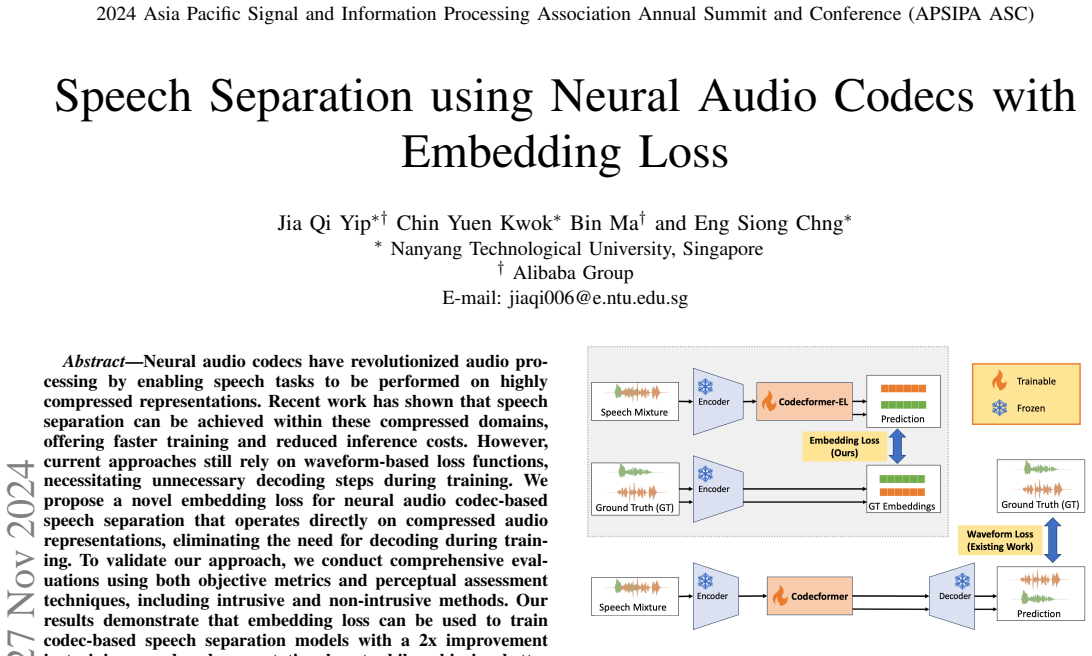
The central object is the embedding loss: mean squared error between the separated embeddings produced by the separator and the ground-truth embeddings produced by the frozen codec encoder, wrapped in permutation invariant training so the loss is taken over the best speaker ordering. It replaces the waveform-domain SI-SDR/PIT loss used in the baseline and lets training skip the codec decoder and the expensive waveform comparison. The separator itself is a transformer stack with channel-adapter layers and a mask-gating block that matches the codec's activation function (ELU for EnCodec and SoundStream, snake for DAC), producing a mask on the mixture embeddings. Because the frozen encoder is fixed, ground-truth embeddings can be precomputed before training, which is what makes the loss cheap.
What would settle it
Train Codecformer-EL with the frozen codec encoder replaced by a randomly initialized, untrained encoder (same architecture, weights fixed). If the embedding-loss models still show the reported DNSMOS and STOI gains over waveform loss, the improvements do not depend on the codec's learned embedding geometry, which would contradict the paper's premise.
Extended reading notes
Core claim
The paper's central discovery is that the frozen encoder of a pre-trained neural audio codec provides a sufficient training target for speech separation: the separator minimizes PIT-wrapped MSE between its output embeddings and the ground-truth speaker embeddings, and the codec decoder is needed only at inference time. Across DAC, EnCodec, and SoundStream pre-trained on AMUSE, models trained this way reach comparable or better DNSMOS and STOI than the same separator trained with waveform loss, while training 2.5x faster and using 1.9x fewer MACs than the waveform-loss Codecformer baseline (and 6.8x faster than Sepformer with 97x fewer MACs). The authors also find that the embedding-loss advantage persists across different codec pre-training datasets, except for the original DAC model with 1024-dimensional embeddings, where the larger embedding size appears to hurt the method.
Load-bearing premise
The load-bearing premise is that a frozen codec encoder's embedding space behaves enough like a spectrogram that pulling a mixture's embeddings toward a clean speaker's embeddings with mean squared error produces embeddings the codec decoder turns into perceptually good speech.
Editorial extensions
If this is right
- Training a codec-based separator with embedding loss removes the decoder from the training graph, cutting per-epoch time from 1.0 to 0.4 hours and GMACs from 1.5 to 0.8 on 2-second 8 kHz audio in the paper's setup.
- The same embedding-loss recipe works with three different codec architectures (DAC, EnCodec, SoundStream), so the approach is not tied to a single codec.
- Optimizing for perceptual metrics can be a better guide than SI-SDR when the output is resynthesized by a GAN-trained codec decoder; the paper's embedding-loss models often win on DNSMOS and STOI despite lower SI-SDR.
- Ground-truth embeddings can be precomputed before training, meaning the training data can be stored in compressed form and the per-step memory cost stays low.
- Embedding size interacts with separator width: the 1024-dimensional original DAC embedding performs worse with embedding loss, suggesting dimension alignment is a design parameter for future work.
Reading between the lines
- Going beyond the paper's experiments: if MSE on frozen codec embeddings is a reliable perceptual proxy, then other embedding-space objectives—masked prediction, contrastive losses, or fine-tuning the encoder—are natural next steps that could further close the objective-metric gap.
- The same decoder-free training recipe should transfer to other audio-to-audio tasks such as enhancement, de-reverberation, and music source separation, because the loss never touches the waveform domain.
- A testable consequence is that the method's advantage should grow with dataset size: since embeddings can be precomputed, the memory and compute savings compound as training corpora scale, unlike waveform-domain losses.
- The objective-versus-perceptual divergence reported here suggests that SI-SDR leaderboards may systematically undervalue codec-based separators; evaluating those systems with DNSMOS and STOI or a differentiable perceptual proxy would make comparisons fairer.
Editorial analysis
A structured set of objections, weighed in public.
Referee Report
Summary. The paper proposes Codecformer-EL, a modification of the Codecformer speech separation model that trains using an embedding-level MSE loss on the frozen encoder representations of a neural audio codec, removing the need to decode during training. The authors claim a 2x improvement in training speed and computational cost, and better DNSMOS and STOI performance on WSJ0-2mix across three pre-trained codecs (DAC, EnCodec, SoundStream), despite lower objective metrics. They also compare separation performance across codec pre-training datasets and extend Codecformer to support EnCodec and SoundStream.
Significance. If the central claim holds, the efficiency gain of avoiding codec decoding during training is practically valuable, and the positive perceptual results would suggest that embedding-space training is a viable alternative for codec-based separation. The paper is also useful for expanding codec-based separation to multiple codec architectures and for documenting the objective-perceptual metric gap in this setting. However, the support for the headline claim is weakened by the absence of statistical significance testing, a small contradictory DNSMOS result for one codec, and an unaddressed quantization mismatch between the training target and decoder input. The manuscript honestly acknowledges some limitations, but the load-bearing claim needs better empirical grounding.
major comments (4)
- [Abstract and Section IV-B, Table II] The abstract and Table II's discussion claim 'better DNSMOS' for embedding loss relative to waveform loss, but Table II reports DAC with embedding loss DNSMOS OVRL 1.80 versus waveform loss 1.81, which is worse. The claim is only consistently true for STOI across all three codecs, and for DNSMOS on EnCodec and SoundStream. Please either revise the claim to acknowledge the DAC result or provide error bars and significance tests demonstrating that the differences (including the 0.01 OVRL gap) are robust.
- [Section II-A and Figure 1] The neural audio codec decoders (SoundStream, EnCodec, DAC) are trained to invert quantized embeddings (RVQ codebook sums), but Codecformer-EL outputs continuous embeddings at inference and the manuscript never states that these are quantized before decoding. If the decoder receives unquantized continuous vectors, it operates out-of-distribution, and the very low SI-SDR values (e.g., EnCodec embedding loss -29.1 dB) combined with high DNSMOS/STOI may be resynthesis artifacts of the generative decoder rather than genuine improvements in separation. The authors should clarify whether quantization is applied at inference, and if not, should either apply it or provide an explicit analysis of the encoder/decoder distribution mismatch, including a comparison of decoded outputs with and without quantization.
- [Section III-D and Table IV] The training speed comparison is confounded by different batch sizes: the embedding-loss model is trained with batch size 20 while the waveform-loss Codecformer uses batch size 3. Since MACs and training time are reported for the full training procedure, the '2x' advantage could partly reflect the larger batch size of the proposed method rather than the removal of the decoder alone. Please provide a comparison at matched batch size, or at least per-sample measurements, and a breakdown of where the MAC/time savings occur (e.g., decoder forward/backward vs. loss computation).
- [Tables II and III] No error bars, confidence intervals, or significance tests are reported for any of the objective or perceptual metrics. Given that some differences are very small (e.g., DAC DNSMOS OVRL 1.80 vs. 1.81), the reader cannot assess whether the claimed perceptual improvements are reliable. Please report variance across multiple training runs or a significance test, and state the number of runs used.
minor comments (5)
- [Section I, Contributions] The first contribution states '2x improvement in training speech' but the intended word is 'speed'; please fix the typo.
- [Section III-C] The permutation for perceptual metrics is chosen by maximizing SI-SDR, which is an objective metric. This is consistent, but it may not be the permutation that maximizes the perceptual metric itself; consider also reporting results under per-metric optimal permutations, or justify the SI-SDR-based choice.
- [Section II-A] The justification that embeddings are 'spectrogram-like' and therefore MSE is appropriate is an analogy rather than a derivation. A small ablation comparing MSE against an alternative loss (e.g., cosine similarity or L1) would strengthen the argument, but is not essential if the empirical results are robust.
- [Table II] The EnCodec embedding-loss SI-SDR of -29.1 dB is drastically lower than the waveform baseline (-9.0 dB). While the paper attributes this to the objective-perceptual gap, the magnitude deserves a brief discussion to reassure readers that the output is not semantically disconnected from the target speech.
- [Section IV-C] The comparison across pre-training datasets for DAC is confounded by embedding size (Original DAC has 1024 vs. 512 for ESPnet versions). The paper mentions this, but it would be informative to state whether the performance drop for the Original DAC embedding loss is more plausibly due to dataset or embedding-size mismatch, given the scope of the paper.
Circularity Check
No circular derivation chain; only minor non-load-bearing self-citations in the Codecformer baseline and ESPnet-Codec toolkit.
full rationale
The central claim is an empirical comparison, not a derivation. Codecformer-EL is trained by minimizing Eq. (1), an MSE between the separator output and the frozen codec encoder output of the clean target, and is evaluated with standard external metrics (SI-SDR, DNSMOS, PESQ, STOI) on the public WSJ0-2mix benchmark. No parameter is fitted to the reported metrics, and the PIT permutation is chosen by maximizing SI-SDR, which does not favor the embedding method. The only self-citations are the Codecformer architecture/baseline [21] and the ESPnet-Codec release [26], both used as implementation baselines; the comparison to the waveform-loss Codecformer is a direct measured contrast, and the codec checkpoints are public pretrained models. The '2x speedup' follows from omitting the decoder from the training graph, but it is reported as a measured MAC/time benchmark, not as a prediction derived from the loss. The authors' limitation section (IV-E) explicitly concedes dependence on codec quality, which is an assumption about external validity rather than a circular step. No equation reduces to its own input, so there is no self-definitional, fitted-input, or imported-uniqueness circularity.
Assumptions & free parameters
free parameters (3)
- Batch size (embedding loss: 20; waveform loss: 3) =
20 / 3
- Learning rate 1.5e-4 with halving after epoch 5 (patience 2) =
1.5e-4
- Number of transformer blocks N=16 and adapter embedding size 256 =
16 blocks, 256 dim
assumptions (4)
- domain assumption MSE on frozen codec embeddings is an appropriate training signal for speech separation.
- domain assumption The codec decoder, frozen from pre-training, can decode the separator's masked embeddings into perceptually acceptable waveforms.
- domain assumption Resampling 8 kHz WSJ0-2mix to 16 kHz does not significantly affect separation results.
- standard math Permutation invariant training resolves speaker order ambiguity in the embedding domain.
Cite this review
Pith. "Pith review of Speech Separation using Neural Audio Codecs with Embedding Loss." pith.science (2026). https://pith.science/paper/AEVUZVK5
@misc{pith2026241117998,
  author       = {Pith},
  title        = {Pith review of: Speech Separation using Neural Audio Codecs with Embedding Loss},
  year         = {2026},
  howpublished = {\url{https://pith.science/paper/AEVUZVK5}},
  note         = {Machine review of arXiv:2411.17998}
}
read the original abstract
Neural audio codecs have revolutionized audio processing by enabling speech tasks to be performed on highly compressed representations. Recent work has shown that speech separation can be achieved within these compressed domains, offering faster training and reduced inference costs. However, current approaches still rely on waveform-based loss functions, necessitating unnecessary decoding steps during training. We propose a novel embedding loss for neural audio codec-based speech separation that operates directly on compressed audio representations, eliminating the need for decoding during training. To validate our approach, we conduct comprehensive evaluations using both objective metrics and perceptual assessment techniques, including intrusive and non-intrusive methods. Our results demonstrate that embedding loss can be used to train codec-based speech separation models with a 2x improvement in training speed and computational cost while achieving better DNSMOS and STOI performance on the WSJ0-2mix dataset across 3 different pre-trained codecs.
Figures

Forward citations
Cited by 1 Pith paper
-
CodecSep: Prompt-Driven Universal Sound Separation on Neural Audio Codec Latents
CodecSep performs prompt-driven universal sound separation directly in neural audio codec latents by combining a frozen DAC backbone with a lightweight FiLM-conditioned Transformer masker driven by CLAP embeddings, yi...
Reference graph
Works this paper leans on
-
[1]
Some experiments on the recognition of speech, with one and with two ears,
E. C. Cherry, “Some experiments on the recognition of speech, with one and with two ears,” The Journal of the acoustical society of America , vol. 25, no. 5, pp. 975–979, 1953
1953
-
[2]
Atten- tion is all you need in speech separation,
C. Subakan, M. Ravanelli, S. Cornell, M. Bronzi, and J. Zhong, “Atten- tion is all you need in speech separation,” in ICASSP 2021-2021 IEEE International Conference on Acoustics, Speech and Signal Processing (ICASSP). IEEE, 2021, pp. 21–25
work page 2021
-
[3]
Spgm: Prioritizing local features for enhanced speech separation performance,
J. Q. Yip, S. Zhao, Y . Ma, C. Ni, C. Zhang, H. Wang, T. H. Nguyen, K. Zhou, D. Ng, E. S. Chng et al., “Spgm: Prioritizing local features for enhanced speech separation performance,” in ICASSP 2024 - 2024 IEEE International Conference on Acoustics, Speech and Signal Processing (ICASSP), 2024
work page 2024
-
[4]
S. Zhao, Y . Ma, C. Ni, C. Zhang, H. Wang, T. H. Nguyen, K. Zhou, J. Q. Yip, D. Ng, and B. Ma, “Mossformer2: Combining transformer and rnn-free recurrent network for enhanced time-domain monaural speech separation,” in ICASSP 2024 - 2024 IEEE International Conference on Acoustics, Speech and Signal Processing (ICASSP) , 2024
work page 2024
-
[5]
Gass: Generalizing audio source separation with large-scale data,
J. Pons, X. Liu, S. Pascual, and J. Serr `a, “Gass: Generalizing audio source separation with large-scale data,” in ICASSP 2024-2024 IEEE International Conference on Acoustics, Speech and Signal Processing (ICASSP). IEEE, 2024, pp. 546–550
work page 2024
-
[6]
Exploring self-attention mechanisms for speech separation,
C. Subakan, M. Ravanelli, S. Cornell, F. Grondin, and M. Bronzi, “Exploring self-attention mechanisms for speech separation,” IEEE/ACM Transactions on Audio, Speech, and Language Processing , vol. 31, pp. 2169–2180, 2022
work page 2022
-
[7]
TF- GridNet: Integrating full- and sub-band modeling for speech separation,
Z. Wang, S. Cornell, S. Choi, Y . Lee, B. Kim, and S. Watanabe, “TF- GridNet: Integrating full- and sub-band modeling for speech separation,” TASLP, vol. 31, pp. 3221–3236, 2022
work page 2022
-
[8]
A neural state-space model approach to efficient speech separation,
C. Chen, C.-H. H. Yang, K. Li, Y . Hu, P.-J. Ku, and E. S. Chng, “A neural state-space model approach to efficient speech separation,” in Proc. Interspeech, 2023
work page 2023
Show all 30 references
-
[9]
Permutation invariant training of deep models for speaker-independent multi-talker speech separation,
D. Yu, M. Kolbæk, Z.-H. Tan, and J. Jensen, “Permutation invariant training of deep models for speaker-independent multi-talker speech separation,” in 2017 IEEE International Conference on Acoustics, Speech and Signal Processing (ICASSP) , 2017, pp. 241–245
2017
-
[10]
Sdr–half-baked or well done?
J. Le Roux, S. Wisdom, H. Erdogan, and J. R. Hershey, “Sdr–half-baked or well done?” in ICASSP 2019-2019 IEEE International Conference on Acoustics, Speech and Signal Processing (ICASSP) . IEEE, 2019, pp. 626–630
2019
-
[11]
Soundstream: An end-to-end neural audio codec,
N. Zeghidour, A. Luebs, A. Omran, J. Skoglund, and M. Tagliasacchi, “Soundstream: An end-to-end neural audio codec,” IEEE/ACM Transac- tions on Audio, Speech, and Language Processing , vol. 30, pp. 495–507, 2021
2021
-
[12]
High fidelity neural audio compression,
A. D ´efossez, J. Copet, G. Synnaeve, and Y . Adi, “High fidelity neural audio compression,” arXiv preprint arXiv:2210.13438 , 2022
2022 arXiv
-
[13]
High- fidelity audio compression with improved rvqgan,
R. Kumar, P. Seetharaman, A. Luebs, I. Kumar, and K. Kumar, “High- fidelity audio compression with improved rvqgan,” Advances in Neural Information Processing Systems , vol. 36, 2024
2024
-
[14]
Vector quantization,
R. M. Gray, “Vector quantization,” IEEE ASSP Magazine , vol. 1, pp. 4–29, 1984
1984
-
[15]
Viola: Unified codec language models for speech recognition, synthesis, and translation,
T. Wang, L. Zhou, Z. Zhang, Y . Wu, S. Liu, Y . Gaur, Z. Chen, J. Li, and F. Wei, “Viola: Unified codec language models for speech recognition, synthesis, and translation,” arXiv:2305.16107, 2023
2023 arXiv
-
[16]
Exploring the limits of decoder-only models trained on public speech recognition corpora,
A. Gupta, G. Saon, and B. Kingsbury, “Exploring the limits of decoder-only models trained on public speech recognition corpora,” arXiv:2402.00235, 2024
2024 arXiv
-
[17]
Naturalspeech 3: Zero-shot speech synthesis with factorized codec and diffusion models,
Z. Ju, Y . Wang, K. Shen, X. Tan, D. Xin, D. Yang, E. Liu, Y . Leng, K. Song, S. Tang et al. , “Naturalspeech 3: Zero-shot speech synthesis with factorized codec and diffusion models,” in ICML, 2024
2024
-
[18]
Simple- speech: Towards simple and efficient text-to-speech with scalar latent transformer diffusion models,
D. Yang, D. Wang, H. Guo, X. Chen, X. Wu, and H. Meng, “Simple- speech: Towards simple and efficient text-to-speech with scalar latent transformer diffusion models,” arXiv:2406.02328, 2024
2024 arXiv
-
[19]
Discrete audio representation as an alternative to mel-spectrograms for speaker and speech recognition,
K. C. Puvvada, N. R. Koluguri, K. Dhawan, J. Balam, and B. Ginsburg, “Discrete audio representation as an alternative to mel-spectrograms for speaker and speech recognition,” in ICASSP 2024-2024 IEEE Interna- tional Conference on Acoustics, Speech and Signal Processing (ICASSP...
2024
-
[20]
The Interspeech 2024 challenge on speech processing using discrete units,
X. Chang, J. Shi, J. Tian, Y . Wu, Y . Tang, Y . Wu, S. Watanabe, Y . Adi, X. Chen, and Q. Jin, “The Interspeech 2024 challenge on speech processing using discrete units,” in Proc. Interspeech, 2024
2024
-
[21]
Towards audio codec-based speech separation,
J. Q. Yip, S. Zhao, D. Ng, E. S. Chng, and B. Ma, “Towards audio codec-based speech separation,” in Proc. Interspeech, 2024
2024
-
[22]
Perceptual evaluation of speech quality (PESQ)-a new method for speech quality assessment of telephone networks and codecs,
A. W. Rix, J. G. Beerends, M. P. Hollier, and A. P. Hekstra, “Perceptual evaluation of speech quality (PESQ)-a new method for speech quality assessment of telephone networks and codecs,” in Proc. ICASSP, vol. 2. IEEE, 2001, pp. 749–752
2001
-
[23]
An algorithm for intelligibility prediction of time–frequency weighted noisy speech,
C. H. Taal, R. C. Hendriks, R. Heusdens, and J. Jensen, “An algorithm for intelligibility prediction of time–frequency weighted noisy speech,” TASLP, vol. 19, no. 7, pp. 2125–2136, 2011
2011
-
[24]
DNSMOS: A non-intrusive perceptual objective speech quality metric to evaluate noise suppressors,
C. K. Reddy, V . Gopal, and R. Cutler, “DNSMOS: A non-intrusive perceptual objective speech quality metric to evaluate noise suppressors,” in ICASSP 2021-2021 IEEE International Conference on Acoustics, Speech and Signal Processing (ICASSP) . IEEE, 2021, pp. 6493–6497
2021
-
[25]
LibriTTS: A corpus derived from librispeech for text-to-speech,
H. Zen, V . Dang, R. Clark, Y . Zhang, R. J. Weiss, Y . Jia, Z. Chen, and Y . Wu, “LibriTTS: A corpus derived from librispeech for text-to-speech,” in Proc. Interspeech, 2019
2019
-
[26]
Espnet-codec: Comprehensive training and evaluation of neural codecs for audio, music, and speech,
J. Shi, J. Tian, Y . Wu, J.-w. Jung, J. Q. Yip, Y . Masuyama, W. Chen, Y . Wu, Y . Tang, M. Baaliet al., “Espnet-codec: Comprehensive training and evaluation of neural codecs for audio, music, and speech,” in Proceedings of IEEE Spoken Language Technology Workshop (SLT) . IEEE, 2024
2024
-
[27]
Fast and accurate deep network learning by exponential linear units (elus),
D.-A. Clevert, T. Unterthiner, and S. Hochreiter, “Fast and accurate deep network learning by exponential linear units (elus),” arXiv preprint arXiv:1511.07289, 2015
2015 arXiv
-
[28]
Deep clustering: Discriminative embeddings for segmentation and separation,
J. R. Hershey, Z. Chen, J. Le Roux, and S. Watanabe, “Deep clustering: Discriminative embeddings for segmentation and separation,” in 2016 IEEE international conference on acoustics, speech and signal process- ing (ICASSP) . IEEE, 2016, pp. 31–35
2016
-
[29]
SpeechBrain: A general- purpose speech toolkit,
M. Ravanelli, T. Parcollet, P. Plantinga, A. Rouhe, S. Cornell, L. Lu- gosch, C. Subakan, N. Dawalatabad, A. Heba, J. Zhong, J.-C. Chou, S.-L. Yeh, S.-W. Fu, C.-F. Liao, E. Rastorgueva, F. Grondin, W. Aris, H. Na, Y . Gao, R. D. Mori, and Y . Bengio, “SpeechBrain: A general- p...
2021 arXiv
-
[30]
Discretization and re-synthesis: an alternative method to solve the cocktail party problem,
J. Shi, X. Chang, T. Hayashi, Y .-J. Lu, S. Watanabe, and B. Xu, “Discretization and re-synthesis: an alternative method to solve the cocktail party problem,” 2022. [Online]. Available: https://arxiv.org/abs/2112.09382 6
2022 arXiv
Reviewed August 12, 2026 · model on record in the stance chip above.
Discussion (0). Continue with ORCID to comment.