REVIEW 4 major objections 5 minor 1 cited by
Stochastic Parameter Prediction in Cardiovascular Problems
T0 review · 4 major / 5 minor · reviewed 2026-08-12 · deepseek-v4-flash
Pith's one-line read A stochastic data assimilation filter can recover unknown inlet velocity profiles in aortic blood-flow models with relative errors below 3% in 2D and about 7% in a patient-specific 3D model, even when the solver inside the filter is a…
desk verdict Plausible application of an existing EnKF variant to aortic inlet BC estimation, but the stabilization constraint feeds the filter the answer within ±20%, so the headline errors don't yet demonstrate blind estimation. read the letter →
The pith
A machine-rendered reading of the paper's core claim, the machinery that carries it, and where it could break.
The reading
What carries the argument
The central object is the Ensemble-based Simultaneous Input and State Filtering with direct feedthrough (EnSISF-wDF), a derivative-free ensemble Kalman filter extension that jointly estimates unknown inputs and states by maintaining an ensemble of coupled input-state samples. At each time step it forecasts the ensemble through the forward Navier-Stokes solver, forms predicted observation ensembles through a direct input-to-output measurement function, computes sample covariances and the ensemble Kalman gain, and updates the joint ensemble. The stabilizing ingredient is the parameter constraint $0.8\,\bar{v}_m \le \hat{u}_{\mathrm{inlet},n} \le 1.2\,\bar{v}_m$, which clamps the estimated inlet velocity to within 80% to 120% of the average velocity measured at sensor points immediately upstream and prevents filter divergence. The measurement layout follows the guideline that about 5% of grid points be used as sensors: 27 of 498 cells in 2D and 330 of 8471 cells in 3D.
What would settle it
Repeat the 2D space-time-dependent and 3D patient-specific experiments with the stabilization constraint in Eq. (18) removed, or with the upstream sensor points moved far enough that their average velocity no longer approximates the inlet velocity; if the relative errors stay near 2.6% and 7.4%, the constraint is not doing the work, while a large error increase would show that the reported accuracy depends on it.
Extended reading notes
Core claim
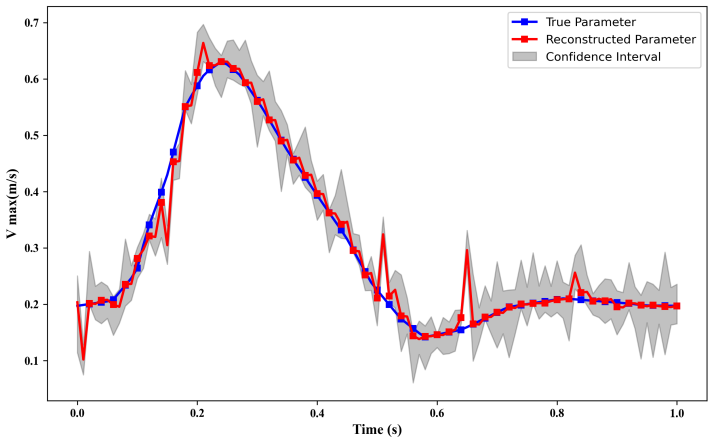
The central claim is that the EnSISF-wDF filter can simultaneously estimate the unknown inlet velocity boundary condition and the internal velocity-pressure state of an aortic flow model by treating the inlet velocity as a stochastic input, propagating an ensemble through the Navier-Stokes equations, and applying a Kalman gain built from sample cross-covariances between states and observations. The paper tests this on progressively harder unknown inputs: constant, time-dependent, and space-time-dependent (parabolic with unknown peak velocity) inlet conditions in a 2D idealized abdominal aorta, then a space-time-dependent condition in a 3D patient-specific aorta. It reports that the reconstructed parameter converges after the first assimilation cycles, with relative errors of 0.996%, 2.63%, and 2.61% in 2D and 7.37% in 3D over a 0.02-second observation span. A secondary claim is that the forward solver inside the filter can be low-fidelity while the pseudo-experimental data come from a high-fidelity transitional k-omega SST simulation; reconstructed velocity and pressure fields match well at most cardiac phases, with the largest deviations at peak systole, where the true flow is transitional and the filter's forward model is laminar. The paper concludes that refining the inlet profile this way improves wall shear stress predictions, which are central to predicting diseases like atherosclerosis.
Load-bearing premise
The method depends on the stabilization constraint in Eq. (18), which pins the unknown inlet velocity to within $\pm 20\%$ of the average velocity measured just upstream, and since the flow is nearly incompressible that upstream velocity is essentially the quantity being estimated.
Editorial extensions
If this is right
- A constant inlet velocity profile in a 2D aorta model can be recovered to 0.996% relative error with observations every two time steps (0.02 s).
- Time-dependent and space-time-dependent inlet profiles in 2D can be recovered to about 2.6% relative error over the same observation span, after an initial warm-up phase.
- In a 3D patient-specific abdominal aorta, a space-time-dependent inlet profile can be recovered to 7.37% relative error, indicating the approach extends beyond idealized geometries.
- Using a low-fidelity laminar forward solver inside the filter is sufficient for state and parameter reconstruction at most cardiac phases, which keeps the computational cost of the ensemble manageable.
- Refined inlet velocity estimates improve the accuracy of downstream wall shear stress predictions, the quantity tied to atherosclerosis and aneurysm risk.
Reading between the lines
- A direct way to test how much the stabilization constraint carries the result is to rerun the 2D and 3D cases with Eq. (18) disabled or with the upstream sensors moved far enough that their average no longer approximates the inlet velocity; the error jump, if any, would quantify the constraint's contribution.
- Because the 2D errors sit near 2.6% while the 3D patient-specific error is 7.37%, the gap suggests that geometric complexity and the transitional regime at peak systole, not the boundary-parameter form itself, dominate the remaining error.
- A clinical extension would feed noisy 4D-flow-MRI measurements into the same filter; the paper's synthetic-data setup does not include realistic imaging noise, so the reported errors are a lower bound on what clinical data would produce.
- The filter's confidence intervals widen between observation times and narrow at them, which suggests the method could be used to schedule acquisitions: placing measurements at peak systole and maximum deceleration would target the phases where the paper shows the largest deviations.
Editorial analysis
A structured set of objections, weighed in public.
Referee Report
Summary. This paper applies the Ensemble-based Simultaneous Input and State Filtering with direct feedthrough (EnSISF-wDF) to estimate unknown inlet velocity boundary conditions in two-dimensional idealized and three-dimensional patient-specific models of the abdominal aorta. The forward model inside the filter is a low-fidelity laminar, Newtonian, coarse-mesh solver, while the pseudo-experimental observations are generated by a high-fidelity transitional turbulence model. The authors report relative errors of 0.996% for a constant inlet condition, 2.63% for a time-dependent condition, and 2.61% for a space-time-dependent condition in 2D, and 7.37% in 3D, and claim that this improves wall shear stress predictions.
Significance. The paper addresses a relevant problem in patient-specific hemodynamics: estimating inflow boundary conditions from velocity measurements. The use of a low-fidelity forward solver inside an ensemble Kalman filter is computationally attractive, and the algorithm is described with sufficient detail to be reproducible in principle. The 2D experiments demonstrate that the filter can converge to the true parameter after observation updates. However, the central demonstration is weakened by (i) the stabilization constraint in Eq. (18) that directly bounds the unknown parameter using upstream velocity measurements, (ii) in-sample hyperparameter tuning and post hoc selection of the observation span, and (iii) the use of noiseless synthetic observations. These choices make the reported accuracy optimistic relative to a truly unknown boundary condition. If the stabilization constraint were relaxed or replaced with a physically meaningful prior, and if the method were tested with noisy observations and a consistent observation schedule, the contribution would be more convincing.
major comments (4)
- [Section 2.4, Eq. (18)] The stabilization constraint bounds the estimated inlet velocity by 0.8*v_m <= u_inlet <= 1.2*v_m, where v_m is the average velocity measured at sensor points immediately upstream of the inlet. In an incompressible flow with a nearly uniform cross-section, v_m is essentially identical to the inlet velocity (up to small area changes). Thus the constraint supplies the filter with the target parameter to within ±20% before any data assimilation occurs. The reported relative errors of 0.996%–7.37% therefore measure how well the filter adjusts within a narrow, already-informed interval rather than how well it estimates a truly unknown boundary condition. The authors should either remove or drastically widen this constraint (e.g., using a physiological range based on general knowledge), or provide a control experiment without the constraint, to attribute the reported accuracy to the filtering algorithm.
- [Section 5.1, Table 1] Hyperparameters (prior state covariance, model error covariance, measurement noise covariance, prior parameter covariance, ensemble size) were selected by trial-and-error for each scenario, and Table 2 shows that the observation span was chosen post hoc as the one giving the lowest error. The reported errors are therefore in-sample estimates and may not reflect out-of-sample performance. The authors should adopt a fixed hyperparameter setting across scenarios or validate on a separate test scenario, and they should present sensitivity to the observation span rather than selecting the best one.
- [Section 3, pseudo-experimental data] The observations are generated by a high-fidelity simulation and are noiseless. Real 4D flow MRI data contains significant noise and low spatial resolution, so the method's performance on noiseless synthetic data is not a realistic test of the claimed practical utility. The authors should add a noise sensitivity study, for example by adding zero-mean Gaussian noise with realistic standard deviation to the observations, and report how the relative errors change.
- [Abstract and Conclusion] The paper claims that the method improves wall shear stress (WSS) predictions, but no WSS quantification is presented anywhere in the results. The claim is therefore unsupported. The authors should provide quantitative WSS comparisons (e.g., spatial distributions of WSS or pointwise errors) or revise the claim to be about the velocity field only.
minor comments (5)
- [Section 3.1.1] The equations for the transitional k-omega SST model are not fully defined; the production, destruction, and source terms are only described qualitatively. Please define or reference all symbols for completeness.
- [References] Reference [33] appears to be a placeholder ("John Smith. An Investigation into Machine Learning"). Please verify this reference and correct or remove it.
- [Throughout] There are several typos and grammatical errors, including "represenr" after Eq. (6), "erros" near Eq. (3), "Times-Space-Dependent" in Section 5.1.3, and "combine then iteratively" in Section 2. The paper should be carefully edited.
- [Table 1] In the row for "Observation Span (sec)", the constant-parameter column shows "[0.02, 0.04, 0.05]", which is a set of tested values rather than the selected value. Please clarify by indicating the chosen span chosen (0.02) or by restructuring the table.
- [Figure 2] The algorithm flowchart is complex and might be difficult to follow; consider adding a pseudocode block for clarity.
Circularity Check
Eq. (18) constrains the unknown inlet velocity using velocities measured immediately upstream of the inlet, so the target parameter is known to within a narrow band before assimilation; trial-and-error hyperparameter tuning on the same benchmarks further makes the reported errors in-sample.
-
self definitional
[Section 2.4, Eqs. (17)-(18), and Figures 6-7]
"In our approach, we apply this conventional practice to the estimation of the parameter, i.e. inlet boundary condition within the abdominal aorta. Specifically, the inlet velocity parameter is constrained such that it does not exceed or fall below 80% of the average velocity measured at predefined sensor locations immediately upstream of the inlet boundary. [Eq. (18):] 0.8 · ¯vm ≤ ˆ uinlet,n ≤ 1.2 · ¯vm"
The bound is built from ¯v_m, the average of velocities measured at sensors described as 'immediately upstream of the inlet boundary.' By incompressible mass conservation in an area-preserving vessel segment, that upstream averaged velocity is essentially the inlet velocity itself (for the uniform cases) or a direct fixed multiple of the parabolic-profile parameter Vmax (for the space-time case). Equation (18) therefore encodes direct local information about the target parameter into the admissible interval before any Kalman update; the filter is asked only to refine a parameter whose value is already pinned by measurements of the same quantity.
-
fitted input called prediction
[Section 5.1, Table 1]
"For the 2D case, after using a trial-and-error approach to optimize the model hyperparameters, we selected the parameter set shown in Table 1, which achieved the highest accuracy in parameter estimation across different scenarios."
The hyperparameters (prior means and covariances, model and measurement noise covariances, observation span, seed count) were tuned by trial and error to minimize error on the very benchmark cases whose results are later presented as the method's prediction accuracy (0.996%, 2.63%, 2.61% in 2D and 7.37% in 3D). Because the same scenarios used for tuning are used for evaluation, the quoted errors are in-sample rather than out-of-sample predictions. This does not make the algorithm circular by definition, but it removes the status of the reported percentages as independent measures of predictive skill.
full rationale
The EnSISF update itself is not circular: it follows a published ensemble Kalman filter formulation, and the forward model is genuinely lower-fidelity (laminar, Newtonian, coarse mesh) than the high-fidelity transitional model used to generate pseudo-experimental data. The central circularity is the stabilization step. Equation (18) constrains the 'unknown' inlet velocity using ¯v_m, the averaged velocity measured at sensors placed immediately upstream of the inlet. For an incompressible flow in a vessel with approximately constant cross-section, that upstream measurement is the target quantity (or a fixed fraction of it for the parabolic case), so the admissible interval is centered on direct information about the parameter before assimilation. The filter's success is therefore partly guaranteed by construction rather than by the ability to infer an unseen boundary from distal observations. The trial-and-error selection of hyperparameters on the same benchmark cases compounds this by making the reported errors in-sample. Because the method still assimilates distributed flow sensors and the constraint is only a bound rather than an exact assignment, the paper is not wholly circular; a score of 6 reflects partial circularity of the central accuracy claim.
Assumptions & free parameters
free parameters (7)
- Prior state covariance (sigma_T) =
1e-10 (constant), 1e-4 (time-dependent and space-time)
- Model error covariance Qk =
1e-08 (constant), 1e-04 (time-dependent and space-time)
- Measurement noise covariance Rk =
1e-10 (constant), 1e-08 (time-dependent and space-time)
- Prior parameter covariance kappa =
4e-06 (constant), 4e-04 (time-dependent and space-time)
- Observation span =
0.02 s (2 time steps)
- Stabilization bound constants =
0.8 and 1.2
- Ensemble size Sn =
80
assumptions (5)
- domain assumption Incompressible Navier-Stokes equations govern aortic blood flow (Eq. 19-20).
- domain assumption Synthetic high-fidelity simulation data are representative of in-vivo measurements such as 4D flow MRI.
- domain assumption A low-fidelity laminar, Newtonian, coarse-mesh solver is sufficient for the EnKF forecast step.
- ad hoc to paper The inlet velocity is bounded by 0.8*v_m <= u_inlet <= 1.2*v_m, where v_m is the average velocity measured at sensors immediately upstream of the inlet (Eq. 18).
- standard math Process and measurement noises are zero-mean Gaussian with known covariances (Eq. 2-3).
Cite this review
Pith. "Pith review of Stochastic Parameter Prediction in Cardiovascular Problems." pith.science (2026). https://pith.science/paper/KLORIRXO
@misc{pith2026241118089,
  author       = {Pith},
  title        = {Pith review of: Stochastic Parameter Prediction in Cardiovascular Problems},
  year         = {2026},
  howpublished = {\url{https://pith.science/paper/KLORIRXO}},
  note         = {Machine review of arXiv:2411.18089}
}
read the original abstract
Patient-specific modeling of cardiovascular flows with high-fidelity is challenging due to its dependence on accurately estimated velocity boundary profiles, which are essential for precise simulations and directly influence wall shear stress calculations - key in predicting cardiovascular diseases like atherosclerosis. This data, often derived from in vivo modalities like 4D flow MRI, suffers from low resolution and noise. To address this, we employ a stochastic data assimilation technique that integrates computational fluid dynamics with an advanced Ensemble-based Kalman filter, enhancing model accuracy while accounting for uncertainties. Our approach sequentially collects velocity data over time within the vascular model, enabling real-time refinement of unknown boundary estimations. The mathematical model uses the incompressible Navier-Stokes equation to simulate aortic blood flow. We consider unknown boundaries as constant, time-dependent, and space-time dependent in two- and three-dimensional models. In our 2-dimensional model, relative errors were as low as 0.996\% for constant boundaries and up to 2.63\% and 2.61\% for time-dependent and space-time dependent boundaries, respectively, over an observation span of two-time steps. For the 3-dimensional patient-specific model, the relative error was 7.37\% for space-time dependent boundaries. By refining the velocity boundary profile, our method improves wall shear stress predictions, enhancing the accuracy and reliability of models specific to individual cardiovascular patients. These advancements could contribute to better diagnosis and treatment of cardiovascular diseases.
Figures


Figures from the paper (17 more)




Forward citations
Cited by 1 Pith paper
-
A Deep-Learning Enhanced Gappy Proper Orthogonal Decomposition Method for Conjugate Heat Transfer Problem
A hybrid deep-learning and Gappy POD reduced-order model reconstructs refrigerator temperature fields from sparse sensors with reported error under 1°C and 5,000x speed-up.
Reference graph
Works this paper leans on
-
[33]
An Investigation into Machine Learning
John Smith. An Investigation into Machine Learning . Phd thesis, University of Knowledge, 2023
work page 2023
-
[1]
Tracking of blood vessels motion from 4d-flow mri data
Mocia Agbalessi, Alain Lalande, Olivier Bouchot, Toshiyuki Hayase, Jean-Joseph Christophe, Miguel Angel Fern´ andez, and Damiano Lombardi. Tracking of blood vessels motion from 4d-flow mri data. Cardiovascular Engineering and Technology, 14(4):577–604, 2023
work page 2023
-
[2]
Katharina Urschel, Miyuki Tauchi, Stephan Achenbach, and Barbara Dietel. Investigation of wall shear stress in cardiovascular research and in clinical practice—from bench to bedside. International Journal of Molecular Sciences , 22(11):5635, 2021
work page 2021
-
[3]
Precision medicine in human heart modeling: Perspectives, challenges, and opportunities
M Peirlinck, F Sahli Costabal, J Yao, JM Guccione, S Tripathy, Y Wang, D Ozturk, P Segars, TM Morrison, S Levine, et al. Precision medicine in human heart modeling: Perspectives, challenges, and opportunities. Biomechanics and modeling in mechanobiology , 20:803–831, 2021
work page 2021
-
[4]
Victoriya Kashtanova, Mihaela Pop, Ibrahim Ayed, Patrick Gallinari, and Maxime Serme- sant. Simultaneous data assimilation and cardiac electrophysiology model correction using differentiable physics and deep learning. Interface Focus, 13(6):20230043, 2023
work page 2023
-
[5]
Diagnosis, monitoring, and treatment of heart rhythm: new insights and novel computational methods
Jieyun Bai, Jichao Zhao, Haibo Ni, and Dechun Yin. Diagnosis, monitoring, and treatment of heart rhythm: new insights and novel computational methods. Frontiers in Physiology , 14:1272377, 2023. 27
work page 2023
-
[6]
Anouk GW de Lepper, Carlijn MA Buck, Marcel van ‘t Veer, Wouter Huberts, Frans N van de Vosse, and Lukas RC Dekker. From evidence-based medicine to digital twin technology for predicting ventricular tachycardia in ischaemic cardiomyopathy. Journal of the Royal Society Interface, 19(194):20220317, 2022
work page 2022
-
[7]
Effect of particle aspect ratio in targeted drug delivery in abdominal aortic aneurysm
Sajad Salavatidezfouli, Saeid Barzegar, Armin Sheidani, Arash Hajisharifi, Michele Girfoglio, Giovanni Stabile, and Gianluigi Rozza. Effect of particle aspect ratio in targeted drug delivery in abdominal aortic aneurysm. European Journal of Mechanics-B/Fluids , 106:181–196, 2024
work page 2024
Show all 48 references
-
[8]
Numerical computations of blood flow through stenosed arteries via cfd tool openfoam
Sohail Nadeem, Salman Akhtar, Anber Saleem, Nevzat Akkurt, Hassan Ali Ghazwani, and Sayed M Eldin. Numerical computations of blood flow through stenosed arteries via cfd tool openfoam. Alexandria Engineering Journal , 69:613–637, 2023
2023
-
[9]
In vitro studies on hemodynamics of type b aortic dis- section: Accuracy and reliability
Mingwei Wu, Li Liu, and Jiang Xiong. In vitro studies on hemodynamics of type b aortic dis- section: Accuracy and reliability. Journal of Endovascular Therapy, page 15266028231182229, 2023
2023
-
[10]
Inverse problems in reduced order models of cardiovascular haemodynam- ics: aspects of data assimilation and heart rate variability
Sanjay Pant, Chiara Corsini, Catriona Baker, Tain-Yen Hsia, Giancarlo Pennati, and Irene E Vignon-Clementel. Inverse problems in reduced order models of cardiovascular haemodynam- ics: aspects of data assimilation and heart rate variability. Journal of The Royal Society Interf...
2017
-
[11]
The influence of inlet velocity profile on predicted flow in type b aortic dissection
Chl¨ oe Harriet Armour, Baolei Guo, Selene Pirola, Simone Saitta, Yifan Liu, Zhihui Dong, and Xiao Yun Xu. The influence of inlet velocity profile on predicted flow in type b aortic dissection. Biomechanics and modeling in mechanobiology , 20:481–490, 2021
2021
-
[12]
4d flow imaging with mri
Zoran Stankovic, Bradley D Allen, Julio Garcia, Kelly B Jarvis, and Michael Markl. 4d flow imaging with mri. Cardiovascular diagnosis and therapy , 4(2):173, 2014
2014
-
[13]
# 2115 phase- contrast magnetic resonance imaging (pc-mri) for quantification of volumetric flow in re- nal transplant arteries: an observational cohort study
Paul Martin, Wladyslaw Gedroyc, Richard Corbett, and Michelle Willicombe. # 2115 phase- contrast magnetic resonance imaging (pc-mri) for quantification of volumetric flow in re- nal transplant arteries: an observational cohort study. Nephrology Dialysis Transplantation, 39(Sup...
2024
-
[14]
The role of 4d flow mri for clinical applications in cardiovascular disease: current status and future perspectives
Baiyan Zhuang, Arlene Sirajuddin, Shihua Zhao, and Minjie Lu. The role of 4d flow mri for clinical applications in cardiovascular disease: current status and future perspectives. Quantitative Imaging in Medicine and Surgery , 11(9):4193, 2021
2021
-
[15]
4d flow mri for non-invasive measurement of blood flow in the brain: a systematic review
Alasdair G Morgan, Michael J Thrippleton, Joanna M Wardlaw, and Ian Marshall. 4d flow mri for non-invasive measurement of blood flow in the brain: a systematic review. Journal of Cerebral Blood Flow & Metabolism , 41(2):206–218, 2021
2021
-
[16]
Automatic estimation of the aortic lumen geometry by ellipse tracking
Pablo G Tahoces, Luis Alvarez, Esther Gonz´ alez, Carmelo Cuenca, Agust ´ ın Trujillo, Daniel Santana-Cedr´ es, Julio Esclar ´ ın, Luis Gomez, Luis Mazorra, Miguel Alem´ an-Flores, et al. Automatic estimation of the aortic lumen geometry by ellipse tracking. International jour...
2019
-
[17]
Data assimilation for full 4d pc-mri measurements: Physics- based denoising and interpolation
Niels HLC de Hoon, Andrei C Jalba, ES Farag, Pim van Ooij, Aart J Nederveen, Elmar Eisemann, and Anna Vilanova. Data assimilation for full 4d pc-mri measurements: Physics- based denoising and interpolation. In Computer Graphics Forum, volume 39, pages 496–512. Wiley Online Lib...
2020
-
[18]
A flexible framework for sequential estimation of model parameters in compu- tational hemodynamics
Christopher J Arthurs, Nan Xiao, Philippe Moireau, Tobias Schaeffter, and C Alberto Figueroa. A flexible framework for sequential estimation of model parameters in compu- tational hemodynamics. Advanced modeling and simulation in engineering sciences , 7:1–37, 2020
2020
-
[19]
Identification of artery wall stiffness: In vitro validation and in vivo results of a data assimilation procedure applied to a 3d fluid–structure interaction model
Crist´ obal Bertoglio, David Barber, Nicholas Gaddum, Israel Valverde, Marcel Rutten, Philipp Beerbaum, Philippe Moireau, Rodney Hose, and Jean-Fr´ ed´ eric Gerbeau. Identification of artery wall stiffness: In vitro validation and in vivo results of a data assimilation procedu...
2014
-
[20]
Data assimilation in the geosciences: An overview of methods, issues, and perspectives
Alberto Carrassi, Marc Bocquet, Laurent Bertino, and Geir Evensen. Data assimilation in the geosciences: An overview of methods, issues, and perspectives. Wiley Interdisciplinary Reviews: Climate Change , 9(5):e535, 2018
2018
-
[21]
Data assimilation using era5, asos, and the u-stn model for weather forecasting over the uk
Wenqi Wang, Jacob Bieker, Rossella Arcucci, and C´ esar Quilodr´ an-Casas. Data assimilation using era5, asos, and the u-stn model for weather forecasting over the uk. arXiv preprint arXiv:2401.07604, 2024
2024 arXiv
-
[22]
Current challenges and future directions in data assimilation and reanalysis
Arianna Valmassoi, Jan D Keller, Daryl T Kleist, Stephen English, Bodo Ahrens, Ivan Baˇ st´ ak ˇDur´ an, Elisabeth Bauernschubert, Michael G Bosilovich, Masatomo Fujiwara, Hans Hersbach, et al. Current challenges and future directions in data assimilation and reanalysis. Bulle...
2023
-
[23]
Wrf-pdaf v1
Changliang Shao and Lars Nerger. Wrf-pdaf v1. 0: implementation and application of an online localized ensemble data assimilation framework. Geoscientific Model Development , 17(10):4433–4445, 2024
2024
-
[24]
Data assimilation by stochastic ensemble kalman filter- ing to enhance turbulent cardiovascular flow data from under-resolved observations
Dario De Marinis and Dominik Obrist. Data assimilation by stochastic ensemble kalman filter- ing to enhance turbulent cardiovascular flow data from under-resolved observations. Frontiers in cardiovascular medicine, 8:742110, 2021
2021
-
[25]
Data assimilation in cardiovascular medicine: Merging experimental measurements with physics-based computational models
E Lim, Y Shi, HL Leo, and A Al Abed. Data assimilation in cardiovascular medicine: Merging experimental measurements with physics-based computational models. Frontiers in Physiol- ogy, 14:1153861, 2023
2023
-
[26]
A vector fit- ting approach for the automated estimation of lumped boundary conditions of 1d circulation models
Elisa Fevola, Tommaso Bradde, Piero Triverio, and Stefano Grivet-Talocia. A vector fit- ting approach for the automated estimation of lumped boundary conditions of 1d circulation models. Cardiovascular Engineering and Technology, 14(4):505–525, 2023
2023
-
[27]
Parameter estimation for closed-loop lumped parameter models of the systemic circulation using synthetic data
Nikolai L Bjørdalsbakke, Jacob T Sturdy, David R Hose, and Leif R Hellevik. Parameter estimation for closed-loop lumped parameter models of the systemic circulation using synthetic data. Mathematical biosciences, 343:108731, 2022
2022
-
[28]
Sequential data assimila- tion for mechanical systems with complex image data: application to tagged-mri in cardiac mechanics
Alexandre Imperiale, Dominique Chapelle, and Philippe Moireau. Sequential data assimila- tion for mechanical systems with complex image data: application to tagged-mri in cardiac mechanics. Advanced Modeling and Simulation in Engineering Sciences , 8(1):2, 2021
2021
-
[29]
Estimating external tissue support parameters with fluid–structure interaction models from 4d ultrasound of murine thoracic aortae.Engineering with Computers, 38(5):4005–4022, 2022
Tanmay C Shidhore, Hannah L Cebull, Megan C Madden, Ivan C Christov, Vitaliy L Rayz, and Craig J Goergen. Estimating external tissue support parameters with fluid–structure interaction models from 4d ultrasound of murine thoracic aortae.Engineering with Computers, 38(5):4005–4...
2022
-
[30]
Pulmonary hemodynamics simulations before stage 2 single ventricle surgery: patient-specific parameter identification and clinical data assessment
Gregory Arbia, Chiara Corsini, Catriona Baker, Giancarlo Pennati, Tain-Yen Hsia, and Irene E Vignon-Clementel. Pulmonary hemodynamics simulations before stage 2 single ventricle surgery: patient-specific parameter identification and clinical data assessment. Cardiovas- cular e...
2015
-
[31]
Model inversion via multi-fidelity bayesian optimization: a new paradigm for parameter estimation in haemodynamics, and beyond
Paris Perdikaris and George Em Karniadakis. Model inversion via multi-fidelity bayesian optimization: a new paradigm for parameter estimation in haemodynamics, and beyond. Journal of The Royal Society Interface , 13(118):20151107, 2016
2016
-
[32]
Boundary Conditions Estimation Techniques for Cardiovascular Modeling
Elisa Fevola. Boundary Conditions Estimation Techniques for Cardiovascular Modeling . Phd thesis, Politecnico di Torino, 2022
2022
-
[34]
Schiavazzi, Alessia Baretta, Giancarlo Pennati, Tain-Yen Hsia, and Alison L
Daniele E. Schiavazzi, Alessia Baretta, Giancarlo Pennati, Tain-Yen Hsia, and Alison L. Mars- den. Patient-specific parameter estimation in single-ventricle lumped circulation models un- der uncertainty. International Journal for Numerical Methods in Biomedical Engineering , 33, 2017
2017
-
[35]
Dutson, and Jeff D
Daniel Canuto, Joe Luis Pantoja, Joyce Han, Erik P. Dutson, and Jeff D. Eldredge. An ensemble kalman filter approach to parameter estimation for patient-specific cardiovascular flow modeling. Theoretical and Computational Fluid Dynamics , pages 1–24, 2020. 29
2020
-
[36]
Ppg-based windkessel model parameter identification via un- scented kalman filtering
Akhil Walia and Amit Kaul. Ppg-based windkessel model parameter identification via un- scented kalman filtering. International Journal of Biomedical Engineering and Technology , 2023
2023
-
[37]
de Callafon, and Mulugeta A
Huazhen Fang, Thayjes Srivas, Raymond A. de Callafon, and Mulugeta A. Haile. Ensemble- based simultaneous input and state estimation for nonlinear dynamic systems with application to wildfire data assimilation. Control Engineering Practice, 63:104–115, 2017
2017
-
[38]
Ensemble- based simultaneous input and state estimation for nonlinear dynamic systems with application to wildfire data assimilation
Huazhen Fang, Thayjes Srivas, Raymond A de Callafon, and Mulugeta A Haile. Ensemble- based simultaneous input and state estimation for nonlinear dynamic systems with application to wildfire data assimilation. Control Eng. Pract. , 63:104–115, June 2017
2017
-
[39]
Optimized bayesian framework for inverse heat transfer problems using reduced order methods
Kabir Bakhshaei, Umberto Emil Morelli, Giovanni Stabile, and Gianluigi Rozza. Optimized bayesian framework for inverse heat transfer problems using reduced order methods. arXiv preprint arXiv:2402.19381, 2024
2024 arXiv
-
[40]
An en- semble kalman filter approach to parameter estimation for patient-specific cardiovascular flow modeling
Daniel Canuto, Joe L Pantoja, Joyce Han, Erik P Dutson, and Jeff D Eldredge. An en- semble kalman filter approach to parameter estimation for patient-specific cardiovascular flow modeling. Theoretical and Computational Fluid Dynamics , 34:521–544, 2020
2020
-
[41]
Calibrating land hydrological models and enhancing their forecasting skills using an ensemble kalman filter with one-step- ahead smoothing
Mehdi Khaki, Boujemaa Ait-El-Fquih, and Ibrahim Hoteit. Calibrating land hydrological models and enhancing their forecasting skills using an ensemble kalman filter with one-step- ahead smoothing. Journal of Hydrology , 584:124708, 2020
2020
-
[42]
Numerical investigation of patient-specific thoracic aortic aneurysms and comparison with normal subject via com- putational fluid dynamics (cfd)
Mustafa Etli, Gokhan Canbolat, Oguz Karahan, and Murat Koru. Numerical investigation of patient-specific thoracic aortic aneurysms and comparison with normal subject via com- putational fluid dynamics (cfd). Medical & Biological Engineering & Computing , 59:71–84, 2021
2021
-
[43]
Influence of shear-thinning blood rheology on the laminar-turbulent transition over a backward facing step
Nathaniel S Kelly, Harinderjit S Gill, Andrew N Cookson, and Katharine H Fraser. Influence of shear-thinning blood rheology on the laminar-turbulent transition over a backward facing step. Fluids, 5(2):57, 2020
2020
-
[44]
Fluid-structure interaction simulations of repaired type a aortic dissection: a comprehensive comparison with rigid wall models
Yu Zhu, Saeed Mirsadraee, Ulrich Rosendahl, John Pepper, and Xiao Yun Xu. Fluid-structure interaction simulations of repaired type a aortic dissection: a comprehensive comparison with rigid wall models. Frontiers in Physiology, 13:913457, 2022
2022
-
[45]
Aortic haemodynamics and wall stress analysis following arch aneurysm repair using a single-branched endograft
Sampad Sengupta, Xun Yuan, Ludovica Maga, Selene Pirola, Christoph A Nienaber, and Xiao Yun Xu. Aortic haemodynamics and wall stress analysis following arch aneurysm repair using a single-branched endograft. Frontiers in Cardiovascular Medicine, 10:1125110, 2023
2023
-
[46]
Modeling dynamic stall of a straight blade vertical axis wind turbine
KM Almohammadi, DB Ingham, L Ma, and M Pourkashanian. Modeling dynamic stall of a straight blade vertical axis wind turbine. Journal of Fluids and Structures , 57:144–158, 2015
2015
-
[47]
Disturbed flow in a stenosed carotid artery bifurcation: Comparison of rans-based transitional model and les with experimental measurements
NH Johari, NB Wood, Z Cheng, R Torii, M Oishi, M Oshima, and XY Xu. Disturbed flow in a stenosed carotid artery bifurcation: Comparison of rans-based transitional model and les with experimental measurements. International Journal of Applied Mechanics , 11(04):1950032, 2019
2019
-
[48]
Numerical simulation of blood flow in a flexible stenosed abdominal real aorta
M Alishahi, MM Alishahi, and H Emdad. Numerical simulation of blood flow in a flexible stenosed abdominal real aorta. Scientia Iranica, 18(6):1297–1305, 2011. 30
2011
Reviewed August 12, 2026 · model on record in the stance chip above.
Discussion (0). Continue with ORCID to comment.