REVIEW 3 major objections 4 minor 117 references
Comprehensive Kernel Safety in the Spectre Era: Mitigations and Performance Evaluation (Extended Version)
T0 review · 3 major / 4 minor · reviewed 2026-08-12 · deepseek-v4-flash
Pith's one-line read This paper proves that any kernel safe against ordinary attackers can be automatically transformed to be safe against Spectre-style, side-channel-equipped attackers, and it implements three such transformations whose optimized version…
desk verdict Solid formal KASLR-safety result with three fence transformations; 'comprehensive' overclaims because RSB/Phantom are excluded, but the paper is honest about it and merits refereeing. read the letter →
The pith
A machine-rendered reading of the paper's core claim, the machinery that carries it, and where it could break.
The reading
What carries the argument
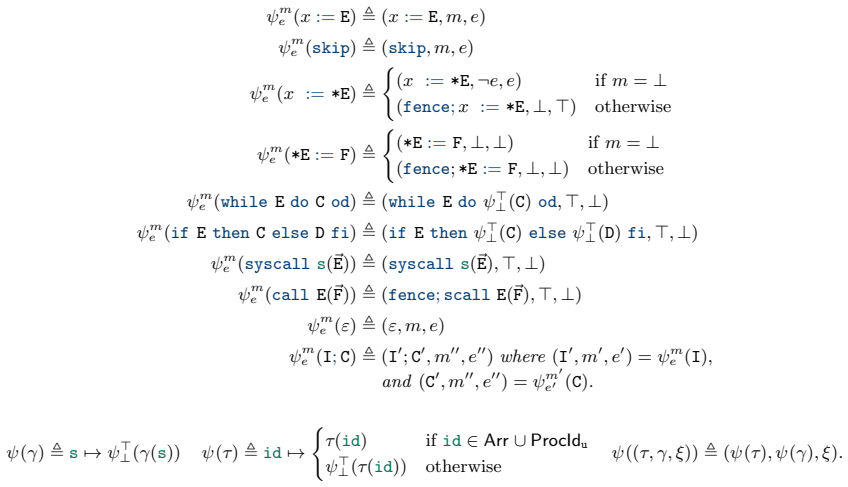
The load-bearing object is the instrumented speculative semantics, in which each speculative step is driven by a directive (branch direction, branch target, or store-to-load forwarding) and emits an observation (branch taken, accessed address, jump target, or backtrack), modeling a side channel while kernel safety is defined as absence of a transition to unsafe, meaning a system call touches or invokes an object outside its declared capabilities. The transformations work by inserting speculation barriers that resolve outstanding speculation and by rewriting indirect calls to a jump instruction whose target cannot be speculatively predicted, called scall in the model. The optimized transformation carries two flags through a static analysis, tracking whether the current instruction could be reached under mis-speculation and whether the write buffer is empty, so that redundant fences can be omitted. Theorem 3 is the formal workhorse: it makes speculative kernel safety a corollary of classic kernel safety once the two conditions on the transformation hold.
What would settle it
Run the transformed kernel on a CPU that permits return-stack-buffer or Phantom-style speculation, which the paper explicitly leaves out of scope, and try a system call that transiently calls a kernel procedure outside its capability set; if the call executes and its address leak reaches the cache, the speculative kernel safety guarantee fails exactly where the model stops.
Extended reading notes
Core claim
The central discovery is that speculative kernel safety can be reduced to classic kernel safety by a semantics-preserving program transformation. Stated as Theorem 3: if a system is kernel safe, and a transformation both imposes speculative kernel safety and preserves system call semantics, then the transformed system is speculative kernel safe and semantically equivalent to the original. The three exhibited transformations meet these conditions by inserting speculation barriers before any instruction that could transiently violate a capability and by replacing ordinary indirect calls with non-speculable jumps. The transformations differ in how many fences they insert: the baseline fences every potentially unsafe operation, the optimized version uses a static analysis of mis-speculation and buffer state to drop redundant fences, and the third fences after every speculation source. The empirical claim is that the optimized transformation costs less than 5 percent on compute-heavy and several I/O workloads, while system-call-heavy workloads see 3x to 10x overhead.
Load-bearing premise
The proof depends on the CPU behaving exactly as the model does: user-space execution cannot influence kernel indirect-branch prediction, a non-speculable jump instruction exists, and only the three modeled speculation mechanisms (branch direction, branch target, store-to-load forwarding) are present.
Editorial extensions
If this is right
- A kernel proved safe against ordinary attackers can be deployed with any of the three transformations and be formally safe against speculative attackers, without user programs observing any difference.
- Layout randomization alone cannot be relied on for kernel safety in the Spectre era; the side-channel layout non-interference condition restores safety, but when it holds randomization is redundant.
- The optimized transformation is cheap enough for production on compute-heavy and many I/O workloads, with overhead under 5 percent, but system-call-heavy workloads such as process creation and inter-process communication pay 3x to 10x.
- Existing mitigations reviewed in the paper, including speculative load hardening, speculative constant-time, taint tracking, and the compiler side-effect suppression pass, do not uniformly stop the three representative attacks, whereas the new transformations do.
- The reduction theorem extends in principle to additional speculation mechanisms such as load value injection and return-address speculation, but the transformations would need to be extended to block those additional sources.
Reading between the lines
- The same reduction could apply to hypervisor-level privileged interfaces, since the model abstracts over the kernel; a hypercall-based system satisfying classic safety would inherit the speculative safety guarantee.
- Because system-call-heavy overhead dominates the cost, the practical research target implied by the paper is a smarter static analysis that proves more reaches of kernel code fence-free, rather than faster fences.
- The hidden hardware dependency is the existence of a true non-speculable jump instruction; if future CPUs expose one cheaply, the approach becomes substantially more attractive than today's retpoline and eIBRS combination.
- A certification tool that checks whether every potentially unsafe instruction in a hardened kernel binary is fence-dominated would let existing kernels be audited against the paper's model without recompiling.
Editorial analysis
A structured set of objections, weighed in public.
Referee Report
Summary. The paper studies kernel safety in two threat models. In the classic (non-speculative) model, it proves that layout randomization gives a probabilistic kernel-safety guarantee for systems whose system calls satisfy a layout non-interference condition, relaxing the syntactic restrictions of Abadi et al. In the speculative model, it argues that layout randomization alone cannot restore safety, introduces a side-channel layout non-interference condition that suffices for speculative kernel safety, and proposes three program transformations (η, ψ, θ) that turn a kernel-safe system into a semantically equivalent speculative-kernel-safe system. The transformations are implemented as an LLVM pass and evaluated on SPEC CPU 2017, UnixBench, and several I/O workloads.
Significance. The paper makes a substantial formal contribution: it gives a clean probabilistic semantics for KASLR with a non-trivial bound δµ,σ, it identifies layout non-interference as the right classic-model assumption, and it reduces speculative kernel safety to classic kernel safety via program transformations. The three transformations are concrete, the LLVM implementation is open source, and the performance evaluation covers both compute-heavy and syscall-heavy workloads with a useful comparison between eIBRS and retpoline. The explicit admission in Section 10 that RSB speculation remains out of scope is honest, but it directly limits the practical reach of the title and abstract claims.
major comments (3)
- [Section 4 / Section 10 / Figure 3] The formal safety guarantee and the transformations cover only PHT, BTB, and STL speculation. Section 4 explicitly excludes return-address (RSB) and Phantom speculation, and the language has no return instruction: procedures return through the [Pop] rule, which none of η, ψ, or θ fences or replaces. Section 10 then states that systems protected with these mitigations 'may still be vulnerable to attacks relying on RSB speculation.' Since Retbleed-style RSB prediction can transiently redirect returns even with eIBRS and retpoline, Theorem 3 and Lemmas 4-6 do not establish speculative kernel safety for real CPUs. The title's 'Comprehensive' and the abstract's 'guarantee speculative kernel safety in the Spectre era' therefore overstate the result. The authors should either extend the model and transformations to returns or systematically qualify the central claims to the PHT/BTB/STL model.
- [Section 8, Lemmas 4-6] The soundness proofs of the three transformations are only sketched. The proof of Lemma 5 says that it relies on 'a form of subject reduction and of soundness of our static analysis' plus 'other technical invariant properties', but these invariants are never stated, and the appendix does not contain proofs for Lemmas 4-6 (Appendix A.2 covers Section 6 only). Since the applicability of Theorem 3 depends entirely on these lemmas, the central formal claim of the paper is not fully verified in the manuscript. The authors should provide complete proofs, a machine-checked formalization, or a precise statement of the invariants with a detailed proof outline.
- [Section 6.3] The claim that layout randomization 'cannot be restored' in the speculative threat model is supported only by two example gadgets and a reference to BlindSide, not by a formal theorem. The examples show that certain systems violate speculative kernel safety, but they do not show that no layout distribution and no system satisfying the paper's assumptions can have a probabilistic guarantee. Since the demise of KASLR is presented as one of the paper's main contributions, the authors should state and prove a concrete impossibility result, for example: for any layout distribution µ and any sufficiently expressive kernel, there exists a speculative attacker that learns a kernel address through the model's observations and then triggers an unsafe access. Without such a theorem, the broad statement in the introduction and abstract is not established.
minor comments (4)
- [Abstract] The sentence 'We show that kernel safety cannot be restored for attackers capable of using side-channels and speculative execution' appears twice; one occurrence should be removed.
- [Section 9, final remarks] The sentence claiming that ψ's overhead 'never exceeds 5%' should explicitly say 'on SPEC CPU 2017 and on SQLite/CrossDB/grep/vbench', because Tables 5-6 show about 3.5x overhead on Apache, 4.1x on nginx, and 3.3x on AES for the same transformation.
- [Section 3.1 and elsewhere] There are several typos: 'idenitifiers' in Section 3.1, 'specualtive' in Section 8, 'F ormal' in Section 10, and 'ngninx' in Tables 5-6. These should be corrected.
- [Figure 14] The y-axis origin is set to 0.975 in Figures 14a-14b, which visually magnifies differences below 2.5%; the caption should state this explicitly so that the normalized run times are not misinterpreted.
Circularity Check
No significant circularity: the main theorems are proved from the paper's explicit speculative semantics, and the stated exclusions and hardware assumptions are scope limits, not fitted inputs.
full rationale
The claimed derivation chain is self-contained rather than circular. Theorem 3 is a conditional statement: it holds for any transformation satisfying Definition 6 (system call semantics preservation) and Definition 7 (imposition of speculative kernel safety), and Lemmas 4-6 establish those conditions by induction over the speculative semantics of Sections 6.1.1 and 8, not by assuming the conclusion. The probabilistic bound in Theorem 1 is not a fitted prediction: the parameter delta_mu_sigma is defined directly as the minimum probability that a probe for an unallocated kernel address fails, and the proof bounds the probability of unsafe by 1 - delta_mu_sigma via Lemma 2; no value is calibrated afterward to make the result come out. The only self-reference is to the companion CCS paper [30] as provenance for the baseline transformation; because the transformation eta is defined in Figure 11 and its soundness is argued in the text, that citation is not load-bearing. The paper explicitly scopes out return-address speculation (Retbleed) and Phantom speculation in Section 4, and acknowledges in Section 10 that protected systems 'may still be vulnerable to attacks relying on RSB speculation'; this is an honest threat-model limitation, not a circular derivation. Likewise, the non-speculable 'scall' instruction is introduced under the stated hardware assumption of fully effective retpoline or eIBRS with BHI_DIS_S, an assumption the paper acknowledges rather than derives. Nothing in the paper reduces a claimed result to its own input by construction, so the circularity score is minimal.
Assumptions & free parameters
assumptions (5)
- domain assumption Speculative execution is fully captured by PHT, BTB and STL directives; RSB, LVI, and Phantom speculation are out of scope.
- domain assumption The victim CPU provides eIBRS (or fully effective retpoline) and BHI_DIS_S, so that indirect branch targets cannot be influenced by user-space execution, and the scall instruction is non-predictable.
- domain assumption Layout non-interference of system calls (Definition 2) is a prerequisite for the probabilistic kernel-safety result (Theorem 1).
- domain assumption Side-channel layout non-interference (Definition 4) is assumed for Theorem 2, and requires a kernel address space large enough to move any object (κk ≥ sum of sizes + 2*max size).
- domain assumption The attacker model includes IBT, PTI, SMAP, SMEP and a W^X memory policy; these hardware features behave as specified in the operational rules.
invented entities (2)
-
fence instruction (modeled lfence)
independent evidence
-
scall instruction (speculative-safe call)
independent evidence
Cite this review
Pith. "Pith review of Comprehensive Kernel Safety in the Spectre Era: Mitigations and Performance Evaluation (Extended Version)." pith.science (2026). https://pith.science/paper/5VTGFYP3
@misc{pith2026241118094,
  author       = {Pith},
  title        = {Pith review of: Comprehensive Kernel Safety in the Spectre Era: Mitigations and Performance Evaluation (Extended Version)},
  year         = {2026},
  howpublished = {\url{https://pith.science/paper/5VTGFYP3}},
  note         = {Machine review of arXiv:2411.18094}
}
read the original abstract
The efficacy of address space layout randomization has been formally demonstrated in a shared-memory model by Abadi et al., contingent on specific assumptions about victim programs. However, modern operating systems, implementing layout randomization in the kernel, diverge from these assumptions and operate on a separate memory model with communication through system calls. In this work, we relax Abadi et al.'s language assumptions while demonstrating that layout randomization offers a comparable safety guarantee in a system with memory separation. However, in practice, speculative execution and side-channels are recognized threats to layout randomization. We show that kernel safety cannot be restored for attackers capable of using side-channels and speculative execution, and introduce enforcement mechanisms that can guarantee speculative kernel safety for safe system calls in the Spectre era. We implement three suitable mechanisms and we evaluate their performance overhead on the Linux kernel.
Figures


Figures from the paper (19 more)




Reference graph
Works this paper leans on
-
[1]
On layout randomization for arrays and functions
Mart ´ ın Abadi and J´ er´ emy Planul. On layout randomization for arrays and functions. InPrinciples of Security and Trust, pages 167–185, Berlin, Heidelberg, 2013. Springer. ISBN 978-3-642-36830- 1
2013
-
[2]
Mart ´ ın Abadi and Gordon D. Plotkin. On protection by layout randomization.ACM Trans. Inf. Syst. Secur., 15(2), jul 2012. ISSN 1094-9224
2012
-
[3]
Control-flow integrity
Mart ´ ın Abadi, Mihai Budiu,´Ulfar Erlingsson, and Jay Ligatti. Control-flow integrity. In Pro- ceedings of the 12th ACM Conference on Computer and Communications Security , page 340–353, New York, NY, USA, 2005. ACM. ISBN 1595932267
2005
-
[4]
Plotkin.Layout Randomization and Nondetermin- ism, pages 1–39
Mart ´ ın Abadi, J´ er´ emy Planul, and Gordon D. Plotkin.Layout Randomization and Nondetermin- ism, pages 1–39. Springer International Publishing, Berlin, Heidelberg, 2014
2014
-
[5]
Technical guidance for mitigating branch type confusion
AMD. Technical guidance for mitigating branch type confusion. Technical report, AMD, November 2022. URL https://www.amd.com/content/dam/amd/en/documents/resources/ technical-guidance-for-mitigating-branch-type-confusion.pdf . White Paper
2022
-
[6]
Enforcing fine-grained constant-time policies
Basavesh Ammanaghatta Shivakumar, Gilles Barthe, Benjamin Gr´ egoire, Vincent Laporte, and Swarn Priya. Enforcing fine-grained constant-time policies. In Proceedings of the 2022 ACM SIGSAC Conference on Computer and Communications Security , page 83–96, New York, NY, USA, 2022. ACM. ISBN 9781450394505
2022
-
[7]
The meaning of memory safety
Arthur Azevedo de Amorim, C˘ at˘ alin Hrit ¸cu, and Benjamin C Pierce. The meaning of memory safety. In Proceedings of Principles of Security and Trust: 7th International Conference , pages 79–105, Springer, 2018. Springer Berlin, Heidelberg
2018
-
[8]
Branch history injection: On the effectiveness of hardware mitigations against Cross-Privilege spectre-v2 attacks
Enrico Barberis, Pietro Frigo, Marius Muench, Herbert Bos, and Cristiano Giuffrida. Branch history injection: On the effectiveness of hardware mitigations against Cross-Privilege spectre-v2 attacks. In 31st USENIX Security Symposium (USENIX Security’22) , pages 971–988, Boston, MA, August 2022. USENIX Association
2022
Show all 117 references
-
[9]
System-level non-interference for constant-time cryptography
Gilles Barthe, Gustavo Betarte, Juan Campo, Carlos Luna, and David Pichardie. System-level non-interference for constant-time cryptography. In Proceedings of the 2014 ACM SIGSAC Con- ference on Computer and Communications Security, page 1267–1279, New York, NY, USA, 2014. ACM
2014
-
[10]
High-assurance cryptography in the spectre era
Gilles Barthe, Sunjay Cauligi, Benjamin Gr´ egoire, Adrien Koutsos, Kevin Liao, Tiago Oliveira, Swarn Priya, Tamara Rezk, and Peter Schwabe. High-assurance cryptography in the spectre era. In 2021 IEEE Symposium on Security and Privacy (SP) , pages 1884–1901, New York, NY, USA,
2021
-
[11]
Frans Kaashoek
Jonathan Behrens, Adam Belay, and M. Frans Kaashoek. Performance evolution of mitigating transient execution attacks. In Proceedings of the Seventeenth European Conference on Computer Systems, page 251–265, New York, NY, USA, 2022. ACM. ISBN 9781450391627. 38
2022
-
[12]
Berger and Benjamin G
Emery D. Berger and Benjamin G. Zorn. Diehard: Probabilistic memory safety for unsafe lan- guages. In Proceedings of the 27th ACM SIGPLAN Conference on Programming Language Design and Implementation , page 158–168, New York, NY, USA, 2006. ACM. ISBN 1595933204
2006
-
[13]
Understanding the Linux Kernel: from I/O ports to process management
Daniel P Bovet and Marco Cesati. Understanding the Linux Kernel: from I/O ports to process management. ” O’Reilly Media, Inc.”, 2005
2005
-
[14]
Kaslr: Break it, fix it, repeat
Claudio Canella, Michael Schwarz, Martin Haubenwallner, Martin Schwarzl, and Daniel Gruss. Kaslr: Break it, fix it, repeat. In Proceedings of the 15th ACM Asia Conference on Computer and Communications Security, page 481–493, New York, NY, USA, 2020. ACM. ISBN 9781450367509
2020
-
[15]
Speculative load hardening, Sep 2018
Chandler Carruth. Speculative load hardening, Sep 2018. URL https://llvm.org/docs/ SpeculativeLoadHardening.html
2018
-
[16]
Gleissenthall, Dean Tullsen, Deian Stefan, Tamara Rezk, and Gilles Barthe
Sunjay Cauligi, Craig Disselkoen, Klaus v. Gleissenthall, Dean Tullsen, Deian Stefan, Tamara Rezk, and Gilles Barthe. Constant-time foundations for the new spectre era. In Proceedings of the 41st ACM SIGPLAN Conference on Programming Language Design and Implementation , page 9...
2020
-
[17]
A systematic study of elastic objects in kernel exploitation
Yueqi Chen, Zhenpeng Lin, and Xinyu Xing. A systematic study of elastic objects in kernel exploitation. In Proceedings of the 2020 ACM SIGSAC Conference on Computer and Communi- cations Security, page 1165–1184, New York, NY, USA, 2020. ACM. ISBN 9781450370899
2020
-
[18]
Speculative privacy tracking (spt): Leaking information from speculative execution without compromising privacy
Rutvik Choudhary, Jiyong Yu, Christopher Fletcher, and Adam Morrison. Speculative privacy tracking (spt): Leaking information from speculative execution without compromising privacy. In MICRO-54: 54th Annual IEEE/ACM International Symposium on Microarchitecture , page 607–622,...
2021
-
[19]
Gaidis, Vaggelis Atlidakis, and Vasileios P
Neophytos Christou, Alexander J. Gaidis, Vaggelis Atlidakis, and Vasileios P. Kemerlis. Eclipse: Preventing speculative memory-error abuse with artificial data dependencies. In Proceedings of the 2024 ACM SIGSAC Conference on Computer and Communications Security , CCS ’24, New...
2024
-
[20]
Supervisor mode access prevention, 2012
Jonathan Corbet. Supervisor mode access prevention, 2012. URL https://lwn.net/Articles/ 517475/
2012
-
[21]
Intel analysis of speculative execution side channels
Intel Corporation. Intel analysis of speculative execution side channels. Technical re- port, Intel Corporation, May 2018. URL https://www.intel.com/content/www/us/en/ content-details/671163/intel-analysis-of-speculative-execution-side-channels. html. White Paper
2018
-
[22]
Indirect branch restricted speculation, 2018
Intel Corporation. Indirect branch restricted speculation, 2018. URL https://www.intel. com/content/www/us/en/developer/articles/technical/software-security-guidance/ technical-documentation/indirect-branch-restricted-speculation.html
2018
-
[23]
Retpoline: A branch target injection mitigation, 2018
Intel Corporation. Retpoline: A branch target injection mitigation, 2018. URL https://www.intel.com/content/dam/develop/external/us/en/documents/ retpoline-a-branch-target-injection-mitigation.pdf
2018
-
[24]
Branch history injection and intra-mode branch target injection / cve-2022-0001, cve-2022-0002 / intel-sa-00598
Intel Corporation. Branch history injection and intra-mode branch target injection / cve-2022-0001, cve-2022-0002 / intel-sa-00598. Technical report, Intel Corporation, May
2022
-
[25]
Affected processors: Guidance for security issues on intel ® processors,
Intel Corporation. Affected processors: Guidance for security issues on intel ® processors,
-
[26]
Bench test, 2024
CrossDB. Bench test, 2024. URL https://crossdb.org/get-started/bench/
2024
-
[27]
cryptsetup, 2025
cryptsetup Group. cryptsetup, 2025. URL https://gitlab.com/cryptsetup/cryptsetup
2025
-
[28]
ProSpeCT: Provably secure speculation for the Constant-Time policy
Lesly-Ann Daniel, Marton Bognar, Job Noorman, S´ ebastien Bardin, Tamara Rezk, and Frank Piessens. ProSpeCT: Provably secure speculation for the Constant-Time policy. In 32nd USENIX Security Symposium (USENIX Security 23) , pages 7161–7178, Anaheim, CA, August 2023. USENIX Ass...
2023
-
[29]
Comprehensive kernel safety in the spectre era, 2024
Davide Davoli. Comprehensive kernel safety in the spectre era, 2024. URL https://gitlab. inria.fr/ddavoli/comprehensive-kernel-safety-in-the-spectre-era
2024
-
[30]
On kernel’s safety in the spectre era (and kaslr is formally dead)
Davide Davoli, Martin Avanzini, and Tamara Rezk. On kernel’s safety in the spectre era (and kaslr is formally dead). In Proceedings of the 2024 ACM SIGSAC Conference on Computer and Communications Security, CCS 2024, USA, October 14-18, 2023 , New York, NY, USA, 2024. ACM
2024
-
[31]
Openbsd 6.3, Oct 2017
Theo de Raadt. Openbsd 6.3, Oct 2017. URL https://www.openbsd.org/33.html
2017
-
[32]
Kernel address space layout randomization, 2013
Jake Edge. Kernel address space layout randomization, 2013. URL https://lwn.net/Articles/ 569635/
2013
-
[33]
Jump over aslr: attacking branch predictors to bypass aslr
Dmitry Evtyushkin, Dmitry Ponomarev, and Nael Abu-Ghazaleh. Jump over aslr: attacking branch predictors to bypass aslr. In The 49th Annual IEEE/ACM International Symposium on Microarchitecture, New York, NY, USA, 2016. IEEE
2016
-
[34]
Supervisor mode execution protection, 2011
Stephen Fischer. Supervisor mode execution protection, 2011. URL https://www.ncsi.com/ nsatc11/presentations/wednesday/emerging_technologies/fischer.pdf
2011
-
[35]
ab – apache http server benchmarking tool, 2025
The Apache Software Foundation. ab – apache http server benchmarking tool, 2025. URL https://httpd.apache.org/docs/2.4/programs/ab.html
2025
-
[36]
Randomizing the linux kernel heap freelists, Sep 2016
Thomas Garnier. Randomizing the linux kernel heap freelists, Sep 2016. URL https://mxatone. medium.com/randomizing-the-linux-kernel-heap-freelists-b899bb99c767
2016
-
[37]
Fine-grained control-flow in- tegrity for kernel software
Xinyang Ge, Nirupama Talele, Mathias Payer, and Trent Jaeger. Fine-grained control-flow in- tegrity for kernel software. In 2016 IEEE European Symposium on Security and Privacy (Eu- roS&P), pages 179–194, New York, NY, USA, 2016. IEEE. doi: 10.1109/EuroSP.2016.24
2016 doi
-
[38]
Fix rsb fill on context switch for serialize
Thomas Gleixner. Fix rsb fill on context switch for serialize. https://lore.kernel.org/all/ 20220716230344.239749011@linutronix.de/, July 2022. Linux Kernel Mailing List
2022
-
[39]
J. A. Goguen and J. Meseguer. Security policies and security models. In 1982 IEEE Symposium on Security and Privacy , New York, NY, USA, 1982. IEEE
1982
-
[40]
Spec- ulative probing: Hacking blind in the spectre era
Enes G¨ oktas, Kaveh Razavi, Georgios Portokalidis, Herbert Bos, and Cristiano Giuffrida. Spec- ulative probing: Hacking blind in the spectre era. In Proceedings of the 2020 ACM SIGSAC Conference on Computer and Communications Security , page 1871–1885, New York, NY, USA,
2020
-
[41]
Prefetch side-channel attacks: Bypassing smap and kernel aslr
Daniel Gruss, Cl´ ementine Maurice, Anders Fogh, Moritz Lipp, and Stefan Mangard. Prefetch side-channel attacks: Bypassing smap and kernel aslr. In Proceedings of the 2016 ACM SIGSAC Conference on Computer and Communications Security , page 368–379, New York, NY, USA,
2016
-
[42]
Kaslr is dead: Long live kaslr
Daniel Gruss, Moritz Lipp, Michael Schwarz, Richard Fellner, Cl´ ementine Maurice, and Stefan Mangard. Kaslr is dead: Long live kaslr. In Engineering Secure Software and Systems , pages 161–176, Berlin, Heidelberg, 2017. Springer International Publishing. ISBN 978-3-319-62105-0
2017
-
[43]
Morales, Jan Reineke, and Andr´ es S´ anchez
Marco Guarnieri, Boris K¨ opf, Jos´ e F. Morales, Jan Reineke, and Andr´ es S´ anchez. Spectector: Principled detection of speculative information flows. In 2020 IEEE Symposium on Security and Privacy (SP) , pages 1–19, New York, NY, USA, 2020. IEEE
2020
-
[44]
Hardware-software contracts for secure speculation
Marco Guarnieri, Boris K¨ opf, Jan Reineke, and Pepe Vila. Hardware-software contracts for secure speculation. In 2021 IEEE Symposium on Security and Privacy (SP) , pages 1868–1883, New York, NY, USA, 2021. IEEE
2021
-
[45]
Practical timing side channel attacks against kernel space aslr
Ralf Hund, Carsten Willems, and Thorsten Holz. Practical timing side channel attacks against kernel space aslr. In 2013 IEEE Symposium on Security and Privacy , pages 191–205, New York, NY, USA, 2013. IEEE
2013
-
[46]
Mac os x has you covered, May 2011
Apple Inc. Mac os x has you covered, May 2011. URL http://www.apple.com/macosx/ security/
2011
-
[47]
ugrep, 2025
Genivia Inc. ugrep, 2025. URL https://github.com/Genivia/ugrep-benchmarks
2025
-
[48]
Intel Corporation, September 2023
Intel ®64 and IA-32 Architectures Software Developer’s Manualx . Intel Corporation, September 2023
2023
-
[49]
Page table isolation (pti), 2023
The kernel development community. Page table isolation (pti), 2023. URLhttps://www.kernel. org/doc/html/next/x86/pti.html
2023
-
[50]
Spectre attacks: Exploiting speculative execution
Paul Kocher, Jann Horn, Anders Fogh, Daniel Genkin, Daniel Gruss, Werner Haas, Mike Ham- burg, Moritz Lipp, Stefan Mangard, Thomas Prescher, Michael Schwarz, and Yuval Yarom. Spectre attacks: Exploiting speculative execution. In 2019 IEEE Symposium on Security and Privacy (SP)...
2019
-
[51]
Tagbleed: Breaking kaslr on the isolated kernel address space using tagged tlbs
Jakob Koschel, Cristiano Giuffrida, Herbert Bos, and Kaveh Razavi. Tagbleed: Breaking kaslr on the isolated kernel address space using tagged tlbs. In 2020 IEEE European Symposium on Security and Privacy (EuroS&P) , pages 309–321, New York, NY, USA, 2020. IEEE
2020
-
[52]
Un- contained: Uncovering container confusion in the linux kernel
Jakob Koschel, Pietro Borrello, Daniele Cono D’Elia, Herbert Bos, and Cristiano Giuffrida. Un- contained: Uncovering container confusion in the linux kernel. In 32nd USENIX Security Sympo- sium (USENIX Security 23), pages 5055–5072, Anaheim, CA, August 2023. USENIX Association...
2023
-
[53]
Lattner and V
C. Lattner and V. Adve. Llvm: a compilation framework for lifelong program analysis & transfor- mation. In International Symposium on Code Generation and Optimization, 2004. CGO 2004. , pages 75–86, New York, NY, USA, 2004. IEEE
2004
-
[54]
Com- prehensive and efficient protection of kernel control data
Jinku Li, Zhi Wang, Tyler Bletsch, Deepa Srinivasan, Michael Grace, and Xuxian Jiang. Com- prehensive and efficient protection of kernel control data. IEEE Transactions on Information Forensics and Security, 6(4):1404–1417, 2011
2011
-
[55]
Learn the architecture – providing protection for complex software, 2022
Arm Limited. Learn the architecture – providing protection for complex software, 2022. URL https://developer.arm.com/documentation/102433/0100. 41
2022
-
[56]
Meltdown: Reading kernel memory from user space
Moritz Lipp, Michael Schwarz, Daniel Gruss, Thomas Prescher, Werner Haas, Anders Fogh, Jann Horn, Stefan Mangard, Paul Kocher, Daniel Genkin, Yuval Yarom, and Mike Hamburg. Meltdown: Reading kernel memory from user space. In 27th USENIX Security Symposium (USENIX Security 18),...
2018
-
[57]
Entrybleed: A universal kaslr bypass against kpti on linux
William Liu, Joseph Ravichandran, and Mengjia Yan. Entrybleed: A universal kaslr bypass against kpti on linux. In Proceedings of the 12th International Workshop on Hardware and Architectural Support for Security and Privacy , HASP ’23, page 10–18, New York, NY, USA,
-
[58]
Towards unveiling exploitation potential with multiple error behaviors for kernel bugs
Ziqin Liu, Zhenpeng Lin, Yueqi Chen, Yuhang Wu, Yalong Zou, Dongliang Mu, and Xinyu Xing. Towards unveiling exploitation potential with multiple error behaviors for kernel bugs. IEEE Transactions on Dependable and Secure Computing , 21(1):1–18, 2023
2023
-
[59]
Kim, Parthasarathy Ranganathan, Daniel Stodolsky, and Mark Wachsler
Andrea Lottarini, Alex Ramirez, Joel Coburn, Martha A. Kim, Parthasarathy Ranganathan, Daniel Stodolsky, and Mark Wachsler. vbench: Benchmarking video transcoding in the cloud. In Proceedings of the Twenty-Third International Conference on Architectural Support for Program- mi...
2018
-
[60]
Mambretti, A
A. Mambretti, A. Sandulescu, A. Sorniotti, W. Robertson, E. Kirda, and A. Kurmus. Bypassing memory safety mechanisms through speculative control flow hijacks. In 2021 IEEE European Symposium on Security and Privacy (EuroS&P) , pages 633–649, Los Alamitos, CA, USA, sep
2021
-
[61]
Attacking the ios kernel: A look at ‘evasi0n’, March 2013
Tarjei Mandt. Attacking the ios kernel: A look at ‘evasi0n’, March 2013. URL https://papers. put.as/papers/ios/2013/NISlecture201303.pdf
2013
-
[62]
Address space layout randomization (aslr), July 2023
Ed Maste. Address space layout randomization (aslr), July 2023. URL https://wiki.freebsd. org/AddressSpaceLayoutRandomization
2023
-
[63]
Michael, Anitha Gollamudi, Jay Bosamiya, Evan Johnson, Aidan Denlinger, Craig Disselkoen, Conrad Watt, Bryan Parno, Marco Patrignani, Marco Vassena, and Deian Stefan
Alexandra E. Michael, Anitha Gollamudi, Jay Bosamiya, Evan Johnson, Aidan Denlinger, Craig Disselkoen, Conrad Watt, Bryan Parno, Marco Patrignani, Marco Vassena, and Deian Stefan. Mswasm: Soundly enforcing memory-safe execution of unsafe code. In Proceedings of the 50th ACM SI...
2023
-
[64]
Drop the rop fine-grained control-flow integrity for the linux kernel, 2017
Jo˜ ao Moreira, Sandro Rigo, Michalis Polychronakis, and Vasileios P Kemerlis. Drop the rop fine-grained control-flow integrity for the linux kernel, 2017
2017
-
[65]
Martin, and Steve Zdancewic
Santosh Nagarakatte, Jianzhou Zhao, Milo M.K. Martin, and Steve Zdancewic. Softbound: Highly compatible and complete spatial memory safety for c. SIGPLAN Not. , 44(6):245–258, 2009
2009
-
[66]
Exorcising spectres with secure compilers
Marco Patrignani and Marco Guarnieri. Exorcising spectres with secure compilers. In Proceedings of the 2021 ACM SIGSAC Conference on Computer and Communications Security, page 445–461, New York, NY, USA, 2021. ACM. ISBN 9781450384544
2021
-
[67]
Kernel hardening, August 2022
Android Open Source Project. Kernel hardening, August 2022. URL https://source.android. com/docs/core/architecture/kernel/hardening
2022
-
[68]
X86speculativeexecutionsideeffectsuppression.cpp file reference, 2025
The LL VM Project. X86speculativeexecutionsideeffectsuppression.cpp file reference, 2025. URL https://www.llvm.org/doxygen/X86SpeculativeExecutionSideEffectSuppression_8cpp. html. 42
2025
-
[69]
Linux 6.1: Rust to hit mainline kernel, October 2022
Liam Proven. Linux 6.1: Rust to hit mainline kernel, October 2022. URL https://www. theregister.com/2022/10/05/rust_kernel_pull_request_pulled/
2022
-
[70]
Pacman: Attacking arm pointer authentication with speculative execution
Joseph Ravichandran, Weon Taek Na, Jay Lang, and Mengjia Yan. Pacman: Attacking arm pointer authentication with speculative execution. InProceedings of the 49th Annual International Symposium on Computer Architecture, pages 685–698, New York, NY, USA, 2022. ACM
2022
-
[71]
Toward linux kernel memory safety
Elena Reshetova, Hans Liljestrand, Andrew Paverd, and N Asokan. Toward linux kernel memory safety. Software: Practice and Experience , 48(12):2237–2256, 2018
2018
-
[72]
Linux kernel heap feng shui in 2022, May 2022
Michael S and Vitaly Nikolenko. Linux kernel heap feng shui in 2022, May 2022. URL https: //duasynt.com/blog/linux-kernel-heap-feng-shui-2022
2022
-
[73]
Threat overview for linux kernel, November 2022
SecurityScorecard. Threat overview for linux kernel, November 2022. URL https://www. cvedetails.com/product/47/Linux-Linux-Kernel.html
2022
-
[74]
On the effectiveness of address-space randomization
Hovav Shacham, Matthew Page, Ben Pfaff, Eu-Jin Goh, Nagendra Modadugu, and Dan Boneh. On the effectiveness of address-space randomization. In Proceedings of the 11th ACM Conference on Computer and Communications Security , page 298–307, New York, NY, USA, 2004. ACM. ISBN 1581139616
2004
-
[75]
Tanenbaum and Herbert Bos
Andrew S. Tanenbaum and Herbert Bos. Modern Operating Systems. Prentice Hall Press, USA, 4th edition, 2014. ISBN 013359162X
2014
-
[76]
Documentation for the pax project, 2003
PaX Team. Documentation for the pax project, 2003. URL https://pax.grsecurity.net/ docs/
2003
-
[77]
Inception: Exposing new attack surfaces with training in transient execution
Dani¨ el Trujillo, Johannes Wikner, and Kaveh Razavi. Inception: Exposing new attack surfaces with training in transient execution. In 32nd USENIX Security Symposium (USENIX Security 23), pages 7303–7320, Anaheim, CA, August 2023. USENIX Association. ISBN 978-1-939133-37-
2023
-
[78]
Retpoline: a software construct for preventing branch-target-injection, 2018
Paul Turner. Retpoline: a software construct for preventing branch-target-injection, 2018. URL https://support.google.com/faqs/answer/7625886
2018
-
[79]
Hypersafe: A lightweight approach to provide lifetime hypervisor control-flow integrity
Zhi Wang and Xuxian Jiang. Hypersafe: A lightweight approach to provide lifetime hypervisor control-flow integrity. In 2010 IEEE Symposium on Security and Privacy , pages 380–395, New York, NY, USA, 2010. IEEE. doi: 10.1109/SP.2010.30
2010 doi
-
[80]
Watson, Jonathan Woodruff, Peter G
Robert N.M. Watson, Jonathan Woodruff, Peter G. Neumann, Simon W. Moore, Jonathan An- derson, David Chisnall, Nirav Dave, Brooks Davis, Khilan Gudka, Ben Laurie, Steven J. Murdoch, Robert Norton, Michael Roe, Stacey Son, and Munraj Vadera. Cheri: A hybrid capability-system arc...
2015
-
[81]
Wenisch, and Baris Kasikci
Ofir Weisse, Ian Neal, Kevin Loughlin, Thomas F. Wenisch, and Baris Kasikci. Nda: Preventing speculative execution attacks at their source. In Proceedings of the 52nd Annual IEEE/ACM International Symposium on Microarchitecture, page 572–586, New York, NY, USA, 2019. ACM. ISBN...
2019
-
[82]
InSpectre gadget: Inspecting the residual attack surface of cross-privilege spectre v2
Sander Wiebing, Alvise de Faveri Tron, Herbert Bos, and Cristiano Giuffrida. InSpectre gadget: Inspecting the residual attack surface of cross-privilege spectre v2. In 33rd USENIX Security Symposium (USENIX Security 24) , pages 577–594, Philadelphia, PA, August 2024. USENIX As...
2024
-
[83]
URL https://www.usenix.org/conference/usenixsecurity23/presentation/trujillo
-
[84]
Phantom: Exploiting decoder-detectable mispredictions
Johannes Wikner, Dani¨ el Trujillo, and Kaveh Razavi. Phantom: Exploiting decoder-detectable mispredictions. In Proceedings of the 56th Annual IEEE/ACM International Symposium on Mi- croarchitecture, MICRO ’23, page 49–61, New York, NY, USA, 2023. Association for Computing Mac...
2023
-
[85]
Fletcher
Jiyong Yu, Mengjia Yan, Artem Khyzha, Adam Morrison, Josep Torrellas, and Christopher W. Fletcher. Speculative taint tracking (stt): A comprehensive protection for speculatively accessed data. In Proceedings of the 52nd Annual IEEE/ACM International Symposium on Microarchi- te...
2019
-
[86]
Ultimate slh: taking speculative load hardening to the next level
Zhiyuan Zhang, Gilles Barthe, Chitchanok Chuengsatiansup, Peter Schwabe, and Yuval Yarom. Ultimate slh: taking speculative load hardening to the next level. In Proceedings of the 32nd USENIX Conference on Security Symposium , USA, 2023. USENIX Association. ISBN 978-1- 939133-3...
2023
-
[89]
RETBLEED: Arbitrary speculative code execution with return instructions
Johannes Wikner and Kaveh Razavi. RETBLEED: Arbitrary speculative code execution with return instructions. In 31st USENIX Security Symposium (USENIX Security 22) , pages 3825– 3842, Boston, MA, August 2022. USENIX Association. ISBN 978-1-939133-31-1
2022
-
[93]
∧ u(F1) ⇒ w ⊢σ2 ϕ2 →∗ (F, w⋄ τ′
-
[94]
We prove this by induction on n: - Case 0
∧ τ′ 1 =Idu∪ArrIdk τ′ 2. We prove this by induction on n: - Case 0. This case is trivial. - Case n + 1. In this case, we assume: w ⊢σ1 ϕ1 →n (F, w⋄ τ′
-
[95]
We apply the IH to the n-step transition, obtaining: w ⊢σ2 ϕ2 →∗ (F, w⋄ τ′
→ (F ′, w⋄ τ′′ 1 ) ∧ u(F ′). We apply the IH to the n-step transition, obtaining: w ⊢σ2 ϕ2 →∗ (F, w⋄ τ′
-
[96]
Our goal is to establish: w ⊢σ2 (F, w⋄ τ′
∧ τ′ 1 =Idu∪ArrIdk τ′ 2. Our goal is to establish: w ⊢σ2 (F, w⋄ τ′
-
[97]
The proof proceeds by case analysis on the rule used in: w ⊢σ1 (F, w⋄ τ′
→∗ (F ′, w⋄ τ′′ 2 ) ∧ τ′′ 1 =Idu∪ArrIdk τ′′ 2 . The proof proceeds by case analysis on the rule used in: w ⊢σ1 (F, w⋄ τ′
-
[98]
(†) In most cases, the identity of the frame stack and the equivalence τ′ 1 =Idu∪ArrIdk τ′ 2 suffice to show that the same rule applies to the corresponding transition in σ2
→ (F ′, w⋄ τ′′ 1 ). (†) In most cases, the identity of the frame stack and the equivalence τ′ 1 =Idu∪ArrIdk τ′ 2 suffice to show that the same rule applies to the corresponding transition in σ2. To illustrate this, we consider [Load] as an example. Another notable case is [ Po...
-
[99]
- Case [Pop]
→ (F ′, w⋄ τ′ 2) In particular, the stack frame is F ′ because τ′ 1(a, i) = τ′ 2(a, i). - Case [Pop]. We can refine the assumption ( †) as follows: w ⊢σ1 (⟨ε, ρ′, b⟩ : F , w⋄ τ′
-
[100]
Additionally, we have u(F ′ ) which also implies u(F )
→ (F ′ , w⋄ τ′ 1) where, in particular, F ′ is obtained by updating the register map of F according to the rule. Additionally, we have u(F ′ ) which also implies u(F ). We proceed by cases on b. - Case b = u. In this case, we can apply the IH, and the remaining part of the pro...
-
[101]
In ( ∗), we tacitly unrolled the first reduction step of the system call invocation
( ∗) and w ⊢σ1 (⟨γ1(s), ρ′ 0, ks⟩, w⋄ τ′′ 1 ) →n−n′−1 (⟨ε, ρ′, ks⟩ : F ′′ , w⋄ τ′ 1), (‡) with F ′′ : ⟨D, ρ,u⟩ : F ′′ = F and k(F ′′ ). In ( ∗), we tacitly unrolled the first reduction step of the system call invocation. From k(F ′′ ) and u(F ), we deduce that F ′′ must be emp...
-
[102]
→ (⟨γ1(s), ρ′ 0, ks⟩ : ⟨D, ρ′, u⟩ : F, w⋄ τ′
-
[103]
→∗ (F ′ : ⟨D, ρ′, u⟩ : F, w⋄ τ′′ 1 ) → err, and that: w ⊢σ1 (⟨γ1(s), ρ′ 0, ks⟩, w⋄ τ′
-
[104]
By case analysis on the rules that has been used to prove w ⊢σ1 ϕ′ 1 → err, we observe that the same rule can also be used to prove w ⊢σ1 (F ′, w⋄ τ′′ 1 ) → err
→∗ (F ′, w⋄ τ′′ 1 ) In the first conclusion, we tacitly replaced ϕ′ 1 with ( F ′ : ⟨D, ρ′, u⟩ : F, w⋄ τ′′ 1 ) and we made the first reduction step after the system call invocation explicit. By case analysis on the rules that has been used to prove w ⊢σ1 ϕ′ 1 → err, we observe ...
-
[105]
→∗ err, and by applying the assumption on the preservation of system call semantics, we deduce: w ⊢σ2 (⟨γ2(s), ρ′ 0, ks⟩, w⋄ τ′
-
[106]
By applying the auxiliary claim, we prove: w ⊢σ2 ϕ2 →∗ (⟨syscall s(E1,
→∗ err. By applying the auxiliary claim, we prove: w ⊢σ2 ϕ2 →∗ (⟨syscall s(E1, . . . ,Ek); D, ρ′, u⟩ : F, w⋄ τ′
-
[107]
We conclude with an application of Lemma 9, which proves w ⊢σ2 ϕ2 →∗ err
→ (⟨γ2(s), ρ′ 0, ks⟩ : ⟨D, ρ′, u⟩ : F, w⋄ τ′ 2), Here, we unrolled the first step of the execution of the system call using the rule [ SC]. We conclude with an application of Lemma 9, which proves w ⊢σ2 ϕ2 →∗ err. - Case unsafe. This case is analogous to the previous one. - Ca...
-
[109]
: ⟨Ck, ρk, bk⟩ for C0,
F = ⟨C0, ρ0, b0⟩ : . . .: ⟨Ck, ρk, bk⟩ for C0, . . . ,Ck such that Σ(C0, ⊤, ⊥), . . . ,Σ(Ck, ⊤, ⊥)
-
[110]
C = ψm e (C′) ∧ bms ⇒ m ∧ e ⇒ µ = ϵ
-
[111]
Consequently, we can apply Remark 8 to establish that τ ′ =ProcId τ =ProcId τ ′′
dom([JEKAddr ρ,w 7→ JFKρ,w]) ⊆ w(ArrId) From (H2), we conclude that the domain of µ is a subset of ArrId. Consequently, we can apply Remark 8 to establish that τ ′ =ProcId τ =ProcId τ ′′. This follows directly from (H2), and hence ψ, σ⊢ twfw(τ ′), given that σ ∈ im(ψ). Point (...
-
[112]
(µ, w⋄ τ) = w ⋄ τ ′ for some τ ′ such that ψ, σ⊢ twfw(τ ′)
-
[113]
,Ck such that Σ(C0, ⊤, ⊥),
All frames in the stack of the final configuration carry commands C0, . . . ,Ck such that Σ(C0, ⊤, ⊥), . . . ,Σ(Ck, ⊤, ⊥)
-
[114]
Point (2) is a consequence of (H2), and follows by introspection of the target configuration
dom(ϵ) ⊆ w(ArrId) The proof of point (1) is analogous to the one given for stores. Point (2) is a consequence of (H2), and follows by introspection of the target configuration. Points (3) and (4) (where we already replaced m, e, bms and µ with their actual value for this sub-d...
-
[115]
w ⋄ τ =ProcId w ⋄ τ ′′, which directly follows from (H2)
-
[116]
: ⟨Ck, ρk, bk⟩, where C0,
The stack F is of the form⟨C0, ρ0, b0⟩ : . . .: ⟨Ck, ρk, bk⟩, where C0, . . . ,Ck satisfies Σ(C0, ⊤, ⊥), . . . ,Σ(Ck, ⊤, ⊥). This follows trivially from (H2), as the frame stack remains unchanged
-
[117]
Σ( ψ⊤ ⊥(Ci); ψ⊤ ⊥(D)), that is trivial
-
[118]
- Case ⃗Q ̸= ε
dom(µ) ⊆ w(ArrId), which is a consequence of (H2). - Case ⃗Q ̸= ε. This remaining case is analogous to the case where ⃗Q = ε and C ̸= ε, as the premises (H1), (H2), (H3) also hold for the first element of ⃗Q. Lemma 25. Let σ = (τ, γ, ξ) be a system. For every configuration sta...
-
[2016]
ISBN 9781450341394
ACM. ISBN 9781450341394
-
[2021]
IEEE Computer Society
-
[2022]
URL https://www.intel.com/content/www/us/en/developer/articles/technical/ software-security-guidance/technical-documentation/branch-history-injection. html. Technical Documentation. 39
-
[2023]
ISBN 9798400716232
ACM. ISBN 9798400716232
-
[2025]
URL https://www.intel.com/content/www/us/en/developer/topic-technology/ software-security-guidance/processors-affected-consolidated-product-cpu-model. html
Reviewed August 12, 2026 · model on record in the stance chip above.
Discussion (0). Continue with ORCID to comment.