REVIEW 2 major objections 5 minor 88 references
DistinctAD: Distinctive Audio Description Generation in Contexts
T0 review · 2 major / 5 minor · reviewed 2026-08-12 · deepseek-v4-flash
Pith's one-line read DistinctAD: Generating movie audio descriptions that avoid repeating the same words across similar consecutive scenes.
desk verdict Solid empirical paper on distinctive AD generation, but Eq. (12) is misprinted or wrong and must be fixed before the method is reproducible. read the letter →
The pith
A machine-rendered reading of the paper's core claim, the machinery that carries it, and where it could break.
The reading
What carries the argument
The central objects are (a) a CLIP-AD adaptation stage, which fine-tunes only the CLIP vision encoder using two contrastive losses (global video-to-AD matching and frame-to-word multi-instance loss) while keeping the CLIP text encoder frozen, and (b) a Contextual Expectation-Maximization Attention (EMA) module operating on N consecutive video clips, which iteratively estimates responsibilities, updates K compact bases, reconstructs denoised features $\hat{H}$, and additionally attends from raw features to bases to produce $\hat{e}_H$ features. A distinctive word loss $L_{\text{dist}}$ over a word set created by filtering out duplicates from the N-context ADs is added to the standard auto-regressive loss.
What would settle it
Run the Stage-II training with the printed $L_{\text{dist}}$ term replaced by a loss that, for each token position, sums over all non-repeated distinctive words as in Eq. 12, and observe whether the model's generated ADs become incoherent or the Recall@5/16 gain over the baseline disappears; conversely, if the paper were to release the exact training code, comparing the loss computation in the released code against Eq. 12 would settle whether the reported gain is attributable to $L_{\text{dist}}$ as described.
Extended reading notes
Core claim
The central claim is that the two failure modes of automatic audio description, a vision-side domain gap and contextual redundancy between neighboring clips, can be addressed by (1) fine-tuning only the CLIP vision encoder with a global video-AD contrastive loss plus a parameter-free fine-grained frame-word multi-instance loss, and (2) adding a Contextual Expectation-Maximization Attention module that compresses and re-attends N consecutive clips' features through K learned bases, together with a distinctive word prediction loss that explicitly pushes the frozen LLM to generate words unique to the current AD rather than words repeated in nearby ADs. The paper reports that this pipeline, with the adapted CLIPAD-B16 encoder and LLaMA3-8B, reaches CIDEr 27.3 and Recall@5/16 56.0 on MAD-Eval and beats AutoAD-III's CIDEr and Recall@1/5 on CMD-AD and TV-AD. The qualitative examples show that prior systems tend to output generic actions like 'looks at something' while DistinctAD tends to name specific objects and actions that identify the current clip.
Load-bearing premise
The load-bearing premise is that the distinctive-word prediction loss, as implemented, truly improves distinctiveness without corrupting normal sentence generation, but the paper only prints a loss formula that appears to conflict with the auto-regressive loss and gives no implementation detail to resolve the discrepancy.
Editorial extensions
If this is right
- If the central claim holds, automatic AD can move from generic clip-level captions to context-aware narration that flags what changes from one scene to the next, improving accessibility for blind and low-vision viewers and also supporting eye-free watching.
- The adapted CLIP vision encoder (CLIPAD) is a drop-in replacement that can replace CLIP in other CLIP-based partial-fine-tuning AD systems, so the Stage-I adaptation should transfer to other captioning or narration pipelines.
- The Contextual EMA and distinctive-word loss are generic enough that the same redundancy-removal recipe could be applied to dense video captioning and to any long-video-to-text task where adjacent segments are semantically redundant.
- The distinctive-word loss could be made even more explicit by decoding with a constraint that actively avoids the words already present in the neighboring ADs.
- If the evaluation metric Recall@k/N is trusted as a proxy for distinctiveness, the gains reported here (e.g., 56.0 vs 52.8 for AutoAD-III on MAD-Eval) suggest that the method's main contribution is real, measurable improvement in clip-specificity.
Reading between the lines
- The paper's own experiments include a non-consecutive-clips control (Table 6) showing that R@5/16 *improves* when the N clips are not consecutive; the paper attributes this to more diverse visual content, which would suggest distinctiveness and local accuracy are at least partially in tension.
- The distinctive-word loss, as printed in Eq. 12, sums log-probabilities of every distinctive word at every token position, which as written would fight the auto-regressive loss at each position, so the published equation probably does not mirror the actual training objective and would need clarification before the result can be reproduced.
- Because the paper downloads raw movies and re-aligns timestamps, the reported results implicitly depend on its own re-sorted MAD split (482 movies, 326,632 ADs rather than the original 488 movies and 334,296 ADs), so direct comparisons with numbers reported by other papers on MAD-Eval may not all be on the same training data.
- The method still leaves a large gap to human annotations (CIDEr ~27 vs human-like reconstruction CIDEr 612 from the paper's own Appendix A), so the practical outcome is better *relative* AD quality within a still-far-from-human regime.
Editorial analysis
A structured set of objections, weighed in public.
Referee Report
Summary. This paper presents DistinctAD, a two-stage framework for automatic audio description (AD) generation for movies. Stage-I adapts a CLIP vision encoder to movie-AD data via a global video-AD contrastive loss and a fine-grained frame-AD multi-instance matching loss, claiming to close the domain gap without requiring extra AD text corpora. Stage-II processes N consecutive video clips with a Contextual Expectation-Maximization Attention (EMA) module and an explicit distinctive word prediction loss, using a frozen LLM (GPT-2 or LLaMA) to generate ADs. The authors report state-of-the-art results on MAD-Eval, CMD-AD, and TV-AD, with particular gains on the Recall@k/N metric.
Significance. If the proposed training scheme is sound, the paper makes a meaningful contribution to AD generation: the Stage-I adaptation is a lightweight, reusable way to reduce the movie-AD domain gap, and the Contextual EMA offers a principled mechanism to compact redundant visual information across clips. The empirical study is extensive, covering three benchmarks, multiple backbones, and component ablations, and the reported gains over strong baselines such as AutoAD-II/III are substantial. The paper also includes qualitative comparisons and a motivating analysis of the CLIP embedding space. However, the central distinctiveness mechanism is not reproducible from the published equations, and the paper does not address the significant overlap between the proposed loss and the headline evaluation metric.
major comments (2)
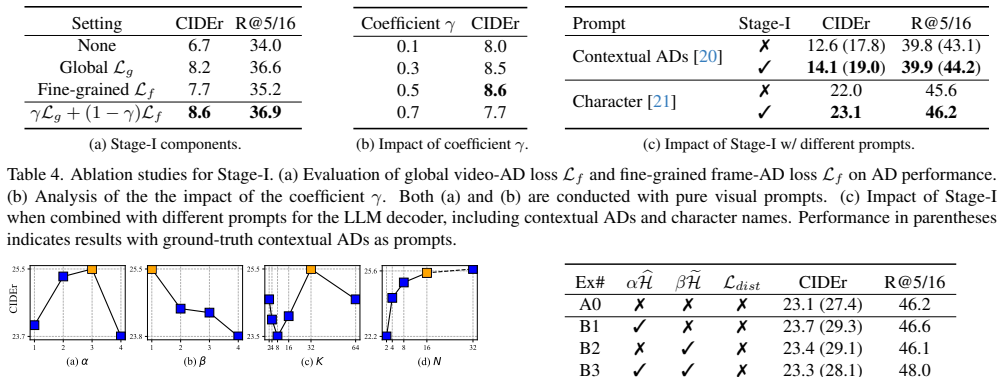
- [Section 3.2, Eq. (12)] The distinctive-word loss as printed is not a valid autoregressive training objective. At each token position n, the double sum over i=1..u of log P(w_n = w_i^d | prompt, w_<n) asks the model to maximize the probability of all u distinctive words simultaneously, but a softmax output layer normalizes over the vocabulary, so these probabilities compete. This conflicts with the standard autoregressive loss Lauto in Eq. (11), and since u can be large, Ldist can dominate the total loss, potentially destroying next-token generation. Moreover, no masking, position alignment, indicator function, or reweighting is specified to connect the set w_d to the actual target tokens, and the term "word" is not mapped to the LLM's subword vocabulary. The paper must provide a corrected equation and exact implementation details (how w_d is filtered, how words are tokenized, and how the loss is applied in training). Without this, the gains attributed to Ldist in Table 5 (e.g., C3 vs B3: 25.5 vs 23.3 CIDEr and 51.7 vs 48.0 R@5/16) cannot be traced to the stated mechanism.
- [Sections 3.2 and 4.1] The distinctive-word loss and the R@k/N metric are closely aligned by design: Ldist explicitly trains the model to produce words that are unique to the current AD among its N neighboring context ADs, while R@k/N evaluates retrieval of the current ground-truth AD among those same N neighboring GT texts using token-overlap-based BERTScore. This overlap means that gains on R@k/N are partly a direct consequence of optimizing for the same notion of distinctiveness, and the paper does not discuss this alignment. To make the distinctiveness claim more convincing, the authors should report an independent evaluation (e.g., human ratings of distinctiveness, or a diversity/novelty metric computed on the generated outputs) and should analyze how much of the R@k/N improvement is due to the explicit loss versus the contextual EMA module, ideally with a version of the model trained without Ldist evaluated on a distinctiveness metric not aligned with the training signal.
minor comments (5)
- [Abstract and Table 2] The abstract states that DistinctAD "consistently outperforms baselines," but in Table 2 on CMD-AD, AutoAD-III† reports a higher CIDEr (25.0 vs 22.7). The authors acknowledge this in Section 4.2, but the wording in the abstract should be qualified, e.g., "outperforms previous methods that do not use large-scale external pre-training."
- [Section 4.1, Metrics] The definition of R@k/N is incomplete: the paper says it "calculates the average value of Recall@k for each AD with its N temporally adjacent GT texts" using BERTScore, but does not specify the retrieval procedure (e.g., how candidates are formed, whether the current GT is included, and how ties are broken). Please provide an exact formula or a more detailed description, since this is a headline metric.
- [Appendix A] The motivating analysis states that ADs reconstructed from CLIP visual features are "often of poor quality," but only the text-reconstruction results are shown in Table A.1. To support the claim that the vision encoder is the bottleneck, the authors should include the corresponding visual-reconstruction experiment.
- [Section 3.1, Eq. (3)] The fine-grained frame-AD matching loss samples a single frame f from Vi; please clarify how many frames are sampled per clip and whether this is done repeatedly per batch, as this affects the gradient estimate and the choice of negative set.
- [Section 3.2 and Fig. 4] The hyperparameter settings for the Contextual EMA are not fully explained: the temperatures τ in Eqs. (2) and (6) are not given numerical values, and the x-axis labels in Fig. 4 are not shown for all panels. Please specify the used values in the implementation details and ensure the plots are self-contained.
Circularity Check
No significant circularity; all central claims are evaluated against held-out benchmarks and no load-bearing step reduces to its own inputs by construction.
full rationale
DistinctAD's three contributions are an empirical system: fine-tuning a CLIP vision encoder on movie-AD pairs (Stage-I), a Contextual EMA module that summarizes N consecutive clips, and a distinctive-word prediction loss added to the autoregressive LLM objective (Stage-II). None of these defines its headline quantities in terms of the evaluation metric. The R@k/N metric ranks generated ADs against neighboring ground-truth ADs using BERTScore on held-out test splits; it is not the training objective, and no test-set parameter is fitted to it. The distinctive-word loss is applied to training examples and the reported gains are measured on unseen benchmarks, so the claim of improved distinctiveness is an empirical result rather than a tautology. The paper does import previous work (EMA, Perceiver, CLIP, LLaMA, AutoAD), but these are standard components and are not invoked to forbid alternatives or to justify a conclusion solely by author self-citation. The only closely related self-citations are Chan's earlier distinctive-captioning papers (refs. 75-77), which appear only in related work and are not load-bearing. The most serious issue in the manuscript is Eq. (12), which as printed sums log-probabilities over all distinctive words at every token position and appears inconsistent with next-token generation; however, this is a correctness and reproducibility concern about whether the published equation describes the implemented loss, not a circularity in which the output is equivalent to the input by definition. Because no specific reduction of a claimed result to its own inputs can be exhibited with a quotation, the appropriate circularity score is 0.
Assumptions & free parameters
free parameters (7)
- γ (Stage-I loss balance) =
0.5
- α (weight for compact reconstruction bH) =
3
- β (weight for cross-attended features eH) =
1
- K (number of EMA bases) =
32
- N (number of consecutive context clips) =
16
- τ (softmax temperatures in Eq. 2 and Eq. 6) =
not reported
- R (EMA iteration count) =
not reported
assumptions (4)
- domain assumption CLIP text embeddings contain enough information to reconstruct ADs with a small projector and GPT-2, so the text encoder can be frozen during adaptation.
- domain assumption Consecutive movie clips share redundant visual content, so removing common bases via EMA improves distinctiveness.
- domain assumption A multiple-instance relationship holds between frames and AD words: each word may appear in only some frames, allowing frame-word attention to align them.
- ad hoc to paper The distinctive word set wd, produced by filtering duplicates from context ADs, is a valid training signal for the LLM.
Cite this review
Pith. "Pith review of DistinctAD: Distinctive Audio Description Generation in Contexts." pith.science (2026). https://pith.science/paper/KNR7U5OM
@misc{pith2026241118180,
  author       = {Pith},
  title        = {Pith review of: DistinctAD: Distinctive Audio Description Generation in Contexts},
  year         = {2026},
  howpublished = {\url{https://pith.science/paper/KNR7U5OM}},
  note         = {Machine review of arXiv:2411.18180}
}
read the original abstract
Audio Descriptions (ADs) aim to provide a narration of a movie in text form, describing non-dialogue-related narratives, such as characters, actions, or scene establishment. Automatic generation of ADs remains challenging due to: i) the domain gap between movie-AD data and existing data used to train vision-language models, and ii) the issue of contextual redundancy arising from highly similar neighboring visual clips in a long movie. In this work, we propose DistinctAD, a novel two-stage framework for generating ADs that emphasize distinctiveness to produce better narratives. To address the domain gap, we introduce a CLIP-AD adaptation strategy that does not require additional AD corpora, enabling more effective alignment between movie and AD modalities at both global and fine-grained levels. In Stage-II, DistinctAD incorporates two key innovations: (i) a Contextual Expectation-Maximization Attention (EMA) module that reduces redundancy by extracting common bases from consecutive video clips, and (ii) an explicit distinctive word prediction loss that filters out repeated words in the context, ensuring the prediction of unique terms specific to the current AD. Comprehensive evaluations on MAD-Eval, CMD-AD, and TV-AD benchmarks demonstrate the superiority of DistinctAD, with the model consistently outperforming baselines, particularly in Recall@k/N, highlighting its effectiveness in producing high-quality, distinctive ADs.
Figures


Figures from the paper (3 more)


Reference graph
Works this paper leans on
-
[1]
https://github
Vlog: Video as a long document. https://github. com/showlab/VLog, 2023. GitHub repository. 6
2023
-
[2]
Josh Achiam, Steven Adler, Sandhini Agarwal, Lama Ah- mad, Ilge Akkaya, Florencia Leoni Aleman, Diogo Almeida, Janko Altenschmidt, Sam Altman, Shyamal Anadkat, et al. Gpt-4 technical report. arXiv preprint arXiv:2303.08774 ,
-
[3]
Llama 3 model card
AI@Meta. Llama 3 model card. 2024. 6, 2
2024
-
[4]
Flamingo: a visual language model for few-shot learning
Jean-Baptiste Alayrac, Jeff Donahue, Pauline Luc, Antoine Miech, Iain Barr, Yana Hasson, Karel Lenc, Arthur Mensch, Katherine Millican, Malcolm Reynolds, et al. Flamingo: a visual language model for few-shot learning. NeurIPS, 35: 23716–23736, 2022. 1, 3, 4
2022
-
[5]
Spice: Semantic propositional image cap- tion evaluation
Peter Anderson, Basura Fernando, Mark Johnson, and Stephen Gould. Spice: Semantic propositional image cap- tion evaluation. In ECCV, pages 382–398. Springer, 2016. 5
2016
-
[6]
Condensed movies: Story based retrieval with con- textual embeddings
Max Bain, Arsha Nagrani, Andrew Brown, and Andrew Zis- serman. Condensed movies: Story based retrieval with con- textual embeddings. In ACCV, 2020. 5
2020
-
[7]
Whisperx: Time-accurate speech transcription of long- form audio
Max Bain, Jaesung Huh, Tengda Han, and Andrew Zisser- man. Whisperx: Time-accurate speech transcription of long- form audio. arXiv preprint arXiv:2303.00747, 2023. 2
arXiv 2023
-
[8]
Livedescribe: can amateur describers create high-quality audio description? Journal of Visual Impairment & Blindness, 106(3):154–165,
Carmen J Branje and Deborah I Fels. Livedescribe: can amateur describers create high-quality audio description? Journal of Visual Impairment & Blindness, 106(3):154–165,
Show all 88 references
-
[9]
End-to-end speaker seg- mentation for overlap-aware resegmentation
Herv ´e Bredin and Antoine Laurent. End-to-end speaker seg- mentation for overlap-aware resegmentation. In Interspeech,
-
[10]
Pyannote
Herv ´e Bredin, Ruiqing Yin, Juan Manuel Coria, Gregory Gelly, Pavel Korshunov, Marvin Lavechin, Diego Fustes, Hadrien Titeux, Wassim Bouaziz, and Marie-Philippe Gill. Pyannote. audio: neural building blocks for speaker diariza- tion. In ICASSP, pages 7124–7128. IEEE, 2020. 2
2020
-
[11]
Groupcap: Group-based image captioning with structured relevance and diversity constraints
Fuhai Chen, Rongrong Ji, Xiaoshuai Sun, Yongjian Wu, and Jinsong Su. Groupcap: Group-based image captioning with structured relevance and diversity constraints. In CVPR, pages 1345–1353, 2018. 3
2018
-
[12]
Towards bridging event captioner and sentence localizer for weakly supervised dense event captioning
Shaoxiang Chen and Yu-Gang Jiang. Towards bridging event captioner and sentence localizer for weakly supervised dense event captioning. In CVPR, pages 8425–8435, 2021. 2
2021
-
[13]
Llm-ad: Large language model based audio description system
Peng Chu, Jiang Wang, and Andre Abrantes. Llm-ad: Large language model based audio description system. arXiv preprint arXiv:2405.00983, 2024. 1, 3, 6
2024 arXiv
-
[14]
The ides of march
George Clooney. The ides of march. Columbia Pictures,
-
[15]
Contrastive learning for image cap- tioning
Bo Dai and Dahua Lin. Contrastive learning for image cap- tioning. NeurIPS, 30, 2017. 3
2017
-
[16]
Maximum likelihood from incomplete data via the em al- gorithm
Arthur P Dempster, Nan M Laird, and Donald B Rubin. Maximum likelihood from incomplete data via the em al- gorithm. Journal of the royal statistical society: series B (methodological), 39(1):1–22, 1977. 2, 4
1977
-
[17]
Sketch, ground, and refine: Top-down dense video caption- ing
Chaorui Deng, Shizhe Chen, Da Chen, Yuan He, and Qi Wu. Sketch, ground, and refine: Top-down dense video caption- ing. In CVPR, pages 234–243, 2021. 2
2021
-
[18]
Describing differences in image sets with natural language
Lisa Dunlap, Yuhui Zhang, Xiaohan Wang, Ruiqi Zhong, Trevor Darrell, Jacob Steinhardt, Joseph E Gonzalez, and Serena Yeung-Levy. Describing differences in image sets with natural language. In CVPR, pages 24199–24208, 2024. 3
2024
-
[19]
An introduction to audio description: A prac- tical guide, 2016
Louise Fryer. An introduction to audio description: A prac- tical guide, 2016. 1
2016
-
[20]
Autoad: Movie description in context
Tengda Han, Max Bain, Arsha Nagrani, G ¨ul Varol, Weidi Xie, and Andrew Zisserman. Autoad: Movie description in context. In CVPR, pages 18930–18940, 2023. 1, 2, 3, 4, 5, 6, 7
2023
-
[21]
Autoad ii: The sequel-who, when, and what in movie audio description
Tengda Han, Max Bain, Arsha Nagrani, Gul Varol, Weidi Xie, and Andrew Zisserman. Autoad ii: The sequel-who, when, and what in movie audio description. In ICCV, pages 13645–13655, 2023. 1, 3, 4, 5, 6, 7
2023
-
[22]
Autoad iii: The prequel-back to the pixels
Tengda Han, Max Bain, Arsha Nagrani, G ¨ul Varol, Weidi Xie, and Andrew Zisserman. Autoad iii: The prequel-back to the pixels. In CVPR, pages 18164–18174, 2024. 1, 2, 3, 5, 6, 7
2024
-
[23]
Lora: Low-rank adaptation of large language models
Edward J Hu, Yelong Shen, Phillip Wallis, Zeyuan Allen- Zhu, Yuanzhi Li, Shean Wang, Lu Wang, and Weizhu Chen. Lora: Low-rank adaptation of large language models. arXiv preprint arXiv:2106.09685, 2021. 6
2021 arXiv
-
[24]
A better use of audio-visual cues: Dense video captioning with bi-modal transformer
Vladimir Iashin and Esa Rahtu. A better use of audio-visual cues: Dense video captioning with bi-modal transformer. In BMVC, 2020. 2
2020
-
[25]
Multi-modal dense video captioning
Vladimir Iashin and Esa Rahtu. Multi-modal dense video captioning. In CVPRW, pages 958–959, 2020. 2
2020
-
[26]
Expectation- maximization contrastive learning for compact video-and- language representations
Peng Jin, Jinfa Huang, Fenglin Liu, Xian Wu, Shen Ge, Guoli Song, David Clifton, and Jie Chen. Expectation- maximization contrastive learning for compact video-and- language representations. NeurIPS, 35:30291–30306, 2022. 2
2022
-
[27]
Adam: A method for stochastic opti- mization
Diederik P Kingma. Adam: A method for stochastic opti- mization. arXiv preprint arXiv:1412.6980, 2014. 6
2014 arXiv
-
[28]
Dense-captioning events in videos
Ranjay Krishna, Kenji Hata, Frederic Ren, Li Fei-Fei, and Juan Carlos Niebles. Dense-captioning events in videos. In ICCV, pages 706–715, 2017. 2
2017
-
[29]
Tvqa: Localized, compositional video question answering
Jie Lei, Licheng Yu, Mohit Bansal, and Tamara L Berg. Tvqa: Localized, compositional video question answering. In EMNLP, 2018. 5
2018
-
[30]
Deep dive: How audio description benefits ev- eryone, 2021
Elisa Lewis. Deep dive: How audio description benefits ev- eryone, 2021. Accessed on, pages 11–13, 2023. 1 9
2021
-
[31]
Mimic- it: Multi-modal in-context instruction tuning
Bo Li, Yuanhan Zhang, Liangyu Chen, Jinghao Wang, Fanyi Pu, Jingkang Yang, Chunyuan Li, and Ziwei Liu. Mimic- it: Multi-modal in-context instruction tuning. arXiv preprint arXiv:2306.05425, 2023. 3
2023 arXiv
-
[32]
Otter: a multi-modal model with in-context instruction tuning
Bo Li, Yuanhan Zhang, Liangyu Chen, Jinghao Wang, Jingkang Yang, and Ziwei Liu. Otter: a multi-modal model with in-context instruction tuning. corr abs/2305.03726 (2023), 2023. 3
2023 arXiv
-
[33]
Blip-2: Bootstrapping language-image pre-training with frozen image encoders and large language models
Junnan Li, Dongxu Li, Silvio Savarese, and Steven Hoi. Blip-2: Bootstrapping language-image pre-training with frozen image encoders and large language models. arXiv preprint arXiv:2301.12597, 2023. 1, 3
2023 arXiv
-
[34]
Expectation-maximization attention net- works for semantic segmentation
Xia Li, Zhisheng Zhong, Jianlong Wu, Yibo Yang, Zhouchen Lin, and Hong Liu. Expectation-maximization attention net- works for semantic segmentation. In ICCV, pages 9167– 9176, 2019. 2, 4
2019
-
[35]
Jointly localizing and describing events for dense video captioning
Yehao Li, Ting Yao, Yingwei Pan, Hongyang Chao, and Tao Mei. Jointly localizing and describing events for dense video captioning. In CVPR, pages 7492–7500, 2018. 2
2018
-
[36]
Rouge: A package for automatic evaluation of summaries
Chin-Yew Lin. Rouge: A package for automatic evaluation of summaries. In Text summarization branches out , pages 74–81, 2004. 5
2004
-
[37]
Swinbert: End-to-end transformers with sparse attention for video cap- tioning
Kevin Lin, Linjie Li, Chung-Ching Lin, Faisal Ahmed, Zhe Gan, Zicheng Liu, Yumao Lu, and Lijuan Wang. Swinbert: End-to-end transformers with sparse attention for video cap- tioning. In CVPR, pages 17949–17958, 2022. 2
2022
-
[38]
Mm-vid: Advanc- ing video understanding with gpt-4v (ision)
Kevin Lin, Faisal Ahmed, Linjie Li, Chung-Ching Lin, Ehsan Azarnasab, Zhengyuan Yang, Jianfeng Wang, Lin Liang, Zicheng Liu, Yumao Lu, et al. Mm-vid: Advanc- ing video understanding with gpt-4v (ision). arXiv preprint arXiv:2310.19773, 2023. 1, 2, 6
-
[39]
Learning video context as interleaved multimodal sequences
Kevin Qinghong Lin, Pengchuan Zhang, Difei Gao, Xide Xia, Joya Chen, Ziteng Gao, Jinheng Xie, Xuhong Xiao, and Mike Zheng Shou. Learning video context as interleaved multimodal sequences. arXiv preprint arXiv:2407.21757 ,
-
[40]
Swem: Towards real- time video object segmentation with sequential weighted expectation-maximization
Zhihui Lin, Tianyu Yang, Maomao Li, Ziyu Wang, Chun Yuan, Wenhao Jiang, and Wei Liu. Swem: Towards real- time video object segmentation with sequential weighted expectation-maximization. In CVPR, pages 1362–1372,
-
[41]
Visual instruction tuning
Haotian Liu, Chunyuan Li, Qingyang Wu, and Yong Jae Lee. Visual instruction tuning. NeurIPS, 36, 2024. 1
2024
-
[42]
Show, tell and discriminate: Image captioning by self-retrieval with partially labeled data
Xihui Liu, Hongsheng Li, Jing Shao, Dapeng Chen, and Xi- aogang Wang. Show, tell and discriminate: Image captioning by self-retrieval with partially labeled data. In ECCV, pages 338–354, 2018. 3
2018
-
[43]
Decoupled weight decay regularization
I Loshchilov. Decoupled weight decay regularization. arXiv preprint arXiv:1711.05101, 2017. 6
2017 arXiv
-
[44]
Univl: A unified video and language pre-training model for multimodal understanding and generation
Huaishao Luo, Lei Ji, Botian Shi, Haoyang Huang, Nan Duan, Tianrui Li, Jason Li, Taroon Bharti, and Ming Zhou. Univl: A unified video and language pre-training model for multimodal understanding and generation. arXiv preprint arXiv:2002.06353, 2020. 2
2002 arXiv
-
[45]
Clip4clip: An empirical study of clip for end to end video clip retrieval and captioning
Huaishao Luo, Lei Ji, Ming Zhong, Yang Chen, Wen Lei, Nan Duan, and Tianrui Li. Clip4clip: An empirical study of clip for end to end video clip retrieval and captioning. Neu- rocomputing, 508:293–304, 2022. 3
2022
-
[46]
Discriminability objective for training de- scriptive captions
Ruotian Luo, Brian Price, Scott Cohen, and Gregory Shakhnarovich. Discriminability objective for training de- scriptive captions. In CVPR, pages 6964–6974, 2018. 3
2018
-
[47]
Howto100m: Learning a text-video embedding by watching hundred million narrated video clips
Antoine Miech, Dimitri Zhukov, Jean-Baptiste Alayrac, Makarand Tapaswi, Ivan Laptev, and Josef Sivic. Howto100m: Learning a text-video embedding by watching hundred million narrated video clips. In ICCV, pages 2630–2640, 2019. 6, 7
2019
-
[48]
End-to-end learning of visual representations from uncurated instruc- tional videos
Antoine Miech, Jean-Baptiste Alayrac, Lucas Smaira, Ivan Laptev, Josef Sivic, and Andrew Zisserman. End-to-end learning of visual representations from uncurated instruc- tional videos. In CVPR, pages 9879–9889, 2020. 4
2020
-
[49]
Clip- cap: Clip prefix for image captioning
Ron Mokady, Amir Hertz, and Amit H Bermano. Clip- cap: Clip prefix for image captioning. arXiv preprint arXiv:2111.09734, 2021. 6
2021 arXiv
-
[50]
Streamlined dense video captioning
Jonghwan Mun, Linjie Yang, Zhou Ren, Ning Xu, and Bo- hyung Han. Streamlined dense video captioning. In CVPR, pages 6588–6597, 2019. 2
2019
-
[51]
Text-only training for image captioning using noise-injected clip.arXiv preprint arXiv:2211.00575, 2022
David Nukrai, Ron Mokady, and Amir Globerson. Text-only training for image captioning using noise-injected clip.arXiv preprint arXiv:2211.00575, 2022. 6
2022 arXiv
-
[52]
Gpt-4v(ision) system card
OpenAI. Gpt-4v(ision) system card. 2023. 1, 2, 6
2023
-
[53]
Rescribe: Authoring and automatically editing audio descriptions
Amy Pavel, Gabriel Reyes, and Jeffrey P Bigham. Rescribe: Authoring and automatically editing audio descriptions. In Proceedings of the 33rd Annual ACM Symposium on User Interface Software and Technology, pages 747–759, 2020. 1, 2
2020
-
[54]
Gains and losses of watching audio described films for sighted viewers
Elisa Perego. Gains and losses of watching audio described films for sighted viewers. Target, 28(3):424–444, 2016. 1
2016
-
[55]
Micap: A unified model for identity- aware movie descriptions
Haran Raajesh, Naveen Reddy Desanur, Zeeshan Khan, and Makarand Tapaswi. Micap: A unified model for identity- aware movie descriptions. In CVPR, pages 14011–14021,
-
[56]
Language models are unsu- pervised multitask learners
Alec Radford, Jeffrey Wu, Rewon Child, David Luan, Dario Amodei, Ilya Sutskever, et al. Language models are unsu- pervised multitask learners. OpenAI blog, 1(8):9, 2019. 2, 1
2019
-
[57]
Learn- ing transferable visual models from natural language super- vision
Alec Radford, Jong Wook Kim, Chris Hallacy, Aditya Ramesh, Gabriel Goh, Sandhini Agarwal, Girish Sastry, Amanda Askell, Pamela Mishkin, Jack Clark, et al. Learn- ing transferable visual models from natural language super- vision. In ICML, pages 8748–8763. PMLR, 2021. 2, 1
2021
-
[58]
Watch, listen and tell: Multi-modal weakly supervised dense event captioning
Tanzila Rahman, Bicheng Xu, and Leonid Sigal. Watch, listen and tell: Multi-modal weakly supervised dense event captioning. In ICCV, pages 8908–8917, 2019. 2
2019
-
[59]
A dataset for movie description
Anna Rohrbach, Marcus Rohrbach, Niket Tandon, and Bernt Schiele. A dataset for movie description. In CVPR, pages 3202–3212, 2015. 2
2015
-
[60]
Movie description
Anna Rohrbach, Atousa Torabi, Marcus Rohrbach, Niket Tandon, Christopher Pal, Hugo Larochelle, Aaron Courville, and Bernt Schiele. Movie description. IJCV, 123:94–120,
-
[61]
End-to-end generative pretraining for mul- timodal video captioning
Paul Hongsuck Seo, Arsha Nagrani, Anurag Arnab, and Cordelia Schmid. End-to-end generative pretraining for mul- timodal video captioning. In CVPR, pages 17959–17968,
-
[62]
Conceptual captions: A cleaned, hypernymed, im- age alt-text dataset for automatic image captioning
Piyush Sharma, Nan Ding, Sebastian Goodman, and Radu Soricut. Conceptual captions: A cleaned, hypernymed, im- age alt-text dataset for automatic image captioning. In ACL, pages 2556–2565, 2018. 2
2018
-
[63]
Weakly super- vised dense video captioning
Zhiqiang Shen, Jianguo Li, Zhou Su, Minjun Li, Yurong Chen, Yu-Gang Jiang, and Xiangyang Xue. Weakly super- vised dense video captioning. In CVPR, pages 1916–1924,
1916
-
[64]
Dense procedure captioning in narrated instructional videos
Botian Shi, Lei Ji, Yaobo Liang, Nan Duan, Peng Chen, Zhendong Niu, and Ming Zhou. Dense procedure captioning in narrated instructional videos. In ACL, pages 6382–6391,
-
[65]
What does clip know about a red circle? visual prompt engineering for vlms
Aleksandar Shtedritski, Christian Rupprecht, and Andrea Vedaldi. What does clip know about a red circle? visual prompt engineering for vlms. In ICCV, pages 11987–11997,
-
[66]
Audio description: The visual made verbal
Joel Snyder. Audio description: The visual made verbal. In International congress series , pages 935–939. Elsevier,
-
[67]
Mad: A scalable dataset for language grounding in videos from movie audio descriptions
Mattia Soldan, Alejandro Pardo, Juan Le ´on Alc´azar, Fabian Caba, Chen Zhao, Silvio Giancola, and Bernard Ghanem. Mad: A scalable dataset for language grounding in videos from movie audio descriptions. In CVPR, pages 5026–5035,
-
[68]
Using descriptive video services to create a large data source for video annotation research
Atousa Torabi, Christopher Pal, Hugo Larochelle, and Aaron Courville. Using descriptive video services to create a large data source for video annotation research. arXiv preprint arXiv:1503.01070, 2015. 2
2015 arXiv
-
[69]
Llama 2: Open foundation and fine-tuned chat models.arXiv preprint arXiv:2307.09288, 2023
Hugo Touvron, Louis Martin, Kevin Stone, Peter Albert, Amjad Almahairi, Yasmine Babaei, Nikolay Bashlykov, Soumya Batra, Prajjwal Bhargava, Shruti Bhosale, et al. Llama 2: Open foundation and fine-tuned chat models.arXiv preprint arXiv:2307.09288, 2023. 6
2023 arXiv
-
[70]
Visualizing data using t-sne
Laurens Van der Maaten and Geoffrey Hinton. Visualizing data using t-sne. JMLR, 9(11), 2008. 8
2008
-
[71]
Cider: Consensus-based image description evalua- tion
Ramakrishna Vedantam, C Lawrence Zitnick, and Devi Parikh. Cider: Consensus-based image description evalua- tion. In CVPR, pages 4566–4575, 2015. 5
2015
-
[72]
Joint optimization for cooperative image captioning
Gilad Vered, Gal Oren, Yuval Atzmon, and Gal Chechik. Joint optimization for cooperative image captioning. In ICCV, pages 8898–8907, 2019. 3
2019
-
[73]
Contextual ad narration with interleaved mul- timodal sequence
Hanlin Wang, Zhan Tong, Kecheng Zheng, Yujun Shen, and Limin Wang. Contextual ad narration with interleaved mul- timodal sequence. arXiv preprint arXiv:2403.12922, 2024. 1, 2, 3, 4, 5
2024 arXiv
-
[74]
Bidirectional attentive fusion with context gating for dense video captioning
Jingwen Wang, Wenhao Jiang, Lin Ma, Wei Liu, and Yong Xu. Bidirectional attentive fusion with context gating for dense video captioning. In CVPR, pages 7190–7198, 2018. 2
2018
-
[75]
Compare and reweight: Distinctive image caption- ing using similar images sets
Jiuniu Wang, Wenjia Xu, Qingzhong Wang, and Antoni B Chan. Compare and reweight: Distinctive image caption- ing using similar images sets. In ECCV, pages 370–386. Springer, 2020. 3
2020
-
[76]
Group-based distinctive image captioning with mem- ory attention
Jiuniu Wang, Wenjia Xu, Qingzhong Wang, and Antoni B Chan. Group-based distinctive image captioning with mem- ory attention. In ACMMM, pages 5020–5028, 2021
2021
-
[77]
On distinctive image captioning via comparing and reweighting
Jiuniu Wang, Wenjia Xu, Qingzhong Wang, and Antoni B Chan. On distinctive image captioning via comparing and reweighting. TPAMI, 45(2):2088–2103, 2022. 3
2022
-
[78]
Event-centric hierarchical representation for dense video captioning
Teng Wang, Huicheng Zheng, Mingjing Yu, Qian Tian, and Haifeng Hu. Event-centric hierarchical representation for dense video captioning. TCSVT, 31(5):1890–1900, 2020. 2
1900
-
[79]
End-to-end dense video captioning with parallel decoding
Teng Wang, Ruimao Zhang, Zhichao Lu, Feng Zheng, Ran Cheng, and Ping Luo. End-to-end dense video captioning with parallel decoding. In ICCV, pages 6847–6857, 2021. 2
2021
-
[80]
Non-local neural networks
Xiaolong Wang, Ross Girshick, Abhinav Gupta, and Kaim- ing He. Non-local neural networks. In CVPR, pages 7794– 7803, 2018. 4
2018
-
[81]
Autoad-zero: A training-free framework for zero-shot audio description
Junyu Xie, Tengda Han, Max Bain, Arsha Nagrani, G ¨ul Varol, Weidi Xie, and Andrew Zisserman. Autoad-zero: A training-free framework for zero-shot audio description. arXiv preprint arXiv:2407.15850, 2024. 1, 2, 3, 4, 5, 6, 7, 8
2024 arXiv
-
[82]
Vid2seq: Large-scale pretraining of a vi- sual language model for dense video captioning
Antoine Yang, Arsha Nagrani, Paul Hongsuck Seo, An- toine Miech, Jordi Pont-Tuset, Ivan Laptev, Josef Sivic, and Cordelia Schmid. Vid2seq: Large-scale pretraining of a vi- sual language model for dense video captioning. In CVPR, pages 10714–10726, 2023. 2
2023
-
[83]
Image difference cap- tioning with pre-training and contrastive learning
Linli Yao, Weiying Wang, and Qin Jin. Image difference cap- tioning with pre-training and contrastive learning. In AAAI, pages 3108–3116, 2022. 3
2022
-
[84]
Videoblip, 2023
Keunwoo Peter Yu. Videoblip, 2023. 6
2023
-
[85]
Mm-narrator: Narrating long-form videos with multimodal in-context learning
Chaoyi Zhang, Kevin Lin, Zhengyuan Yang, Jianfeng Wang, Linjie Li, Chung-Ching Lin, Zicheng Liu, and Lijuan Wang. Mm-narrator: Narrating long-form videos with multimodal in-context learning. In CVPR, pages 13647–13657, 2024. 1, 2, 4, 6
2024
-
[86]
Video-llama: An instruction-tuned audio-visual language model for video un- derstanding
Hang Zhang, Xin Li, and Lidong Bing. Video-llama: An instruction-tuned audio-visual language model for video un- derstanding. arXiv preprint arXiv:2306.02858, 2023. 6
2023 arXiv
-
[87]
Bertscore: Evaluating text genera- tion with bert
Tianyi Zhang, Varsha Kishore, Felix Wu, Kilian Q Wein- berger, and Yoav Artzi. Bertscore: Evaluating text genera- tion with bert. arXiv preprint arXiv:1904.09675, 2019. 5
1904 arXiv
-
[88]
nuns” mistakenly appears in (d). AutoAD-II tends to gen- erates similar AD words, e.g. “furrowed brow
Luowei Zhou, Yingbo Zhou, Jason J Corso, Richard Socher, and Caiming Xiong. End-to-end dense video captioning with masked transformer. In CVPR, pages 8739–8748, 2018. 2 11 DistinctAD: Distinctive Audio Description Generation in Contexts Supplementary Material A. Analysis of AD...
2002
Reviewed August 12, 2026 · model on record in the stance chip above.
Discussion (0). Continue with ORCID to comment.