REVIEW 4 major objections 3 minor 1 cited by
Exponential speed up in Monte Carlo sampling through Radial Updates
T0 review · 4 major / 3 minor · reviewed 2026-08-12 · deepseek-v4-flash
Pith's one-line read Radial updates guarantee exponential convergence for MCMC on non-compact spaces.
desk verdict Generalizes Kennedy-Yu radial updates into a practical universal recipe, but theorem 3's stated condition doesn't cover its own polynomial example; a fixable gap, still worth peer review. read the letter →
The pith
A machine-rendered reading of the paper's core claim, the machinery that carries it, and where it could break.
The reading
What carries the argument
The load-bearing object is the effective potential $V_{\mathrm{eff}}(z, \theta) := V(f(z), \theta) - \ln|\det J(z, \theta)|$, where $f: \mathbb{R} \to [0, \infty)$ is a diffeomorphism reparameterising the radius and $J$ is its Jacobian. This substitution converts multiplicative steps in the radius (which become vanishingly small in flat regions) into additive steps in $z$, where a local step always changes the effective potential by an exponential factor. The proof then reduces to lemma 3.12, which shows that a non-trivial symmetric additive kernel with Metropolis–Hastings acceptance satisfies the strong geometric drift condition for any potential of the form $c e^{a|z|+o(|z|)}$. That lemma is what turns the coordinate substitution into a provable exponential convergence rate.
What would settle it
Take the polynomial target $V(r) = r$ in $d = 1$ and implement algorithm 1 with $r = e^z$ and a normal additive update in $z$, then measure the distance to stationarity over a long simulation; if the decay is not exponential, the theorem's guarantee fails for this substitution. A more direct check is to evaluate the drift inequality $(PV)(z) \le \alpha V(z) + K$ for the effective potential $V_{\mathrm{eff}}(z) = e^z - z$ on the negative tail, where the potential is linear in $|z|$ rather than exponential; the lemma's proof does not cover this region, so that numerical evaluation decides whether the missing compact-tail argument is essential.
Extended reading notes
Core claim
The central claim is theorem 3: on a radial Riemannian manifold, any algorithm with stationary distribution $p(x) \propto e^{-V(x)}$ that satisfies the compact Doeblin condition and the weak geometric drift condition converges exponentially when combined with a radial update of the form $z \mapsto z + \gamma$, provided the substitution $r = f(z)$ makes the effective potential $V_{\mathrm{eff}}(z, \theta) = c(\theta)\, e^{a(\theta)|z| + o(|z|)}$. The mechanism is lemma 3.12: for a one-dimensional potential of exactly exponential form $V(z) = c e^{a|z|+o(|z|)}$, every non-trivial symmetric additive kernel with Metropolis–Hastings acceptance satisfies $(PV)(z) \le \alpha V(z) + K$ with $\alpha < 1$, which is the strong geometric drift condition. The radial update therefore repairs the missing drift ingredient that prevents convergence on non-compact spaces, and for polynomial potentials the paper's recipe becomes $r \mapsto r e^{\gamma}$ with $\gamma \sim \mathcal{N}(0, \sigma^2)$ and $\sigma = \sqrt{2/(ad)}$.
Load-bearing premise
The whole construction stands on the claim that a non-trivial symmetric additive update in a variable whose effective potential grows exponentially is guaranteed to pull the chain back toward the bulk at a constant rate; in the main polynomial case the effective potential grows only linearly on one side, and the proof covers that side by asserting it is a harmless compact region rather than by direct verification.
Editorial extensions
If this is right
- Any MCMC algorithm that samples well on compact spaces can be extended to non-compact spaces with guaranteed exponential convergence by combining it with a radial update built from a substitution that makes the effective potential grow exponentially.
- For asymptotically polynomial potentials $V(x) \simeq c|x|^a$ in $d$ dimensions, the radial update $r \mapsto r e^{\gamma}$ with $\gamma \sim \mathcal{N}(0, \sigma^2)$ and $\sigma = \sqrt{2/(ad)}$ gives near-optimal autocorrelation; the $\sigma \propto 1/\sqrt{d}$ scaling is universal.
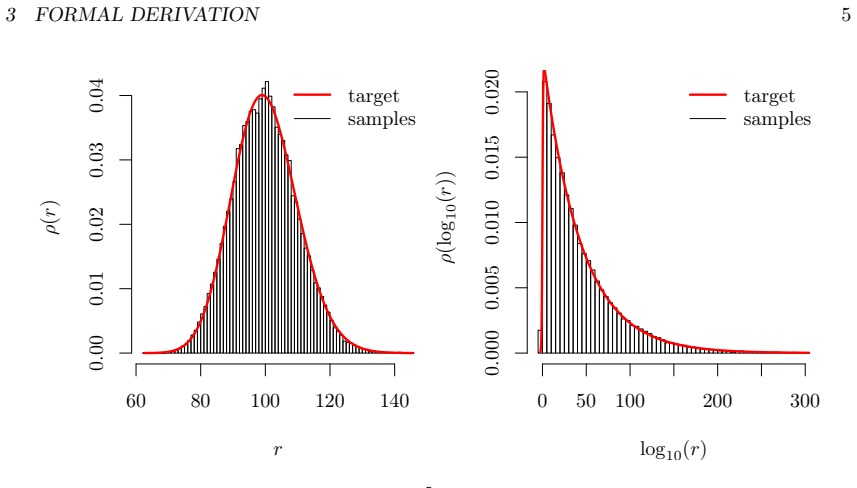
- Heavy-tailed targets such as $p(r) \propto 1/(1+r^{1.01})$ become tractable: the sampler reliably visits radii as large as $10^{200}$, whereas a conventional additive updater would need times $\gg 10^{400}$ to reach such regions.
- Even a badly chosen radial update still leads to convergence; theorem 4 classifies the approach as exponential, polynomial, or diffusive depending on whether $\log V$ grows at least linearly in $r$, $V$ grows at least linearly in $r$, or merely $e^{-V}$ is normalisable.
- The hybrid Monte Carlo algorithm alone is guaranteed to converge on radial Riemannian manifolds, with the same classification of approach rates, but the radial update accelerates it by many orders of magnitude.
Reading between the lines
- Because the radial update is independent of the angular sampler, the same substitution recipe should transfer to any future MCMC method that satisfies the compact Doeblin and weak drift conditions; the paper proves the theorem generally but demonstrates tuning only on one-dimensional radial problems, so high-dimensional non-radially-symmetric targets are a natural stress test.
- The proof's treatment of the polynomial case leaves one tail of the effective potential growing only linearly, so in practice the substitution needs to tame the potential only outside a compact region; this suggests simpler, easier-to-invert substitutions could be used without losing exponential convergence, although the stated theorem requires the stronger exponential-tail condition.
- The radial update's documented ability to jump over potential barriers (the paper cites its use to cure an ergodicity problem in a Hubbard-model simulation) implies the method may also help with metastability in compact problems where the radial direction is bounded but barriers are large; that use is not proven in this paper.
Editorial analysis
A structured set of objections, weighed in public.
Referee Report
Summary. The manuscript develops radial updates for MCMC sampling on non-compact radial Riemannian manifolds. It proposes to substitute the radius r=f(z) so that the effective potential V_eff(z,θ)=V(f(z),θ)-ln|det J(z,θ)| grows exponentially in |z|, then apply a symmetric additive update to z. Theorem 3 claims exponential convergence of the combined algorithm under this condition; Corollary 3.14 specializes this to log-normal updates for exponential, polynomial, and logarithmic potentials; Theorem 4 classifies convergence rates for slower or badly chosen radial updates; Theorem 5 derives a dimension scaling σ≈√(2/(ad)) for polynomial potentials. Numerical examples show sampling of very heavy-tailed distributions and autocorrelation measurements supporting the scaling claim.
Significance. If the central theorem is correct, the paper gives an actionable and essentially parameter-free recipe for exponential convergence of MCMC on non-compact spaces, generalizing the Kennedy-Yu construction [2] and removing most tuning from the radial-update step. The numerical demonstrations are convincing: the heavy-tailed examples reach radii as large as 10^200, and the autocorrelation data confirm the 1/√d scaling to within the expected O(1) factor. The paper also ships public code and data, which is a strength. However, the proof of the main theorem has a gap with respect to the paper's own Algorithm 1: condition (21) is two-sided, while the polynomial recipe only satisfies it on the outward tail.
major comments (4)
- [§3.1, Eq. (21) and Corollary 3.14] Theorem 3's condition (21) requires V_eff(z,θ)=c(θ)e^{a(θ)|z|+o(|z|)} on both tails. For the polynomial-potential recipe in Corollary 3.14 and Algorithm 1, the substitution r=e^z gives V_eff(z)=c e^{a z}-d z, which grows exponentially for z→+∞ but only linearly for z→−∞. The Appendix A proof of Corollary 3.14 dismisses the linear term as 'negligible in the e^{o(z)}-sense,' which is valid only on the positive tail. Since z→−∞ corresponds to r→0, a compact region, the conclusion can be repaired by absorbing this tail into the compact set X_0 of Theorem 2, but the manuscript does not supply that argument. As stated, Theorem 3 does not cover the paper's main algorithm; please add a one-sided condition with a compact-tail lemma, or prove that the log-normal update is equivalent to a substitution such as r=exp(z-e^{-z}) for which (21) holds on both tails.
- [§3.1, Lemma 3.12 proof, Eq. (8)] The proof of Lemma 3.12 assumes that for large z the acceptance probability satisfies A(z,z+γ)=1 for all γ≤0. This is false when z+γ<−z (more precisely γ<−2z), because then |z+γ|>z and V(z+γ)>V(z), so the proposal is not automatically accepted. For heavy-tailed symmetric additive kernels this region has nonzero probability, and the displayed calculation replaces the true (small) accepted contribution by an expression that is not the correct V(z+γ)/V(z) ratio. The lemma is probably true and the missing contribution is bounded by the Metropolis acceptance factor, but a complete proof needs a separate treatment of the γ<−2z region; as written, this is a gap in a central statement.
- [§3.1, proof of Theorem 3] Lemma 3.12 gives the SGDC for the effective potential V_eff in the auxiliary variable z, whereas Theorem 2 requires the SGDC for the original potential V on X\X_0. The proof of Theorem 3 moves directly from one to the other. This transfer is not automatic because V and V_eff differ by the log-Jacobian term; one must show that V_eff and V are comparable outside a compact set (for the substitutions used here, V_eff/V→1 on the outward tail). Without this comparability, the reduction to Theorem 2 is incomplete; adding this argument would also clarify which tails may be placed into X_0.
- [Appendix B, proof of Corollary 3.15] The claim that the HMC without radial updates converges with the rates listed in Corollary 3.15 is not established by the given proof. The short-trajectory ('Langevin regime') argument covers only a limiting regime, and the step to arbitrary trajectory lengths rests on the assertion that 'the drift that guarantees convergence can only increase and never decrease,' which is not proved and does not follow from symplecticity alone. Since this corollary is advertised as a generalization, either supply a rigorous argument or explicitly label it as a heuristic/conjecture.
minor comments (3)
- [Table 1 and Eq. (21)] The Landau symbols are defined for the one-sided limit x_0=(∞,θ_0), while condition (21) uses |z|→∞; the two-sided convention should be stated explicitly where o(|z|) is used.
- [Algorithm 2] The line z_i ← f^{-1}(||x_i||) is undefined at ||x_i||=0; since this is a measure-zero set, a short sentence on handling the origin would remove ambiguity.
- [Theorem 5] The theorem is phrased as giving the 'optimal' standard deviation, but the proof relies on the heuristic Estimate 3.17 and the numerical fit in Fig. 5 gives σ_min=1.528(7)/√d rather than 1/√d; consider stating the result as near-optimal or asymptotically optimal up to an O(1) factor.
Circularity Check
No significant circularity: central theorems are proven from drift conditions, the sigma scaling is derived then tested, and self-citations are contextual only.
full rationale
The paper's derivation chain is not circular. Theorem 3 and Corollary 3.14 reduce radial-update convergence to the strong geometric drift condition, which is proven in Lemma 3.12 by an explicit one-dimensional drift calculation rather than assumed. The external Kennedy–Yu Theorem 2 is cited but also re-derived in Appendix A using Lemma B.4 and Lemma B.6, so the result does not rest on an unexamined self-citation. The sigma-scaling prediction in Theorem 5 is derived from an approximate analytic minimization (Estimate 3.17) and then compared with numerical autocorrelation data; the reported prefactor 1.528(7) differs from the predicted 1, which would be impossible if the prediction were merely a fit renamed as a prediction. The author's self-citations [12,13] are contextual application papers and carry no load in the proof. The explicitly unproven Conjecture B.5 is presented as a conjecture and is not used in the main results. A genuine proof gap exists in Corollary 3.14: with r = e^z the effective potential grows exponentially only as z → +infinity, not as z → -infinity, so condition (21) is not satisfied on both tails without an additional compact-tail argument; this is a correctness concern, not a circular reduction.
Assumptions & free parameters
free parameters (1)
- radial update standard deviation sigma =
default sqrt(2/(a d)); empirical optimum prefactor 1.528(7) vs predicted 1
assumptions (4)
- standard math CDC plus SGDC imply exponential convergence (Hairer-Mattingly theorem 1)
- standard math Hopf-Rinow theorem: complete connected Riemannian manifolds have minimal geodesics between any two points
- domain assumption The base algorithm to be augmented satisfies the CDC and WGDC
- domain assumption Normalisability of e^{-V} and finiteness of the relevant integrals
Cite this review
Pith. "Pith review of Exponential speed up in Monte Carlo sampling through Radial Updates." pith.science (2026). https://pith.science/paper/4FCGKVBA
@misc{pith2026241118218,
  author       = {Pith},
  title        = {Pith review of: Exponential speed up in Monte Carlo sampling through Radial Updates},
  year         = {2026},
  howpublished = {\url{https://pith.science/paper/4FCGKVBA}},
  note         = {Machine review of arXiv:2411.18218}
}
abstract
Recently, it has been shown that the hybrid Monte Carlo (HMC) algorithm is guaranteed to converge exponentially to a given target probability distribution $p(x)\propto e^{-V(x)}$ on non-compact spaces if augmented by an appropriate radial update. In this work we present a simple way to derive efficient radial updates meeting the necessary requirements for any potential $V$. We reduce the problem to finding a substitution for the radial direction $||x||=f(z)$ so that the effective potential $V(f(z))$ grows exponentially with $z\rightarrow\pm\infty$. Any additive update of $z$ then leads to the desired convergence. We show that choosing this update from a normal distribution with standard deviation $\sigma\approx 1/\sqrt{d}$ in $d$ dimensions yields very good results. We further generalise the previous results on radial updates to a wide class of Markov chain Monte Carlo (MCMC) algorithms beyond the HMC and we quantify the convergence behaviour of MCMC algorithms with badly chosen radial update. Finally, we apply the radial update to the sampling of heavy-tailed distributions and achieve a speed up of many orders of magnitude.
Figures


Figures from the paper (2 more)


Forward citations
Cited by 1 Pith paper
-
The Physicist's Guide to the HMC
HMC with exact Fourier acceleration is exact for quadratic actions and only mildly worse for perturbed ones; for generic targets the guide recommends random long trajectories, radial updates, and a regularized kinetic term.
Reference graph
Works this paper leans on
-
[1]
1S. Duane, A. D. Kennedy, B. J. Pendleton and D. Roweth, “Hybrid Monte Carlo”, Phys. Lett. B 195, 216 –222 (1987). 2A. D. Kennedy and X. Yu, “On the geometric convergence of HMC on Riemannian manifolds”, PoS LATTICE2024, 064 (2025). 3A. Kennedy and B. Pendleton, “Acceptances and autocorrelations in hybrid Monte Carlo”, Nuc- lear Physics B - Proceedings Su...
arXiv 1987
-
[2777]
Equation of state calculations by fast computing machines
15N. Metropolis, A. W. Rosenbluth, M. N. Rosenbluth, A. H. Teller and E. Teller, “Equation of state calculations by fast computing machines”, The Journal of Chemical Physics21, 1087–1092 (1953), eprint: https://pubs.aip.org/aip/jcp/article-pdf/21/6/1087/18802390/1087\ _1\_online.pdf. 16W. K. Hastings, “Monte Carlo sampling methods using Markov chains and ...
Reviewed August 12, 2026 · model on record in the stance chip above.
Discussion (0). Continue with ORCID to comment.