REVIEW 4 major objections 5 minor 130 references
PHOENIX -- Paderborn highly optimized and energy efficient solver for two-dimensional nonlinear Schr\"odinger equations with integrated extensions
T0 review · 4 major / 5 minor · reviewed 2026-08-12 · deepseek-v4-flash
Pith's one-line read This paper presents PHOENIX, an open-source C++/CUDA solver claiming up to a thousandfold speedup and 99.8% energy savings over a conventional MATLAB implementation for two-dimensional nonlinear Schrödinger equations.
desk verdict Solid, useful software paper; the speedup claim is credible, but the 99.8% energy saving is extrapolated from peak power, not directly measured. read the letter →
The pith
A machine-rendered reading of the paper's core claim, the machinery that carries it, and where it could break.
The reading
What carries the argument
The load-bearing mechanism is subgrid decomposition: the full $N_x \times N_y$ grid is divided into smaller subgrids, each surrounded by a halo of neighboring cells, so every RK4 step operates on data that fits in the last-level cache. The spatial derivative uses a five-point stencil, the intermediate RK4 sums are modeled as STREAM-triad-like kernels, and a Roofline model using measured device cache and memory bandwidths predicts the iteration-time floor. This decomposition turns a low-computational-intensity stencil into a cache-bandwidth-bound calculation, which is why the solver can approach hardware limits on consumer GPUs.
What would settle it
Benchmark PHOENIX and a vectorized or spectral MATLAB solver of the same equation on the same grids while directly metering wall-clock energy draw of each process; a speedup well below three orders of magnitude or an energy saving far below 99.8 percent would falsify the headline claim.
Extended reading notes
Core claim
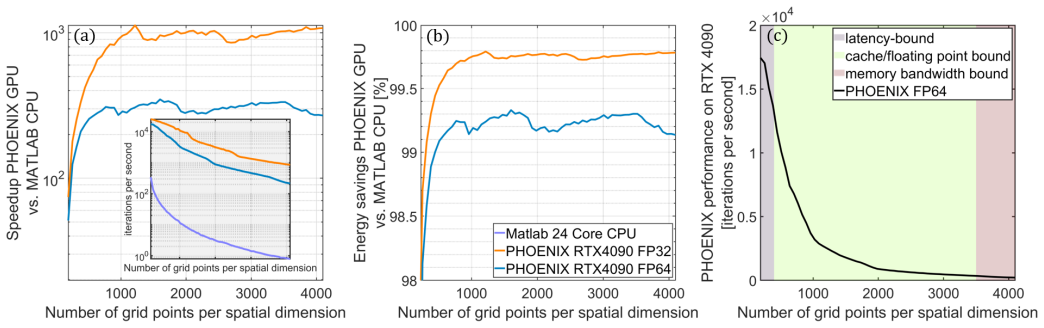
The paper's central claim is that the bottleneck in two-dimensional nonlinear Schrödinger time evolution is data movement, not arithmetic, and PHOENIX is built around that fact. By decomposing the grid into cache-sized subgrids with halos and expressing RK4 as a sequence of stencil and summation kernels, the solver reaches 51 to 94 percent of the cache-bandwidth bound on tested GPUs and saturates memory bandwidth for large grids. The same design yields up to three orders of magnitude speedup and up to 99.8 percent energy savings compared with a conventional MATLAB implementation, with single-precision runs roughly doubling throughput whenever the physics tolerates reduced precision.
Load-bearing premise
The central claim assumes that the MATLAB sparse-matrix RK4 code is a fair 'conventional' baseline and that energy savings computed from runtime ratio and peak power approximately equal true energy use.
Editorial extensions
If this is right
- Simulations that were previously too slow for routine exploration, such as 9000-by-9000-grid corner states or optimizer-driven exceptional-point searches, become one-hour or one-day tasks on a single GPU.
- Statistical studies needing many repeated runs, such as 150- or 2250-sample Monte Carlo ensembles for quantum-state tomography, become practical on consumer hardware rather than large HPC allocations.
- Users can extend the equation set with additional Hamiltonian terms or new integrators by editing short arithmetic kernels, without writing explicit parallel code.
- Because the solver is transfer-bound rather than arithmetic-bound, single-precision execution approximately halves data movement and doubles throughput when physics permits it, with the paper noting sharp spectral resonances as an exception.
- The subgrid design offers a direct path to multi-GPU or multi-node execution by distributing subgrids, extending the solver to grids that exceed a single device's memory.
Reading between the lines
- The 99.8 percent energy saving is best read as an upper bound: it is derived from the speedup multiplied by manually measured peak power rather than from simultaneous energy metering of both codes, so the true energy advantage over an efficient MATLAB implementation is likely smaller.
- The speedup claim is tied to the sparse-matrix RK4 MATLAB baseline; a MATLAB user already working with spectral or well-vectorized methods should expect a much smaller gain, and the 'conventional' label may overstate how representative that baseline is.
- The observed gap between the H100's summation kernels and the cache-bandwidth bound points to a concrete next target: improving cache behavior of the two- and five-term sums could push datacenter GPUs closer to the bound, not just consumer GPUs.
- The same subgrid-plus-Roofline recipe may transfer to other low-computational-intensity stencil solvers beyond the nonlinear Schrödinger family, such as reaction-diffusion or wave-propagation codes, though the paper does not claim this extension.
Editorial analysis
A structured set of objections, weighed in public.
Referee Report
Summary. The paper presents PHOENIX, an MIT-licensed open-source C++/CUDA solver for the two-dimensional dissipative nonlinear Schrödinger equation and its extensions, including spinor fields, reservoir dynamics, coherent and incoherent driving, and stochastic noise. The solver uses an explicit RK4 integrator with a five-point Laplacian, subgrid decomposition for cache reuse, optional FFT smoothing, and fp32/fp64 support. Benchmarks on several CPUs and GPUs are compared with a roofline model, and the paper reports up to a 1000x speedup and 99.8% energy savings relative to a MATLAB sparse-matrix RK4 implementation. Four application examples from exciton-polariton physics are included to demonstrate the solver's breadth.
Significance. If the quantitative claims are fully substantiated, PHOENIX would be a valuable community resource: it ships public, MIT-licensed code with benchmark documentation, a parameter-free roofline model based on measured hardware bandwidths, and a simple extension interface for non-specialist users. The four worked examples show practical breadth, although they largely reproduce the authors' own earlier results rather than providing independent validation. The main uncertainty is not in the basic numerical scheme or the PHOENIX-side measurements, which are credible, but in the two headline comparison claims: the energy saving is derived from peak-power assumptions rather than direct measurement, and the speedup is measured against a baseline whose code is not provided. These issues affect the abstract and title and therefore need to be resolved before the paper's central claims can be accepted.
major comments (4)
- [Fig. 1(b), Sec. 4.5, Abstract] The headline claim of energy savings 'up to 99.8%' is not supported by direct energy measurement. As the Fig. 1 caption states, the energy savings are 'determined by the speedup and the peak power consumption for large grids manually measured using HWiNFO.' This assumes both PHOENIX and the MATLAB baseline sustain their peak power for the entire run, which is implausible for a CPU-bound sparse-matrix MATLAB code with idle and stall phases. The paper already has a direct energy methodology with RAPL and NVML in Sec. 4.5 for PHOENIX; the same methodology should be applied to the MATLAB baseline, or the 99.8% figure should be relabeled as an upper-bound estimate and removed from the abstract and title.
- [Sec. 3.1 and Fig. 1(a)] The three-orders-of-magnitude speedup is measured against a baseline that is described only by a short paragraph and whose code and exact configuration are not deposited. A sparse-matrix-vector RK4 code in MATLAB is one plausible 'conventional' implementation, but it is not demonstrated to be representative, and the comparison also conflates the programming-language and hardware changes. Please release the MATLAB benchmark script with all settings (sparse-matrix construction, time step, precision, MATLAB version, threading, and whether gpuArray is used), and ideally report the speedup against at least one additional baseline such as a vectorized or spectral MATLAB solver.
- [Figs. 4-6 and Sec. 4.1] None of the performance or energy curves includes repeated-run statistics. The paper makes precise quantitative statements such as 'between 51% and 94% of the cache bandwidth bound' and '24-30 nJ per grid point update', and the 99.8% energy-saving figure rests on single-point comparisons. At minimum, the headline comparisons in Fig. 1 should report the mean and min-max spread over several runs, and the measurement protocol for the manually measured peak power should be described in enough detail to be replicable.
- [Sec. 3.2.8 and Eq. (12)] The roofline estimate in Eq. (12) excludes the halo exchange and the extra halo-cell computations described in Secs. 3.2.4 and 3.2.6, yet Fig. 4 compares that estimate with full RK4 timings that include those costs. For subgrid settings with small subgrids, the halo overhead is not negligible, so the reported fractions of the cache-bandwidth bound are optimistic. Please quantify the halo overhead or restrict the 'close to the bound' comparison to runs without subgrid decomposition.
minor comments (5)
- [Sec. 3.2.8 and Eq. (12)] The factor 2 in Eq. (12) is not explained in the text; since each complex buffer contains two real components, please state that explicitly when d is introduced.
- [Table 2] The AMD 7763 full-CPU row lists Pfp32 (2.5 TFlop/s) as smaller than Pfp64 (5.1 TFlop/s), which is inconsistent with the 5800X3D row and with the usual Zen3 fp32/fp64 throughput relation; please verify these values or explain the measurement result.
- [Sec. 3.2.6] The phrase 'grid sizes beyond approximately 10^4' is ambiguous; it should say 10^4 points per spatial dimension, consistent with the 15000 x 15000 grid discussion in Sec. 5.1.
- [Sec. 5.1 and Eq. (16)] The parameters E0 and omega for the coherent drive are only given in the reference list entry [80]; they should be defined in the main text for readability.
- [Throughout] There are several typographical errors: 'Phyton' in the Introduction, 'peridoic' and 'V ortices' in Sec. 5, and 'AMD 77632 CPU' in the Fig. 5 caption.
Circularity Check
No significant circularity: PHOENIX's performance and energy claims are measured against independent hardware bounds and an explicit MATLAB baseline, and the application demonstrations are validations rather than load-bearing derivations.
full rationale
The paper's central quantitative claims are benchmark results, not fitted predictions. The speedup is obtained by directly timing PHOENIX against the MATLAB sparse-matrix RK4 implementation described in Sec. 3.1, and the energy savings in Fig. 1(b) are explicitly computed from those timings and from peak power values manually measured with HWiNFO, as stated in the Fig. 1 caption: "Energy savings are determined by the speedup and the peak power consumption for large grids manually measured using HWiNFO." That is a derived, model-based estimate rather than a direct energy measurement of both codes, which is a legitimate methodological caveat about the 99.8% figure, but it is not circular: the speedup and power inputs are independent empirical inputs, and the reported quantity is not used to define or fit those inputs. The roofline analysis in Secs. 3.2.8 and 4.1 compares measured update rates to bounds computed from kernel read/write counts (Table 1) and hardware bandwidth limits measured with LIKWID and gpu-benches (Table 2); the measured performance is not fed back into the model, so the 51-94% achievement figures are genuine comparisons rather than identities. The application sections reproduce or extend the authors' earlier results (e.g., Refs. [38], [39], [40]), but these self-citations are demonstrative validations of the solver on standard physics examples, not load-bearing justifications of the performance claims, and no uniqueness theorem or ansatz is imported from prior author work to force a choice. The MATLAB baseline is admittedly defined by the authors, but the paper states its construction explicitly and the speedup is a measured consequence of that stated baseline, not a quantity fitted to make the speedup appear. Overall, no derivation chain in the paper reduces to its own inputs by construction.
Assumptions & free parameters
assumptions (5)
- domain assumption RK4 explicit time integration is stable and accurate for the dNLSE with chosen time steps; no convergence or stability analysis is shown.
- standard math Five-point central difference stencil Eq. (8) approximates the Laplacian sufficiently well on the uniform grid.
- domain assumption Single precision is sufficient except for sharp spectral resonances (Sec. 3.2.5).
- domain assumption Truncated Wigner approximation with noise correlation Eq. (22) correctly models quantum fluctuations.
- domain assumption Roofline model Eq. (11) with measured hardware specifications in Table 2 bounds achievable performance.
Cite this review
Pith. "Pith review of PHOENIX -- Paderborn highly optimized and energy efficient solver for two-dimensional nonlinear Schr\"odinger equations with integrated extensions." pith.science (2026). https://pith.science/paper/O5J2ZJHE
@misc{pith2026241118341,
  author       = {Pith},
  title        = {Pith review of: PHOENIX -- Paderborn highly optimized and energy efficient solver for two-dimensional nonlinear Schr\"odinger equations with integrated extensions},
  year         = {2026},
  howpublished = {\url{https://pith.science/paper/O5J2ZJHE}},
  note         = {Machine review of arXiv:2411.18341}
}
read the original abstract
In this work, we introduce PHOENIX, a highly optimized explicit open-source solver for two-dimensional nonlinear Schr\"odinger equations with extensions. The nonlinear Schr\"odinger equation and its extensions (Gross-Pitaevskii equation) are widely studied to model and analyze complex phenomena in fields such as optics, condensed matter physics, fluid dynamics, and plasma physics. It serves as a powerful tool for understanding nonlinear wave dynamics, soliton formation, and the interplay between nonlinearity, dispersion, and diffraction. By extending the nonlinear Schr\"odinger equation, various physical effects such as non-Hermiticity, spin-orbit interaction, and quantum optical aspects can be incorporated. PHOENIX is designed to accommodate a wide range of applications by a straightforward extendability without the need for user knowledge of computing architectures or performance optimization. The high performance and power efficiency of PHOENIX are demonstrated on a wide range of entry-class to high-end consumer and high-performance computing GPUs and CPUs. Compared to a more conventional MATLAB implementation, a speedup of up to three orders of magnitude and energy savings of up to 99.8% are achieved. The performance is compared to a performance model showing that PHOENIX performs close to the relevant performance bounds in many situations. The possibilities of PHOENIX are demonstrated with a range of practical examples from the realm of nonlinear (quantum) photonics in planar microresonators with active media including exciton-polariton condensates. Examples range from solutions on very large grids, the use of local optimization algorithms, to Monte Carlo ensemble evolutions with quantum noise enabling the tomography of the system's quantum state.
Figures


Figures from the paper (7 more)


Reference graph
Works this paper leans on
-
[1]
S. H. Strogatz, Nonlinear dynamics and chaos: with applications to physics, biology, chemistry, and engineering, CRC press, 2018
2018
-
[2]
Bongard, H
J. Bongard, H. Lipson, Automated reverse engineering of nonlinear dy- namical systems, Proceedings of the National Academy of Sciences 104 (2007) 9943–9948
2007
-
[3]
J. M. T. Thompson, H. B. Stewart, Nonlinear dynamics and chaos, John Wiley & Sons, 2002
2002
-
[4]
Lam, Introduction to nonlinear physics, Springer Science & Business Media, 2003
L. Lam, Introduction to nonlinear physics, Springer Science & Business Media, 2003
2003
-
[5]
W.-M. Liu, B. Wu, Q. Niu, Nonlinear e ffects in interference of Bose- Einstein condensates, Physical Review Letters 84 (2000) 2294–2297
2000
-
[6]
N. G. Berlo ff, Nonlocal nonlinear Schrödinger equations as models of superfluidity, Journal of Low Temperature Physics 116 (1999) 359–380
1999
-
[7]
Malomed, M
B. Malomed, M. I. Weinstein, Soliton dynamics in the discrete nonlinear Schrödinger equation, Physics Letters A 220 (1996) 91–96
1996
-
[8]
Akhmediev, A
N. Akhmediev, A. Ankiewicz, J. M. Soto-Crespo, Rogue waves and ra- tional solutions of the nonlinear Schrödinger equation, Physical Review E 80 (2009) 026601
2009
Show all 130 references
-
[9]
Wang, Optical solitons of the perturbed nonlinear Schrödinger equation in Kerr media, Optik 243 (2021) 167382
M.-Y . Wang, Optical solitons of the perturbed nonlinear Schrödinger equation in Kerr media, Optik 243 (2021) 167382
2021
-
[10]
H. Deng, H. Haug, Y . Yamamoto, Exciton-polariton Bose-Einstein con- densation, Reviews of Modern Physics 82 (2010) 1489
2010
-
[11]
Byrnes, N
T. Byrnes, N. Y . Kim, Y . Yamamoto, Exciton–polariton condensates, Nature Physics 10 (2014) 803–813
2014
-
[12]
P. N. Glaskowsky, NVIDIA’s Fermi: The First Complete GPU Comput- ing Architecture, accessed: 2024-09-24 (2009). URL https://www.nvidia.com/content/pdf/fermi_white_ papers/p.glaskowsky_nvidia%27s_fermi-the_first_ complete_gpu_architecture.pdf
2009
-
[13]
URL https://docs.nvidia.com/cuda/pdf/CUDA_C_ Programming_Guide.pdf
NVIDIA Corporation & a ffiliates, Cuda C ++ Programming Guide Version 12.6, accessed: 2024-09-24 (2024). URL https://docs.nvidia.com/cuda/pdf/CUDA_C_ Programming_Guide.pdf
2024
-
[14]
Y . R. Choi, V . Stegailov, GPU-accelerated matrix exponent for solving 1D time-dependent Schrödinger equation, in: V . V oevodin, S. Sobolev, M. Yakobovskiy, R. Shagaliev (Eds.), Supercomputing, Springer Nature Switzerland, Cham, 2023, pp. 100–113
2023
-
[15]
B. D. Smith, L. W. Cooke, L. J. LeBlanc, GPU-accelerated solutions of the nonlinear Schrödinger equation for simulating 2D spinor BECs, Computer Physics Communications 275 (2022) 108314
2022
-
[16]
Lon ˇcar, A
V . Lon ˇcar, A. Balaž, A. Bogojevi ´c, S. Škrbi ´c, P. Muruganandam, S. K. Adhikari, CUDA programs for solving the time-dependent dipo- lar Gross–Pitaevskii equation in an anisotropic trap, Computer Physics Communications 200 (2016) 406–410
2016
-
[17]
Kivioja, S
M. Kivioja, S. Mönkölä, T. Rossi, GPU-accelerated time integration of Gross-Pitaevskii equation with discrete exterior calculus, Computer Physics Communications 278 (2022) 108427
2022
-
[18]
Jiang, X.-Y
T. Jiang, X.-Y . Wei, Y . Li, D.-S. Wang, J.-Y . Yuan, A fast and accurate coupled meshless algorithm for the 2D /3D Gross–Pitaevskii equations on two GPUs, Computing 105 (2023) 2595–2620
2023
-
[19]
Fioroni, L
L. Fioroni, L. Gravina, J. Stefaniak, A. Baumgärtner, F. Finger, D. Dreon, T. Donner, A Python GPU-accelerated solver for the Gross- Pitaevskii equation and applications to many-body cavity QED, arXiv preprint arXiv:2404.14401 (2024)
2024 arXiv
-
[20]
Gaidamour, Q
J. Gaidamour, Q. Tang, X. Antoine, BEC2HPC: A HPC spectral solver for nonlinear Schrödinger and rotating Gross-Pitaevskii equations. sta- tionary states computation, Computer Physics Communications 265 (2021) 108007
2021
-
[21]
O. L. Berman, R. Y . Kezerashvili, G. V . Kolmakov, L. M. Pomirchi, Spontaneous formation and nonequilibrium dynamics of a soliton- shaped Bose-Einstein condensate in a trap, Physical Review E 91 (2015) 062901
2015
-
[22]
Gothandaraman, S
A. Gothandaraman, S. Sadatian, M. Faryniarz, O. L. Berman, G. V . Kol- makov, Application of graphics processing units (GPUs) to the study of non-linear dynamics of the exciton Bose-Einstein condensate in a semi- conductor quantum well, in: 2011 Symposium on Application Accele...
2011
-
[23]
Wingenbach, D
J. Wingenbach, D. Bauch, X. Ma, R. Schade, C. Plessl, S. Schumacher, PHOENIX: Paderborn highly optimized and energy e fficient solver for two-dimensional nonlinear Schrödinger equations with integrated extensions (Nov. 2024). doi:10.5281/zenodo.14228839. URL https://github.com...
2024 doi
-
[24]
Program Generation, Optimization, and Platform Adaptation
M. Frigo, S. G. Johnson, The design and implementation of FFTW3, Proceedings of the IEEE 93 (2005) 216–231, special issue on “Program Generation, Optimization, and Platform Adaptation”
2005
-
[25]
Haidar, S
A. Haidar, S. Tomov, J. Dongarra, N. J. Higham, Harnessing GPU ten- sor cores for fast FP16 arithmetic to speed up mixed-precision iterative refinement solvers, in: Proceedings of the International Conference for High Performance Computing, Networking, Storage, and Analysis, S...
2018
-
[26]
N. J. Higham, S. Pranesh, M. Zounon, Squeezing a matrix into half pre- cision, with an application to solving linear systems, SIAM Journal on Scientific Computing 41 (2019) A2536–A2551
2019
-
[27]
N. J. Higham, T. Mary, Mixed precision algorithms in numerical linear algebra, Acta Numerica 31 (2022) 347–414
2022
-
[28]
Schade, T
R. Schade, T. Kenter, H. Elgabarty, M. Lass, O. Schütt, A. Lazzaro, H. Pabst, S. Mohr, J. Hutter, T. D. Kühne, C. Plessl, Towards electronic structure-based ab-initio molecular dynamics simulations with hundreds of millions of atoms, Parallel Computing 111 (2022) 102920
2022
-
[29]
Abdelfattah, H
A. Abdelfattah, H. Anzt, E. G. Boman, E. Carson, T. Cojean, J. Don- garra, A. Fox, M. Gates, N. J. Higham, X. S. Li, J. Loe, P. Luszczek, S. Pranesh, S. Rajamanickam, T. Ribizel, B. F. Smith, K. Swirydow- icz, S. Thomas, S. Tomov, Y . M. Tsai, U. M. Yang, A survey of nu- meric...
2021
-
[30]
J. D. McCalpin, Memory bandwidth and machine balance in current high performance computers, IEEE Computer Society Technical Com- mittee on Computer Architecture (TCCA) Newsletter (1995) 19–25
1995
-
[31]
J. D. McCalpin, STREAM: Sustainable memory bandwidth in high performance computers, Tech. rep., University of Virginia, Charlottesville, Virginia, a continually updated technical report. http://www.cs.virginia.edu/stream/ (1991-2007). 15
1991
-
[32]
Roehl, J
T. Roehl, J. Treibig, G. Hager, G. Wellein, Overhead analysis of per- formance counter measurements, in: 43rd International Conference on Parallel Processing Workshops (ICCPW), 2014, pp. 176–185
2014
-
[33]
Ernst, gpu-benches, version 1c36d509ee717dca9215c27135fa1e611bb03ed1, Accessed: 2024-11-05, (2024)
D. Ernst, gpu-benches, version 1c36d509ee717dca9215c27135fa1e611bb03ed1, Accessed: 2024-11-05, (2024). URL https://github.com//te42kyfo/gpu-benches
2024
-
[34]
URL https://nvdam.widen.net/content/hj0uek1pxq/ original/NVIDIA_H100_Tensor_Core_GPU_Architecture_ Whitepaper_V1.03.pdf
NVIDIA Corporation, NVIDIA H100 Tensor Core GPU Architecture (2021). URL https://nvdam.widen.net/content/hj0uek1pxq/ original/NVIDIA_H100_Tensor_Core_GPU_Architecture_ Whitepaper_V1.03.pdf
2021
-
[35]
URL https://images.nvidia.com/ aem-dam/Solutions/Data-Center/l4/ nvidia-ada-gpu-architecture-whitepaper-v2.1.pdf
NVIDIA Corporation, NVIDIA ADA GPU ARCHITECTURE (2023). URL https://images.nvidia.com/ aem-dam/Solutions/Data-Center/l4/ nvidia-ada-gpu-architecture-whitepaper-v2.1.pdf
2023
-
[36]
X. Ma, R. Driben, B. A. Malomed, T. Meier, S. Schumacher, Two- dimensional symbiotic solitons and vortices in binary condensates with attractive cross-species interaction, Scientific Reports 6 (2016) 34847
2016
-
[37]
Pukrop, S
M. Pukrop, S. Schumacher, X. Ma, Circular polarization reversal of half- vortex cores in polariton condensates, Physical Review B 101 (2020) 205301
2020
-
[38]
Lüders, M
C. Lüders, M. Pukrop, E. Rozas, C. Schneider, S. Höfling, J. Sperling, S. Schumacher, M. Aßmann, Quantifying quantum coherence in polari- ton condensates, PRX Quantum 2 (2021) 030320
2021
-
[39]
Y . Li, X. Ma, Z. Hatzopoulos, P. G. Savvidis, S. Schumacher, T. Gao, Switching off a microcavity polariton condensate near the exceptional point, ACS Photonics 9 (2022) 2079–2086
2022
-
[40]
Schneider, W
T. Schneider, W. Gao, T. Zentgraf, S. Schumacher, X. Ma, Topological edge and corner states in coupled wave lattices in nonlinear polariton condensates, Nanophotonics 13 (2024) 509
2024
-
[41]
Lindberg, S
M. Lindberg, S. W. Koch, Effective Bloch equations for semiconductors, Physical Review B 38 (1988) 3342
1988
-
[42]
Takayama, N
R. Takayama, N. Kwong, I. Rumyantsev, M. Kuwata-Gonokami, R. Binder, T-matrix analysis of biexcitonic correlations in the nonlinear optical response of semiconductor quantum wells, The European Physi- cal Journal B-Condensed Matter and Complex Systems 25 (2002) 445– 462
2002
-
[43]
Wouters, I
M. Wouters, I. Carusotto, Excitations in a nonequilibrium Bose-Einstein condensate of exciton polaritons, Physical Review Letters 99 (2007) 140402
2007
-
[44]
Wingenbach, M
J. Wingenbach, M. Pukrop, S. Schumacher, X. Ma, Dynamics of phase defects trapped in optically imprinted orbits in dissipative binary polari- ton condensates, Physical Review B 105 (2022) 245302
2022
-
[45]
A. V . Kavokin, J. J. Baumberg, G. Malpuech, F. P. Laussy, Microcavities, V ol. 21, Oxford university press, 2017
2017
-
[46]
H. Deng, G. Weihs, C. Santori, J. Bloch, Y . Yamamoto, Condensation of semiconductor microcavity exciton polaritons, Science 298 (2002) 199– 202
2002
-
[47]
Kasprzak, M
J. Kasprzak, M. Richard, S. Kundermann, A. Baas, P. Jeambrun, J. M. J. Keeling, F. M. Marchetti, M. H. Szyma ´nska, R. André, J. L. Staehli, V . Savona, P. B. Littlewood, B. Deveaud, L. S. Dang, Bose–Einstein condensation of exciton polaritons, Nature 443 (2006) 409–414
2006
-
[48]
H. Deng, H. Haug, Y . Yamamoto, Exciton-polariton Bose-Einstein con- densation, Reviews of Modern Physics 82 (2010) 1489–1537
2010
-
[49]
Wertz, L
E. Wertz, L. Ferrier, D. D. Solnyshkov, R. Johne, D. Sanvitto, A. Lemaître, I. Sagnes, R. Grousson, A. V . Kavokin, P. Senellart, et al., Spontaneous formation and optical manipulation of extended polariton condensates, Nature Physics 6 (2010) 860–864
2010
-
[50]
Sanvitto, S
D. Sanvitto, S. Pigeon, A. Amo, D. Ballarini, M. De Giorgi, I. Carusotto, R. Hivet, F. Pisanello, V . G. Sala, P. S. S. Guimaraes, et al., All-optical control of the quantum flow of a polariton condensate, Nature Photonics 5 (2011) 610–614
2011
-
[51]
Wertz, A
E. Wertz, A. Amo, D. D. Solnyshkov, L. Ferrier, T. C. H. Liew, D. San- vitto, P. Senellart, I. Sagnes, A. Lemaître, A. V . Kavokin, G. Malpuech, J. Bloch, Propagation and amplification dynamics of 1D polariton con- densates, Physical Review Letters 109 (2012) 216404
2012
-
[52]
Cristofolini, A
P. Cristofolini, A. Dreismann, G. Christmann, G. Franchetti, N. G. Berloff, P. Tsotsis, Z. Hatzopoulos, P. G. Savvidis, J. J. Baumberg, Op- tical superfluid phase transitions and trapping of polariton condensates, Physical Review Letters 110 (2013) 186403
2013
-
[53]
Askitopoulos, H
A. Askitopoulos, H. Ohadi, A. V . Kavokin, Z. Hatzopoulos, P. G. Sav- vidis, P. G. Lagoudakis, Polariton condensation in an optically induced two-dimensional potential, Physical Review B 88 (2013) 041308(R)
2013
-
[54]
Christopoulos, G
S. Christopoulos, G. B. H. V on Högersthal, A. J. D. Grundy, P. G. Lagoudakis, A. V . Kavokin, J. J. Baumberg, G. Christmann, R. Butté, E. Feltin, J.-F. Carlin, et al., Room-temperature polariton lasing in semi- conductor microcavities, Physical Review Letters 98 (2007) 126405
2007
-
[55]
K˛ edziora, A
M. K˛ edziora, A. Opala, R. Mastria, L. De Marco, M. Król, K. Łempicka- Mirek, K. Tyszka, M. Ekielski, M. Guziewicz, K. Bogdanowicz, A. Sz- erling, H. Sigurðsson, T. Czyszanowski, J. Szczytko, M. Matuszewski, D. Sanvitto, B. Pi˛ etka, Predesigned perovskite crystal waveguides ...
2024
-
[56]
Baas, J.-P
A. Baas, J.-P. Karr, M. Romanelli, A. Bramati, E. Giacobino, Optical bistability in semiconductor microcavities in the nondegenerate para- metric oscillation regime: Analogy with the optical parametric oscil- lator, Physical Review B 70 (2004) 161307
2004
-
[57]
N. A. Gippius, I. A. Shelykh, D. D. Solnyshkov, S. S. Gavrilov, Y . G. Rubo, A. V . Kavokin, S. G. Tikhodeev, G. Malpuech, Polarization multi- stability of cavity polaritons, Physical Review Letters 98 (2007) 236401
2007
-
[58]
T. K. Paraïso, M. Wouters, Y . Léger, F. Morier-Genoud, B. Deveaud- Plédran, Multistability of a coherent spin ensemble in a semiconductor microcavity, Nature Materials 9 (2010) 655–660
2010
-
[59]
Ballarini, M
D. Ballarini, M. De Giorgi, E. Cancellieri, R. Houdré, E. Giacobino, R. Cingolani, A. Bramati, G. Gigli, D. Sanvitto, All-optical polariton transistor, Nature Communications 4 (2013) 1778
2013
-
[60]
Mirek, A
R. Mirek, A. Opala, P. Comaron, M. Furman, M. Król, K. Tyszka, B. Seredy ´nski, D. Ballarini, D. Sanvitto, T. C. H. Liew, W. Pacuski, J. Suffczy´nski, J. Szczytko, M. Matuszewski, B. Pi˛ etka, Neuromorphic binarized polariton networks, Nano Letters 21 (2021) 3715–3720
2021
-
[61]
Y . G. Rubo, Half vortices in exciton polariton condensates, Physical Re- view Letters 99 (2007) 106401
2007
-
[62]
K. G. Lagoudakis, T. Ostatnick `y, A. V . Kavokin, Y . G. Rubo, R. An- dré, B. Deveaud-Plédran, Observation of half-quantum vortices in an exciton-polariton condensate, Science 326 (2009) 974–976
2009
-
[63]
Panzarini, L
G. Panzarini, L. C. Andreani, A. Armitage, D. Baxter, M. S. Skolnick, V . N. Astratov, J. S. Roberts, A. V . Kavokin, M. R. Vladimirova, M. A. Kaliteevski, Exciton-light coupling in single and coupled semiconductor microcavities: Polariton dispersion and polarization splitting...
1999
-
[64]
Kavokin, G
A. Kavokin, G. Malpuech, M. Glazov, Optical spin Hall e ffect, Physical Review Letters 95 (2005) 136601
2005
-
[65]
Leyder, M
C. Leyder, M. Romanelli, J. P. Karr, E. Giacobino, T. C. H. Liew, M. M. Glazov, A. V . Kavokin, G. Malpuech, A. Bramati, Observation of the optical spin Hall effect, Nature Physics 3 (2007) 628–631
2007
-
[66]
Lafont, S
O. Lafont, S. M. H. Luk, P. Lewandowski, N. H. Kwong, P. T. Le- ung, E. Galopin, A. Lemaitre, J. Tignon, S. Schumacher, E. Baudin, R. Binder, Controlling the optical spin hall e ffect with light, Applied Physics Letters 110 (2017) 061108
2017
-
[67]
S. M. H. Luk, H. Vergnet, O. Lafont, P. Lewandowski, N. H. Kwong, E. Galopin, A. Lemaitre, P. Roussignol, J. Tignon, S. Schumacher, R. Binder, B. E, All-optical beam steering using the polariton lighthouse effect, ACS Photonics 8 (2021) 449
2021
-
[68]
Flayac, D
H. Flayac, D. D. Solnyshkov, G. Malpuech, Oblique half-solitons and their generation in exciton-polariton condensates, Physical Review B 83 (2011) 193305
2011
-
[69]
Hivet, H
R. Hivet, H. Flayac, D. D. Solnyshkov, D. Tanese, T. Boulier, D. An- dreoli, E. Giacobino, J. Bloch, A. Bramati, G. Malpuech, et al., Half- solitons in a polariton quantum fluid behave like magnetic monopoles, Nature Physics 8 (2012) 724–728
2012
-
[70]
Vladimirova, S
M. Vladimirova, S. Cronenberger, D. Scalbert, K. V . Kavokin, A. Mi- ard, A. Lemaître, J. Bloch, D. Solnyshkov, G. Malpuech, A. V . Kavokin, Polariton-polariton interaction constants in microcavities, Physical Re- view B 82 (2010) 075301
2010
-
[71]
Boulier, M
T. Boulier, M. Bamba, A. Amo, C. Adrados, A. Lemaitre, E. Galopin, I. Sagnes, J. Bloch, C. Ciuti, E. Giacobino, A. Bramati, Polariton- generated intensity squeezing in semiconductor micropillars, Nature Communications 5 (2014) 3260
2014
-
[72]
J. C. López Carreño, C. Sánchez Muñoz, D. Sanvitto, E. del Valle, F. P. Laussy, Exciting polaritons with quantum light, Physical Review Letters 115 (2015) 196402
2015
-
[73]
Lüders, M
C. Lüders, M. Pukrop, F. Barkhausen, E. Rozas, C. Schneider, 16 S. Höfling, J. Sperling, S. Schumacher, M. Aßmann, Tracking quan- tum coherence in polariton condensates with time-resolved tomography, Physical Review Letters 130 (2023) 113601
2023
-
[74]
Lüders, F
C. Lüders, F. Barkhausen, M. Pukrop, E. Rozas, J. Sperling, S. Schu- macher, M. Aßmann, Continuous-variable quantum optics and resource theory for ultrafast semiconductor spectroscopy, Optical Materials Ex- press 13 (2023) 2997–3035
2023
-
[75]
St-Jean, V
P. St-Jean, V . Goblot, E. Galopin, A. Lemaître, T. Ozawa, L. Le Gratiet, I. Sagnes, J. Bloch, A. Amo, Lasing in topological edge states of a one- dimensional lattice, Nature Photonics 11 (2017) 651–656
2017
-
[76]
W. A. Benalcazar, B. A. Bernevig, T. L. Hughes, Quantized electric mul- tipole insulators, Science 357 (2017) 61–66
2017
-
[77]
Obana, F
D. Obana, F. Liu, K. Wakabayashi, Topological edge states in the su- schrieffer-heeger model, Physical Review B 100 (2019) 075437
2019
-
[78]
Z. Wang, Y . Chong, J. D. Joannopoulos, M. Soljaˇci´c, Observation of uni- directional backscattering-immune topological electromagnetic states, Nature 461 (2009) 772–775
2009
-
[79]
Klembt, T
S. Klembt, T. H. Harder, O. A. Egorov, K. Winkler, R. Ge, M. A. Ban- dres, M. Emmerling, L. Worschech, T. C. H. Liew, M. Segev, C. Schnei- der, S. Hö"fling, Exciton-polariton topological insulator, Nature 562 (2018) 552
2018
-
[80]
N = 9000, L = 900 µm, meff = 10−4me,γ = 0.005 ps−1, g = 2 µeVµm2, E± = E0exp (−iωt), dW = 0,γr = 0, ∆LT = 0, gr = 0
-
[81]
Kato, Perturbation theory for linear operators, V ol
T. Kato, Perturbation theory for linear operators, V ol. 132, Springer Sci- ence & Business Media, 2013
2013
-
[82]
Wiersig, Nonorthogonality constraints in open quantum and wave sys- tems, Physical Review Research 1 (2019) 033182
J. Wiersig, Nonorthogonality constraints in open quantum and wave sys- tems, Physical Review Research 1 (2019) 033182
2019
-
[83]
M. V . Berry, Physics of non-Hermitian degeneracies, Czechoslovak Journal of Physics 54 (2004) 1039–1047
2004
-
[84]
C. M. Bender, Making sense of non-Hermitian Hamiltonians, Reports on Progress in Physics 70 (2007) 947
2007
-
[85]
W. D. Heiss, Exceptional points of non-Hermitian operators, Journal of Physics A: Mathematical and General 37 (2004) 2455
2004
-
[86]
W. D. Heiss, The physics of exceptional points, Journal of Physics A: Mathematical and Theoretical 45 (2012) 444016
2012
-
[87]
Dembowski, H.-D
C. Dembowski, H.-D. Gräf, H. L. Harney, A. Heine, W. D. Heiss, H. Re- hfeld, A. Richter, Experimental observation of the topological structure of exceptional points, Physical Review Letters 86 (2001) 787
2001
-
[88]
Y . Choi, S. Kang, S. Lim, W. Kim, J.-R. Kim, J.-H. Lee, K. An, Quasieigenstate coalescence in an atom-cavity quantum composite, Physical Review Letters 104 (2010) 153601
2010
-
[89]
Kodigala, T
A. Kodigala, T. Lepetit, B. Kanté, Exceptional points in three- dimensional plasmonic nanostructures, Physical Review B 94 (2016) 201103
2016
-
[90]
A. Guo, G. J. Salamo, D. Duchesne, R. Morandotti, M. V olatier-Ravat, V . Aimez, G. A. Siviloglou, D. N. Christodoulides, Observation of PT- symmetry breaking in complex optical potentials, Physical Review Let- ters 103 (2009) 093902
2009
-
[91]
S.-B. Lee, J. Yang, S. Moon, S.-Y . Lee, J.-B. Shim, S. W. Kim, . f. J.- H. Lee, K. An, Observation of an exceptional point in a chaotic optical microcavity, Physical Review Letters 103 (2009) 134101
2009
-
[92]
Fruchart, R
M. Fruchart, R. Hanai, P. B. Littlewood, V . Vitelli, Non-reciprocal phase transitions, Nature 592 (2021) 363–369
2021
-
[93]
Zhang, F
H. Zhang, F. Saif, Y . Jiao, H. Jing, Loss-induced transparency in op- tomechanics, Optics Express 26 (2018) 25199–25210
2018
-
[94]
Z. Lin, H. Ramezani, T. Eichelkraut, T. Kottos, H. Cao, D. N. Christodoulides, Unidirectional invisibility induced by PT-symmetric periodic structures, Physical Review Letters 106 (2011) 213901
2011
-
[95]
El-Ganainy, M
R. El-Ganainy, M. Khajavikhan, L. Ge, Exceptional points and lasing self-termination in photonic molecules, Physical Review A 90 (2014) 013802
2014
-
[96]
Chen, ¸ S
W. Chen, ¸ S. Kaya Özdemir, G. Zhao, J. Wiersig, L. Yang, Exceptional points enhance sensing in an optical microcavity, Nature 548 (2017) 192–196
2017
-
[97]
Wiersig, Review of exceptional point-based sensors, Photonics Re- search 8 (2020) 1457–1467
J. Wiersig, Review of exceptional point-based sensors, Photonics Re- search 8 (2020) 1457–1467
2020
-
[98]
Mandal, E
I. Mandal, E. J. Bergholtz, Symmetry and higher-order exceptional points, Physical Review Letters 127 (2021) 186601
2021
-
[99]
T. Gao, E. Estrecho, K. Y . Bliokh, T. C. H. Liew, M. D. Fraser, S. Brod- beck, M. Kamp, C. Schneider, S. Höfling, Y . Yamamoto, et al., Ob- servation of non-Hermitian degeneracies in a chaotic exciton-polariton billiard, Nature 526 (2015) 554–558
2015
-
[100]
T. Gao, G. Li, E. Estrecho, T. C. H. Liew, D. Comber-Todd, A. Nalitov, M. Steger, K. West, L. Pfei ffer, D. W. Snoke, et al., Chiral modes at exceptional points in exciton-polariton quantum fluids, Physical Review Letters 120 (2018) 065301
2018
-
[101]
Hanai, A
R. Hanai, A. Edelman, Y . Ohashi, P. B. Littlewood, Non-Hermitian phase transition from a polariton Bose-Einstein condensate to a photon laser, Physical Review Letters 122 (2019) 185301
2019
-
[102]
Rahmani, A
A. Rahmani, A. Opala, M. Matuszewski, Exceptional points and phase transitions in non-hermitian nonlinear binary systems, Physical Review B 109 (2024) 085311
2024
-
[103]
Wingenbach, S
J. Wingenbach, S. Schumacher, X. Ma, Manipulating spectral topology and exceptional points by nonlinearity in non-Hermitian polariton sys- tems, Physical Review Research 6 (2024) 013148
2024
-
[104]
N = 200, L = 20 µm, meff = 0.5· 10−4me, γ = 0.16 ps−1, γr = 1.5γ, g = 6 µeVµm2, gr = 2g, R = 0.01 ps−1µm2, gx = 0, ∆LT = 0, E± = 0, dW = 0
-
[105]
Kuster, Y
O. Kuster, Y . Augenstein, C. Rockstuhl, T. J. Sturges, Inverse design of polaritonic devices, Applied Physics Letters 125 (2004) 181102
2004
-
[106]
K. G. Lagoudakis, M. Wouters, M. Richard, A. Baas, I. Carusotto, R. André, L. S. Dang, B. Deveaud-Plédran, Quantized vortices in an exciton–polariton condensate, Nature Physics 4 (2008) 706–710
2008
-
[107]
Sanvitto, F
D. Sanvitto, F. M. Marchetti, M. H. Szyma ´nska, G. Tosi, M. Baud- isch, F. P. Laussy, D. N. Krizhanovskii, M. S. Skolnick, L. Marrucci, A. Lemaitre, et al., Persistent currents and quantized vortices in a polari- ton superfluid, Nature Physics 6 (2010) 527–533
2010
-
[108]
Roumpos, M
G. Roumpos, M. D. Fraser, A. Lö ffler, S. Höfling, A. Forchel, Y . Ya- mamoto, Single vortex–antivortex pair in an exciton-polariton conden- sate, Nature Physics 7 (2011) 129–133
2011
-
[109]
T. C. H. Liew, O. A. Egorov, M. Matuszewski, O. Kyriienko, X. Ma, E. A. Ostrovskaya, Instability-induced formation and nonequilibrium dynamics of phase defects in polariton condensates, Physical Review B 91 (2015) 085413
2015
-
[110]
N. B. Baranova, A. V . Mamaev, N. F. Pilipetsky, V . V . Shkunov, B. Y . Zel’dovich, Wave-front dislocations: topological limitations for adaptive systems with phase conjugation, JOSA 73 (1983) 525–528
1983
-
[111]
X. Ma, S. Schumacher, V ortex-vortex control in exciton-polariton con- densates, Physical Review B 95 (2017) 235301
2017
-
[112]
Y . Xue, I. Chestnov, E. Sedov, E. Kiktenko, A. K. Fedorov, S. Schu- macher, X. Ma, A. Kavokin, Split-ring polariton condensates as macro- scopic two-level quantum systems, Physical Review Research 3 (2021) 013099
2021
-
[113]
Barrat, A
J. Barrat, A. F. Tzortzakakis, M. Niu, X. Zhou, G. G. Paschos, D. Pet- rosyan, P. G. Savvidis, Qubit analog with polariton superfluid in an an- nular trap, Science Advances 10 (2024) eado4042
2024
-
[114]
K. G. Lagoudakis, F. Manni, B. Pietka, M. Wouters, T. C. H. Liew, V . Savona, A. V . Kavokin, R. André, B. Deveaud-Plédran, Probing the dynamics of spontaneous quantum vortices in polariton superfluids, Physical Review Letters 106 (2011) 115301
2011
-
[115]
E. A. Ostrovskaya, J. Abdullaev, A. S. Desyatnikov, M. D. Fraser, Y . S. Kivshar, Dissipative solitons and vortices in polariton Bose-Einstein condensates, Physical Review A 86 (2012) 013636
2012
-
[116]
X. Ma, B. Berger, M. Aßmann, R. Driben, T. Meier, C. Schneider, S. Höfling, S. Schumacher, Realization of all-optical vortex switching in exciton-polariton condensates, Nature Communications 11 (2020) 897
2020
-
[117]
S. W. Seo, S. Kang, W. J. Kwon, Y .-i. Shin, Half-quantum vortices in an antiferromagnetic spinor Bose-Einstein condensate, Physical Review Letters 115 (2015) 015301
2015
-
[118]
S. W. Seo, W. J. Kwon, S. Kang, Y . Shin, Collisional dynamics of half- quantum vortices in a spinor Bose-Einstein condensate, Physical Review Letters 116 (2016) 185301
2016
-
[119]
Manni, Y
F. Manni, Y . Léger, Y . G. Rubo, R. André, B. Deveaud, Hyperbolic spin vortices and textures in exciton–polariton condensates, Nature Commu- nications 4 (2013) 2590
2013
-
[120]
N = 500, L = 100 µm, meff = 10−4me, γ = 0.15 ps−1, γr = 1.5γ, g = 3 µeVµm2, gr = 2g, R = 0.01 ps−1µm2, gx = 0.2g, ∆LT = 0.025 meVµm2, E± = 0, V = 0, dW = 0
-
[121]
A. P. D. Love, D. N. Krizhanovskii, D. M. Whittaker, R. Bouchekioua, D. Sanvitto, S. A. Rizeiqi, R. Bradley, M. S. Skolnick, P. R. East- ham, R. André, L. S. Dang, Intrinsic decoherence mechanisms in the microcavity polariton condensate, Physical Review Letters 101 (2008) 17 067404
2008
-
[122]
Horikiri, P
T. Horikiri, P. Schwendimann, A. Quattropani, S. Höfling, A. Forchel, Y . Yamamoto, Higher order coherence of exciton-polariton condensates, Physical Review B 81 (2010) 033307
2010
-
[123]
A. F. Adiyatullin, M. D. Anderson, P. V . Busi, H. Abbaspour, R. André, M. T. Portella-Oberli, B. Deveaud, Temporally resolved second-order photon correlations of exciton-polariton Bose-Einstein condensate for- mation, Applied Physics Letters 107 (2015) 221107
2015
-
[124]
Klaas, E
M. Klaas, E. Schlottmann, H. Flayac, F. P. Laussy, F. Gericke, M. Schmidt, M. v. Helversen, J. Beyer, S. Brodbeck, H. Suchomel, S. Höfling, S. Reitzenstein, C. Schneider, Photon-number-resolved mea- surement of an exciton-polariton condensate, Physical Review Letters 121 (2018) 047401
2018
-
[125]
Carusotto, C
I. Carusotto, C. Ciuti, Quantum fluids of light, Reviews of Modern Physics 85 (2013) 299
2013
-
[126]
Sinatra, C
A. Sinatra, C. Lobo, Y . Castin, The truncated Wigner method for Bose- condensed gases: limits of validity andapplications, Journal of Physics B: Atomic, Molecular and Optical Physics 35 (2002) 3599
2002
-
[127]
Wouters, V
M. Wouters, V . Savona, Stochastic classical field model for polariton condensates, Physical Review B 79 (2009) 165302
2009
-
[128]
Alnatah, P
H. Alnatah, P. Comaron, S. Mukherjee, J. Beaumariage, L. N. Pfei ffer, K. West, K. Baldwin, M. Szymanska, D. W. Snoke, Critical fluctuations in a confined driven-dissipative quantum condensate, Science Advances 10 (2024) eadi6762
2024
-
[129]
N = 257, L = 230.4 µm, meff = 10−4me, γ = 0.2 ps−1, γr = 1.5γ, g = 6 µeVµm2, gr = 2g, R = 0.015 ps−1µm2, gx = 0, ∆LT = 0, E± = 0, V = 0, dW = 1
-
[130]
Bauer, T
C. Bauer, T. Kenter, M. Lass, L. Mazur, M. Meyer, H. Nitsche, H. Riebler, R. Schade, M. Schwarz, N. Winnwa, et al., Noctua 2 su- percomputer, Journal of large-scale research facilities 9 (2024). 18
2024
Reviewed August 12, 2026 · model on record in the stance chip above.
Discussion (0). Continue with ORCID to comment.