REVIEW 4 major objections 4 minor 2 cited by
Unveiling the Strong Interaction origin of Baryon Masses with Lattice QCD
T0 review · 4 major / 4 minor · reviewed 2026-08-12 · deepseek-v4-flash
Pith's one-line read First-principles lattice QCD reproduces the lightest baryon masses to within 1% and decomposes them into a small Higgs-induced part and a flavor-blind gluon trace anomaly of about 0.8–1.2 GeV.
desk verdict A serious lattice calculation with a valuable mass table, but the headline claims outrun the error budget and the gluon-anomaly decomposition rests on an unquantified fit-form assumption. read the letter →
The pith
A machine-rendered reading of the paper's core claim, the machinery that carries it, and where it could break.
The reading
What carries the argument
The central object is the energy-momentum tensor trace decomposition (Eq. 2), which partitions hadron mass into quark $\sigma$ terms plus the gluon trace anomaly. The operational machinery is the Feynman–Hellman theorem applied to a global chiral perturbation theory fit: the nucleon and $\Delta$ masses are fitted with a SU(4|2) partially quenched heavy baryon chiral perturbation theory ansatz (Eq. 5), and other baryons with a linear or interpolation ansatz, all as functions of valence and sea pion masses, the $\eta_s$ mass, lattice spacing, and volume. Derivatives of this fitted mass surface with respect to quark masses give $\sigma_{q,H}$; subtracting $(1+\gamma_m)\sum_q\sigma_{q,H}$ from the physical mass yields the gluon trace anomaly. The machinery also includes tuned valence strange and charm quark masses to remove mismatch effects and a decoupling argument that neglects charm sea quarks.
What would settle it
Compute the scalar matrix elements $\langle \bar{q}q\rangle_H$ directly on the same ensembles instead of via the Feynman–Hellman derivative of the fit and show that the resulting $\sigma_{q,H}$ differ from the paper's values by more than the quoted uncertainties, or repeat the joint fit with a different chiral perturbation theory ansatz (for example, including higher-order terms or a different handling of the $m_\pi^3$ correction) and observe the gluon trace anomaly shifting outside 0.8–1.2 GeV.
Extended reading notes
Core claim
The central claim is that a baryon mass $m_H$ decomposes as $m_H = \sum_q \sigma_{q,H} + \gamma_m \sum_q \sigma_{q,H} + \frac{\beta(\alpha_s)}{2\alpha_s}\langle G^2\rangle_H$, where $\sigma_{q,H} \equiv m_q \langle \bar{q}q\rangle_H$ is the Higgs contribution of flavor $q$ and the last term is the gluon trace anomaly. From a joint fit of 14 gauge ensembles at five lattice spacings, the paper extracts the $\sigma$ terms by differentiating the fitted hadron masses with respect to valence and sea quark masses. It finds that the ratio $(1+\gamma_m)\sigma_{q,H}/(n_q m_q)$ is 4–8 for light quarks, 2–3 for strange quarks, and 1.2–1.3 for charm quarks at the $\overline{\mathrm{MS}}$ 2 GeV scale, and that the subtracted gluon trace anomaly $\langle H_a^g\rangle_H$ converges to 0.8–1.2 GeV across all baryons. The authors conclude that the gluon trace anomaly, not the Higgs mechanism, dominates the mass of visible matter.
Load-bearing premise
The entire mass decomposition rests on the assumption that the global fit ansatz (Eq. 5) correctly captures the quark-mass dependence of the baryon masses over the fitted range (sea pion masses 122–351 MeV), so the derivatives with respect to quark masses are trustworthy.
Editorial extensions
If this is right
- Ground-state baryon masses across the light, strange, and doubly and triply charmed sectors are now predictable at the sub-percent level from first principles.
- The Higgs-generated quark masses contribute to baryon mass with flavor-dependent enhancement factors (4–8 for light, 2–3 for strange, 1.2–1.3 for charm), meaning the effective Higgs–nucleon coupling is larger than the bare quark masses would suggest.
- The gluon trace anomaly contributes a nearly constant 0.8–1.2 GeV to every baryon, making it the dominant component of the proton's mass and of visible matter in general.
- The charm sea-quark contribution to baryon mass is suppressed by heavy-quark decoupling, with a leading-order estimate of about 74(15) MeV for the baryons studied.
Reading between the lines
- If the gluon trace anomaly is as flavor-blind as claimed, the same decomposition should hold for excited baryons and for most mesons (with the pion as a special case); testing that would separate a universal mass-generation mechanism from hadron-specific structure.
- The extracted light-quark sigma terms directly constrain dark-matter–nucleon scattering cross sections, and the reported enhancement factors of 4–8 imply stronger Higgs-mediated couplings than models built from bare quark masses would predict.
- The near-constancy of the gluon trace anomaly across baryons suggests a connection to the Yang–Mills mass gap: a nonzero, hadron-independent scale in the trace of the energy-momentum tensor may be the same phenomenon that gives rise to the mass gap in pure gauge theory.
Editorial analysis
A structured set of objections, weighed in public.
Referee Report
Summary. The paper reports CLQCD lattice QCD calculations of the ground-state spin-1/2 and spin-3/2 baryon masses for light, strange, and charmed baryons using 14 ensembles with 2+1 flavors, and it uses these masses to propose a decomposition of the baryon mass into quark sigma terms and the gluon trace anomaly. The central phenomenological claims are that all predicted masses agree with experiment within 1% and that the decomposition yields flavor-dependent Higgs enhancement factors (4–8 for light, 2–3 for strange, 1.2–1.3 for charm quarks) plus a flavor-insensitive gluon trace anomaly of 0.8–1.2 GeV. The sigma terms are extracted from Feynman–Hellman derivatives of a joint mass fit, and the gluon trace anomaly is obtained as the remainder in Eq. (3).
Significance. If the mass decomposition and the quoted uncertainties were reliable, the paper would provide a unified lattice-QCD picture of baryon mass generation and would strengthen the case that the gluon trace anomaly dominates visible mass. The strengths of the paper include the use of a large number of gauge ensembles, the detailed error budget in Table III, cross-checks with the distillation method, and comparisons with earlier lattice calculations. However, as detailed below, the strongest claims are not currently supported by the paper's own tables and by the stated treatment of the fit ansatz.
major comments (4)
- [Abstract; Table III] The abstract's claim of predicting ground-state spin-1/2 and spin-3/2 baryon masses 'within 1% of experimental values' is contradicted by the paper's own Table III for the Δ and Σ* rows: the central values are 1.2732 GeV and 1.4172 GeV, which are roughly 3.3% and 2.4% above the experimental Δ(1232) and Σ*(1385) masses. The claim should either be restricted to the states for which it actually holds, or the comparison should explicitly account for the resonance-pole definition and the finite decay widths of the experimental states.
- [Supplement §3 and §5; Eq. (3)] The gluon trace anomaly in Eq. (3) is a remainder, ⟨H_g^a⟩ = m_H − (1+γ_m)σ_H, so any systematic error in the fitted sigma terms propagates directly into the central decomposition. For all baryons except N and Δ, the sigma terms are derivatives of a fit whose quark-mass dependence is not the SU(4|2) χPT form: the supplement states that χPT is not applicable for baryons with strange and charm valence quarks and uses a linear/interpolation ansatz. The 'fit ansatz' systematic quoted in Table III is defined as additive versus multiplicative discretization errors, so it does not cover the choice of the quark-mass functional form. For Ω_ccc, where σ_c ≈ 2.98 GeV, even a 5% functional-form bias changes the anomaly by roughly 150 MeV, comparable to the width of the advertised 0.8–1.2 GeV range. The authors should either provide a direct scalar-matrix-element check on these ensembles or quantify the functional-form uncertainty by varying the fit ansatz.
- [Section 2; Fig. 11; Abstract] The abstract's strange-quark enhancement factor of 2–3 is inconsistent with Section 2, which states that the strange enhancement factor is approximately 1.5, and with the middle panel of Fig. 11. This internal inconsistency matters because the enhancement factors are the quantitative output of the sigma-term fits; the abstract needs to be revised to match the values actually obtained.
- [Section 3, item 4] The paper defers isospin-breaking and QED corrections with the estimate that both effects are 'at the 1% level'. Since the headline claim is agreement with experimental masses at the 1% level, a 1% estimate is not a controlled systematic; for the Δ and Σ*, where the paper's own deviations are already 2–3%, the comparison with experiment is ambiguous. The manuscript should either include an estimate of these effects in the error budget or explicitly state that the mass predictions are for isospin-symmetric, QCD-only quantities.
minor comments (4)
- [Throughout] There are several typographical errors, including 'valance' instead of 'valence' in figure labels and the Supplement, 'whrere' in Supplement §3, and 'the the' in Supplement §3.
- [Fig. 1 caption] The caption says 'Baryon mass prediction' and 'experimental values .' with an irregular period; the figure would be clearer if the experimental references and the meaning of the shaded width bands were stated in a single convention.
- [Supplement §5, Table III] The table would benefit from a row or column explicitly listing the experimental masses used for comparison, since several central values are compared to experiment but the experimental inputs are only shown graphically.
- [Supplement §3, Eq. (5)] The notation 'm_val^π' and 'm_sea^π' is used before being defined; defining these quantities at the first occurrence in Eq. (5) would improve readability.
Circularity Check
No significant circularity: baryon masses are genuine lattice QCD results, and the gluon trace anomaly is extracted from the exact trace relation after independently evaluated sigma terms; self-citations are not load-bearing.
full rationale
The paper's primary claim, the 1% mass predictions of ground-state baryons, rests on lattice correlators, continuum/chiral extrapolations, and comparisons with experiment and independent lattice determinations (Fig. 1). No fitted parameter is renamed as a prediction: the physical masses are extrapolated outputs of the global fit, not inputs. The sigma terms are obtained from Feynman-Hellman derivatives of the fitted mass surface (Supplement Sec. 4), and the gluon trace anomaly is then computed from the exact QCD trace relation, Eq. (2)/(3), as m_H - (1+gamma_m) sigma_H. That is a derived decomposition, not a definition of the anomaly equal to an input. The flavor-insensitivity claim is an observation about the resulting residuals, not imposed by the fit ansatz; the anomalies for N and Delta, for example, differ by about 0.27 GeV, which is not a constant by construction. The SU(4|2) chiPT ansatz is standard and cited to Tiburzi as well as to the authors' earlier work; the linear interpolation for non-N/Delta baryons is an openly stated modeling choice. The main caveat, that the quoted 'fit ansatz' systematic (Supplement Sec. 5) covers only additive vs. multiplicative discretization errors and not the valence-quark functional form, is a systematic-uncertainty limitation rather than a circular step. Self-citations to CLQCD ensembles and earlier xQCD/CLQCD methodology are normal prior-work citations and do not carry the load of the present derivation. Overall, the derivation chain is self-contained enough that no equation reduces to its own input.
Assumptions & free parameters
free parameters (2)
- Global fit coefficients C^tag_j, C_s, C_L, C_{a,2i} in Eq. (5) =
Not quoted individually; fitted jointly
- Valence quark mass correction coefficients d^s_l, d^s_s, d^c_l, d^c_s in Eq. (14) =
d^c_l=-0.161(11), d^c_s=-0.388(44), d^s_l=-0.0267(30), d^s_s=-0.0090(10) GeV^-1
assumptions (6)
- domain assumption The trace anomaly mass decomposition (Eq. 2) is valid for ground-state hadrons.
- standard math The Feynman-Hellman theorem relates the quark mass derivative of the hadron mass to the scalar matrix element (Eq. 6).
- ad hoc to paper The SU(4|2) partially quenched heavy baryon chiPT ansatz (Eq. 5) correctly describes the nucleon mass for m_pi in 0.12-0.35 GeV, and similar truncated forms suffice for the other baryons.
- domain assumption Charm sea quark loops are negligible via the heavy quark decoupling relation m_Q<QbarQ> = -(alpha_s/12pi)F^2.
- domain assumption Isospin symmetry breaking and QED effects are at the 1% level and can be deferred.
- domain assumption The anomalous dimension gamma_m=0.295 at MS 2 GeV from the PDG is accurate and scale-appropriate for the subtraction in Eq. (3).
Cite this review
Pith. "Pith review of Unveiling the Strong Interaction origin of Baryon Masses with Lattice QCD." pith.science (2026). https://pith.science/paper/NV6KKASB
@misc{pith2026241118402,
  author       = {Pith},
  title        = {Pith review of: Unveiling the Strong Interaction origin of Baryon Masses with Lattice QCD},
  year         = {2026},
  howpublished = {\url{https://pith.science/paper/NV6KKASB}},
  note         = {Machine review of arXiv:2411.18402}
}
abstract
Both the Higgs mechanism and strong interactions contribute to the masses of visible matter, yet how the six Higgs-generated quark masses and uniform strong interaction strength determine the hundreds of hadron masses remains unclear. Additionally, the role of massless, flavor-neutral gluons on hadron mass formation is central to the unresolved Millennium Prize problem on the mass gap in Yang-Mills theory. Addressing these questions requires advanced simulations on state-of-the-art supercomputers using Lattice Quantum Chromodynamics (QCD), which offers a rigorous, non-perturbative definition of QCD solvable numerically. Here we present first-principles lattice QCD calculations using comprehensive gauge ensembles that accurately predict ground state spin-1/2 and spin-3/2 baryon masses with light, strange, and charm quarks within 1\% of experimental values. At the \(\overline{\mathrm{MS}}\) 2 GeV scale, our results unveil two fundamental mass generation mechanisms for those baryon masses in QCD: 1) the flavor-dependent enhancement of Higgs contributions, 4-8 for light, 2-3 for strange, and 1.2-1.3 for charm quarks; and 2) the flavor-insensitive contribution 0.8-1.2 GeV from gluon quantum anomaly. This breakthrough significantly advances our comprehension of strong interaction dynamics and the genesis of visible matter's mass.
Figures


Figures from the paper (9 more)


Forward citations
Cited by 2 Pith papers
-
Impact of Dynamical Charm Quark and Mixed Action Effect on Light Hadron Masses and Decay Constants
A dynamical charm quark does not measurably change light-hadron masses or decay constants, and a clover-on-HISQ mixed action reduces O(a^2) discretization errors in the continuum limit.
-
Nucleon sigma terms with a variational analysis from Lattice QCD
A variational basis with nucleon-sigma interpolators reduces excited state contamination in direct lattice QCD determinations of nucleon sigma terms, demonstrated on one Nf=3 ensemble at M_pi=429 MeV.
Reference graph
Works this paper leans on
-
[1]
Mismatch effects arising from the masses of the light and strange quarks: The ensembles [2, 3] use different 3 light quark masses ranging from 0.8 to 6.7 times the av- eraged mass of the up and down quarks. This allows us to interpolate the light quark mass to its physical value, using the SU(4 |2) partially quenched heavy baryon chi- ral perturbation the...
-
[2]
Impact of tuning the charm quark mass and con- sidering the missing charm quark loop: Similar to our approach with the strange quark, we adjust the valence charm quark mass to correspond with the physical mass of the Ds meson in each ensemble, and then eliminate the mismatch effects from the light and strange quark loops through a joint fit. As demonstrat...
-
[3]
Additionally, the a4 correction is crucial for capturing the a dependence of certain charmed baryons
Continuum and infinite volume extrapolation: We find that the linear a2 correction adequately describes the masses of baryons without the charm quark across differ- ent lattice spacings a. Additionally, the a4 correction is crucial for capturing the a dependence of certain charmed baryons. Consequently, we retain the a4 term in the con- tinuum extrapolati...
-
[4]
Therefore, we defer their investigation to future studies
Isospin symmetry breaking (ISB) and quantum elec- trodynamics (QED) effects: Naive power counting in- dicates that both effects are at the 1% level and then unlikely to alter the conclusions presented in this work. Therefore, we defer their investigation to future studies. More evidence validating above procedure are provided in the supplementary informat...
-
[5]
2 displays the light quark σ terms, representing the direct contributions of light quark masses to the baryon mass
Light quark sigma term σπH ≡ σuH + σdH : The upper left panel of Fig. 2 displays the light quark σ terms, representing the direct contributions of light quark masses to the baryon mass. Some of the enhancement originates solely from the light quark loop (a gluon splits into a quark and anti-quark pair which combines into an- other gluon at a later time), ...
-
[6]
Conse- quently, as observed in the upper-right panel of Fig
Strange quark sigma term σsH : When the quark mass reaches the magnitude of the strange quark mass 92.4(1.0) MeV at MS 2 GeV [28, 59–63, 66], the enhance- ments from both the quark loop and connected-sea mech- anisms diminish, as the gluon must provide significantly more energy for the related processes to occur. Conse- quently, as observed in the upper-r...
-
[7]
2 illustrates that the charm quark scenario is no- tably more consistent, with the valence σcH being di- rectly proportional to the charm quark by a factor of ap- proximately 1
Charm quark sigma term σcH : The lower-left panel of Fig. 2 illustrates that the charm quark scenario is no- tably more consistent, with the valence σcH being di- rectly proportional to the charm quark by a factor of ap- proximately 1. In comparison to the charm quark mass of 1.093(7) GeV at MS 2 GeV [28, 63, 67–71], the ra- tio may be slightly smaller th...
-
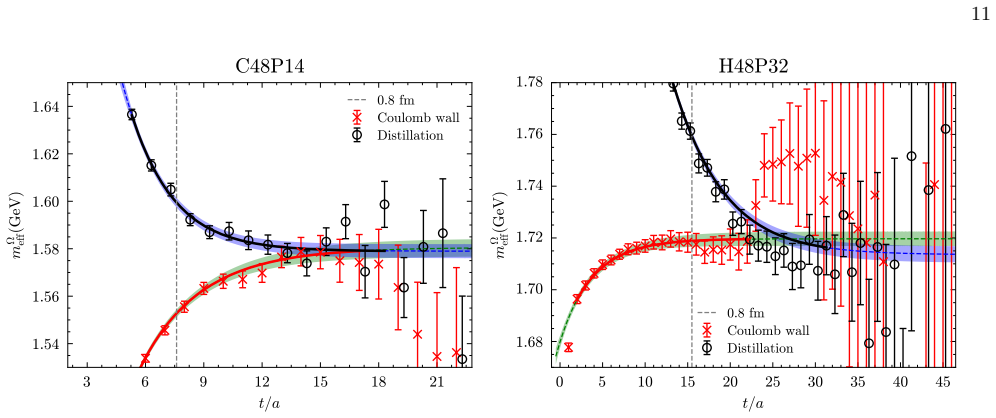
[8]
(3), the val- ues of ⟨Ha⟩H (represented by hollow triangles) for dif- ferent hadrons H are displayed in the lower-right panel of Fig
Trace anomaly contribution: By subtracting the to- tal σ term from the baryon mass using Eq. (3), the val- ues of ⟨Ha⟩H (represented by hollow triangles) for dif- ferent hadrons H are displayed in the lower-right panel of Fig. 2. It is evident that ⟨Ha⟩H increases with the number of heavy valence quarks, resulting in a twofold enhancement from the lightes...
Show all 117 references
-
[9]
K. G. Wilson, Phys. Rev. D 10, 2445 (1974)
1974
-
[10]
Hu et al
Z.-C. Hu et al. (CLQCD), Phys. Rev. D 109, 054507 (2024), arXiv:2310.00814 [hep-lat]
2024 arXiv
- [11]
-
[12]
J. C. Collins, A. Duncan, and S. D. Joglekar, Phys. Rev. D 16, 438 (1977)
1977
-
[13]
N. K. Nielsen, Nucl. Phys. B 120, 212 (1977)
1977
-
[14]
M. A. Shifman, A. I. Vainshtein, and V. I. Zakharov, Phys. Lett. B78, 443 (1978)
1978
-
[15]
Ji, Phys
X.-D. Ji, Phys. Rev. Lett. 74, 1071 (1995), arXiv:hep- ph/9410274
1995
-
[16]
Y.-B. Yang, J. Liang, Y.-J. Bi, Y. Chen, T. Draper, K.-F. Liu, and Z. Liu, Phys. Rev. Lett. 121, 212001 (2018), arXiv:1808.08677 [hep-lat]
2018 arXiv
-
[17]
Lorc´ e, H
C. Lorc´ e, H. Moutarde, and A. P. Trawi´ nski, Eur. Phys. J. C 79, 89 (2019), arXiv:1810.09837 [hep-ph]
2019 arXiv
- [18]
-
[19]
Duane, A
S. Duane, A. D. Kennedy, B. J. Pendleton, and D. Roweth, Phys. Lett. B 195, 216 (1987)
1987
- [20]
-
[21]
Alexandrou, V
C. Alexandrou, V. Drach, K. Jansen, C. Kallidonis, and G. Koutsou, Phys. Rev. D 90, 074501 (2014), arXiv:1406.4310 [hep-lat]
2014 arXiv
-
[22]
G. S. Bali, S. Collins, P. Georg, D. Jenkins, P. Kor- cyl, A. Sch¨ afer, E. E. Scholz, J. Simeth, W. S¨ oldner, and S. Weish¨ aupl (RQCD), JHEP 05, 035 (2023), arXiv:2211.03744 [hep-lat]
2023 arXiv
-
[23]
Alexandrou, S
C. Alexandrou, S. Bacchio, G. Christou, and J. Finkenrath, Phys. Rev. D 108, 094510 (2023), arXiv:2309.04401 [hep-lat]
2023 arXiv
-
[24]
R. A. Briceno, H.-W. Lin, and D. R. Bolton, Phys. Rev. D 86, 094504 (2012), arXiv:1207.3536 [hep-lat]
2012 arXiv
-
[25]
Z. S. Brown, W. Detmold, S. Meinel, and K. Orginos, Phys. Rev. D 90, 094507 (2014), arXiv:1409.0497 [hep- lat]
2014 arXiv
-
[26]
Mathur and M
N. Mathur and M. Padmanath, Phys. Rev. D99, 031501 (2019), arXiv:1807.00174 [hep-lat]
2019 arXiv
-
[27]
N. S. Dhindsa, D. Chakraborty, A. Radhakrish- nan, N. Mathur, and M. Padmanath, (2024), arXiv:2411.12729 [hep-lat]
2024
-
[28]
Aoki et al
S. Aoki et al. (PACS-CS), Phys. Rev. D 79, 034503 (2009), arXiv:0807.1661 [hep-lat]
2009 arXiv
-
[29]
Bietenholz et al
W. Bietenholz et al. , Phys. Rev. D 84, 054509 (2011), arXiv:1102.5300 [hep-lat]. 6
2011 arXiv
-
[30]
Alexandrou and C
C. Alexandrou and C. Kallidonis, Phys. Rev. D 96, 034511 (2017), arXiv:1704.02647 [hep-lat]
2017 arXiv
-
[31]
Liu, H.-W
L. Liu, H.-W. Lin, K. Orginos, and A. Walker-Loud, Phys. Rev. D 81, 094505 (2010), arXiv:0909.3294 [hep- lat]
2010 arXiv
-
[32]
Namekawa et al
Y. Namekawa et al. (PACS-CS), Phys. Rev. D 87, 094512 (2013), arXiv:1301.4743 [hep-lat]
2013 arXiv
-
[33]
P´ erez-Rubio, S
P. P´ erez-Rubio, S. Collins, and G. S. Bali, Phys. Rev. D 92, 034504 (2015), arXiv:1503.08440 [hep-lat]
2015 arXiv
-
[34]
Li, L.-C
J.-B. Li, L.-C. Gui, W. Sun, J. Liang, and W. Qin, (2022), arXiv:2211.04713 [hep-lat]
2022 arXiv
-
[35]
B. C. Tiburzi, Phys. Rev. D 72, 094501 (2005), [Er- ratum: Phys.Rev.D 79, 039904 (2009)], arXiv:hep- lat/0508019
2005
-
[36]
Aoki et al
Y. Aoki et al. (Flavour Lattice Averaging Group (FLAG)), (2024), arXiv:2411.04268 [hep-lat]
2024 arXiv
-
[37]
Agadjanov, D
A. Agadjanov, D. Djukanovic, G. von Hippel, H. B. Meyer, K. Ottnad, and H. Wittig, Phys. Rev. Lett. 131, 261902 (2023), arXiv:2303.08741 [hep-lat]
2023 arXiv
-
[38]
Borsanyi, Z
S. Borsanyi, Z. Fodor, C. Hoelbling, L. Lellouch, K. K. Szabo, C. Torrero, and L. Varnhorst, (2020), arXiv:2007.03319 [hep-lat]
2020 arXiv
-
[39]
P. M. Copeland, C.-R. Ji, and W. Melnitchouk, Phys. Rev. D 107, 094041 (2023), arXiv:2112.03198 [nucl-th]
2023 arXiv
- [40]
-
[41]
Gupta, S
R. Gupta, S. Park, M. Hoferichter, E. Mereghetti, B. Yoon, and T. Bhattacharya, Phys. Rev. Lett. 127, 242002 (2021), arXiv:2105.12095 [hep-lat]
2021 arXiv
-
[42]
Martin Camalich, L
J. Martin Camalich, L. S. Geng, and M. J. Vicente Va- cas, Phys. Rev. D 82, 074504 (2010), arXiv:1003.1929 [hep-lat]
2010 arXiv
-
[43]
K. I. Ishikawa et al. (PACS-CS), Phys. Rev. D 80, 054502 (2009), arXiv:0905.0962 [hep-lat]
2009 arXiv
-
[44]
Ren, L.-S
X.-L. Ren, L.-S. Geng, and J. Meng, Phys. Rev. D 91, 051502 (2015), arXiv:1404.4799 [hep-ph]
2015 arXiv
-
[45]
X. L. Ren, L. S. Geng, J. Martin Camalich, J. Meng, and H. Toki, JHEP 12, 073 (2012), arXiv:1209.3641 [nucl-th]
2012 arXiv
-
[46]
Semke and M
A. Semke and M. F. M. Lutz, Phys. Lett. B 717, 242 (2012), arXiv:1202.3556 [hep-ph]
2012 arXiv
-
[47]
R. D. Young and A. W. Thomas, Nucl. Phys. A 844, 266C (2010), arXiv:0911.1757 [hep-lat]
2010 arXiv
-
[48]
Alvarez-Ruso, T
L. Alvarez-Ruso, T. Ledwig, J. Martin Camalich, and M. J. Vicente-Vacas, Phys. Rev. D 88, 054507 (2013), arXiv:1304.0483 [hep-ph]
2013 arXiv
-
[49]
Durr et al
S. Durr et al. (BMW), Phys. Rev. D 85, 014509 (2012), [Erratum: Phys.Rev.D 93, 039905 (2016)], arXiv:1109.4265 [hep-lat]
2012 arXiv
-
[50]
Horsley, Y
R. Horsley, Y. Nakamura, H. Perlt, D. Pleiter, P. E. L. Rakow, G. Schierholz, A. Schiller, H. Stuben, F. Winter, and J. M. Zanotti (QCDSF-UKQCD), Phys. Rev. D85, 034506 (2012), arXiv:1110.4971 [hep-lat]
2012 arXiv
-
[51]
C. S. An and B. Saghai, Phys. Rev. D92, 014002 (2015), arXiv:1404.2389 [hep-ph]
2015 arXiv
-
[52]
Junnarkar and A
P. Junnarkar and A. Walker-Loud, Phys. Rev. D 87, 114510 (2013), arXiv:1301.1114 [hep-lat]
2013 arXiv
-
[53]
Takeda, S
K. Takeda, S. Aoki, S. Hashimoto, T. Kaneko, J. Noaki, and T. Onogi (JLQCD), Phys. Rev. D 83, 114506 (2011), arXiv:1011.1964 [hep-lat]
2011 arXiv
-
[54]
Toussaint and W
D. Toussaint and W. Freeman (MILC), Phys. Rev. Lett. 103, 122002 (2009), arXiv:0905.2432 [hep-lat]
2009 arXiv
-
[55]
Alexandrou, S
C. Alexandrou, S. Bacchio, M. Constantinou, J. Finken- rath, K. Hadjiyiannakou, K. Jansen, G. Koutsou, and A. Vaquero Aviles-Casco, Phys. Rev. D 102, 054517 (2020), arXiv:1909.00485 [hep-lat]
2020 arXiv
-
[56]
Durr et al
S. Durr et al. , Phys. Rev. Lett. 116, 172001 (2016), arXiv:1510.08013 [hep-lat]
2016 arXiv
-
[57]
Y.-B. Yang, A. Alexandru, T. Draper, J. Liang, and K.-F. Liu (xQCD), Phys. Rev. D 94, 054503 (2016), arXiv:1511.09089 [hep-lat]
2016 arXiv
-
[58]
G. S. Bali, S. Collins, D. Richtmann, A. Sch¨ afer, W. S¨ oldner, and A. Sternbeck (RQCD), Phys. Rev. D 93, 094504 (2016), arXiv:1603.00827 [hep-lat]
2016 arXiv
-
[59]
Gong et al
M. Gong et al. (XQCD), Phys. Rev. D 88, 014503 (2013), arXiv:1304.1194 [hep-ph]
2013 arXiv
-
[60]
Abdel-Rehim, C
A. Abdel-Rehim, C. Alexandrou, M. Constantinou, K. Hadjiyiannakou, K. Jansen, C. Kallidonis, G. Kout- sou, and A. Vaquero Aviles-Casco (ETM), Phys. Rev. Lett. 116, 252001 (2016), arXiv:1601.01624 [hep-lat]
2016 arXiv
-
[61]
G. S. Bali et al. (QCDSF), Phys. Rev. D 85, 054502 (2012), arXiv:1111.1600 [hep-lat]
2012 arXiv
-
[62]
P. L. J. Petrak, G. Bali, S. Collins, J. Heitger, D. Jenk- ins, and S. Weish¨ aupl, PoS LA TTICE2022, 112 (2023), arXiv:2301.03871 [hep-lat]
2023 arXiv
-
[63]
Hisano, K
J. Hisano, K. Ishiwata, and N. Nagata, Phys. Rev. D 82, 115007 (2010), arXiv:1007.2601 [hep-ph]
2010 arXiv
-
[64]
Hisano, K
J. Hisano, K. Ishiwata, N. Nagata, and T. Takesako, JHEP 07, 005 (2011), arXiv:1104.0228 [hep-ph]
2011 arXiv
-
[65]
J. R. Ellis, K. A. Olive, and C. Savage, Phys. Rev. D 77, 065026 (2008), arXiv:0801.3656 [hep-ph]
2008 arXiv
-
[66]
Crivellin, M
A. Crivellin, M. Hoferichter, and M. Procura, Phys. Rev. D 89, 054021 (2014), arXiv:1312.4951 [hep-ph]
2014 arXiv
-
[67]
Bruno, I
M. Bruno, I. Campos, P. Fritzsch, J. Koponen, C. Pena, D. Preti, A. Ramos, and A. Vladikas (ALPHA), Eur. Phys. J. C 80, 169 (2020), arXiv:1911.08025 [hep-lat]
2020 arXiv
-
[68]
Blum et al
T. Blum et al. (RBC, UKQCD), Phys. Rev. D 93, 074505 (2016), arXiv:1411.7017 [hep-lat]
2016 arXiv
-
[69]
S. Durr, Z. Fodor, C. Hoelbling, S. D. Katz, S. Krieg, T. Kurth, L. Lellouch, T. Lippert, K. K. Szabo, and G. Vulvert (BMW), Phys. Lett. B 701, 265 (2011), arXiv:1011.2403 [hep-lat]
2011 arXiv
-
[70]
S. Durr, Z. Fodor, C. Hoelbling, S. D. Katz, S. Krieg, T. Kurth, L. Lellouch, T. Lippert, K. K. Szabo, and G. Vulvert (BMW), JHEP 08, 148 (2011), arXiv:1011.2711 [hep-lat]
2011 arXiv
-
[71]
McNeile, C
C. McNeile, C. T. H. Davies, E. Follana, K. Hornbostel, and G. P. Lepage, Phys. Rev. D 82, 034512 (2010), arXiv:1004.4285 [hep-lat]
2010 arXiv
-
[72]
Bazavov et al
A. Bazavov et al. , PoS LA TTICE2010, 083 (2010), arXiv:1011.1792 [hep-lat]
2010 arXiv
-
[73]
Liu, W.-C
K.-F. Liu, W.-C. Chang, H.-Y. Cheng, and J.-C. Peng, Phys. Rev. Lett. 109, 252002 (2012), arXiv:1206.4339 [hep-ph]
2012 arXiv
- [74]
-
[75]
Bussone, A
A. Bussone, A. Conigli, J. Frison, G. Herdo ´ ıza, C. Pena, D. Preti, A. S´ aez, and J. Ugarrio (Alpha), Eur. Phys. J. C 84, 506 (2024), arXiv:2309.14154 [hep-lat]
2024 arXiv
- [76]
-
[77]
Nakayama, B
K. Nakayama, B. Fahy, and S. Hashimoto, Phys. Rev. D 94, 054507 (2016), arXiv:1606.01002 [hep-lat]
2016 arXiv
-
[78]
Petreczky and J
P. Petreczky and J. H. Weber, Phys. Rev. D100, 034519 (2019), arXiv:1901.06424 [hep-lat]
2019 arXiv
-
[79]
Heitger, F
J. Heitger, F. Joswig, and S. Kuberski (ALPHA), JHEP 05, 288 (2021), arXiv:2101.02694 [hep-lat]
2021 arXiv
-
[80]
Tarrach, Nucl
R. Tarrach, Nucl. Phys. B196, 45 (1982). 7
1982
-
[81]
Appelquist and J
T. Appelquist and J. Carazzone, Phys. Rev. D 11, 2856 (1975)
1975
-
[82]
R. L. Workman et al. (Particle Data Group), PTEP 2022, 083C01 (2022)
2022
-
[83]
F. He, P. Sun, and Y.-B. Yang ( χQCD), Phys. Rev. D 104, 074507 (2021), arXiv:2101.04942 [hep-lat]
2021 arXiv
-
[84]
B. Wang, F. He, G. Wang, T. Draper, J. Liang, K.- F. Liu, and Y.-B. Yang ( χQCD), Phys. Rev. D 109, 094504 (2024), arXiv:2401.05496 [hep-lat]
2024 arXiv
-
[85]
Cao, F.-K
X.-H. Cao, F.-K. Guo, Q.-Z. Li, and D.-L. Yao, (2024), arXiv:2411.13398 [hep-ph]
2024 arXiv
-
[86]
D. C. Hackett, D. A. Pefkou, and P. E. Shanahan, Phys. Rev. Lett. 132, 251904 (2024), arXiv:2310.08484 [hep- lat]
2024 arXiv
-
[87]
D. C. Hackett, P. R. Oare, D. A. Pefkou, and P. E. Shanahan, Phys. Rev. D 108, 114504 (2023), arXiv:2307.11707 [hep-lat]
2023 arXiv
- [88]
-
[89]
Kharzeev, Proc
D. Kharzeev, Proc. Int. Sch. Phys. Fermi 130, 105 (1996), arXiv:nucl-th/9601029
1996 arXiv
-
[90]
Hatta and D.-L
Y. Hatta and D.-L. Yang, Phys. Rev. D 98, 074003 (2018), arXiv:1808.02163 [hep-ph]
2018 arXiv
- [91]
-
[92]
Jiang, C
X. Jiang, C. Shi, Y. Chen, M. Gong, and Y.-B. Yang, (2024), arXiv:2411.08461 [hep-lat]
2024 arXiv
-
[93]
R. G. Edwards and B. Joo (SciDAC, LHPC, UKQCD), Lattice field theory. Proceedings, 22nd International Symposium, Lattice 2004, Batavia, USA, June 21- 26, 2004 , Nucl. Phys. Proc. Suppl. 140, 832 (2005), [,832(2004)], arXiv:hep-lat/0409003 [hep-lat]
2005 arXiv
-
[94]
M. A. Clark, R. Babich, K. Barros, R. C. Brower, and C. Rebbi, Comput. Phys. Commun. 181, 1517 (2010), arXiv:0911.3191 [hep-lat]
2010 arXiv
-
[95]
Babich, M
R. Babich, M. A. Clark, B. Joo, G. Shi, R. C. Brower, and S. Gottlieb, in SC11 International Conference for High Performance Computing, Networking, Storage and Analysis Seattle, Washington, November 12-18, 2011 (2011) arXiv:1109.2935 [hep-lat]
2011 arXiv
-
[96]
M. A. Clark, B. Jo, A. Strelchenko, M. Cheng, A. Gamb- hir, and R. Brower, (2016), arXiv:1612.07873 [hep-lat]
2016 arXiv
-
[97]
Y.-J. Bi, Y. Xiao, M. Gong, W.-Y. Guo, P. Sun, S. Xu, and Y.-B. Yang, Proceedings, 37th International Sym- posium on Lattice Field Theory (Lattice 2019): Wuhan, China, June 16-22 2019 , PoS LA TTICE2019, 286 (2020), arXiv:2001.05706 [hep-lat]
2020 arXiv
-
[98]
H. Xing, J. Liang, L. Liu, P. Sun, and Y.-B. Yang, (2022), arXiv:2210.08555 [hep-lat]
2022 arXiv
-
[99]
H. Liu, J. He, L. Liu, P. Sun, W. Wang, Y.-B. Yang, and Q.-A. Zhang, Sci. China Phys. Mech. Astron. 67, 211011 (2024), arXiv:2207.00183 [hep-lat]
2024 arXiv
-
[100]
H. Liu, L. Liu, P. Sun, W. Sun, J.-X. Tan, W. Wang, Y.- B. Yang, and Q.-A. Zhang, Phys. Lett. B 841, 137941 (2023), arXiv:2303.17865 [hep-lat]
2023 arXiv
-
[101]
H. Liu, W. Wang, and Q.-A. Zhang, Phys. Rev. D 109, 036037 (2024), arXiv:2309.05432 [hep-ph]
2024 arXiv
-
[102]
H. Yan, C. Liu, L. Liu, Y. Meng, and H. Xing, (2024), arXiv:2404.13479 [hep-lat]
2024 arXiv
-
[103]
Zhang et al
Q.-A. Zhang et al. , Chin. Phys. C 46, 011002 (2022), arXiv:2103.07064 [hep-lat]
2022 arXiv
-
[104]
X.-Y. Han, J. Hua, X. Ji, C.-D. L¨ u, W. Wang, J. Xu, Q.-A. Zhang, and S. Zhao, (2024), arXiv:2403.17492 [hep-ph]
2024 arXiv
-
[105]
Meng, J.-L
Y. Meng, J.-L. Dang, C. Liu, Z. Liu, T. Shen, H. Yan, and K.-L. Zhang, Phys. Rev. D 109, 074511 (2024), arXiv:2401.13475 [hep-lat]
2024 arXiv
-
[106]
Meng, J.-L
Y. Meng, J.-L. Dang, C. Liu, X.-Y. Tuo, H. Yan, Y.- B. Yang, and K.-L. Zhang, Phys. Rev. D 110, 074510 (2024), arXiv:2407.13568 [hep-lat]
2024 arXiv
- [107]
-
[108]
Di Carlo, D
M. Di Carlo, D. Giusti, V. Lubicz, G. Martinelli, C. T. Sachrajda, F. Sanfilippo, S. Simula, and N. Tantalo, Phys. Rev. D 100, 034514 (2019), arXiv:1904.08731 [hep-lat]. 8 TABLE I. Lattice size ˜L3 × ˜T , gauge coupling ˆβ, bare quark mass parameters ˜mb l,s, the corresponding...
2019 arXiv
-
[109]
They were generated using a tadpole-improved tree-level Symanzik (TITLS) gauge action with a 2+1 flavor tadpole-improved tree-level Clover (TITLC) fermion action
Details of the ensembles The ensembles used in this work are summarized in Table I. They were generated using a tadpole-improved tree-level Symanzik (TITLS) gauge action with a 2+1 flavor tadpole-improved tree-level Clover (TITLC) fermion action. The TITLS gauge action, denote...
-
[110]
Here, ˜V = ˜L3 × ˜T is the dimensionless 4-D volume of the lattice, and we use ˜O for the dimensionless value of any quantity O
6 g2 0 u4 0 ≡ 10 g2 0 u4 0 , with c0 1 = − 1 12 , c1 = c0 1 u2 0 , and u0 = * ReTrP x,µ<ν P U µν(x) 6Nc ˜V +1/4 being the tadpole improvement factor. Here, ˜V = ˜L3 × ˜T is the dimensionless 4-D volume of the lattice, and we use ˜O for the dimensionless value of any quantity O...
-
[111]
Note that some of the particles require linear combination of different permutations of three quarks
Interpolation fields, 2-point functions and ground state baryon mass extraction For the interpolation fields of the baryons, we useϵabcP + (q1 a)T Cγ 5q2 b q3 c and ϵabcP + (q1 a)T Cγ µq2 b q3 c for the spin- 1/2 and 3/2 particles, respectively. Note that some of the particles...
-
[112]
[99] is the pure QCD ηs mass which corresponds to the physical strange quark mass
Joint fit of the baryon mass We fit the nucleon mass using the the SU(4 |2) partially quenched heavy baryon chiral perturbative theory ( χPT) ansatz [8, 27], mH mval π , msea π , msea ηs , a,1/L =mphys H + X tag=val/pq,j=2,3 C tag j [ mtag π j − mphys π j ] + Cs (msea ηs )2 − ...
1966
-
[113]
(6) 14 Here, mval/sea q denote the valence/sea quark masses, and mH (mval q , msea q ) is derived from joint fits of lattice data across ensembles with varying mval q and msea q
σqH extraction The Feynman-Hellman theorem establishes the relation ⟨¯qq⟩H = ∂mH ∂mq , which can be further decomposed into contributions from valence and sea quarks: ⟨¯qq⟩H = ⟨¯qq⟩val H + ⟨¯qq⟩sea H , ⟨¯qq⟩val H = ∂mH (mval q , msea q ) ∂mvalq , ⟨¯qq⟩sea H = ∂mH (mval q , mse...
-
[114]
Error budget of our predictions In table III, we summarized the final numerical results of the baryon masses, sigma terms and also trace anomaly contributions. 17 The statistical uncertainty is categorized by its sources: the statistical fluctuations in the dimensionless pion ...
-
[115]
The experimental Ds mass measurement
-
[116]
multiplicative discretization errors)
Choice of fit ansatz (additive vs. multiplicative discretization errors)
-
[117]
(10) and (12), which propagate to uncertainties of the sea quark mass contribution of sigma terms, and then also that of the gluon trace anomaly due to the sum rule
Sea quark dependence parameters ds(c) 1,2 in Eqs. (10) and (12), which propagate to uncertainties of the sea quark mass contribution of sigma terms, and then also that of the gluon trace anomaly due to the sum rule. The primary source of uncertainty is statistical, arising fro...
1970
Reviewed August 12, 2026 · model on record in the stance chip above.
Discussion (0). Continue with ORCID to comment.