REVIEW 4 major objections 5 minor 51 references
Re examination of \b{eta} decay in Hg, Pb and Po Isotopes
T0 review · 4 major / 5 minor · reviewed 2026-08-12 · deepseek-v4-flash
Pith's one-line read This paper argues that beta-decay half-lives and Gamow-Teller strengths in neutron-deficient Hg, Pb, and Po isotopes vary by up to an order of magnitude with nuclear deformation, making them usable observables for nuclear shape.
desk verdict Competent model-sensitivity study whose central 'good observable' conclusion is undermined by its own 206Po example and a missing uncertainty budget. read the letter →
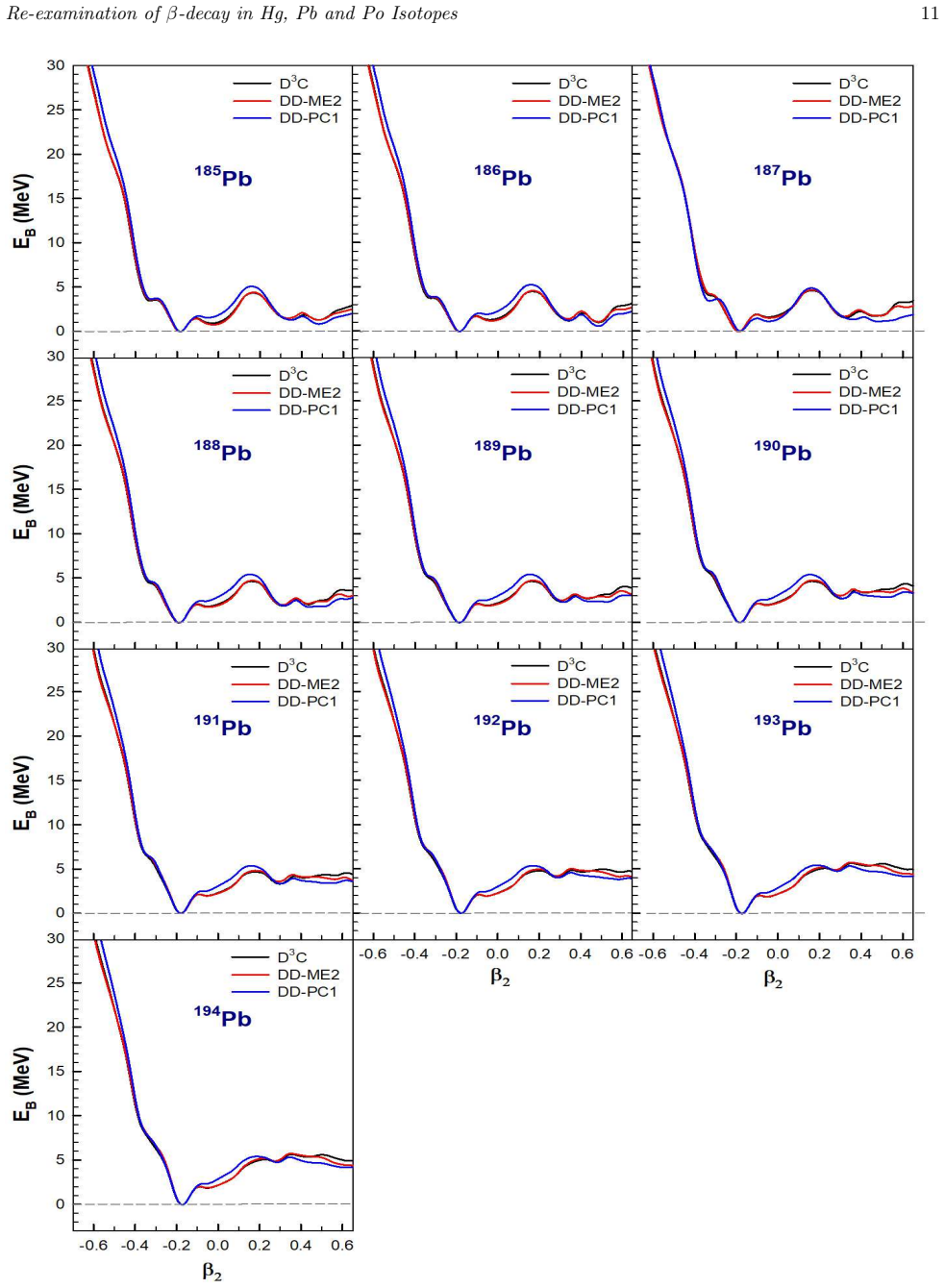
The pith
A machine-rendered reading of the paper's core claim, the machinery that carries it, and where it could break.
The reading
What carries the argument
The load-bearing machinery is the pairing of a quadrupole-constrained relativistic mean-field (RMF) calculation, which supplies the deformation parameter $\beta_2$ as the minimum of a potential energy curve, with a deformed proton-neutron quasiparticle random phase approximation (pn-QRPA) model that uses a separable spin-isospin residual interaction. The pn-QRPA builds Nilsson single-particle states at the chosen $\beta_2$, adds BCS pairing, adjusts particle-hole and particle-particle GT strengths with a standard $1/A^{0.7}$ parameterization, and computes GT strength distributions and half-lives through phase-space integrals. The paper's control is to keep every model parameter fixed and change only $\beta_2$ among the RMF, FRDM, and Skyrme sets, so the reported order-of-magnitude changes in half-life are attributed to deformation alone.
What would settle it
Repeat the pn-QRPA calculation for $^{186}$Pb—where spherical, oblate, and prolate $0^+$ states sit within about 700 keV—using a shape-mixed ground state instead of a single $\beta_2$; if the order-of-magnitude variation in half-life disappears or changes direction, the single-shape input is the cause, and if it survives, the paper's conclusion is supported. A measured GT strength distribution for $^{186}$Pb would settle which case holds.
Extended reading notes
Core claim
The central discovery is that the $\beta$-decay response of neutron-deficient Hg, Pb, and Po isotopes is sensitive to the ground-state deformation parameter $\beta_2$, and that this sensitivity is large enough to matter. The authors use a quadrupole-constrained relativistic mean-field calculation with three density-dependent functionals to build potential energy curves and read off $\beta_2$ at the minima; they also take $\beta_2$ sets from the Finite Range Droplet Model and from an earlier deformed Skyrme calculation. Feeding all these shapes into the same deformed proton-neutron QRPA model, with all other parameters fixed, they obtain Gamow-Teller strength distributions, centroids, branching ratios, and $\beta$-decay half-lives within the decay $Q$-value window. They find that the total GT strength and the half-lives change considerably with $\beta_2$, in some cases by more than an order of magnitude. This directly contradicts an earlier study's conclusion that half-lives and summed strengths were not good deformation observables.
Load-bearing premise
The calculation treats each nucleus as having one fixed axially symmetric shape, with $\beta_2$ taken from the lowest minimum of a potential energy curve, even though the neutron-deficient Hg, Pb, and Po nuclei studied here are known to display coexisting spherical, oblate, and prolate configurations.
Editorial extensions
If this is right
- Half-lives in this neutron-deficient region cannot be computed reliably without a realistic deformation; a wrong $\beta_2$ can change the half-life by an order of magnitude.
- Total Gamow-Teller strength within the $Q$-window and the centroid of the GT distribution are candidates for observables that probe deformation, not just the distribution's shape.
- Which deformation set is used matters for benchmarking: the earlier Skyrme SLy4 deformations give the closest half-lives overall, while DD-ME2 is the best of the three RMF functionals used here.
- Astrophysical decay-rate tables for these isotopes should record the deformation assumption alongside the half-life, because the same model with different shapes gives different rates.
Reading between the lines
- Editorial inference: if the claimed sensitivity is right, shape mixing is the next hurdle—nuclei such as $^{186}$Pb are known to superpose spherical, oblate, and prolate configurations, and a single-minimum $\beta_2$ may not describe their beta decay.
- Editorial inference: the same machinery could be applied to other neutron-deficient shape-coexisting chains, such as gold, thallium, and bismuth isotopes, to map where half-life deformation sensitivity is largest before committing to experimental campaigns.
- Editorial inference: the strong dependence on small $\beta_2$ differences means more model tests should target nuclei with flat potential energy curves, where a tiny change in the minimum shifts the GT centroid relative to the $Q$-value and produces the largest half-life swings.
Editorial analysis
A structured set of objections, weighed in public.
Referee Report
Summary. The paper re-examines whether beta-decay half-lives and Gamow-Teller (GT) strength distributions in neutron-deficient Hg, Pb, and Po isotopes are sensitive to nuclear deformation. The authors compute ground-state deformation parameters with three relativistic mean-field (RMF) functionals (D3C, DD-ME2, DD-PC1) and supplement these with FRDM and Skyrme SLy4 deformations. These beta2 values are then used as inputs to a deformed proton-neutron quasiparticle random phase approximation (pn-QRPA) calculation of GT strength distributions, half-lives, and branching ratios. The central claim is that both GT strengths and half-lives vary considerably with deformation, in contrast to the earlier conclusion of Ref. [19] that half-lives and summed strengths are not good deformation observables. The paper concludes that half-lives might be good observables for studying deformation effects in these mass regions.
Significance. If the central claim holds, the paper would overturn an earlier published conclusion and suggest that beta-decay half-lives can be used as a probe of nuclear deformation in neutron-deficient Hg, Pb, and Po isotopes. The study is systematic in comparing three RMF functionals and several independent deformation sets, and the qualitative deformation sensitivity of GT strength distributions is directly visible in the displayed figures. However, the half-life claims are undermined by internal numerical inconsistencies, an unquantified extreme sensitivity case, and a large unexplained discrepancy for Pb isotopes. The calibration of the particle-hole interaction on a subset of the studied nuclei also weakens the predictive character of the comparisons.
major comments (4)
- [Section 3, 206Po paragraph] In the paragraph on 206Po, the paper states that the D3C interaction gives a half-life 'a factor 55 bigger' than DD-PC1, but the tabulated ratios 10.10 and 0.89 give a factor of about 11.4; the ratio to DD-ME2 (ratio 0.19) is about 53. This numerical inconsistency affects the main illustrative example. More fundamentally, a change in beta2 of only 0.0013 (from -0.04651 to -0.04521) changes the calculated half-life by roughly two orders of magnitude, which suggests a near-threshold phase-space effect or numerical instability rather than a smooth deformation dependence. The paper should quantify d log T1/2/dbeta2, check the convergence of the QRPA with respect to the deformation mesh and model space, and discuss whether such sensitivity is physical. Without this, the conclusion that half-lives are 'good observables to study the deformation effects' is not supported.
- [Section 3, Table 4 and Eq. (33)] The claim in the text that the overall comparison of calculated and measured half-lives is satisfactory (within a factor 2) contradicts the standard deviations in Table 4. For Pb isotopes in the oblate configuration, sigma_err is 20.197 (FRDM), 21.282 (D3C), 21.680 (DD-ME2), and 21.452 (DD-PC1), whereas SLy4 gives 0.082. These values indicate that the RMF- and FRDM-based half-lives for Pb are typically off by an order of magnitude or more. The paper does not discuss this large discrepancy and even claims in the conclusions that RMF deformations lead to 'good agreement' for Pb. The Pb case needs either explanation (e.g., shape coexistence, wrong minima) or the conclusions need to be scaled back.
- [Section 2.2 and Fig. 1] The particle-hole interaction strength chi is constrained by fitting the GTGR positions of 186Hg, 190Pb, and 192Pb, which are part of the chains studied in this paper. Therefore the good agreement shown in Fig. 1 for these nuclei is by construction and does not validate the model for the remaining nuclei. The paper should explicitly acknowledge this calibration and, ideally, test predictive power by leaving out one of the fitted nuclei. In addition, the fitted values of chi and kappa are not reported, so the reader cannot check the sensitivity of the deformation effect to these parameters.
- [Section 2.1 and 3 (ground-state deformation input)] The calculation uses a single beta2 value taken from the minimum of a potential energy curve for each nucleus. The introduction documents shape coexistence in exactly these isotope chains (e.g., 186Pb triplet, Hg staggering, Po mixing). The authors never address how a single-deformation pn-QRPA calculation is related to an experimental situation in which the parent or daughter is a superposition of shapes. If the physical half-life is an average over coexisting configurations, then the calculated sensitivity to one beta2 value is not a direct measure of the observability of deformation. The paper should either include a shape-mixing treatment or explicitly restrict the claim to mean-field configurations and discuss the possible impact of shape coexistence.
minor comments (5)
- [Table 4 caption] The caption references 'Eq. (43)', but the standard deviation formula is Eq. (33).
- [Section 3, 206Po paragraph] The phrase 'a factor 55' is inconsistent with the ratios given in the same paragraph; the D3C/DD-PC1 ratio is about 11 and the D3C/DD-ME2 ratio is about 53.
- [Global] There are numerous OCR/encoding artifacts in the text (e.g., 'W ah', 'Pa kistan', 'B¨ oy¨ ukata', 'S ¸evki'); these should be fixed in the final version.
- [Section 2.2] 'Eq. 28' should be written as 'Eq. (28)' for consistency with the rest of the paper.
- [Section 3] The phrase 'FRDM comparison was exceptional for Po isotopes' is ambiguous; the authors should clarify whether 'exceptional' means exceptionally good or exceptionally poor.
Circularity Check
No significant circularity: the deformation-sensitivity result is a model-output comparison across independently computed β2 inputs; the χ calibration to GTGR positions is not load-bearing.
full rationale
The paper's derivation chain is self-contained in the sense relevant to circularity. Ground-state β2 values are computed independently from the RMF model (D3C, DD-ME2, DD-PC1) and from FRDM and Skyrme HF+BCS sources, not fitted to the half-lives or GT strengths that are later reported. These β2 values are then used as inputs to the Nilsson single-particle basis inside the pn-QRPA calculation, with all other model parameters fixed. The central conclusion, that GT strengths and half-lives vary with deformation, is therefore a sensitivity statement comparing outputs of the same model for different independently obtained shape parameters; it is not a parameter fitted to the target data and then renamed as a prediction. The only in-sample element is the particle-hole strength χ, which is constrained by observed GTGR positions in selected isotopes; the Fig. 1 comparison for 186Hg, 190Pb and 192Pb is a calibration check rather than an independent prediction. This calibration does not enforce the deformation-sensitivity claim, because χ is kept constant while β2 is varied across the model sets. The self-citation to Ref. [42] only provides additional formalism details and is not load-bearing for any uniqueness claim. The notable 206Po numerical sensitivity is a robustness or internal-consistency concern, not a circular reduction: the half-life variation with tiny β2 changes is an output of the model, not an input imposed by construction. Overall, no step in the derivation reduces by definition to its own inputs, and the central claim retains independent content.
Assumptions & free parameters
free parameters (3)
- Per-isotope ground-state deformation beta2 =
e.g., -0.135 for 180Hg (D3C), -0.187 for 186Pb (D3C), -0.178 for 196Po (D3C); multiple sets from D3C, DD-ME2, DD-PC1…
- Particle-hole GT interaction strength chi =
not quoted numerically; constrained to reproduce observed GTGR positions
- Particle-particle GT interaction strength kappa =
parameterized as 1/A^0.7 (Ref. [39])
assumptions (3)
- domain assumption Axially symmetric mean-field with a single constrained beta2 minimum represents the nuclear ground state for all listed isotopes.
- domain assumption The separable pn-QRPA Hamiltonian with Nilsson single-particle states and BCS pairing captures the Gamow-Teller response.
- ad hoc to paper chi and kappa parameterizations calibrated to selected experimental GT data remain valid across all studied isotopes and deformations.
Cite this review
Pith. "Pith review of Re examination of \b{eta} decay in Hg, Pb and Po Isotopes." pith.science (2026). https://pith.science/paper/KVFKCCMA
@misc{pith2026241118411,
  author       = {Pith},
  title        = {Pith review of: Re examination of \beta decay in Hg, Pb and Po Isotopes},
  year         = {2026},
  howpublished = {\url{https://pith.science/paper/KVFKCCMA}},
  note         = {Machine review of arXiv:2411.18411}
}
read the original abstract
This study re examines the effect of nuclear deformation on the calculated Gamow Teller (GT) strength distributions of neutron deficient (178 192Hg, 185 194Pb and 196 206Po) nuclei. The nuclear ground state properties and shape parameters were calculated using the Relativistic Mean Field model. Three different density dependent interactions were used in the calculation. Estimated shape parameters were later used within the framework of deformed proton-neutron quasi random phase approximations model, with a separable interaction, to calculate the GT strength distributions, half lives and branching ratios for these neutron deficient isotopes. It was concluded that half lives and GT strength distributions vary considerably with change in shape parameter.
Figures


Figures from the paper (8 more)


Reference graph
Works this paper leans on
-
[19]
N. A. Smirnova, P.-H. Heenen, and G. Neyens, Phys. Lett. B 569, 151 (2003)
work page 2003
-
[1]
Introduction The study of nuclear structure properties of neutron- deficient nuclei is one of the most active areas of research in nuclear physics. The researchers, on one side, endeavor to upgrade the experimental facilities, while on the other side, develop new theoretical tools to extend the knowledge of nuclear physics far away from the β-stability lin...
-
[2]
We calculated the ground state binding energies per nucleon and potential energy curves (PECs)
F ormalism Nuclear structure calculations were performed using the Relativistic Mean Field (RMF) model. We calculated the ground state binding energies per nucleon and potential energy curves (PECs). Three different versions of density-dependent RMF functional were used in our calculation. The calculations of GT strength distributions and half-lives were p...
-
[3]
(21) The rearrangement contribution in Eq. (15) is consequently reduced to Σ R 0 = ∂gσ ∂ρv ρsσ + ∂gω ∂ρv ρvω + ∂gρ ∂ρv ρtvρ, (22) whereρtv represents the isovector density. The meson- nucleon couplings can be parameterized [30, 31, 32]. The couplings of σ andω mesons to nucleon field reads gi(ρ) = gi(ρsat)fi(x) for i =σ,ω, (23) where ρsat is the baryon den...
-
[4]
Results and Discussion We first discuss the nuclear structure calculations and determination of β2 for 178−192Hg, 185−194Pb and 196−206Po. To do the needful, RMF model was employed using three different interactions (D 3C, DD- ME2 and DD-PC1). Later we investigate the effect of β2 on the calculated GT strength distributions and β-decay half-lives using the p...
-
[5]
The D 3C, DD-ME2 and DD-PC1 func- tionals produced similar PECs for the selected nuclei
Conclusions In this work, the ground state deformation parameters of 178−192Hg, 185−194Pb and 196−206Po were investi- gated using the quadrupole moment constrained RMF calculation. The D 3C, DD-ME2 and DD-PC1 func- tionals produced similar PECs for the selected nuclei. The results indicate that 185−194Pb and 196−206Po iso- topes have oblate shape configura...
work page 2021
- [6]
- [7]
Show all 51 references
-
[8]
J. L. W ood et al., Phys. Rep. 215, 101 (1992)
1992
-
[9]
Frauendorfand V
S. Frauendorfand V. V. Pashkevich, Phys. Lett. B 55, 365 (1975)
1975
-
[10]
J. Bonn, G. Huber, H.-J. Klunge and E. W. Otten, Z. Phys. A 276 203 (1976)
1976
-
[11]
B. A. Marsh, et al., Nat. Phys., 14 12 (2018)
2018
-
[12]
Sel et al., Phys
S. Sel et al., Phys. Rev., 99 044306 (2019)
2019
-
[13]
Olaizola et al., Phys
B. Olaizola et al., Phys. Rev. C, 100 2 (2019)
2019
-
[14]
Esmaylzadeh et al., Phys
A. Esmaylzadeh et al., Phys. Rev. C, 98 014313 (2018)
2018
-
[15]
A. N. Andreyev et al., Nature 405, 430 (2000)
2000
-
[16]
Ojala et al., Comm
J. Ojala et al., Comm. Phy. 5 1 (2022)
2022
-
[17]
Kesteloot et al., Phys
N. Kesteloot et al., Phys. Rev. C, 92 054301 (2015)
2015
-
[18]
Bengtsson and W
R. Bengtsson and W. Nazarewicz, Z. Phys. A 334, 269 (1989); W. Nazarewicz, Phys. Lett. B 305, 195 (1993)
1989
-
[20]
Niksic, D
T. Niksic, D. Vretenar, P. Ring, and G. A. Lalazissis, Phys. Rev. C 65, 054320 (2002)
2002
-
[21]
Libert, M
J. Libert, M. Girod, and J.-P. Delaroche, Phys. Rev. C 60, 054301 (1999)
1999
-
[22]
J. L. Egido, L. M. Robledo, and R. R. Rodr /acute.ts1ıguez-Guzman, /acute.ts1Phys. Rev. Lett. 93, 082502 (2004); R. R. Rodr /acute.ts1ıguez- Guzman, /acute.ts1J. L. Egido, and L. M. Robledo, Phys. Rev. C 69, 054319 (2004)
2004
-
[23]
Bender, P
M. Bender, P. Bonche, T. Duguet, and P.-H. Heenen, Phys. Rev. C 69, 064303 (2004)
2004
-
[24]
Moreno, P
O. Moreno, P. Sarriguren, R. Alvarez-Rodriguez and E. M . De Guerra, Phys. Rev. C 73, 054302 (2006)
2006
-
[25]
M¨ oller, et al., At
P. M¨ oller, et al., At. Data Nucl. Data Tables 109–110 , 1 (2016)
2016
-
[26]
J. D. W alecka, Annals Phys. 83, 491 (1974)
1974
-
[27]
Boguta and A
J. Boguta and A. R. Bodmer, N. Phys. A 292, 413 (1977)
1977
-
[28]
Ring, Prog
P. Ring, Prog. Part. N. Phys. 37, 193 (1996)
1996
-
[29]
G. A. Lalazissis, S. Raman and P. Ring, Atom. Data N. Data Tab. 71, 1 (1999)
1999
-
[30]
Vretenar, A
D. Vretenar, A. V. Afanasjev and G. A. Lalazissis, Phys. Rep. 409, 101 (2005)
2005
-
[31]
G. A. Lalazissis, T. Nikˇ si´ c, D. Vretenar and P. Ring, Phys. Rev. C 71, 024312 (2005)
2005
-
[32]
Bayram and S
T. Bayram and S. Akkoyun, Phys. Scrip. 87, 065201 (2013)
2013
-
[33]
Bayram, Phys
T. Bayram, Phys. At. N. 82, 317 (2019)
2019
-
[34]
J. Meng, H. Toki, S. G. Zhou, S. Q. Zhang, W. H. Long and L. S. Geng, Prog. Part. N. Phys. 57, 470 (2006)
2006
-
[35]
Typel and H
S. Typel and H. H. W olter, Nucl. Phys. A 656, 331 (1999)
1999
-
[36]
Nikˇ si´ c, D
T. Nikˇ si´ c, D. Vretenar, P. Finelli and P. Ring, Phys. Rev. C 66, 024306 (2002)
2002
-
[37]
Typel, Phys
S. Typel, Phys. Rev. C 71, 064301 (2005)
2005
-
[38]
Nikˇ si´ c, N
T. Nikˇ si´ c, N. Paar, D. Vretenar and P. Ring, Comp. Phys. Commu. 185, 1808 (2014)
2014
-
[39]
Nikˇ si´ c, D
T. Nikˇ si´ c, D. Vretenar, P. Ring, Phys. Rev. C 78, 034318 (2008)
2008
-
[40]
Karatzikos, A
S. Karatzikos, A. V. Afanasjev, G. A. Lalazissis and P. R ing, Phys. Lett. B 689, 72 (2010)
2010
-
[41]
S. G. Nilsson, Mat. Fys. Medd. Dan. Vid. Selsk 29, 16 (1955)
1955
-
[42]
Ragnarsson, R
I. Ragnarsson, R. K. Sheline, Phys. Scripta 29, 385 (1984)
1984
-
[43]
F. G. Kondev, M. W ang, W. J. Huang, S. Naimi, G. Audi, Chin. Phys. C 45, 030001 (2021)
2021
-
[44]
Homma, E
H. Homma, E. Bender, M. Hirsch, K. Muto, H. Klapdor- Kleingrothaus, T. Oda, Phys. Rev. C 54, 2972 (1996)
1996
-
[45]
Algora et al., Phys Lett B , 819, 136438 (2021)
A. Algora et al., Phys Lett B , 819, 136438 (2021)
2021
-
[46]
M. E. Estevez Aguado et al., Phys Rev C , 92, 044321 (2015)
2015
-
[47]
Ullah, J.-U
A. Ullah, J.-U. Nabi and M. Tahir, Braz. J. of Phys. , 53, 39 (2023)
2023
-
[48]
Bayram and A
T. Bayram and A. H. Yılmaz, Mod. Phys. Lett. A 28, 1350068 (2013)
2013
-
[49]
M. V. Stoitsov, J. Dobaczewski, W. Nazarewicz, S. Pitte l, and D. J. Dean, Phys. Rev. C 68, 054312 (2003)
2003
-
[50]
Pritychenko, M
B. Pritychenko, M. Birch, B. Singh, M. Horoi, At. Data and Nuc. Data Tables 107, 1-139 (2016). Re-examination of β-decay in Hg, Pb and Po Isotopes 8 /s48 /s46 /s53 /s49 /s46 /s48 /s49 /s46 /s53 /s50 /s46 /s48 /s50 /s46 /s53 /s51 /s46 /s48 /s48 /s46 /s48 /s48 /s46 /s50 /s48 /s4...
2016
-
[51]
Standard deviations of the err(T 1/ 2) [Eq
B(E2) [12] D 3C DD-ME2 DD-PC1 FRDM [20] 196 0.159 0.129(05) -0.178 -0.177 -0.180 0.049 197 0.130 - -0.174 -0.173 -0.175 0.055 198 0.119 0.116(14) -0.170 -0.169 -0.171 0.043 199 0.090 - -0.167 -0.166 -0.167 0.042 200 0.100 0.104(03) -0.163 -0.162 -0.163 0.027 201 0.100 - -0.159...
Reviewed August 12, 2026 · model on record in the stance chip above.
Discussion (0). Continue with ORCID to comment.