REVIEW 2 major objections 5 minor 60 references
Shift spin photocurrents in two-dimensional systems
T0 review · 2 major / 5 minor · reviewed 2026-08-12 · deepseek-v4-flash
Pith's one-line read Circularly polarized light can drive a pure spin current in two-dimensional systems with higher-order spin-orbit coupling or Zeeman splitting, while $k$-linear systems remain dark; mirror symmetry fixes the current's direction.
desk verdict Solid analytic catalog with a useful symmetry rule; the Zeeman peak needs a caveat about orbital effects, but the core results hold. read the letter →
The pith
A machine-rendered reading of the paper's core claim, the machinery that carries it, and where it could break.
The reading
What carries the argument
The central object is the shift spin conductivity tensor $\sigma^{Ic;ab}$ (Eq. (8)) and its matrix element $\mathrm{Re}[M^{Ic;xy}_{-1,1}]$ for a two-band Hamiltonian $H_0 = \epsilon_k + \mathbf{d}(k)\cdot\boldsymbol{\sigma}$. The calculation reduces to a few algebraic factors: the band-geometric factor $(1 - \frac{k}{d}\frac{\partial d}{\partial k})$, which is exactly zero for $k$-linear dispersion ($q=1$) and nonzero for $q\neq 1$; the Zeeman energy $\mu_z$ entering the dispersion $d = \sqrt{(k^q \gamma)^2 + \mu_z^2}$; and the momentum-space symmetry operations (mirror $M_x$, $M_y$ and parity-mirror $PM_x$, $PM_y$) that constrain the allowed conductivity components. The paper evaluates these analytically and then confirms by numerical integration, identifying the longitudinal ($xx$, $yy$) and transverse ($xy$, $yx$) components and the out-of-plane ($zx$, $zy$) components.
What would settle it
Measure the circular-photogalvanic spin current in a clean two-dimensional electron gas with purely linear Rashba coupling and no magnetic field, isolating the relaxation-time-independent shift contribution: the central claim predicts exactly zero shift spin photocurrent at every photon frequency, so any nonzero shift signal would falsify the vanishing theorem.
Extended reading notes
Core claim
The paper's central claim is that the shift spin photocurrent induced by circularly polarized light in a two-band system is governed by a geometric matrix element $\mathrm{Re}[M^{Ic;xy}_{-1,1}]$ whose value is fixed by the momentum dependence of the spin-orbit field $\mathbf{d}(k)$. For any $k$-linear spin-orbit Hamiltonian with no Zeeman coupling, the factor $(1 - \frac{k}{d}\frac{\partial d}{\partial k})$ vanishes identically, making all shift spin conductivities zero; this is stated in Sec. V as 'for $k$-linear system $q=1$, we always have $\mathrm{Re}[M]=0$'. The vanishing is lifted either by higher-order ($k$-cubic) terms or by a Zeeman term $\mu_z$, which changes the dispersion to $d = \sqrt{(k^q \gamma)^2 + \mu_z^2}$ and makes the factor nonzero. The paper further shows that mirror (Rashba-type) or parity-mirror (Dresselhaus-type) symmetries select which tensor components survive, producing longitudinal or transverse spin currents respectively, and that Dirac surface states with hexagonal warping support longitudinal shift spin photocurrent. Finally, when Zeeman splitting is nonzero, the joint density of states has a van Hove singularity at the band bottom, giving a sharp peak in the shift spin conductivity at $\hbar\omega = 2\mu_z$.
Load-bearing premise
The paper's results assume that an external magnetic field contributes only the Zeeman energy $\mu_z$ to the spin-orbit field, with no orbital (Landau-quantization) effects; if orbital effects are significant, the predicted resonance at twice the Zeeman energy would not appear as calculated.
Editorial extensions
If this is right
- In a two-dimensional electron gas with purely linear Rashba or Dresselhaus spin-orbit coupling, circularly polarized light will produce no shift spin photocurrent unless a magnetic field is applied; experimental searches should focus on higher-order spin-orbit systems or field-tuned samples.
- Rashba-type systems will always convert circular light into a spin current whose spin polarization is parallel to the current direction (longitudinal), while Dresselhaus-type systems produce a transverse geometry; this gives a symmetry-based design rule for generating spin currents with a chosen polarization direction.
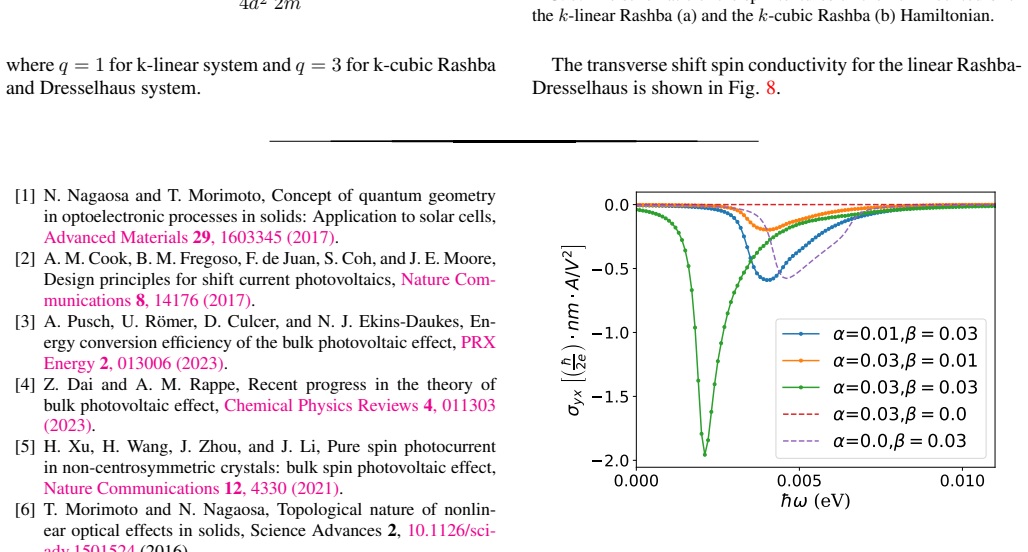
- Applying a perpendicular Zeeman field $\mu_z$ introduces a sharp, tunable peak in the shift spin conductivity at photon energy $\hbar\omega = 2\mu_z$, so sweeping the magnetic field tunes the optical frequency at which pure spin current is resonantly generated.
- Dirac surface states with hexagonal warping support longitudinal shift spin photocurrent with no need to break time-reversal symmetry, and the response strengthens with warping, making topological insulator surfaces a candidate platform for all-optical spin injection.
Reading between the lines
- An immediate extension would be to include orbital (Landau) effects beyond the Zeeman term; the $2\mu_z$ peak would likely split into Landau-level resonances, changing the predicted line shape in real magnetic fields.
- The same mirror-symmetry selection rules should apply to other second-order spin responses, such as injection spin photocurrents, so the longitudinal/transverse classification could be tested in complementary measurements.
- The exact zero for $k$-linear two-band models appears to be a purely algebraic consequence of the factor $(1 - \frac{k}{d}\frac{\partial d}{\partial k}) = 0$, suggesting a general geometric selection rule that may protect other response tensors in linear-in-$k$ systems.
Editorial analysis
A structured set of objections, weighed in public.
Referee Report
Summary. This manuscript studies the shift spin photocurrent induced by circularly polarized light in two-dimensional two-band spin-orbit coupled systems. Starting from the general second-order response formula of Ref. [21], the authors derive analytic expressions for the six components of Re[M^{Ic,xy}_{-1,1}] for Hamiltonians of the form H0 = ε_k + d(k)·σ, and apply them to k-linear Rashba, Dresselhaus, Rashba-Dresselhaus, Weyl, and persistent-spin-texture models; to k-cubic Rashba, Dresselhaus, Rashba-Dresselhaus, and wurtzite models; and to Dirac surface states with a hexagonal warping term. The central claims are: (i) without Zeeman coupling, the shift spin conductivity vanishes for all k-linear systems, while k-cubic systems and warped Dirac surface states can give nonzero response; (ii) adding a constant Zeeman term μ_z to d_z produces a peak at ℏω=2μ_z, attributed to a van Hove singularity in the joint density of states; and (iii) mirror symmetry enforces longitudinal shift spin photocurrents for Rashba-type systems and transverse ones for Dresselhaus-type systems.
Significance. If the main claims hold, the paper provides a useful symmetry-based classification of shift spin photocurrents and a sharp selection rule: k-linear spin-orbit systems cannot generate shift spin photocurrents under circular light unless a Zeeman term is present. The analytic expressions in Appendix B are a strength: they are derived transparently, are internally consistent for the specific Hamiltonians in Tables I and II, and the k-linear vanishing follows cleanly from the homogeneity argument in Eq. (31). The paper also correctly identifies longitudinal versus transverse responses for Rashba- and Dresselhaus-type systems and supports the classification with numerical evaluation of the conductivity. However, the headline prediction of a peak at ℏω=2μ_z is not derived for a realistic perpendicular magnetic field, because orbital coupling is omitted, and the universal 'any k-linear system' statement is broader than the derivation actually proves. These issues are load-bearing for the paper's main conclusions and require substantive revision.
major comments (2)
- [Sec. II; Eq. (29); Figs. 2 and 4] The central prediction of a shift-spin-conductivity peak at ℏω=2μ_z is obtained by adding only a constant Zeeman term d_z=μ_z to the Hamiltonian, with μ_z explicitly defined as (1/2)gμ_BB from a perpendicular magnetic field. The vector potential and Landau quantization are never introduced. For the parameters used in Fig. 1 (m*=0.05m0, μ_z=0.001 eV), the required field is B≈17 T for g≈2, and the cyclotron energy is ℏω_c≈40μ_z, so Landau quantization dominates the low-energy spectrum. The van Hove singularity in the zero-field joint density of states is therefore not a reliable prediction for a real perpendicular-field experiment. The authors must either include orbital coupling and compute the interband response in Landau levels, or explicitly restate μ_z as an exchange splitting rather than a Zeeman field. In the latter case they must also verify that the shift charge conductivity remains zero, because the time-reversal-symmetry argument quoted in the Introduction no longer applies when μ_z≠0.
- [Abstract; Sec. V; Sec. VI.A; Eq. (31)] The claim that the shift spin conductivity vanishes in 'any k-linear system' without Zeeman coupling is broader than the derivation. The vanishing is proven for models with d_z=0, where the surviving term in Eq. (B3) is proportional to [1-(k/d)∂d/∂k]=1-q and hence vanishes for q=1. A generic k-linear Hamiltonian can have d_z(k) linear in k; such a term is not excluded by time-reversal symmetry, and then the terms proportional to d_z^2 in Eq. (B3) can contribute even when q=1. The universal statement in the abstract and Sec. V should be restricted to the d_z=0 case or accompanied by a proof for general k-linear d(k).
minor comments (5)
- [Abstract; Sec. I; Sec. VII] There are several typos that should be corrected: 'photoccurrent' in the abstract, 'cosely' in Sec. I, 'theoreticaly' in Sec. VII, 'finte' in Sec. VI.A, and 'circurlar' in Sec. VI.B.
- [Appendix A] The basis set in Eq. (A1) is written as (|3/2,3/2⟩, |3/2,1/2⟩, |3/2,−1/2⟩, |3/2,1/2⟩), which repeats the |3/2,1/2⟩ state; the last entry should be |3/2,−3/2⟩.
- [Fig. 2 caption] The caption contains repeated '(a)(a)(a)(a)' formatting artifacts; these should be cleaned up.
- [Sec. VI.B] The equality σyy,xy=σxx,xy for Dirac surface states is asserted but not derived; a brief symmetry argument or explicit formula would make the statement easier to verify.
- [Fig. 5] The caption refers to 'top' and 'bottom' panels, but the panels are not labeled; adding (a) and (b) labels would improve readability.
Circularity Check
No significant circularity: the central results are analytical evaluations of a published shift-spin-conductivity formula, with no fitted parameters and no load-bearing self-citations.
full rationale
The paper's derivation chain is self-contained. The shift spin conductivity formula in Eq. (8) is taken from the independent work of Ref. [21] (Lihm and Park), and the paper then evaluates this formula analytically for a generic two-band Hamiltonian with d_z = mu_z. The key vanishing result for k-linear systems follows algebraically from Eq. (31), where (1 - k/d * partial d / partial k) = (1 - q) and q = 1, giving Re[M] = 0 exactly; this is a direct consequence of the stated model, not a fit or a renamed input. The peak at hbar*omega = 2*mu_z follows from the joint density of states: the interband energy E_- - E_+ = 2*sqrt((k^q gamma)^2 + mu_z^2) has its minimum at k = 0, producing a van Hove singularity at 2*mu_z; this is derived, not assumed as the target. The symmetry classifications of longitudinal and transverse components are obtained from mirror/parity-mirror transformations of the matrix elements and are consistent with, not derived from, the numerical integrations. The two self-citations ([12], [43]) appear only in background context: [12] supports a general statement about Christoffel symbols in the introduction, and [43] is cited as one example of a wurtzite system; neither is load-bearing for the central derivation. No parameter is fitted to the target conductivities, and no uniqueness theorem or prior ansatz by the same authors is invoked to force the conclusions. The omission of orbital coupling and Landau quantization is a physical modeling assumption that could affect the realism of the 2*mu_z peak, but it is not a circularity: the paper explicitly states it is adding only the Zeeman term mu_z to d_z, and the subsequent calculation is faithful to that stated model.
Assumptions & free parameters
free parameters (5)
- SOC strengths alpha0, beta0, alpha, beta, alpha', beta' =
varied; e.g. alpha=beta=0.03 eV*A for k-linear, 0.12 eV*A^3 for k-cubic, lambda=125-500 eV*A^3
- Effective mass m* =
0.05 m0, 0.27 m0, 0.13 m0
- Chemical potential mu =
0.005, 0.01, 0.05 eV
- Zeeman energy mu_z =
0.001, 0.003, 0.005 eV
- Dirac velocity hbar*v and warping lambda =
hbar*v=2.5 eV*A; lambda=125-500 eV*A^3
assumptions (3)
- domain assumption The response is evaluated in a closed two-band model; virtual transitions to higher bands are neglected.
- domain assumption A perpendicular magnetic field enters only as a Zeeman term mu_z in dz; orbital effects are neglected.
- domain assumption For k-cubic hole systems the spin operator is 3s^I acting on heavy-hole pseudospin.
Cite this review
Pith. "Pith review of Shift spin photocurrents in two-dimensional systems." pith.science (2026). https://pith.science/paper/MRLTDIMB
@misc{pith2026241118437,
  author       = {Pith},
  title        = {Pith review of: Shift spin photocurrents in two-dimensional systems},
  year         = {2026},
  howpublished = {\url{https://pith.science/paper/MRLTDIMB}},
  note         = {Machine review of arXiv:2411.18437}
}
abstract
The generation of nonlinear spin photocurrents by circularly polarized light in two-dimensional systems is theoretically investigated by calculating the shift spin conductivities. In time-reversal symmetric systems, shift spin photocurrent can be generated under the irradiation of circularly polarized light , while the shift charge photoccurrent is forbidden by symmetry. We show that the $k$-cubic Rashba-Dresselhaus system, the $k$-cubic wurtzite system and Dirac surface states can support the shift spin photocurrent. By symmetry analysis, it is found that in the Rashba type spin-orbit coupled systems, mirror symmetry requires that the spin polarization and the moving direction of the spin photocurrent be parallel, which we name longitudinal shift spin photocurrent. The Dirac surface states with warping term exhibit mirror symmetry, similar to the Rashba type system, and support longitudinal shift spin photocurrent. In contrast, in the Dresselhaus type spin-orbit coupled systems, the parity-mirror symmetry requires that the spin polarization and the moving direction of the spin photocurrent be perpendicular, which we dub transverse shift spin photocurrent. Furthermore, we find that the shift spin photocurrent always vanishes in any $k$-linear spin-orbit coupled system unless the Zeeman coupling is turned on. We find that the splitting of degenerate energy bands due to Zeeman coupling $\mu_z$ causes the van Hove singularity. The resulting shift spin conductivity has a significant peak at optical frequency $\omega=2\mu_z/\hbar$.
Figures


Figures from the paper (4 more)


Reference graph
Works this paper leans on
-
[21]
Aversa and J
C. Aversa and J. E. Sipe, Nonlinear optical susceptibilities of semiconductors: Results with a length-gauge analysis, Phys. Rev. B 52, 14636 (1995)
1995
-
[1]
When α = β, the Zeeman coupling destroys the degeneracy and opens up a finte gap at ϕ = 0.25π, 1.25π
As shown in the figure, when α = β, there is a strong response near ℏω = 0 .002 eV . When α = β, the Zeeman coupling destroys the degeneracy and opens up a finte gap at ϕ = 0.25π, 1.25π. If the chemical potential is within the gap, the joint density of states show van Hove singularies. The shift spin conductivities and the joint density of states for α = ...
-
[2]
Matrix elements M Ic,ab for dz ̸= 0 Suppose that dz = dz(k), we have Re[M yy,xy −1,1 ] = N ( (− ˆd2 z) ∂dy ∂kx 1 − ky d ∂d ∂ky + ∂dy ∂ky ky d ∂d ∂kx + G ˆdx d ky 1 − k d ∂d ∂k ) , Re[M xy,xy −1,1 ] = N ( (− ˆd2 z) ∂dx ∂kx 1 − ky d ∂d ∂ky + ∂dx ∂ky ky d ∂d ∂kx − G ˆdy d ky 1 − k d ∂d ∂k ) , Re[M xx,xy −1,1 ] = N ( (+ ˆd2 z) ∂dx ∂ky 1 − kx d ∂d ∂kx + ∂dx ∂k...
- [3]
-
[4]
Matrix elements of spin The diagonal matrix elements of Pauli matrices in the basis of Eq. (2) are given by ⟨nk|σx|nk⟩ = −n ˆdx, ⟨nk|σy|nk⟩ = −n ˆdy, ⟨nk|σz|nk⟩ = −n ˆdz, (B1) The off-diagonal matrix elements of Pauli matrices are given by ⟨+k|σx|−k⟩ = ˆdz + (−i) ˆdy( ˆdx + i ˆdy) 1 + ˆdz , ⟨+k|σy|−k⟩ = i ˆdz + (+i) ˆdx( ˆdx + i ˆdy) 1 + ˆdz , ⟨+k|σz|−k⟩ ...
-
[5]
H. Xu, H. Wang, J. Zhou, and J. Li, Pure spin photocurrent in non-centrosymmetric crystals: bulk spin photovoltaic effect, Nature Communications 12, 4330 (2021)
2021
-
[6]
N. Nagaosa and T. Morimoto, Concept of quantum geometry in optoelectronic processes in solids: Application to solar cells, Advanced Materials 29, 1603345 (2017)
work page 2017
-
[7]
A. M. Cook, B. M. Fregoso, F. de Juan, S. Coh, and J. E. Moore, Design principles for shift current photovoltaics, Nature Com- munications 8, 14176 (2017)
work page 2017
Show all 60 references
-
[8]
For the k-cubic Rashba-Dresselhaus system, the longitudi- nal shift spin conductivities are shown in Fig
in the shift spin conductivities. For the k-cubic Rashba-Dresselhaus system, the longitudi- nal shift spin conductivities are shown in Fig. 3. Unlike the k-linear Rashba-Dresselhaus systems, the shift spin photocur- rent is nonvanishing even without Zeeman coupling. Like the k...
-
[9]
Dai and A
Z. Dai and A. M. Rappe, Recent progress in the theory of bulk photovoltaic effect, Chemical Physics Reviews 4, 011303 (2023)
2023
-
[10]
de Juan, A
F. de Juan, A. G. Grushin, T. Morimoto, and J. E. Moore, Quan- tized circular photogalvanic effect in Weyl semimetals, Nature Communications 8, 15995 (2017)
2017
-
[11]
The requirement for the bulk photovoltaic effects is the breaking of inversion symmetry [13]
and Christoffel symbols [7, 12]. The requirement for the bulk photovoltaic effects is the breaking of inversion symmetry [13]. Low-dimensional sys- tems naturally lack the inversion symmetry and could sup- port bulk photovoltaic effect [2, 14]. Typical examples in- clude the t...
2025 arXiv
-
[12]
Morimoto and N
T. Morimoto and N. Nagaosa, Topological nature of nonlin- ear optical effects in solids, Science Advances 2, 10.1126/sci- adv.1501524 (2016)
2016 doi
-
[13]
Ahn, G.-Y
J. Ahn, G.-Y . Guo, and N. Nagaosa, Low-frequency divergence and quantum geometry of the bulk photovoltaic effect in topo- logical semimetals, Phys. Rev. X 10, 041041 (2020)
2020
-
[14]
Ahn, G.-Y
J. Ahn, G.-Y . Guo, N. Nagaosa, and A. Vishwanath, Rieman- nian geometry of resonant optical responses, Nature Physics18, 290 (2022)
2022
-
[15]
T ¨orm¨a, Essay: Where can quantum geometry lead us?, Phys
P. T ¨orm¨a, Essay: Where can quantum geometry lead us?, Phys. Rev. Lett. 131, 240001 (2023)
2023
-
[16]
Gao, Y .-F
A. Gao, Y .-F. Liu, J.-X. Qiu, B. Ghosh, T. V . Trevisan, Y . On- ishi, C. Hu, T. Qian, H.-J. Tien, S.-W. Chen, M. Huang, D. B ´erub´e, H. Li, C. Tzschaschel, T. Dinh, Z. Sun, S.-C. Ho, S.-W. Lien, B. Singh, K. Watanabe, T. Taniguchi, D. C. Bell, H. Lin, T.-R. Chang, C. R. Du,...
2023
-
[17]
Hsu, J.-S
H.-C. Hsu, J.-S. You, J. Ahn, and G.-Y . Guo, Nonlinear pho- toconductivities and quantum geometry of chiral multifold fermions, Phys. Rev. B 107, 155434 (2023)
2023
-
[18]
R. W. Boyd, Nonlinear Optics, Third Edition , 3rd ed. (Aca- demic Press, Inc., USA, 2008)
2008
-
[19]
S. D. Ganichev and L. E. Golub, Interplay of rashba/dresselhaus spin splittings probed by photogalvanic spectroscopy –a review, physica status solidi (b) 251, 1801 (2014)
2014
-
[20]
Winkler, Spin-orbit Coupling Effects in Two-Dimensional 12 Electron and Hole Systems , 1st ed
R. Winkler, Spin-orbit Coupling Effects in Two-Dimensional 12 Electron and Hole Systems , 1st ed. (Springer Berlin, Heidel- berg, Germany, 2003)
2003
-
[22]
J. E. Sipe and A. I. Shkrebtii, Second-order optical response in semiconductors, Phys. Rev. B 61, 5337 (2000)
2000
-
[23]
H. Xu, J. Zhou, H. Wang, and J. Li, Light-induced static magne- tization: Nonlinear edelstein effect, Phys. Rev. B 103, 205417 (2021)
2021
-
[24]
K. W. Kim, T. Morimoto, and N. Nagaosa, Shift charge and spin photocurrents in Dirac surface states of topological insulator, Phys. Rev. B 95, 035134 (2017)
2017
-
[25]
Fujimoto, T
T. Fujimoto, T. Kurihara, Y . Murotani, T. Tamaya, N. Kanda, C. Kim, J. Yoshinobu, H. Akiyama, T. Kato, and R. Matsunaga, Observation of terahertz spin hall conductivity spectrum in gaas with optical spin injection, Phys. Rev. Lett.132, 016301 (2024)
2024
-
[26]
Lihm and C.-H
J.-M. Lihm and C.-H. Park, Comprehensive theory of second- order spin photocurrents, Phys. Rev. B 105, 045201 (2022)
2022
-
[27]
R. Dong, R. Cao, D. Tan, and R. Fei, Crystal symmetry selected pure spin photocurrent in altermagnetic insulators (2024), arXiv:2412.09216 [cond-mat.mtrl-sci]
2024 arXiv
-
[28]
C. Pan, S. Hu, F. Yang, D. Yang, W. Fan, Z. Shi, L. Pan, S. Zhou, and X. Qiu, Unveiling the nonrelativistic spin current polarization in an altermagnet (2024), arXiv:2412.18937 [cond- mat.mes-hall]
2024 arXiv
-
[29]
E. I. Rashba, Sov. Phys. Solid State 2, 1109 (1960)
1960
-
[30]
Y . A. Bychkov and E. I. Rashba, Oscillatory effects and the magnetic susceptibility of carriers in inversion layers, Journal of Physics C: Solid State Physics 17, 6039 (1984)
1984
-
[31]
Singh and A
S. Singh and A. H. Romero, Giant tunable rashba spin split- ting in a two-dimensional bisb monolayer and in bisb/aln het- erostructures, Phys. Rev. B 95, 165444 (2017)
2017
-
[32]
K. Y . Mak, L. L. Tao, and Y . Zhou, Polarization tunable Rashba effect in 2D LiAlTe2, Applied Physics Letters 118, 062404 (2021)
2021
-
[33]
Dresselhaus, Spin-orbit coupling effects in zinc blende struc- tures, Phys
G. Dresselhaus, Spin-orbit coupling effects in zinc blende struc- tures, Phys. Rev. 100, 580 (1955)
1955
-
[34]
A. G. Aronov and Y . B. Lyanda-Geller, Nuclear electric reso- nance and orientation of carrier spins by an electric field, So- viet Journal of Experimental and Theoretical Physics Letters 50, 431 (1989)
1989
-
[35]
A. G. Aronov, Y . B. Lyanda-Geller, and G. E. Pikus, Spin-orbit coupling effects in zinc blende structures, Sov. Phys. JETP 73, 537 (1991)
1991
-
[36]
L. L. Tao, T. R. Paudel, A. A. Kovalev, and E. Y . Tsymbal, Reversible spin texture in ferroelectric HfO 2, Phys. Rev. B 95, 245141 (2017)
2017
-
[37]
Hirayama, R
M. Hirayama, R. Okugawa, S. Ishibashi, S. Murakami, and T. Miyake, Weyl node and spin texture in trigonal tellurium and selenium, Phys. Rev. Lett. 114, 206401 (2015)
2015
-
[38]
Sakano, M
M. Sakano, M. Hirayama, T. Takahashi, S. Akebi, M. Nakayama, K. Kuroda, K. Taguchi, T. Yoshikawa, K. Miyamoto, T. Okuda, K. Ono, H. Kumigashira, T. Ideue, Y . Iwasa, N. Mitsuishi, K. Ishizaka, S. Shin, T. Miyake, S. Murakami, T. Sasagawa, and T. Kondo, Radial spin texture in e...
2020
-
[39]
L. L. Tao and E. Y . Tsymbal, Persistent spin texture enforced by symmetry, Nature Communications 9, 2763 (2018)
2018
-
[40]
B. A. Bernevig and S.-C. Zhang, Spin splitting and spin cur- rent in strained bulk semiconductors, Phys. Rev. B 72, 115204 (2005)
2005
-
[41]
Y . Kato, R. C. Myers, A. C. Gossard, and D. D. Awschalom, Coherent spin manipulation without magnetic fields in strained semiconductors, Nature 427, 50 (2004)
2004
-
[42]
Y . K. Kato, R. C. Myers, A. C. Gossard, and D. D. Awschalom, Current-induced spin polarization in strained semiconductors, Phys. Rev. Lett. 93, 176601 (2004)
2004
-
[43]
Winkler, Rashba spin splitting in two-dimensional electron and hole systems, Phys
R. Winkler, Rashba spin splitting in two-dimensional electron and hole systems, Phys. Rev. B 62, 4245 (2000)
2000
-
[44]
Winkler, H
R. Winkler, H. Noh, E. Tutuc, and M. Shayegan, Anomalous rashba spin splitting in two-dimensional hole systems, Phys. Rev. B 65, 155303 (2002)
2002
-
[45]
D. V . Bulaev and D. Loss, Spin relaxation and decoherence of holes in quantum dots, Phys. Rev. Lett. 95, 076805 (2005)
2005
-
[46]
Wong and F
A. Wong and F. Mireles, Spin hall and longitudinal conductiv- ity of a conserved spin current in two dimensional heavy-hole gases, Phys. Rev. B 81, 085304 (2010)
2010
-
[47]
Zorkani and E
I. Zorkani and E. Kartheuser, Resonant magneto-optical spin transitions in zinc-blende and wurtzite semiconductors, Phys. Rev. B 53, 1871 (1996)
1996
-
[48]
H. J. Chang, T. W. Chen, J. W. Chen, W. C. Hong, W. C. Tsai, Y . F. Chen, and G. Y . Guo, Current and strain-induced spin po- larization in InGaN/GaN superlattices, Phys. Rev. Lett. 98, 136403 (2007)
2007
-
[49]
G. B. Ventura, D. J. Passos, J. M. B. Lopes dos Santos, J. M. Viana Parente Lopes, and N. M. R. Peres, Gauge covariances and nonlinear optical responses, Phys. Rev. B 96, 035431 (2017)
2017
-
[50]
Iba ˜nez Azpiroz, S
J. Iba ˜nez Azpiroz, S. S. Tsirkin, and I. Souza, Ab initio calcu- lation of the shift photocurrent by wannier interpolation, Phys. Rev. B 97, 245143 (2018)
2018
-
[51]
Schliemann and D
J. Schliemann and D. Loss, Spin-Hall transport of heavy holes in iii-v semiconductor quantum wells, Phys. Rev. B71, 085308 (2005)
2005
-
[52]
Nakamura, T
H. Nakamura, T. Koga, and T. Kimura, Experimental evidence of cubic Rashba effect in an inversion-symmetric oxide, Phys. Rev. Lett. 108, 206601 (2012)
2012
-
[53]
Fu, Hexagonal warping effects in the surface states of the topological insulator Bi 2Te3, Phys
L. Fu, Hexagonal warping effects in the surface states of the topological insulator Bi 2Te3, Phys. Rev. Lett. 103, 266801 (2009)
2009
-
[54]
Y . L. Chen, J. G. Analytis, J.-H. Chu, Z. K. Liu, S.-K. Mo, X. L. Qi, H. J. Zhang, D. H. Lu, X. Dai, Z. Fang, S. C. Zhang, I. R. Fisher, Z. Hussain, and Z.-X. Shen, Experimental realization of a three-dimensional topological insulator, Bi2Te3, Science 325, 178 (2009)
2009
-
[55]
J. M. Luttinger and W. Kohn, Motion of electrons and holes in perturbed periodic fields, Phys. Rev. 97, 869 (1955)
1955
-
[56]
J. M. Luttinger, Quantum theory of cyclotron resonance in semiconductors: General theory, Phys. Rev. 102, 1030 (1956)
1956
-
[57]
G. L. Bir and G. E. Pikus, Symmetry and strain-induced effects in semiconductors (1974)
1974
-
[58]
Moriya, K
R. Moriya, K. Sawano, Y . Hoshi, S. Masubuchi, Y . Shiraki, A. Wild, C. Neumann, G. Abstreiter, D. Bougeard, T. Koga, and T. Machida, Cubic rashba spin-orbit interaction of a two- dimensional hole gas in a strained- Ge/SiGe quantum well, Phys. Rev. Lett. 113, 086601 (2014)
2014
-
[59]
Nomura, J
K. Nomura, J. Wunderlich, J. Sinova, B. Kaestner, A. H. Mac- Donald, and T. Jungwirth, Edge-spin accumulation in semicon- ductor two-dimensional hole gases, Phys. Rev. B 72, 245330 (2005)
2005
-
[60]
H. J. Zhao, H. Nakamura, R. Arras, C. Paillard, P. Chen, J. Gosteau, X. Li, Y . Yang, and L. Bellaiche, Purely cubic spin splittings with persistent spin textures, Phys. Rev. Lett. 125, 216405 (2020)
2020
Reviewed August 12, 2026 · model on record in the stance chip above.
Discussion (0). Continue with ORCID to comment.