REVIEW 3 major objections 6 minor 16 references
Potential technosignature from anomalously low deuterium/hydrogen (D/H) in planetary water depleted by nuclear fusion technology
T0 review · 3 major / 6 minor · reviewed 2026-08-12 · deepseek-v4-flash
Pith's one-line read The paper argues that a long-lived civilization running deuterium-deuterium fusion would deplete its oceans' deuterium-to-hydrogen ratio below the interstellar-medium background within hundreds of millions of years, and that the resulting…
desk verdict D/H depletion from fusion is a genuinely new, durable technosignature idea with clean arithmetic; the detectability numbers are optimistic and the initial-D/H premise needs a quantitative look. read the letter →
The pith
A machine-rendered reading of the paper's core claim, the machinery that carries it, and where it could break.
The reading
What carries the argument
The carrying mechanism is a simple inventory identity: the time to reach anomalous D/H equals the deuterium mass above the threshold divided by the rate at which fusion consumes deuterium, which is set by power draw and the reaction's energy yield. That identity is anchored by the measured specific energy of DD fusion, $3.53\times 10^{11}$ J per gram of D, and by the SMOW initial ratio. On the observational side, the central object is the HDO molecule: its fundamental O-D stretch near 3.7 $\mu$m and weaker overtone and combination bands near 1.5 and 7.5 $\mu$m provide the spectral handles by which a remote observer could see that deuterium is missing relative to protium.
What would settle it
Measure the HDO/H$_2$O ratio near 3.7 $\mu$m in transmission spectra of a dozen or more temperate rocky exoplanets around small stars, or in reflected light near 1.5 $\mu$m with a future direct-imaging observatory. If the measured D/H distribution clusters near the local ISM value rather than near Earth-like enrichment, or if sub-ISM D/H appears on planets whose host stars and cometary material have normal ISM D/H with no other industrial markers, then a low D/H reading would no longer be a dependable fusion technosignature.
Extended reading notes
Core claim
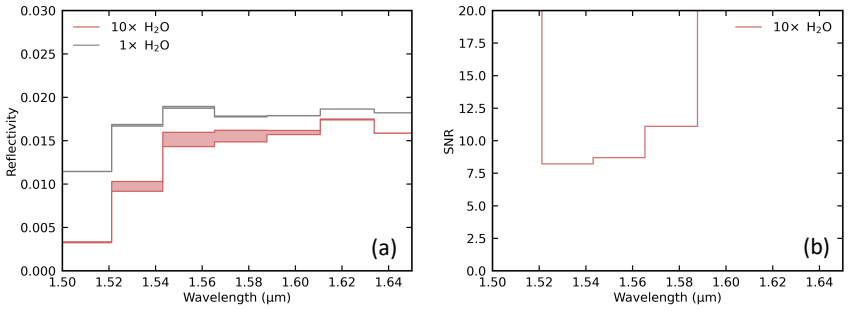
The central claim is that DD fusion on a planetary scale depletes the deuterium-to-hydrogen ratio of an ocean and that the depleted ratio can be distinguished from every known natural astronomical source. The paper's calculation uses the net fusion reaction $3\mathrm{D}\to{}^4\mathrm{He}+p+n$, which releases $3.53\times 10^{11}$ J per gram of deuterium, and assumes 33% energy-conversion efficiency; with an Earth-mass ocean and 1000 TW of continuous power, the D/H would fall from the SMOW value to the local ISM threshold in roughly 170 million years. The same arithmetic scales linearly: a 4%-Earth ocean reaches the threshold in about 7 million years, and higher power or lower initial D/H shortens the wait. The detection side rests on the fact that removing deuterium from water vapor removes the HDO isotopologue's absorption features while leaving $\mathrm{H_2O}$ largely unchanged; the 3.7 $\mu$m O-D stretch is the cleanest sign, with weaker discriminators near 1.5 $\mu$m in reflected light and near 7.5 $\mu$m in thermal emission. The paper also notes that a D/H ratio merely below other rocky planets' values, even if still above the ISM, could be anomalous once comparative data exist.
Load-bearing premise
The scenario assumes that rocky exoplanets begin with water deuterium-enriched well above the interstellar-medium ratio, as Earth's ocean is; if many rocky planets instead acquire water with near-ISM or lower D/H, a sub-ISM reading would not be uniquely attributable to fusion technology.
Editorial extensions
If this is right
- A D/H measurement below about $16 \times 10^{-6}$ in exoplanet water would, under the paper's assumptions, be a strong candidate technosignature.
- Because the depletion persists after the civilization is gone, searches would not need to catch a civilization in action; a survey of many rocky planets accumulates sensitivity to past as well as present technology.
- A null result would give quantitative constraints: a lack of sub-ISM D/H across many planets rules out the combination of high power use and long technological lifetimes.
- The proposed 3.7 $\mu$m O-D stretch feature is the most promising near-term target, potentially within reach of existing transit-spectroscopy capabilities for nearby M-dwarf planets.
Reading between the lines
- Beyond the paper: because the depletion signal is cumulative, a population survey of D/H across rocky exoplanets would act as a fossil record of regional industrial history, not just a snapshot of active broadcasts; the authors gesture at this but do not develop the survey statistics.
- A concrete follow-up the paper leaves open is modeling how Rayleigh distillation at cold poles and mantle degassing of undepleted water would dilute or mimic the fusion signal; computing disk-averaged versus pole-on viewing geometries would sharpen the claimed detectability.
- If sub-ISM D/H is ever found, the most direct confirmation would be a correlated absence of HDO in the same atmosphere under different phase angles, combined with stellar and cometary D/H that are normal; that conjunction is hard to produce naturally.
Editorial analysis
A structured set of objections, weighed in public.
Referee Report
Summary. The paper proposes that long-lived technological civilizations relying on deuterium-deuterium (DD) fusion would deplete deuterium in planetary water reservoirs, eventually driving the D/H ratio below the local interstellar medium value of ~16 ppm, and that this sub-ISM D/H anomaly would constitute a durable technosignature. The authors compute depletion timescales under assumed power use (1000 TW, 33% efficiency) for Earth-like ocean masses and initial D/H, and use the SMART radiative transfer model to identify candidate HDO absorption features for JWST (~3.7 μm), HWO (~1.5 μm), and LIFE (~3.7 μm and ~7.5 μm). The paper argues that unlike radio signals or short-lived pollutant technosignatures, the D/H anomaly would persist for eons even after the civilization ceases.
Significance. If the central claim holds, this is a genuinely novel and important technosignature concept: it is durable, requires no active transmitter, and can in principle be tested with near-future observatories. A key strength is that the energy-budget calculation is a transparent forward model built from measured constants (CODATA masses, SMOW D/H, local ISM D/H) and explicitly stated scenario assumptions; there is no fitting to the target result, and the spectral features are generated by an independent radiative transfer code. The paper also clearly identifies where further modeling (clouds, 3D circulation, instrument noise) is needed. The main weaknesses are the unquantified premise about the initial D/H of rocky exoplanet water and the mismatch between the spectral models (which remove all HDO) and the proposed detection threshold (90% depletion), both of which are load-bearing for the paper's central detectability and uniqueness claims.
major comments (3)
- [Section 1, Figure 2] The central claim that sub-ISM D/H in planetary water is a fusion technosignature depends on the premise that rocky exoplanet water initially has an Earth-like D/H ratio of ~156 ppm, i.e., an order of magnitude above the ISM value. The paper argues this from pre-stellar ice deuteration, but this is an unquantified extrapolation: if a significant fraction of rocky planets acquire water with near-protosolar D/H (~20 ppm) via nebular gas accretion or D-poor planetesimals, then reaching the 16 ppm threshold requires only ~20% deuterium removal, which could plausibly be produced by atmospheric escape or Rayleigh condensation without any fusion. The paper treats low initial D/H only as shortening the fusion timescale (end of Section 1) and not as a background that could mimic the signal, so the uniqueness of the technosignature is not established.
- [Section 3.2, Figure 4] The radiative transfer detectability analysis removes all deuterium-containing water vapor from the atmospheric models ('depleted cases have all deuterium-containing water vapor removed'), while the proposed anomaly threshold is a 90% depletion to sub-ISM D/H (i.e., D/H reduced to ~10% of the SMOW value). Consequently, the predicted transit depth reduction of 4–5 km and the quoted JWST integration times of ~43–100 hours are for a signal that is roughly ten times larger than what would be observed at the threshold, making the detectability claims optimistic. A model with 90% HDO removal should be used to assess whether the 3.7 μm feature is actually detectable in a realistic scenario.
- [Section 4] In the Discussion, the paper correctly notes that Rayleigh distillation in cool polar regions can deplete D/H in atmospheric water vapor, but it only evaluates this against an Earth-like initial D/H. Since the sub-ISM threshold is only ~16 ppm, any natural process that drives vapor D/H below the initial water value, such as condensation or atmospheric escape, could produce a sub-ISM vapor signal on worlds with near-protosolar initial D/H. The paper should either model these natural fractionation pathways quantitatively or explicitly restrict the technosignature claim to planets whose initial D/H is confirmed to be Earth-like.
minor comments (6)
- [Section 1] There are several typos: 'renewed interested' should be 'renewed interest'; 'new few decades' should be 'next few decades'; 'a only small proportion' should be 'only a small proportion'.
- [Section 2.2 and Figure 5] The text specifies an HWO resolving power of 40–70, but Figure 5 and its caption state a resolving power of 70; please make the nominal resolution consistent.
- [Section 5] In the Conclusions, 'JSWT' should be 'JWST'.
- [References] The spelling of 'Mollière' is inconsistent, appearing as 'Molliere' in Section 3.2 and 'Mollière' in the reference list.
- [Section 3.2] The integration-time estimate of 43 hours does not specify the assumed host star magnitude, planet radius, or system distance; please provide these assumptions for reproducibility.
- [Figure 2 caption] The caption lists 'Bocklee-Morvan et al. (2015)' while the reference list uses 'Bockelée-Morvan'; please correct the spelling.
Circularity Check
No significant circularity: the D/H depletion timescale is a forward calculation from stated assumptions and measured constants, and the spectral detectability modeling is independent.
full rationale
The derivation chain is self-contained and non-circular. The central timescale calculation begins from measured external constants (SMOW D/H = 155.76 ppm, CODATA-2018 masses, local ISM D/H = 15.6e-6) and stated scenario assumptions (1000 TW, 33% efficiency, Earth-like ocean mass), then computes the energy per gram of deuterium and the time to deplete ~90% of oceanic deuterium to reach the ISM threshold. No parameter is fitted to the target result, and the resulting ~167 Myr figure is a direct arithmetic consequence. The so-called 'prediction' of anomalously low D/H is not equivalent to an input by construction, because the ISM threshold is an externally measured baseline and the depletion is independently calculated. The paper's assumption that rocky exoplanet water begins with Earth-like D/H is an extrapolation from pre-stellar ice chemistry, not a definitional identification of the conclusion with the premise; the paper explicitly acknowledges that lower initial D/H would shorten the timescale. The spectral detectability analysis uses the SMART radiative transfer model, cited to Meadows & Crisp (1996) and Robinson (2017); although Robinson is a co-author, SMART is an established, independently documented radiative-transfer code, and the HDO/H2O spectral features are physical molecular absorption features, not an output that has been tuned to match the fusion-depletion claim. Other self-citations (Catling et al. 2018; Krissansen-Totton & Catling 2017; Zahnle et al. 2019) are contextual references for biogenic gas searches, climate sensitivity, and solar-system D/H evolution, and none is load-bearing for the central fusion-depletion argument. The paper also candidly notes limitations such as cloudy atmospheres, three-dimensional circulation, and Rayleigh condensation lowering atmospheric D/H; these are acknowledged uncertainties about a real physical background, not circular steps. The central claim therefore has independent content and is not forced by self-citation or by definition.
Assumptions & free parameters
free parameters (6)
- ET civilization power use =
1000 TW (fiducial)
- Fusion power conversion efficiency =
33%
- Initial ocean D/H ratio =
155.76 ppm (SMOW)
- Ocean mass =
1 Earth ocean = 1.426e21 kg; also 0.05, 0.5, 1.5 Mocean
- HDO removal fraction in spectral models =
100% (all HDO removed)
- Atmospheric water vapor abundance enhancement =
1x and 10x Earth
assumptions (6)
- standard math The net DD fusion reaction (D + D + D -> 4He + p + n) and CODATA masses give the stated energy per gram of deuterium.
- domain assumption A long-lived technological civilization will adopt and maintain DD fusion at ~1000 TW for geological timescales, and will not be limited by waste heat or switch to other energy sources.
- domain assumption Deuterium is a closed reservoir in the ocean: no significant replenishment from comets, mantle degassing, or other sources over the depletion timescale.
- domain assumption Initial water on rocky exoplanets has D/H substantially above the local ISM, inherited from D-enriched pre-stellar ices.
- domain assumption Atmospheric water vapor D/H reflects the ocean value to within known condensation fractionation (~10-15%), so ocean depletion appears in atmospheric spectra.
- standard math The SMART radiative transfer model and adopted line lists give accurate HDO/H2O spectra for cloud-free atmospheres.
Cite this review
Pith. "Pith review of Potential technosignature from anomalously low deuterium/hydrogen (D/H) in planetary water depleted by nuclear fusion technology." pith.science (2026). https://pith.science/paper/3WWFFB6Q
@misc{pith2026241118595,
  author       = {Pith},
  title        = {Pith review of: Potential technosignature from anomalously low deuterium/hydrogen (D/H) in planetary water depleted by nuclear fusion technology},
  year         = {2026},
  howpublished = {\url{https://pith.science/paper/3WWFFB6Q}},
  note         = {Machine review of arXiv:2411.18595}
}
abstract
Deuterium-deuterium (DD) fusion is viewed as an ideal energy source for humanity in the far future, given a vast seawater supply of D. Here, we consider long-lived, extraterrestrial, technological societies that develop DD fusion. If such a society persists over geologic timescales, oceanic deuterium would diminish. For an ocean mass and initial D/H that are Earth-like, fusion power use of only $\sim$10 times that projected for humankind next century would deplete the deuterium-hydrogen ratio (D/H) in $\sim$(a few)$\times 10^8$ years to values below that of the local Interstellar Medium (ISM). Ocean masses of a few percent Earth's would reach anomalously low D/H in $\sim10^6$ to $10^7$ years. The timescale shortens with greater energy consumption, smaller oceans, or lower initial D/H. Here, we suggest that anomalous D/H in planetary water below local ISM values of $\sim16\times 10^{-6}$ (set by Big Bang nucleosynthesis plus deuterium loss onto dust or small admixtures of deuterium-poor stellar material) may be a technosignature. Unlike SETI from radio signals, anomalous D/H would persist for eons, even if civilizations perish or relocate. We discuss wavelengths of strong absorption features for detecting D/H anomalies in atmospheric water vapor. These are vibrational O-D stretching at 3.7 $\mu$m in transmission spectroscopy of Earth-like worlds, $\sim1.5$ $\mu$m (in the wings of the 1.4 $\mu$m water band) in the shorter near-infrared for direct imaging by Habitable Worlds Observatory, and 3.7 $\mu$m or $\sim7.5$ $\mu$m (in the wings of the broad 6.3 $\mu$m bending vibration of water) for concepts like the Large Interferometer for Exoplanets (LIFE).
Figures

Reference graph
Works this paper leans on
-
[1]
INTRODUCTION The current telescopic search for life elsewhere focuses mainly on spectroscopic identification of potentially biogenic gases (e.g., CH4 and O2) emitted by microbes or plant-like organisms in extraterrestrial biospheres (Catling et al. 2018; Schwieterman et al. 2018), but technosignatures – detectable evidence of technology that modifies its ...
work page 2022
-
[2]
because pre-stellar chemistry makes D-enriched water. In general, ices, such as those in comets or moons accreted from comet-like material (e.g., Enceladus), concentrate deuterium in both organic and water molecules because low-temperature reactions in pre-stellar clouds at temperatures of ~10 to ~100 K favor isotopic exchange reactions such as H2O + HD =...
work page 1981
-
[3]
The annual average power use of humankind in Terawatts (left vertical axis) and the corresponding fraction of global, ice-free land area (right vertical axis) that would need to be covered by solar panels to provide all the power. We note that current human-modified land (infrastructure, crops, and managed land) leaves less than half of land in another st...
work page 2012
-
[4]
(c) The additional power use for a population of ~10.4 billion assuming 2021 US per capita levels of power, which is the projected peak global population towards the end of the 21st century. The population projection is from the United Nations, Department of Economic and Social Affairs, Population Division: World Population Prospects 2022, Online Edition,...
work page 2021
-
[5]
CONCLUSIONS In this paper, we have presented a new idea that very long-lived, advanced extraterrestrial (ET) civilizations using continuous deuterium-deuterium (DD) nuclear fusion could lower the D/H ratio in an ocean to less than the ratio found in natural astronomical sources. Big Bang nucleosynthesis set an initial D/H ratio of 24-27 ppm but the averag...
arXiv 1997
-
[10]
The deuterium/hydrogen (D/H) ratio in astronomical objects and on Earth. A technosignature in exoplanetary water of prolonged deuterium-deuterium nuclear fusion would plot below natural astronomical D/H values in the green shaded zone and be anomalous. Data sources: Bocklee-Morvan et al. (2015) and references therein for comets; Donahue et al. (1997) for ...
work page 2015
-
[11]
METHODS 2.1 Nuclear Fusion Assumptions To calculate the depletion of deuterium in long-term nuclear fusion of an extraterrestrial civilization requires knowing an initial concentration of deuterium in an ocean and the energy release per gram of deuterium. For a practical reference calculation, we assume an initial D/H ratio of Earth’s ocean. We then assum...
work page 1970
-
[14]
Spectra emphasize the O-D stretching vibration of HDO near 3.7 µm
This figure demonstrates the possibility of using transit spectroscopy to detect the effect of deuterium depletion in water vapor for an Earth-twin and a world with 10 times enhanced atmospheric water vapor, which could be the case for a warm Earth-like world near the habitable zone inner edge. Spectra emphasize the O-D stretching vibration of HDO near 3....
work page 2022
Show all 16 references
-
[15]
and future telescopes (Figures 5 and 6). In future measurements of D/H, it may be important to consider possible climatic influences on the D/H in atmospheric water vapor, specifically the preferential rainout of relatively isotopically heavy ice, rain or snow that might lower...
2015
-
[1983]
Lithium could be extracted from seawater by electrolysis (Yang et al
of which 6Li is 7.42% (James & Palmer 2000), i.e., a mass of (0.17´10-6) ´0.0742´ (1.426´1021 kg/ocean) ~ 1.8´1012 kg 6Li or ~18,000 million tonnes. Lithium could be extracted from seawater by electrolysis (Yang et al
2000
-
[1988]
and orbit (Vandaele et al. 2019). Molliere and Snellen (2019) calculate that 1 night of Extremely Large Telescope observing time with 𝜆/Δ𝜆 ∼ 100,000 at ~3.7 µm would be sufficient to measure HDO on Proxima Cen b if it has an Earth-like atmosphere with Earth-like D/H ratio in i...
2019
-
[2011]
would rapidly produce an anomalous D/H ratio, e.g., after only ~7 Myr for 4% of Earth’s ocean mass. Even modest energy consumption (such as the that predicted for humankind with a population predicted for ~2100 and 2021 American per capita power use) would produce an anomalous...
2021
-
[2016]
but would cause intolerable disruption to ecosystems from the huge land use. The size can be seen from scaling up an order of magnitude the land use in Figure 1, noting that over half of the land free of ice sheets is unavailable because of human-occupation or management. Nucl...
2011
-
[2018]
Each DT fusion reaction releases 2.8´10-12 J
followed by 6Li-enrichment. Each DT fusion reaction releases 2.8´10-12 J. Because each atom of 6Li generates one tritium atom, the amount of energy per gram of 6Li is (2.8´10−12 J ´ NA)/( 6.015125 g/mol 6Li) = 2.8 ´1011 J, where NA is Avogadro’s number, 6.022´1023. For an uppe...
2005
-
[2021]
human power equivalents
or chlorofluorocarbons (CFCs) (Haqq-Misra et al. 2022; Seager et al. 2023), but as trace gases they are generally undetectable with present or near-term technology. Also, such gases from immature civilizations would probably be extremely short-lived compared to the signal that...
2010
-
[2024]
are possible. But on rocky worlds, initial D/H in water may generally be about an order of magnitude higher than gas giant hydrogen and perhaps Earth-like because of inheritance from pre-stellar icy material. Of course, some rocky planets may have even more elevated D/H in the...
2017
Reviewed August 12, 2026 · model on record in the stance chip above.
Discussion (0). Continue with ORCID to comment.