REVIEW 2 major objections 4 minor 75 references
Analytic solution to degenerate biphoton states generated in arrays of nonlinear waveguides
T0 review · 2 major / 4 minor · reviewed 2026-08-12 · deepseek-v4-flash
Pith's one-line read The complete spatial biphoton state of any nonlinear waveguide array is an explicit analytic function of the coupling matrix's eigenvalues and eigenvectors, turning a numerical propagation problem into a closed form.
desk verdict The central biphoton formula is a real, sound step forward, but the printed correlation-matrix normalization in Eq. (35) is wrong as written and the inverse-problem numbers need to be rechecked against the code. read the letter →
The pith
A machine-rendered reading of the paper's core claim, the machinery that carries it, and where it could break.
The reading
What carries the argument
The load-bearing object is the supermode decomposition of the array: the orthogonal matrix $S$ whose rows are the normalized eigenvectors of the real symmetric tridiagonal coupling matrix $\Omega$ that describes nearest-neighbor evanescent coupling. Its eigenvalues $\lambda_n$ set the phase-matching scale through the factor $\tilde{T}_{nm}(z)=\mathrm{sinc}[(\lambda_n+\lambda_m)z/2]$ (times a phase), so supermode pairs with $\lambda_n+\lambda_m\approx 0$ dominate at long propagation. The formula $K(z)=D\odot\big(S^{T}[\delta\tilde{P}\odot\tilde{T}]S\big)$ does the work: it separates the physics into pump shaping ($\tilde{P}$), phase matching ($\tilde{T}$), degeneracy ($D$), and the change of basis ($S$), which is what makes both direct evaluation and inverse optimization scalable, since the only nontrivial step is diagonalizing the $N\times N$ tridiagonal matrix $\Omega$.
What would settle it
Numerically integrate the full momentum-operator equations (without the first-order truncation) for a small array, say $N=6$, with an asymmetric coupling profile and a weak pump, and compare the exact two-photon amplitudes with the formula's $K(z)$: they must agree to first order in the pump amplitude, and any discrepancy should grow as the square of the pump strength. Experimentally, the normalized two-photon coincidence distribution measured at the output of a waveguide array with a known non-homogeneous coupling profile should match the closed-form prediction for that profile.
Extended reading notes
Core claim
The paper's central claim is that in the degenerate, phase-matched, undepleted-pump regime the output state from vacuum is $|\Psi(z)\rangle = \frac{1}{\sqrt{\mathcal{N}}}\big[1 + \sum_{k,q} K_{kq}(z)\,\hat{a}^{\dagger}_k \hat{a}^{\dagger}_q\big]|0\rangle$, with the individual-mode joint spatial amplitude matrix given by $K(z) = D \odot \big(S^{T} \big[\delta(z)\,\tilde{P} \odot \tilde{T}(z)\big] S\big)$. Here $S$ is the orthogonal matrix of eigenvectors of the linear coupling matrix $\Omega$ (the supermode basis), $\delta(z)=i z g\|\boldsymbol{\alpha}\|$ is the pump-strength factor, $\tilde{P}_{nm}=\sum_j |\eta_j|e^{i\phi_j} S_{nj}S_{mj}$ encodes the injection profile in the supermode basis, $\tilde{T}_{nm}(z)=e^{i(\lambda_n+\lambda_m)z/2}\mathrm{sinc}\big[(\lambda_n+\lambda_m)z/2\big]$ is the phase-matching term, and $D_{nm}=2^{1-\delta_{nm}/2}$ accounts for photon degeneracy. The authors derive this by transforming the momentum operator to the supermode basis, integrating the interaction-picture nonlinear term to first order in the pump amplitude, and transforming back to individual waveguides. In the supermode basis the corresponding amplitude matrix is simply $\tilde{K}(z)=\delta(z) D \odot \tilde{P} \odot \tilde{T}(z)$, so the solution is a factorization of pump shaping, phase matching, degeneracy, and basis change.
Load-bearing premise
The solution holds only in the low-injection regime: the pump must be weak enough that the output state can be truncated to first order in the pump amplitude, keeping just the vacuum and two-photon components; if the pump is strong or the array long enough for four-photon or higher terms to matter, the closed-form amplitude matrix no longer describes the actual state.
Editorial extensions
If this is right
- For homogeneous, parabolic, and square-root (Glauber-Fock) coupling profiles, the eigenvectors and eigenvalues of the coupling matrix have known closed forms, so the biphoton state can be computed without any numerical diagonalization.
- With a symmetric odd/even injection profile, the supermode amplitude matrix reduces to diagonal plus anti-diagonal pieces, so bunching or antibunching in the supermode basis can be selected purely by the relative phase of the pump fields.
- In an odd symmetric array pumped at its center waveguide, only odd supermodes are excited; because symmetric supermode pairs obey $\lambda_n+\lambda_{N+1-n}=0$, the long-propagation state is dominated by those pairs and, in the bunching case, approaches two photons in the zero supermode.
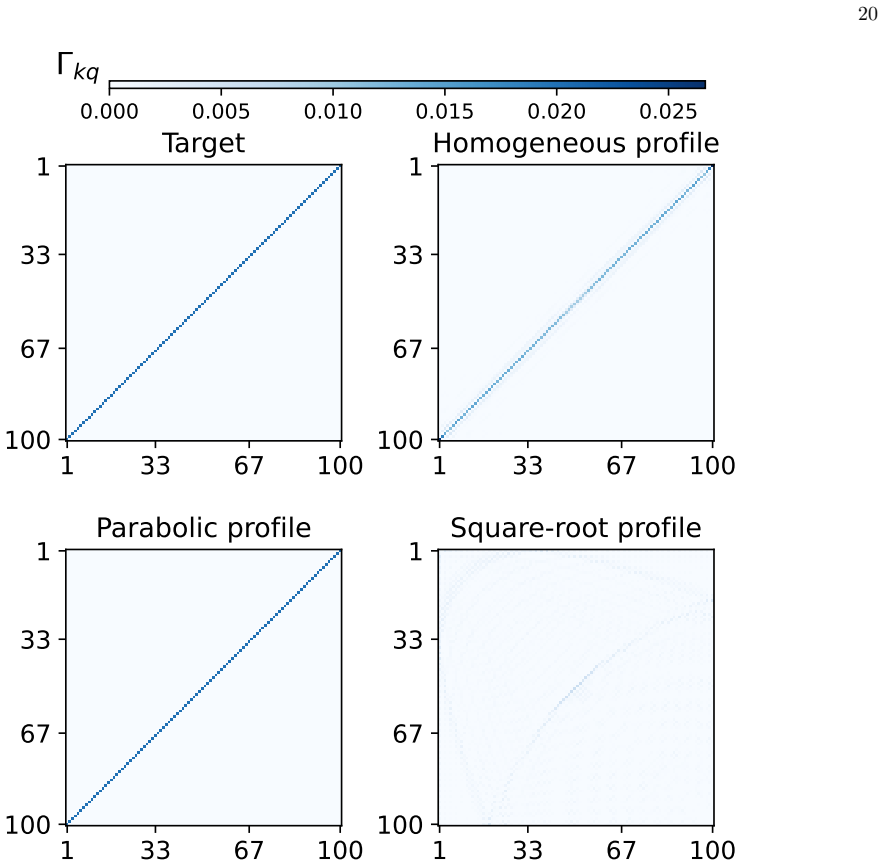
- The analytic form turns the inverse problem into an optimization: for a 50-waveguide array with parabolic coupling, a target antidiagonal correlation matrix is matched with similarity $S=0.9998$ (and $S=0.99991$ for $N=100$), whereas a homogeneous profile reaches only about $0.63$.
- Because only the eigen-decomposition of the coupling matrix is needed, computing the output state for $N=1000$ waveguides takes a few minutes on standard hardware, making large-scale direct and inverse calculations practical.
Reading between the lines
- The factorization suggests a route to exact reachability conditions: since the pump enters only through the supermode matrix $\tilde{P}$, one could characterize which correlation matrices $\Gamma$ are exactly generatable, a problem the authors leave open.
- Because the phase-matching factor depends only on the sum $\lambda_n+\lambda_m$, every symmetric array should develop the same anti-diagonal dominance at long propagation, so the asymptotic structure seen in the examples is likely universal for symmetric coupling profiles.
- The same supermode-plus-Hadamard-product structure could carry over to non-degenerate biphoton states or to spectral and temporal degrees of freedom by substituting the relevant Hamiltonian for the spatial coupling matrix, making the approach a template for analytic biphoton engineering beyond spatial arrays.
- A testable scaling conjecture: the nearly optimal solution found for the parabolic profile (two central waveguides, equal amplitude and phase, at $C_0 z \approx 9.4$ for $N=50$) may remain near-optimal for other array sizes, which a systematic scan could confirm.
Editorial analysis
A structured set of objections, weighed in public.
Referee Report
Summary. This paper presents an analytic solution for the evolution of degenerate biphoton states generated by spontaneous parametric down-conversion in a one-dimensional array of nonlinear waveguides. The solution expresses the joint spatial amplitude matrix in terms of the eigenvalues and eigenvectors of the linear coupling matrix, via a first-order interaction-picture calculation. The authors apply the solution to symmetric injection profiles, two- and three-waveguide arrays, and an inverse problem in which the pump profile is optimized to approximate a target correlation matrix. The paper also reports scalability benchmarks for large arrays.
Significance. The central formula (Eqs. (13)-(20)) is a useful, parameter-free result that reduces the computation of the biphoton amplitude to an eigen-decomposition plus matrix multiplications. The derivation is transparent and the N=2 and N=3 limiting cases agree with Belsley et al. [39]. The paper includes a public code repository, and the inverse-problem examples illustrate a promising approach to state engineering if the correlation-matrix normalization is corrected. The advertised scalability for arrays with up to 1000 waveguides is supported by the benchmarks.
major comments (2)
- [VI, Eq. (35)] The correlation matrix normalization in Eq. (35) is unphysical as printed. The denominator sum_{i,j} (2δ_ij - 1)|K_ij|^2 equals sum_i |K_ii|^2 - sum_{i≠j} |K_ij|^2, which can be negative when off-diagonal amplitudes dominate, as in the antidiagonal target states studied in this section. A negative denominator makes Γ not a probability matrix and renders the similarity values and merit function undefined from the printed formula. The correct conditional pair-probability denominator is P = sum_i |K_ii|^2 + sum_{k<q} |K_kq|^2 = (1/2) sum_{a,b} |K_ab|^2. Since the inverse problem is a central advertised application, this equation and the reported results that rely on it must be corrected and re-verified.
- [V.A.2, Eq. (30)] Equation (30) does not follow from the general solution. For the N=2 homogeneous case, the general formula (13)-(20) gives the |2_q> coefficient proportional to i z g||α|| √2 [ F_A sum_n S_nq^2 T̃_nn + F_B (-1)^{q+1} ] and the off-diagonal coefficient i z g||α|| 2 F_A sum_n S_nk S_nq T̃_nn; Eq. (30) as printed omits the z factor on the F_A terms and also omits the overall pump strength g||α||. As a result, Eq. (30) does not reproduce Eq. (33) without additional unstated rescaling. Since Eq. (30) is used to derive the individual-mode bunching conditions, the expression should be corrected or the derivation explicitly shown.
minor comments (4)
- [Throughout] The symbol N is used both for the number of waveguides and for the state normalization constant (e.g., Eqs. (12), (17), (29)); this is confusing and should be disambiguated.
- [V.A, Eqs. (29)-(30)] Equations (29) and (30) omit the overall factor g||α|| that appears in the general solution; if the authors are setting this factor to unity in the examples, they should state this explicitly.
- [VI] There is a typo, 'develope', and in Section II 'undistinguishable' should be 'indistinguishable'; these should be fixed in the final version.
- [Appendix C] The scalability benchmarks in Fig. 5 and Fig. 6 include the time for numerical diagonalization of the coupling matrix, even for homogeneous and parabolic profiles where analytic eigen-decompositions are known; the text should clarify that the reported times are for the numerical route, and that using analytic expressions could reduce the times further.
Circularity Check
No circularity: the analytic biphoton solution is derived from the stated Hamiltonian and is independently checked; no prediction reduces to a fitted input.
full rationale
The central result K(z)=D⊙(S^T[δ(z)P̃⊙T̃(z)]S) is obtained in Sec. III and Appendix A by a first-order Dyson/space-ordering expansion of the momentum operator (Eqs. A1-A14) starting from the Hamiltonian Eq. (1)/(5). The only inputs are the coupling matrix eigenvalues/eigenvectors and the pump vector; no parameter is fitted to the output it is used to predict. The consistency checks for N=2 and N=3 against Belsley et al. [39] are external comparisons, not load-bearing self-citations. The inverse problem in Sec. VI optimizes pump parameters to minimize a merit function built from the same forward solution; this is genuine inverse design, not a prediction forced by construction. The first-order-in-pump truncation in Eq. (A8) is explicitly acknowledged as a low-injection assumption and limits the regime but does not render the derivation circular. The printed normalization in Eq. (35), with weights (2δij-1), can be unphysical for antidiagonal-dominated K (negative denominator), and this deserves a correctness check; however it is an error or ambiguity in the correlation-matrix definition, not a circularity in the derivation chain. No step was found in which a quantity is defined in terms of the quantity it is claimed to derive, and no fitted input is renamed as a prediction. The solution is self-contained against the stated model.
Assumptions & free parameters
assumptions (6)
- domain assumption Undepleted pump approximation; pump photons are not depleted by SPDC and remain in their initial waveguides (pump field evanescently uncoupled).
- domain assumption Degenerate phase matching Δβ = β(ωp) - 2β(ωs) = 0 and identical waveguides so βj(ω) = β(ω).
- domain assumption First-order (low-injection) truncation of the evolution, keeping only vacuum and biphoton terms.
- standard math Spectral theorem for real symmetric tridiagonal coupling matrix Ω: complete orthonormal eigenbasis with real eigenvalues.
- domain assumption Nearest-neighbor coupling only, with coupling constants constant along propagation.
- domain assumption Space-ordering of the momentum operator is neglected, valid in the low-injection regime.
Cite this review
Pith. "Pith review of Analytic solution to degenerate biphoton states generated in arrays of nonlinear waveguides." pith.science (2026). https://pith.science/paper/XUCLYULA
@misc{pith2026241118740,
  author       = {Pith},
  title        = {Pith review of: Analytic solution to degenerate biphoton states generated in arrays of nonlinear waveguides},
  year         = {2026},
  howpublished = {\url{https://pith.science/paper/XUCLYULA}},
  note         = {Machine review of arXiv:2411.18740}
}
read the original abstract
The arrays of nonlinear waveguides are a powerful integrated photonics platform for studying and manipulating quantum states of light. Also, they are a valuable resource for various quantum technologies. In this work, we employed a supermode approach to obtain an analytic solution to the evolution of degenerate biphoton states in arrays of nonlinear waveguides. The solution accounts for arrays of an arbitrary number of waveguides and coupling profiles. In addition, it provides an explicit analytic expression without the need of computationally-expensive steps. Actually, it only relies on the calculation of the eigenvalues and eigenvectors of the coupling matrix. In general, this needs to be performed numerically, but there are relevant instances in which analytic expressions are available. Thus, in certain cases, the procedure proposed here does not require the use of any numerical method. We analyze the general properties of the solution and show some application examples. Particularly, simple solutions that can be obtained by special symmetric injection profiles, the results for small arrays, and the properties of the propagation when only the center waveguide is pumped in a symmetric odd array. In addition, we present a proof-of-principle example on how to use the analytic solution to tackle inversion problems. That is, obtaining the initial conditions required to achieve a desired quantum state -- which is a valuable technological application. A relevant aspect of the method presented here is its scalability for large arrays due to the lack of resource-intensive steps -- both for the direct and inverse problems.
Figures


Figures from the paper (15 more)




Reference graph
Works this paper leans on
-
[39]
Y. F. Bai, P. Xu, L. L. Lu, M. L. Zhong, and S. N. 28 Zhu, Two-photon anderson localization in a disordered quadratic waveguide array, Journal of Optics18, 055201 (2016)
work page 2016
-
[40]
Y. Yang, P. Xu, L. L. Lu, and S. N. Zhu, Manipulation of a two-photon state in aχ(2)-modulated nonlinear waveg- uide array, Physical Review A90, 043842 (2014)
work page 2014
-
[1]
Simple solution in the supermode basis The result from Eq. (28) can be plugged into Eq. (15) to obtain the following simplified solution in the super- mode basis |Ψ(z)⟩b = 1√ N ( |0⟩b +iz √ 2FA NX n=1 eiλnzsinc(λnz)| . . . ,2n, . . .⟩b +2izFB ⌊N/2⌋X n=1 | . . . ,1n, . . . ,1N +1−n, . . .⟩b ) . (29) The output state given in Eq. (29) presents interest- ing...
-
[2]
Planes Complementarios de I+D+I con las Comunidades Autónomas
Simple solution in the individual-mode basis The output state in the individual-mode basis equiva- lent to the expression given in Eq. (29) can be obtained by transforming the corresponding matrix ˜Q(z) accord- ing to Eq. (18) and applying Eq. (20). This gives the related iJSA matrix, whose entries can be plugged into 7 Eq. (19) to get |Ψ(z)⟩ = 1√ N ( |0⟩...
-
[3]
The data are presented for two propagation distances given byC0z = 1 and C0z = 20
Two consecutive waveguides in the middle of the array injected with the same amplitude and phase (parabolic coupling profile,N = 8) Figure 9 depicts the entries of the relevant matrices for the case of a seven-waveguide ANW with a parabolic coupling profile and injecting only two consecutive waveguides in the center of the array with the same amplitude an...
-
[4]
The data are presented for two propagation distances given byC0z = 1 and C0z = 20
Flat pump (homogeneous coupling profile, N = 7) Figure 7 depicts the entries of the relevant matrices for the case of a homogeneous seven-waveguide ANW with a flat pump injection, in which all waveguides are excited with the same pump amplitude and phase. The data are presented for two propagation distances given byC0z = 1 and C0z = 20. FIG. 7. Absolute v...
-
[5]
The data are presented for two propagation distances given byC0z = 1 and C0z = 20
Flat pump amplitude with alternating π phase (homogeneous coupling profile,N = 7) Figure 8 depicts the entries of the relevant matrices for the case of a homogeneous seven-waveguide ANW with an injection consisting of a flat pump amplitude with alternatingπ phase—in this case, the pump amplitudes are the same for all waveguides while the corresponding pha...
-
[6]
S. Shekhar, W. Bogaerts, L. Chrostowski, J. E. Bowers, M. Hochberg, R. Soref, and B. J. Shastri, Roadmapping the next generation of silicon photonics, Nature Commu- nications 15, 751 (2024)
work page 2024
Show all 75 references
-
[7]
The resulting similarity values for the different coupling profiles are presented in Table I and the corresponding optimized parameters are depicted in Fig
Antidiagonal correlation matrix with equal nonvanishing entries (N = 100) Here, we employed the optimization method with a target consisting of an antidiagonal correlation matrix with equal nonvanishing entries for an array of100 waveguides. The resulting similarity values for...
-
[8]
The resulting similarity values for the different coupling profiles are presented in Table II and the corresponding optimized parameters are depicted in Fig
Diagonal correlation matrix with equal nonvanishing entries (N = 50) Here, we employed the optimization method with a target consisting of an diagonal correlation matrix with equal nonvanishing entries for an array of50 waveguides. The resulting similarity values for the diffe...
-
[9]
The resulting similarity values for the different coupling profiles are presented in Table III and the corresponding optimized parameters are depicted in Fig
Correlation matrix with only odd individual modes and equal nonvanishing entries (N = 25) Here, we employed the optimization method with a target consisting of a correlation matrix with only odd individual modes and equal nonvanishing entries for an array of25 waveguides. The ...
-
[10]
The resulting similarity values for the different coupling profiles are presented in Table IV and the corresponding optimized parameters are depicted in Fig
Supermode correlation matrix with only odd supermodes and equal nonvanishing entries (N = 25) Here, we employed the optimization method with a target consisting of a supermode correlation matrix with only odd supermodes and equal nonvanishing entries for an array of25 waveguid...
-
[11]
Taballione, M
C. Taballione, M. C. Anguita, M. de Goede, P. Vender- bosch, B. Kassenberg, H. Snijders, N. Kannan, W. L. Vleeshouwers, D. Smith, J. P. Epping, R. van der Meer, P. W. H. Pinkse, H. van den Vlekkert, and J. J. Ren- ema, 20-Mode Universal Quantum Photonic Processor, Quantum 7, 1...
2023
-
[12]
J. Wang, F. Sciarrino, A. Laing, and M. G. Thompson, Integrated photonic quantum technologies, Nature Pho- tonics 14, 273 (2019)
2019
-
[13]
Pelucchi, G
E. Pelucchi, G. Fagas, I. Aharonovich, D. Englund, E. Figueroa, Q. Gong, H. Hannes, J. Liu, C.-Y. Lu, N. Matsuda, J.-W. Pan, F. Schreck, F. Sciarrino, C. Sil- berhorn, J. Wang, and K. D. Jöns, The potential and global outlook of integrated photonics for quantum tech- nologies,...
2021
-
[14]
R. K. Ramakrishnan, A. B. Ravichandran, A. Mishra, A. Kaushalram, G. Hegde, S. Talabattula, and P. P. Ro- hde, Integrated photonic platforms for quantum technol- ogy: a review, ISSS Journal of Micro and Smart Systems 12, 83 (2023)
2023
-
[15]
F.Baboux, G.Moody,andS.Ducci,Nonlinearintegrated quantum photonics with AlGaAs, Optica10, 917 (2023)
2023
-
[16]
Zhang, M
C. Zhang, M. A. Tran, Z. Zhang, A. E. Dorche, Y. Shen, B. Shen, K. Asawa, G. Kim, N. Kim, F. Levinson, J. E. Bowers, and T. Komljenovic, Integrated photonics beyond communications, Applied Physics Letters 123, 230501 (2023)
2023
-
[17]
In addition, the target and the obtained correlation matrices after the optimization are shown in Fig. 18. This is actually an optimization problem in the supermode basis. In fact, the target is given in terms of the supermode correlation matrix ˜Γ, which is analogous to the i...
-
[18]
Labonté, O
L. Labonté, O. Alibart, V. D’Auria, F. Doutre, J. Etesse, G. Sauder, A. Martin, É. Picholle, and S. Tanzilli, In- tegrated photonics for quantum communications and metrology, PRX Quantum5, 010101 (2024)
2024
-
[19]
A. Dutt, A. Mohanty, A. L. Gaeta, and M. Lipson, Non- linear and quantum photonics using integrated optical materials, Nature Reviews Materials9, 321 (2024)
2024
-
[20]
M. Reck, A. Zeilinger, H. J. Bernstein, and P. Bertani, Experimental realization of any discrete unitary opera- tor, Physical Review Letters73, 58 (1994)
1994
-
[21]
W. R. Clements, P. C. Humphreys, B. J. Metcalf, W. S. Kolthammer, and I. A. Walsmley, Optimal design for uni- versal multiport interferometers, Optica3, 1460 (2016)
2016
-
[22]
Rai and D
A. Rai and D. G. Angelakis, Dynamics of nonclassical light in integrated nonlinear waveguide arrays and gener- ation of robust continuous-variable entanglement, Phys- ical Review A85, 052330 (2012)
2012
-
[23]
Carolan, C
J. Carolan, C. Harrold, C. Sparrow, E. Martín-López, N. J. Russell, J. W. Silverstone, P. J. Shadbolt, N. Mat- suda, M. Oguma, M. Itoh, G. D. Marshall, M. G. Thomp- son, J. C. F. Matthews, T. Hashimoto, J. L. O’Brien, and A. Laing, Universal linear optics, Science349, 711 (2015)
2015
-
[24]
have been investigated in connection with ANW. Re- garding biphoton states in ANW, these have been stud- ied in relation to different topics—for example, quan- tum walks [16, 25], topological photonics [26, 27], Ander- son localization [28], engineering of spatio-spectral cor-...
2025 arXiv
-
[25]
Maring, A
N. Maring, A. Fyrillas, M. Pont, E. Ivanov, P. Stepanov, N. Margaria, W. Hease, A. Pishchagin, A. Lemaître, I. Sagnes, T. H. Au, S. Boissier, E. Bertasi, A. Baert, M. Valdivia, M. Billard, O. Acar, A. Brieussel, R. Mezher, S. C. Wein, A. Salavrakos, P. Sinnott, D. A. Fioretto,...
2024
-
[26]
Peruzzo, M
A. Peruzzo, M. Lobino, J. C. F. Matthews, N. Matsuda, A. Politi, K. Poulios, X.-Q. Zhou, Y. Lahini, N. Ismail, K. Wörhoff, Y. Bromberg, Y. Silberberg, M. G. Thomp- son, and J. L. OBrien, Quantum walks of correlated pho- tons, Science329, 1500 (2010)
2010
-
[27]
Weimann, A
S. Weimann, A. Perez-Leija, M. Lebugle, R. Keil, M. Tichy, M. Gräfe, R. Heilmann, S. Nolte, H. Moya- Cessa, G. Weihs, D. N. Christodoulides, and A. Sza- meit, Implementation of quantum and classical discrete fractional fourier transforms, Nature Communications7, 11027 (2016)
2016
-
[28]
A. S. Solntsev, F. Setzpfandt, A. S. Clark, C. W. Wu, M. J. Collins, C. Xiong, A. Schreiber, F. Katzschmann, F. Eilenberger, R. Schiek, W. Sohler, A. Mitchell, C. Sil- berhorn, B. J. Eggleton, T. Pertsch, A. A. Sukhorukov, D. N. Neshev, and Y. S. Kivshar, Generation of nonclas...
2014
-
[29]
D.N.Christodoulides, F.Lederer,andY.Silberberg,Dis- cretizing light behaviour in linear and nonlinear waveg- uide lattices, Nature424, 817 (2003)
2003
-
[30]
Barral, M
D. Barral, M. Walschaers, K. Bencheikh, V. Parigi, J. A. Levenson, N. Treps, and N. Belabas, Versatile photonic entanglement synthesizer in the spatial domain, Physical Review Applied14, 044025 (2020)
2020
-
[31]
Kruse, F
R. Kruse, F. Katzschmann, A. Christ, A. Schreiber, S. Wilhelm, K. Laiho, A. Gábris, C. S. Hamilton, I. Jex, andC.Silberhorn,Spatio-spectralcharacteristicsofpara- metric down-conversion in waveguide arrays, New Jour- nal of Physics15, 083046 (2013)
2013
-
[32]
Raymond, A
A. Raymond, A. Zecchetto, J. Palomo, M. Morassi, A. Lemaître, F. Raineri, M. Amanti, S. Ducci, and F. Baboux, Tunable generation of spatial entanglement in nonlinear waveguide arrays, Physical Review Letters 133, 233602 (2024)
2024
-
[33]
Herec, J
J. Herec, J. Fiurášek, and L. Mišta, Entanglement gen- eration in continuously coupled parametric generators, Journal of Optics B: Quantum and Semiclassical Optics 5, 419 (2003)
2003
-
[34]
Barral, M
D. Barral, M. Walschaers, K. Bencheikh, V. Parigi, J. A. Levenson, N. Treps, and N. Belabas, Quantum state en- gineering in arrays of nonlinear waveguides, Physical Re- view A102, 043706 (2020)
2020
-
[35]
M. Y. Bacaoco, M. J. Galettis, J. Huang, D. Ilin, and A. S. Solntsev, Generation of Tunable Three-Photon En- tanglement in Cubic Nonlinear Coupled Waveguides, Ad- vanced Quantum Technologies8, 2400409 (2025)
2025
-
[36]
C. S. Hamilton, R. Kruse, L. Sansoni, C. Silberhorn, and I. Jex, Driven quantum walks, Physical Review Letters 113, 083602 (2014)
2014
-
[37]
Leykam, A
D. Leykam, A. S. Solntsev, A. A. Sukhorukov, and A. S. Desyatnikov, Lattice topology and spontaneous paramet- ric down-conversion in quadratic nonlinear waveguide ar- rays, Physical Review A92, 033815 (2015)
2015
-
[38]
Doyle, W.-W
C. Doyle, W.-W. Zhang, M. Wang, B. A. Bell, S. D. Bartlett, and A. Blanco-Redondo, Biphoton entangle- ment of topologically distinct modes, Physical Review A 105, 023513 (2022)
2022
-
[41]
C. S. Hamilton, R. Christ, S. Barkhofen, S. M. Bar- nett, I. Jex, and C. Silberhorn, Quantum-state creation in nonlinear-waveguide arrays, Physical Review A105, 042622 (2022)
2022
-
[42]
Gisin and R
N. Gisin and R. Thew, Quantum communication, Nature Photonics 1, 165 (2007)
2007
-
[43]
Couteau, S
C. Couteau, S. Barz, T. Durt, T. Gerrits, J. Huwer, R. Prevedel, J. Rarity, A. Shields, and G. Weihs, Ap- plications of single photons to quantum communication and computing, Nature Reviews Physics5, 326 (2023)
2023
-
[44]
W. Luo, L. Cao, Y. Shi, L. Wan, H. Zhang, S. Li, G. Chen, Y. Li, S. Li, Y. Wang, S. Sun, M. F. Karim, H. Cai, L. C. Kwek, and A. Q. Liu, Recent progress in quantumphotonicchipsforquantumcommunicationand internet, Light: Science & Applications12, 175 (2023)
2023
-
[45]
P. Kok, W. J. Munro, K. Nemoto, T. C. Ralph, J. P. Dowling, and G. J. Milburn, Linear optical quantum computing with photonic qubits, Reviews of Modern Physics 79, 135 (2007)
2007
-
[46]
D.-H. Kim, S. Hong, Y.-S. Kim, Y. Kim, S.-W. Lee, R. C. Pooser, K. Oh, S.-Y. Lee, C. Lee, and H.-T. Lim, Dis- tributed quantum sensing of multiple phases with fewer photons, Nature Communications15, 266 (2024)
2024
-
[47]
A. S. Solntsev, A. A. Sukhorukov, D. N. Neshev, and Y. S. Kivshar, Spontaneous parametric down-conversion and quantum walks in arrays of quadratic nonlinear waveguides, Physical Review Letters108, 023601 (2012)
2012
-
[48]
Gräfe, A
M. Gräfe, A. S. Solntsev, R. Keil, A. A. Sukhorukov, M. Heinrich, A. Tünnermann, S. Nolte, A. Szameit, and Y. S. Kivshar, Biphoton generation in quadratic waveg- uide arrays: A classical optical simulation, Scientific Re- ports 2, 562 (2012)
2012
-
[49]
A. S. Solntsev, A. A. Sukhorukov, D. N. Neshev, and Y. S. Kivshar, Photon-pair generation in arrays of cubic nonlinear waveguides, Optics Express20, 27441 (2012)
2012
-
[50]
Belsley, T
A. Belsley, T. Pertsch, and F. Setzpfandt, Generating path entangled states in waveguide systems with second- order nonlinearity, Optics Express28, 28792 (2020)
2020
-
[51]
Y. He, S. Xia, D. Leykam, and Z. Chen, Optimizing biphoton generation via reconfigurable nonlinear waveg- uide arrays based on scattering tensor, Optics Express 32, 32244 (2024)
2024
-
[52]
Meng, Q.-Z
Y.-C. Meng, Q.-Z. Guo, W.-H. Tan, and Z.-M. Huang, Analytical solutions of coupled-mode equations for mul- tiwaveguide systems, obtained by use of Chebyshev and generalized Chebyshev polynomials, Journal of the Opti- cal Society of America A21, 1518 (2004)
2004
-
[53]
Bossé and L
-O. Bossé and L. Vinet, Coherent transport in photonic lattices: A survey of recent analytic results, Symmetry, Integrability and Geometry: Methods and Applications 13, 074 (2017)
2017
-
[54]
Perez-Leija, R
A. Perez-Leija, R. Keil, H. Moya-Cessa, A. Szameit, and D. N. Christodoulides, Perfect transfer of path-entangled photons in Jx photonic lattices, Physical Review A87, 022303 (2013)
2013
-
[55]
Perez-Leija, H
A. Perez-Leija, H. Moya-Cessa, A. Szameit, and D. N. Christodoulides, Glauber–Fock photonic lattices, Optics Letters 35, 2409 (2010)
2010
-
[56]
B. M. Rodríguez-Lara, Exact dynamics of finite Glauber- Fock photonic lattices, Physical Review A 84, 053845 (2011)
2011
-
[57]
W. P. Grice and I. A. Walmsley, Spectral information and distinguishability in type-II down-conversion with a broadband pump, Physical Review A56, 1627 (1997)
1997
-
[58]
J. Noda, M. Fukuma, and O. Mikami, Design calculations for directional couplers fabricated by Ti-diffusedLiNbO3 waveguides, Applied Optics20, 2284 (1981)
1981
-
[59]
Toren and Y
M. Toren and Y. Ben-Aryeh, The problem of propagation in quantum optics, with applications to amplification, coupling of em modes and distributed feedback lasers, Quantum Optics: Journal of the European Optical Soci- ety Part B6, 425 (1994)
1994
-
[60]
D. B. Horoshko, Generator of spatial evolution of the electromagnetic field, Physical Review A 105, 013708 (2022)
2022
-
[61]
Liñares, M
J. Liñares, M. C. Nistal, and D. Barral, Quantization of coupled 1d vector modes in integrated photonic waveg- uides, New Journal of Physics10, 063023 (2008)
2008
-
[62]
Ben-Aryeh and S
Y. Ben-Aryeh and S. Serulnik, The quantum treatment of propagation in non-linear optical media by the use of temporal modes, Physics Letters A155, 473 (1991)
1991
-
[63]
Y. Yang, R. J. Chapman, B. Haylock, F. Lenzini, Y. N. Joglekar, M. Lobino, and A. Peruzzo, Programmable high-dimensional Hamiltonian in a photonic waveguide array, Nature Communications15, 50 (2024)
2024
-
[64]
Onodera, M
T. Onodera, M. M. Stein, B. A. Ash, M. M. So- honi, M. Bosch, R. Yanagimoto, M. Jankowski, T. P. McKenna, T. Wang, G. Shvets, M. R. Shcherbakov, L. G. Wright, and P. L. McMahon, Scaling on-chip photonic neural processors using arbitrarily programmable wave propagation, arXiv:2...
2024
-
[65]
Quesada and J
N. Quesada and J. E. Sipe, Effects of time ordering in quantum nonlinear optics, Physical Review A90, 063840 (2014)
2014
-
[66]
Kapon, J
E. Kapon, J. Katz, and A. Yariv, Supermode analysis of phase-locked arrays of semiconductor lasers: erratum, Optics Letters9, 318 (1984)
1984
-
[67]
N. K. Efremidis and D. N. Christodoulides, Revivals in engineered waveguide arrays, Optics Communications 246, 345 (2005)
2005
-
[68]
Kruse, L
R. Kruse, L. Sansoni, S. Brauner, R. Ricken, C. S. Hamil- ton, I. Jex, and C. Silberhorn, Dual-path source engineer- ing in integrated quantum optics, Physical Review A92, 053841 (2015)
2015
-
[69]
Blanco-Redondo, B
A. Blanco-Redondo, B. Bell, D. Oren, B. J. Eggleton, and M. Segev, Topological protection of biphoton states, Science 362, 568 (2018)
2018
-
[70]
Medina Dueñas, G
J. Medina Dueñas, G. O’Ryan Pérez, C. Hermann- Avigliano, and L. E. F. Foa Torres, Quadrature protec- tion of squeezed states in a one-dimensional photonic topological insulator, Quantum5, 526 (2021)
2021
-
[71]
Ren, Y.-H
R.-J. Ren, Y.-H. Lu, Z.-K. Jiang, J. Gao, W.-H. Zhou, Y. Wang, Z.-Q. Jiao, X.-W. Wang, A. S. Solntsev, and X.-M. Jin, Topologically protecting squeezed light on a photonic chip, Photonics Research10, 456 (2022)
2022
-
[72]
Eichelkraut, R
T. Eichelkraut, R. Heilmann, S. Weimann, S. Stützer, F. Dreisow, D. N. Christodoulides, S. Nolte, and A. Sza- meit, Mobility transition from ballistic to diffusive trans- port in non-hermitian lattices, Nature Communications 4, 2533 (2013)
2013
-
[73]
E. T. Kokkinakis, K. G. Makris, and E. N. Economou, 29 Andersonlocalizationversushoppingasymmetryinadis- ordered lattice, Physical Review A110, 053517 (2024)
2024
-
[74]
ANW_sol (2025), https://github.com/Jefferson- Delgado/ANW_sol
2025
-
[75]
Google, Welcome To Colab, available online: https://colab.research.google.com (accessed on 8 May 2025)
2025
Reviewed August 12, 2026 · model on record in the stance chip above.
Discussion (0). Continue with ORCID to comment.