REVIEW 3 major objections 5 minor 1 cited by
SynthPop: A New Framework for Synthetic Milky Way Population Generation
T0 review · 3 major / 5 minor · reviewed 2026-08-12 · deepseek-v4-flash
Pith's one-line read SynthPop is a modular, open-source Python framework for generating synthetic Milky Way star catalogs along arbitrary sightlines, and the paper validates it against GUMS and Gaia DR3.
desk verdict SynthPop is a genuinely useful open-source framework; the paper is honest about its limits, but the position-generation formula in Sec. 3.3 needs correcting and the GUMS comparison is partly forced. read the letter →
The pith
A machine-rendered reading of the paper's core claim, the machinery that carries it, and where it could break.
The reading
What carries the argument
The central object is the modular generation pipeline: each structural component of the Galaxy is a Population defined by abstract-parent-class modules for density, IMF, age, metallicity, and kinematics, while Evolution, Extinction, and PostProcessing modules handle stellar properties and survey treatment. The mechanism that keeps isochrone interpolation physical is the CharonInterpolator, which remaps initial masses onto equivalent evolutionary phases (terminal-age main sequence, red giant branch tip, and asymptotic giant branch end) of adjacent age and metallicity isochrones before cubic interpolation in mass, preventing spurious bridging between phases. Extinction is handled by separating the three-dimensional extinction map from the extinction law, with a conversion formula that connects map reference wavelengths to arbitrary filters.
What would settle it
Generate a single-age, single-metallicity SynthPop catalog with [Fe/H] = -2.25 and age above 2.5 Gyr, then overlay the post-AGB and white-dwarf cooling regions of the color-magnitude diagram on MIST web-interpolator isochrones; if the catalog shows spurious bridging between the red giant clump and the white dwarf sequence, the admitted post-AGB interpolation failure is confirmed in that regime.
Extended reading notes
Core claim
The paper's central claim is that a flexible Galactic population synthesis code can be built entirely in Python with a modular, JSON-configured architecture and still approximately reproduce established models and real data. SynthPop generates each stellar population separately by Poisson-sampling the expected number of stars in distance slices along a cone, then drawing positions, initial masses, ages, metallicities, and velocities from module-specified distributions, and finally interpolating evolutionary properties and photometry from MIST isochrones. Validation shows that the generated stars follow the input IMF, age, and metallicity distributions, that density and kinematics match the implemented Besançon profiles, and that color-magnitude diagrams agree with the MIST web interpolator. In the example comparison, a SynthPop implementation of the Gaia Universe Model Snapshot matches GUMS after renormalizing thick-disk and halo densities to exclude white dwarfs, and both models overpredict Gaia DR3 counts in the outer field by about sixty percent.
Load-bearing premise
The load-bearing premise is that the CharonInterpolator's phase-aligned mass remapping yields reliable magnitudes and colors for stars in fast evolutionary phases, and the paper itself concedes that this fails for post-AGB stars at [Fe/H] between -2.5 and -2.
Editorial extensions
If this is right
- Astronomers can build and compare alternative Milky Way models by changing one JSON-configured component at a time, isolating which density, IMF, extinction, or kinematic choice drives differences in predicted catalogs.
- SynthPop can feed microlensing survey simulators such as gulls and PyLIMASS with large, deep bulge catalogs, supporting Roman Galactic Bulge Time Domain Survey yield estimates and field optimization.
- For catalogs of roughly one million stars or fewer, SynthPop is competitive with or faster than Galaxia after a one-time initialization, generating about 50,000 stars per second on a single core.
- The example use case shows that approximate SynthPop re-implementations of existing models are feasible but require validation and sometimes density renormalization before the output can stand in for the original model.
- Because SynthPop returns pandas DataFrames and can be imported as a Python module, catalog generation can be embedded in scripts and notebooks rather than run through a web interface.
Reading between the lines
- A testable extension suggested by the design is to feed SynthPop catalogs as training sets for stellar classification or for data-driven density maps, since the modular interface would make it straightforward to add a neural density or IMF module.
- The phase-aligned remapping idea could generalize: if secondary Equivalent Evolutionary Phase anchor points were added, the CharonInterpolator might also handle other isochrone systems or close the post-AGB gap the paper flags as inaccurate.
- The paper's constant-density-per-slice approximation implies that for very large solid angles or strong density gradients, users should split fields or shrink the slice thickness, a prediction that could be tested by comparing catalog statistics across field-size choices.
- The custom observer position option could let a user generate absolute-magnitude catalogs from outside the Sun, but because extinction maps are calibrated for the Sun's location, only distance-modulus-free outputs would be safe to trust in that mode.
Signed reviews
Editorial analysis
A structured set of objections, weighed in public.
Referee Report
Summary. The paper presents SynthPop, an open-source Python framework for generating synthetic Milky Way stellar catalogs along user-specified sightlines. It describes the modular architecture (density profiles, IMF, age and metallicity distributions, isochrone interpolation, extinction, kinematics, post-processing), the generation algorithm, JSON-based configuration, validation tests, a comparison with the Gaia Universe Model Snapshot and Gaia DR3, and a runtime comparison with Galaxia. The stated deliverable is a flexible, scriptable, and reproducible population-synthesis tool rather than a new physical model of the Milky Way.
Significance. If the framework performs as described, it fills a genuine niche: existing tools such as Besançon, TRILEGAL, and Galaxia offer less flexibility or are harder to integrate into Python workflows. The paper's strengths include a clear modular design, public code with pip installation and documentation, validation scripts shipped in the repository, a candid list of known inaccuracies, and a performance comparison against Galaxia. The GUMS comparison and the isochrone tests provide useful end-to-end demonstrations, though as discussed below some of the validation is qualitative or partly post-hoc. For a software-methods paper, the central bar is reproducibility and an accurate description of the implemented algorithm; the manuscript is close to that bar but needs clarification in a few load-bearing places.
major comments (3)
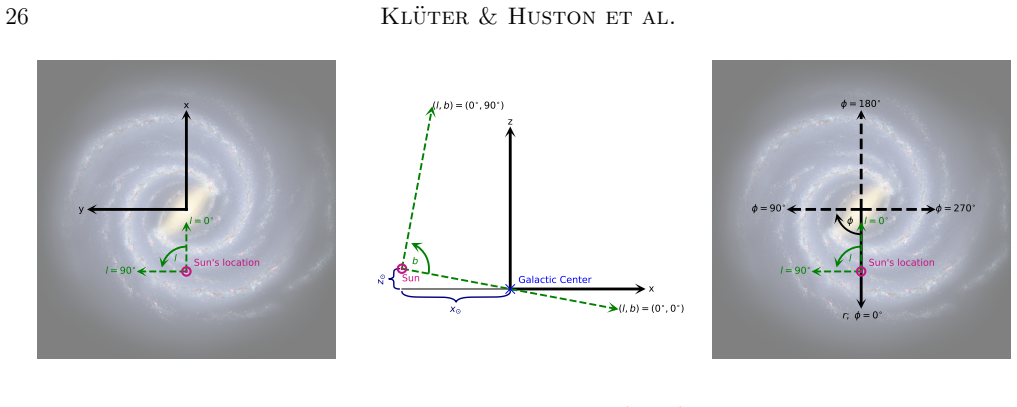
- [Section 3.3, Eq. (13)] A direct check shows that the cone center is recovered: Rz(l)Ry(b)(1,0,0)^T = (cos b cos l, cos b sin l, sin b)^T, so the concern that Eq. (13) maps the center of the cone to a mirror latitude is not valid. However, the parameterization is still not a uniform-on-the-cap sampler for finite solid angles. With α = Θ cosΦ and β = Θ sinΦ, the actual angular offset from the sightline is δ = arccos(cos α cos β), which is not equal to Θ, and the induced measure on the sphere is not proportional to sin δ dδ dΦ. Therefore, for large Ω, star positions are not drawn uniformly within the stated cone, which would bias the density profile, extinction, and apparent magnitudes. If the code implements a different, correct sampler, Eq. (13) should be corrected; if it implements Eq. (13), the bias should be quantified and the text's 'solid angle' claim should be qualified.
- [Section 7.1, Figs. 7-9] The thick-disk and halo agreement with GUMS is obtained only after applying a renormalization to the SynthPop densities; the non-renormalized SynthPop curves visibly differ in Fig. 7. Because the renormalized model is then adopted for the luminosity-function comparison, the statement that 'SynthPop can produce stellar catalogs that approximately reproduce other models and/or real data' is partly by construction. Please present the renormalization as an explicit model assumption with justification (e.g., a test of the white-dwarf-exclusion hypothesis), or evaluate how sensitive the conclusions in Figs. 8-9 are to this renormalization.
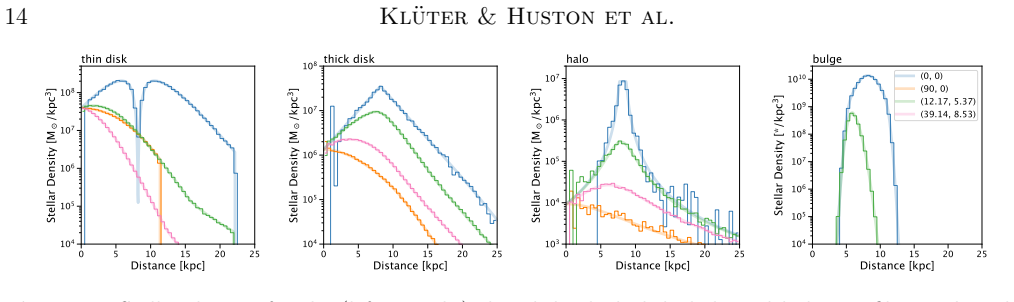
- [Section 5, Figs. 2-4] The validation of initial properties, density profiles, and kinematics is entirely qualitative. The text states that generated distributions 'follow' the input distributions, but no quantitative goodness-of-fit statistics are reported. Since the central claim is that the sampler reproduces the user-specified input distributions, please add quantitative metrics (e.g., Kolmogorov-Smirnov or Anderson-Darling tests for masses, ages, and metallicities, and binned residual statistics for the density profiles in Fig. 3). This would make the validation statistically meaningful and reproducible.
minor comments (5)
- [Section 3.3, Eq. (13)] The symbol Θ is used both for the drawn offset and as an argument in spherical coordinates via α = Θ cosΦ and β = Θ sinΦ; this is confusing. Please rename one of the quantities or state explicitly that Θ is not the final angular offset from the sightline.
- [Appendix A, Eq. (A4)] Equation (A4) has an unbalanced parenthesis: 'Ry(arctan(z⊙/x⊙)' is missing a closing parenthesis.
- [Fig. 3] The four panels use inconsistent units for the vertical axis (M_sun/kpc^3 for the thin disk, thick disk, and halo, but stars/kpc^3 for the bulge). Please make the units consistent or clearly label each panel.
- [Section 5.1] The solid angles used for the four validation sightlines are not stated; the text only says they were chosen to yield ~100,000 stars per population. Listing the actual solid angles would improve reproducibility of the validation.
- [Section 8] The statement that 'None of these [inaccuracies] is expected to affect the results significantly' is asserted without support. Given the post-AGB interpolation issue in Section 6.3, a brief quantitative or literature-based justification would be useful.
Circularity Check
No significant circularity: SynthPop's central software claim is supported by disclosed internal consistency checks and independent external benchmarks.
full rationale
SynthPop is a software-framework paper: its central claim is that the modular package exists, runs, and can be configured, not that a new physical model of the Milky Way is derived from first principles. The Section 5.1 and 5.2 self-consistency tests check that the inverse-transform samplers, Poisson draws, and coordinate/position generation reproduce the input distributions; these are implementation checks, and the paper does not present them as external validation of any Galactic model. The only comparison in which the model is adjusted, the Section 7.1 GUMS comparison, is transparent: the authors show both the non-normalized and re-normalized density profiles, state the assumption that the GUMS density excludes white dwarfs, and then use the re-normalized model only for that illustrative comparison. The distance-dependent shape of the profiles and the independent Gaia DR3 comparison remain non-forced, and the paper explicitly warns that its implementations of other models are approximations that users should verify. The self-citation to Huston et al. (2025) is simply the code-release pointer and carries no load-bearing argument. External anchors such as the MIST web interpolator, galaxia runtime, and Gaia DR3 provide independent checks. The cone-position formula in Eq. (13) may be a correctness or documentation concern, but it is not an input-output circularity, so it does not affect this verdict.
Assumptions & free parameters
free parameters (3)
- SODC extinction law coefficients (alpha, a1, b1) =
alpha = 2.255, a1 = 0.539764, b1 = -0.495567
- Thick disk and halo density renormalization factors =
not specified in the paper
- Mass loss correction factor a_massloss =
population- and isochrone-dependent; four estimation options
assumptions (6)
- domain assumption MIST isochrones provide accurate stellar properties and photometry on the age-metallicity-initial mass grid
- domain assumption The published Galactic structure models (Besancon, GUMS, genstars, and others) are accurate enough representations of the Milky Way
- ad hoc to paper CharonInterpolator's phase-aligned mass remapping preserves stellar evolution continuity across grid points
- ad hoc to paper Stellar density is constant within each distance slice
- ad hoc to paper Mass loss factor a_massloss estimated by the four listed options adequately converts density to star counts
- domain assumption Extinction maps and laws are valid at the chosen wavelengths and sightlines
invented entities (2)
-
SODC extinction law
-
CharonInterpolator
independent evidence
Cite this review
Pith. "Pith review of SynthPop: A New Framework for Synthetic Milky Way Population Generation." pith.science (2026). https://pith.science/paper/YPQ2I76V
@misc{pith2026241118821,
  author       = {Pith},
  title        = {Pith review of: SynthPop: A New Framework for Synthetic Milky Way Population Generation},
  year         = {2026},
  howpublished = {\url{https://pith.science/paper/YPQ2I76V}},
  note         = {Machine review of arXiv:2411.18821}
}
read the original abstract
We present SynthPop, a new open source, modular population synthesis Galactic modeling software to simulate catalogs of Milky Way stars along any sightline outward from the Sun. Motivated by a lack flexibility in existing Galactic models, SynthPop is coded entirely in python, can be run standalone or as an imported module, and is configured by json files that allow different model components to be switched out as desired. We describe the modular code structure, how the population generation process runs, and how to use the code. We also present model validation testing and known inaccuracies, and present an example of the code use, comparing Gaia data and the Gaia Universe Model Snapshot to a SynthPop implementation. The code is available now via GitHub with ReadTheDocs documentation and can be installed via pip.
Figures


Figures from the paper (8 more)



Forward citations
Cited by 1 Pith paper
-
Reconstructing the Free-floating Planet Mass Function with the Nancy Grace Roman Space Telescope
A simulation study argues Roman's microlensing survey could reconstruct the free-floating planet mass function from event durations alone, improving sub-Earth abundance constraints by orders of magnitude, but only if ...
Reference graph
Works this paper leans on
-
[1]
, " * write output.state after.block = add.period write newline
ENTRY address archivePrefix author booktitle chapter doi edition editor eprint howpublished institution journal key month number organization pages publisher school series title misctitle type volume year version url label extra.label sort.label short.list INTEGERS output.state before.all mid.sentence after.sentence after.block FUNCTION init.state.consts ...
-
[2]
write newline
" write newline "" before.all 'output.state := FUNCTION format.url url empty "" new.block "" url * "" * if FUNCTION format.eprint eprint empty "" archivePrefix empty "" archivePrefix "arXiv" = new.block " " eprint * " " * new.block " " eprint * " " * if if if FUNCTION format.doi doi empty "" " " doi * " " * if FUNCTION format.pid doi empty eprint empty ur...
-
[3]
p '[7 ! G>rA 89HPsOW dvNj^ƿZƿ^ &f: ///.?W Ӌڧ5@'nov`[I p; kutv
thebibliography [1] 20pt to REFERENCES 6pt =0pt \@twocolumntrue 12pt -12pt 10pt plus 3pt =0pt =0pt =1pt plus 1pt =0pt =0pt -12pt =13pt plus 1pt =20pt =13pt plus 1pt \@M =10000 =-1.0em =0pt =0pt 0pt =0pt =1.0em @enumiv\@empty 10000 10000 `\.\@m \@noitemerr \@latex@warning Empty `thebibliography' environment \@ifnextchar \@reference \@latexerr Missing key o...
arXiv 2017
-
[4]
2019, in Highlights on Spanish Astrophysics X, ed
Abuter , R., Amorim , A., Anugu , N., et al. 2019, in Highlights on Spanish Astrophysics X, ed. B. Montesinos , A. Asensio Ramos , F. Buitrago , R. Sch \"o del , E. Villaver , S. P \'e rez-Hoyos , & I. Ord \'o \ n ez-Etxeberria , 609--610
2019
-
[5]
Am\^ores, E. B. , Robin, A. C. , & Reyl\'e, C. 2017, title Evolution over time of the Milky Way\' s disc shape, A&A, 602, A67, 10.1051/0004-6361/201628461
-
[6]
Astropy Collaboration , Robitaille , T. P., Tollerud , E. J., et al. 2013, title Astropy: A community Python package for astronomy , , 558, A33, 10.1051/0004-6361/201322068
-
[7]
Astropy Collaboration , Price-Whelan , A. M., Sip o cz , B. M., et al. 2018, title The Astropy Project: Building an Open-science Project and Status of the v2.0 Core Package , , 156, 123, 10.3847/1538-3881/aabc4f
-
[8]
Astropy Collaboration , Price-Whelan , A. M., Lim , P. L., et al. 2022, title The Astropy Project: Sustaining and Growing a Community-oriented Open-source Project and the Latest Major Release (v5.0) of the Core Package , apj, 935, 167, 10.3847/1538-4357/ac7c74
Show all 96 references
-
[9]
2021, title Gaia EDR3 documentation Chapter 2: Simulated data , , Gaia EDR3 documentation, European Space Agency; Gaia Data Processing and Analysis Consortium
Babusiaux , C., Masana , E., Robin , A., et al. 2021, title Gaia EDR3 documentation Chapter 2: Simulated data , , Gaia EDR3 documentation, European Space Agency; Gaia Data Processing and Analysis Consortium. Online at https://gea.esac.esa.int/archive/documentation/GEDR3/index....
2021
-
[10]
2024, title Estimating Microlensing Parameters from Observables and Stellar Isochrones with pyLIMASS , , 168, 24, 10.3847/1538-3881/ad4862
Bachelet , E., Hundertmark , M., & Calchi Novati , S. 2024, title Estimating Microlensing Parameters from Observables and Stellar Isochrones with pyLIMASS , , 168, 24, 10.3847/1538-3881/ad4862
2024 doi
-
[11]
N., & Soneira , R
Bahcall , J. N., & Soneira , R. M. 1980, title The universe at faint magnitudes. I. Models for the Galaxy and the predicted star counts. , , 44, 73, 10.1086/190685
1980 doi
-
[12]
F., Freeman, K
Beaulieu, S. F., Freeman, K. C., Kalnajs, A. J., Saha, P., & Zhao, H. 2000, title Dynamics of the Galactic Bulge Using Planetary Nebulae, The Astronomical Journal, 120, 855, 10.1086/301504
2000 doi
-
[13]
C., & Creze , M
Bienayme , O., Robin , A. C., & Creze , M. 1987, title The mass density in our galaxy. I. A dynamical model constrained by general star counts , , 180, 94
1987
-
[14]
2011, PhD thesis, New York University
Bovy , J. 2011, PhD thesis, New York University
2011
-
[15]
1982, title Reddenings derived from H I and galaxy counts : accuracy and maps
Burstein , D., & Heiles , C. 1982, title Reddenings derived from H I and galaxy counts : accuracy and maps. , , 87, 1165, 10.1086/113199
1982 doi
-
[16]
J., & Gould , A
Cao , L., Mao , S., Nataf , D., Rattenbury , N. J., & Gould , A. 2013, title A new photometric model of the Galactic bar using red clump giants , , 434, 595, 10.1093/mnras/stt1045
2013 doi
-
[17]
A., Clayton , G
Cardelli , J. A., Clayton , G. C., & Mathis , J. S. 1989, title The Relationship between Infrared, Optical, and Ultraviolet Extinction , , 345, 245, 10.1086/167900
1989 doi
-
[18]
2003, title The Galactic Disk Mass Function: Reconciliation of the Hubble Space Telescope and Nearby Determinations, The Astrophysical Journal, 586, L133, 10.1086/374879
Chabrier, G. 2003, title The Galactic Disk Mass Function: Reconciliation of the Hubble Space Telescope and Nearby Determinations, The Astrophysical Journal, 586, L133, 10.1086/374879
2003 doi
-
[19]
Q., Liu , X
Chen , B. Q., Liu , X. W., Yuan , H. B., et al. 2014, title A three-dimensional extinction map of the Galactic anticentre from multiband photometry , , 443, 1192, 10.1093/mnras/stu1192
2014 doi
-
[20]
2019, title An intuitive 3D map of the Galactic warp's precession traced by classical Cepheids , Nature Astronomy, 3, 320, 10.1038/s41550-018-0686-7
Chen , X., Wang , S., Deng , L., et al. 2019, title An intuitive 3D map of the Galactic warp's precession traced by classical Cepheids , Nature Astronomy, 3, 320, 10.1038/s41550-018-0686-7
2019 doi
-
[21]
2023, title Corrected SFD: A More Accurate Galactic Dust Map with Minimal Extragalactic Contamination , , 958, 118, 10.3847/1538-4357/acf4a1
Chiang , Y.-K. 2023, title Corrected SFD: A More Accurate Galactic Dust Map with Minimal Extragalactic Contamination , , 958, 118, 10.3847/1538-4357/acf4a1
2023 doi
-
[23]
2016, title Mesa Isochrones and Stellar Tracks (MIST)
Choi , J., Dotter , A., Conroy , C., et al. 2016, title Mesa Isochrones and Stellar Tracks (MIST). I. Solar-scaled Models , , 823, 102, 10.3847/0004-637X/823/2/102
2016 doi
-
[24]
A., Blum , R
Damineli , A., Almeida , L. A., Blum , R. D., et al. 2016, title Extinction law in the range 0.4-4.8 m and the 8620 A DIB towards the stellar cluster Westerlund 1 , , 463, 2653, 10.1093/mnras/stw2122
2016 doi
-
[25]
Delchambre , L., Bailer-Jones , C. A. L., Bellas-Velidis , I., et al. 2023, title Gaia Data Release 3. Apsis. III. Non-stellar content and source classification , , 674, A31, 10.1051/0004-6361/202243423
2023 doi
-
[27]
2016, title MESA Isochrones and Stellar Tracks (MIST) 0: Methods for the Construction of Stellar Isochrones , , 222, 8, 10.3847/0067-0049/222/1/8
Dotter , A. 2016, title MESA Isochrones and Stellar Tracks (MIST) 0: Methods for the Construction of Stellar Isochrones , , 222, 8, 10.3847/0067-0049/222/1/8
2016 doi
-
[28]
2024, title A parsec-scale Galactic 3D dust map out to 1.25 kpc from the Sun , , 685, A82, 10.1051/0004-6361/202347628
Edenhofer , G., Zucker , C., Frank , P., et al. 2024, title A parsec-scale Galactic 3D dust map out to 1.25 kpc from the Sun , , 685, A82, 10.1051/0004-6361/202347628
2024 doi
-
[29]
L., & Massa , D
Fitzpatrick , E. L., & Massa , D. 2009, title An Analysis of the Shapes of Interstellar Extinction Curves. VI. The Near-IR Extinction Law , , 699, 1209, 10.1088/0004-637X/699/2/1209
2009 doi
-
[30]
Gaia Collaboration , Vallenari , A., Brown , A. G. A., et al. 2023, title Gaia Data Release 3. Summary of the content and survey properties , , 674, A1, 10.1051/0004-6361/202243940
2023 doi
-
[31]
M., Brasseur , C
Ginsburg , A., Sip o cz , B. M., Brasseur , C. E., et al. 2019, title astroquery: An Astronomical Web-querying Package in Python , , 157, 98, 10.3847/1538-3881/aafc33
2019 doi
-
[32]
2000, title Evolutionary tracks and isochrones for low- and intermediate-mass stars: From 0.15 to 7 M _ sun , and from Z=0.0004 to 0.03 , , 141, 371, 10.1051/aas:2000126
Girardi , L., Bressan , A., Bertelli , G., & Chiosi , C. 2000, title Evolutionary tracks and isochrones for low- and intermediate-mass stars: From 0.15 to 7 M _ sun , and from Z=0.0004 to 0.03 , , 141, 371, 10.1051/aas:2000126
2000 doi
-
[33]
Girardi , L., Groenewegen , M. A. T., Hatziminaoglou , E., & da Costa , L. 2005, title Star counts in the Galaxy. Simulating from very deep to very shallow photometric surveys with the TRILEGAL code , , 436, 895, 10.1051/0004-6361:20042352
2005 doi
-
[34]
2018, title dustmaps: A Python interface for maps of interstellar dust , The Journal of Open Source Software, 3, 695, 10.21105/joss.00695
Green , G. 2018, title dustmaps: A Python interface for maps of interstellar dust , The Journal of Open Source Software, 3, 695, 10.21105/joss.00695
2018 doi
-
[35]
M., Schlafly , E., Zucker , C., Speagle , J
Green , G. M., Schlafly , E., Zucker , C., Speagle , J. S., & Finkbeiner , D. 2019, title A 3D Dust Map Based on Gaia, Pan-STARRS 1, and 2MASS , , 887, 93, 10.3847/1538-4357/ab5362
2019 doi
-
[36]
M., Schlafly , E
Green , G. M., Schlafly , E. F., Finkbeiner , D. P., et al. 2015, title A Three-dimensional Map of Milky Way Dust , , 810, 25, 10.1088/0004-637X/810/1/25
2015 doi
-
[37]
M., Schlafly , E
Green , G. M., Schlafly , E. F., Finkbeiner , D., et al. 2018, title Galactic reddening in 3D from stellar photometry - an improved map , , 478, 651, 10.1093/mnras/sty1008
2018 doi
-
[38]
R., Millman, K
Harris, C. R., Millman, K. J., van der Walt, S. J., et al. 2020, title Array programming with NumPy , Nature, 585, 357–362, 10.1038/s41586-020-2649-2
2020 doi
-
[39]
C., & Creze , M
Haywood , M., Robin , A. C., & Creze , M. 1997, title The evolution of the Milky Way disc. I. Vertical structure and local constraints. , , 320, 428
1997
-
[40]
R., Lam , C
Hosek , Matthew W., J., Lu , J. R., Lam , C. Y., et al. 2020, title SPISEA: A Python-based Simple Stellar Population Synthesis Code for Star Clusters , , 160, 143, 10.3847/1538-3881/aba533
2020 doi
-
[41]
R., Anderson , J., et al
Hosek , Matthew W., J., Lu , J. R., Anderson , J., et al. 2018, title The Optical/Near-infrared Extinction Law in Highly Reddened Regions , , 855, 13, 10.3847/1538-4357/aaabbb
2018 doi
-
[42]
J., Klüter, J., Aronica, A., et al
Huston, M. J., Klüter, J., Aronica, A., et al. 2025, title SynthPop: A New Framework for Synthetic Milky Way Population Generation, , v1.0.0 Zenodo, 10.5281/zenodo.15128000
2025 doi
-
[43]
A., Penny , M., Gaudi , B
Johnson , S. A., Penny , M., Gaudi , B. S., et al. 2020, title Predictions of the Nancy Grace Roman Space Telescope Galactic Exoplanet Survey. II. Free-floating Planet Detection Rates , , 160, 123, 10.3847/1538-3881/aba75b
2020 doi
-
[44]
S., Hansen , B
Kalirai , J. S., Hansen , B. M. S., Kelson , D. D., et al. 2008, title The Initial-Final Mass Relation: Direct Constraints at the Low-Mass End , , 676, 594, 10.1086/527028
2008 doi
-
[45]
Karim , T., & Mamajek , E. E. 2017, title Revised geometric estimates of the North Galactic Pole and the Sun's height above the Galactic mid-plane , , 465, 472, 10.1093/mnras/stw2772
2017 doi
-
[46]
C., & Marshall , D
Kerins , E., Robin , A. C., & Marshall , D. J. 2009, title Synthetic microlensing maps of the Galactic bulge , , 396, 1202, 10.1111/j.1365-2966.2009.14791.x
2009
-
[47]
King , I. R. 1977, title The Stellar Distribution above the Galactic Plane: An Introduction , Highlights of Astronomy, 4, 41, 10.1017/S1539299600002963
1977 doi
-
[48]
Koshimoto , N., Baba , J., & Bennett , D. P. 2021, title A Parametric Galactic Model toward the Galactic Bulge Based on Gaia and Microlensing Data , , 917, 78, 10.3847/1538-4357/ac07a8
2021 doi
-
[49]
2001, title On the variation of the initial mass function , , 322, 231, 10.1046/j.1365-8711.2001.04022.x
Kroupa , P. 2001, title On the variation of the initial mass function , , 322, 231, 10.1046/j.1365-8711.2001.04022.x
2001
-
[50]
L., et al
Lallement , R., Babusiaux , C., Vergely , J. L., et al. 2019, title Gaia-2MASS 3D maps of Galactic interstellar dust within 3 kpc , , 625, A135, 10.1051/0004-6361/201834695
2019 doi
-
[51]
Y., Lu, J
Lam, C. Y., Lu, J. R., Hosek, M. W., Dawson, W. A., & Golovich, N. R. 2020, title PopSyCLE: A New Population Synthesis Code for Compact Object Microlensing Events, The Astrophysical Journal, 889, 31, 10.3847/1538-4357/ab5fd3
2020 doi
-
[52]
S., & Dor \'e , O
Lenz , D., Hensley , B. S., & Dor \'e , O. 2017, title A New, Large-scale Map of Interstellar Reddening Derived from H I Emission , , 846, 38, 10.3847/1538-4357/aa84af
2017 doi
-
[53]
J., Robin , A
Marshall , D. J., Robin , A. C., Reyl \'e , C., Schultheis , M., & Picaud , S. 2006, title Modelling the Galactic interstellar extinction distribution in three dimensions , , 453, 635, 10.1051/0004-6361:20053842
2006 doi
-
[54]
1981, Galactic astronomy
Mihalas , D., & Binney , J. 1981, Galactic astronomy. Structure and kinematics (W.H. Freeman)
1981
-
[55]
V., Savchenko, S
Mosenkov, A. V., Savchenko, S. S., Smirnov, A. A., & Camps, P. 2021, title The structure of the Milky Way based on unWISE 3.4 μm integrated photometry , Monthly Notices of the Royal Astronomical Society, 507, 5246, 10.1093/mnras/stab2445
2021 doi
-
[56]
K., Bertelli , G., Bressan , A., Chiosi , C., & Lub , J
Ng , Y. K., Bertelli , G., Bressan , A., Chiosi , C., & Lub , J. 1995, title The Galactic structure towards the Galactic Centre. I. A study of the Palomar-Groningen Field 3. , , 295, 655
1995
-
[57]
Nishiyama , S., Tamura , M., Hatano , H., et al. 2009, title Interstellar Extinction Law Toward the Galactic Center III: J, H, K _ S Bands in the 2MASS and the MKO Systems, and 3.6, 4.5, 5.8, 8.0 m in the Spitzer/IRAC System , , 696, 1407, 10.1088/0004-637X/696/2/1407
2009 doi
-
[58]
O'Donnell , J. E. 1994, title R v-dependent Optical and Near-Ultraviolet Extinction , , 422, 158, 10.1086/173713
1994 doi
-
[59]
2020, title pandas-dev/pandas: Pandas, , latest Zenodo, 10.5281/zenodo.3509134
pandas development team, T. 2020, title pandas-dev/pandas: Pandas, , latest Zenodo, 10.5281/zenodo.3509134
2020 doi
-
[60]
2011, title Modules for Experiments in Stellar Astrophysics (MESA) , , 192, 3, 10.1088/0067-0049/192/1/3
Paxton , B., Bildsten , L., Dotter , A., et al. 2011, title Modules for Experiments in Stellar Astrophysics (MESA) , , 192, 3, 10.1088/0067-0049/192/1/3
2011 doi
-
[61]
2013, title Modules for Experiments in Stellar Astrophysics (MESA): Planets, Oscillations, Rotation, and Massive Stars , , 208, 4, 10.1088/0067-0049/208/1/4
Paxton , B., Cantiello , M., Arras , P., et al. 2013, title Modules for Experiments in Stellar Astrophysics (MESA): Planets, Oscillations, Rotation, and Massive Stars , , 208, 4, 10.1088/0067-0049/208/1/4
2013 doi
-
[62]
2015, title Modules for Experiments in Stellar Astrophysics (MESA): Binaries, Pulsations, and Explosions , , 220, 15, 10.1088/0067-0049/220/1/15
Paxton , B., Marchant , P., Schwab , J., et al. 2015, title Modules for Experiments in Stellar Astrophysics (MESA): Binaries, Pulsations, and Explosions , , 220, 15, 10.1088/0067-0049/220/1/15
2015 doi
-
[63]
B., et al
Paxton , B., Schwab , J., Bauer , E. B., et al. 2018, title Modules for Experiments in Stellar Astrophysics (MESA): Convective Boundaries, Element Diffusion, and Massive Star Explosions , , 234, 34, 10.3847/1538-4365/aaa5a8
2018 doi
-
[64]
Paxton , B., Smolec , R., Schwab , J., et al. 2019, title Modules for Experiments in Stellar Astrophysics (MESA): Pulsating Variable Stars, Rotation, Convective Boundaries, and Energy Conservation , , 243, 10, 10.3847/1538-4365/ab2241
2019 doi
-
[65]
Peek , J. E. G., & Graves , G. J. 2010, title A Correction to the Standard Galactic Reddening Map: Passive Galaxies as Standard Crayons , , 719, 415, 10.1088/0004-637X/719/1/415
2010 doi
-
[66]
T., Gaudi , B
Penny , M. T., Gaudi , B. S., Kerins , E., et al. 2019, title Predictions of the WFIRST Microlensing Survey. I. Bound Planet Detection Rates , , 241, 3, 10.3847/1538-4365/aafb69
2019 doi
-
[67]
T., Kerins , E., Rattenbury , N., et al
Penny , M. T., Kerins , E., Rattenbury , N., et al. 2013, title ExELS: an exoplanet legacy science proposal for the ESA Euclid mission - I. Cold exoplanets , , 434, 2, 10.1093/mnras/stt927
2013 doi
-
[68]
Picaud , S., & Robin , A. C. 2004, title 3D outer bulge structure from near infrared star counts , , 428, 891, 10.1051/0004-6361:20041218
2004 doi
-
[69]
Planck Collaboration , Abergel , A., Ade , P. A. R., et al. 2014, title Planck 2013 results. XI. All-sky model of thermal dust emission , , 571, A11, 10.1051/0004-6361/201323195
2014 doi
-
[70]
2016, title Planck intermediate results
Planck Collaboration , Aghanim , N., Ashdown , M., et al. 2016, title Planck intermediate results. XLVIII. Disentangling Galactic dust emission and cosmic infrared background anisotropies , , 596, A109, 10.1051/0004-6361/201629022
2016 doi
-
[71]
A., Sukhbold , T., & \"O zel , F
Raithel , C. A., Sukhbold , T., & \"O zel , F. 2018, title Confronting Models of Massive Star Evolution and Explosions with Remnant Mass Measurements , , 856, 35, 10.3847/1538-4357/aab09b
2018 doi
-
[72]
J., & Brunthaler, A
Reid, M. J., & Brunthaler, A. 2020, title The Proper Motion of Sagittarius A*. III. The Case for a Supermassive Black Hole, The Astrophysical Journal, 892, 39, 10.3847/1538-4357/ab76cd
2020 doi
-
[73]
1986, title Stellar populations in the milky way: a synthetic model
Robin , A., & Creze , M. 1986, title Stellar populations in the milky way: a synthetic model. , , 157, 71
1986
- [74]
-
[75]
C., Reyl \'e , C., Derri \`e re , S., & Picaud , S
Robin , A. C., Reyl \'e , C., Derri \`e re , S., & Picaud , S. 2003, title A synthetic view on structure and evolution of the Milky Way , , 409, 523, 10.1051/0004-6361:20031117
2003 doi
-
[76]
C., Reyl \'e , C., Derri \`e re , S., & Picaud , S
Robin , A. C., Reyl \'e , C., Derri \`e re , S., & Picaud , S. 2004, title Erratum: A synthetic view on structure and evolution of the Milky Way , , 416, 157, 10.1051/0004-6361:20040968
2004 doi
-
[77]
C., Luri , X., Reyl \'e , C., et al
Robin , A. C., Luri , X., Reyl \'e , C., et al. 2012, title Gaia Universe model snapshot. A statistical analysis of the expected contents of the Gaia catalogue , , 543, A100, 10.1051/0004-6361/201118646
2012 doi
-
[78]
Y., Lu , J
Rose , S., Lam , C. Y., Lu , J. R., et al. 2022, title The Impact of Initial-Final Mass Relations on Black Hole Microlensing , , 941, 116, 10.3847/1538-4357/aca09d
2022 doi
-
[79]
1993, title The alpha -enhanced Isochrones and Their Impact on the FITS to the Galactic Globular Cluster System , , 414, 580, 10.1086/173105
Salaris , M., Chieffi , A., & Straniero , O. 1993, title The alpha -enhanced Isochrones and Their Impact on the FITS to the Galactic Globular Cluster System , , 414, 580, 10.1086/173105
1993 doi
-
[80]
E., Drew , J
Sale , S. E., Drew , J. E., Barentsen , G., et al. 2014, title A 3D extinction map of the northern Galactic plane based on IPHAS photometry , , 443, 2907, 10.1093/mnras/stu1090
2014 doi
-
[81]
F., & Finkbeiner , D
Schlafly , E. F., & Finkbeiner , D. P. 2011, title Measuring Reddening with Sloan Digital Sky Survey Stellar Spectra and Recalibrating SFD , , 737, 103, 10.1088/0004-637X/737/2/103
2011 doi
-
[82]
J., Finkbeiner , D
Schlegel , D. J., Finkbeiner , D. P., & Davis , M. 1998, title Maps of Dust Infrared Emission for Use in Estimation of Reddening and Cosmic Microwave Background Radiation Foregrounds , , 500, 525, 10.1086/305772
1998 doi
-
[83]
2010, title Local kinematics and the local standard of rest , Monthly Notices of the Royal Astronomical Society, 403, 1829, 10.1111/j.1365-2966.2010.16253.x
Schönrich, R., Binney, J., & Dehnen, W. 2010, title Local kinematics and the local standard of rest , Monthly Notices of the Royal Astronomical Society, 403, 1829, 10.1111/j.1365-2966.2010.16253.x
2010
-
[84]
V., & Binney , J
Sharma , S., Bland-Hawthorn , J., Johnston , K. V., & Binney , J. 2011, title Galaxia: A Code to Generate a Synthetic Survey of the Milky Way , , 730, 3, 10.1088/0004-637X/730/1/3
2011 doi
-
[85]
2011, in Journal of Physics Conference Series, Vol
Sordo , R., Vallenari , A., Tantalo , R., et al. 2011, in Journal of Physics Conference Series, Vol. 328, Journal of Physics Conference Series (IOP), 012006, 10.1088/1742-6596/328/1/012006
2011 doi
-
[86]
C., Sanders , J
Sormani , M. C., Sanders , J. L., Fritz , T. K., et al. 2022, title Self-consistent modelling of the Milky Way's nuclear stellar disc , , 512, 1857, 10.1093/mnras/stac639
2022 doi
-
[87]
S., & Gallagher, III, J
Sparke, L. S., & Gallagher, III, J. S. 2007, Galaxies in the Universe: An Introduction, 2nd edn. (Cambridge University Press)
2007
-
[88]
2015, title The mass spectrum of compact remnants from the PARSEC stellar evolution tracks , , 451, 4086, 10.1093/mnras/stv1161
Spera , M., Mapelli , M., & Bressan , A. 2015, title The mass spectrum of compact remnants from the PARSEC stellar evolution tracks , , 451, 4086, 10.1093/mnras/stv1161
2015 doi
-
[89]
E., Brown , J
Sukhbold , T., Ertl , T., Woosley , S. E., Brown , J. M., & Janka , H. T. 2016, title Core-collapse Supernovae from 9 to 120 Solar Masses Based on Neutrino-powered Explosions , , 821, 38, 10.3847/0004-637X/821/1/38
2016 doi
-
[90]
Sukhbold , T., & Woosley , S. E. 2014, title The Compactness of Presupernova Stellar Cores , , 783, 10, 10.1088/0004-637X/783/1/10
2014 doi
-
[91]
A., et al
Surot , F., Valenti , E., Gonzalez , O. A., et al. 2020, title Mapping the stellar age of the Milky Way bulge with the VVV. III. High-resolution reddening map , , 644, A140, 10.1051/0004-6361/202038346
2020 doi
-
[92]
E., et al
Virtanen, P., Gommers, R., Oliphant, T. E., et al. 2020, title SciPy 1.0: Fundamental Algorithms for Scientific Computing in Python , Nature Methods, 17, 261, 10.1038/s41592-019-0686-2
2020 doi
-
[93]
2019, title The Optical to Mid-infrared Extinction Law Based on the APOGEE, Gaia DR2, Pan-STARRS1, SDSS, APASS, 2MASS, and WISE Surveys , , 877, 116, 10.3847/1538-4357/ab1c61
Wang , S., & Chen , X. 2019, title The Optical to Mid-infrared Extinction Law Based on the APOGEE, Gaia DR2, Pan-STARRS1, SDSS, APASS, 2MASS, and WISE Surveys , , 877, 116, 10.3847/1538-4357/ab1c61
2019 doi
-
[94]
2010, in P roceedings of the 9th P ython in S cience C onference, ed
W es M c K inney. 2010, in P roceedings of the 9th P ython in S cience C onference, ed. S t\'efan van der W alt & J arrod M illman, 56 -- 61, 10.25080/Majora-92bf1922-00a
2010 doi
-
[95]
Woosley , S. E. 2017, title Pulsational Pair-instability Supernovae , , 836, 244, 10.3847/1538-4357/836/2/244
2017 doi
-
[96]
E., Sukhbold , T., & Janka , H
Woosley , S. E., Sukhbold , T., & Janka , H. T. 2020, title The Birth Function for Black Holes and Neutron Stars in Close Binaries , , 896, 56, 10.3847/1538-4357/ab8cc1
2020 doi
-
[97]
2001, title Toward Better Age Estimates for Stellar Populations: The Y ^ 2 Isochrones for Solar Mixture , , 136, 417, 10.1086/321795
Yi , S., Demarque , P., Kim , Y.-C., et al. 2001, title Toward Better Age Estimates for Stellar Populations: The Y ^ 2 Isochrones for Solar Mixture , , 136, 417, 10.1086/321795
2001 doi
-
[98]
K., Speagle , J
Zucker , C., Saydjari , A. K., Speagle , J. S., et al. 2025, title A Deep, High-Angular Resolution 3D Dust Map of the Southern Galactic Plane , arXiv e-prints, arXiv:2503.02657, 10.48550/arXiv.2503.02657
2025 doi
Reviewed August 12, 2026 · model on record in the stance chip above.
Discussion (0). Continue with ORCID to comment.