REVIEW 3 major objections 4 minor 38 references
Redesigning the ensemble Kalman filter with a dedicated model of epistemic uncertainty
T0 review · 3 major / 4 minor · reviewed 2026-08-12 · deepseek-v4-flash
Pith's one-line read The paper introduces a possibilistic ensemble Kalman filter that treats uncertainty as lack of knowledge and demonstrates better-calibrated uncertainty estimates than standard ensemble Kalman filters at the same ensemble size.
desk verdict A genuinely new possibilistic EnKF with an elegant Gaussian fitting rule, but the abstract oversells performance and the nonlinear prediction step is unvalidated; worth a referee after revision. read the letter →
The pith
A machine-rendered reading of the paper's core claim, the machinery that carries it, and where it could break.
The reading
What carries the argument
The central object is the Gaussian possibility function $\mathcal{N}(\mu,\Sigma)$, a function of the form $\exp(-\tfrac12 (x-\mu)^\top \Lambda (x-\mu))$ with mode $\mu$ and precision matrix $\Lambda=\Sigma^{-1}$, used as a model of epistemic uncertainty. The load-bearing fitting procedure is the constrained optimisation problem $\max_{\Lambda\in S_d^+} \log|\Lambda|$ subject to $\mathcal{N}(x_i;\mu,\Sigma)\ge w_i$, which replaces moment matching: it returns the least informative Gaussian possibility that still dominates the weighted particles. This fitting rule, together with the mode-propagation identity and the Cholesky transport-map construction, carries the prediction step, while the square-root EnKF update is carried over unchanged because linear transformations preserve Gaussian possibility functions.
What would settle it
Run the p-EnKF on a one-dimensional state with a deterministic, non-invertible map that folds a Gaussian possibility into two well-separated modes, set $U_k=0$, and compare the fitted Gaussian's contours with the exact propagated possibility given by the change-of-variable formula; if the fitted Gaussian lies visibly below the true possibility over large regions, or the posterior Mahalanobis distance drifts from a high-resolution reference filter's value, the central claim fails.
Extended reading notes
Core claim
The paper's central claim is that replacing the probabilistic description of the hidden state with a Gaussian possibility function, fitted by a constrained optimisation problem, yields an ensemble Kalman filter whose uncertainty estimates are better calibrated than those of standard EnKFs at the same ensemble size. The p-EnKF represents knowledge of the state by a Gaussian possibility function $\mathcal{N}(\mu,\Sigma)$ fitted to the weighted ensemble $\{(w_i,x_i)\}_{i=0}^N$ by solving $\max_{\Lambda\in S_d^+} \log|\Lambda|$ subject to $\mathcal{N}(x_i;\mu,\Sigma) \ge w_i$, with $\Lambda=\Sigma^{-1}$. Because the fitted Gaussian is required to dominate the empirical possibility function, it introduces no artificial information at the particle locations, and imposing conditional independence constraints on the precision matrix automatically inflates the remaining variance, providing localisation without tuning parameters. Prediction uses the mode-propagation identity $\mathbb{E}^*(F_k(x)) = F_k(\mathbb{E}^*(x))$ and a linear transport map built from the Cholesky factors $T = (\tilde{\Sigma}_k + U_k)^{1/2}\tilde{\Lambda}_k^{1/2}$, while the update step is formally identical to the square-root EnKF. The paper shows that this filter can outperform standard EnKFs at equal sample size even when the underlying uncertainty is genuinely aleatoric, and that its posterior Mahalanobis distance stays close to the Kalman filter's in linear and nonlinear test problems.
Load-bearing premise
The load-bearing premise is that the Gaussian possibility function fitted after propagating an ensemble through a nonlinear map remains a faithful description of the true predictive possibility, so that adding model uncertainty through the linear transport map does not materially distort the result; the paper offers no check of this for strongly nonlinear or multimodal dynamics.
Editorial extensions
If this is right
- In linear-Gaussian settings the p-EnKF's posterior mean and variance track the Kalman filter closely, while standard EnKFs underestimate variance and produce inflated Mahalanobis distances.
- The identity $\mathbb{E}^*(F_k(x)) = F_k(\mathbb{E}^*(x))$ makes prediction cheaper and more stable: one designated particle carries the expected value through nonlinear dynamics without ensemble averaging.
- Localisation can be applied as conditional-independence constraints on the precision matrix, and the required inflation is determined automatically by the optimisation rather than by hand-tuned parameters.
- At equal ensemble sizes the p-EnKF can outperform both stochastic and square-root EnKFs, even when the uncertainty being filtered is aleatoric rather than epistemic.
Reading between the lines
- The same precision-constrained fitting idea could be applied to other ensemble filters or variational data assimilation schemes, providing an automatic, parameter-free trade-off between localisation and inflation.
- If a fast solver for the constrained optimisation problem were developed, the p-EnKF's small-sample calibration advantage might extend to higher-dimensional geophysical problems, which the paper's experiments do not yet reach.
- The clean separation between aleatoric and epistemic uncertainty suggests a testable extension: represent multimodal epistemic states by mixtures of Gaussian possibility functions, a case the current algorithm does not handle.
Signed reviews
Editorial analysis
A structured set of objections, weighed in public.
Referee Report
Summary. The paper introduces a possibilistic ensemble Kalman filter (p-EnKF) for state-space models in which epistemic uncertainty is represented by Gaussian possibility functions rather than probability distributions. The method approximates a possibility function by weighted particles, fits a Gaussian possibility function via a constrained maximum-precision optimisation (Eq. 4), propagates the mode exactly through nonlinear maps using the identity E*(F_k(x)) = F_k(E*(x)), adds model uncertainty by a linear transport map, and then applies the standard square-root EnKF update. Numerical experiments on a linear model and a modified Lorenz-96 model compare the p-EnKF with the stochastic and square-root EnKFs and the UKF, emphasising small-sample variance recovery, calibration via Mahalanobis distance, and automatic localisation/inflation through constrained conditional independence.
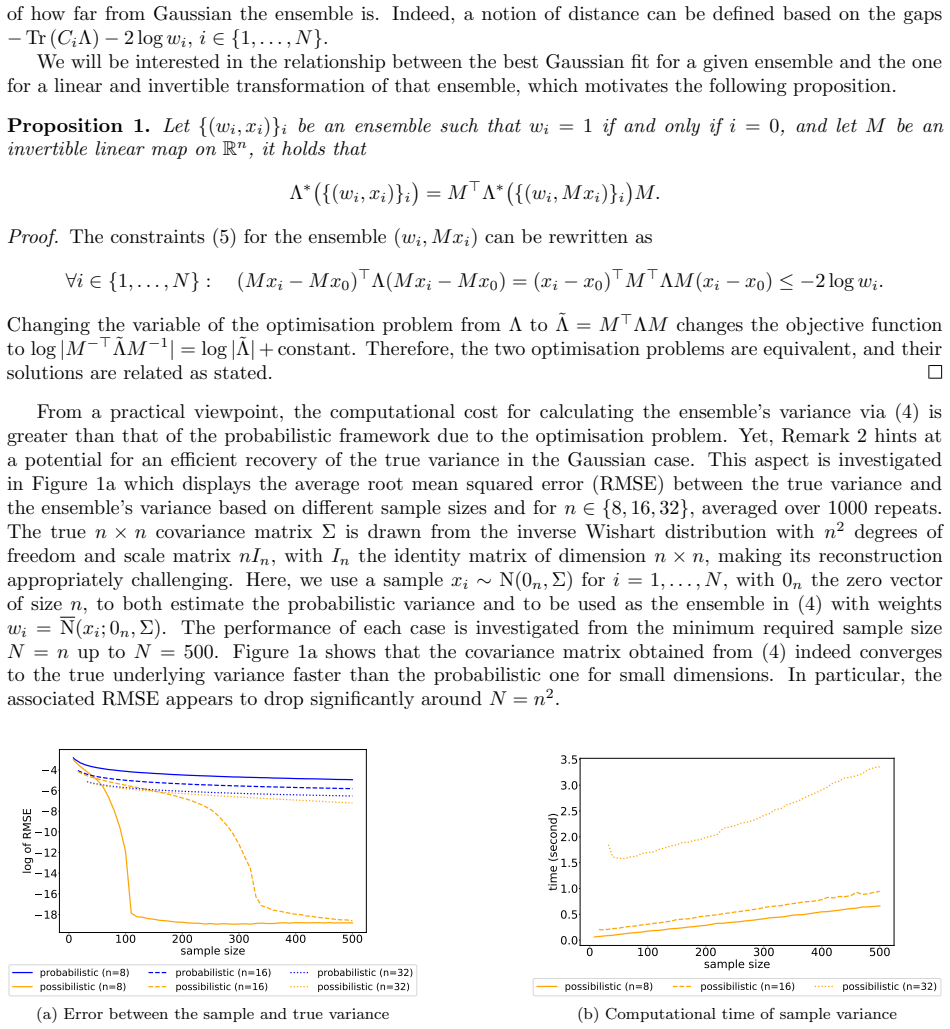
Significance. If the claims hold, this is a conceptually interesting and potentially useful reformulation of EnKF heuristics in a possibility-theoretic framework. The constrained Gaussian fit (Eq. 4) is a genuine new construction, and the variance-recovery experiment in Figure 1a is informative: it shows a regime in which the possibilistic covariance estimate beats moment matching at small sample sizes. The derivation that the square-root EnKF update preserves a Gaussian possibility function (Section 3.5) is clean, and the automatic inflation induced by imposing conditional independence is an appealing idea. The paper does not, however, ship code, and the current experiments do not stress the main Gaussianity assumption; the significance is therefore conditional on the additional validation requested below.
major comments (3)
- [Algorithm 4 / Section 3.4] Algorithm 4 is internally inconsistent and cannot be reproduced as printed. Algorithm 3 indexes the ensemble as {0,...,N}, but line 1 of Algorithm 4 loops over i ∈ {1,...,N+1}, leaving x̃^0_k undefined for line 4; and line 5 computes Λ̃_k from the previous posterior ensemble {(w_i, x̂^i_{k−1})} rather than from the propagated ensemble {(w_i, x̃^i_k)} as the surrounding text requires. These are not cosmetic typos: for F_k different from the identity, the previous posterior precision is not the precision of the propagated ensemble, so the covariance used in the Kalman-like update (line 8 and Section 3.5) would be wrong. Please correct the indexing and the argument of Λ*, and state which version was used to produce the experiments.
- [Section 3.4] The prediction step's validity depends on the propagated ensemble {(w_i, x̃^i_k)} being adequately summarised by a single Gaussian possibility function: Algorithm 4 fits N(µ_k, Σ̃_k) to those particles and then applies the SqrtEnKF update. The only justification offered is that 'U_k is typically small compared to Σ̃_k', but this bounds the additive model-error term and says nothing about the deformation of the ensemble by F_k. Under the sup-transform (3), a non-injective or strongly nonlinear F_k can produce a multimodal or skewed predictive possibility function, and the constrained fit (4) can then return an artificially broad Gaussian that is an artifact of the fitting criterion. The Lorenz-96 experiments with Δt=0.01 (Section 4.2) are mildly nonlinear, and no diagnostic of the fitted Gaussian's fidelity (e.g., the gaps −Tr(C_iΛ)−2 log w_i after propagation) is reported. Please add a stress test with a strongly nonlinear or multi-modal transition, or explicitly restrict the claims and state this as a limitation.
- [Abstract and Section 4.1.1] The abstract's claim that the p-EnKF 'can outperform standard ensemble Kalman filters at given sample size' is not supported by the fully-observed linear experiments as reported: Section 4.1.1 states that the SqrtEnKF improves on the p-EnKF by at least four orders of magnitude in RMSE of the posterior mean relative to the KF. The evidence for outperformance is in variance RMSE (Figure 2c), in the partially-observed linear case (Figure 4), and in Mahalanobis calibration, not in mean accuracy for the fully-observed linear case. Please qualify the abstract and conclusion, e.g., by specifying 'in terms of uncertainty quantification' or by restricting the claim to the regimes actually demonstrated.
minor comments (4)
- [Figures 2 and 5] Many axis labels and legends in Figures 2 and 5 are rendered as '/uni...' escape sequences, making the figures unreadable; please regenerate the figures with standard fonts.
- [Section 3.4, last paragraph] The sentence 'fitting a Gaussian possibility function to the predicted ensemble is unnecessary' is confusing because the algorithm has just fitted one; clarify that only the post-transport fit is unnecessary.
- [Section 4.1.1] There are small textual errors: 'the performance would necessary be lower' should read 'necessarily', and 'p-EnkF' should read 'p-EnKF'.
- [Section 3.6.2] The claim that conditional-independence localisation involves 'no additional tuning parameters' should be softened, because the choice of which off-diagonal precision entries to set to zero (e.g., the bandwidth) remains a modelling choice.
Circularity Check
No significant circularity: the p-EnKF derivation is self-contained, with self-citations supplying background rather than forcing the claimed result.
full rationale
The central derivation chain is not circular. The prediction step uses the identity E*(F_k(x)) = F_k(E*(x)), which is a direct property of the possibilistic change-of-variable formula (Eq. 3), not an imported conclusion of this paper. The predictive covariance is obtained from a newly defined constrained Gaussian fit (Eq. 4), and no fitted parameter is later relabeled as a prediction. The update step is proved in-text: Proposition 3 shows that an invertible linear transport map sends N(µ,Σ) to N(µ~,Σ~), and the SqrtEnKF-style map is then verified to reproduce the Kalman-filter posterior; Proposition 1, proved in the paper, gives the needed equivariance of the best-fit under linear maps. The self-citations to [17], [19], and [20] supply the possibility-theory framework and the additive-Gaussian variance rule Σ+U, but these are mathematical results with stated assumptions independent of the paper's target claims, not a uniqueness theorem invoked to forbid alternatives. The sentence 'Uk is typically small compared to Σ~k so that the impact of this assumption is expected to be small' is an approximation caveat, not a circular step. One internal inconsistency exists: Algorithm 4, Step 5, computes Λ~k from {(w_i, x̂_{k-1})} although the surrounding text says the Gaussian fit is to the predicted ensemble {(w_i, x̃_i)}; this is a reproducibility/correctness issue rather than a reduction of the claimed derivation to its own inputs.
Assumptions & free parameters
free parameters (4)
- Ensemble size N =
N = 2n in all experiments (except n=64 with 50 repeats)
- UKF tuning parameters (α, κ, β) =
α=0.25, κ=130, β=2
- Banded precision bandwidth =
bandwidth 2
- Initialisation scheme =
random Gaussian vs UKF sigma points
assumptions (6)
- domain assumption Uncertainty about the state can be represented by Gaussian possibility functions N(μ, Σ) with mode-based expectation and curvature-based variance
- domain assumption E*(F_k(x_{k-1})) = F_k(E*(x_{k-1})) for arbitrary nonlinear F_k
- domain assumption Possibilistic Bayes update f(θ|y) ∝ p(y|θ)f(θ) from Houssineau 2018 [17]
- domain assumption Additive epistemic model uncertainty leads to predictive variance Σ̃_k + U_k, as in the possibilistic KF [19]
- ad hoc to paper The fitted Gaussian remains a faithful representation of the ensemble after applying F_k and the transport map T
- standard math Maximization over weighted particles approximates the optimization over the possibility function, converging as N→∞
Cite this review
Pith. "Pith review of Redesigning the ensemble Kalman filter with a dedicated model of epistemic uncertainty." pith.science (2026). https://pith.science/paper/XTUVOMFM
@misc{pith2026241118864,
  author       = {Pith},
  title        = {Pith review of: Redesigning the ensemble Kalman filter with a dedicated model of epistemic uncertainty},
  year         = {2026},
  howpublished = {\url{https://pith.science/paper/XTUVOMFM}},
  note         = {Machine review of arXiv:2411.18864}
}
read the original abstract
The problem of incorporating information from observations received serially in time is widespread in the field of uncertainty quantification. Within a probabilistic framework, such problems can be addressed using standard filtering techniques. However, in many real-world problems, some (or all) of the uncertainty is epistemic, arising from a lack of knowledge, and is difficult to model probabilistically. This paper introduces a possibilistic ensemble Kalman filter designed for this setting and characterizes some of its properties. Using possibility theory to describe epistemic uncertainty is appealing from a philosophical perspective, and it is easy to justify certain heuristics often employed in standard ensemble Kalman filters as principled approaches to capturing uncertainty within it. The possibilistic approach motivates a robust mechanism for characterizing uncertainty which shows good performance with small sample sizes, and can outperform standard ensemble Kalman filters at given sample size, even when dealing with genuinely aleatoric uncertainty.
Figures


Figures from the paper (3 more)


Reference graph
Works this paper leans on
-
[1]
Rossella Arcucci, Lamya Moutiq, and Yi-Ke Guo. Neural assimilation. In Computational Science–ICCS 2020: 20th International Conference, Amsterdam, The Netherlands, June 3–5, 2020, Proceedings, Part VI 20 , pages 155–168. Springer, 2020
work page 2020
-
[2]
Mark Asch, Marc Bocquet, and Ma¨ elle Nodet.Data assimilation: methods, algorithms, and applications . SIAM, 2016
work page 2016
-
[3]
Representing parametric probabilistic models tainted with imprecision
C´ edric Baudrit, Didier Dubois, and Nathalie Perrot. Representing parametric probabilistic models tainted with imprecision. Fuzzy sets and systems , 159(15):1913–1928, 2008
work page 1913
-
[4]
Robust Kalman and Bayesian set-valued filtering and model validation for linear stochastic systems
Adrian N Bishop and Pierre Del Moral. Robust Kalman and Bayesian set-valued filtering and model validation for linear stochastic systems. SIAM/ASA Journal on Uncertainty Quantification , 11(2):389– 425, 2023
work page 2023
-
[5]
Analysis scheme in the ensemble Kalman filter
Gerrit Burgers, Peter Jan Van Leeuwen, and Geir Evensen. Analysis scheme in the ensemble Kalman filter. Monthly weather review , 126(6):1719–1724, 1998
work page 1998
-
[6]
Observer control for bearings-only tracking using possibility functions
Zhijin Chen, Branko Ristic, Jeremie Houssineau, and Du Yong Kim. Observer control for bearings-only tracking using possibility functions. Automatica, 133:109888, 2021
work page 2021
-
[7]
Reducing the bandwidth of sparse symmetric matrices
Elizabeth Cuthill and James McKee. Reducing the bandwidth of sparse symmetric matrices. In Pro- ceedings of the 1969 24th National Conference , pages 157–172, 1969. 21
work page 1969
-
[8]
Conditioning in possibility theory with strict order norms
Bernard De Baets, Elena Tsiporkova, and Radko Mesiar. Conditioning in possibility theory with strict order norms. Fuzzy Sets and Systems , 106(2):221–229, 1999
work page 1999
Show all 38 references
-
[9]
The Dempster–Shafer calculus for statisticians
Arthur P Dempster. The Dempster–Shafer calculus for statisticians. International Journal of Approxi- mate Reasoning, 48(2):365–377, 2008
2008
-
[10]
Possibility theory, probability and fuzzy sets misun- derstandings, bridges and gaps: Misunderstandings, bridges and gaps
Didier Dubois, Hung T Nguyen, and Henri Prade. Possibility theory, probability and fuzzy sets misun- derstandings, bridges and gaps: Misunderstandings, bridges and gaps. In Fundamentals of fuzzy sets , pages 343–438. Springer, 2000
2000
-
[11]
Possibility theory and its applications: Where do we stand? Springer Handbook of Computational Intelligence , pages 31–60, 2015
Didier Dubois and Henry Prade. Possibility theory and its applications: Where do we stand? Springer Handbook of Computational Intelligence , pages 31–60, 2015
2015
-
[12]
Particle filters and data assimilation.Annual Review of Statistics and Its Application , 5:421–449, 2018
Paul Fearnhead and Hans R K¨ unsch. Particle filters and data assimilation.Annual Review of Statistics and Its Application , 5:421–449, 2018
2018
-
[13]
The fiducial argument in statistical inference
Ronald A Fisher. The fiducial argument in statistical inference. Annals of Eugenics, 6(4):391–398, 1935
1935
-
[14]
Ensemble Kalman filtering and generalizations
Marco Frei. Ensemble Kalman filtering and generalizations . PhD thesis, ETH Zurich, 2013
2013
-
[15]
A quasi-Monte Carlo method for optimal control under uncertainty.SIAM/ASA Journal on Uncertainty Quantification, 9(2):354–383, 2021
Philipp A Guth, Vesa Kaarnioja, Frances Y Kuo, Claudia Schillings, and Ian H Sloan. A quasi-Monte Carlo method for optimal control under uncertainty.SIAM/ASA Journal on Uncertainty Quantification, 9(2):354–383, 2021
2021
-
[16]
Generalized fiducial inference: A review and new results
Jan Hannig, Hari Iyer, Randy CS Lai, and Thomas CM Lee. Generalized fiducial inference: A review and new results. Journal of the American Statistical Association , 111(515):1346–1361, 2016
2016
-
[17]
Parameter estimation with a class of outer probability measures
Jeremie Houssineau. Parameter estimation with a class of outer probability measures. arXiv preprint arXiv:1801.00569, 2018
2018 arXiv
-
[18]
A linear algorithm for multi-target tracking in the context of possibility theory
Jeremie Houssineau. A linear algorithm for multi-target tracking in the context of possibility theory. IEEE Transactions on Signal Processing , 69:2740–2751, 2021
2021
-
[19]
Smoothing and filtering with a class of outer measures
Jeremie Houssineau and Adrian N Bishop. Smoothing and filtering with a class of outer measures. SIAM/ASA Journal on Uncertainty Quantification , 6(2):845–866, 2018
2018
-
[20]
Elements of asymptotic theory with outer probability measures
Jeremie Houssineau, Neil K Chada, and Emmanuel Delande. Elements of asymptotic theory with outer probability measures. arXiv preprint arXiv:1908.04331 , 2019
1908 arXiv
-
[21]
On domain lo- calization in ensemble-based Kalman filter algorithms
Tijana Janji´ c, Lars Nerger, Alberta Albertella, Jens Schr¨ oter, and Sergey Skachko. On domain lo- calization in ensemble-based Kalman filter algorithms. Monthly Weather Review , 139(7):2046–2060, 2011
2011
-
[22]
R. Kalman. A new approach to linear filtering and prediction problems. Journal of Basic Engineering , 82:35–42, 1960
1960
-
[23]
Atmospheric modeling, data assimilation and predictability
Eugenia Kalnay. Atmospheric modeling, data assimilation and predictability . Cambridge University Press, 2003
2003
-
[24]
Understanding the ensemble Kalman filter
Matthias Katzfuss, Jonathan R Stroud, and Christopher K Wikle. Understanding the ensemble Kalman filter. The American Statistician , 70(4):350–357, 2016
2016
-
[25]
Ensemble Kalman filtering with an alternative representation of uncertainty
Chatchuea Kimchaiwong. Ensemble Kalman filtering with an alternative representation of uncertainty . PhD thesis, University of Warwick, 2024
2024
-
[26]
Monte Carlo and quasi-Monte Carlo sampling , volume 20
Christiane Lemieux. Monte Carlo and quasi-Monte Carlo sampling , volume 20. Springer, 2009
2009
-
[27]
Reasoning with belief functions: An analysis of compatibility
Judea Pearl. Reasoning with belief functions: An analysis of compatibility. International Journal of Approximate Reasoning, 4(5-6):363–389, 1990. 22
1990
-
[28]
Localization in the ensemble Kalman filter
Ruth E Petrie. Localization in the ensemble Kalman filter. MSc Atmosphere, Ocean and Climate University of Reading , 2008
2008
-
[29]
Probabilistic forecasting and Bayesian data assimilation
Sebastian Reich and Colin Cotter. Probabilistic forecasting and Bayesian data assimilation . Cambridge University Press, 2015
2015
-
[30]
Monte Carlo statistical methods , volume 2
Christian P Robert and George Casella. Monte Carlo statistical methods , volume 2. Springer, 1999
1999
-
[31]
Cambridge University Press, 2023
Simo S¨ arkk¨ a and Lennart Svensson.Bayesian filtering and smoothing . Cambridge University Press, 2023
2023
-
[32]
An optimal transport formulation of the ensemble Kalman filter
Amirhossein Taghvaei and Prashant G Mehta. An optimal transport formulation of the ensemble Kalman filter. IEEE Transactions on Automatic Control , 66(7):3052–3067, 2020
2020
-
[33]
Nonlinear measurement function in the ensemble Kalman filter
Youmin Tang, Jaison Ambandan, and Dake Chen. Nonlinear measurement function in the ensemble Kalman filter. Advances in Atmospheric Sciences , 31(3):551–558, 2014
2014
-
[34]
Extended Kalman filter tutorial
Gabriel A Terejanu et al. Extended Kalman filter tutorial. University at Buffalo , 2008
2008
-
[35]
Ensemble square root filters
Michael K Tippett, Jeffrey L Anderson, Craig H Bishop, Thomas M Hamill, and Jeffrey S Whitaker. Ensemble square root filters. Monthly weather review , 131(7):1485–1490, 2003
2003
-
[36]
Nonlinear data assimilation for high- dimensional systems: -with geophysical applications
Peter Jan Van Leeuwen, Yuan Cheng, and Sebastian Reich. Nonlinear data assimilation for high- dimensional systems: -with geophysical applications . Springer, 2015
2015
-
[37]
The unscented Kalman filter for nonlinear estimation
Eric A Wan and Rudolph Van Der Merwe. The unscented Kalman filter for nonlinear estimation. In Proceedings of the IEEE 2000 Adaptive Systems for Signal Processing, Communications, and Control Symposium (Cat. No. 00EX373) , pages 153–158. IEEE, 2000
2000
-
[38]
Ensemble data assimilation without perturbed observations
Jeffrey S Whitaker and Thomas M Hamill. Ensemble data assimilation without perturbed observations. Monthly Weather Review , 130(7):1913–1924, 2002. 23
1913
Reviewed August 12, 2026 · model on record in the stance chip above.
Discussion (0). Continue with ORCID to comment.