REVIEW 2 major objections 4 minor 46 references
Prospects for detecting the rare heavy Higgs decay $H\to h\gamma\gamma$ through the $H\to b\bar{b}\gamma\gamma$ channel at the LHC
T0 review · 2 major / 4 minor · reviewed 2026-08-12 · deepseek-v4-flash
Pith's one-line read Rare decay $H\to h\gamma\gamma$ with $h\to b\bar b$ could reach 5$\sigma$ at HL-LHC for $M_H$ up to 950 GeV (type-II), 650 GeV (lepton-specific/flipped), 350 GeV (type-I) 2HDMs.
desk verdict A real one-loop calculation and collider study, but the 5σ reach claims are for the cascade-dominated b¯bγγ final state, not for H→hγγ itself. read the letter →
The pith
A machine-rendered reading of the paper's core claim, the machinery that carries it, and where it could break.
The reading
What carries the argument
The machinery is the exact one-loop invariant amplitude for $H(p)\to\gamma(k_1)\gamma(k_2)h(k_3)$, computed in the unitary gauge and reduced to Passarino-Veltman scalar functions; the full polarization-summed $|M|^2$ is given in Appendix C. The amplitude separates into box form factors for fermions, $W$ bosons and charged Higgses and a reducible-diagram form factor, with the type dependence carried entirely by coupling products such as $g_h^f g_H^f (g_\gamma^f/q_f)^2$ listed in Table IV. In the alignment limit these products make bottom and tau loops $\tan\beta$-enhanced in the type-II, lepton-specific and flipped models, which is what turns the decay rate into a model-discriminating observable.
What would settle it
Recompute the leading-order cross section $\sigma(pp\to H\to hh\to b\bar b\gamma\gamma)$ for each benchmark point and compare it with the observed 95% CL upper limits in Fig. 1; any point above the black observed curve is already excluded and its corresponding 5-$\sigma$ reach is invalid. A direct experimental check is a recast of the existing 13 TeV $b\bar b\gamma\gamma$ search data that sets observed limits in the $M_{\gamma\gamma b\bar b}$ distribution for the benchmark points.
Extended reading notes
Core claim
The central claim is that the loop-level decay $H\to h\gamma\gamma$ is a real, observable process in two-Higgs-doublet models with natural flavor conservation, and that its signature through $h\to b\bar b$ competes with the usual $H\to hh\to b\bar b\gamma\gamma$ search. The one-loop amplitude is built from box diagrams with fermions, $W$ bosons and charged Higgses plus reducible diagrams, and the narrow-width approximation $\Gamma(H\to h\gamma\gamma)\simeq\Gamma(H\to hh)\,\mathrm{BR}(h\to\gamma\gamma)$ is accurate only at the 20% level, so the genuine three-body contribution cannot be discarded without biasing the rate and the kinematics. Because the bottom-quark and tau couplings differ among the four 2HDM types, the size of the $H\to h\gamma\gamma$ rate discriminates type-I, type-II, lepton-specific and flipped models. With the analysis cuts of Section IV, the projected significance reaches $5\sigma$ at $3000~\mathrm{fb}^{-1}$ for $M_H$ up to $950$ GeV in the type-II model, $650$ GeV in the lepton-specific and flipped models, and $350$ GeV in the type-I model.
Load-bearing premise
The projected discovery masses assume that the benchmark parameter points used in the analysis are not already ruled out by current LHC searches for a heavy Higgs decaying to two lighter Higgs bosons; the paper verifies that assumption explicitly for only two of the parameter choices, so if any benchmark is in fact excluded, its quoted 5-sigma reach does not hold.
Editorial extensions
If this is right
- A $5\sigma$ observation of the $b\bar b\gamma\gamma$ resonance would be direct evidence of a second Higgs doublet and of the loop-level $H\to h\gamma\gamma$ transition.
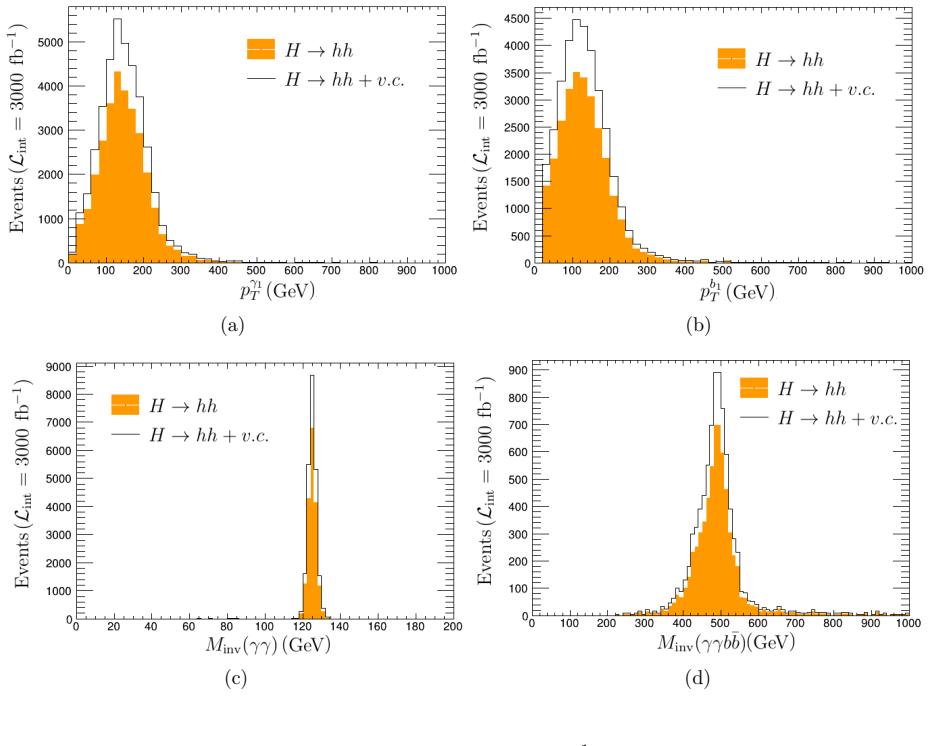
- Searches for $H\to b\bar b\gamma\gamma$ should include the three-body component: at the benchmark points it raises the expected yield by about 20% over the $H\to hh$ cascade and shifts the $p_T$ and invariant-mass distributions.
- The size of the $H\to h\gamma\gamma$ rate distinguishes 2HDM types, since bottom and tau loops are $\tan\beta$-enhanced in type-II, lepton-specific and flipped models but suppressed in type-I.
- The channel is primarily a High-Luminosity probe: at 300 fb$^{-1}$ only the type-II model reaches about $3\sigma$ for favorable benchmark points, while $5\sigma$ requires 1000-3000 fb$^{-1}$ depending on the model.
- For the favored type-II benchmark, the $5\sigma$ reach extends to $M_H\simeq 950$ GeV at 3000 fb$^{-1}$.
Reading between the lines
- Editorial: the same $b\bar b\gamma\gamma$ dataset could be recast to set model-independent limits on $\mathrm{BR}(H\to h\gamma\gamma)$ for any narrow heavy scalar, since the genuine three-body decay shifts the invariant-mass and $p_T$ distributions relative to the $hh$ cascade.
- Editorial: a shape-based analysis of the two-photon $p_T$ or the $M_{\gamma\gamma}$ line shape could isolate the three-body component and verify the claimed O(20%) excess without assuming the total signal rate.
- Editorial: because $h\to\tau\tau$ could replace $h\to b\bar b$, the lepton-specific 2HDM could also be probed through $\tau\tau\gamma\gamma$ events, extending the discrimination into the lepton sector; this is not studied in the paper.
Editorial analysis
A structured set of objections, weighed in public.
Referee Report
Summary. The paper studies the decay H -> h gamma gamma in the four 2HDM types and argues that the b bbar gamma gamma final state can yield a 5-sigma discovery at HL-LHC for heavy-Higgs masses up to 950 GeV (type-II), 650 GeV (Lepton-Specific and Flipped), and 350 GeV (type-I). Section III derives the one-loop amplitude, presented in closed form in App. C, and tests the narrow-width approximation against it. Section IV defines benchmark points after imposing theoretical and some experimental constraints, simulates pp -> b bbar gamma gamma at 14 TeV with MadGraph/Pythia/MadAnalysis, applies b-tagging, photon isolation and invariant-mass cuts, and computes significances with N_S/sqrt(N_S+N_B+(kappa N_B)^2) for integrated luminosities between 300 and 3000 fb^-1. The paper further claims that the virtual H -> h gamma gamma contributions produce an O(20%) excess over the two-body H -> hh -> b bbar gamma gamma cascade and could help discriminate 2HDM types.
Significance. If the predictions hold, the channel would add a new final state to the LHC heavy-Higgs search program and could provide a complementary handle on 2HDM type discrimination. The paper has real strengths: the one-loop amplitude is documented in analytic form and cross-checked with FeynCalc and PackageX; the narrow-width approximation is tested rather than assumed; the collider study includes fake rates, b-tagging efficiencies, and detector emulation; and the parameter scan enforces perturbativity, vacuum stability, unitarity, oblique parameters and b -> s gamma constraints. The main caveats are that the quoted discovery significances are dominated by the already-constrained H -> hh -> b bbar gamma gamma cascade rather than by an isolated H -> h gamma gamma signal, and that the benchmark points are not explicitly checked against the observed limits in Fig. 1. Both issues are addressable by reframing the claims or adding the missing validation.
major comments (2)
- [Section IV, benchmark points and Fig. 1] The benchmark points used for the 5-sigma mass reaches are not validated against the 95% CL limits shown in Fig. 1. The text quotes exclusions only for tan beta = 0.1 (type-I, Lepton-Specific and Flipped) and tan beta = 8 (type-II), but BMP1, BMP2 and BMP3 use tan beta = 0.3, 0.2 and 1 for type-I/LS/Flipped and tan beta = 3, 5 for type-II. Since sigma(pp -> H -> hh -> b bbar gamma gamma) grows toward small tan beta in the first three types, the quoted limits do not imply that the BMP cross sections are allowed; the paper should overlay the predictions for each benchmark point on the observed and expected limit curves in Fig. 1 and restrict the mass reach to regions not excluded by current data.
- [Section IV, 'Signal significance'; Abstract and Conclusions] The significance plotted in Figs. 7-9 is computed from the total number of signal events in the combined b bbar gamma gamma final state, which the same section states is dominated by the cascade H -> hh -> b bbar gamma gamma, with the genuine H -> h gamma gamma virtual contributions adding only an O(20%) excess. The quoted 5-sigma reaches therefore establish, at best, sensitivity to the combined final state, most of which is the H -> hh process already constrained by the searches reproduced in Fig. 1; they do not by themselves establish that the rare decay H -> h gamma gamma is observable. To support the abstract's claim, the authors must either reformulate the claims as sensitivity to the b bbar gamma gamma final state with H -> h gamma gamma as a subdominant correction, or provide a shape-based test statistic, such as a binned likelihood over the M(h gamma gamma) or pT(gamma) distributions, that isolates the H -> h gamma gamma excess from the H -> hh cascade. Fig. 5 shows non-uniform ratios but no statistical separation, and the statement that neglecting the h gamma gamma subprocess would cause a sizable unitarity violation is not an argument for detectability.
minor comments (4)
- [Section IV, 'Signal significance'] The phrase 'neglecting the h gamma gamma subprocess would amount to a sizable unitarity violation' is imprecise: omitting a loop-induced contribution is a model-completeness issue, not a violation of S-matrix unitarity in the presented calculation; the wording should be revised.
- [Section III, around Eq. (3.3)] The statement that the narrow-width approximation is accurate at the O(20%) level should specify the parameter region for which this holds, since the size of the box and reducible contributions will depend on M_H, tan beta and the 2HDM type.
- [Table V and Section IV] The pre-cut background cross sections in Table V are enormous, especially b bbar jj, but the paper does not provide a cut-flow table listing N_S and N_B after each stage of the analysis; such a table is needed to make the significances in Figs. 7-9 reproducible.
- [Section V, Conclusions] The claim that Lepton-Specific and Flipped 2HDMs 'would be the most difficult versions to distinguish' because their sensitivities differ by about 5% is not a demonstrated discrimination statement; without an explicit hypothesis test, a 5% cross-section difference with 5% systematic uncertainty is not evidence of distinguishability.
Circularity Check
No significant circularity: the decay width and signal significance are computed from stated 2HDM parameters; the only notable issue is that the 5σ projections use the combined b¯bγγ final state dominated by H→hh→b¯bγγ, which is an attribution/over-claim rather than a circular derivation.
full rationale
The paper's central derivation is self-contained. In Section III, the width Γ(H→hγγ) is computed from stated Lagrangian parameters via the exact one-loop amplitude (Eq. (3.1), Appendix C), and the narrow-width approximation (Eq. (3.3)) is checked against the exact result, with the paper explicitly noting that the approximation is only accurate at the O(20%) level. The collider significance in Section IV is obtained by generating signal and background events with MadGraph/Pythia/MadAnalysis, applying kinematic cuts, and evaluating NS/sqrt(NS+NB+(κNB)^2); no parameter is fitted to the projected significance, and the benchmark points are inputs scanned subject to the stated constraints, not outputs of the analysis. The self-citations (refs. [14], [27], [40]) are not load-bearing: ref. [40] is only used as a caution about an allowed region, and ref. [14] is a related dark-sector study. One interpretive concern, but not circularity: the abstract states that H→hγγ 'could be observed at the 5σ level,' while the computed significance is for the combined pp→H→b¯bγγ signal, which the paper itself says is dominated by the cascade H→hh→b¯bγγ, with the rare H→hγγ contribution adding only an O(20%) excess. The paper does not compute an excess-only significance, so the 5σ claim for the rare decay alone is not established. This is a statistical/attribution issue, not a case where a prediction reduces by construction to its input: the rare-decay amplitude is an independent, computed contribution, and no step of the derivation uses the conclusion as a premise.
Assumptions & free parameters
free parameters (5)
- tan beta =
0.2 (BMP2, type-I/LS/F), 0.3 (BMP1), 1 (BMP3), 3 or 5 (type-II)
- cos(beta - alpha) =
0.01
- MH =
scanned from mh to 1000 GeV
- MA and MH+/- =
set equal to MH in the collider scans
- m12 =
700 GeV for Fig. 2, otherwise unspecified
assumptions (6)
- domain assumption Two-Higgs-doublet model with softly-broken Z2 symmetry and natural flavor conservation
- domain assumption CP conservation in the scalar sector
- domain assumption Alignment limit cos(beta - alpha) approximately 0
- domain assumption Narrow-width approximation for H to hh and h to gamma gamma
- domain assumption Leading-order cross sections and PDF choice adequate for the significance estimate
- ad hoc to paper Existing LHC limits on pp to H to hh to b bbar gamma gamma do not exclude the chosen benchmark points
Cite this review
Pith. "Pith review of Prospects for detecting the rare heavy Higgs decay $H\to h\gamma\gamma$ through the $H\to b\bar{b}\gamma\gamma$ channel at the LHC." pith.science (2026). https://pith.science/paper/DJTHJNGC
@misc{pith2026241119170,
  author       = {Pith},
  title        = {Pith review of: Prospects for detecting the rare heavy Higgs decay $H\to h\gamma\gamma$ through the $H\to b\barb\gamma\gamma$ channel at the LHC},
  year         = {2026},
  howpublished = {\url{https://pith.science/paper/DJTHJNGC}},
  note         = {Machine review of arXiv:2411.19170}
}
abstract
We study the decay of a heavy CP-even neutral Higgs into an on-shell Standard Model-like Higgs boson and two photons, $H\to h\gamma\gamma$, in the two-Higgs doublet model. We argue that the decay channel $H\to h\gamma\gamma$, followed by the decay of the Standard Model Higgs $h\rightarrow b\bar b$, could be observed at the 5$\sigma$ level at the High-Luminosity LHC for masses of the heavy Higgs up to 950 GeV for the type-II, 650 GeV for the Lepton Specific and the Flipped 2HDMs, and 350 GeV for the type-I. We also discuss the possible role of the decay $H\to h\gamma\gamma$ in discriminating among different types of 2HDMs and in enhancing the total number of events in the final state $H\rightarrow b\bar b \gamma\gamma$ compared to the cascade decay $H\to hh$ followed by $h\to\gamma\gamma$ $h\to b\bar{b}$ with identical final state (although with different kinematical distributions).
Figures


Figures from the paper (6 more)



Reference graph
Works this paper leans on
-
[42]
M. Cacciari, G. P. Salam, and G. Soyez, JHEP 04, 063 (2008), arXiv:0802.1189 [hep-ph]
arXiv 2008
-
[1]
6 This was done through the interface of MadAnalysis
We identify b-jets and photons by imposing the transverse momentum cuts pT (γ) > 35 GeV and pT (b) > 40 GeV. 6 This was done through the interface of MadAnalysis. 16 (a) (b) (c) FIG. 6: Invariant mass distributions for (a) Minv(b¯b), (b) Minv(γγ ), and (c) Minv(hγγ ) in the 2HDM-II scenario with cos( β − α) = 0.01, tan β = 3 and MA = MH ± = MH
-
[2]
We require the angular separation between the b-jets to be 0 .4 < ∆R < 2.8 and that the angular separation between each photon pair be ∆ R ≡ p ∆ϕ2 + ∆η2 < 3,
-
[3]
We impose a cut on the invariant masses Minv(¯bb) and Minv(γγ ) in the ranges 105 GeV < Minv(b¯b) <140 GeV and 122.5 GeV < Minv(γγ ) <128.5 GeV, respectively,
-
[4]
Estancias pos- doctorales por M´ exico (SECIHTI)
Finally, the cuts on MH − 50 GeV < Minv(hγγ ) < MH + 50 GeV are also required. These requirements efficiently removes background events, as apparent from Figure 6, which shows the number of events from different processes (scaled to one) versus invariant mass distributions for representative choices of parameters in the 2HDM-II; we obtain analogous result...
2024
- [5]
-
[6]
S. Chatrchyan et al. (CMS), Phys. Lett. B 716, 30 (2012), arXiv:1207.7235 [hep-ex]
arXiv 2012
-
[7]
T. D. Lee, Phys. Rev. D 8, 1226 (1973)
work page 1973
Show all 46 references
-
[8]
Georgi, Hadronic J
H. Georgi, Hadronic J. 1, 155 (1978)
1978
-
[9]
N. G. Deshpande and E. Ma, Phys. Rev. D 18, 2574 (1978)
1978
-
[10]
R. M. Barnett, G. Senjanovic, L. Wolfenstein, and D. Wyler, Phys. Lett. B 136, 191 (1984). 26
1984
-
[11]
Aad et al
G. Aad et al. (ATLAS), Phys. Rev. D 106, 052001 (2022), arXiv:2112.11876 [hep-ex]
2022 arXiv
- [12]
-
[13]
Khachatryan et al
V. Khachatryan et al. (CMS), Phys. Rev. D 94, 052012 (2016), arXiv:1603.06896 [hep-ex]
2016 arXiv
- [14]
-
[15]
Navas et al
S. Navas et al. (Particle Data Group), Phys. Rev. D 110, 030001 (2024)
2024
-
[16]
Haller, A
J. Haller, A. Hoecker, R. Kogler, K. M¨ onig, T. Peiffer, and J. Stelzer, Eur. Phys. J. C78, 675 (2018), arXiv:1803.01853 [hep-ph]
2018 arXiv
-
[17]
L. Wang, J. M. Yang, and Y. Zhang, Commun. Theor. Phys. 74, 097202 (2022), arXiv:2203.07244 [hep-ph]
2022 arXiv
-
[18]
Ghosh, A
A. Ghosh, A. Ibarra, T. Mondal, and B. Mukhopadhyaya, JCAP 01, 011 (2020), arXiv:1909.13292 [hep-ph]
2020 arXiv
-
[19]
G. C. Branco, P. M. Ferreira, L. Lavoura, M. N. Rebelo, M. Sher, and J. P. Silva, Phys. Rept. 516, 1 (2012), arXiv:1106.0034 [hep-ph]
2012 arXiv
-
[20]
J. F. Gunion, H. E. Haber, G. L. Kane, and S. Dawson, The Higgs Hunter’s Guide, Vol. 80 (2000)
2000
- [21]
-
[22]
J. F. Gunion and H. E. Haber, Phys. Rev. D 67, 075019 (2003), arXiv:hep-ph/0207010
2003 arXiv
-
[23]
Barger, H
V. Barger, H. E. Logan, and G. Shaughnessy, Phys. Rev. D 79, 115018 (2009), arXiv:0902.0170 [hep-ph]
2009 arXiv
-
[24]
Aad et al
G. Aad et al. (ATLAS), Phys. Rev. D 101, 012002 (2020), arXiv:1909.02845 [hep-ex]
2020 arXiv
-
[25]
Semenov, Comput
A. Semenov, Comput. Phys. Commun. 201, 167 (2016), arXiv:1412.5016 [physics.comp-ph]
2016 arXiv
-
[26]
Alwall, R
J. Alwall, R. Frederix, S. Frixione, V. Hirschi, F. Maltoni, O. Mattelaer, H. S. Shao, T. Stelzer, P. Torrielli, and M. Zaro, JHEP 07, 079 (2014), arXiv:1405.0301 [hep-ph]
2014 arXiv
-
[27]
R. D. Ball et al. (NNPDF), Eur. Phys. J. C 77, 663 (2017), arXiv:1706.00428 [hep-ph]
2017 arXiv
-
[28]
Ciuchini, G
M. Ciuchini, G. Degrassi, P. Gambino, and G. F. Giudice, Nucl. Phys. B 527, 21 (1998), arXiv:hep- ph/9710335
1998
-
[29]
Misiak and M
M. Misiak and M. Steinhauser, Eur. Phys. J. C 77, 201 (2017), arXiv:1702.04571 [hep-ph]
2017 arXiv
-
[30]
M. D. Goodsell and F. Staub, Phys. Lett. B 788, 206 (2019), arXiv:1805.07310 [hep-ph]
2019 arXiv
-
[31]
M. A. Arroyo-Ure˜ na, R. Gait´ an, and T. A. Valencia-P´ erez, Rev. Mex. Fis. E 19, 020206 (2022), arXiv:2008.00564 [hep-ph]
2022 arXiv
-
[32]
Passarino and M
G. Passarino and M. J. G. Veltman, Nucl. Phys. B 160, 151 (1979)
1979
-
[33]
Mertig, M
R. Mertig, M. Bohm, and A. Denner, Comput. Phys. Commun. 64, 345 (1991)
1991
-
[34]
H. H. Patel, Comput. Phys. Commun. 197, 276 (2015), arXiv:1503.01469 [hep-ph]
2015 arXiv
-
[35]
ATLAS note ATL-PHYS-PUB-2013-009 (2013)
2013
-
[36]
A. M. Sirunyan et al. (CMS), JINST 13, P05011 (2018), arXiv:1712.07158 [physics.ins-det]
2018 arXiv
-
[37]
Degrande, C
C. Degrande, C. Duhr, B. Fuks, D. Grellscheid, O. Mattelaer, and T. Reiter, Comput. Phys. Com- mun. 183, 1201 (2012), arXiv:1108.2040 [hep-ph]. 27
2012 arXiv
-
[38]
Sj¨ ostrand, Comput
T. Sj¨ ostrand, Comput. Phys. Commun.246, 106910 (2020), arXiv:1907.09874 [hep-ph]
2020 arXiv
-
[39]
Conte, B
E. Conte, B. Fuks, and G. Serret, Comput. Phys. Commun. 184, 222 (2013), arXiv:1206.1599 [hep-ph]
2013 arXiv
-
[40]
Beta card for HL-LHC and HE-LHC studies,
M. Selvaggi, “Beta card for HL-LHC and HE-LHC studies,” (2017)
2017
-
[41]
Cacciari, G
M. Cacciari, G. P. Salam, and G. Soyez, Eur. Phys. J. C 72, 1896 (2012), arXiv:1111.6097 [hep-ph]
2012 arXiv
- [43]
-
[44]
M. A. Arroyo-Ure˜ na and J. L. Diaz-Cruz, Phys. Lett. B 810, 135799 (2020), arXiv:2005.01153 [hep- ph]
2020 arXiv
-
[45]
Statistics,
G. Cowan, “Statistics,” in Handbook of Particle Detection and Imaging, edited by C. Grupen and I. Buvat (2021) pp. 103–124
2021
-
[46]
K. H. Phan, D. T. Tran, and T. H. Nguyen, (2024), arXiv:2406.15749 [hep-ph]. 28
2024 arXiv
Reviewed August 12, 2026 · model on record in the stance chip above.
Discussion (0). Continue with ORCID to comment.