REVIEW 4 major objections 6 minor 53 references
Z-STAR+: A Zero-shot Style Transfer Method via Adjusting Style Distribution
T0 review · 4 major / 6 minor · reviewed 2026-08-12 · deepseek-v4-flash
Pith's one-line read Style transfer can run on a pretrained diffusion model without any training, using only attention reweighting and a scaled normalization step to pull style from a reference image.
desk verdict A readable Z* extension with a solid local attention mechanism, but the new SAIN formula contradicts its own design goal and the supporting evidence is weak. read the letter →
The pith
A machine-rendered reading of the paper's core claim, the machinery that carries it, and where it could break.
The reading
What carries the argument
The central object is the Cross-attention Reweighting attention matrix $A'=\sigma([\lambda Q_c K_s^T/\sqrt{d}, Q_c K_c^T/\sqrt{d}])$, applied to the stacked value features $[V_s; V_c]$. It replaces a hand-tuned $\lambda$ outside the softmax with a $\lambda$ inside a single softmax, so each output row is normalized across both style and content tokens; this is what lets weak style matches fade to content self-attention automatically. The second mechanism is SAIN, $\hat f_c = f_c - \mu_c w + \mu_s w$ with $w=e^{KL(f_s\|f_c)}$, applied at the initial denoising step to shift the global color statistics toward the style image. Dual DDIM inversion supplies the content and style feature trajectories that feed both mechanisms.
What would settle it
Take many content/style pairs, compute the KL divergence between their initial noise feature distributions, run the method with and without SAIN, and plot the color-histogram distance between output and style as a function of that KL. The paper's stated goal predicts a decreasing relationship, while its formula $w=e^{KL}$ predicts an increasing one, so a monotonicity measurement would settle which behavior actually occurs. A second check would quantify whether initial noise means cluster by style using a metric such as silhouette score instead of by eye; if they do not, the SAIN target does not exist.
Extended reading notes
Core claim
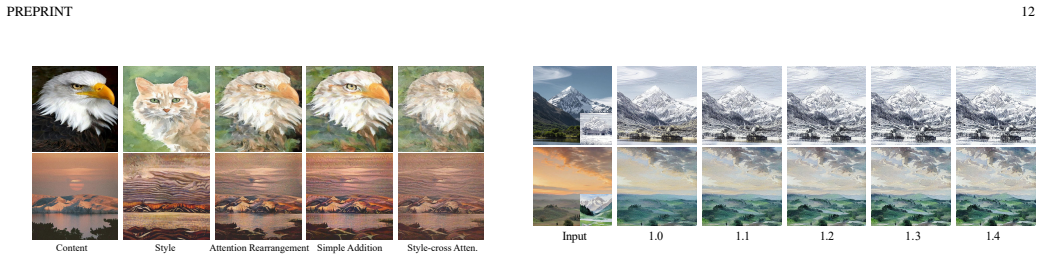
Z-STAR+ claims that in a vanilla latent diffusion model, the spatial features obtained from DDIM inversion separate into content-like and style-like components, so a style image and a content image can be denoised along parallel paths and fused at the attention level. Local style transfer is performed by a Cross-attention Reweighting module: content features provide the query $Q_c$, style features provide keys and values $K_s,V_s$, and these are concatenated with the content self-attention inside a single softmax that also contains a scale parameter $\lambda$. Because the softmax normalizes the combined row, weak content-style matches are automatically suppressed rather than amplified, which the paper argues fixes the content loss caused by naive style-cross attention or simple addition. Global color alignment is handled by Scaled Adaptive Instance Normalization (SAIN), which replaces a fraction of the content feature mean with the style feature mean, scaled by an exponential KL weight $w=e^{KL}$, applied on the first denoising step. The paper argues that this closes the global style gap without destroying content, and it extends the pipeline to video by concatenating key-value features from the first and previous frames and minimizing an energy loss in the predicted clean-image space.
Load-bearing premise
The global color adjustment assumes that the style of the initial noisy latent is set by the mean of the random noise produced when inverting the content and style images, so shifting that mean toward the style image's noise mean can align colors without disturbing the content.
Editorial extensions
If this is right
- Style transfer becomes a training-free operation: any content/style pair can be stylized by reusing a pretrained diffusion model's weights as-is.
- The injection schedule controls the trade-off: starting attention earlier transfers more style, while later injection preserves more content; the paper finds the 5th through 30th denoising steps and the higher-resolution decoder layers work best.
- SAIN changes only the global color statistics; the paper shows that removing it leaves color misaligned, while replacing it with a plain mean adjustment harms content.
- The video extension makes the method applicable to stylizing clips by reusing key/value features of the first and previous frames and adding an energy loss in the noise-free domain.
Reading between the lines
- The same reweighted-attention matrix could serve as a general texture-routing tool, attaching different style keys to different spatial regions to composite multiple styles beyond the binary-mask control the paper demonstrates.
- If the initial-noise-mean premise holds, the SAIN recipe generalizes: other global statistics of the inverted noise could be aligned before denoising, providing a cheap way to steer the global look of diffusion outputs beyond color.
- The SAIN formula makes a testable prediction about how color shift scales with style-content divergence; measuring that scaling would separate the color-alignment effect from the attention effect.
Signed reviews
Editorial analysis
A structured set of objections, weighed in public.
Referee Report
Summary. The paper proposes Z-STAR+, a training-free style transfer method built on Stable Diffusion. It uses two DDIM-inverted denoising paths for content and style images, a cross-attention reweighting module to transfer local style patterns, and a scaled adaptive instance normalization (SAIN) to adjust global color in the first denoising step. The method is extended to video by injecting inter-frame attention and an energy loss in the noise-free domain. Experiments compare against eight baselines on content/style losses, a user study, and video consistency metrics.
Significance. If the method worked as described, it would be a useful zero-shot extension to the authors' prior Z* work, adding global color control and video support without retraining. The local attention mechanism is inherited from Z* and appears reasonable. However, the main new component, SAIN, contains a direct internal contradiction in the definition of its scaling weight, and its supporting hypothesis is only qualitatively validated. The video extension also has an inconsistent update rule. The central technical claims are therefore not currently supported, though the issues are potentially fixable.
major comments (4)
- [Sec. IV-D, Eq. (17)] The definition w = e^{KL(f_s||f_c)} is inconsistent with the stated design goal. Since KL divergence is nonnegative and exp(.) is monotonically increasing, w >= 1 and grows as the style and content distributions diverge. The prose immediately after Eq. (17) says the opposite: 'When the probability distribution difference between initial content and style is larger, the scale weight are smaller.' As written, SAIN applies a larger mean replacement exactly when the method claims to be most conservative. Because Table IV and Fig. 15 use the SAIN ablation as evidence for the paper's main new contribution, this is a load-bearing error. Either the formula is missing a minus sign (and the text is wrong) or the implementation uses a decreasing weight but the paper is misdescribed; neither case is reproducible as submitted.
- [Sec. IV-D, Eq. (17)] The KL term is under-specified. The paper states that p(f_s) and p(f_c) are estimated by histogram-based methods, but does not say what features f_s and f_c are (initial DDIM noise latents? U-Net features at a specific layer?), how many bins are used, or whether the estimate is per-channel or over the whole tensor. Without this information Eqs. (16)-(17) cannot be reproduced. In addition, the only evidence for the load-bearing hypothesis that the mean of the initial noise encodes style is the t-SNE plot in Fig. 6 over three style groups; no quantitative cluster-separation measure is given. The global adjustment step therefore rests on a qualitative observation.
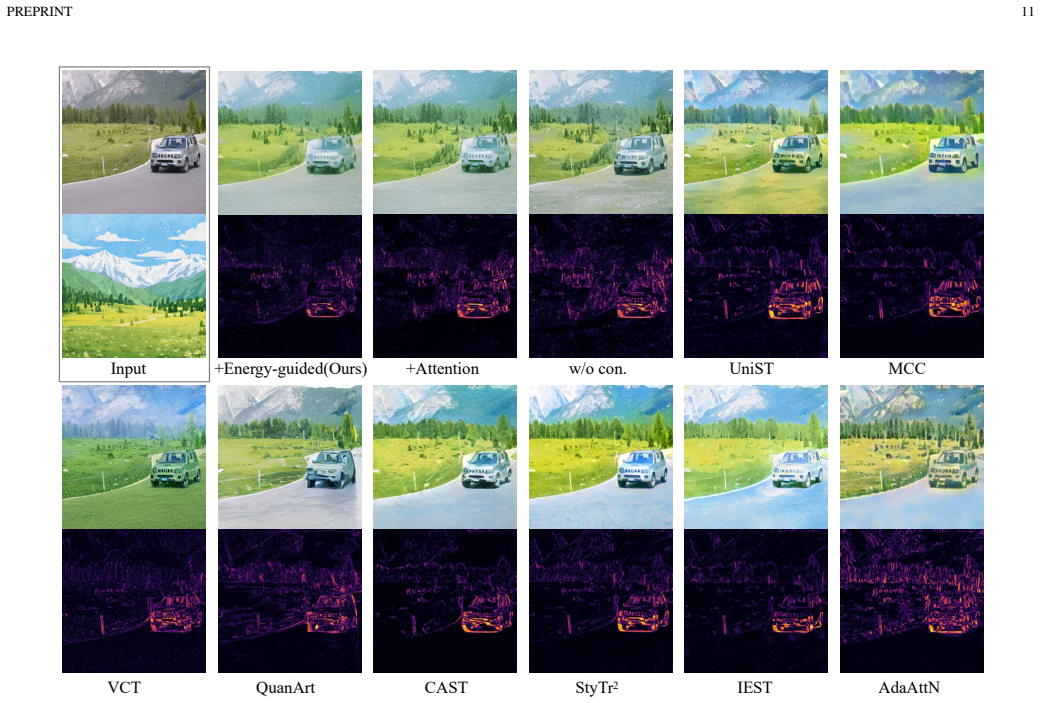
- [Sec. V-B, Table IV and Eq. (21)] The evaluation of SAIN is partly confounded by the metric. The style loss L_s in Eq. (21) is the mean and variance difference of VGG features, and SAIN directly replaces the content latent mean with the style latent mean in the initial denoising step. The reported improvement in L_s from removing SAIN (3.70 vs 3.63 in Table IV) therefore partly reflects the operation itself rather than a general style-alignment effect. More importantly, the claim that SAIN preserves content better than the unscaled mean adjustment (L_c 1.65 vs 1.88 in Table IV) is in direct tension with Eq. (17): if w >= 1, SAIN shifts the mean more aggressively than Eq. (15), which should increase content damage, not reduce it. The authors need to state the actual weight used and provide additional validation (e.g., a content metric not based on the same statistics, or a quantitative color-distribution measure) to support the global-adjustment claim.
- [Sec. IV-E, Eq. (19)] The video update rule is inconsistent. The equation writes f^i_{t-1} = f^i_{t-1} − w · ∇_{f^i_t} · E_{t-1}, where E_{t-1} is computed from the predicted noise-free samples at step t-1. As written, the updated variable and the differentiation variable do not match, and the weight w is not specified anywhere in the paper. Since the video experiments (Fig. 11, Table III) depend on this update, the extension is not reproducible without further details.
minor comments (6)
- [Table I] The first numeric entry under InstantStyle-Plus ('14.5') lacks the percentage sign used by the other entries; the table formatting should be corrected.
- [Table III] The caption reads 'User study results' but the table reports mean/variance of inter-frame differences; the caption should be changed to 'Quantitative video consistency results'.
- [Sec. IV-E] 'emergy loss' should be 'energy loss'; 'denosing' and 'lager' should be 'denoising' and 'larger'.
- [Eq. (11)] The bracket contains an extra comma after Q_c K_c^T / sqrt(d).
- [Sec. IV-D] 'scale wight' should be 'scale weight'.
- [Fig. 6] The caption does not explain what the colors/legends correspond to; please clarify the three style groups.
Circularity Check
No significant circularity: the new SAIN and attention-reweighting components are explicit, self-contained mechanisms evaluated on external VGG-based metrics; the Eq. (17) sign issue is a correctness bug, not a circular derivation.
full rationale
The paper's novel global adjustment, SAIN, is a hand-designed normalization (Eq. 16) that replaces a content latent mean with a scaled style latent mean; it is not a parameter fitted to the reported loss, and its evaluation metric Ls (Eq. 21) operates on VGG features rather than the same latent statistics. Table IV even shows 'Mean adjustment' achieving a lower Ls (3.59) than 'ours' (3.63), so the reported SAIN result is not forced by construction. The cross-attention reweighting is derived algebraically from Eq. (8) via the softmax reformulation in Eqs. (9)-(12) and is ablated with alternative attention arrangements; it does not reduce to the content/style inputs. The extension of the authors' CVPR 2024 Z* paper is transparently declared; no uniqueness theorem is imported to forbid alternatives. The only serious issue in the derivation chain is Eq. (17): w=e^{KL(fs||fc)} is monotonically increasing in the KL divergence, while the text immediately below states 'When the probability distribution difference... is lager, the scale wight are smaller.' As written, the formula contradicts the stated design rationale and the KL estimation is underspecified. This is a correctness and reproducibility flaw, not a circularity: the claimed result does not become equivalent to its inputs by definition. The t-SNE evidence in Fig. 6 is qualitative and weak, but supporting a hypothesis with a visualization is not circular reasoning.
Assumptions & free parameters
free parameters (4)
- lambda (style scaling factor) =
1.2
- Attention injection layers =
U-Net layers 10-15
- Attention injection denoising steps =
steps 5-30
- Energy loss weight w for video =
not specified
assumptions (5)
- domain assumption Pretrained Stable Diffusion latent features contain separable content and style distributions such that Q from content and K/V from style can be mixed in self-attention layers.
- ad hoc to paper The mean of the initial DDIM inversion noise encodes image style, and shifting it toward the style noise mean aligns global color without destroying content.
- ad hoc to paper Histogram-based KL divergence between high-dimensional feature distributions is a valid and stable measure for setting the SAIN weight.
- ad hoc to paper For video, attention to the first frame and previous frame plus an energy loss in noise-free space yields temporal coherence without retraining.
- domain assumption VGG19 content and style losses are reliable proxies for content preservation and style quality, and the differences reported are meaningful without error bars.
Cite this review
Pith. "Pith review of Z-STAR+: A Zero-shot Style Transfer Method via Adjusting Style Distribution." pith.science (2026). https://pith.science/paper/FQAKZSTY
@misc{pith2026241119231,
  author       = {Pith},
  title        = {Pith review of: Z-STAR+: A Zero-shot Style Transfer Method via Adjusting Style Distribution},
  year         = {2026},
  howpublished = {\url{https://pith.science/paper/FQAKZSTY}},
  note         = {Machine review of arXiv:2411.19231}
}
read the original abstract
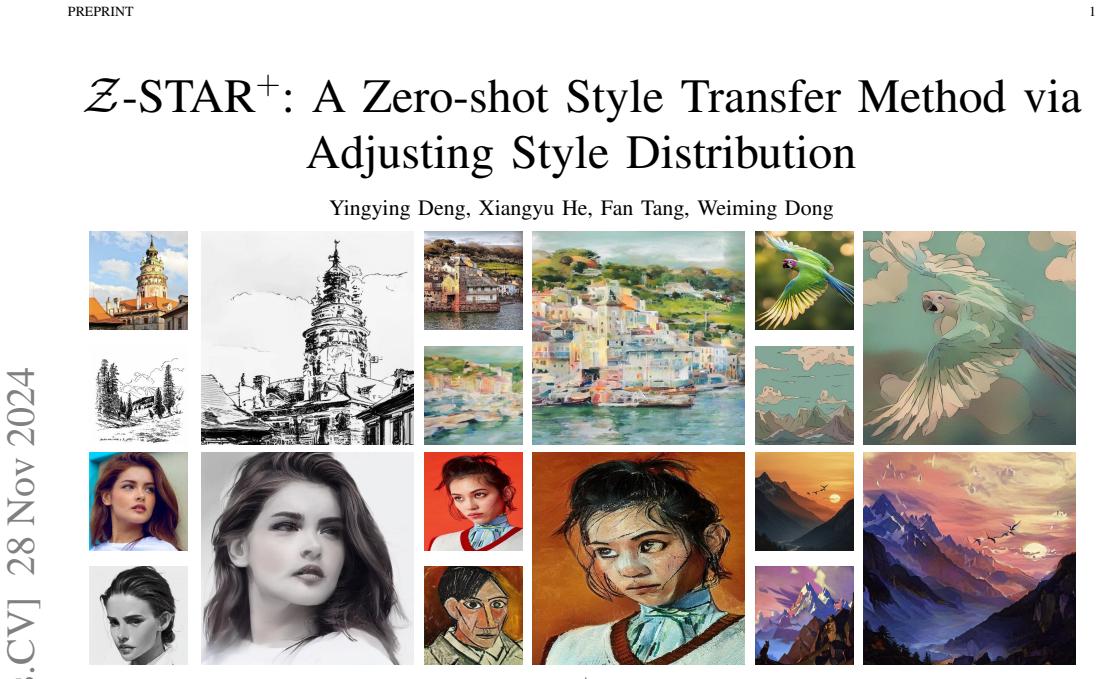
Style transfer presents a significant challenge, primarily centered on identifying an appropriate style representation. Conventional methods employ style loss, derived from second-order statistics or contrastive learning, to constrain style representation in the stylized result. However, these pre-defined style representations often limit stylistic expression, leading to artifacts. In contrast to existing approaches, we have discovered that latent features in vanilla diffusion models inherently contain natural style and content distributions. This allows for direct extraction of style information and seamless integration of generative priors into the content image without necessitating retraining. Our method adopts dual denoising paths to represent content and style references in latent space, subsequently guiding the content image denoising process with style latent codes. We introduce a Cross-attention Reweighting module that utilizes local content features to query style image information best suited to the input patch, thereby aligning the style distribution of the stylized results with that of the style image. Furthermore, we design a scaled adaptive instance normalization to mitigate inconsistencies in color distribution between style and stylized images on a global scale. Through theoretical analysis and extensive experimentation, we demonstrate the effectiveness and superiority of our diffusion-based \uline{z}ero-shot \uline{s}tyle \uline{t}ransfer via \uline{a}djusting style dist\uline{r}ibution, termed Z-STAR+.
Figures


Figures from the paper (11 more)




Reference graph
Works this paper leans on
-
[1]
Stytr2: Image style transfer with transformers,
Y . Deng, F. Tang, W. Dong, C. Ma, X. Pan, L. Wang, and C. Xu, “Stytr2: Image style transfer with transformers,” in Proceedings of the IEEE/CVF Conference on Computer Vision and Pattern Recognition (CVPR) , June 2022, pp. 11 326–11 336. 1, 2, 3, 8, 10, 11
work page 2022
-
[2]
Inversion-based style transfer with diffusion models,
Y . Zhang, N. Huang, F. Tang, H. Huang, C. Ma, W. Dong, and C. Xu, “Inversion-based style transfer with diffusion models,” in Proceedings of the IEEE/CVF Conference on Computer Vision and Pattern Recognition , 2023, pp. 10 146–10 156. 1, 2, 3, 8
work page 2023
-
[3]
Instantstyle- plus: Style transfer with content-preserving in text-to-image generation,
H. Wang, P. Xing, R. Huang, H. Ai, Q. Wang, and X. Bai, “Instantstyle- plus: Style transfer with content-preserving in text-to-image generation,” CoRR, vol. abs/2407.00788, 2024. 2, 8
arXiv 2024
-
[4]
Image style transfer using convolutional neural networks,
L. A. Gatys, A. S. Ecker, and M. Bethge, “Image style transfer using convolutional neural networks,” in IEEE/CVF Conference on Computer Vision and Pattern Recognition (CVPR) , 2016, pp. 2414–2423. 1, 3
work page 2016
-
[5]
Arbitrary style transfer in real-time with adaptive instance normalization,
X. Huang and B. Serge, “Arbitrary style transfer in real-time with adaptive instance normalization,” in IEEE International Conference on Computer Vision (ICCV), 2017, pp. 1501–1510. 1, 3
work page 2017
-
[6]
Perceptual losses for real-time style transfer and super-resolution,
J. Johnson, A. Alahi, and L. Fei-Fei, “Perceptual losses for real-time style transfer and super-resolution,” in European Conference on Computer Vision (ECCV). Springer, 2016, pp. 694–711. 1
work page 2016
-
[7]
Avatar-net: Multi-scale zero- shot style transfer by feature decoration,
L. Sheng, Z. Lin, J. Shao, and X. Wang, “Avatar-net: Multi-scale zero- shot style transfer by feature decoration,” in IEEE/CVF Conference on Computer Vision and Pattern Recognition (CVPR) . IEEE, 2018, pp. 8242–8250. 1
work page 2018
-
[8]
Arbitrary style transfer with style-attentional networks,
D. Y . Park and K. H. Lee, “Arbitrary style transfer with style-attentional networks,” in IEEE/CVF Conference on Computer Vision and Pattern Recognition (CVPR), 2019, pp. 5880–5888. 1, 3
work page 2019
Show all 53 references
-
[9]
Arbitrary style transfer via multi-adaptation network,
Y . Deng, F. Tang, W. Dong, W. Sun, F. Huang, and C. Xu, “Arbitrary style transfer via multi-adaptation network,” in ACM International Conference on Multimedia, 2020, pp. 2719–2727. 1, 3
2020
-
[10]
Infostyler: Disentanglement information bottleneck for artistic style transfer,
Y . Lyu, Y . Jiang, B. Peng, and J. Dong, “Infostyler: Disentanglement information bottleneck for artistic style transfer,” IEEE Transactions on Circuits and Systems for Video Technology, vol. 34, no. 4, pp. 2070–2082,
-
[11]
Swinit: Hierarchical image-to-image translation framework without cycle consistency,
J. Liu, H. Fu, X. Wang, and H. Ma, “Swinit: Hierarchical image-to-image translation framework without cycle consistency,” IEEE Transactions on Circuits and Systems for Video Technology, vol. 34, no. 7, pp. 5546–5559,
-
[12]
Incremental learning of multi- domain image-to-image translations,
D. S. Tan, Y .-X. Lin, and K.-L. Hua, “Incremental learning of multi- domain image-to-image translations,” IEEE Transactions on Circuits and Systems for Video Technology, vol. 31, no. 4, pp. 1526–1539, 2021. 1
2021
-
[13]
Let there be light: Improved traffic surveillance via detail preserving night-to-day transfer,
L. Fu, H. Yu, F. Juefei-Xu, J. Li, Q. Guo, and S. Wang, “Let there be light: Improved traffic surveillance via detail preserving night-to-day transfer,” IEEE Transactions on Circuits and Systems for Video Technology, vol. 32, no. 12, pp. 8217–8226, 2022. 1
2022
-
[14]
ArtFlow: Unbiased image style transfer via reversible neural flows,
J. An, S. Huang, Y . Song, D. Dou, W. Liu, and J. Luo, “ArtFlow: Unbiased image style transfer via reversible neural flows,” in IEEE/CVF Conferences on Computer Vision and Pattern Recognition (CVPR) , 2021, pp. 862–871. 1, 3
2021
-
[15]
Styleformer: Real-time arbitrary style transfer via parametric style composition,
X. Wu, Z. Hu, L. Sheng, and D. Xu, “Styleformer: Real-time arbitrary style transfer via parametric style composition,” in Proceedings of the IEEE/CVF International Conference on Computer Vision (ICCV) , 2021, pp. 14 618–14 627. 1, 3
2021
-
[16]
General image-to-image translation with one-shot image guidance,
B. Cheng, Z. Liu, Y . Peng, and Y . Lin, “General image-to-image translation with one-shot image guidance,” in Proceedings of the IEEE/CVF International Conference on Computer Vision , 2023, pp. 22 736–22 746. 1, 2, 3, 8, 11
2023
-
[17]
Controlling perceptual factors in neural style transfer,
L. A. Gatys, A. S. Ecker, M. Bethge, A. Hertzmann, and E. Shechtman, “Controlling perceptual factors in neural style transfer,” in 2017 IEEE Conference on Computer Vision and Pattern Recognition, CVPR 2017, Honolulu, HI, USA, July 21-26, 2017 . IEEE Computer Society, 2017, pp....
2017
-
[18]
Demystifying neural style transfer,
Y . Li, N. Wang, J. Liu, and X. Hou, “Demystifying neural style transfer,” in International Joint Conference on Artificial Intelligence (IJCAI) , 2017. 1
2017
-
[19]
Domain enhanced arbitrary image style transfer via contrastive learning,
Y . Zhang, F. Tang, W. Dong, H. Huang, C. Ma, T.-Y . Lee, and C. Xu, “Domain enhanced arbitrary image style transfer via contrastive learning,” in ACM SIGGRAPH 2022 Conference Proceedings , 2022, pp. 1–8. 2, 3, 8, 10, 11
2022
-
[20]
T2i-adapter: Learning adapters to dig out more controllable ability for text-to-image diffusion models,
C. Mou, X. Wang, L. Xie, Y . Wu, J. Zhang, Z. Qi, Y . Shan, and X. Qie, “T2i-adapter: Learning adapters to dig out more controllable ability for text-to-image diffusion models,” arXiv preprint arXiv:2302.08453 , 2023. 2, 3
2023 arXiv
-
[21]
Ipadapter-instruct: Resolving ambiguity in image-based conditioning using instruct prompts,
C. Rowles, S. Vainer, D. D. Nigris, S. Elizarov, K. Kutsy, and S. Donné, “Ipadapter-instruct: Resolving ambiguity in image-based conditioning using instruct prompts,” CoRR, vol. abs/2408.03209, 2024. 2
2024 arXiv
-
[22]
High-resolution image synthesis with latent diffusion models,
R. Rombach, A. Blattmann, D. Lorenz, P. Esser, and B. Ommer, “High-resolution image synthesis with latent diffusion models,” in Proceedings of the IEEE/CVF Conference on Computer Vision and Pattern Recognition, 2022, pp. 10 684–10 695. 2, 3
2022
-
[23]
Z*: Zero-shot style transfer via attention reweighting,
Y . Deng, X. He, F. Tang, and W. Dong, “Z*: Zero-shot style transfer via attention reweighting,” in Proceedings of the IEEE/CVF Conference on Computer Vision and Pattern Recognition (CVPR) , June 2024, pp. 6934–6944. 3
2024
-
[24]
Quality evaluation of arbitrary style transfer: Subjective study and objective metric,
H. Chen, F. Shao, X. Chai, Y . Gu, Q. Jiang, X. Meng, and Y .-S. Ho, “Quality evaluation of arbitrary style transfer: Subjective study and objective metric,” IEEE Transactions on Circuits and Systems for Video Technology, vol. 33, no. 7, pp. 3055–3070, 2023. 3
2023
-
[25]
Universal style transfer via feature transforms,
Y . Li, C. Fang, J. Yang, Z. Wang, X. Lu, and M.-H. Yang, “Universal style transfer via feature transforms,” in Advances Neural Information Processing Systems (NeurIPS) , 2017, pp. 386–396. 3
2017
-
[26]
Adaattn: Revisit attention mechanism in arbitrary neural style transfer,
S. Liu, T. Lin, D. He, F. Li, M. Wang, X. Li, Z. Sun, Q. Li, and E. Ding, “Adaattn: Revisit attention mechanism in arbitrary neural style transfer,” in Proceedings of the IEEE International Conference on Computer Vision (ICCV), 2021, pp. 6649–6658. 3, 8, 11
2021
-
[27]
A comparative study of cnn-and transformer-based visual style transfer,
H.-P. Wei, Y .-Y . Deng, F. Tang, X.-J. Pan, and W.-M. Dong, “A comparative study of cnn-and transformer-based visual style transfer,” Journal of Computer Science and Technology, vol. 37, no. 3, pp. 601–614,
-
[28]
Master: Meta style transformer for controllable zero-shot and few-shot artistic style transfer,
H. Tang, S. Liu, T. Lin, S. Huang, F. Li, D. He, and X. Wang, “Master: Meta style transformer for controllable zero-shot and few-shot artistic style transfer,” in Proceedings of the IEEE/CVF Conference on Computer Vision and Pattern Recognition (CVPR) , June 2023, pp. 18 329–18 338. 3
2023
-
[29]
Fine-grained image style transfer with visual transformers,
J. Wang, H. Yang, J. Fu, T. Yamasaki, and B. Guo, “Fine-grained image style transfer with visual transformers,” in Proceedings of the Asian Conference on Computer Vision , 2022, pp. 841–857. 3 PREPRINT 14
2022
-
[30]
S2wat: Image style transfer via hierarchical vision transformer using strips window attention,
C. Zhang, J. Yang, L. Wang, and Z. Dai, “S2wat: Image style transfer via hierarchical vision transformer using strips window attention,” arXiv preprint arXiv:2210.12381, 2022. 3
2022 arXiv
-
[31]
Transformers in computational visual media: A survey,
Y . Xu, H. Wei, M. Lin, Y . Deng, K. Sheng, M. Zhang, F. Tang, W. Dong, F. Huang, and C. Xu, “Transformers in computational visual media: A survey,” Computational Visual Media , vol. 8, no. 1, pp. 33–62, 2022. 3
2022
-
[32]
Artistic style transfer with internal-external learning and contrastive learning,
H. Chen, Z. Wang, H. Zhang, Z. Zuo, A. Li, W. Xing, D. Lu et al. , “Artistic style transfer with internal-external learning and contrastive learning,” Advances in Neural Information Processing Systems , vol. 34, pp. 26 561–26 573, 2021. 3
2021
-
[33]
Zero-shot contrastive loss for text- guided diffusion image style transfer,
S. Yang, H. Hwang, and J. C. Ye, “Zero-shot contrastive loss for text- guided diffusion image style transfer,” arXiv preprint arXiv:2303.08622 ,
-
[34]
Artistic style transfer with internal-external learning and contrastive learning,
H. Chen, Z. Wang, H. Zhang, Z. Zuo, A. Li, W. Xing, D. Lu et al. , “Artistic style transfer with internal-external learning and contrastive learning,” in Advances in Neural Information Processing Systems (NeurIPS), 2021. 3, 8, 10, 11
2021
-
[35]
Hierarchical text-conditional image generation with CLIP latents,
A. Ramesh, P. Dhariwal, A. Nichol, C. Chu, and M. Chen, “Hierarchical text-conditional image generation with CLIP latents,” CoRR, vol. abs/2204.06125, 2022. 3
2022 arXiv
-
[36]
Photorealistic text-to-image diffusion models with deep language understanding,
C. Saharia, W. Chan, S. Saxena, L. Li, J. Whang, E. L. Denton, S. K. S. Ghasemipour, R. G. Lopes, B. K. Ayan, T. Salimans, J. Ho, D. J. Fleet, and M. Norouzi, “Photorealistic text-to-image diffusion models with deep language understanding,” in NeurIPS, 2022. 3
2022
-
[37]
Glide: Towards photorealistic image generation and editing with text-guided diffusion models,
A. Nichol, P. Dhariwal, A. Ramesh, P. Shyam, P. Mishkin, B. McGrew, I. Sutskever, and M. Chen, “Glide: Towards photorealistic image generation and editing with text-guided diffusion models,” arXiv preprint arXiv:2112.10741, 2021. 3
2021 arXiv
-
[38]
Imagic: Text-based real image editing with diffusion models,
B. Kawar, S. Zada, O. Lang, O. Tov, H. Chang, T. Dekel, I. Mosseri, and M. Irani, “Imagic: Text-based real image editing with diffusion models,” CoRR, vol. abs/2210.09276, 2022. 3
2022 arXiv
-
[39]
Prompt-to-prompt image editing with cross-attention control,
A. Hertz, R. Mokady, J. Tenenbaum, K. Aberman, Y . Pritch, and D. Cohen-Or, “Prompt-to-prompt image editing with cross-attention control,” in The Eleventh International Conference on Learning Repre- sentations, ICLR 2023, Kigali, Rwanda, May 1-5, 2023. OpenReview.net,
2023
-
[40]
Null- text inversion for editing real images using guided diffusion models,
R. Mokady, A. Hertz, K. Aberman, Y . Pritch, and D. Cohen-Or, “Null- text inversion for editing real images using guided diffusion models,” CoRR, vol. abs/2211.09794, 2022. 3
2022 arXiv
-
[41]
Stylediffusion: Prompt-embedding inversion for text-based editing,
S. Li, J. van de Weijer, T. Hu, F. S. Khan, Q. Hou, Y . Wang, and J. Yang, “Stylediffusion: Prompt-embedding inversion for text-based editing,” arXiv preprint arXiv:2303.15649 , 2023. 3
2023 arXiv
-
[42]
Plug-and-play diffusion features for text-driven image-to-image translation,
N. Tumanyan, M. Geyer, S. Bagon, and T. Dekel, “Plug-and-play diffusion features for text-driven image-to-image translation,” CoRR, vol. abs/2211.12572, 2022. 3, 4
2022 arXiv
-
[43]
Masactrl: Tuning-free mutual self-attention control for consistent image synthesis and editing,
M. Cao, X. Wang, Z. Qi, Y . Shan, X. Qie, and Y . Zheng, “Masactrl: Tuning-free mutual self-attention control for consistent image synthesis and editing,” CoRR, vol. abs/2304.08465, 2023. 3, 4
2023 arXiv
-
[44]
An image is worth one word: Personalizing text-to- image generation using textual inversion,
R. Gal, Y . Alaluf, Y . Atzmon, O. Patashnik, A. H. Bermano, G. Chechik, and D. Cohen-Or, “An image is worth one word: Personalizing text-to- image generation using textual inversion,” in The Eleventh International Conference on Learning Representations, ICLR 2023, Kigali, Rwa...
2023
-
[45]
Prompt- free diffusion: Taking
X. Xu, J. Guo, Z. Wang, G. Huang, I. Essa, and H. Shi, “Prompt- free diffusion: Taking "text" out of text-to-image diffusion models,” in IEEE/CVF Conference on Computer Vision and Pattern Recognition, CVPR 2024, Seattle, WA, USA, June 16-22, 2024 . IEEE, 2024, pp. 8682–8692. 3
2024
-
[46]
Adding conditional control to text-to-image diffusion models,
L. Zhang, A. Rao, and M. Agrawala, “Adding conditional control to text-to-image diffusion models,” in IEEE/CVF International Conference on Computer Vision, ICCV 2023, Paris, France, October 1-6, 2023 . IEEE, 2023, pp. 3813–3824. 3
2023
-
[47]
Neural machine translation by jointly learning to align and translate,
D. Bahdanau, K. Cho, and Y . Bengio, “Neural machine translation by jointly learning to align and translate,” in 3rd International Conference on Learning Representations, ICLR 2015, San Diego, CA, USA, May 7-9, 2015, Conference Track Proceedings, Y . Bengio and Y . LeCun, Eds.,
2015
-
[48]
Attention is all you need,
A. Vaswani, N. Shazeer, N. Parmar, J. Uszkoreit, L. Jones, A. N. Gomez, L. Kaiser, and I. Polosukhin, “Attention is all you need,” in Advances in Neural Information Processing Systems 30: Annual Conference on Neural Information Processing Systems 2017, December 4-9, 2017, Long...
2017
-
[49]
Pix2video: Video editing using image diffusion,
D. Ceylan, C. P. Huang, and N. J. Mitra, “Pix2video: Video editing using image diffusion,” in IEEE/CVF International Conference on Computer Vision, ICCV 2023, Paris, France, October 1-6, 2023 . IEEE, 2023, pp. 23 149–23 160. 8
2023
-
[50]
Quantart: Quantizing image style transfer towards high visual fidelity,
S. Huang, J. An, D. Wei, J. Luo, and H. Pfister, “Quantart: Quantizing image style transfer towards high visual fidelity,” in Proceedings of the IEEE Conference on Computer Vision and Pattern Recognition , June
-
[51]
High- resolution image synthesis with latent diffusion models,
R. Rombach, A. Blattmann, D. Lorenz, P. Esser, and B. Ommer, “High- resolution image synthesis with latent diffusion models,” in IEEE/CVF Conference on Computer Vision and Pattern Recognition, CVPR 2022, New Orleans, LA, USA, June 18-24, 2022 . IEEE, 2022, pp. 10 674– 10 685. 8
2022
-
[52]
Two birds, one stone: A unified framework for joint learning of image and video style transfers,
B. Gu, H. Fan, and L. Zhang, “Two birds, one stone: A unified framework for joint learning of image and video style transfers,” in Proceedings of the IEEE/CVF International Conference on Computer Vision (ICCV) , October 2023, pp. 23 545–23 554. 10, 11
2023
-
[53]
Exploring the temporal consistency of arbitrary style transfer: A channelwise perspective,
X. Kong, Y . Deng, F. Tang, W. Dong, C. Ma, Y . Chen, Z. He, and C. Xu, “Exploring the temporal consistency of arbitrary style transfer: A channelwise perspective,” IEEE Transactions on Neural Networks and Learning Systems, pp. 1–15, 2023. 10, 11
2023
Reviewed August 12, 2026 · model on record in the stance chip above.
Discussion (0). Continue with ORCID to comment.