REVIEW 3 major objections 6 minor 55 references
Diffusion Models Meet Network Management: Improving Traffic Matrix Analysis with Diffusion-based Approach
T0 review · 3 major / 6 minor · reviewed 2026-08-12 · deepseek-v4-flash
Pith's one-line read A diffusion-based framework, Diffusion-TM, recovers traffic matrices from partial link loads or sparse flow measurements, and the paper proves its measurement-guidance corrections keep estimates on the data manifold.
desk verdict Useful diffusion-based toolkit for traffic matrix tasks with real empirical gains, but the advertised theoretical guarantee in Theorem 1 is not established by the proof as written. read the letter →
The pith
A machine-rendered reading of the paper's core claim, the machinery that carries it, and where it could break.
The reading
What carries the argument
The load-bearing object is the guided reverse-diffusion step. At each time $t$, the algorithm performs the ordinary DDPM/DDIM denoising update to get $x'_{t-1}$, then adds the measurement gradient $\rho_t \nabla_{x_t} \lVert y - \mathcal{A}(\hat{x}_0)\rVert_2^2$, where $\hat{x}_0 = E[x_0 \mid x_t]$ comes from Tweedie's formula. This gradient is the tractable proxy for the intractable likelihood term $\nabla_{x_t}\log p_t(y \mid x_t)$, and Theorem 1 states that, for linear manifolds, this correction lies in the tangent space of the data manifold and cannot push the sample outside it. The supporting identity is Tweedie's formula, which makes the conditional expectation available in closed form from the learned score function. Around this core sit the EM iteration for tomography, the replace-based guidance for completion, and the two-stage masked training (autoencoder infilling followed by a loss computed only on observed entries).
What would settle it
A decisive test is to train Diffusion-TM on a synthetic traffic dataset whose ground-truth manifold is deliberately nonlinear (for example, points on a low-dimensional curve embedded into the flow space) and then measure whether the guided samples stay close to that manifold, using the distance from each final estimate to the nearest true sample; if estimates consistently fall far from the manifold or are no more accurate than unguided sampling, the paper's linear-projection assumption fails.
Extended reading notes
Core claim
Diffusion-TM turns the reverse process of an unconditional diffusion model into a posterior sampler for network measurements by adding a single correction at each denoising step. For a noisy state $x_t$, the conditional score $\nabla_{x_t} \log p_t(x_t \mid y)$ is approximated as the unconditional score plus $- (1/\sigma_z^2) \nabla_{x_t} \lVert y - \mathcal{A}(\hat{x}_0)\rVert_2^2$, where $\hat{x}_0 = E[x_0 \mid x_t]$ is the Tweedie estimate of the clean matrix and $\mathcal{A}$ is the measurement operator (the routing matrix for tomography or the observation mask for completion). Theorem 1 then asserts that, under a linear-manifold assumption on traffic data, each guided step remains on the data manifold, so the final estimate is both measurement-consistent and distribution-realistic. The same construction is augmented with an EM refinement for tomography, a replace-based guidance for completion, and a masked training loss preceded by autoencoder-based infilling of missing values. The result is a single framework for traffic matrix estimation, completion, and generation.
Load-bearing premise
The guarantee that gradient guidance keeps estimates on the data manifold assumes the set of valid traffic matrices is a linear (or affine) subspace and that the Tweedie estimate $D_t(x_t) = E[x_0 \mid x_t]$ acts locally as an orthogonal projection onto it; real traffic data may live on a nonlinear manifold.
Editorial extensions
If this is right
- One unconditional diffusion model, once trained, can be applied at sampling time to traffic matrix estimation from link loads, completion from sparse flow entries, and synthetic traffic generation without retraining for each task.
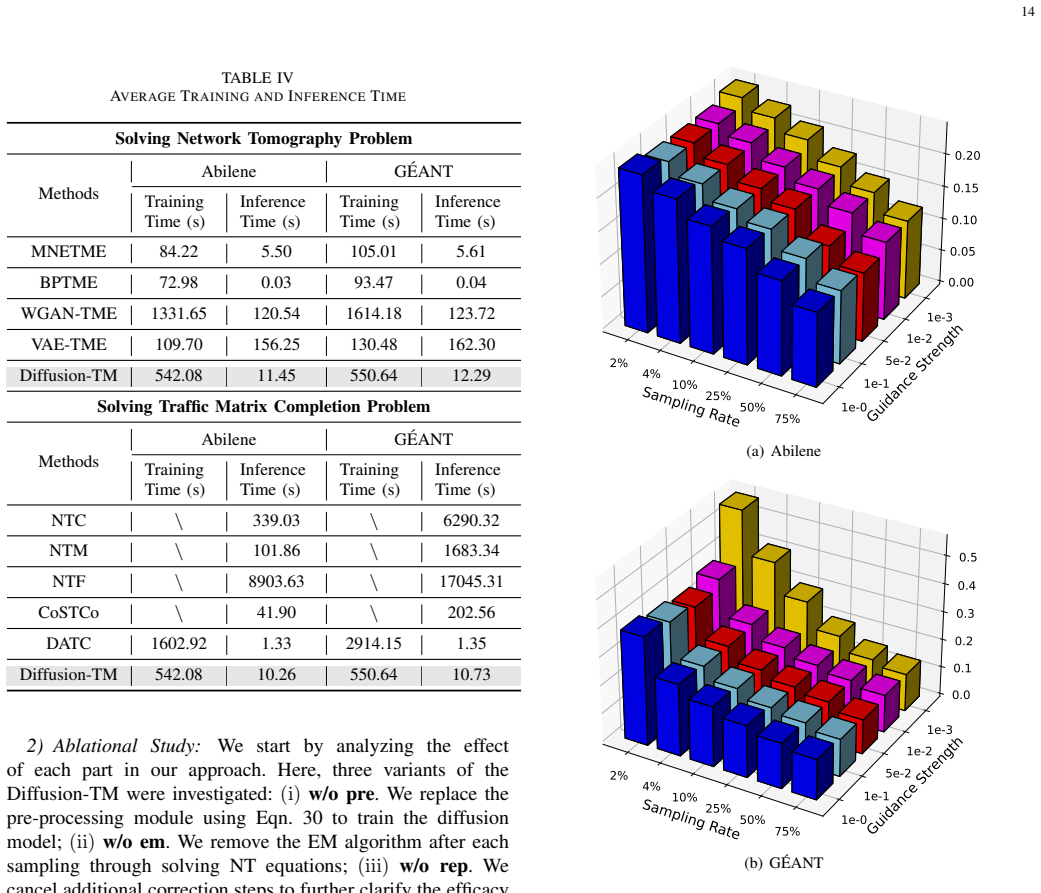
- Network operators can reconstruct all origin-to-destination flows from cheap link-load or partial-flow measurements, with the experiments showing useful accuracy even when only 2% to 5% of flow values are observed.
- Because the guided estimates stay on the learned traffic distribution, downstream management tasks such as capacity planning and anomaly detection can treat the reconstructed matrices as realistic traffic data.
- Multiple measurement sources can be combined in one sampling run, so operators can use both link loads and known OD pairs together rather than being limited to a single observation type.
Reading between the lines
- The manifold-stability theorem is only proven for linear or affine data manifolds; if real traffic matrices live on a nonlinear manifold, the same guarantee does not automatically follow, though the experiments suggest the method still works in practice.
- The same measurement-gradient recipe could be applied to other network inverse problems with differentiable forward maps, such as link-delay tomography or router-level latency estimation, whenever a diffusion prior over the target quantity is available.
- The masked-loss plus autoencoder-infilling training scheme could serve as a general recipe for training deep generative models on heavily incomplete industrial datasets, a setting that goes beyond traffic matrices.
- The paper argues that the method avoids the fixed-routing requirement of learning-based tomography, but it does not experiment with dynamically changing routing; testing under adaptive routing would be a natural next step.
Signed reviews
Editorial analysis
A structured set of objections, weighed in public.
Referee Report
Summary. The paper proposes Diffusion-TM, a diffusion-model framework for traffic matrix (TM) analysis that targets network tomography, TM completion, and synthetic TM generation in a plug-and-play manner. The method uses a pre-trained unconditional DDPM/DDIM prior and injects measurement consistency at each reverse step via a gradient guidance term (Eq. 24) derived from an approximation to the conditional score (Eqs. 22-23); a two-stage training scheme with an autoencoder preprocessing module and a masked reconstruction loss (Eq. 29) is designed for highly incomplete training sets. The authors claim a theoretical guarantee (Theorem 1) that the guidance correction keeps the iterate on the data manifold, and they evaluate the approach on Abilene and GÉANT traces against tensor-completion and deep tomography baselines using NMAE, NRMSE, TRE, and MMD. Empirically, Diffusion-TM reports consistently lower errors and lower MMD across sampling rates, with ablations supporting the contribution of each component.
Significance. If the reported empirical results are reproducible, the paper makes a useful practical contribution: a single trained diffusion model can handle several TM-related tasks, and the two-stage training scheme appears to reduce sensitivity to missing data, which is a realistic operational constraint. The paper also ships a public code repository, uses two real-world traces, and compares against a broad set of baselines with ablation and sensitivity studies. The theoretical guarantee, however, is currently not established, and because it is advertised in the abstract and in the contribution list, the paper is not yet ready in its present form.
major comments (3)
- [V.C and Appendix "Proof for Theorem 1"] Theorem 1 as stated is not established by the appendix proof. The proof inserts the condition that the data manifold M has linear structure and asserts that p(x0|xt) is radial with center E[x0|xt], neither of which appears in the theorem statement or is verified for traffic data; a weighted average of points on a nonlinear manifold need not lie on the manifold, and the conditional posterior of a diffusion model at finite noise level is not generally radial. Moreover, the calculation in Eq. (40) shows only that the gradient correction vector lies in the tangent space Ts(M, Dt(xt)); it does not show that the updated iterate x_{t-1}, which at intermediate steps is a noisy point outside the clean-data manifold, remains in M. The proof therefore establishes a different statement from the theorem's claim that the correction "will not leave the data manifold."
- [V.B, Eqs. (22)-(24)] The approximation ∇xt log p(y|xt) ≈ ∇xt log p(y|E[x0|xt]) is introduced without an error bound or stated validity conditions, and the displayed Eq. (22) omits the logarithm that is used in Eq. (15); at intermediate diffusion steps, when xt is far from the clean manifold and the posterior p(x0|xt) is multimodal, this approximation can be arbitrarily poor. Since Eqs. (23)-(24) and the claimed posterior-sampling interpretation depend on this step, the derivation is heuristic rather than a rigorous theoretical guarantee.
- [Abstract and Section I contribution list] The paper advertises a theoretical proof as a key contribution ("theoretically prove its efficiency"), but the only supporting argument is Theorem 1, which is not proven under the stated conditions. The authors should either supply a rigorous theorem with explicitly stated and empirically checked assumptions, or reclassify the claim as a heuristic with strong empirical support; as written, the central contribution is overclaimed.
minor comments (6)
- [Section II] There is a typo in the phrase "DM-basd approach," which should read "DM-based approach."
- [Algorithm 1, lines 4-5] Line 4 defines a variable ŝθ but line 5 uses sθ without making clear whether these are the same object; please make the notation consistent.
- [Section VII.G.3] The ablation text refers to "DDIM shown in Eqn. 12," but the DDIM update is Eqn. 13; the cross-reference should be corrected.
- [Notation throughout] The symbol M is used both for the observation mask in Eq. (2) and for the data manifold in Theorem 1 and Appendix C, which is confusing; one of the two should be renamed.
- [Eq. (40)] The chain rule for the gradient ∇xt ||y - H D_t(xt)||^2 is written with ambiguous notation J_{HD_t}; the expression should be expanded explicitly so that the role of the Jacobian of D_t is clear.
- [Table II caption] The meaning of "Diffusion-TM (p%)" in the table body is explained only in the text; the caption should state that p denotes the percentage of link loads used as additional constraints.
Circularity Check
No significant circularity: the empirical evaluation is anchored to external datasets and baselines, and the theoretical guarantee, while resting on strong imported manifold assumptions, is not a fit or definitional reduction.
full rationale
Walking the derivation chain, the core update in Eq. (24) follows the standard DPS-style decomposition of the conditional score, with rho_t derived from the noise model rather than fitted to the target. Proposition 1 is a direct application of Tweedie's formula, and Eq. (22) is explicitly labeled an approximation. The two-stage training scheme uses losses restricted to observed entries, which is a design choice rather than a renamed prediction. The experimental claims are tested against public Abilene and GEANT data and external baselines (DATC, NTC, NTM, NTF, CoSTCo, VAE-TME, WGAN-TME, BPTME, MNETME), so the main empirical results are self-contained. The only author-overlapping citation, [36], is used in Related Work to distinguish the single-run conditional sampling approach from a prior latent-diffusion TM estimator; it is not load-bearing in any derivation. The proof of Theorem 1 is a genuine rigor concern but not a circularity: it imports the manifold-constraint argument from the external reference [38] and introduces strong assumptions (linear manifold structure, radial conditional density) to conclude that D_t is locally an orthogonal projection onto M. Even granting those assumptions, the proof only places the gradient vector in the tangent space at D_t(x_t), and does not establish that the updated iterate x_{t-1} remains on the clean-data manifold. That is a soundness gap, not an equation that reduces to its own input or a fitted parameter renamed as a prediction. No step in the paper satisfies the quoted reduction test for circularity.
Assumptions & free parameters
free parameters (4)
- Guidance strength rho_t (fixed rho = 0.05) =
0.05
- Total diffusion steps T =
300
- Transformer hyperparameters (batch size, attention heads, base dimension) =
not reported precisely
- Measurement noise variance sigma_z^2 =
not estimated or reported
assumptions (5)
- domain assumption Gaussian measurement noise z ~ N(0, sigma_z^2 I) in Eqn. 3
- domain assumption Linear routing model Y = HX + z with known routing matrix A
- ad hoc to paper Traffic data manifold M is linear and D_t(x_t) = E[x_0|x_t] acts as an orthogonal projection onto M
- ad hoc to paper Approximation grad_{x_t} log p(y|x_t) ≈ grad_{x_t} log p(y|E[x_0|x_t]) in Eqn. 22
- standard math Tweedie's formula and DDPM score matching provide the posterior mean (Eqns. 19 and 21)
Cite this review
Pith. "Pith review of Diffusion Models Meet Network Management: Improving Traffic Matrix Analysis with Diffusion-based Approach." pith.science (2026). https://pith.science/paper/7PRYVKU4
@misc{pith2026241119493,
  author       = {Pith},
  title        = {Pith review of: Diffusion Models Meet Network Management: Improving Traffic Matrix Analysis with Diffusion-based Approach},
  year         = {2026},
  howpublished = {\url{https://pith.science/paper/7PRYVKU4}},
  note         = {Machine review of arXiv:2411.19493}
}
abstract
Due to network operation and maintenance relying heavily on network traffic monitoring, traffic matrix analysis has been one of the most crucial issues for network management related tasks. However, it is challenging to reliably obtain the precise measurement in computer networks because of the high measurement cost, and the unavoidable transmission loss. Although some methods proposed in recent years allowed estimating network traffic from partial flow-level or link-level measurements, they often perform poorly for traffic matrix estimation nowadays. Despite strong assumptions like low-rank structure and the prior distribution, existing techniques are usually task-specific and tend to be significantly worse as modern network communication is extremely complicated and dynamic. To address the dilemma, this paper proposed a diffusion-based traffic matrix analysis framework named Diffusion-TM, which leverages problem-agnostic diffusion to notably elevate the estimation performance in both traffic distribution and accuracy. The novel framework not only takes advantage of the powerful generative ability of diffusion models to produce realistic network traffic, but also leverages the denoising process to unbiasedly estimate all end-to-end traffic in a plug-and-play manner under theoretical guarantee. Moreover, taking into account that compiling an intact traffic dataset is usually infeasible, we also propose a two-stage training scheme to make our framework be insensitive to missing values in the dataset. With extensive experiments with real-world datasets, we illustrate the effectiveness of Diffusion-TM on several tasks. Moreover, the results also demonstrate that our method can obtain promising results even with $5\%$ known values left in the datasets.
Figures


Figures from the paper (9 more)




Reference graph
Works this paper leans on
-
[13]
Deep adversarial tensor completion for accurate network traffic measurement,
K. Xie, Y . Ouyang, X. Wang, G. Xie, K. Li, W. Liang, J. Cao, and J. Wen, “Deep adversarial tensor completion for accurate network traffic measurement,” IEEE/ACM Transactions on Networking, 2023
work page 2023
-
[1]
An approximation method of origin–destination flow traffic from link load counts,
D. Jiang, Z. Xu, H. Xu, Y . Han, Z. Chen, and Z. Yuan, “An approximation method of origin–destination flow traffic from link load counts,” Computers & Electrical Engineering, vol. 37, no. 6, pp. 1106–1121, 2011
work page 2011
-
[2]
Internet traffic matrices: A primer,
P. Tune, M. Roughan, H. Haddadi, and O. Bonaventure, “Internet traffic matrices: A primer,” Recent Advances in Networking, vol. 1, pp. 1–56, 2013
work page 2013
-
[3]
S. S. Hussain, M. A. Sultan, S. Qazi, and M. Ameer, “Intelligent traffic matrix estimation using levenberg- marquardt artificial neural network of large scale ip network,” in 2019 13th International Conference on Mathematics, Actuarial Science, Computer Science and Statistics (MACS). IEEE, 2019, pp. 1–5
work page 2019
-
[4]
Mining anomalies using traffic feature distributions,
A. Lakhina, M. Crovella, and C. Diot, “Mining anomalies using traffic feature distributions,” ACM SIGCOMM computer communication review, vol. 35, no. 4, pp. 217– 228, 2005
work page 2005
-
[5]
{LiveMicro}: An edge computing system for collabo- rative telepathology,
A. Sacco, F. Esposito, P. Okorie, and G. Marchetto, “{LiveMicro}: An edge computing system for collabo- rative telepathology,” in 2nd USENIX Workshop on Hot Topics in Edge Computing (HotEdge 19), 2019
work page 2019
-
[6]
Cisco systems netflow services export version 9,
B. Claise, “Cisco systems netflow services export version 9,” Tech. Rep., 2004
work page 2004
-
[7]
Opentm: Traffic matrix estimator for openflow networks,
A. Tootoonchian, M. Ghobadi, and Y . Ganjali, “Opentm: Traffic matrix estimator for openflow networks,” in Proceedings of the 11th International Conference on Passive and Active Measurement, ser. PAM’10. Berlin, Heidelberg: Springer-Verlag, 2010, p. 201–210
Show all 55 references
-
[8]
Network tomography using genetic algorithms,
R. A. Memon, S. Qazi, and A. A. Farooqui, “Network tomography using genetic algorithms,” inTENCON 2012 IEEE Region 10 Conference. IEEE, 2012, pp. 1–6
2012
-
[9]
Network monitoring in software-defined networking: A review,
P.-W. Tsai, C.-W. Tsai, C.-W. Hsu, and C.-S. Yang, “Network monitoring in software-defined networking: A review,”IEEE Systems Journal, vol. 12, no. 4, pp. 3958– 3969, 2018
2018
-
[10]
A review of advanced algebraic approaches enabling network tomography for future network infras- tructures,
G. Kakkavas, D. Gkatzioura, V . Karyotis, and S. Pa- pavassiliou, “A review of advanced algebraic approaches enabling network tomography for future network infras- tructures,” Future Internet, vol. 12, no. 2, p. 20, 2020
2020
-
[11]
Spatio- temporal tensor completion for imputing missing in- ternet traffic data,
H. Zhou, D. Zhang, K. Xie, and Y . Chen, “Spatio- temporal tensor completion for imputing missing in- ternet traffic data,” in 2015 ieee 34th international performance computing and communications conference (ipccc). IEEE, 2015, pp. 1–7
2015
-
[12]
Neural tensor completion for accurate network monitoring,
K. Xie, H. Lu, X. Wang, G. Xie, Y . Ding, D. Xie, J. Wen, and D. Zhang, “Neural tensor completion for accurate network monitoring,” in IEEE INFOCOM 2020-IEEE Conference on Computer Communications. IEEE, 2020, pp. 1688–1697
2020
-
[14]
Accurate estimation of large-scale ip traffic matrix,
D. Jiang, X. Wang, L. Guo, H. Ni, and Z. Chen, “Accurate estimation of large-scale ip traffic matrix,” AEU - International Journal of Electronics and Communications, vol. 65, no. 1, pp. 75–86,
-
[15]
Traffic matrix estimation: A neural network approach with extended input and expectation maximization iteration,
H. Zhou, L. Tan, Q. Zeng, and C. Wu, “Traffic matrix estimation: A neural network approach with extended input and expectation maximization iteration,” Journal of Network and Computer Applications, vol. 60, pp. 220–232, 2016. [Online]. Available: https://www.sciencedirect.com/...
2016
-
[16]
Denoising diffusion probabilistic models,
J. Ho, A. Jain, and P. Abbeel, “Denoising diffusion probabilistic models,” 2020
2020
-
[17]
Deep unsupervised learning using nonequi- librium thermodynamics,
J. Sohl-Dickstein, E. Weiss, N. Maheswaranathan, and S. Ganguli, “Deep unsupervised learning using nonequi- librium thermodynamics,” in International conference on machine learning. PMLR, 2015, pp. 2256–2265
2015
-
[18]
Generative modeling by esti- mating gradients of the data distribution,
Y . Song and S. Ermon, “Generative modeling by esti- mating gradients of the data distribution,” Advances in neural information processing systems, vol. 32, 2019. 17
2019
-
[19]
Diffusion posterior sampling for general noisy in- verse problems,
H. Chung, J. Kim, M. T. Mccann, M. L. Klasky, and J. C. Ye, “Diffusion posterior sampling for general noisy in- verse problems,” arXiv preprint arXiv:2209.14687, 2022
2022 arXiv
-
[20]
Pseudoinverse-guided diffusion models for inverse problems,
J. Song, A. Vahdat, M. Mardani, and J. Kautz, “Pseudoinverse-guided diffusion models for inverse problems,” in International Conference on Learning Representations, 2022
2022
-
[21]
Zero-shot image restoration using denoising diffusion null-space model,
W. Yinhuai, Y . Jiwen, and Z. Jian, “Zero-shot image restoration using denoising diffusion null-space model,” arXiv preprint arXiv:2212.00490, vol. 3, 2022
2022 arXiv
-
[22]
Opentm: traffic matrix estimator for openflow networks,
A. Tootoonchian, M. Ghobadi, and Y . Ganjali, “Opentm: traffic matrix estimator for openflow networks,” in International Conference on Passive and Active Network Measurement. Springer, 2010, pp. 201–210
2010
-
[23]
A scalable and error-tolerant solution for traffic matrix as- sessment in hybrid ip/sdn networks,
J. Gal ´an-Jim´enez, M. Polverini, and A. Cianfrani, “A scalable and error-tolerant solution for traffic matrix as- sessment in hybrid ip/sdn networks,” IEEE Transactions on Network and Service Management, vol. 17, no. 1, pp. 251–264, 2019
2019
-
[24]
Spatio-temporal compressive sensing and internet traffic matrices,
Y . Zhang, M. Roughan, W. Willinger, and L. Qiu, “Spatio-temporal compressive sensing and internet traffic matrices,” in Proceedings of the ACM SIGCOMM 2009 conference on Data communication, 2009, pp. 267–278
2009
-
[25]
Spatio-temporal compressive sensing and internet traffic matrices (extended version),
M. Roughan, Y . Zhang, W. Willinger, and L. Qiu, “Spatio-temporal compressive sensing and internet traffic matrices (extended version),” IEEE/ACM Transactions on Networking, vol. 20, no. 3, pp. 662–676, 2011
2011
-
[26]
Network tomography: Estimating source- destination traffic intensities from link data,
Y . Vardi, “Network tomography: Estimating source- destination traffic intensities from link data,” Journal of the American statistical association, vol. 91, no. 433, pp. 365–377, 1996
1996
-
[27]
Fast accurate computation of large-scale ip traffic matri- ces from link loads,
Y . Zhang, M. Roughan, N. Duffield, and A. Greenberg, “Fast accurate computation of large-scale ip traffic matri- ces from link loads,” ACM SIGMETRICS Performance Evaluation Review, vol. 31, no. 1, pp. 206–217, 2003
2003
-
[28]
Tripartite graph aided tensor completion for sparse network measurement,
X. Li, K. Xie, X. Wang, G. Xie, K. Li, J. Cao, D. Zhang, and J. Wen, “Tripartite graph aided tensor completion for sparse network measurement,” IEEE Transactions on Parallel and Distributed Systems, vol. 34, no. 1, pp. 48– 62, 2022
2022
-
[29]
Neutm: A neural network- based framework for traffic matrix prediction in sdn,
A. Azzouni and G. Pujolle, “Neutm: A neural network- based framework for traffic matrix prediction in sdn,” in NOMS 2018-2018 IEEE/IFIP Network Operations and Management Symposium. IEEE, 2018, pp. 1–5
2018
-
[30]
Deep convolutional lstm network-based traffic matrix prediction with partial in- formation,
P. Le Nguyen, Y . Ji et al., “Deep convolutional lstm network-based traffic matrix prediction with partial in- formation,” in 2019 IFIP/IEEE Symposium on Integrated Network and Service Management (IM). IEEE, 2019, pp. 261–269
2019
-
[31]
Ai-assisted traffic matrix prediction using ga-enabled deep ensemble learning for hybrid sdn,
R. Etengu, S. C. Tan, T. C. Chuah, Y . L. Lee, and J. Galan-Jimenez, “Ai-assisted traffic matrix prediction using ga-enabled deep ensemble learning for hybrid sdn,” Computer Communications, vol. 203, pp. 298–311, 2023
2023
-
[32]
A new approach for traffic matrix estimation in high load computer networks based on graph embedding and convolutional neural network,
M. Emami, R. Akbari, R. Javidan, and A. Zamani, “A new approach for traffic matrix estimation in high load computer networks based on graph embedding and convolutional neural network,”Transactions on Emerging Telecommunications Technologies, vol. 30, no. 6, p. e3604, 2019
2019
-
[33]
Completing and predicting internet traffic matrices using adversar- ial autoencoders and hidden markov models,
A. Sacco, F. Esposito, and G. Marchetto, “Completing and predicting internet traffic matrices using adversar- ial autoencoders and hidden markov models,” IEEE Transactions on Network and Service Management, 2023
2023
-
[34]
Future network traffic matrix synthesis and es- timation based on deep generative models,
G. Kakkavas, M. Kalntis, V . Karyotis, and S. Papavas- siliou, “Future network traffic matrix synthesis and es- timation based on deep generative models,” in 2021 International Conference on Computer Communications and Networks (ICCCN). IEEE, 2021, pp. 1–8
2021
-
[35]
Learning based methods for traffic matrix estimation from link measurements,
S. Xu, M. Kodialam, T. Lakshman, and S. S. Panwar, “Learning based methods for traffic matrix estimation from link measurements,” IEEE Open Journal of the Communications Society, vol. 2, pp. 488–499, 2021
2021
-
[36]
Traffic matrix estimation based on denoising diffusion proba- bilistic model,
X. Yuan, Y . Qiao, P. Zhao, R. Hu, and B. Zhang, “Traffic matrix estimation based on denoising diffusion proba- bilistic model,” in 2023 IEEE Symposium on Computers and Communications (ISCC). IEEE, 2023, pp. 316–322
2023
-
[37]
A case study of the accuracy of snmp measurements,
M. Roughan, “A case study of the accuracy of snmp measurements,” Journal of Electrical and Computer Engineering, vol. 2010, pp. 1–7, 2010
2010
-
[38]
Improving diffusion models for inverse problems using manifold constraints,
H. Chung, B. Sim, D. Ryu, and J. C. Ye, “Improving diffusion models for inverse problems using manifold constraints,” Advances in Neural Information Processing Systems, vol. 35, pp. 25 683–25 696, 2022
2022
-
[39]
Denoising diffusion models for plug-and-play image restoration,
Y . Zhu, K. Zhang, J. Liang, J. Cao, B. Wen, R. Timo- fte, and L. Van Gool, “Denoising diffusion models for plug-and-play image restoration,” in Proceedings of the IEEE/CVF Conference on Computer Vision and Pattern Recognition, 2023, pp. 1219–1229
2023
-
[40]
Denoising diffusion implicit models,
J. Song, C. Meng, and S. Ermon, “Denoising diffusion implicit models,” arXiv preprint arXiv:2010.02502, 2020
2010 arXiv
-
[41]
Tweedie’s formula and selection bias,
B. Efron, “Tweedie’s formula and selection bias,” Journal of the American Statistical Association, vol. 106, no. 496, pp. 1602–1614, 2011
2011
-
[42]
Network tomography: Estimating source- destination traffic intensities from link data,
Y . Vardi, “Network tomography: Estimating source- destination traffic intensities from link data,” Journal of the American statistical association, pp. 365–377, 1996
1996
-
[43]
Score-based generative mod- eling through stochastic differential equations,
Y . Song, J. Sohl-Dickstein, D. P. Kingma, A. Kumar, S. Ermon, and B. Poole, “Score-based generative mod- eling through stochastic differential equations,” arXiv preprint arXiv:2011.13456, 2020
2011 arXiv
-
[44]
Basisdetect: A model-based network event detection framework,
B. Eriksson, P. Barford, R. Bowden, N. Duffield, J. Som- mers, and M. Roughan, “Basisdetect: A model-based network event detection framework,” in Proceedings of the 10th ACM SIGCOMM conference on Internet measurement, 2010, pp. 451–464
2010
-
[45]
At- tention is all you need,
A. Vaswani, N. Shazeer, N. Parmar, J. Uszkoreit, L. Jones, A. N. Gomez, Ł. Kaiser, and I. Polosukhin, “At- tention is all you need,” Advances in neural information processing systems, vol. 30, 2017
2017
-
[46]
G. J. McLachlan and T. Krishnan, The EM algorithm and extensions. John Wiley & Sons, 2007
2007
-
[47]
Finite mixture models,
G. J. McLachlan, S. X. Lee, and S. I. Rathnayake, “Finite mixture models,” Annual review of statistics and its application, vol. 6, pp. 355–378, 2019
2019
-
[48]
Abilene network topology data and traffic 18 traces,
Y . Zhang, “Abilene network topology data and traffic 18 traces,” 2004
2004
-
[49]
Providing public intradomain traffic matrices to the research community,
S. Uhlig, B. Quoitin, J. Lepropre, and S. Balon, “Providing public intradomain traffic matrices to the research community,” ACM SIGCOMM Computer Communication Review, vol. 36, no. 1, pp. 83–86, 2006
2006
-
[50]
Neural tensor model for learning multi-aspect factors in recommender systems,
H. Chen and J. Li, “Neural tensor model for learning multi-aspect factors in recommender systems,” in Proceedings of the Twenty-Ninth International Joint Conference on Artificial Intelligence, IJCAI-20, C. Bessiere, Ed. International Joint Conferences on Artificial Intelligenc...
2020 doi
-
[51]
Neural tensor factorization for temporal interaction learning,
X. Wu, B. Shi, Y . Dong, C. Huang, and N. Chawla, “Neural tensor factorization for temporal interaction learning,” Proceedings of the Twelfth ACM International Conference on Web Search and Data Mining, 2019. [Online]. Available: https://api.semanticscholar.org/CorpusID:59528341
2019
-
[52]
Costco: A neural tensor completion model for sparse tensors,
H. Liu, Y . Li, M. Tsang, and Y . Liu, “Costco: A neural tensor completion model for sparse tensors,” Proceedings of the 25th ACM SIGKDD International Conference on Knowledge Discovery & Data Mining,
-
[53]
Lightnestle: Quick and accurate neural sequential ten- sor completion via meta learning,
Y . Li, W. Liang, K. Xie, D. Zhang, S. Xie, and K. Li, “Lightnestle: Quick and accurate neural sequential ten- sor completion via meta learning,” in IEEE INFOCOM 2023-IEEE Conference on Computer Communications. IEEE, 2023, pp. 1–10
2023
-
[2011]
Available: https://www.sciencedirect
[Online]. Available: https://www.sciencedirect. com/science/article/pii/S1434841110000531
-
[2019]
Available: https://api.semanticscholar
[Online]. Available: https://api.semanticscholar. org/CorpusID:198117731
Reviewed August 12, 2026 · model on record in the stance chip above.
Discussion (0). Continue with ORCID to comment.