REVIEW 3 major objections 6 minor 44 references
Ensemble Watermarks for Large Language Models
T0 review · 3 major / 6 minor · reviewed 2026-08-12 · deepseek-v4-flash
Pith's one-line read The paper proposes layering acrostic, sensorimotor, and red-green watermarks in LLM output and reports that the combination detects 97.75% of watermarked text, staying above 95% after paraphrasing while red-green alone falls to about 49%.
desk verdict Useful empirical ensemble watermark with a real statistical flaw in the detection rule; the ranking of configurations likely survives, but the headline rates are not at a controlled false-positive level. read the letter →
The pith
A machine-rendered reading of the paper's core claim, the machinery that carries it, and where it could break.
The reading
What carries the argument
The load-bearing mechanism is a streaming generation loop in which a secret key is updated from the generated text itself: hashing the previous word selects a sensorimotor class, and hashing the lemmatized previous sentence selects an acrostic letter. During generation, the first token of each new sentence is boosted by $\delta_{acro}$ if it starts with the key letter, later tokens are boosted by $\delta_{senso}$ if they belong to the key sensorimotor class, and tokens in the pseudorandom green list are boosted by $\delta_{redgreen}$. At detection, the same key schedule is replayed; the acrostic and sensorimotor features are scored with binomial tails, the red-green feature with a normal-approximation $Z$-score, and the final score is the product of the three p-values, thresholded at $\alpha=0.05$.
What would settle it
Generate long human-written passages, run the detector with the watermark key, and count how often the product of the three p-values falls below 0.05; if the false-positive rate is far above 5%, the threshold is miscalibrated and the reported detection advantage must be recomputed with a standard p-value combination method.
Extended reading notes
Core claim
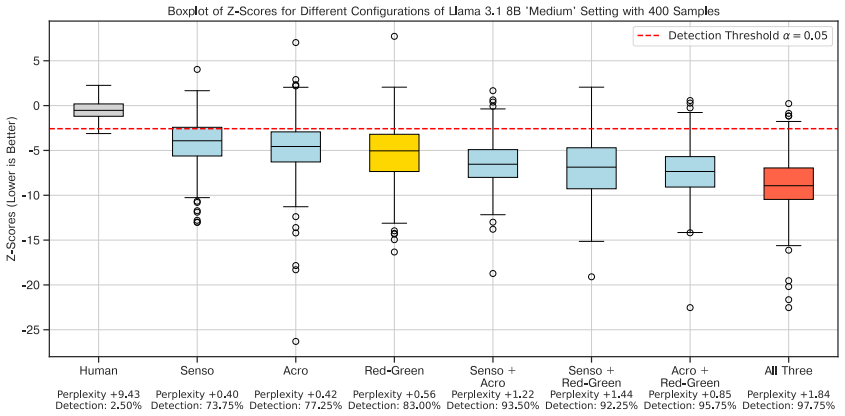
The paper's central claim is that watermark signals of different kinds can be layered into a single LLM generation by adding per-feature boosts to the raw token scores, and that the layered result is harder to erase than any one signal. In its evaluation, the full ensemble—acrostic first letters, sensorimotor word categories, and the standard red-green token split—gives the highest detection rate in every model and strength setting tested, reaching 97.75% on Llama 3.1 8B medium-strength text and holding above 95% after a paraphrasing attack; the red-green feature alone falls to roughly 49% under the same attack. The authors claim that the same detection routine, which recomputes the key from the previous word and sentence and scores each feature separately, works unchanged for any subset of features.
Load-bearing premise
The load-bearing premise is that the three feature tests are independent enough that multiplying their probability values gives a valid single test at the 0.05 threshold; the paper combines them this way without validating that assumption.
Editorial extensions
If this is right
- Operators can choose feature subsets by deployment constraint: acrostics add strong detectability with minimal perplexity cost, sensorimotor cues add paraphrase resilience, and red-green anchors the baseline signal.
- A single detection function works for every configuration, so a provider can vary the watermark strength or feature mix per user without maintaining separate detectors.
- Because the secret key is re-derived from the generated text at both generation and detection, no external model or service is needed to verify a watermark.
- The ablation suggests the ensemble reaches high detection with fewer sentences than any single feature, making it usable for shorter texts.
Reading between the lines
- A standard meta-analytic combination of the three p-values (for example, a chi-square combining method) would likely shift the reported detection rates; the raw-product threshold assumes an independence the paper does not test.
- The same logit-bias design could absorb other stylometric features—part-of-speech targets, sentence-length constraints, or word-frequency bands—so the ensemble approach is not limited to the three features evaluated.
- An attacker who paraphrases mainly at sentence boundaries could specifically erode the acrostic signal while leaving sensorimotor and red-green cues intact, so the reported paraphrase resistance may depend on the attack's span-level behavior.
Editorial analysis
A structured set of objections, weighed in public.
Referee Report
Summary. The paper proposes a multi-feature watermarking scheme for large language models that combines acrostics, sensorimotor word classes, and the established red-green logit watermark. During generation, logits are modified according to a secret key derived from the previous words and sentences; during detection, per-feature p-values are computed and combined into a final score that is thresholded at 0.05. Experiments on Llama 3.1 8B, Llama 3.2 3B, and Mistral 7B at three watermark strengths report that the three-feature ensemble yields the highest detection rates, including after a paraphrasing attack, and an ablation study examines the effect of text length.
Significance. If the detection statistic were valid, the paper would offer a flexible and reasonably robust multi-feature watermark, with the useful property that a single detection function handles any feature subset. The release of code and data, the multi-model evaluation, and the consistent relative ordering of configurations are strengths. However, the central statistical combination of p-values is not a valid p-value, so the absolute detection rates and the stated alpha=0.05 control are not supported as written. The relative ranking of configurations may survive a corrected analysis, but the headline numbers require re-reporting at a properly calibrated operating point.
major comments (3)
- [Section 3.2, Algorithm 2 (final_score)] The detection rule final_score = Pacrostic × Psensorimotor × Predgreen with detection when final_score < 0.05 is not a valid combination of p-values. For three independent uniform p-values, P(product ≤ 0.05) ≈ 0.424, not 0.05; the additional product over sensorimotor classes (Psensorimotor = ∏_c Psensorimotor,c) makes the inflation worse. Consequently, the detection rates in Figure 1 and Table 2 are reported at an uncontrolled false-positive rate, and the statement in Section 4.1 that α = 0.05 determines statistical significance is incorrect. Please replace the product rule with a valid meta-analytic combination such as Fisher's method applied to the per-feature p-values, or report ROC curves and detection rates at a fixed empirical false-positive rate.
- [Section 4.1, Table 2] No calibration or null-distribution analysis is provided for final_score. The low human detection rates in Table 2 are observed on a specific corpus and do not establish control of Type I error at the claimed 0.05 level; they are an empirical outcome rather than a guarantee. The paper should report the distribution of final_score on human-written text and on unwatermarked model text, and specify operating points by empirical false-positive rate. This is load-bearing because the headline rates (97.75% in Figure 1, >95% after paraphrasing in Table 2) are absolute numbers whose meaning depends on a valid statistical test.
- [Section 3.2, final_score formula] The sentence 'Assuming independence, the final score is...' introduces an independence assumption that is not justified. The acrostic and sensorimotor keys are derived from hashes of preceding words and sentences, and the red-green list is seeded by the previous token, so the three test statistics are plausibly dependent. If the authors switch to Fisher's method, they must either justify independence or use a dependence-robust calibration. At minimum, the paper should report the correlation between the per-feature p-values on the human baseline and discuss the impact on the combined test.
minor comments (6)
- [Section 4.2, Table 2] The text refers to 'Llama 3.1 3B', but the implementation details and Table 2 refer to Llama 3.2 3B; please correct this inconsistency.
- [Figure 1] Figure 1 is described as plotting Z-scores, but Section 3.2 defines a Z-score only for the red-green feature; please define how a combined Z-score is computed for configurations that include acrostic or sensorimotor features.
- [Table 3] It is unclear whether the reported p-values are for a single representative sample or aggregated across samples; please clarify and, if possible, report the corresponding final_score values.
- [Section 4.1] The evaluation would benefit from confidence intervals for the detection rates, since each configuration has only 300–400 samples.
- [Section 2.3] The sentence 'We outline four distinct approaches below, each with its own strengths and weaknesses' appears twice in succession; please remove the duplication.
- [Introduction] The phrase 'large-scale pertaining' should read 'large-scale pre-training'.
Circularity Check
No significant circularity; only a minor, non-load-bearing self-citation appears.
full rationale
The paper's central claim is an empirical evaluation of an ensemble watermark, and the detection statistic is computed with the same secret key used during generation, which is standard watermarking practice rather than a circular reduction. The acrostic, sensorimotor, and red-green p-values are each computed against fixed null distributions (1/26 for a random acrostic letter, Google N-gram class frequencies for sensorimotor words, and γ=0.5 for the red-green list), and these baselines are not fitted to the evaluation data; the δ weights are manually chosen. The only self-citation is Table 1's caption, 'Extended from Niess and Kern, 2024', which introduces a peripheral taxonomy of stylometric features and does not carry the empirical detection-rate argument. The product-of-p-values final score is statistically questionable because a product of uniform p-values is not itself uniform under the null, but this is a correctness and robustness concern, not a circularity: the reported detection rates are observed outcomes of the paper's explicit decision rule, not quantities defined as their own inputs.
Assumptions & free parameters
free parameters (4)
- δacro =
10.0 (weak), 20.0 (medium), 40.0 (strong)
- δsenso =
1.0 (weak), 2.5 (medium), 5.0 (strong)
- δredgreen =
1.0 (weak), 2.0 (medium), 10.0 (strong)
- γ =
0.5
assumptions (3)
- domain assumption The three watermark detection tests are independent and can be combined by multiplying p-values.
- domain assumption Sensorimotor baseline class frequencies from Google N-gram corpus are representative of human text frequencies.
- standard math The normal approximation to the binomial distribution for red-green detection is valid for the text lengths considered.
Cite this review
Pith. "Pith review of Ensemble Watermarks for Large Language Models." pith.science (2026). https://pith.science/paper/RG3CQAZE
@misc{pith2026241119563,
  author       = {Pith},
  title        = {Pith review of: Ensemble Watermarks for Large Language Models},
  year         = {2026},
  howpublished = {\url{https://pith.science/paper/RG3CQAZE}},
  note         = {Machine review of arXiv:2411.19563}
}
read the original abstract
As large language models (LLMs) reach human-like fluency, reliably distinguishing AI-generated text from human authorship becomes increasingly difficult. While watermarks already exist for LLMs, they often lack flexibility and struggle with attacks such as paraphrasing. To address these issues, we propose a multi-feature method for generating watermarks that combines multiple distinct watermark features into an ensemble watermark. Concretely, we combine acrostica and sensorimotor norms with the established red-green watermark to achieve a 98% detection rate. After a paraphrasing attack, the performance remains high with 95% detection rate. In comparison, the red-green feature alone as a baseline achieves a detection rate of 49% after paraphrasing. The evaluation of all feature combinations reveals that the ensemble of all three consistently has the highest detection rate across several LLMs and watermark strength settings. Due to the flexibility of combining features in the ensemble, various requirements and trade-offs can be addressed. Additionally, the same detection function can be used without adaptations for all ensemble configurations. This method is particularly of interest to facilitate accountability and prevent societal harm.
Figures


Reference graph
Works this paper leans on
-
[1]
Gomez, Lukasz Kaiser, and Illia Polosukhin
Ashish Vaswani, Noam Shazeer, Niki Parmar, Jakob Uszkoreit, Llion Jones, Aidan N. Gomez, Lukasz Kaiser, and Illia Polosukhin. Attention Is All You Need , December 2017. URL http://arxiv.org/abs/1706.03762. arXiv:1706.03762 [cs]
arXiv 2017
-
[2]
BERT : Pre -training of Deep Bidirectional Transformers for Language Understanding , May 2019
Jacob Devlin, Ming-Wei Chang, Kenton Lee, and Kristina Toutanova. BERT : Pre -training of Deep Bidirectional Transformers for Language Understanding , May 2019. URL http://arxiv.org/abs/1810.04805. arXiv:1810.04805 [cs]
arXiv 2019
-
[3]
Luan, Dario Amodei, and Ilya Sutskever
Alec Radford, Jeff Wu, Rewon Child, D. Luan, Dario Amodei, and Ilya Sutskever. Language Models are Unsupervised Multitask Learners . OpenAI blog, 1 0 (8): 0 9, 2019. URL https://paperswithcode.com/paper/language-models-are-unsupervised-multitask
work page 2019
-
[4]
Defending Against Neural Fake News
Rowan Zellers, Ari Holtzman, Hannah Rashkin, Yonatan Bisk, Ali Farhadi, Franziska Roesner, and Yejin Choi. Defending Against Neural Fake News . In Advances in Neural Information Processing Systems , volume 32. Curran Associates, Inc., 2019. URL https://proceedings.neurips.cc/paper/2019/hash/3e9f0fc9b2f89e043bc6233994dfcf76-Abstract.html
work page 2019
-
[5]
TweepFake : about Detecting Deepfake Tweets
Tiziano Fagni, Fabrizio Falchi, Margherita Gambini, Antonio Martella, and Maurizio Tesconi. TweepFake : about Detecting Deepfake Tweets . PLOS ONE, 16 0 (5): 0 e0251415, May 2021. ISSN 1932-6203. doi:10.1371/journal.pone.0251415. URL http://arxiv.org/abs/2008.00036. arXiv:2008.00036 [cs]
arXiv 2021
-
[6]
Brown, Benjamin Chess, Rewon Child, Scott Gray, Alec Radford, Jeffrey Wu, and Dario Amodei
Jared Kaplan, Sam McCandlish, Tom Henighan, Tom B. Brown, Benjamin Chess, Rewon Child, Scott Gray, Alec Radford, Jeffrey Wu, and Dario Amodei. Scaling Laws for Neural Language Models , January 2020. URL http://arxiv.org/abs/2001.08361. arXiv:2001.08361 [cs, stat]
arXiv 2020
-
[7]
Partha Pratim Ray. ChatGPT : A comprehensive review on background, applications, key challenges, bias, ethics, limitations and future scope. Internet of Things and Cyber-Physical Systems, 3: 0 121--154, January 2023. ISSN 2667-3452. doi:10.1016/j.iotcps.2023.04.003. URL https://www.sciencedirect.com/science/article/pii/S266734522300024X
-
[8]
A Watermark for Large Language Models
John Kirchenbauer, Jonas Geiping, Yuxin Wen, Jonathan Katz, Ian Miers, and Tom Goldstein. A Watermark for Large Language Models . ICML 2023 OralPoster, June 2023. URL https://openreview.net/forum?id=aX8ig9X2a7
work page 2023
Show all 44 references
-
[9]
Surveying Stylometry Techniques and Applications
Tempestt Neal, Kalaivani Sundararajan, Aneez Fatima, Yiming Yan, Yingfei Xiang, and Damon Woodard. Surveying Stylometry Techniques and Applications . ACM Computing Surveys, 50 0 (6): 0 86:1--86:36, November 2017. ISSN 0360-0300. doi:10.1145/3132039. URL https://doi.org/10.1145/3132039
2017 doi
-
[10]
A survey of modern authorship attribution methods
Efstathios Stamatatos. A survey of modern authorship attribution methods. Journal of the American Society for information Science and Technology, 60 0 (3): 0 538--556, 2009 a
2009
-
[11]
Authorship Attribution for Neural Text Generation
Adaku Uchendu, Thai Le, Kai Shu, and Dongwon Lee. Authorship Attribution for Neural Text Generation . In Proceedings of the 2020 Conference on Empirical Methods in Natural Language Processing ( EMNLP ) , pages 8384--8395, Online, November 2020. Association for Computational Li...
2020 doi
-
[12]
The Lancaster Sensorimotor Norms : multidimensional measures of perceptual and action strength for 40,000 English words
Dermot Lynott, Louise Connell, Marc Brysbaert, James Brand, and James Carney. The Lancaster Sensorimotor Norms : multidimensional measures of perceptual and action strength for 40,000 English words. Behavior Research Methods, 52 0 (3): 0 1271--1291, June 2020. ISSN 1554-3528. ...
2020 doi
-
[13]
boethius
Ian Johnson. Authorial self-identification in the acrostics of walton's" boethius" and the question of john bonejohn. Carmina Philosophiae, 15: 0 1--12, 2006
2006
-
[14]
Stylometric watermarks for large language models, 2024
Georg Niess and Roman Kern. Stylometric watermarks for large language models, 2024. URL https://arxiv.org/abs/2405.08400
2024 arXiv
-
[15]
New AI classifier for indicating AI -written text, January 2023
Jan Hendrik Kirchner, Jan Ahmad, Scott Aaronson, and Jan Leike. New AI classifier for indicating AI -written text, January 2023. URL https://openai.com/blog/new-ai-classifier-for-indicating-ai-written-text
2023
-
[16]
GPTZero The Trusted AI Detector for ChatGPT , GPT -4, & More , 2023
Edward Tian. GPTZero The Trusted AI Detector for ChatGPT , GPT -4, & More , 2023. URL https://gptzero.me/
2023
-
[17]
Manning, and Chelsea Finn
Eric Mitchell, Yoonho Lee, Alexander Khazatsky, Christopher D. Manning, and Chelsea Finn. DetectGPT : zero-shot machine-generated text detection using probability curvature. In Proceedings of the 40th International Conference on Machine Learning , volume 202 of ICML '23 , page...
2023
-
[18]
Ganesh Jawahar, Muhammad Abdul-Mageed, and Laks V. S. Lakshmanan. Automatic Detection of Machine Generated Text : A Critical Survey , November 2020. URL http://arxiv.org/abs/2011.01314. arXiv:2011.01314 [cs]
2020 arXiv
-
[19]
On the Possibilities of AI - Generated Text Detection , October 2023
Souradip Chakraborty, Amrit Singh Bedi, Sicheng Zhu, Bang An, Dinesh Manocha, and Furong Huang. On the Possibilities of AI - Generated Text Detection , October 2023. URL http://arxiv.org/abs/2304.04736. arXiv:2304.04736 [cs]
2023 arXiv
-
[20]
Undetectable Watermarks for Language Models , 2023
Miranda Christ, Sam Gunn, and Or Zamir. Undetectable Watermarks for Language Models , 2023. URL https://eprint.iacr.org/2023/763. Report Number: 763
2023
-
[21]
My AI Safety Lecture for UT Effective Altruism , November 2022
Scott Aaronson. My AI Safety Lecture for UT Effective Altruism , November 2022. URL https://scottaaronson.blog/?p=6823
2022
-
[22]
Watermarking of Large Language Models , August 2023
Scott Aaronson. Watermarking of Large Language Models , August 2023. URL https://simons.berkeley.edu/talks/scott-aaronson-ut-austin-openai-2023-08-17
2023
-
[23]
A reversible natural language watermarking for sensitive information protection
Lingyun Xiang, Yangfan Liu, and Zhongliang Yang. A reversible natural language watermarking for sensitive information protection. Information Processing & Management, 61 0 (3): 0 103661, 2024
2024
-
[24]
Sentence-bert: Sentence embeddings using siamese bert-networks
Nils Reimers and Iryna Gurevych. Sentence-bert: Sentence embeddings using siamese bert-networks. arXiv preprint arXiv:1908.10084, 2019
1908 arXiv
-
[25]
Provable Robust Watermarking for AI - Generated Text , October 2023
Xuandong Zhao, Prabhanjan Ananth, Lei Li, and Yu-Xiang Wang. Provable Robust Watermarking for AI - Generated Text , October 2023. URL http://arxiv.org/abs/2306.17439. arXiv:2306.17439
2023 arXiv
-
[26]
Robust Distortion -free Watermarks for Language Models , June 2024
Rohith Kuditipudi, John Thickstun, Tatsunori Hashimoto, and Percy Liang. Robust Distortion -free Watermarks for Language Models , June 2024. URL http://arxiv.org/abs/2307.15593. arXiv:2307.15593
2024 arXiv
-
[27]
Chaoyi Zhu, Jeroen Galjaard, Pin-Yu Chen, and Lydia Y. Chen. Duwak: Dual Watermarks in Large Language Models , August 2024. URL http://arxiv.org/abs/2403.13000. arXiv:2403.13000
2024 arXiv
-
[28]
Ksenia Lagutina, Nadezhda Lagutina, Elena Boychuk, Inna Vorontsova, Elena Shliakhtina, Olga Belyaeva, Ilya Paramonov, and P.G. Demidov. A Survey on Stylometric Text Features . In 2019 25th Conference of Open Innovations Association ( FRUCT ) , pages 184--195, November 2019. do...
2019
-
[29]
A Survey of Modern Authorship Attribution Methods
Efstathios Stamatatos. A Survey of Modern Authorship Attribution Methods . JASIST, 60: 0 538--556, March 2009 b . doi:10.1002/asi.21001
2009 doi
-
[30]
Sensory linguistics
Bodo Winter. Sensory linguistics. Sensory Linguistics, pages 1--303, 2019
2019
-
[31]
Smells like teen spirit: An exploration of sensorial style in literary genres
Osama Khalid and Padmini Srinivasan. Smells like teen spirit: An exploration of sensorial style in literary genres. In Proceedings of the 29th International Conference on Computational Linguistics, pages 55--64, 2022
2022
-
[32]
Cross-language authorship attribution
Dasha Bogdanova and Angeliki Lazaridou. Cross-language authorship attribution. In Proceedings of the Ninth International Conference on Language Resources and Evaluation (LREC'14), pages 2015--2020, 2014
2015
-
[33]
Generating acrostics via paraphrasing and heuristic search
Benno Stein, Matthias Hagen, and Christof Br \"a utigam. Generating acrostics via paraphrasing and heuristic search. In Proceedings of COLING 2014, the 25th International Conference on Computational Linguistics: Technical Papers, pages 2018--2029, 2014
2014
-
[34]
Controlling sequence-to-sequence models-a demonstration on neural-based acrostic generator
Liang-Hsin Shen, Pei-Lun Tai, Chao-Chung Wu, and Shou-De Lin. Controlling sequence-to-sequence models-a demonstration on neural-based acrostic generator. In Proceedings of the 2019 Conference on Empirical Methods in Natural Language Processing and the 9th International Joint C...
2019
-
[35]
Alisa: Acrostic linguistic steganography based on bert and gibbs sampling
Biao Yi, Hanzhou Wu, Guorui Feng, and Xinpeng Zhang. Alisa: Acrostic linguistic steganography based on bert and gibbs sampling. IEEE Signal Processing Letters, 29: 0 687--691, 2022
2022
-
[36]
Teach LLMs to Personalize -- An Approach inspired by Writing Education , August 2023
Cheng Li, Mingyang Zhang, Qiaozhu Mei, Yaqing Wang, Spurthi Amba Hombaiah, Yi Liang, and Michael Bendersky. Teach LLMs to Personalize -- An Approach inspired by Writing Education , August 2023. URL http://arxiv.org/abs/2308.07968. arXiv:2308.07968 [cs]
2023 arXiv
-
[37]
Large Language Models Are Human - Level Prompt Engineers , March 2023
Yongchao Zhou, Andrei Ioan Muresanu, Ziwen Han, Keiran Paster, Silviu Pitis, Harris Chan, and Jimmy Ba. Large Language Models Are Human - Level Prompt Engineers , March 2023. URL http://arxiv.org/abs/2211.01910. arXiv:2211.01910 [cs]
2023 arXiv
-
[38]
Ethereal poem in e, 2024
OpenAI ChatGPT . Ethereal poem in e, 2024. URL https://chat.openai.com/share/8bd7e95d-aad5-4459-ae80-16d2cdea7d75. Feb 1 Version
2024
-
[39]
Taskiran, and Edward J
Mercan Topkara, Cuneyt M. Taskiran, and Edward J. Delp Iii. Natural language watermarking. page 441, San Jose, CA, March 2005. doi:10.1117/12.593790. URL http://proceedings.spiedigitallibrary.org/proceeding.aspx?doi=10.1117/12.593790
2005 doi
-
[40]
Atallah, Victor Raskin, Michael Crogan, Christian Hempelmann, Florian Kerschbaum, Dina Mohamed, and Sanket Naik
Mikhail J. Atallah, Victor Raskin, Michael Crogan, Christian Hempelmann, Florian Kerschbaum, Dina Mohamed, and Sanket Naik. Natural Language Watermarking : Design , Analysis , and a Proof -of- Concept Implementation . In Ira S. Moskowitz, editor, Information Hiding , Lecture N...
2001 doi
-
[41]
The llama 3 herd of models
Abhimanyu Dubey, Abhinav Jauhri, Abhinav Pandey, Abhishek Kadian, Ahmad Al-Dahle, Aiesha Letman, Akhil Mathur, Alan Schelten, Amy Yang, Angela Fan, et al. The llama 3 herd of models. arXiv preprint arXiv:2407.21783, 2024
2024 arXiv
-
[42]
Albert Q. Jiang, Alexandre Sablayrolles, Arthur Mensch, Chris Bamford, Devendra Singh Chaplot, Diego de las Casas, Florian Bressand, Gianna Lengyel, Guillaume Lample, Lucile Saulnier, Lélio Renard Lavaud, Marie-Anne Lachaux, Pierre Stock, Teven Le Scao, Thibaut Lavril, Thomas ...
2023 arXiv
-
[43]
Thomas Wolf, Lysandre Debut, Victor Sanh, Julien Chaumond, Clement Delangue, Anthony Moi, Pierric Cistac, Tim Rault, Rémi Louf, Morgan Funtowicz, Joe Davison, Sam Shleifer, Patrick von Platen, Clara Ma, Yacine Jernite, Julien Plu, Canwen Xu, Teven Le Scao, Sylvain Gugger, Mari...
2020 arXiv
-
[44]
Colin Raffel, Noam Shazeer, Adam Roberts, Katherine Lee, Sharan Narang, Michael Matena, Yanqi Zhou, Wei Li, and Peter J. Liu. Exploring the limits of transfer learning with a unified text-to-text transformer. arXiv e-prints, 2019
2019
Reviewed August 12, 2026 · model on record in the stance chip above.
Discussion (0). Continue with ORCID to comment.