REVIEW 3 major objections 5 minor 70 references
Auto-Encoded Supervision for Perceptual Image Super-Resolution
T0 review · 3 major / 5 minor · reviewed 2026-08-12 · deepseek-v4-flash
Pith's one-line read Replacing pixel loss with an auto-encoder loss sharpens GAN super-resolution.
desk verdict The loss works empirically, but the paper's claim that it isolates systematic error is not established and likely false as stated. read the letter →
The pith
A machine-rendered reading of the paper's core claim, the machinery that carries it, and where it could break.
The reading
What carries the argument
The load-bearing object is the auto-encoder $\psi_{\text{AE}} = \psi_{\text{dec}} \circ \psi_{\text{enc}}$, whose encoder maps HR images to LR space (a bottleneck of LR dimensionality) and whose decoder maps back to HR, trained with the LR-reconstruction loss $\|\psi_{\text{enc}}(I_{\text{HR}}) - I_{\text{LR}}\|_p$ and the HR-reconstruction loss $\|\psi_{\text{AE}}(I_{\text{HR}}) - I_{\text{HR}}\|_p$. The AE is then frozen, and $\mathcal{L}_{\text{AESOP}}$ is computed in the 'AE space', meaning the output of the decoder rather than the bottleneck. This object functions as the claimed differentiable stand-in for the conditional-mean operator, so the pixel-space SE+VE sum is replaced by an approximation of SE alone.
What would settle it
On a fixed dataset, take HR images that share the same LR downsampling but differ in high-frequency random texture and measure whether $\|\psi_{\text{AE}}(I_{\text{HR},1}) - \psi_{\text{AE}}(I_{\text{HR},2})\|_1$ is zero: any nonzero value shows the AE retains perceptual variance and $\mathcal{L}_{\text{AESOP}}$ is not purely SE. Conversely, a pair of HR images that differ only by a sharp, regressable edge but produce identical AE outputs would show the AE dropped regressable structure.
Extended reading notes
Core claim
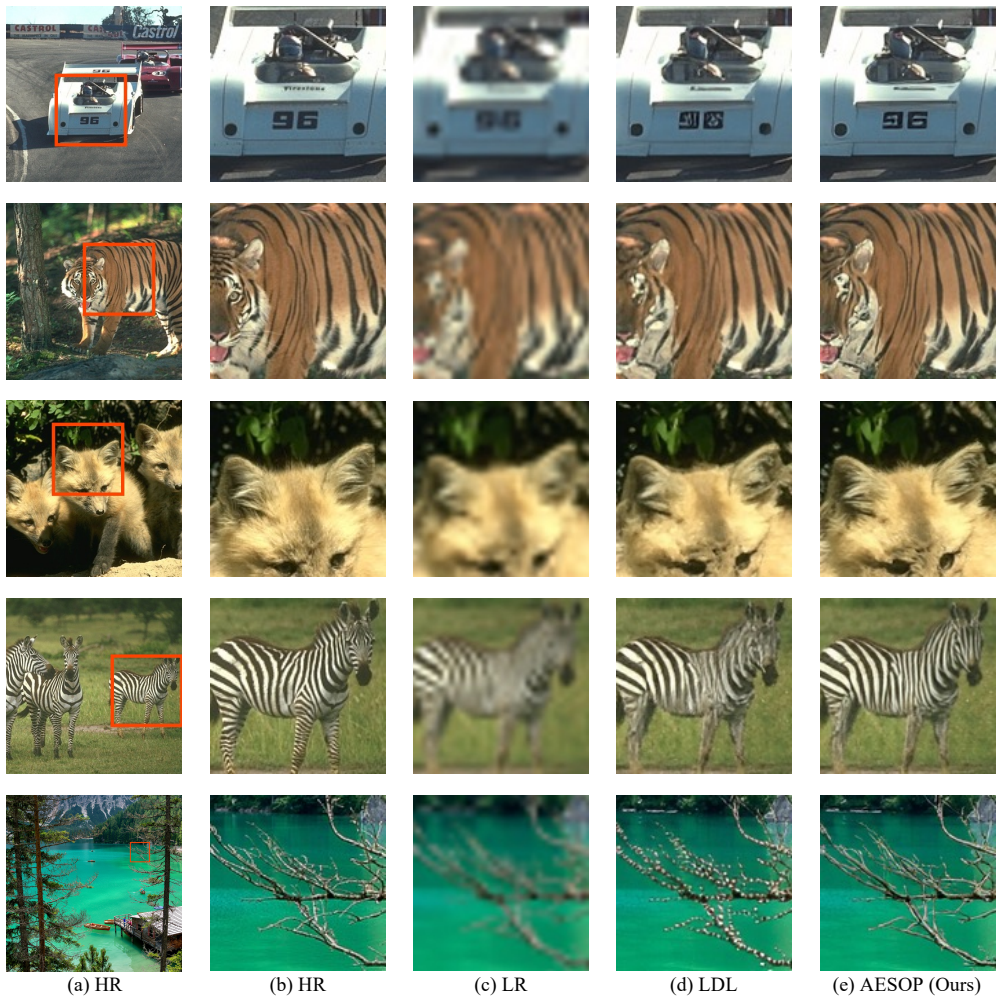
The central claim is that the blurring associated with $\mathcal{L}_{\text{pix}}$ in perceptual super-resolution is caused specifically by its variance-effect component, not by reconstruction guidance as such. For a symmetric loss and $y \sim p(y|x)$, the paper rewrites the expected training objective as $\text{SE}(y,\hat y) + \text{VE}(y,\hat y)$: SE is the fidelity-bias-induced error, the squared distance between the conditional means $\mu_{\hat y}$ and $\mu_y$, while VE is the variance of the estimator around its own mean, which penalizes the realistic, non-regressable high-frequency texture that perceptual SR should preserve. An auto-encoder $\psi_{\text{AE}}$ pretrained with $\mathcal{L}_{\text{pix}}$ on HR/LR pairs, with a bottleneck of LR dimension, is proposed as a differentiable approximation of the conditional-mean operator $\psi(\cdot) = \arg\min_\mu E[\mathcal{L}(\cdot,\mu)]$; therefore $\mathcal{L}_{\text{AESOP}} = \|\psi_{\text{AE}}(I_{\text{HR}}) - \psi_{\text{AE}}(I_{\text{SR}})\|_p$ penalizes almost only SE. Because fidelity bias includes regressable high-frequency edges, unlike low-pass-filtered loss, and because the loss can be applied with coefficient 1 while the AE is kept frozen to avoid collapse, the paper claims GAN-based SR networks reach a better perception-distortion trade-off and fewer artifacts than networks trained with scaled $\mathcal{L}_{\text{pix}}$ or LPF variants.
Load-bearing premise
The load-bearing premise is that an auto-encoder trained with pixel loss on HR/LR pairs really is a faithful differentiable approximation of the conditional-mean operator, so its output space keeps every regressable edge and drops exactly the stochastic textures; if it drops any regressable structure the loss under-constrains it, and if it keeps any perceptual variance the blurring it claims to avoid is partly reintroduced.
Editorial extensions
If this is right
- GAN-based SR training can use reconstruction guidance at full strength ($\lambda_{\text{AESOP}}=1$) instead of the customary 0.01, because the loss no longer suppresses perceptual variance and therefore no longer conflicts with perceptual-quality losses.
- Regressable high-frequency features such as object edges remain supervised, unlike with low-pass filtering, so the method reaches a better point on the perception-distortion curve than LPF-based alternatives.
- Stronger reconstruction guidance also reduces GAN artifacts, because the adversarial head is still held aligned by a strong fidelity-bias signal.
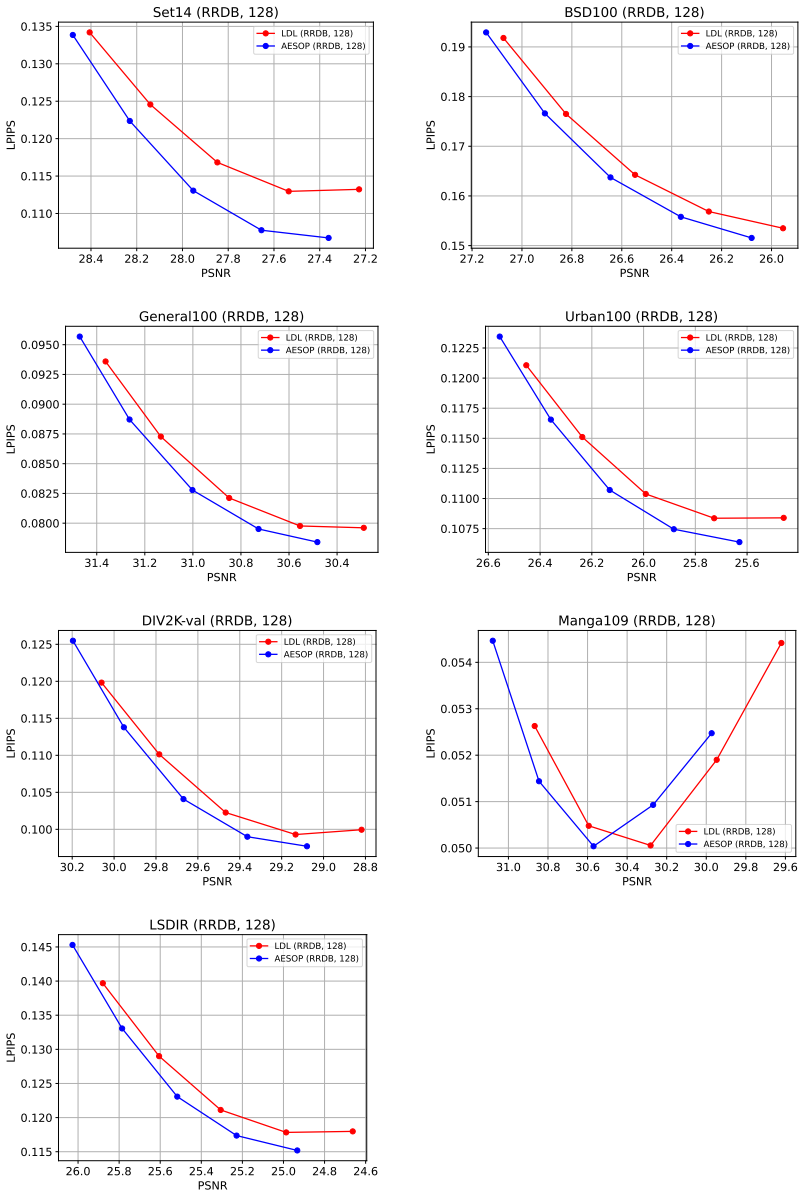
- The benefit grows with model capacity: the reported gains are larger on SwinIR and DRCT backbones than on RRDB.
- The same substitution improves real-world SR benchmarks, where the conflict between pixel loss and perceptual objectives is more severe.
Reading between the lines
- Beyond the paper: the SE/VE decomposition does not depend on super-resolution, so the auto-encoded supervision recipe may transfer to other ill-posed inverse problems such as deblurring, denoising, or compression-artifact removal, where pixel loss likewise blurs stochastic detail; that transfer is not tested here.
- Beyond the paper: the paper shows an SRResNet-based AE loses little performance, so the essential ingredient is the LR-dimensional bottleneck plus pixel-loss pretraining rather than a specific SR backbone, suggesting that a cheaper or distilled AE could sustain the method.
- Beyond the paper: since $\mathcal{L}_{\text{AESOP}}$ can be zero for distinct images sharing one fidelity bias, it is not a distortion metric in the sense of the perception-distortion theorem, so in principle one could push perception without paying a per-pixel fidelity cost; the paper notes this does not make the trade-off disappear entirely.
Signed reviews
Editorial analysis
A structured set of objections, weighed in public.
Referee Report
Summary. The paper proposes Auto-Encoded Supervision for Optimal Penalization (LAESOP), which replaces the pixel-level reconstruction loss Lpix in GAN-based perceptual super-resolution with an Lp loss computed on the outputs of a frozen auto-encoder (AE) pretrained with Lpix on HR/LR pairs. The central claim is that Lpix jointly minimizes a systematic-effect (SE) term and a variance-effect (VE) term, where VE is the component that causes blurring and the PD trade-off; the AE, pretrained to map an HR image to its LR and back, is said to act as a differentiable approximation of the conditional-mean operator, so that the AE output space contains only the fidelity-bias (SE) component. The authors therefore argue that LAESOP provides strong reconstruction guidance on the fidelity bias without penalizing perceptual variance. The manuscript reports consistent improvements over LDL, ESRGAN, SPSR, and CALGAN baselines on RRDB, SwinIR, and DRCT backbones, on bicubic and real-world ×4 SR, with ablations, PD trade-off curves, spectral analyses, and the AE-PSNR/LR-PSNR metrics.
Significance. If the central claim were correct, the paper would offer a simple and principled replacement for a loss term that is widely used in perceptual SR, with clear practical value: stronger fidelity guidance without the usual blurring side effect. The empirical work is a genuine strength: the method is evaluated across multiple backbones (RRDB, SwinIR, DRCT), multiple benchmarks, real-world settings, and with ablations and PD curves, and the reported improvements are consistent. The paper also honestly discloses cases where the method does not help (e.g., Manga109). However, the conceptual contribution is not established: the identification of the AE output space with the fidelity-bias-only space, and the equation LAESOP ≈ SE, are asserted rather than derived, and the analysis below shows the identification conflates two different conditional-mean operators. The empirical gains may be real and useful, but the theoretical framing as an exact SE/VE separation is likely incorrect and needs substantial revision before the paper can be accepted.
major comments (3)
- [Sec. 4.1-4.2, Eq. (8)] The claimed identification LAESOP ≈ SE conflates two different centroids. In Eq. (2), SE is defined through µ_ŷ = argmin_µ E_ŷ[L(ŷ, µ)], the mean of the SR network's predictive distribution for the given LR input. The pretrained AE, however, is trained with Eqs. (4)-(5) to map an input image to its own LR estimate and then reconstruct the HR from that LR; hence ψAE(I) approximates E[y | LR(I)], the true posterior mean conditioned on the LR of I. For the HR image, LR(IHR) = x, so ψAE(IHR) ≈ E[y|x]. For an SR output with LR(ISR) ≈ x — which is exactly what the adversarial and artifact losses encourage — ψAE(ISR) is also close to E[y|x], making LAESOP ≈ 0 regardless of how far the SR predictive mean µ_ŷ is from µ_y. Thus the loss behaves as a learned degradation-consistency (cycle) loss, not as an SE estimator. The 'bottleneck collapse' discussion in Sec. 4.1 acknowledges the degeneracy for exact downscaling, but joint encoder/decoder pretraining does not change the functional form: after pretraining, ψAE(I) = f(φ(I,s)) for a fixed deterministic mapping f, so the loss still vanishes for any degradation-consistent SR output even when SE is large. The nonzero gradients that drive the reported improvements come from imperfect LR estimation on out-of-distribution SR outputs, not from a principled SE/VE separation.
- [Sec. 5.2, Table 4] The AE-PSNR and LR-PSNR metrics cannot validate the SE-reduction claim. AE-PSNR uses the very AE that defines the training loss, making it circular, a point the authors acknowledge. LR-PSNR is independent of the AE, but it measures the PSNR between the downscaled SR and the original LR, i.e., the degradation consistency φ(ISR,s) ≈ x. Under the analysis in the previous comment, this is precisely the quantity that LAESOP directly optimizes, so the improvements in Table 4 (and Appendix Table 8) are expected for a cycle-consistency loss and do not establish that the fidelity bias µ_ŷ is closer to µ_y. An independent measure of the SR predictive mean, or a controlled experiment that varies the LR consistency of SR outputs while holding their fidelity bias fixed, is needed to support the SE interpretation.
- [Sec. 4.1 AE pretraining] The paper asserts that the pretrained AE 'will act as a differentiable approximation of ψ' and that its output space contains only fidelity-bias factors, but no formal statement or quantitative bound connects the pretraining objective in Eqs. (4)-(5) to the operator ψ(·) := argmin_µ E[L(·,µ)] used in Eq. (1). The supporting evidence is limited to the qualitative spectral visualization in Fig. 6 and the ablation in Table 3. Because the entire conceptual contribution rests on this equivalence, the authors should provide at least a synthetic or semi-synthetic experiment with known µ_y and µ_ŷ (e.g., a Gaussian mixture posterior) showing that LAESOP tracks SE rather than degradation consistency. Without such a test, the central claim that LAESOP 'only minimizes SE' is not supported.
minor comments (5)
- [Sec. 3, Eq. (1)] The quantities µ_y and µ_ŷ are used in Eq. (1) but defined only after the equation; please state their definitions before Eq. (1) to avoid ambiguity.
- [Sec. 5.1, Table 1] The superscripts † and * in Table 1 are not defined in the table caption; the text defines them, but the table should be self-contained.
- [Sec. 5.2, Table 5] The column 'DIV2K100' in Table 5 is not defined and is inconsistent with 'DIV2K-val' used in Table 1; please clarify which split is used.
- [Sec. 5.1] It would be helpful to state explicitly which baseline numbers are taken from official checkpoints and which are re-trained by the authors, since Table 1 reports both 'LDL*' and 'LDL' columns without a clear explanation of the difference.
- [Eq. (7)] Writing Lpix = ||IHR − ISR||p is an abuse of notation: Lpix is an expected loss over the data distribution, and the equality is exact only for L2 after omitting the irreducible variance term in Eq. (1). Please add a clarifying sentence.
Circularity Check
The central identification LAESOP ≈ SE is definitional rather than derived: the AE maps every image to the conditional mean of its own LR, so degradation-consistent SR outputs yield LAESOP ≈ 0 independent of the SE term; the paper's own bottleneck-collapse paragraph concedes this degeneracy.
-
self definitional
[Sec. 4.1 (AE pretraining, definition of ψ) and Sec. 4.2 (Eq. (8) and following claim); cf. Sec. 4.1 'Bottleneck collapse']
"Now, the pretrained AE will act as a differentiable approximation of ψ, which can decompose the fidelity bias of images ... Considering the AE pretraining, ψAE is a differential approximation of a fidelity bias estimator. Thus, LAESOP is now fundamentally identical to only penalizing the SE factor of Eq.(2) or Eq.(7)."
The paper defines ψ(·) := arg min_µ E[L(·, µ)] with y ∼ p(y|x) and x ≡ φ(y,s), so ψAE(I) ≈ E[y | LR(I)]. The paper's own 'Bottleneck collapse' text states: 'Consider a scenario where the encoder exactly matches the corresponding LR image of the input. If the SR image simply downscales to the original LR image, no loss would backpropagate regardless of the regressable high-frequency component quality of the SR image.' Therefore, whenever the SR output is degradation-consistent (LR(ISR) ≈ LR(IHR) = x), both ψAE(IHR) and ψAE(ISR) are near E[y|x], and LAESOP ≈ 0 regardless of the SE term (µ_ŷ − µ_y)^2 from Eq. (2). The step treats ψAE(ISR) as the SR predictive mean µ_ŷ, but the AE pretraining defines it as the conditional mean of y given the SR image's own LR.
-
fitted input called prediction
[Sec. 5.2, 'Fidelity bias estimation', Tab. 4]
"This score reflects how well an image captures the fidelity bias of the reference image. However, since AESOP is trained using the AE, there may be unintended biases introduced by the AE itself. Thus, we additionally report LR-PSNR as an unbiased metric independent of the AE."
AE-PSNR is computed with the same frozen AE that defines LAESOP, so the reported improvement in fidelity-bias estimation is partly a re-measurement of the training objective rather than an independent check. The paper explicitly acknowledges this and supplies LR-PSNR as an AE-independent metric, so this is a minor, self-acknowledged circularity and is not load-bearing for the main claim.
full rationale
The main theoretical step is not self-contained. Eq. (8)'s identification LAESOP ≈ SE rests on treating ψAE(ISR) as the SR network's predictive centroid µ_ŷ, but the AE pretraining (Eqs. (4)–(5), ψ(·) = arg min_µ E[L(·, µ)]) defines ψAE(I) as E[y | LR(I)], the conditional mean of the HR image given that image's own LR. Consequently, whenever the SR output is degradation-consistent, LAESOP is approximately zero independent of any predictive bias, exactly as the paper's 'Bottleneck collapse' paragraph concedes. The claimed SE/VE separation is therefore baked into the definition of ψ for the HR side and fails for the SR side; the central 'prediction' reduces by construction. The empirical benchmark evidence (Tab. 1, Fig. 4, Tab. 2) is external and not circular, and the AE-PSNR evaluation circularity is explicitly acknowledged and mitigated with LR-PSNR. Self-citations [20,31] point to standard MLE-average facts and are not load-bearing. Because the central theoretical identification is definitional while the experimental comparisons retain independent content, the score is 6 rather than higher.
Assumptions & free parameters
free parameters (3)
- λAESOP loss coefficient =
1
- AE bottleneck spatial size =
LR resolution (hw)
- Decoder initialization =
pretrained fidelity-oriented SR weights (RRDBNet)
assumptions (4)
- domain assumption An Lpix-trained auto-encoder is a differentiable approximation of the conditional-mean operator ψ(·) = arg min_µ E[L(·, µ)].
- standard math The expected pixel loss decomposes into SE and VE as in Eq. (1), and VE is exactly the perceptual variance that causes blurring.
- domain assumption Fidelity biases include regressable high-frequency components that cannot be separated by frequency filters but are preserved by the AE.
- domain assumption HR images are conditionally distributed as y ~ p(y|x) with x = φ(y, s), a deterministic downsampling function.
Cite this review
Pith. "Pith review of Auto-Encoded Supervision for Perceptual Image Super-Resolution." pith.science (2026). https://pith.science/paper/MRHM34BB
@misc{pith2026241200124,
  author       = {Pith},
  title        = {Pith review of: Auto-Encoded Supervision for Perceptual Image Super-Resolution},
  year         = {2026},
  howpublished = {\url{https://pith.science/paper/MRHM34BB}},
  note         = {Machine review of arXiv:2412.00124}
}
abstract
This work tackles the fidelity objective in the perceptual super-resolution~(SR). Specifically, we address the shortcomings of pixel-level $L_\text{p}$ loss ($\mathcal{L}_\text{pix}$) in the GAN-based SR framework. Since $L_\text{pix}$ is known to have a trade-off relationship against perceptual quality, prior methods often multiply a small scale factor or utilize low-pass filters. However, this work shows that these circumventions fail to address the fundamental factor that induces blurring. Accordingly, we focus on two points: 1) precisely discriminating the subcomponent of $L_\text{pix}$ that contributes to blurring, and 2) only guiding based on the factor that is free from this trade-off relationship. We show that they can be achieved in a surprisingly simple manner, with an Auto-Encoder (AE) pretrained with $L_\text{pix}$. Accordingly, we propose the Auto-Encoded Supervision for Optimal Penalization loss ($L_\text{AESOP}$), a novel loss function that measures distance in the AE space, instead of the raw pixel space. Note that the AE space indicates the space after the decoder, not the bottleneck. By simply substituting $L_\text{pix}$ with $L_\text{AESOP}$, we can provide effective reconstruction guidance without compromising perceptual quality. Designed for simplicity, our method enables easy integration into existing SR frameworks. Experimental results verify that AESOP can lead to favorable results in the perceptual SR task.
Figures


Figures from the paper (21 more)






Reference graph
Works this paper leans on
-
[1]
Ntire 2017 challenge on single image super-resolution: Dataset and study
Eirikur Agustsson and Radu Timofte. Ntire 2017 challenge on single image super-resolution: Dataset and study. In Pro- ceedings of the IEEE Conference on Computer Vision and Pattern Recognition Workshops, pages 126–135, 2017. 6
work page 2017
-
[2]
The perception-distortion tradeoff
Yochai Blau and Tomer Michaeli. The perception-distortion tradeoff. In Proceedings of the IEEE conference on computer vision and pattern recognition , pages 6228–6237, 2018. 1, 3, 5, 6
work page 2018
-
[3]
Toward real-world single image super-resolution: A new benchmark and a new model
Jianrui Cai, Hui Zeng, Hongwei Yong, Zisheng Cao, and Lei Zhang. Toward real-world single image super-resolution: A new benchmark and a new model. In Proceedings of the IEEE/CVF International Conference on Computer Vision , pages 3086–3095, 2019. 7, 2
work page 2019
-
[4]
Any-resolution training for high- resolution image synthesis
Lucy Chai, Michael Gharbi, Eli Shechtman, Phillip Isola, and Richard Zhang. Any-resolution training for high- resolution image synthesis. In European Conference on Computer Vision, pages 170–188. Springer, 2022. 2
work page 2022
-
[5]
Pre-trained image processing transformer
Hanting Chen, Yunhe Wang, Tianyu Guo, Chang Xu, Yiping Deng, Zhenhua Liu, Siwei Ma, Chunjing Xu, Chao Xu, and Wen Gao. Pre-trained image processing transformer. InPro- ceedings of the IEEE/CVF conference on computer vision and pattern recognition, pages 12299–12310, 2021. 2
work page 2021
-
[6]
Activating more pixels in image super- resolution transformer
Xiangyu Chen, Xintao Wang, Jiantao Zhou, Yu Qiao, and Chao Dong. Activating more pixels in image super- resolution transformer. In Proceedings of the IEEE/CVF Conference on Computer Vision and Pattern Recognition , pages 22367–22377, 2023. 2
work page 2023
-
[7]
Rethinking coarse-to-fine approach in sin- gle image deblurring
Sung-Jin Cho, Seo-Won Ji, Jun-Pyo Hong, Seung-Won Jung, and Sung-Jea Ko. Rethinking coarse-to-fine approach in sin- gle image deblurring. In Proceedings of the IEEE/CVF inter- national conference on computer vision , pages 4641–4650,
-
[8]
Selective frequency network for image restoration
Yuning Cui, Yi Tao, Zhenshan Bing, Wenqi Ren, Xinwei Gao, Xiaochun Cao, Kai Huang, and Alois Knoll. Selective frequency network for image restoration. InThe Eleventh In- ternational Conference on Learning Representations , 2023. 8
work page 2023
Show all 70 references
-
[9]
Second-order attention network for single im- age super-resolution
Tao Dai, Jianrui Cai, Yongbing Zhang, Shu-Tao Xia, and Lei Zhang. Second-order attention network for single im- age super-resolution. In Proceedings of the IEEE/CVF con- ference on computer vision and pattern recognition , pages 11065–11074, 2019. 2
2019
-
[10]
Projected distribution loss for image enhancement
Mauricio Delbracio, Hossein Talebei, and Pevman Milanfar. Projected distribution loss for image enhancement. In 2021 IEEE International Conference on Computational Photogra- phy (ICCP), pages 1–12. IEEE, 2021. 3
2021
-
[11]
Wavelet domain style transfer for an effective perception- distortion tradeoff in single image super-resolution
Xin Deng, Ren Yang, Mai Xu, and Pier Luigi Dragotti. Wavelet domain style transfer for an effective perception- distortion tradeoff in single image super-resolution. In Pro- ceedings of the IEEE/CVF international conference on com- puter vision, pages 3076–3085, 2019. 1, 3, 7
2019
-
[12]
Image quality assessment: Unifying structure and tex- ture similarity
Keyan Ding, Kede Ma, Shiqi Wang, and Eero P Simon- celli. Image quality assessment: Unifying structure and tex- ture similarity. IEEE transactions on pattern analysis and machine intelligence, 44(5):2567–2581, 2020. 6
2020
-
[13]
Image super-resolution using deep convolutional net- works
Chao Dong, Chen Change Loy, Kaiming He, and Xiaoou Tang. Image super-resolution using deep convolutional net- works. IEEE transactions on pattern analysis and machine intelligence, 38(2):295–307, 2015. 2
2015
-
[14]
Acceler- ating the super-resolution convolutional neural network
Chao Dong, Chen Change Loy, and Xiaoou Tang. Acceler- ating the super-resolution convolutional neural network. In Computer Vision–ECCV 2016: 14th European Conference, Amsterdam, The Netherlands, October 11-14, 2016, Pro- ceedings, Part II 14, pages 391–407. Springer, 2016. 6
2016
-
[15]
Generative adversarial nets
Ian Goodfellow, Jean Pouget-Abadie, Mehdi Mirza, Bing Xu, David Warde-Farley, Sherjil Ozair, Aaron Courville, and Yoshua Bengio. Generative adversarial nets. Advances in neural information processing systems, 27, 2014. 2
2014
-
[16]
Ode-inspired network design for sin- gle image super-resolution
Xiangyu He, Zitao Mo, Peisong Wang, Yang Liu, Mingyuan Yang, and Jian Cheng. Ode-inspired network design for sin- gle image super-resolution. In Proceedings of the IEEE/CVF Conference on Computer Vision and Pattern Recognition , pages 1732–1741, 2019. 2
2019
-
[17]
Gans trained by a two time-scale update rule converge to a local nash equilib- rium
Martin Heusel, Hubert Ramsauer, Thomas Unterthiner, Bernhard Nessler, and Sepp Hochreiter. Gans trained by a two time-scale update rule converge to a local nash equilib- rium. Advances in neural information processing systems , 30, 2017. 2
2017
-
[18]
Drct: Saving image super-resolution away from information bottleneck
Chih-Chung Hsu, Chia-Ming Lee, and Yi-Shiuan Chou. Drct: Saving image super-resolution away from information bottleneck. arXiv preprint arXiv:2404.00722, 2024. 2, 4, 11, 12
2024 arXiv
-
[19]
Single image super-resolution from transformed self-exemplars
Jia-Bin Huang, Abhishek Singh, and Narendra Ahuja. Single image super-resolution from transformed self-exemplars. In Proceedings of the IEEE conference on computer vision and pattern recognition, pages 5197–5206, 2015. 6
2015
-
[20]
Varsr: Variational super- resolution network for very low resolution images
Sangeek Hyun and Jae-Pil Heo. Varsr: Variational super- resolution network for very low resolution images. In Com- puter Vision–ECCV 2020: 16th European Conference, Glas- gow, UK, August 23–28, 2020, Proceedings, Part XXIII , pages 431–447. Springer, 2020. 2
2020
-
[21]
Variance and bias for general loss func- tions
Gareth M James. Variance and bias for general loss func- tions. Machine learning, 51:115–135, 2003. 3
2003
-
[22]
Percep- tual losses for real-time style transfer and super-resolution
Justin Johnson, Alexandre Alahi, and Li Fei-Fei. Percep- tual losses for real-time style transfer and super-resolution. In European conference on computer vision, pages 694–711. Springer, 2016. 1, 2, 4
2016
-
[23]
A style-based generator architecture for generative adversarial networks
Tero Karras, Samuli Laine, and Timo Aila. A style-based generator architecture for generative adversarial networks. In Proceedings of the IEEE/CVF conference on computer vi- sion and pattern recognition, pages 4401–4410, 2019. 2
2019
-
[24]
Musiq: Multi-scale image quality transformer
Junjie Ke, Qifei Wang, Yilin Wang, Peyman Milanfar, and Feng Yang. Musiq: Multi-scale image quality transformer. In Proceedings of the IEEE/CVF international conference on computer vision, pages 5148–5157, 2021. 2 9
2021
-
[25]
Accurate image super-resolution using very deep convolutional net- works
Jiwon Kim, Jung Kwon Lee, and Kyoung Mu Lee. Accurate image super-resolution using very deep convolutional net- works. In Proceedings of the IEEE conference on computer vision and pattern recognition, pages 1646–1654, 2016. 2
2016
-
[26]
Adam: A method for stochastic optimization
Diederik P Kingma and Jimmy Ba. Adam: A method for stochastic optimization. arXiv preprint arXiv:1412.6980 ,
-
[27]
Sparsity aware nor- malization for gans
Idan Kligvasser and Tomer Michaeli. Sparsity aware nor- malization for gans. In Proceedings of the AAAI Conference on Artificial Intelligence, pages 8181–8190, 2021. 3
2021
-
[28]
Deep self-dissimilarities as powerful visual finger- prints
Idan Kligvasser, Tamar Shaham, Yuval Bahat, and Tomer Michaeli. Deep self-dissimilarities as powerful visual finger- prints. Advances in Neural Information Processing Systems, 34, 2021. 3
2021
-
[29]
Does diffusion beat gan in image super resolution? arXiv preprint arXiv:2405.17261, 2024
Denis Kuznedelev, Valerii Startsev, Daniil Shlenskii, and Sergey Kastryulin. Does diffusion beat gan in image super resolution? arXiv preprint arXiv:2405.17261, 2024. 3
2024 arXiv
-
[30]
Photo- realistic single image super-resolution using a generative ad- versarial network
Christian Ledig, Lucas Theis, Ferenc Husz´ar, Jose Caballero, Andrew Cunningham, Alejandro Acosta, Andrew Aitken, Alykhan Tejani, Johannes Totz, Zehan Wang, et al. Photo- realistic single image super-resolution using a generative ad- versarial network. In Proceedings of the IE...
-
[31]
Noise-free optimization in early training steps for image super-resolution
MinKyu Lee and Jae-Pil Heo. Noise-free optimization in early training steps for image super-resolution. In Proceed- ings of the AAAI Conference on Artificial Intelligence, pages 2920–2928, 2024. 1, 3
2024
-
[32]
Harmonizing maximum likelihood with gans for multimodal conditional generation
Soochan Lee, Junsoo Ha, and Gunhee Kim. Harmonizing maximum likelihood with gans for multimodal conditional generation. arXiv preprint arXiv:1902.09225, 2019. 3
1902 arXiv
-
[33]
Sed: Semantic-aware dis- criminator for image super-resolution
Bingchen Li, Xin Li, Hanxin Zhu, Yeying Jin, Ruoyu Feng, Zhizheng Zhang, and Zhibo Chen. Sed: Semantic-aware dis- criminator for image super-resolution. In Proceedings of the IEEE/CVF Conference on Computer Vision and Pattern Recognition, pages 25784–25795, 2024. 3
2024
-
[34]
On efficient transformer-based image pre-training for low-level vision
Wenbo Li, Xin Lu, Shengju Qian, Jiangbo Lu, Xiangyu Zhang, and Jiaya Jia. On efficient transformer-based image pre-training for low-level vision. arXiv preprint arXiv:2112.10175, 2021. 2
2021 arXiv
-
[35]
Lsdir: A large scale dataset for image restoration
Yawei Li, Kai Zhang, Jingyun Liang, Jiezhang Cao, Ce Liu, Rui Gong, Yulun Zhang, Hao Tang, Yun Liu, Denis Deman- dolx, et al. Lsdir: A large scale dataset for image restoration. In Proceedings of the IEEE/CVF Conference on Computer Vision and Pattern Recognition, pages 1775–17...
2023
-
[36]
Swinir: Image restoration us- ing swin transformer
Jingyun Liang, Jiezhang Cao, Guolei Sun, Kai Zhang, Luc Van Gool, and Radu Timofte. Swinir: Image restoration us- ing swin transformer. InProceedings of the IEEE/CVF Inter- national Conference on Computer Vision, pages 1833–1844,
-
[37]
Details or artifacts: A locally discriminative learning approach to realistic im- age super-resolution
Jie Liang, Hui Zeng, and Lei Zhang. Details or artifacts: A locally discriminative learning approach to realistic im- age super-resolution. In Proceedings of the IEEE/CVF Con- ference on Computer Vision and Pattern Recognition, pages 5657–5666, 2022. 3, 4, 5, 6, 7, 8, 1, 2
2022
-
[38]
Enhanced deep residual networks for single image super-resolution
Bee Lim, Sanghyun Son, Heewon Kim, Seungjun Nah, and Kyoung Mu Lee. Enhanced deep residual networks for single image super-resolution. In The IEEE Conference on Com- puter Vision and Pattern Recognition (CVPR) Workshops ,
-
[39]
Enhanced deep residual networks for single image super-resolution
Bee Lim, Sanghyun Son, Heewon Kim, Seungjun Nah, and Kyoung Mu Lee. Enhanced deep residual networks for single image super-resolution. In Proceedings of the IEEE confer- ence on computer vision and pattern recognition workshops, pages 136–144, 2017. 2
2017
-
[40]
Swin transformer: Hierarchical vision transformer using shifted windows
Ze Liu, Yutong Lin, Yue Cao, Han Hu, Yixuan Wei, Zheng Zhang, Stephen Lin, and Baining Guo. Swin transformer: Hierarchical vision transformer using shifted windows. In Proceedings of the IEEE/CVF international conference on computer vision, pages 10012–10022, 2021. 2
2021
-
[41]
Srflow: Learning the super-resolution space with normalizing flow
Andreas Lugmayr, Martin Danelljan, Luc Van Gool, and Radu Timofte. Srflow: Learning the super-resolution space with normalizing flow. In Computer Vision–ECCV 2020: 16th European Conference, Glasgow, UK, August 23–28, 2020, Proceedings, Part V 16 , pages 715–732. Springer,
2020
-
[42]
Structure-preserving image super-resolution
Cheng Ma, Yongming Rao, Jiwen Lu, and Jie Zhou. Structure-preserving image super-resolution. IEEE transac- tions on pattern analysis and machine intelligence , 44(11): 7898–7911, 2021. 2, 3, 6
2021
-
[43]
A database of human segmented natural images and its application to evaluating segmentation algorithms and measuring ecological statistics
David Martin, Charless Fowlkes, Doron Tal, and Jitendra Malik. A database of human segmented natural images and its application to evaluating segmentation algorithms and measuring ecological statistics. In Proceedings Eighth IEEE International Conference on Computer Vision. IC...
2001
-
[44]
Sketch-based manga retrieval using manga109 dataset
Yusuke Matsui, Kota Ito, Yuji Aramaki, Azuma Fujimoto, Toru Ogawa, Toshihiko Yamasaki, and Kiyoharu Aizawa. Sketch-based manga retrieval using manga109 dataset. Mul- timedia Tools and Applications, 76:21811–21838, 2017. 6, 7
2017
-
[45]
Image super- resolution with non-local sparse attention
Yiqun Mei, Yuchen Fan, and Yuqian Zhou. Image super- resolution with non-local sparse attention. In Proceedings of the IEEE/CVF Conference on Computer Vision and Pattern Recognition, pages 3517–3526, 2021. 2
2021
-
[46]
completely blind
Anish Mittal, Rajiv Soundararajan, and Alan C Bovik. Mak- ing a “completely blind” image quality analyzer. IEEE Sig- nal processing letters, 20(3):209–212, 2012. 2
2012
-
[47]
Single image super-resolution via a holistic attention network
Ben Niu, Weilei Wen, Wenqi Ren, Xiangde Zhang, Lianping Yang, Shuzhen Wang, Kaihao Zhang, Xiaochun Cao, and Haifeng Shen. Single image super-resolution via a holistic attention network. In Computer Vision–ECCV 2020: 16th European Conference, Glasgow, UK, August 23–28, 2020, Pr...
2020
-
[48]
Content-aware local gan for photo-realistic super-resolution
JoonKyu Park, Sanghyun Son, and Kyoung Mu Lee. Content-aware local gan for photo-realistic super-resolution. In Proceedings of the IEEE/CVF International Conference on Computer Vision, pages 10585–10594, 2023. 3, 6, 2, 4, 7, 15
2023
-
[49]
Perception-oriented single image super-resolution using op- timal objective estimation
Seung Ho Park, Young Su Moon, and Nam Ik Cho. Perception-oriented single image super-resolution using op- timal objective estimation. In Proceedings of the IEEE/CVF Conference on Computer Vision and Pattern Recognition , pages 1725–1735, 2023. 3 10
2023
-
[50]
Image super- resolution via iterative refinement
Chitwan Saharia, Jonathan Ho, William Chan, Tim Sali- mans, David J Fleet, and Mohammad Norouzi. Image super- resolution via iterative refinement. IEEE transactions on pattern analysis and machine intelligence, 45(4):4713–4726,
-
[51]
Very deep convo- lutional networks for large-scale image recognition
Karen Simonyan and Andrew Zisserman. Very deep convo- lutional networks for large-scale image recognition. arXiv preprint arXiv:1409.1556, 2014. 5
2014 arXiv
-
[52]
Ex- ploring clip for assessing the look and feel of images
Jianyi Wang, Kelvin CK Chan, and Chen Change Loy. Ex- ploring clip for assessing the look and feel of images. InPro- ceedings of the AAAI Conference on Artificial Intelligence , pages 2555–2563, 2023. 2
2023
-
[53]
Exploiting diffusion prior for real-world image super-resolution
Jianyi Wang, Zongsheng Yue, Shangchen Zhou, Kelvin CK Chan, and Chen Change Loy. Exploiting diffusion prior for real-world image super-resolution. International Journal of Computer Vision, pages 1–21, 2024. 3
2024
-
[54]
Esrgan: En- hanced super-resolution generative adversarial networks
Xintao Wang, Ke Yu, Shixiang Wu, Jinjin Gu, Yihao Liu, Chao Dong, Yu Qiao, and Chen Change Loy. Esrgan: En- hanced super-resolution generative adversarial networks. In Proceedings of the European conference on computer vision (ECCV) workshops, pages 0–0, 2018. 1, 3, 4, 5, 6, 2...
2018
-
[55]
Real-esrgan: Training real-world blind super-resolution with pure synthetic data
Xintao Wang, Liangbin Xie, Chao Dong, and Ying Shan. Real-esrgan: Training real-world blind super-resolution with pure synthetic data. In Proceedings of the IEEE/CVF Inter- national Conference on Computer Vision, pages 1905–1914,
1905
-
[56]
Chan, Chen Change Loy, and Chao Dong
Xintao Wang, Liangbin Xie, Ke Yu, Kelvin C.K. Chan, Chen Change Loy, and Chao Dong. BasicSR: Open source image and video restoration toolbox. https://github. com/XPixelGroup/BasicSR, 2022. 1
2022
-
[57]
Image quality assessment: from error visibility to structural similarity
Zhou Wang, Alan C Bovik, Hamid R Sheikh, and Eero P Si- moncelli. Image quality assessment: from error visibility to structural similarity. IEEE transactions on image processing, 13(4):600–612, 2004. 6
2004
-
[58]
Component divide- and-conquer for real-world image super-resolution
Pengxu Wei, Ziwei Xie, Hannan Lu, Zongyuan Zhan, Qixi- ang Ye, Wangmeng Zuo, and Liang Lin. Component divide- and-conquer for real-world image super-resolution. In Com- puter Vision–ECCV 2020: 16th European Conference, Glas- gow, UK, August 23–28, 2020, Proceedings, Part VIII ...
2020
-
[59]
Desra: Detect and delete the artifacts of gan-based real-world super-resolution models
Liangbin Xie, Xintao Wang, Xiangyu Chen, Gen Li, Ying Shan, Jiantao Zhou, and Chao Dong. Desra: Detect and delete the artifacts of gan-based real-world super-resolution models. 2023. 3, 4
2023
-
[60]
Maniqa: Multi-dimension attention network for no-reference image quality assessment
Sidi Yang, Tianhe Wu, Shuwei Shi, Shanshan Lao, Yuan Gong, Mingdeng Cao, Jiahao Wang, and Yujiu Yang. Maniqa: Multi-dimension attention network for no-reference image quality assessment. In Proceedings of the IEEE/CVF Conference on Computer Vision and Pattern Recognition , pag...
2022
-
[61]
Scaling up to excellence: Practicing model scaling for photo- realistic image restoration in the wild
Fanghua Yu, Jinjin Gu, Zheyuan Li, Jinfan Hu, Xiangtao Kong, Xintao Wang, Jingwen He, Yu Qiao, and Chao Dong. Scaling up to excellence: Practicing model scaling for photo- realistic image restoration in the wild. In Proceedings of the IEEE/CVF Conference on Computer Vision and...
2024
-
[62]
On sin- gle image scale-up using sparse-representations
Roman Zeyde, Michael Elad, and Matan Protter. On sin- gle image scale-up using sparse-representations. In Inter- national conference on curves and surfaces, pages 711–730. Springer, 2010. 6
2010
-
[63]
Swinfir: Revisiting the swinir with fast fourier convolution and improved training for image super- resolution
Dafeng Zhang, Feiyu Huang, Shizhuo Liu, Xiaobing Wang, and Zhezhu Jin. Swinfir: Revisiting the swinir with fast fourier convolution and improved training for image super- resolution. arXiv preprint arXiv:2208.11247, 2022. 2
2022 arXiv
-
[64]
Deep unfold- ing network for image super-resolution
Kai Zhang, Luc Van Gool, and Radu Timofte. Deep unfold- ing network for image super-resolution. In Proceedings of the IEEE/CVF Conference on Computer Vision and Pattern Recognition (CVPR), 2020. 2
2020
-
[65]
Designing a practical degradation model for deep blind im- age super-resolution
Kai Zhang, Jingyun Liang, Luc Van Gool, and Radu Timofte. Designing a practical degradation model for deep blind im- age super-resolution. In Proceedings of the IEEE/CVF Inter- national Conference on Computer Vision, pages 4791–4800,
-
[66]
The unreasonable effectiveness of deep features as a perceptual metric
Richard Zhang, Phillip Isola, Alexei A Efros, Eli Shecht- man, and Oliver Wang. The unreasonable effectiveness of deep features as a perceptual metric. In Proceedings of the IEEE conference on computer vision and pattern recogni- tion, pages 586–595, 2018. 6, 1
2018
-
[67]
Ranksrgan: Generative adversarial networks with ranker for image super-resolution
Wenlong Zhang, Yihao Liu, Chao Dong, and Yu Qiao. Ranksrgan: Generative adversarial networks with ranker for image super-resolution. In Proceedings of the IEEE/CVF International Conference on Computer Vision, pages 3096– 3105, 2019. 2
2019
-
[68]
Image super-resolution using very deep residual channel attention networks
Yulun Zhang, Kunpeng Li, Kai Li, Lichen Wang, Bineng Zhong, and Yun Fu. Image super-resolution using very deep residual channel attention networks. In Proceedings of the European conference on computer vision (ECCV), pages 286–301, 2018. 2
2018
-
[69]
Perception- distortion balanced admm optimization for single-image super-resolution
Yuehan Zhang, Bo Ji, Jia Hao, and Angela Yao. Perception- distortion balanced admm optimization for single-image super-resolution. In European Conference on Computer Vi- sion, pages 108–125. Springer, 2022. 1, 3, 7
2022
-
[70]
Cross-scale internal graph neural network for image super-resolution
Shangchen Zhou, Jiawei Zhang, Wangmeng Zuo, and Chen Change Loy. Cross-scale internal graph neural network for image super-resolution. Advances in neural information processing systems, 33:3499–3509, 2020. 2 11 Auto-Encoded Supervision for Perceptual Image Super-Resolution Sup...
2020
Reviewed August 12, 2026 · model on record in the stance chip above.
Discussion (0). Continue with ORCID to comment.