REVIEW 4 major objections 5 minor 48 references
Ehrenfest dynamics with localized atomic-orbital basis sets within the projector augmented-wave method
T0 review · 4 major / 5 minor · reviewed 2026-08-12 · deepseek-v4-flash
Pith's one-line read The paper implements Ehrenfest dynamics with localized atomic-orbital basis sets in the PAW method, showing that for projectile velocities up to about 4 Å/fs it reproduces grid-based results while running far faster.
desk verdict A useful, honest implementation paper with real speedups, but the central equation has a typo, the energy-conservation numbers don't match the prose, and the neglect of velocity-dependent forces deserves a sharper caveat. read the letter →
The pith
A machine-rendered reading of the paper's core claim, the machinery that carries it, and where it could break.
The reading
What carries the argument
The load-bearing mechanism is the Tomfohr–Sankey time-propagation scheme with a Löwdin orthogonalization step. When atoms move, the LCAO expansion coefficients are mapped by $c_n(t_0+\Delta t)=S^{-1/2}(t_0+\Delta t)S^{1/2}(t_0)\tilde{c}_n(t_0+\Delta t)$, where $S$ is the PAW overlap matrix; this approximately preserves wavefunction continuity without computing the velocity-dependent connection terms $\tilde{P}(t)$ and $G_{\nu\mu}$ that would appear in a full gauge-potential treatment. The electronic coefficients are otherwise propagated by the semi-implicit Crank–Nicolson scheme, and nuclear forces are taken as the negative derivative of the electronic energy with respect to nuclear positions, deliberately omitting velocity-dependent corrections. This combination is what makes the method tractable within PAW—where the projectors move with the nuclei—and sets the velocity ceiling where the approximation breaks down.
What would settle it
Run the same H-on-graphene impact at 0.5 keV with an Ehrenfest implementation that explicitly includes the velocity-dependent connection terms from the moving basis and projectors, and compare the kinetic-energy loss, trajectory, and total-energy conservation with the Tomfohr–Sankey LCAO-PAW-ED results; if the stopping energies differ by more than about one eV or total-energy violations grow beyond the reported few-tenths-of-an-eV level, the neglect is the limiting assumption. A simpler proxy is to check whether LCAO-PAW-ED's energy loss converges to FD-PAW-ED as the grid spacing is tightened at 1 keV, which would indicate the discrepancy is basis-set rather than velocity-term driven.
Extended reading notes
Core claim
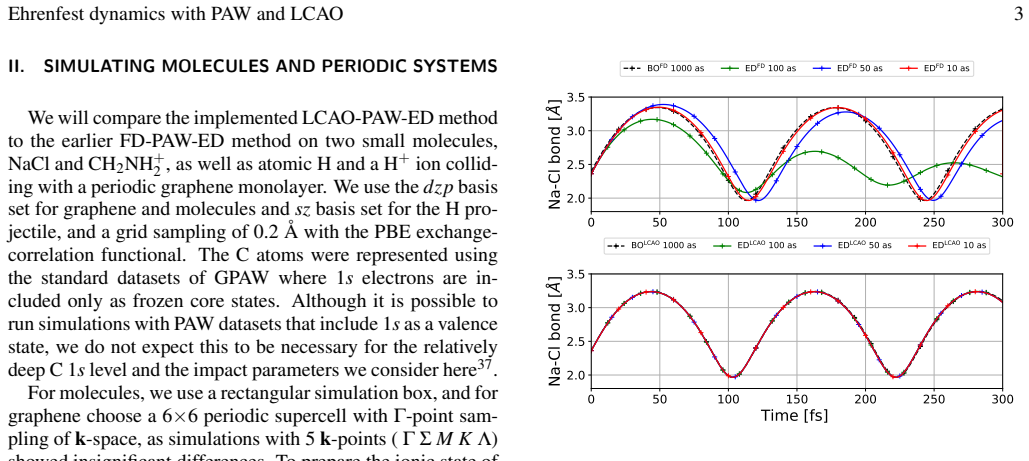
The paper's discovery is that the Tomfohr–Sankey integrator, already known in pseudopotential LCAO codes, can be adapted to the projector augmented-wave formalism and yields an Ehrenfest dynamics method that is quantitatively reliable in the low-velocity regime. Expanding the PAW time-dependent Kohn–Sham equation in localized orbitals introduces two velocity-dependent connection terms—one from the moving PAW projectors, $\tilde{P}(t)$, and one from the moving basis functions, $G_{\nu\mu}$—and the adaptation sidesteps them by applying the Löwdin step $c_n(t_0+\Delta t)=S^{-1/2}(t_0+\Delta t)S^{1/2}(t_0)\tilde{c}_n(t_0+\Delta t)$ after each nuclear displacement. The authors validate the implementation against the pre-existing finite-difference PAW-Ehrenfest method on NaCl bond oscillations, CH$_2$NH$_2^+$ twisting through a conical intersection, and H/H$^+$ impacts on graphene. For projectile velocities up to about 4 Å/fs the two methods agree on electronic-stopping energy loss and on the projectile's charge state, while for 5–10 keV projectiles the LCAO results deviate strongly and total-energy conservation worsens.
Load-bearing premise
The central load-bearing premise is that the velocity-dependent terms in the forces—arising from the moving LCAO basis and moving PAW projectors—can be neglected for the modest velocities studied; the paper states this may only hold within specific velocity ranges and does not verify it against a method that includes those terms.
Editorial extensions
If this is right
- LCAO-PAW-ED can replace the grid-based method for ion-irradiation simulations with projectile speeds up to roughly 4 Å/fs, cutting wall-clock time by more than an order of magnitude in large supercells.
- Cells with much more vacuum become tractable, which matters for simulating collisions of ions with suspended monolayer materials where the grid method's cost scales badly with empty space.
- The weak dependence of LCAO-PAW-ED on the integration timestep in molecular tests means additional savings can come from using longer timesteps without losing accuracy.
- Simulations that track projectile charge state, such as H$^+$ neutralization before impact on graphene, can be run in the same framework as neutral projectiles, since the method captures charge oscillations below the velocity limit.
- For impacts at 5 keV and above, LCAO-PAW-ED should not be trusted; the finite-difference implementation or a method with full connection terms remains necessary.
Reading between the lines
- The measured speedup should grow with the fraction of vacuum in the cell, so the method is likely to make fully ab initio studies of slow highly charged ion impacts on suspended monolayers feasible for the first time—this is our inference, as the paper only hints at it.
- A natural extension, not explored in the paper, would be to add back the velocity-dependent force terms (the connection terms) and test how far the reliable velocity range extends; the current results bracket where those terms start to matter.
- Because the forces omit velocity-dependent terms by construction, energy conservation is not guaranteed; users of LCAO-PAW-ED should monitor total-energy drift as a standard diagnostic, and the 0.1–1 keV window would benefit from a dedicated benchmark against a method that includes the missing terms.
Editorial analysis
A structured set of objections, weighed in public.
Referee Report
Summary. The paper reports an implementation of Ehrenfest molecular dynamics within the projector augmented-wave formalism of GPAW using a localized atomic-orbital (LCAO) basis, following the approximate Tomfohr–Sankey scheme. The authors benchmark LCAO-PAW-ED against the existing real-space grid FD-PAW-ED implementation for NaCl vibrations, CH2NH2+ isomerization, and H/H+ irradiation of a periodic graphene monolayer, and they document substantial savings in runtime and memory for large supercells. The central claim is that, for modest projectile velocities (up to about 4 Å/fs), LCAO-PAW-ED reproduces the electronic stopping and charge-transfer behavior of FD-PAW-ED at much lower cost, while becoming unreliable at higher velocities.
Significance. If the claim survives scrutiny, this is a useful and timely implementation: LCAO-PAW-ED could enable Ehrenfest simulations of ion irradiation with large vacuum cells, which are currently impractical with grid-based FD-PAW-ED. The work has notable strengths: it is benchmarked against an independent existing implementation and against Born-Oppenheimer dynamics, no parameters are fitted to the target results, the comparison is performed on well-defined physical observables (kinetic-energy loss, charge transfer, energy conservation), and the underlying data are openly deposited. The performance advantage is quantified concretely, including wall-clock time and memory. The main weaknesses are that the printed derivation of the velocity-dependent term contains an index inconsistency, the neglected velocity-dependent nuclear forces are not validated against a method that includes them, and a prose statement about energy-conservation errors is inconsistent with the paper's own tables.
major comments (4)
- [§I.B, Eq. (7)] The printed equation and the surrounding text have an index inconsistency in the velocity-dependent term. Starting from Eq. (6), the term involving ∂|Φμ⟩/∂t should lead to a coupling of Gνμ = ⟨Φν|Ŝ|∇Φμ⟩ with the velocity of the atom hosting basis function μ, not ν. The text currently says the matrix Gνμ is 'proportional to the velocity of the atom vν hosting basis function ν'. Please correct the index in Eq. (7) and in the sentence defining G, and clarify whether the implementation solves Eq. (7) explicitly or replaces the G·v term with the Tomfohr–Sankey Löwdin step of Eq. (8).
- [§I.A and §II.C, Tables I–II] The nuclear forces are computed without the velocity-dependent terms that arise from the moving LCAO basis and PAW projectors, and Section I.A states this 'may only be valid within specific velocity ranges'. The paper does not provide a test against any formulation that includes those terms, such as the gauge-potential integrator of Ref. 28 or a full Lagrangian force derivation. This is load-bearing because the reported energy-conservation violations grow rapidly with velocity: at 1.0 keV (3.98 Å/fs) the LCAO maximum violation is 1.07 eV for H and 2.18 eV for H+, whereas the FD values are 0.0092 and 0.0139 eV. The claim that LCAO-PAW-ED is 'satisfactory' up to 4 Å/fs is therefore not yet established; either add a validation against a method that includes the velocity-dependent forces, or narrow the claimed velocity range and the accuracy statement accordingly.
- [§II.C, prose after Tables I–II] The sentence 'even for lower velocities, energy conservation depends on velocity and is also worse (0.011–0.372 eV)' is inconsistent with the table entries. Tables I and II list LCAO Emax values of 0.0038 eV at 0.01 keV H, 0.38 eV at 0.5 keV H, 1.03 eV at 0.5 keV H+, and 2.18 eV at 1.0 keV H+. The prose range of 0.011–0.372 eV does not match any subset of the tabulated data. The authors should correct either the prose or the tables, and the corrected numbers should be used when assessing the accuracy of the method in the modest-velocity regime.
- [§II.C, Figure 7 and Tables I–II] The criterion for 'reproducing' FD-PAW-ED kinetic-energy loss should be stated more quantitatively. For example, at 0.5 keV H+ the LCAO and FD losses differ by about 2.4 eV (11.3 vs 8.9 eV), which is a substantial relative difference, and at 0.5 keV H they differ by 1.6 eV (11.3 vs 9.7 eV). If the intended claim is qualitative agreement, this should be said explicitly; if quantitative agreement is claimed, a tolerance or uncertainty estimate is needed.
minor comments (5)
- [§I.B, text after Eq. (8)] The phrase 'To approximate the transformation of the basis in a square bracket' is unclear; please rewrite to refer explicitly to the action of the G·v term and its replacement by the Löwdin orthogonalization step.
- [Tables I–II] The note about the ×10−2 factor applies only to the final column, but the formatting is easy to misread; please restate the units in each column header and, if possible, use consistent scientific notation for the LCAO and FD columns.
- [Section II.C] The labels 'EDLCAO' and 'EDFD' in Figures 5 and 6 are visually cramped; consider using distinct line styles or a legend with clearer spacing.
- [References] Reference 32 is missing the journal title and volume/page information; please complete the citation.
- [Section II.C, Figure 8 caption] The blue shaded region is described as the van der Waals radius of carbon, but it is not explained how that radius is defined; a brief definition would help the reader interpret the plots.
Circularity Check
No significant circularity; LCAO-PAW-ED is validated against independent FD-PAW-ED and BOMD benchmarks.
full rationale
The paper's central claims are validated against independent external benchmarks: Born-Oppenheimer MD for the NaCl and CH2NH2+ molecules, and the existing real-space grid FD-PAW-ED implementation for graphene irradiation. No parameters are fitted to the target results; the LCAO and FD methods share only the PAW formalism but use different basis representations, and the energy-loss observable is computed from the respective trajectories rather than being imposed. The Tomfohr-Sankey integrator is explicitly introduced as an approximate approach from prior literature (Ref. 29) and is tested against the FD implementation—its known velocity limitations are reported as results, not hidden by circular reasoning. The neglect of velocity-dependent forces is a stated limitation (Section I.A) that weakens the accuracy claim but does not make the prediction equivalent to its inputs; it is a correctness risk, not a circularity. Self-citations (e.g., Ref. 35 for forces, Ref. 37 for the derivation of Eq. 7) are contextual and not load-bearing for the central comparison; they are standard references to established GPAW methodology. The computational-cost comparison is a straightforward benchmark. Overall, the derivation chain is self-contained and the validation is external, so the circularity burden is minimal.
Assumptions & free parameters
assumptions (4)
- domain assumption PAW time-dependent Kohn-Sham equation with the moving-projector term P(t) (Eq. 3) correctly describes electron dynamics with moving nuclei.
- ad hoc to paper The Tomfohr-Sankey Lowdin orthogonalization (Eq. 8) sufficiently maintains wavefunction continuity for LCAO basis sets at the tested velocities.
- ad hoc to paper Neglecting velocity-dependent terms in nuclear forces is acceptable in the modest-velocity regime.
- domain assumption The dzp basis for carbon and nitrogen and the sz basis for hydrogen projectiles are sufficient for the studied collision dynamics.
Cite this review
Pith. "Pith review of Ehrenfest dynamics with localized atomic-orbital basis sets within the projector augmented-wave method." pith.science (2026). https://pith.science/paper/EA5GLAFO
@misc{pith2026241200168,
  author       = {Pith},
  title        = {Pith review of: Ehrenfest dynamics with localized atomic-orbital basis sets within the projector augmented-wave method},
  year         = {2026},
  howpublished = {\url{https://pith.science/paper/EA5GLAFO}},
  note         = {Machine review of arXiv:2412.00168}
}
read the original abstract
Density functional theory with linear combination of atomic orbitals (LCAO) basis sets is useful for studying large atomic systems, especially when it comes to computationally highly demanding time-dependent dynamics. We have implemented the Ehrenfest molecular dynamics (ED) method with the approximate approach of Tomfohr and Sankey within the projector augmented-wave code GPAW. We apply this method to small molecules as well as larger periodic systems, and elucidate its limits, advantages, and disadvantages in comparison to the existing implementation of Ehrenfest dynamics with a real-space grid representation. For modest atomic velocities, LCAO-ED shows satisfactory accuracy at a much reduced computational cost. This method will be particularly useful for modeling ion irradiation processes that require large amounts of vacuum in the simulation cell.
Figures


Figures from the paper (4 more)


Reference graph
Works this paper leans on
-
[1]
merlin.mbs aapmrev4-1.bst 2010-07-25 4.21a (PWD, AO, DPC) hacked
FUNCTION id.bst "merlin.mbs aapmrev4-1.bst 2010-07-25 4.21a (PWD, AO, DPC) hacked" ENTRY address archive archivePrefix author bookaddress booktitle chapter collaboration doi edition editor eid eprint howpublished institution isbn issn journal key language month note number organization pages primaryClass publisher school SLACcitation series title translat...
2010
-
[2]
merlin.mbs aipauth4-1.bst 2010-07-25 4.21a (PWD, AO, DPC) hacked
FUNCTION id.bst "merlin.mbs aipauth4-1.bst 2010-07-25 4.21a (PWD, AO, DPC) hacked" ENTRY address archive archivePrefix author bookaddress booktitle chapter collaboration doi edition editor eid eprint howpublished institution isbn issn journal key language month note number organization pages primaryClass publisher school SLACcitation series title translat...
2010
-
[3]
merlin.mbs aipnum4-1.bst 2010-07-25 4.21a (PWD, AO, DPC) hacked
FUNCTION id.bst "merlin.mbs aipnum4-1.bst 2010-07-25 4.21a (PWD, AO, DPC) hacked" ENTRY address archive archivePrefix author bookaddress booktitle chapter collaboration doi edition editor eid eprint howpublished institution isbn issn journal key language month note number organization pages primaryClass publisher school SLACcitation series title translati...
2010
-
[4]
author author D. Marx \ and\ author J. Hutter ,\ https://doi.org/10.1017/CBO9780511609633 title Ab Initio Molecular Dynamics: Basic Theory and Advanced Methods \ ( publisher Cambridge University Press ,\ year 2009 ) NoStop
-
[5]
author author B. Smith \ and\ author A. V. \ Akimov ,\ title title Modeling nonadiabatic dynamics in condensed matter materials: some recent advances and applications , \ https://doi.org/10.1088/1361-648X/ab5246 journal journal Journal of Physics: Condensed Matter \ volume 32 ,\ pages 073001 ( year 2020 ) NoStop
-
[6]
author author Y. Miyamoto \ and\ author A. Rubio ,\ @noop journal journal Journal of the Physical Society of Japan \ volume 87 ,\ pages 1--11 ( year 2018 ) NoStop
work page 2018
-
[7]
author author J. C. Tully ,\ title title Mixed quantum–classical dynamics , \ https://doi.org/10.1039/A801824C journal journal Faraday Discuss. \ volume 110 ,\ pages 407--419 ( year 1998 ) NoStop
doi:10.1039/a801824c 1998
-
[8]
author author D. R. \ Yarkony ,\ title title Nonadiabatic quantum chemistry—past, present, and future , \ https://doi.org/10.1021/cr2001299 journal journal Chemical Reviews \ volume 112 ,\ pages 481--498 ( year 2012 ) NoStop
Show all 48 references
-
[9]
author author M. R. \ G.A. Worth \ and\ author B. Lasorne ,\ title title Solving the time-dependent schrödinger equation for nuclear motion in one step: direct dynamics of non-adiabatic systems , \ https://doi.org/10.1080/00268970802172503 journal journal Molecular Physics \ v...
-
[10]
author author M. P. \ Gaigeot , author P. Lopez-Tarifa , author F. Martin , author M. Alcami , author R. Vuilleumier , author I. Tavernelli , author M. A. \ Herv \' e du Penhoat ,\ and\ author M. F. \ Politis ,\ title title Theoretical investigation of the ultrafast dissociati...
-
[11]
author author J. C. \ Tully ,\ title title Perspective: Nonadiabatic dynamics theory , \ https://doi.org/10.1063/1.4757762 journal journal The Journal of Chemical Physics \ volume 137 ,\ pages 22A301 ( year 2012 ) NoStop
2012 doi
-
[12]
author author I. Tavernelli ,\ title title Nonadiabatic molecular dynamics simulations: Synergies between theory and experiments , \ https://doi.org/10.1021/ar500357y journal journal Accounts of Chemical Research \ volume 48 ,\ pages 792--800 ( year 2015 ) NoStop
-
[13]
Ma , author J
author author W. Ma , author J. Zhang , author L. Yan , author Y. Jiao , author Y. Gao ,\ and\ author S. Meng ,\ title title Recent progresses in real-time local-basis implementation of time dependent density functional theory for electron-nucleus dynamics , \ https://doi.org/...
-
[14]
author author B. F. E. \ Curchod \ and\ author T. J. \ Martínez ,\ title title Ab initio nonadiabatic quantum molecular dynamics , \ https://doi.org/10.1021/acs.chemrev.7b00423 journal journal Chemical Reviews \ volume 118 ,\ pages 3305--3336 ( year 2018 ) NoStop
-
[15]
author author D. C. \ Yost , author Y. Yao ,\ and\ author Y. Kanai ,\ title title Propagation of maximally localized wannier functions in real-time TDDFT , \ https://doi.org/10.1063/1.5095631 journal journal Journal of Chemical Physics \ volume 150 ,\ pages 194113 ( year 2019 ) NoStop
-
[16]
Zhang , author Z
author author L. Zhang , author Z. Yang , author T. Gong , author R. Pan , author H. Wang , author Z. Guo , author H. Zhang ,\ and\ author X. Fu ,\ title title Recent advances in emerging janus two-dimensional materials: From fundamental physics to device applications , \ http...
-
[17]
Ullah , author F
author author R. Ullah , author F. Corsetti , author D. S \' a nchez-Portal ,\ and\ author E. Artacho ,\ title title Electronic stopping power in a narrow band gap semiconductor from first principles , \ https://doi.org/10.1103/PhysRevB.91.125203 journal journal Physical Revie...
-
[18]
Halliday \ and\ author E
author author J. Halliday \ and\ author E. Artacho ,\ title title Anisotropy of electronic stopping power in graphite , \ https://doi.org/10.1103/PhysRevB.100.104112 journal journal Physical Review B \ volume 100 ,\ pages 1--8 ( year 2019 ) NoStop
-
[19]
author author R. A. \ Wilhelm , author A. S. \ El-Said , author F. Krok , author R. Heller , author E. Gruber , author F. Aumayr ,\ and\ author S. Facsko ,\ title title Highly charged ion induced nanostructures at surfaces by strong electronic excitations , \ https://doi.org/1...
-
[20]
Zhang , author Y
author author H. Zhang , author Y. Miyamoto ,\ and\ author A. Rubio ,\ title title Ab initio simulation of helium-ion microscopy images: The case of suspended graphene , \ https://doi.org/10.1103/PhysRevLett.109.265505 journal journal Physical Review Letters \ volume 109 ,\ pa...
-
[21]
author author R. A. \ Wilhelm ,\ title title The charge exchange of slow highly charged ions at surfaces unraveled with freestanding 2D materials , \ https://doi.org/10.1016/j.surfrep.2022.100577 journal journal Surface Science Reports \ volume 77 ,\ pages 100577 ( year 2022 ) NoStop
2022
-
[22]
Li , author H
author author P. Li , author H. Zhang , author L. Wei , author B. Niu , author H. Yuan , author Z. Cheng , author H. Zhang , author Z. Yang , author Y. Guo , author Y. Ma , author C. Wan , author Y. Cui , author M. Li ,\ and\ author X. Chen ,\ title title Surface nanostructure...
-
[23]
Kononov , author A
author author A. Kononov , author A. Olmstead , author A. D. \ Baczewski ,\ and\ author A. Schleife ,\ title title First-principles simulation of light-ion microscopy of graphene , \ https://doi.org/10.1088/2053-1583/ac8e7e journal journal 2D Materials \ volume 9 ,\ pages 0450...
-
[24]
Niggas , author L
author author A. Niggas , author L. Fischer , author S. Kretschmer , author M. Werl , author H. Biber , author C. Speckmann , author N. McEvoy , author J. Kotakoski , author F. Aumayr , author A. V. \ Krasheninnikov ,\ and\ author R. A. \ Wilhelm ,\ title title Charge-exchange...
-
[25]
Castro , author H
author author A. Castro , author H. Appel , author M. Oliveira , author C. A. \ Rozzi , author X. Andrade , author F. Lorenzen , author M. A. \ Marques , author E. K. \ Gross ,\ and\ author A. Rubio ,\ title title Octopus: A tool for the application of time-dependent density f...
-
[26]
title title Siesta: Recent developments and applications , \ @noop \ volume 152 NoStop
-
[27]
author author T. D. \ Kühne , author M. Iannuzzi , author M. Del Ben , author V. V. \ Rybkin , author P. Seewald , author F. Stein , author T. Laino , author R. Z. \ Khaliullin , author O. Schütt , author F. Schiffmann , author D. Golze , author J. Wilhelm , author S. Chulkov ...
-
[28]
author author J. J. \ Mortensen , author A. H. \ Larsen , author M. Kuisma , author A. V. \ Ivanov , author A. Taghizadeh , author A. Peterson , author A. Haldar , author A. O. \ Dohn , author C. Schäfer , author E. \"O . \ Jónsson , author E. D. \ Hermes , author F. A. \ Nils...
-
[29]
author author P. E. \ Bl \" o chl ,\ title title Projector augmented-wave method , \ https://doi.org/10.1103/PhysRevB.50.17953 journal journal Physical Review B \ volume 50 ,\ pages 17953--17979 ( year 1994 ) NoStop
1994 doi
-
[30]
Kunert \ and\ author R
author author T. Kunert \ and\ author R. Schmidt ,\ title title Non-adiabatic quantum molecular dynamics: General formalism and case study H _2^+ in strong laser fields , \ https://doi.org/10.1140/epjd/e2003-00086-8 journal journal European Physical Journal D \ volume 25 ,\ pa...
-
[31]
Artacho \ and\ author D
author author E. Artacho \ and\ author D. D. \ O’Regan ,\ title title Quantum mechanics in an evolving H ilbert space , \ https://doi.org/10.1103/PhysRevB.95.115155 journal journal Physical Review B \ volume 95 ,\ pages 115155 ( year 2017 ) NoStop
-
[32]
author author J. K. \ Tomfohr \ and\ author O. F. \ Sankey ,\ title title Time-dependent simulation of conduction through a molecule , \ https://doi.org/10.1002/1521-3951(200107)226:1<115::AID-PSSB115>3.0.CO;2-5 journal journal Physica Status Solidi (B) Basic Research \ volume...
-
[33]
author author J. M. \ Soler , author E. Artacho , author J. D. \ Gale , author A. García , author J. Junquera , author P. Ordejón ,\ and\ author D. Sánchez-Portal ,\ title title The SIESTA method for ab initio order- N materials simulation , \ https://doi.org/10.1088/0953-8984...
-
[34]
author author J. F. \ Halliday \ and\ author E. Artacho ,\ title title Numerical integration of quantum time evolution in a curved manifold , \ https://doi.org/10.1103/PhysRevResearch.3.043134 journal journal Physical Review Research \ volume 3 ,\ pages 1--12 ( year 2021 ) NoStop
-
[35]
Ojanperä , author V
author author A. Ojanperä , author V. Havu , author L. Lehtovaara ,\ and\ author M. Puska ,\ @noop journal journal The Journal of Chemical Physics \ volume 136 ,\ pages 144103 ( year 2012 ) NoStop
2012
-
[36]
Enkovaara , author C
author author J. Enkovaara , author C. Rostgaard , author J. J. \ Mortensen , author J. Chen , author M. Dulak , author L. Ferrighi , author J. Gavnholt , author C. Glinsvad , author V. Haikola , author H. A. \ Hansen , author H. H. \ Kristoffersen , author M. Kuisma , author ...
-
[37]
Ojanperä , author A
author author A. Ojanperä , author A. V. \ Krasheninnikov ,\ and\ author M. Puska ,\ title title Electronic stopping power from first-principles calculations with account for core electron excitations and projectile ionization , \ https://doi.org/10.1103/PhysRevB.89.035120 jou...
-
[38]
author author A. H. \ Larsen , author M. Vanin , author J. J. \ Mortensen , author K. S. \ Thygesen ,\ and\ author K. W. \ Jacobsen ,\ title title Localized atomic basis set in the projector augmented wave method , \ https://doi.org/10.1103/PhysRevB.80.195112 journal journal P...
-
[39]
Qian , author J
author author X. Qian , author J. Li , author X. Lin ,\ and\ author S. Yip ,\ title title Time-dependent density functional theory with ultrasoft pseudopotentials: Real-time electron propagation across a molecular junction , \ https://doi.org/10.1103/PhysRevB.73.035408 journal...
-
[40]
author author A. Ojanperä ,\ title Simulating excited-state processes in nanostructures using time-dependent density functional theory- based Ehrenfest dynamics ,\ https://urn.fi/URN:ISBN:978-952-60-6646-2 type Doctoral Dissertation ,\ school Aalto University , address Espoo (...
2016
-
[41]
Kuisma , author A
author author M. Kuisma , author A. Sakko , author T. P. \ Rossi , author A. H. \ Larsen , author J. Enkovaara , author L. Lehtovaara ,\ and\ author T. T. \ Rantala ,\ title title Localized surface plasmon resonance in silver nanoparticles: Atomistic first-principles time-depe...
-
[42]
Melander , author E
author author M. Melander , author E. \"O . \ Jónsson , author J. J. \ Mortensen , author T. Vegge ,\ and\ author J. M. \ García Lastra ,\ title title Implementation of Constrained DFT for Computing Charge Transfer Rates within the Projector Augmented Wave Method , \ https://d...
-
[43]
Barbatti , author A
author author M. Barbatti , author A. J. \ Aquino ,\ and\ author H. Lischka ,\ title title Ultrafast two-step process in the non-adiabatic relaxation of the CH _2 NH _2^+ molecule , \ https://doi.org/10.1080/00268970500417945 journal journal Molecular Physics \ volume 104 ,\ p...
-
[44]
Tavernelli , author B
author author I. Tavernelli , author B. F. E. \ Curchod , author A. Laktionov ,\ and\ author U. Rothlisberger ,\ title title Nonadiabatic coupling vectors for excited states within time-dependent density functional theory in the Tamm-Dancoff approximation and beyond. \ https:/...
-
[45]
Kononov \ and\ author A
author author A. Kononov \ and\ author A. Schleife ,\ title title Anomalous Stopping and Charge Transfer in Proton-Irradiated Graphene , \ https://doi.org/10.1021/acs.nanolett.1c01416 journal journal Nano Letters \ volume 21 ,\ pages 4816--4822 ( year 2021 ) NoStop
-
[46]
author author N. D. \ Birell \ and\ author P. C. W. \ Davies ,\ @noop title Quantum Fields in Curved Space \ ( publisher Cambridge University Press ,\ year 1982 ) NoStop
1982
-
[47]
merlin.mbs apsrev4-1.bst 2010-07-25 4.21a (PWD, AO, DPC) hacked
FUNCTION id.bst "merlin.mbs apsrev4-1.bst 2010-07-25 4.21a (PWD, AO, DPC) hacked" ENTRY address archive archivePrefix author bookaddress booktitle chapter collaboration doi edition editor eid eprint howpublished institution isbn issn journal key language month note number orga...
2010
-
[48]
merlin.mbs apsrmp4-1.bst 2010-07-25 4.21a (PWD, AO, DPC) hacked
FUNCTION id.bst "merlin.mbs apsrmp4-1.bst 2010-07-25 4.21a (PWD, AO, DPC) hacked" ENTRY address archive archivePrefix author bookaddress booktitle chapter collaboration doi edition editor eid eprint howpublished institution isbn issn journal key language month note number orga...
2010
Reviewed August 12, 2026 · model on record in the stance chip above.
Discussion (0). Continue with ORCID to comment.