REVIEW 2 major objections 5 minor 2 cited by
A framework for discrete optimization of stellarator coils
T0 review · 2 major / 5 minor · reviewed 2026-08-12 · deepseek-v4-flash
Pith's one-line read Sparse stellarator coil designs can be optimized on a fixed wireframe mesh, either by constrained least squares or by adding current loops one at a time.
desk verdict Genuinely new wireframe and greedy algorithm for stellarator coil design, with solid math and public code; the main caveat is that the standard field-error metric can miss resonant errors, as Appendix C shows. read the letter →
The pith
A machine-rendered reading of the paper's core claim, the machinery that carries it, and where it could break.
The reading
What carries the argument
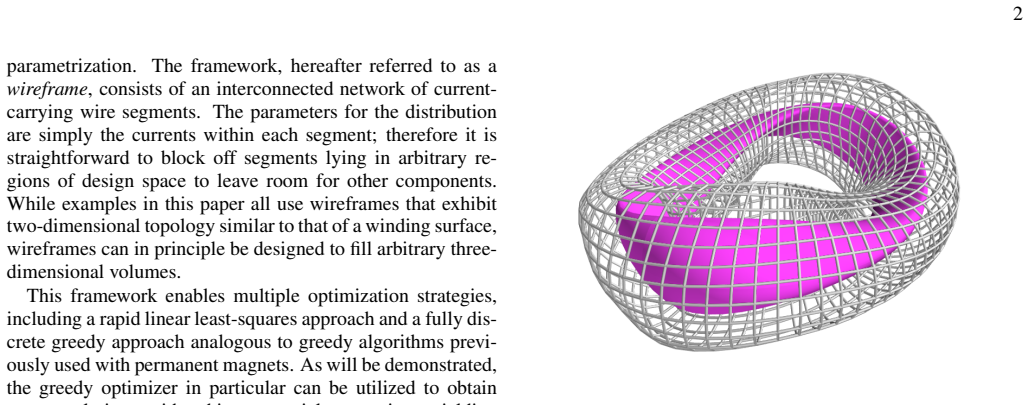
The central object is the wireframe: a fixed toroidal mesh of interconnected straight segments, each carrying a current $x_j$. Its field at plasma-boundary test points is linear in the segment currents (Biot-Savart, Eqs. 1-3), so the entire problem reduces to choosing a vector $\mathbf{x}$ under linear equality constraints (current continuity, net poloidal/toroidal current, zero-current segments). RCLS solves this as a regularized constrained least-squares problem; GSCO instead adds a unit current loop around individual mesh cells one at a time, with interior shared segments canceling so that adjacent loops merge into a saddle coil or reshape an existing coil. The loop addition is what carries the discrete greedy mechanism, and the linearity of the field in $\mathbf{x}$ is what makes the greedy one-step selection cheap to evaluate.
What would settle it
Re-run the RCLS example of Section III B on the same Precise QA equilibrium with the wireframe nodes moved from the conformal offset surface (~0.3 m away) to a sphere of radius 1.3 m centered on the plasma. If $\langle |B\cdot\hat{n}|/|B| \rangle$ stays below $10^{-3}$, the fixed wireframe geometry is not the limiting assumption; if it rises above $10^{-2}$ or the Poincaré cross-sections show broken flux surfaces, the method's usefulness depends on choosing a good wireframe surface rather than on the optimizer alone.
Extended reading notes
Core claim
On its own terms, the paper claims that a wireframe—a toroidal mesh of straight filamentary segments, with currents as the only decision variables—is a useful solution space for stellarator coil design because it combines the spatial locality of permanent-magnet arrays with the field-shaping power of surface current distributions. The central new result is that a fully discrete greedy procedure (GSCO) can build coil-like current paths by adding single-cell loops one at a time, selecting at each step the loop that most reduces the combined field-error and sparsity objective; because shared segment currents cancel between adjacent loops, the added loops assemble into saddle coils or reshape existing modular coils. With this procedure, and with the linear RCLS solver, the paper demonstrates solutions that achieve field accuracies around $\langle|B\cdot\hat{n}|/|B|\rangle\sim 10^{-3}$ or better while obeying hard spatial constraints such as blocked ports or toroidal sectors.
Load-bearing premise
All optimizations keep the wireframe geometry fixed, and the achievable field quality depends strongly on that preselected mesh; Appendix C shows a small change in poloidal node spacing creates a resonant error that deforms flux surfaces even when the averaged field error is slightly better.
Editorial extensions
If this is right
- A fixed wireframe can turn coil design into a linear least-squares problem, so highly accurate vacuum fields for a given equilibrium can be produced in about 100 ms on a laptop, enabling fast scans over equilibria or port layouts.
- The same wireframe can be initialized with planar poloidal loops and reshaped by GSCO into modular coils, saddle coils, or mixtures of both, so the optimizer, not the parameterization, decides the coil topology.
- Spatial restrictions are enforced by setting selected segment currents to zero, which means designs can reserve space for ports, maintenance access, or toroidal-sector assembly without changing the optimization algorithm.
- GSCO output paths contain sharp corners and filamentary junctions, but they give a spline- or space-curve optimizer a concrete starting point with the coil count and rough geometry already determined.
- A multistage variant of GSCO adds coils at successively halved current levels, allowing designs whose coils carry different currents rather than forcing a single current value.
Reading between the lines
- The stop condition for GSCO—the best next loop cancels the previous loop—is a local-minimum signal that resembles matching-pursuit algorithms; one could analyze the gap between GSCO solutions and the unconstrained least-squares optimum using greedy suboptimality bounds, a question the paper leaves open.
- Because the wireframe is independent of the optimizer, the same mesh could host a combined optimizer that co-optimizes node positions and currents, or one that uses triangular or volumetric cells; the paper notes this as a next step, and the sensitivity result in Appendix C makes node-position co-optimization a natural extension.
- The resonant-error sensitivity identified in Appendix C suggests an immediate testable improvement: adding a penalty term for resonant Fourier components of the normal field to $f_{\mathrm{GSCO}}$ could restore flux-surface quality without changing the wireframe geometry.
- A wireframe loop is the current analogue of a permanent-magnet dipole block, so a hybrid design that places permanent magnets in some regions and wireframe currents in others could exploit both local parameterizations; this is not explored in the paper.
Editorial analysis
A structured set of objections, weighed in public.
Referee Report
Summary. The paper introduces a 'wireframe' framework for stellarator coil design, in which the design space is a fixed mesh of straight current-carrying segments enclosing the plasma. Two optimization methods are developed: Regularized Constrained Least Squares (RCLS), a linear least-squares method with equality constraints and Tikhonov regularization, and Greedy Stellarator Coil Optimization (GSCO), an iterative greedy method that adds discrete current loops to the wireframe one at a time. The framework is demonstrated on the Precise QA equilibrium of Ref. [34], producing RCLS solutions with surface-averaged relative normal fields around 6e-4 and GSCO solutions that range from dense saddle-coil distributions to sparse modular-coil sets, including cases with spatial constraints for ports or toroidal sectors and a multi-current solution built from a sequence of GSCO runs. The appendices provide a derivation of the Biot-Savart formula for a straight segment and a derivation of the RCLS solution procedure via QR factorization.
Significance. If the results hold, the wireframe framework is a valuable addition to the stellarator coil design toolbox. Its spatially local parametrization makes it straightforward to enforce arbitrary spatial restrictions on the current distribution, which is more difficult with Fourier-based winding-surface or space-curve parameterizations. The GSCO algorithm is a fully discrete alternative to continuous coil optimization, capable of producing sparse and topologically flexible coil sets that could serve as starting points for further refinement. The paper is notable for shipping open-source implementations (in SIMSOPT) and preserving reproducibility via a data DOI. The formal derivations in Appendices A and B are correct and clearly presented. The main weakness is the reliance on the surface-averaged normal-field error as the primary accuracy metric, which Appendix C itself shows can be misleading for flux-surface quality; this affects the strength of the central claim that GSCO solutions are useful starting points for convenient coil designs.
major comments (2)
- [Section IV B, Fig. 9; Appendix C] The GSCO modular coil solutions in Sec. IV B are assessed only through the surface-averaged relative normal field ⟨|B·n|/|B|⟩, with no Poincaré sections or other independent checks of flux-surface integrity for the solutions in Fig. 9b-d. Appendix C demonstrates that this metric is not a reliable proxy for confinement: a solution with ⟨|B·n|/|B|⟩ = 2.18e-3 (modified wireframe) has worse flux surfaces than one with 2.44e-3 (original wireframe) because of a resonant error. Since the paper's central claim is that GSCO yields 'starting points for convenient coil designs,' the absence of independent flux-surface checks for the main GSCO examples is a load-bearing gap. I request that Poincaré sections (or equivalent measures of rotational-transform and island structure) be provided for the solutions in Fig. 9b-d, or that the claims be explicitly limited to the field-error metric.
- [Introduction and Section V; Appendix C] The paper's framing that the wireframe framework 'enables the attainment of sparse magnet solutions with arbitrary restrictions on where coils may be located' is stronger than what the evidence supports. Appendix C shows that the quality of GSCO solutions is highly sensitive to the fixed wireframe geometry; a small change in poloidal node spacing yields a solution with a slightly better fB but a resonant error that deforms the flux surfaces. This means the method does not by itself guarantee useful sparse solutions for arbitrary spatial constraints; it only does so for favorable a priori choices of the wireframe geometry. The suggestion to 'repeat optimizations with slight variations in wireframe geometry' is a workaround, not a resolution. I recommend that the abstract and introduction be qualified to state that GSCO can produce sparse solutions for these example cases, with the caveat that the fixed wireframe geometry is an essential constraint that must be chosen carefully.
minor comments (5)
- [Introduction] In the second paragraph, 'encompasing' is a typo; it should be 'encompassing'.
- [Fig. 9] The color-scale labels in the right column of Fig. 9 appear to be cut off in the manuscript (e.g., 'mean: . × 10 4'); please ensure the full numerical values are visible in the final figures.
- [Algorithm 2] The input parameter 'Ncells,min' is used in the pseudocode but is never defined in the text; please add a definition, e.g., in the caption or in the surrounding paragraph of Sec. IV D.
- [Section IV C and Fig. 12] The text states that the solution in Fig. 12 was run with λS = 10^-7.5 T^2 m^2, but the figure caption does not list the hyperparameters; adding them would improve reproducibility.
- [Appendix B, Eq. (B1)] The QR factorization is written for C^T, but in the text R is described as upper triangular; the conventions for the dimensions of R in Eq. (B1) appear inconsistent with the later use of forward substitution on R^T. Please clarify the indexing or state that the factorization is applied to C (not C^T) if that resolves the inconsistency.
Circularity Check
No significant circularity: the wireframe optimization claims are supported by external inputs and independent flux-surface checks.
full rationale
The paper's central derivations are self-contained rather than circular. The target magnetic field b is taken from an external Precise QA equilibrium (Ref. [34]), and no physical constant or field quantity is fitted and then reused as the claimed result. RCLS and GSCO minimize fB (Eq. 10) and fGSCO (Eq. 17), and the reported field-error averages are normalized residuals of that same objective; this is a mild tautology if presented alone, but the paper independently tests representative solutions with Poincare flux-surface field-line tracing (Figs. 4b, 12d, 13d), which does not reduce to the optimized objective. Appendix C explicitly shows a case where a slightly better field-error metric accompanies degraded flux surfaces due to a resonant error field, thereby acknowledging that the objective is not silently equated with confinement quality. That is a validity and robustness caveat, not a circular derivation. Self-citations (e.g., Refs. [21] and [27]) appear only as background for prior greedy permanent-magnet optimizers; no load-bearing uniqueness theorem or ansatz is imported from them. The Biot-Savart segment formula is derived from first principles in Appendix A, and the RCLS solution procedure in Appendix B is a standard QR-based constrained least-squares reduction. The fixed wireframe geometry is a stated structural limitation, explicitly examined in Appendix C, rather than an assumption smuggled in via citation. Overall, the claimed contribution, a wireframe parametrization enabling sparse and spatially constrained current solutions, is supported by the algorithm construction and the external target equilibrium, with no step whose output is equivalent by definition to its input.
Assumptions & free parameters
free parameters (7)
- Sparsity weighting factor lambda_S =
10^-9, 10^-6, 10^-5, 10^-7.5, 10^-7 T^2 m^2 across examples
- GSCO loop current I_loop =
0.208 MA (modular), 0.15 MA (sector), 1 MA starting (multistage)
- Wireframe grid resolution =
8x12 and 12x22 (RCLS); 96x100 (GSCO)
- Wireframe surface offset =
approximately 0.3 m from plasma boundary
- RCLS regularization constant W =
10^-10 Tm/A times identity
- Number of initial planar poloidal coils per half-period =
6 (modular), 3 (sector)
- Minimum coil size for removal in multistage GSCO =
20 cells
assumptions (5)
- domain assumption Normal field on the plasma boundary is a sufficient objective for confinement.
- domain assumption Target equilibrium (Precise QA, vacuum, 2 periods) is a valid benchmark.
- domain assumption A fixed toroidal wireframe surface with straight filamentary segments can adequately represent practical coil distributions.
- ad hoc to paper Adding unit current loops greedily, one at a time, leads to useful coil solutions.
- standard math Stellarator symmetry permits solving one half-period and reflecting.
Cite this review
Pith. "Pith review of A framework for discrete optimization of stellarator coils." pith.science (2026). https://pith.science/paper/TZ6K3IBO
@misc{pith2026241200267,
  author       = {Pith},
  title        = {Pith review of: A framework for discrete optimization of stellarator coils},
  year         = {2026},
  howpublished = {\url{https://pith.science/paper/TZ6K3IBO}},
  note         = {Machine review of arXiv:2412.00267}
}
read the original abstract
Designing magnets for three-dimensional plasma confinement is a key task for advancing the stellarator as a fusion reactor concept. Stellarator magnets must produce an accurate field while leaving adequate room for other components and being reasonably simple to construct and assemble. In this paper, a framework for coil design and optimization is introduced that enables the attainment of sparse magnet solutions with arbitrary restrictions on where coils may be located. The solution space is formulated as a "wireframe" consisting of a mesh of interconnected wire segments enclosing the plasma. Two methods are developed for optimizing the current distribution on a wireframe: Regularized Constrained Least Squares (RCLS), which uses a linear least-squares approach to optimize the currents in each segment, and Greedy Stellarator Coil Optimization (GSCO), a fully discrete procedure in which loops of current are added to the mesh one by one to achieve the desired magnetic field on the plasma boundary. Examples are presented of solutions obtainable with each method, some of which achieve high field accuracy while obeying spatial constraints that permit easy assembly.
Figures


Figures from the paper (10 more)





Forward citations
Cited by 2 Pith papers
-
Optimization of passive superconductors for shaping stellarator magnetic fields
First joint optimization of passive superconducting coil arrays and background fields produces low-error magnetic field solutions for four stellarators.
-
Reactor-scale stellarators with force and torque minimized dipole coils
Jointly optimizing movable planar dipole arrays with force and torque penalties produces reactor-scale stellarator coil sets with tolerable loads and simple TF coils.
Reference graph
Works this paper leans on
-
[34]
D. V . Anderson, J. Breazeal, C. H. Finan, and B. M. Johnston, ABCXYZ: vector potential (A) and magnetic field (B) code (C) for Cartesian (XYZ) geometry using general current elements , Tech. Rep. UCRL-52029 (Lawrence Livermore National Labo- ratory, 1976)
work page 1976
-
[1]
identify the most important locations for saddle coils and/or shape modifications for pre-existing coils,
-
[2]
determine coil shapes within the wireframe solution space that produce a highly accurate field,
-
[3]
obey spatial constraints that would be more difficult to enforce with other optimization methods, and
-
[4]
exhibit flexibility in determining the number of coils. There are many possibilities for expanding the wireframe framework and associated optimization methods to increase flexibility and access larger solution spaces. For example, with the GSCO procedure, many solutions can only be found through optimization in multiple stages that use different hy- perpa...
-
[5]
L.-M. Imbert-G ´erard, E. J. Paul, and A. M. Wright, An Intro- duction to Stellarators: from magnetic fields to symmetries and optimization (Society for Indistrial and Applied Mathematics, Philadelphia, PA, 2025)
work page 2025
-
[6]
M. Landreman, An improved current potential method for fast computation of stellarator coil shapes, Nuclear Fusion 57, 046003 (2017)
work page 2017
-
[7]
P. Helander, M. Drevlak, M. Zarnstorff, and S. C. Cowley, Stel- larators with permanent magnets, Physical Review Letters 124, 095001 (2020)
work page 2020
Show all 56 references
-
[8]
Bromberg, M
L. Bromberg, M. Zarnstorff, O. Meneghini, T. Brown, P. Heitzenroeder, G. H. Neilson, J. V . Minervini, and A. Boozer, Stellarator configuration improvement using high temperature superconducting monoliths, Fusion Science and Technology 60, 643 (2011)
2011
-
[9]
Merkel, Solution of stellarator boundary value problems with external currents, Nuclear Fusion 27, 867 (1987)
P. Merkel, Solution of stellarator boundary value problems with external currents, Nuclear Fusion 27, 867 (1987)
1987
-
[10]
Drevlak, Automated optimization of stellarator coils, Fusion Technology 33, 106 (1998)
M. Drevlak, Automated optimization of stellarator coils, Fusion Technology 33, 106 (1998)
1998
-
[11]
W. H. Miner, P. M. Valanju, S. P. Hirshman, A. Brooks, and N. Pomphrey, Use of a genetic algorithm for compact stellarator design, Nuclear Fusion 41, 1185 (2000)
2000
-
[12]
E. J. Paul, M. Landreman, A. Bader, and W. Dorland, An ad- joint method for gradient-based optimization of stellarator coil shapes, Nuclear Fusion 58, 076015 (2018)
2018
-
[13]
D. J. Strickler, L. A. Berry, and S. P. Hirshman, Designing coils for compact stellarators, Fusion Science and Technology 41, 107 (2022)
2022
-
[14]
C. Zhu, S. R. Hudson, Y . Song, and Y . Wan, New method to de- sign stellarator coils without the winding surface, Nuclear Fu- sion 58, 016008 (2018)
2018
-
[15]
Brown, J
T. Brown, J. Breslau, D. Gates, N. Pomphrey, and A. Zolfaghari, Engineering optimization of stellarator coils lead to improvements in device maintenance, in 26th IEEE Sympo- sium on Fusion Engineering (SOFE) (2015)
2015
-
[16]
Yamaguchi, S
H. Yamaguchi, S. Satake, M. Nakata, A. Shimmizu, Y . Suzuki, and the W7-X team, Optimization of modular and helical coils applying genetic algorithm and fully-three-dimensional B- 20 FIG. 15. Comparison of GSCO solutions performed with the same hyperparameters on wireframes wi...
2021
-
[17]
Lonigro and C
N. Lonigro and C. Zhu, Stellarator coil design using cubic splines for improved access to the outboard side, Nuclear Fu- sion 62, 066009 (2022)
2022
-
[18]
Singh, T
L. Singh, T. G. Kruger, A. Bader, C. Zhu, S. R. Hudson, and D. T. Anderson, Optimization of finite-build stellarator coils, Journal of Plasma Physics 86, 905860404 (2020)
2020
-
[19]
McGreivy, S
N. McGreivy, S. R. Hudson, and C. Zhu, Optimized finite-build stellarator coils using automatic differentiation, Nuclear Fusion 61, 026020 (2021)
2021
-
[20]
C. Zhu, M. Zarnstorff, D. Gates, and A. Brooks, Designing stel- larators using perpendicular permanent magnets, Nuclear Fu- sion 60, 076016 (2020)
2020
-
[21]
Landreman and C
M. Landreman and C. Zhu, Calculation of permanent magnet arrangements for stellarators: a linear least-squares method, Plasma Physics and Controlled Fusion 63, 035001 (2021)
2021
-
[22]
G. S. Xu, Z. Y . Lu, D. H. Chen, L. Chen, X. Y . Zhang, X. Q. Wu, M. Y . Ye, and B. N. Wan, Design of quasi-axisymmetric stellarators with varying-thickness permanent magnets based on Fourier and surface magnetic charges method, Nuclear Fusion 61, 026025 (2021)
2021
-
[23]
C. Zhu, K. C. Hammond, M. Zarnstorff, T. Brown, D. Gates, K. Corrigan, M. Sibilia, and E. Feibush, Topology optimiza- tion of permanent magnets for stellarators, Nuclear Fusion 60, 106002 (2020)
2020
-
[24]
A. A. Kaptanoglu, T. Qian, F. Wechsung, and M. Landreman, Permanent magnet optimization for stellarators as sparse re- gression, Physical Review Applied 18, 044006 (2022)
2022
-
[25]
K. C. Hammond, C. Zhu, K. Corrigan, D. A. Gates, R. Lown, R. Mercurio, T. M. Qian, and M. C. Zarnstorff, Design of an arrangement of cubic magnets for a quasi-axisymmetric stel- larator experiment, Nuclear Fusion 62, 126065 (2022)
2022
-
[26]
T. M. Qian, X. Chu, C. Pagano, D. Patch, M. C. Zarnstorff, B. Berlinger, D. Bishop, A. Chambliss, M. Haque, D. Seidita, and C. Zhu, Design and construction of the MUSE permanent magnet stellarator, Journal of Plasma Physics 89, 955890502 (2023)
2023
-
[27]
Madeira and R
M. Madeira and R. Jorge, Tokamak to stellarator conversion us- ing permanent magnets, Plasma Physics and Controlled Fusion 66, 085008 (2024)
2024
-
[28]
Z. Y . Lu, G. S. Xu, D. H. Chen, L. Chen, X. Y . Zhang, M. Y . Ye, and B. N. Wan, Design of quasi-axisymmetric stellarators with variable-thickness perpendicular permanent magnets based on a two-step magnet design strategy, Nuclear Fusion 61, 106028 (2021)
2021
-
[29]
Z. Y . Lu, G. S. Xu, D. H. Chen, X. Y . Zhang, L. Chen, M. Y . Ye, H. Y . Guo, and B. N. Wan, Development of advanced stellarator with identical permanent magnet blocks, Cell Reports Physical Science 3, 100709 (2022)
2022
-
[30]
A. A. Kaptanoglu, R. Conlin, and M. Landreman, Greedy permanent magnet optimization, Nuclear Fusion 63, 036016 (2023)
2023
-
[31]
K. C. Hammond and A. A. Kaptanoglu, Improved stellara- tor permanent magnet designs through combined discrete and continuous optimizations, Computer Physics Communications 299, 109127 (2024)
2024
-
[32]
Elder and A
T. Elder and A. H. Boozer, Current potential patches, Physics of Plasmas 31, 102501 (2024)
2024
-
[33]
A. A. Kaptanoglu, G. P. Langlois, and M. Landreman, Topology optimization for inverse magnetostatics as sparse regression: Application to electromagnetic coils for stellarators, Computer Methods in Applied Mechanics and Engineering 418, 116504 21 (2024)
2024
-
[35]
J. D. Hanson and S. P. Hirshman, Compact expressions for the Biot-Savart fields of a filamentary segment, Physics of Plasmas 9, 4410 (2002)
2002
-
[36]
A. N. Tikhonov, The solution of ill-posed problems and the reg- ularization method, Proceedings of the USSR Academy of Sci- ences 151, 501 (1963)
1963
-
[37]
A. N. Tikhonov, A. V . Goncharsky, V . V . Stepanov, and A. G. Yagola, Numerical methods for the solution of ill-posed prob- lems (Springer, 1995)
1995
-
[38]
Landreman and E
M. Landreman and E. Paul, Magnetic fields with precise qua- sisymmetry for plasma confinement, Physical Review Letters 128, 035001 (2022)
2022
-
[39]
R. L. Dewar and S. R. Hudson, Stellarator symmetry, Physica D 112, 275 (1998)
1998
-
[40]
A. V . Aho, J. E. Hopcroft, and J. D. Ullman, Data Structures and Algorithms (Addison-Wesley, 1983)
1983
-
[41]
Y . C. Pati, R. Rezaiifar, and P. S. Krishnaprasad, Orthogonal Matching Pursuit: recursive function approximation with ap- plications to wavelet decomposition, inProceedings of the 27th Asilomar Conference on Signals, Systems, and Computers (Pa- cific Grove, CA, USA, 1993) p. 40
1993
-
[42]
Zhang, S
Z. Zhang, S. Schwartz, L. Wagner, and W. Miller, A greedy al- gorithm for aligning DNA sequences, Journal of Computational Biology 7, 203 (2000)
2000
-
[43]
Ruiz and T
R. Ruiz and T. St¨utzle, A simple and effective iterated greedy al- gorithm for the permutation flowshop scheduling problem, Eu- ropean Journal of Operational Research 177, 2033 (2007)
2007
-
[44]
D. C. van der Laan, J. D. Weiss, and D. M. McRae, Status of CORC cables and wires for use in high-field magnets and power systems a decade after their introduction, Superconductor Sci- ence and Technology 32, 033001 (2019)
2019
-
[45]
C. Paz-Soldan, Non-planar coil winding angle optimization for compatibility with non-insulated high-temperature supercon- ducting magnets, Journal of Plasma Physics 86, 815860501 (2020)
2020
-
[46]
D. W. Dudt and E. Kolemen, DESC: a stellarator equilibrium solver, Physics of Plasmas 27, 102513 (2020)
2020
-
[47]
Wechsung, M
F. Wechsung, M. Landreman, A. Giuliani, A. Cerfon, and G. Stadler, Precise stellarator quasi-symmetry can be achieved with electromagnetic coils, Proceedings of the National Academy of Sciences 119, e2202084119 (2022)
2022
-
[48]
D. A. Gates, A. H. Boozer, T. Brown, J. Breslau, D. Curreli, M. Landreman, S. A. Lazerson, J. Lore, H. Mynick, G. H. Neil- son, N. Pomphrey, P. Xanthopoulos, and A. Zolfaghari, Recent advances in stellarator optimization, Nuclear Fusion57, 126064 (2017)
2017
-
[49]
Princeton Research Computing, Stellar, https://researchcomputing.princeton.edu/systems/stellar (Accessed 2024-01-16)
2024
-
[50]
Landreman, B
M. Landreman, B. Medasani, F. Wechsung, A. Giuliani, R. Jorge, and C. Zhu, SIMSOPT: a flexible framework for stel- larator optimization, Journal of Open Source Software 6, 3525 (2021)
2021
-
[51]
Ramachandran and G
P. Ramachandran and G. Varoquaux, Mayavi: 3D visualization of scientific data, Computing in Science & Engineering 13, 40 (2011)
2011
-
[52]
Frerichs, FLARE: field line analysis and reconstruction for 3D boundary plasma modeling (2024)
H. Frerichs, FLARE: field line analysis and reconstruction for 3D boundary plasma modeling (2024)
2024
-
[53]
S. A. Lazerson, J. Schmitt, C. Zhu, J. Bres- lau, and STELLOPT Developers, STELLOPT, https://doi.org/10.11578/dc.20180627.6 (2020)
2020 doi
-
[54]
Bj¨orck, Numerical Methods for Least Squares Problems, 2nd ed
˚A. Bj¨orck, Numerical Methods for Least Squares Problems, 2nd ed. (SIAM, 2024)
2024
-
[55]
G. H. Golub, J. Lambers, and L.-H. Lim, Lecture notes for CME 302: Numerical Linear Algebra, University of Chicago (2005)
2005
-
[56]
M. N. Rosenbluth, R. Z. Sagdeev, J. B. Taylor, and G. M. Za- slavski, Destruction of magnetic surfaces by magnetic field ir- regularities, Nuclear Fusion 6, 297 (1966)
1966
Reviewed August 12, 2026 · model on record in the stance chip above.
Discussion (0). Continue with ORCID to comment.