REVIEW 4 major objections 6 minor 49 references
Learning on Less: Constraining Pre-trained Model Learning for Generalizable Diffusion-Generated Image Detection
T0 review · 4 major / 6 minor · reviewed 2026-08-12 · deepseek-v4-flash
Pith's one-line read Training a pre-trained detector on 1% of a single generator's images, with random masks that hide 60–80% of each input, reaches 92.7% average accuracy across eight diffusion model families.
desk verdict Strong empirical result on GenImage, but missing Random Erasing and frozen-CLIP baselines leave the proposed universal-feature mechanism unproven. read the letter →
The pith
A machine-rendered reading of the paper's core claim, the machinery that carries it, and where it could break.
The reading
What carries the argument
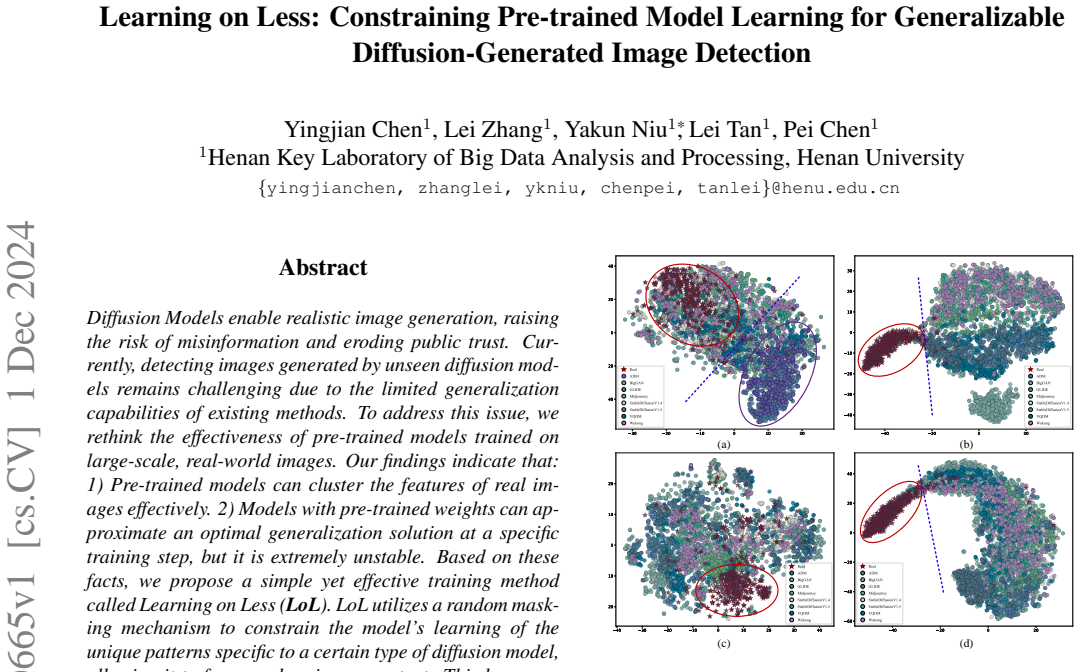
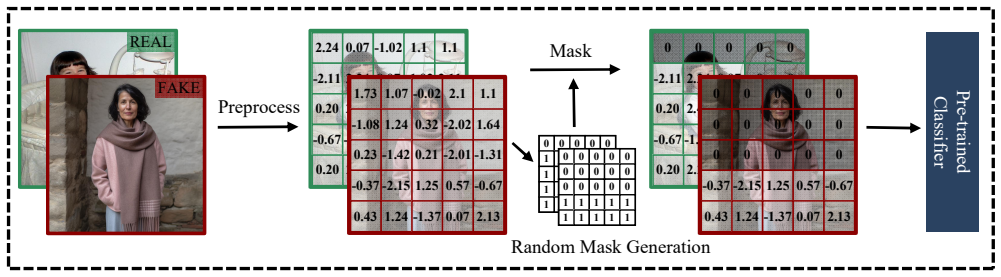
The load-bearing mechanism is a random mask generation algorithm (Algorithm 1) that blanks a rectangular region of each input image before classification. Given an RGB image of size $H \times W$, the algorithm selects a masked area of size $H_{\text{select}} \times W_{\text{select}}$ covering a fraction $r_{\text{mask}}$ (best in the 60–80% range) and an aspect ratio $r_{\text{aspect}}$, sets those pixels to zero in all three channels, and feeds the masked tensor to a pre-trained CLIP-RN50 classifier. The paper's gradient analysis shows that zero-valued pixels do not contribute to the parameter updates of the first convolutional layer, so the model is structurally prevented from learning details localized in the masked region; later layers may re-involve those pixels through larger receptive fields, but their contribution stays constrained. This constraint, combined with CLIP's pre-trained ability to cluster real-image features, is what the paper claims lets the model parameters converge stably toward the optimal generalization solution.
What would settle it
Train LoL on 3,200 images from a single GenImage generator and test on a held-out diffusion model not among the eight, such as SDXL or DALL-E 3. If accuracy falls to near chance while the same detector stays above 90% on the eight, the claimed universal feature is not universal; alternatively, replace the random mask with uniform random pixel dropout of the same ratio and show the accuracy drop is negligible, which would indicate masking acts as generic regularization.
Extended reading notes
Core claim
The central claim is that pre-trained models trained on large-scale real images already contain the representational structure needed for universal synthetic-image detection, and that the only obstacle is overfitting to generator-specific patterns during fine-tuning. The paper argues that a pre-trained CLIP-RN50 can approximate the optimal generalization solution $\theta^*$ at certain training steps, but drifts away from it because the training set's distinctive artifacts dominate learning. LoL applies a randomly generated binary mask to each input tensor before the forward pass, zeroing out a large contiguous region; those zero pixels do not contribute to first-layer gradient updates, so the model cannot latch onto the training generator's unique traces. The result is a detector that, according to the reported experiments, reaches 92.7% average ACC and 98.6% average AP across eight GenImage subsets while training on 3,200 real and 3,200 generated images from a single generator, with per-subset ACC improvements of up to 27 points over the previous state of the art.
Load-bearing premise
The universal, generator-agnostic feature separating all diffusion-generated images from real images exists, is learnable from one generator's masked training images, and is what LoL extracts rather than a byproduct of generic regularization.
Editorial extensions
If this is right
- Detectors can be trained from a single generator's output with 1% of the GenImage data and still detect images from seven unseen generators, so data collection for forensic training becomes far cheaper.
- Training on more data can hurt generalization: LoL's accuracy declines and becomes less stable as the training set grows from 3,200 to 323,994 images, suggesting that overfitting, not data scarcity, is the main barrier.
- The method is robust to geometric transforms: random cropping has almost no effect on accuracy, while noise, blur, and JPEG compression degrade it, implying the learned feature is structural rather than pixel-level.
- CNN-based pre-trained encoders (CLIP-RN50, CLIP-RN101) generalize more reliably than a Transformer-based encoder (CLIP-ViT-L/14) under the same masking scheme.
- The same recipe may transfer to other synthesis families, since the paper's CAM analysis shows generated images across all eight models produce a strong response while real images produce almost none.
Reading between the lines
- If the universal feature is really generator-agnostic, the detector should transfer to diffusion models released after GenImage, such as SDXL or DALL-E 3; this is a direct, testable extrapolation the paper does not run.
- The success of random rectangular masking suggests that preventing the model from attending to local texture may be the active ingredient; a control experiment with random pixel dropout or uniform noise at the same information-loss level would clarify whether the geometry of the mask matters.
- The same 'learn on less' constraint might improve generalization in other forensic tasks, such as GAN-generated face detection or deepfake video detection, where generator-specific artifacts also cause overfitting.
- Because accuracy peaks at 1% data and declines with more data, the practical recipe for practitioners is to keep fine-tuning sets tiny, which would also reduce the computational cost and carbon footprint of building detectors.
Signed reviews
Editorial analysis
A structured set of objections, weighed in public.
Referee Report
Summary. The paper proposes Learning on Less (LoL), a training method for diffusion-generated image detection that fine-tunes a CLIP-ResNet50 while applying randomly generated rectangular masks to input images. The authors argue that masking constrains the model from overfitting to artifacts specific to one generator, allowing it to exploit pre-trained features that separate real images from images produced by any diffusion model. On the GenImage benchmark, training on only 1% of the data yields an average accuracy of 92.7% across eight generator test sets, a 13.6% improvement over the reported state-of-the-art LaRE2. The paper includes extensive experiments on data volume, model architecture, mask ratio, aspect ratio, robustness to perturbations, and CAM visualizations.
Significance. If the headline results are robust, the paper would offer a simple, data-efficient recipe for cross-generator synthetic image detection, with a mechanistic story tied to pre-training. The experimental breadth is a strength: the authors evaluate multiple CLIP architectures, systematically vary data volume and mask parameters, and include robustness and CAM analyses. However, the central claim that masking is a qualitatively new 'learning on less' constraint, rather than a generic regularization or augmentation effect, is not supported by the current experiments; the missing controls are load-bearing for the paper's novelty. The reported gains could in principle come from standard Random Erasing or from the pre-trained features alone.
major comments (4)
- [Section 3.3.1, Algorithm 1, and Table 3] The proposed mask generation algorithm zeros a randomly placed rectangular block whose area and aspect ratio are drawn from a range; this is operationally equivalent to standard Random Erasing or CutOut. Yet the ablation study in Table 3 only varies rmask and raspect within the masking framework and never compares against standard Random Erasing, CutOut, input dropout, or feature noise. Without such a baseline, the observed gains could be entirely attributable to generic augmentation that reduces overfitting to a single generator's artifacts, rather than to the proposed 'learning on less' constraint. The paper's central mechanistic claim therefore rests on a missing control. Please add a matched Random Erasing / CutOut ablation (same rmask and raspect ranges) and a plain fine-tuning baseline on CLIP-RN50 without masking.
- [Table 1 and Section 4.4] The headline result—92.7% AvgAcc, 13.6% above LaRE2—is reported without error bars or significance testing across independent training runs. Figure 6 reports fluctuation across the final five epochs of a single training run, not across seeds, and no error bars are given for the baselines in Table 1. Given the small training set (1,600 real plus 1,600 generated images per class) and the instabilities visible in Figure 2, the margin over LaRE2 may not be stable. Please run the main comparison (Table 1) with at least three independent seeds and report mean ± std, and include the same error bars for the strongest baselines.
- [Tables 2 and 3, Section 4.5] Hyperparameters are selected directly on the test set. In Table 3, the best mask ratio and aspect ratio ranges are chosen by comparing AvgAcc across all GenImage test sets; in Table 2, the 1% data volume is identified as optimal after evaluating test-set performance across many data volumes. This test-set selection is likely to inflate the reported generalization numbers relative to a fair deployment setting. Please either fix the hyperparameters a priori, or perform selection on a validation split (e.g., a held-out subset of the training generator) and report test-set results only for the final configuration.
- [Section 3.2.2, Eqs. (5)–(7)] The gradient argument shows that zero-valued pixels do not contribute to the first convolutional layer's parameter updates, which is standard. However, the argument does not explain why masking should preferentially suppress generator-specific artifacts rather than the universal fake-versus-real margin, since masking is applied uniformly to all image content. The claimed mechanism requires that the pre-trained features already encode the universal margin and that masking merely prevents the head from shifting that prior; this is plausible but untested. The CAM visualizations in the supplementary are qualitative and do not establish a quantitative difference between masked and unmasked fine-tuning. Please provide a quantitative analysis, for example by measuring the similarity of learned feature spaces with and without masking, or by comparing the effect of zero-masking versus random-noise-masking of the same regions.
minor comments (6)
- [Section 4.1] In the list of generative models, 'AMD' should be 'ADM' to match the notation used in the abstract, introduction, and the rest of the paper.
- [Abstract and Section 5] The phrase 'a effective' should be 'an effective' (appears in the abstract and in the conclusion).
- [Section 4.4] The sentence 'with an AvgAcc 27.0% higher' should read 'with an AvgAcc 27.0 percentage points higher,' since a relative percentage is ambiguous.
- [Algorithm 1] The loop bounds in lines 2–3 and 12–13 should be 0 to H-1 and 0 to W-1 for consistency with zero-based indexing; line 9 computes Wselect as sqrt(Sselect/Hselect), but the intended width is Sselect/Hselect, and the min(W, ...) bound should be applied to that value.
- [Figure 2] The 'Optimal Solution' line should be defined in the caption or text; as drawn it is a heuristic reference point, not a formal upper bound.
- [General] No code or training configuration files are provided. Given the method's simplicity, releasing code would substantially aid reproducibility, especially for the mask generation and the exact training schedule.
Circularity Check
No significant circularity: the reported result is an empirical benchmark evaluation, and no prediction is forced by construction or by a self-citation chain.
full rationale
The paper's derivation chain has three load-bearing pieces: the hypothesized universal fake/real feature supported by t-SNE visualization, the gradient-analysis argument that zero-masking constrains parameter updates, and the empirical claim that the resulting training recipe outperforms baselines on GenImage. None of these reduces to its own inputs. The optimal solution theta* in Eq. (1) is a goal specification, not a fitted quantity, and the final accuracy is measured on external test sets rather than derived from the masking operation. The mask generation in Algorithm 1 is formally equivalent to Random Erasing or CutOut, and the paper neither cites those methods nor ablates against them; this is a missing-control and attribution concern, not a circular derivation, because the benchmark numbers are not constructed from the augmentation. Hyperparameters such as masked ratio, aspect ratio, and data volume are selected after inspecting test-set performance, which is a selection-bias risk rather than definitional circularity, since no parameter is fitted to test labels and then renamed as a prediction. There are no load-bearing self-citations and no imported uniqueness theorems. The central claim therefore retains independent empirical content, and the honest circularity finding is essentially negative.
Assumptions & free parameters
free parameters (3)
- Mask ratio rmask =
0.6-0.8
- Aspect ratio range raspect =
(0.33, 3.0)
- Training data volume =
3,200 images (1.0%)
assumptions (4)
- domain assumption Pre-trained CLIP features cluster real images tightly, and generated images of all eight models deviate from this cluster.
- domain assumption Zeroing 60 to 80 percent of input pixels prevents learning generator-specific forgery patterns while preserving the universal real-versus-fake signal.
- standard math The backpropagation formula for the first convolutional layer (Equations 5 to 7) is correct and sufficient to describe masking effects.
- domain assumption GenImage test sets are representative and disjoint, so cross-generator accuracy measures generalization.
invented entities (1)
-
Universal feature separating all diffusion-generated images from real images
Cite this review
Pith. "Pith review of Learning on Less: Constraining Pre-trained Model Learning for Generalizable Diffusion-Generated Image Detection." pith.science (2026). https://pith.science/paper/VMXBXAQM
@misc{pith2026241200665,
  author       = {Pith},
  title        = {Pith review of: Learning on Less: Constraining Pre-trained Model Learning for Generalizable Diffusion-Generated Image Detection},
  year         = {2026},
  howpublished = {\url{https://pith.science/paper/VMXBXAQM}},
  note         = {Machine review of arXiv:2412.00665}
}
read the original abstract
Diffusion Models enable realistic image generation, raising the risk of misinformation and eroding public trust. Currently, detecting images generated by unseen diffusion models remains challenging due to the limited generalization capabilities of existing methods. To address this issue, we rethink the effectiveness of pre-trained models trained on large-scale, real-world images. Our findings indicate that: 1) Pre-trained models can cluster the features of real images effectively. 2) Models with pre-trained weights can approximate an optimal generalization solution at a specific training step, but it is extremely unstable. Based on these facts, we propose a simple yet effective training method called Learning on Less (LoL). LoL utilizes a random masking mechanism to constrain the model's learning of the unique patterns specific to a certain type of diffusion model, allowing it to focus on less image content. This leverages the inherent strengths of pre-trained weights while enabling a more stable approach to optimal generalization, which results in the extraction of a universal feature that differentiates various diffusion-generated images from real images. Extensive experiments on the GenImage benchmark demonstrate the remarkable generalization capability of our proposed LoL. With just 1% training data, LoL significantly outperforms the current state-of-the-art, achieving a 13.6% improvement in average ACC across images generated by eight different models.
Figures

Figures from the paper (3 more)


Reference graph
Works this paper leans on
- [1]
-
[2]
Wukong. https : / / xihe . mindspore . cn / modelzoo/wukong, 2022. 5
work page 2022
-
[3]
Photo forensics from jpeg dimples
Shruti Agarwal and Hany Farid. Photo forensics from jpeg dimples. In 2017 IEEE workshop on information forensics and security (WIFS), pages 1–6. IEEE, 2017. 2
work page 2017
-
[4]
Large scale gan training for high fidelity natural image synthesis
Andrew Brock. Large scale gan training for high fidelity natural image synthesis. arXiv preprint arXiv:1809.11096 ,
-
[5]
Intriguing properties of syn- thetic images: from generative adversarial networks to diffu- sion models
Riccardo Corvi, Davide Cozzolino, Giovanni Poggi, Koki Nagano, and Luisa Verdoliva. Intriguing properties of syn- thetic images: from generative adversarial networks to diffu- sion models. In Proceedings of the IEEE/CVF Conference on Computer Vision and Pattern Recognition , pages 973–982,
-
[6]
Forensictrans- fer: Weakly-supervised domain adaptation for forgery detec- tion
Davide Cozzolino, Justus Thies, Andreas R ¨ossler, Christian Riess, Matthias Nießner, and Luisa Verdoliva. Forensictrans- fer: Weakly-supervised domain adaptation for forgery detec- tion. arXiv preprint arXiv:1812.02510, 2018. 2
arXiv 2018
-
[7]
New find- ing and unified framework for fake image detection
Xin Deng, Bihe Zhao, Zhenyu Guan, and Mai Xu. New find- ing and unified framework for fake image detection. IEEE Signal Processing Letters, 30:90–94, 2023. 2
work page 2023
-
[8]
Diffusion models beat gans on image synthesis
Prafulla Dhariwal and Alexander Nichol. Diffusion models beat gans on image synthesis. Advances in neural informa- tion processing systems, 34:8780–8794, 2021. 5
2021
Show all 49 references
-
[9]
Leveraging fre- quency analysis for deep fake image recognition
Joel Frank, Thorsten Eisenhofer, Lea Sch ¨onherr, Asja Fis- cher, Dorothea Kolossa, and Thorsten Holz. Leveraging fre- quency analysis for deep fake image recognition. In Inter- national conference on machine learning, pages 3247–3258. PMLR, 2020. 2, 1
2020
-
[10]
Vec- tor quantized diffusion model for text-to-image synthesis
Shuyang Gu, Dong Chen, Jianmin Bao, Fang Wen, Bo Zhang, Dongdong Chen, Lu Yuan, and Baining Guo. Vec- tor quantized diffusion model for text-to-image synthesis. In Proceedings of the IEEE/CVF conference on computer vi- sion and pattern recognition, pages 10696–10706, 2022. 5
2022
-
[11]
Deep residual learning for image recognition
Kaiming He, Xiangyu Zhang, Shaoqing Ren, and Jian Sun. Deep residual learning for image recognition. In Proceed- ings of the IEEE conference on computer vision and pattern recognition, pages 770–778, 2016. 6
2016
-
[12]
Denoising dif- fusion probabilistic models
Jonathan Ho, Ajay Jain, and Pieter Abbeel. Denoising dif- fusion probabilistic models. Advances in neural information processing systems, 33:6840–6851, 2020. 1
2020
-
[13]
Bihpf: Bilateral high- pass filters for robust deepfake detection
Yonghyun Jeong, Doyeon Kim, Seungjai Min, Seongho Joe, Youngjune Gwon, and Jongwon Choi. Bihpf: Bilateral high- pass filters for robust deepfake detection. In Proceedings of the IEEE/CVF Winter Conference on Applications of Com- puter Vision, pages 48–57, 2022. 2
2022
-
[14]
Frepgan: robust deepfake detection using frequency- level perturbations
Yonghyun Jeong, Doyeon Kim, Youngmin Ro, and Jongwon Choi. Frepgan: robust deepfake detection using frequency- level perturbations. In Proceedings of the AAAI conference on artificial intelligence, pages 1060–1068, 2022. 2
2022
-
[15]
Glff: Global and local feature fusion for ai-synthesized im- age detection
Yan Ju, Shan Jia, Jialing Cai, Haiying Guan, and Siwei Lyu. Glff: Global and local feature fusion for ai-synthesized im- age detection. IEEE Transactions on Multimedia, 2023. 2
2023
-
[16]
Diffu- sionclip: Text-guided diffusion models for robust image ma- nipulation
Gwanghyun Kim, Taesung Kwon, and Jong Chul Ye. Diffu- sionclip: Text-guided diffusion models for robust image ma- nipulation. In Proceedings of the IEEE/CVF conference on computer vision and pattern recognition, pages 2426–2435,
-
[17]
Adam: A method for stochastic opti- mization
Diederik P Kingma. Adam: A method for stochastic opti- mization. arXiv preprint arXiv:1412.6980, 2014. 6
2014 arXiv
-
[18]
Leveraging rep- resentations from intermediate encoder-blocks for synthetic image detection
Christos Koutlis and Symeon Papadopoulos. Leveraging rep- resentations from intermediate encoder-blocks for synthetic image detection. arXiv preprint arXiv:2402.19091, 2024. 3
2024 arXiv
-
[19]
Iden- tification of deep network generated images using disparities in color components
Haodong Li, Bin Li, Shunquan Tan, and Jiwu Huang. Iden- tification of deep network generated images using disparities in color components. Signal Processing, 174:107616, 2020. 2
2020
-
[20]
Detecting generated images by real images
Bo Liu, Fan Yang, Xiuli Bi, Bin Xiao, Weisheng Li, and Xinbo Gao. Detecting generated images by real images. In European Conference on Computer Vision , pages 95–110. Springer, 2022. 3
2022
-
[21]
Forgery-aware adaptive transformer for generalizable synthetic image detection
Huan Liu, Zichang Tan, Chuangchuang Tan, Yunchao Wei, Jingdong Wang, and Yao Zhao. Forgery-aware adaptive transformer for generalizable synthetic image detection. In Proceedings of the IEEE/CVF Conference on Computer Vi- sion and Pattern Recognition, pages 10770–10780, 2024. 3
2024
-
[22]
Global tex- ture enhancement for fake face detection in the wild
Zhengzhe Liu, Xiaojuan Qi, and Philip HS Torr. Global tex- ture enhancement for fake face detection in the wild. In Pro- ceedings of the IEEE/CVF conference on computer vision and pattern recognition, pages 8060–8069, 2020. 2, 6, 7
2020
-
[23]
Gener- alizing face forgery detection with high-frequency features
Yuchen Luo, Yong Zhang, Junchi Yan, and Wei Liu. Gener- alizing face forgery detection with high-frequency features. In Proceedings of the IEEE/CVF conference on computer vi- sion and pattern recognition, pages 16317–16326, 2021. 2
2021
-
[24]
Lareˆ 2: Latent reconstruction error based method for diffusion-generated image detection
Yunpeng Luo, Junlong Du, Ke Yan, and Shouhong Ding. Lareˆ 2: Latent reconstruction error based method for diffusion-generated image detection. In Proceedings of the IEEE/CVF Conference on Computer Vision and Pattern Recognition, pages 17006–17015, 2024. 2, 3, 6, 7
2024
-
[25]
Exposing the fake: Effective diffusion-generated images detection
Ruipeng Ma, Jinhao Duan, Fei Kong, Xiaoshuang Shi, and Kaidi Xu. Exposing the fake: Effective diffusion-generated images detection. arXiv preprint arXiv:2307.06272, 2023. 3
2023 arXiv
-
[26]
Detecting gan- generated imagery using color cues
Scott McCloskey and Michael Albright. Detecting gan- generated imagery using color cues. arXiv preprint arXiv:1812.08247, 2018. 2
2018 arXiv
-
[27]
Detecting gan- generated imagery using saturation cues
Scott McCloskey and Michael Albright. Detecting gan- generated imagery using saturation cues. In 2019 IEEE in- ternational conference on image processing (ICIP) , pages 4584–4588. IEEE, 2019
2019
-
[28]
Detecting gan generated fake images using co-occurrence matrices
Lakshmanan Nataraj, Tajuddin Manhar Mohammed, Shiv- kumar Chandrasekaran, Arjuna Flenner, Jawadul H Bappy, Amit K Roy-Chowdhury, and BS Manjunath. Detecting gan generated fake images using co-occurrence matrices. arXiv preprint arXiv:1903.06836, 2019. 2
1903 arXiv
-
[29]
Glide: Towards photorealistic image generation 9 and editing with text-guided diffusion models.arXiv preprint arXiv:2112.10741, 2021
Alex Nichol, Prafulla Dhariwal, Aditya Ramesh, Pranav Shyam, Pamela Mishkin, Bob McGrew, Ilya Sutskever, and Mark Chen. Glide: Towards photorealistic image generation 9 and editing with text-guided diffusion models.arXiv preprint arXiv:2112.10741, 2021. 1, 5
2021 arXiv
-
[30]
Towards uni- versal fake image detectors that generalize across genera- tive models
Utkarsh Ojha, Yuheng Li, and Yong Jae Lee. Towards uni- versal fake image detectors that generalize across genera- tive models. In Proceedings of the IEEE/CVF Conference on Computer Vision and Pattern Recognition, pages 24480– 24489, 2023. 3
2023
-
[31]
Pytorch: An im- perative style, high-performance deep learning library
Adam Paszke, Sam Gross, Francisco Massa, Adam Lerer, James Bradbury, Gregory Chanan, Trevor Killeen, Zeming Lin, Natalia Gimelshein, Luca Antiga, et al. Pytorch: An im- perative style, high-performance deep learning library. Ad- vances in neural information processing systems ...
2019
-
[32]
Thinking in frequency: Face forgery detection by min- ing frequency-aware clues
Yuyang Qian, Guojun Yin, Lu Sheng, Zixuan Chen, and Jing Shao. Thinking in frequency: Face forgery detection by min- ing frequency-aware clues. In European conference on com- puter vision, pages 86–103. Springer, 2020. 6, 7
2020
-
[33]
Learning transferable visual models from natural language supervi- sion
Alec Radford, Jong Wook Kim, Chris Hallacy, Aditya Ramesh, Gabriel Goh, Sandhini Agarwal, Girish Sastry, Amanda Askell, Pamela Mishkin, Jack Clark, et al. Learning transferable visual models from natural language supervi- sion. In International conference on machine learning, ...
2021
-
[34]
Hierarchical text-conditional image gener- ation with clip latents
Aditya Ramesh, Prafulla Dhariwal, Alex Nichol, Casey Chu, and Mark Chen. Hierarchical text-conditional image gener- ation with clip latents. arXiv preprint arXiv:2204.06125, 1 (2):3, 2022. 1
2022 arXiv
-
[35]
High-resolution image synthesis with latent diffusion models
Robin Rombach, Andreas Blattmann, Dominik Lorenz, Patrick Esser, and Bj ¨orn Ommer. High-resolution image synthesis with latent diffusion models. In Proceedings of the IEEE/CVF conference on computer vision and pattern recognition, pages 10684–10695, 2022. 1, 5
2022
-
[36]
Learning representations by back-propagating er- rors
David E Rumelhart, Geoffrey E Hinton, and Ronald J Williams. Learning representations by back-propagating er- rors. nature, 323(6088):533–536, 1986. 4
1986
-
[37]
Photorealistic text-to-image diffusion models with deep language understanding
Chitwan Saharia, William Chan, Saurabh Saxena, Lala Li, Jay Whang, Emily L Denton, Kamyar Ghasemipour, Raphael Gontijo Lopes, Burcu Karagol Ayan, Tim Salimans, et al. Photorealistic text-to-image diffusion models with deep language understanding. Advances in neural information...
2022
-
[38]
Denoising diffusion implicit models
Jiaming Song, Chenlin Meng, and Stefano Ermon. Denoising diffusion implicit models. arXiv preprint arXiv:2010.02502, 2020. 1
2010 arXiv
-
[39]
Learning on gradients: Generalized arti- facts representation for gan-generated images detection
Chuangchuang Tan, Yao Zhao, Shikui Wei, Guanghua Gu, and Yunchao Wei. Learning on gradients: Generalized arti- facts representation for gan-generated images detection. In Proceedings of the IEEE/CVF Conference on Computer Vi- sion and Pattern Recognition, pages 12105–12114, 2023. 2, 3
2023
-
[40]
Frequency-aware deepfake de- tection: Improving generalizability through frequency space domain learning
Chuangchuang Tan, Yao Zhao, Shikui Wei, Guanghua Gu, Ping Liu, and Yunchao Wei. Frequency-aware deepfake de- tection: Improving generalizability through frequency space domain learning. In Proceedings of the AAAI Conference on Artificial Intelligence, pages 5052–5060, 2024. 2
2024
-
[41]
Rethinking the up-sampling op- erations in cnn-based generative network for generalizable deepfake detection
Chuangchuang Tan, Yao Zhao, Shikui Wei, Guanghua Gu, Ping Liu, and Yunchao Wei. Rethinking the up-sampling op- erations in cnn-based generative network for generalizable deepfake detection. In Proceedings of the IEEE/CVF Con- ference on Computer Vision and Pattern Recognition,...
2024
-
[42]
Visualizing data using t-sne
Laurens Van der Maaten and Geoffrey Hinton. Visualizing data using t-sne. Journal of machine learning research , 9 (11), 2008. 1
2008
-
[43]
Attention is all you need
A Vaswani. Attention is all you need. Advances in Neural Information Processing Systems, 2017. 4
2017
-
[44]
Cnn-generated images are surprisingly easy to spot
Sheng-Yu Wang, Oliver Wang, Richard Zhang, Andrew Owens, and Alexei A Efros. Cnn-generated images are surprisingly easy to spot... for now. In Proceedings of the IEEE/CVF conference on computer vision and pattern recognition, pages 8695–8704, 2020. 2, 6, 7
2020
-
[45]
Dire for diffusion-generated image detection
Zhendong Wang, Jianmin Bao, Wengang Zhou, Weilun Wang, Hezhen Hu, Hong Chen, and Houqiang Li. Dire for diffusion-generated image detection. In Proceedings of the IEEE/CVF International Conference on Computer Vision , pages 22445–22455, 2023. 2, 3, 6, 7
2023
-
[46]
Detecting and simulating artifacts in gan fake images
Xu Zhang, Svebor Karaman, and Shih-Fu Chang. Detecting and simulating artifacts in gan fake images. In2019 IEEE in- ternational workshop on information forensics and security (WIFS), pages 1–6. IEEE, 2019. 2, 6, 7
2019
-
[47]
Derivation of backpropagation in convo- lutional neural network (cnn)
Zhifei Zhang. Derivation of backpropagation in convo- lutional neural network (cnn). University of Tennessee, Knoxville, TN, 22:23, 2016. 4
2016
-
[48]
Learning deep features for discrimina- tive localization
Bolei Zhou, Aditya Khosla, Agata Lapedriza, Aude Oliva, and Antonio Torralba. Learning deep features for discrimina- tive localization. In Proceedings of the IEEE conference on computer vision and pattern recognition, pages 2921–2929,
-
[49]
Genimage: A million-scale benchmark for de- tecting ai-generated image
Mingjian Zhu, Hanting Chen, Qiangyu Yan, Xudong Huang, Guanyu Lin, Wei Li, Zhijun Tu, Hailin Hu, Jie Hu, and Yunhe Wang. Genimage: A million-scale benchmark for de- tecting ai-generated image. Advances in Neural Information Processing Systems, 36, 2024. 2, 3, 5, 1 10 Learning ...
2024
Reviewed August 12, 2026 · model on record in the stance chip above.
Discussion (0). Continue with ORCID to comment.